Tag: Poetry
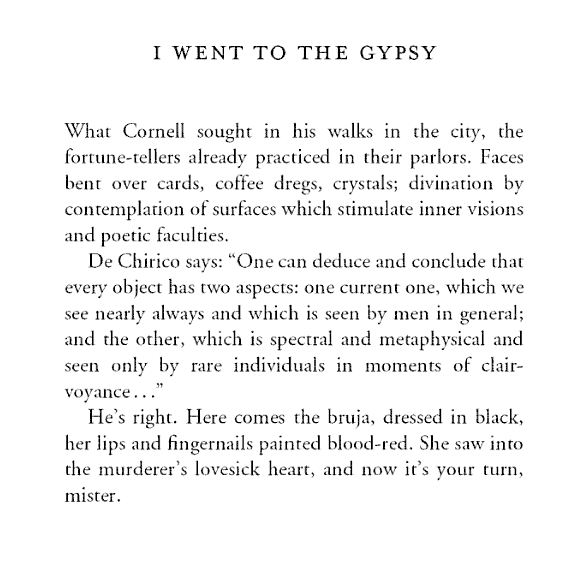
“I Went to the Gypsy” — Charles Simic
“Some Modulated Pissing and Moaning” (Gordon Lish on Poetry)
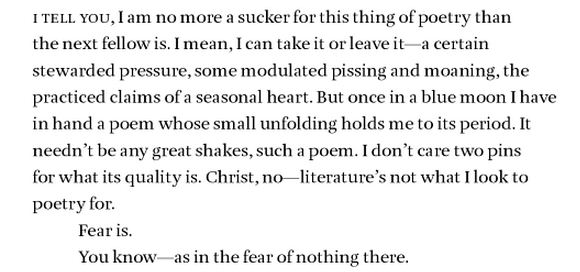
From Gordon Lish’s story “How to Write a Poem.”
“The Brain within its groove” — Emily Dickinson

“Hysteria” — T.S. Eliot

“My life closed twice before its close” — Emily Dickinson
My life closed twice before its close—
It yet remains to see
If Immortality unveil
A third event to meSo huge, so hopeless to conceive
As these that twice befell.
Parting is all we know of heaven,
And all we need of hell.
—Emily Dickinson.
Night’s Plutonian Shore — Gustave Dore Illustrates Edgar Allan Poe’s Poem “The Raven”

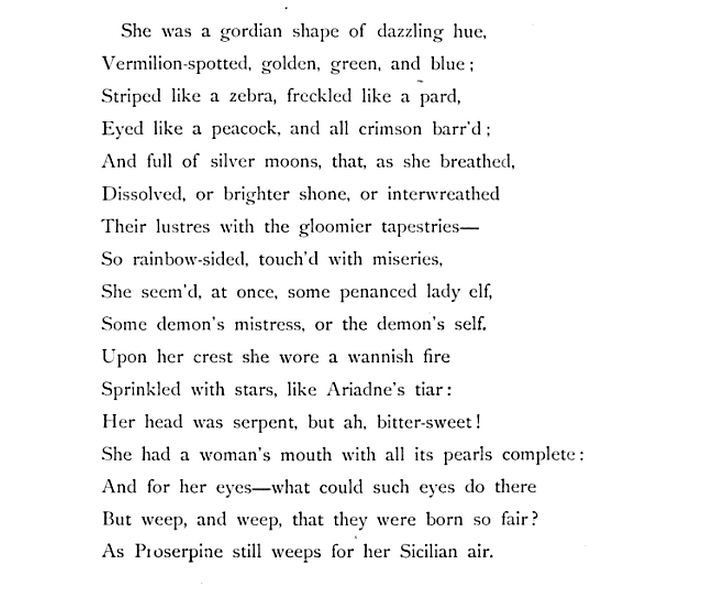
“A Gordian Shape of Dazzling Hue” (Keats’s Lamia)
“One need not be a Chamber–to be Haunted–” — Emily Dickinson
“One need not be a Chamber — to be Haunted –” by Emily Dickinson:
One need not be a Chamber — to be Haunted —
One need not be a House —
The Brain has Corridors — surpassing
Material Place —Far safer, of a Midnight Meeting
External Ghost
Than its interior Confronting —
That Cooler Host.Far safer, through an Abbey gallop,
The Stones a’chase —
Than Unarmed, one’s a’self encounter —
In lonesome Place —Ourself behind ourself, concealed —
Should startle most —
Assassin hid in our Apartment
Be Horror’s least.The Body — borrows a Revolver —
He bolts the Door —
O’erlooking a superior spectre —
Or More —
“I reason, Earth is short–” — Emily Dickinson
“I reason, Earth is short–” by Emily Dickinson:
I reason, Earth is short —
And Anguish — absolute —
And many hurt,
But, what of that?I reason, we could die —
The best Vitality
Cannot excel Decay,
But, what of that?I reason, that in Heaven —
Somehow, it will be even —
Some new Equation, given —
But, what of that?
William H. Gass: The Poet Is a Maker
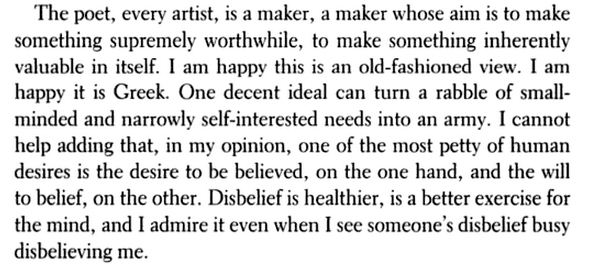
–from William H. Gass’s essay “Finding a Form.”
“Were he my brother, why then I’d have murdered poor Werther” (Goethe)
Ask whomever you will but you’ll never find out where I’m lodging,
High society’s lords, ladies so groomed and refined.
“Tell me, was Werther authentic? Did all of that happen in real life?”
“Lotte, oh where did she live, Werther’s only true love?”
How many times have I cursed those frivolous pages that broadcast
Out among all mankind passions I felt in my youth!
Were he my brother, why then I’d have murdered poor Werther.
Yet his despondent ghost couldn’t have sought worse revenge.
That’s the way “Marlborough,” the ditty, follows the Englishman’s travels
Down to Livorno from France, thence from Livorno to Rome,
All of the way into Naples and then, should he flee on to Madras,
“Marlborough” will surely be there, “Marlborough” sung in the port.
Happily now I’ve escaped, and my mistress knows Werther and Lotte
Not a whit better than who might be this man in her bed:
That he’s a foreigner, footloose and lusty, is all she could tell you,
Who beyond mountains and snow, dwelt in a house made of wood.
From Section I of Goethe’s Erotica Romana.
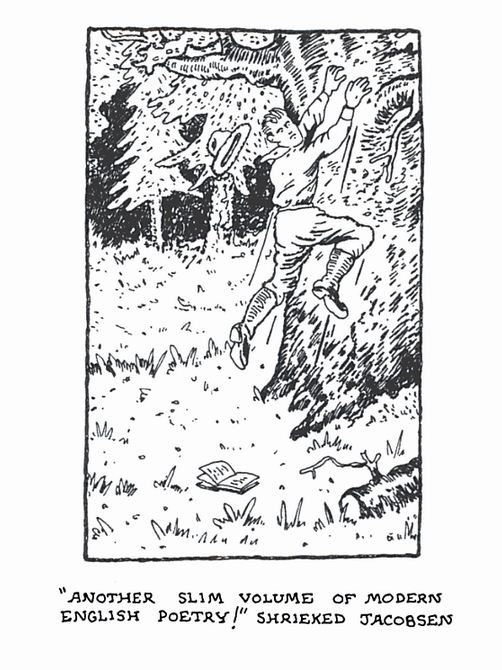
Glen Baxter Comic
Sebald’s After Nature (Book Acquired, 9.21.2012)

W.G. Sebald’s poetry collection After Nature. Not really poetry. Or maybe it is poetry. I don’t know what poetry is.
Tests and Composition Exercises for Young Writers — Ezra Pound

“Little Is Known of the Life of Matthias Grünewald of Aschaffenburg” — W.G. Sebald
Little is known of the life of
Matthias Grünewald of Aschaffenburg.
The first account of the painter
In Joachim von Sandrart’s German Academy
of the year 1675 begins with the notice
that the author knows not one person living
who could provide a written or oral
testimony of that praiseworthy hand.
We may trust the report by Sandrart,
for a portrait in Würzburg museum
has preserved him, aged eighty-two,
wide awake and with eyes uncommonly clear.
Lightly in grey and black,
he writes, Mattheus had painted the outer
wings of an altarpiece made by Dürer
of Mary’s ascension in the
Preachers’ convent in Frankfurt and
thus had lived at around 1505.
Exceedingly strange was the transfiguration
of Christ on Mount Tabor
limned in watercolours, especially
one cloud of wondrous beauty, wherein
above the Apostles convulsed
with awe, Moses and Elijah appear,
a marvel surpassed.
Then in the Mainz cathedral
there had been three altar panels
with facing fronts and reverse
sides painted, one of them
showing a blind hermit who, as he crosses
the frozen Rhine river with a boy
to guide him, is assaulted by two murderers
and beaten to death. Anno 1631 or ’32,
this panel in the wild war of that era
had been taken away and sent off to Sweden
but by shipwreck beside many other
such pieces of art had perished
in the depths of the sea.
At Isenheim, Sandrart had not been,
but had heard of the altar-work there,
which, he writes, was so fashioned that
real life could scarce have been other
and where, it was said, a St. Anthony with
demons meticulously drawn was to be seen.
Except for a St. John with hands clasped
of which he, Sandrart, when at one time in Rome
he was counterfeiting the pope, had caught sight,
with certainty this was all that was not lost
of the work of Aschaffenburg
painter of whom, besides, he knew only
that most of the time he had
resided in Mainz, led a reclusive
melancholy life and been ill-married.
—W.G. Sebald. Chapter II of “…As Snow on the Alps.” From After Nature.
 Biblioklept