Definition of Politics (Ambrose Bierce)

Raskolnikov on Extraordinary and Ordinary People


“That wasn’t quite my contention,” he began simply and modestly. “Yet I admit that you have stated it almost correctly; perhaps, if you like, perfectly so.” (It almost gave him pleasure to admit this.) “The only difference is that I don’t contend that extraordinary people are always bound to commit breaches of morals, as you call it. In fact, I doubt whether such an argument could be published. I simply hinted that an ‘extraordinary’ man has the right… that is not an official right, but an inner right to decide in his own conscience to overstep… certain obstacles, and only in case it is essential for the practical fulfilment of his idea (sometimes, perhaps, of benefit to the whole of humanity). You say that my article isn’t definite; I am ready to make it as clear as I can. Perhaps I am right in thinking you want me to; very well. I maintain that if the discoveries of Kepler and Newton could not have been made known except by sacrificing the lives of one, a dozen, a hundred, or more men, Newton would have had the right, would indeed have been in duty bound… to eliminate the dozen or the hundred men for the sake of making his discoveries known to the whole of humanity. But it does not follow from that that Newton had a right to murder people right and left and to steal every day in the market. Then, I remember, I maintain in my article that all… well, legislators and leaders of men, such as Lycurgus, Solon, Mahomet, Napoleon, and so on, were all without exception criminals, from the very fact that, making a new law, they transgressed the ancient one, handed down from their ancestors and held sacred by the people, and they did not stop short at bloodshed either, if that bloodshed—often of innocent persons fighting bravely in defence of ancient law—were of use to their cause. It’s remarkable, in fact, that the majority, indeed, of these benefactors and leaders of humanity were guilty of terrible carnage. In short, I maintain that all great men or even men a little out of the common, that is to say capable of giving some new word, must from their very nature be criminals—more or less, of course. Otherwise it’s hard for them to get out of the common rut; and to remain in the common rut is what they can’t submit to, from their very nature again, and to my mind they ought not, indeed, to submit to it. You see that there is nothing particularly new in all that. The same thing has been printed and read a thousand times before. As for my division of people into ordinary and extraordinary, I acknowledge that it’s somewhat arbitrary, but I don’t insist upon exact numbers. I only believe in my leading idea that men are in general divided by a law of nature into two categories, inferior (ordinary), that is, so to say, material that serves only to reproduce its kind, and men who have the gift or the talent to utter a new word. There are, of course, innumerable sub-divisions, but the distinguishing features of both categories are fairly well marked. The first category, generally speaking, are men conservative in temperament and law-abiding; they live under control and love to be controlled. To my thinking it is their duty to be controlled, because that’s their vocation, and there is nothing humiliating in it for them. The second category all transgress the law; they are destroyers or disposed to destruction according to their capacities. The crimes of these men are of course relative and varied; for the most part they seek in very varied ways the destruction of the present for the sake of the better. But if such a one is forced for the sake of his idea to step over a corpse or wade through blood, he can, I maintain, find within himself, in his conscience, a sanction for wading through blood—that depends on the idea and its dimensions, note that. It’s only in that sense I speak of their right to crime in my article (you remember it began with the legal question). There’s no need for such anxiety, however; the masses will scarcely ever admit this right, they punish them or hang them (more or less), and in doing so fulfil quite justly their conservative vocation. But the same masses set these criminals on a pedestal in the next generation and worship them (more or less). The first category is always the man of the present, the second the man of the future. The first preserve the world and people it, the second move the world and lead it to its goal. Each class has an equal right to exist. In fact, all have equal rights with me—and vive la guerre éternelle—till the New Jerusalem, of course!”

From Chapter V of Part III of Dostoevsky’s novel Crime and Punishment.


Guy Debord on “Consumable Pseudocyclical Time”


Consumable pseudocyclical time is spectacular time, both in the narrow sense as time spent consuming images and in the broader sense as image of the consumption of time. The time spent consuming images (images which in turn serve to publicize all the other commodities) is both the particular terrain where the spectacle’s mechanisms are most fully implemented and the general goal that those mechanisms present, the focus and epitome of all particular consumptions. Thus, the time that modern society is constantly seeking to “save” by increasing transportation speeds or using packaged soups ends up being spent by the average American in watching television three to six hours a day. As for the social image of the consumption of time, it is exclusively dominated by leisure time and vacations — moments portrayed, like all spectacular commodities, at a distance and as desirable by definition. These commodified moments are explicitly presented as moments of real life whose cyclical return we are supposed to look forward to. But all that is really happening is that the spectacle is displaying and reproducing itself at a higher level of intensity. What is presented as true life turns out to be merely a more truly spectacular life.

Guy Debord, section 153 of The Society of the Spectacle


“This Ain’t No Picnic” — The Minutemen

Maurice Sendak on The Colbert Report (In Case You Missed It)

Vodpod videos no longer available. Vodpod videos no longer available.

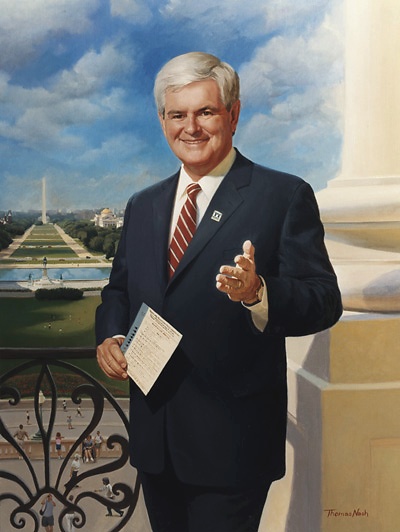
Newt Gingrich (And Other Portraits of Old, Rich White Men) by Thomas V. Nash

I recently saw this portrait of current Republican nomination candidate/constant font of regressive ideas Newt Gingrich on an image board I frequent. It’s by Georgia-based portrait artist Thomas Nash, whose website I had to visit after seeing this picture.

For some reason I can’t quite articulate, Nash’s portraits are surreal to me. I don’t think it’s purposeful, of course—he’s clearly a technically competent artist whose oil paintings are meant to confer a sense of power twinned in benevolence.

It must be my own sense of history, of power, of irony, that makes me feel thoroughly creeped out by this portrait of Newt—the manically glib glint in his eye (his left eyebrow ever-so slightly arched in cocky condescension), the sinister light that seems to emanate from his upraised, extended left hand, the mysterious document casually clutched in his right, the phallic authority of the Washington Monument jutting out from the Mall in the background as tiny tourists mill about, one even pausing to aim his camera from behind the scroll work at the viewer . . .

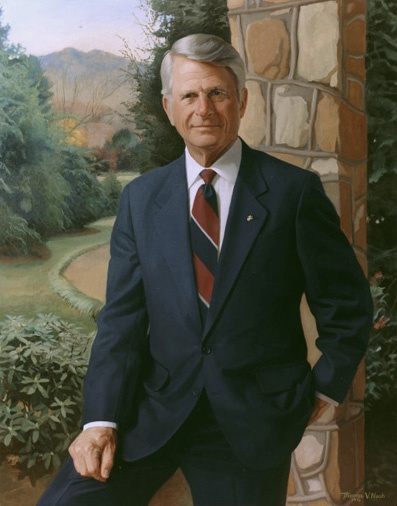
It’s odd, malevolent, and engrossing, but when paired against the other portraits in Nash’s collection of “Men,” like former Democratic Senator (and George W. Bush supporter) Zell Miller, it seems even more sinister and ironic to me, as if some evil scream lurked in the background, suppressed, detained, a black hood over its metaphorical head:

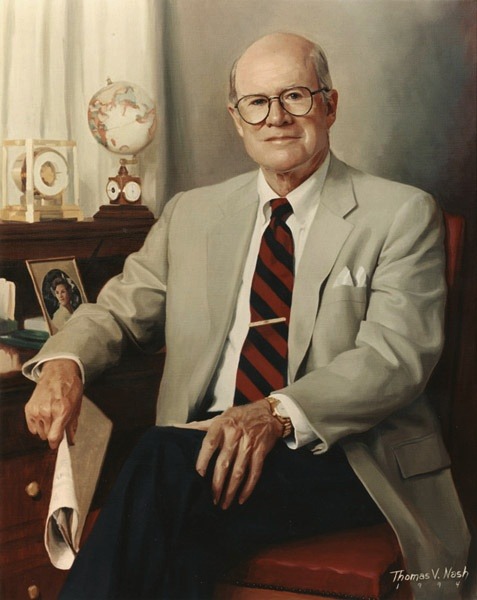
Or these guys:

In some sense, these paintings strike me as the strange dry twins of the work of sensualist John Currin, a subjective claim that is perhaps unsupportable but nevertheless seems true to me.

Books Acquired, 9.10.11

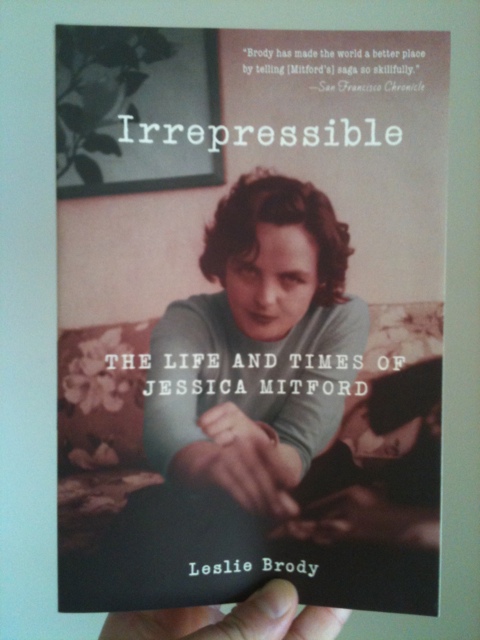
20110910-040358.jpg

Two books in the mail today from Counterpoint Press, an expanding indie press with a broad but sharp catalog (including Soft Skull Press). The first is Irrepressible: The Life and Times of Jessica Mitford, a biography of the progressive upstart. From the press release—

Admirers and detractors use the same words to describe Jessica Mitford: subversive, mischief-maker, muckraker. J.K. Rowling calls Mitford her “most influential writer.” Those who knew her best simply called her “Decca.” Born into one of Britain’s most famous aristocratic families, Mitford eloped with Winston Churchill’s nephew to America as a teenager in 1939. A no-holds barred civil rights activist, outspoken communist, and feared journalist, Mitford rose to one of the New Deal’s most notorious bureaucrats. For her the personal was political. She coined the term “frenemies,”  and as a member of the American Communist Party, she made several, though not among the Cold War witch hunters. When she left the Communist Party in 1958 after fifteen years, she promised to be subversive whenever the opportunity arose. True to her word, late in life she hit her stride as a writer, publishing nine books before her death in 1996. With unrestricted access to the Mitford Family archives, Leslie Brody presents a moving, impeccably researched biography of one of the most influential women of the 20th century.

20110910-040407.jpg

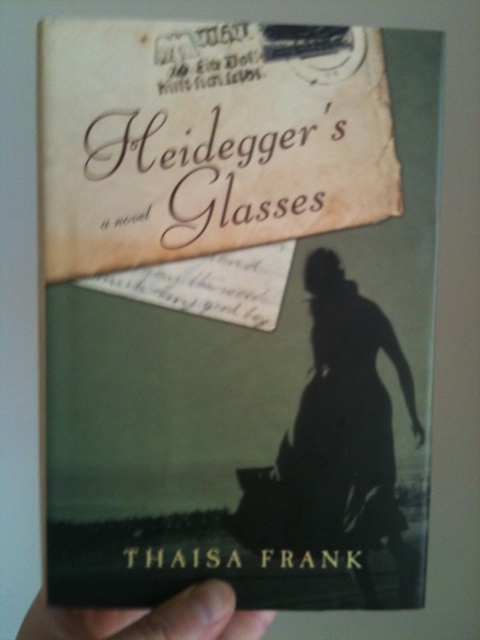
Heidegger’s Glasses is a novel by Thaisa Frank that seems promising. Description—

Magical and surreal, Heidegger’s Glasses offers a completely original vantage point on the Holocaust.  The story opens during the end of World War II in a failing Germany coming apart at the seams. The Third Reich’s strong reliance on the occult and the leading officials’ obsession with the astral plane has led to the formation of a secret Compound of Scribes–multilingual translators that have been spared from deportation to answer returned letters written to the dead in the concentration camps. Ellie Schacten, the mysterious heroine of the novel, supervises the Scribes, yet secretly uses the compound to hide a steadily growing number of refugees. When a letter arrives, written by eminent German philosopher Martin Heidegger to his friend and optometrist––a man who is now lost in the dying thralls of Auschwitz––a series of events unfold that turn the Reich’s attention to the compound and threaten Ellie’s operation and the lives of the Scribes.

Based on the real Third Reich procedure, Operation Mail, which forced concentration camp prisoners to send letters to loved ones extolling conditions in the camps, Heidegger’s Glasses explores a dark, absurd world in which fear and death are a constant companion, and yet, Frank’s characters show how that when stripped of their freedom and virtually all material possessions, the human spirit perseveres and thrives.

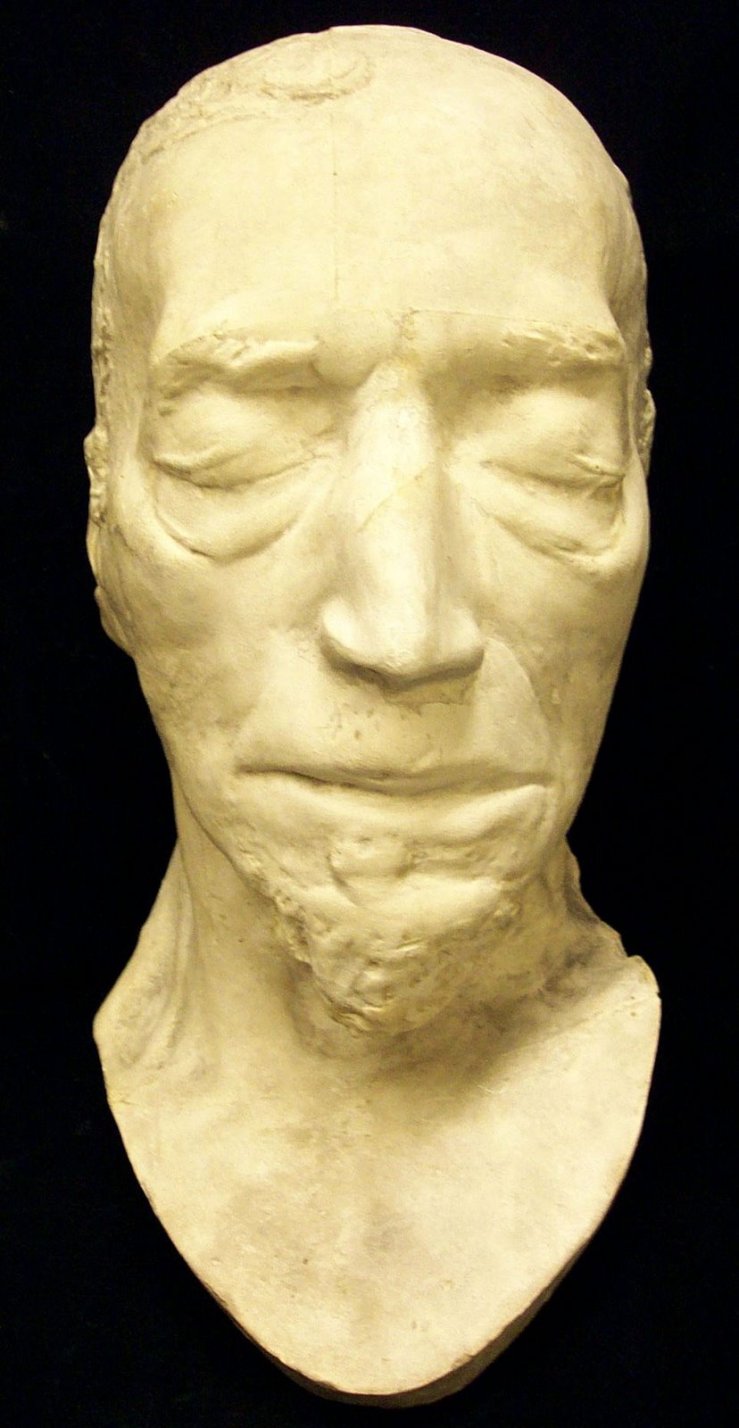
Disraeli’s Death Mask

When Skateboards Will Be Free — Saïd Sayrafiezadeh

skateboardsSaïd Sayrafiezadeh’s memoir When Skateboards Will Be Free recounts the author’s youth as the son of two diehard socialists, Party members who are far more devoted to the impending Revolution than their family. Sayrafiezadeh’s father, an Iranian intellectual, leaves the family before the boy can even speak, and throughout the book he remains a paradoxical touchstone, a living emblem of Sayrafiezadeh’s alienation. Sayrafiezadeh is raised by his Jewish-American mother, first in New York City, then in Pittsburgh, always in poverty. His mother Martha is such a committed socialist that she willfully chooses a life of poverty for both herself and her young son. Sayrafiezadeh writes:

…my mother actively, consciously, chose not only for us to be poor but for us to remain poor, and the two of us suffered greatly for it. Because to suffer and to suffer greatly was the point. It was the fulfillment of ourselves. My mother was no doubt emboldened by the philosophy that ther was honor in wretchedness, virtue in misery, nobility in hardship.

The passage above is one of the rare reflective moments in this memoir; most of the time, Sayrafiezadeh’s strategy is to relate his youth in simple, immediate terms. We see Sayrafiezadeh and his mother move from squalid apartment to squalid apartment,  we experience the boredom that a young boy would feel at Socialist party meetings, we feel the strange alienation Sayrafiezadeh experiences at school–an alienation that does not emanate from his parents’ political stance alone, but also in his ethnic identity. To be in  middle school is hard; to be in middle school as a person of Iranian descent during the 1979 hostage crisis is really hard. Sayrafiezadeh always follows the “show don’t tell” dictum of good writing, and, as a result, his description of the suffering he experiences as a young person–poverty, confusion, and alienation–never seems contrived or out of place. Indeed, these are feelings common for any kid, here magnified exponentially. Ultimately, however, it is not so much sympathy that the reader experiences but anger, a specific, concentrated anger at Sayrafiezadeh’s selfish parents coupled with a more muted sense that pure adherence to any ideology can be emotionally destructive.

The book moves episodically between a chronological telling of Sayrafiezadeh’s life and the narration of a grown-up Sayrafiezadeh still navigating his strange identity in contemporary New York. This grown-up Sayrafiezadeh is hardly a screw-up, but he is clearly marked by the ideology his parents have attempted to imprint upon him. In one clever passage, an adult Sayrafiezadeh ponders over tissue box holders–ephemeral, essentially unnecessary items, products born of capitalism’s need to manufacture desire–and buys a ridiculously overpriced one with a certain relish. The scene plays as a muted “fuck you” to his parents, but is perhaps unnecessary in this regard, as the whole of When Skateboards Will Be Free paints Sayrafiezadeh’s mother and father as neglectful figures. Sayrafiezadeh’s father not only abandons the family, but is largely absent from his son’s life in any regard. He’s late–often months late–to special birthday dinners and any scene where the two interact shows that they do not know each other. While Sayrafiezadeh’s mother manages to eke out a living for the two of them, it is also repeatedly clear that her ideological choice to live in poverty has hurt her son beyond mere embarrassment. Sayrafiezadeh is the emblematic latchkey kid, left to himself for long stretches of time–even whole weekends–at a very young age, as his mother attends her Socialist meetings. In one grim episode, a very yong Sayrafiezadeh is sexually molested by a “comrade” of the Socialist party who has generously volunteered to babysit. This is just one extreme example of the underlying irony of the memoir, an irony that Sayrafiezadeh does not specifically name: his parents, in the name of a political philosophy that espouses the value of caring for one’s fellow man, have failed to adequately care for him.

Written in a brisk, lucid style with simple dialogue, When Skateboards Will Be Free effectively compresses a young life into three hundred pages that can be read over three or four afternoons. We’re not exactly big fans of the memoir around Biblioklept, but Sayrafiezadeh’s effort eschews many of the genre’s hallmarks (sensationalism, overly-reflective post-event analysis) in favor of a style that allows his readers to draw their own conclusions. This isn’t to suggest that Sayrafiezadeh doesn’t lead his readers to some definitive ends, but rather that his writerly approach is less overt manipulation than the stuff of most memoir. While Skateboards isn’t exactly essential reading, those who can’t get enough memoir in their reading diet will surely appreciate its vitality and generous honesty.

When Skateboards Will Be Free is available in hardcover March 24, 2009 from Random House.


A Respite from Cynicism

I am a cynic and skeptic of the worst kind, the type of person who claims to be a realist but who secretly knows that he is a hopeless pessimist. And yet I cannot help but feel more than a little relieved and lightened, very much in spite of myself, at our country’s overwhelming endorsement of a new ideology, one that I believe is different and separate from the politics that survived on the perpetuation of the myth of a “culture war.” I’m talking about Barrack Obama, President Elect, if I haven’t been clear enough.

I’m not naive enough to believe that Obama isn’t a politician, fallible like all before him, and I’m not giddy or silly enough to think of him as a Jesusian savior of America. When the conservative movement mocked Obama’s followers for seemingly seeing in the man a messiah figure, what they didn’t understand was the radical break that Obama represented. It is not so much Obama the man that we longed for, but the idea of Obama–the idea of someone radically different from everything that had come before. And in electing Obama–and the idea of Obama–we immediately achieved something, as Americans, that is wholly independent of anything Obama will do over the next four years as President. We showed the world that our democracy works and that we as a people are not the ignorant xenophobic fundamentalists that the Bush administration worked so hard to paint us as.

I’ve been thinking these past few days about Michelle Obama’s infamous comment during the campaign that she felt proud to be an American for the first time in her adult life. The comment was fodder for right wingers, of course, and at the time it seemed like a bit of a blunder even to some Obama supporters. But now I see it in a new way. My adult life has essentially taken place in this decade, the Bush decade, the 9/11 decade (I turned 21 in the year 2000). While I’ve had moments of pride in individual Americans, it’s been hard to see the (regressive) movement of our country in any positive light. I remember being a child, being taught and believing that this was a special country, a different country, a country that people wanted to come to because it was special and different. In my adult life in this decade, I’ve watched our ideological stock plummet around the globe. I’ve found myself, while traveling abroad, having to explain–with quite a bit of difficulty–that we’re not all ignorant fundamentalists in America. That thinking critically was actually once considered patriotic. That America was really a much better place than its elected leadership exemplified. The policies of the Bush administration–and the nation’s acquiescent and apathetic response to them–slowly drained my energy and hardened my pessimism in politics and people into a thick, cynical shell. I am amazed at how quickly the November 4th, 2008 election shattered this shell.

I know that Obama will make mistakes, that he will have to engage in the same kind of political gamesmanship that every other president has had to in order to push their agenda. But again, to paraphrase Obama himself, this isn’t about him–this is about us, the U.S., and our declared mandate for political and cultural change in this country. So while I will keep my skeptical reservations and pessimism about politics and the two-party system that we let dominate this country, I can’t help but feel a restoration of pride and a sense of possibility for this country.

Jesse Jackson’s Tears

I was surprised by the emotional response I had to Obama’s sweeping win last night–or rather, I was surprised by the emotional response that I had to the emotional responses I saw on my television. But it was these images of Jesse Jackson crying that intrigued me–and continue to intrigue me–the most:

What are we seeing here? Jackson’s tears, his clenched jaw, his bared teeth–all stand out in strange relief against the cheering, joyous faces around him. What is he thinking? What is he feeling? What is the word for how he feels? Is this catharsis?

Raw and complex, Jackson’s response is not gleeful joy, but some kind of release–not elation, but deflation, it seems. Indeed, Jackson’s tears, his face, seem to reflect and signal the aspiration of a lifetime’s work–his work–achieved now in a different man, a new man, a man for a new and different time. In some sense–and perhaps I’m way overboard here–it seems that Jackson is working through some deep Oedipal anxieties. And yet such a cathartic response, such a purging also seems to indicate and symbolize a dramatic shift in America’s narrative.

In any case, in our heavily mediated age of instant news and “reality TV” (an age saturated with information and scant on wisdom or reflection), Jackson’s tears strike me viscerally. They are wholly real, the abject edges of turmoil and pain, but also the strange fruit of over fifty years of the Civil Rights movement. And while Obama’s ascendancy in no way changes the past, it changes the future, and delivers a promise to the rest of the world that America truly is a land of freedom, opportunity, and hope.

Syntactic Decay

Like many Americans, my main interest in last night’s Vice-Presidential Debate was the hope for a little schadenfreude: I wanted to see Palin dissolve in a “nucular” meltdown. And while the clumsy silences and passive aggressive volleys of her previous interviews weren’t on show last night, Palin still managed to cram her “answers” with stock speaking points and vague generalities–namely, what passes for political rhetoric today. What gets me is this: expectations for the doltish Palin were so low that without a spectacle gaffe, many pundits are today declaring her jabberwocky a success. For example, take David Brooks’s gushing op-ed piece in today’s New York Times:

By the end of her opening answers, it was clear she would meet the test. She spoke with that calm, measured poise that marked her convention speech, not the panicked meanderings of her subsequent interviews.

Okay, so, now, in 2008, as America seeks to prove that we can dare to be dumber than ever, it seems that anything above “panicked meanderings” equals success (Palin’s agitated mannerisms, particularly at the beginning of the debate, didn’t really strike me as “calm” or “measured” either). Fair and balanced FOX News reported that Palin’s “cool and confident performance . . . helped John McCain regain his footing.” I don’t know what specific data they have to back this claim up.

What FOX hailed as a “bravura performance” was yet another incoherent string of non-answers tarted up in sloganeering and divisive, diversionary rhetoric. Palin doesn’t understand the traditional purpose of debate; at one point she even said as much: “I may not answer the questions that either the moderator or you [Biden] want to hear, but I’m going to talk straight to the American people and let them know my track record also.” Near the end of the debate, when asked what her biggest weakness is, Palin simply didn’t answer: she just blasted out a bunch of talking points (I thought that I might’ve misheard the question, but no–check out the transcript here). Governor Palin, the point of the debate is to respond to questions and to respond and rebut your opponent’s responses. Is it too much to ask that you do this? Or is it that you simply have no answers? I believe it’s the latter.

What fascinated me most during the debate was Palin’s syntax. Her long, elliptical answers danced around the topic at hand in a showy, glittery masquerade of stock phrases, slowly disintegrating into the kind of glowing generalities that I guess Joe Six-Pack and his hockey mom wife are supposed to lap up (being an east-coast liberal elitist I simply don’t understand such realities of the Heartland; I’m far too busy eating latte salads in my Subaru while listening to gay operas and worshiping false idols to care about this kind of mundane peasant behavior).  At least one critic got it right. Also from today’s New York Times:

After a series of stumbling interviews that raised serious doubts even among conservatives about her fitness to serve as vice president, Ms. Palin had to do little more than say one or two sensible things and avoid an election-defining gaffe. By that standard, but only by that standard, the governor of Alaska did well. But Ms. Palin never really got beyond her talking points in 90 minutes, mostly repeating clichés and tired attack lines and energetically refusing to answer far too many questions.

Are specific answers too much to ask from our leaders? Or are we now okay with our politicians not even answering the questions that we ask?

Palin Bingo, or, What to do for Kicks as You Inwardly Reel in Horror while Watching Tonight’s Debate

(Image links to fun user-friendly pdfs)

There’s also this

Sarah Palin, Vague Threats, and Why Banned Books Week Matters

We know Sarah Palin loves to read. In a great op/ed piece in today’s Washington Post, Ruth Marcus writes:

Asked in an interview for PBS’s Charlie Rose show last year (http://www.charlierose.com/guests/sarah-palin) about her favorite authors, Palin cited C.S. Lewis — “very, very deep” — and Dr. George Sheehan, a now-deceased writer for Runner’s World magazine whose columns Palin still keeps on hand.

“Very inspiring and very motivating,” she said. “He was an athlete and I think so much of what you learn in athletics about competition and healthy living that he was really able to encapsulate, has stayed with me all these years.”

Also, she got a Garfield desk calendar for Christmas 1987 that made a big impression.

Great stuff. Who doesn’t love to read? Books is where you gets knowledge. However, Palin is the sort of fundamentalist hardliner who thinks she knows what’s best for all of us to read–or not read. By now, you’ve probably heard of the pressure Palin exerted on the librarian of Wasilla. As mayor, Palin inquired how she might go about removing books from the library. Of course, according to most reports, including this one from The Anchorage Daily News earlier this month, “Palin didn’t mention specific books at that meeting.”

Huh. Hard to imagine that Palin didn’t get specific, right?

Palin then wrote the librarian in question a letter telling her she would be fired for lack of loyalty. Although public outcry prevented the firing, the librarian eventually moved away from Wasilla. Palin said at the time, and has maintained since then, that the question was “rhetorical”; she simply wanted to know how one would go about removing “objectionable” books.

Why would you ask how to remove books if you had no intention of removing them?

It’s too easy to dismiss Palin’s inquiries into censorship. Her moralistic will to ban what others read is really an attempt to control ideas, to control thoughts, to control bodies even–the ultimate goal of the far Christian right. It’s the middle of Banned Book’s Week, and it’s time to say “No” to the vacuous (a)moralizing of those like Palin who would presume to dictate what is and is not acceptable to be loaned in a public library. I don’t know about you, but I’m not going to let a woman who apparently believes that “dinosaurs and humans walked the Earth at the same time” tell me what to think or feel or read.

Banned Books Week calls attention to not only the great currency of ideas we have in literature, but to also points out that there are still those who seek to suppress ideas with which they don’t agree. Even as we celebrate these books, we must attack those who would ban them–especially those who work so surreptitiously.

Language, Politics, Elitism, and Sarah Palin’s Horrendous Pronunciation

It wasn’t so much Governor Palin’s fumbling toward a semblance of specificity in her recent Katie Couric interview that made me cringe. It wasn’t her misapprehension that Putin is still the president of Russia (an honest mistake, I’m sure) that raised my hackles. It wasn’t her neocon-lite reduction of global politics to “good guys” vs “bad guys” that so irritated me. Even her ignorance of Henry Kissinger’s foreign policy philosophy re: Iran didn’t bother me. If anything, I delighted in watching Gov. Palin blather incoherently, especially after this fiasco two weeks ago. No, what really raised the hairs on the back of my neck was this exchange:

Couric: You recently said three times that you would never, quote, “second guess” Israel if that country decided to attack Iran. Why not?

Palin: We shouldn’t second guess Israel’s security efforts because we cannot ever afford to send a message that we would allow a second Holocaust, for one. Israel has got to have the opportunity and the ability to protect itself. They are our closest ally in the Mideast. We need them. They need us. And we shouldn’t second guess their efforts.

But, you see, it wasn’t what she said so much as it was how she said it. Or mispronounced it, rather.

Let me admit it. I’m an elitist, something of a snob I guess. I can’t help it. Although I didn’t go to five colleges, I did attend two universities to earn two degrees–nothing as prestigious as Palin’s hard-earned MS in communications, of course–but I do have some linguistic standards and expectations for our executive leadership. You see, Gov. Palin didn’t say “second guess,” as the CBS News transcript so generously credits her. No, Gov. Palin distinctly says “second guest.”

Now, we already know that Palin has had some difficulty with one of Bush’s biggest stumbling blocks, that oh-so daunting word “nuclear” (as in “nü-klē-ər” not “nyoo-kyoo-lar”). Observe:

Unfortunately, as of right now there’s no full footage of tonight’s interview up on a site that WordPress will allow me to embed here, and most of the posted clips focus on Palin’s rambling knowledge of basic geography (even Miss Teen South Carolina still managed to get more specific than Palin — “They don’t have maps”).

VIDEO UPDATE–Palin mispronounces “second guess” as “second guest” at 00:17:

If you go to CBS News and wait patiently, Palin’s redneck phrasing pops up at 8:55, wedged neatly amid a vague heap of rhetorically empty catchphrases that the neo-cons and Bush administration have been excreting for the past decade.

In the best assessment I’ve read on Palin yet, Roger Ebert points out that most middle-class Americans would brag if their kids went to Harvard on scholarship; that most of us honor travel as a form of education and the signal of intellectual curiosity. How did we get here? When, exactly, did we decide that our president needs to have the qualities of a good drinking buddy? In short, why do we think that provincialism and ignorance, so summarily captured in Palin’s groan-inducing “second guest,” are the signs of a “real,” “true” American? If we’re going to elect smug, hypocritical leaders, is it too much to ask that they exhibit a modicum of intelligence, or, at the very least, don’t trip over their words?

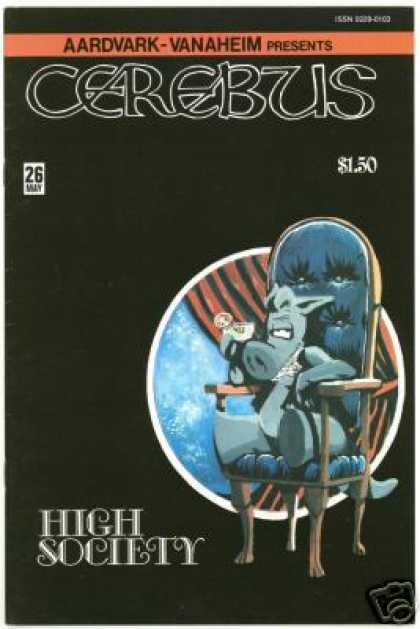
High Society–Dave Sim

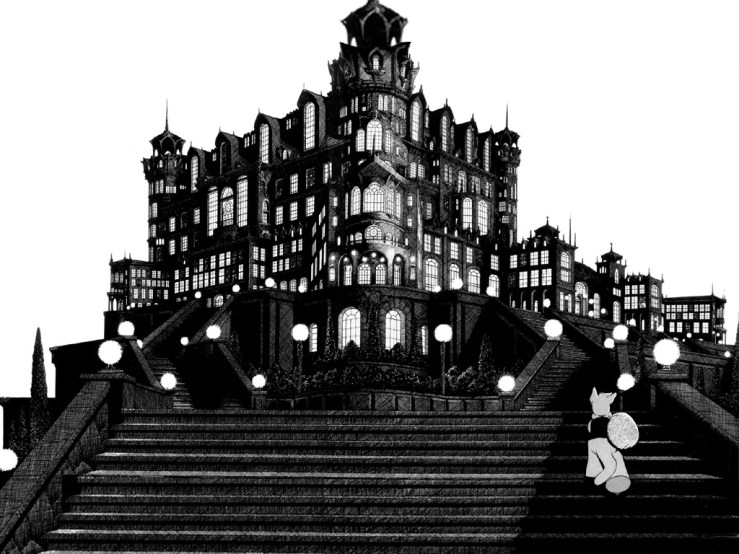
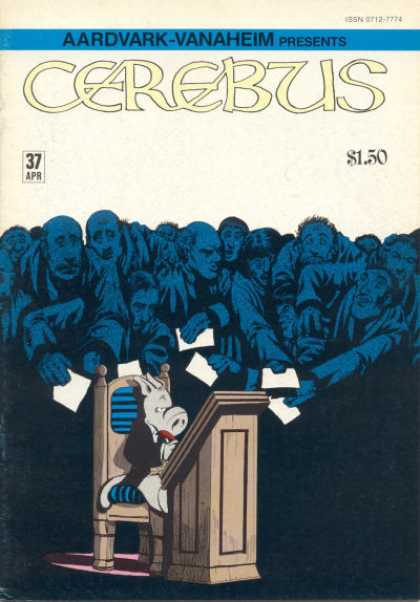
If you’re at all interested in reading any of Dave Sim’s epic 300-issue comic book Cerebus, a book chronicling the life–and death–of a misanthropic mystical barbarian aardvark, High Society is the best (and possibly only) starting point. High Society tells the story of Cerebus’s political adventures in Iest, the largest cosmopolitan city-state of Estarcion. Guided (or perhaps manipulated) by Machiavellian Astoria, Cerebus undertakes a strange, comic odyssey of political ascendancy, culminating in an election for Prime Minister (against Groucho Marx stand-in Lord Julius’s goat, of all things). Sim has a deft ear for political satire and the volume holds up particularly well to a rereading against the backdrop of the current American electoral process. While High Society conveys a certain cynical contempt for the cronyism, deal-making, and the general nasty malfeasance that underwrites politics, there’s also a reconciling of democracy, liberty, and art here that you could never find from a CNN analyst or a Fox News hack. By this point, the crude art and flubbed pacing that hampered the first few years of Cerebus are nowhere to be found. High Society is tightly-plotted, full of smart gags expressed in Sim’s keen lines, without an over-reliance on bubbles overstuffed with exposition.

The book is funny without ever being light, and rereading it again, I was surprised at how moved–and exhilarated–I was by the conclusion. Although the parody of Marvel’s forgotten Batman ripoff Moon Knight doesn’t hold up very well, and the “sideways” issues at the end are an annoying (but interesting) experiment, High Society continues to deliver both laughs and insight about the political process over twenty years after its single-volume publication. Very good stuff, and highly recommended (read it along with/against the 2008 election).

(Strange aside that I couldn’t work into the piece–remember Ken Jennings? That guy who won Jeopardy! like, a year straight? According to his blog he’s a huge Cerebus fan).

To the Castle and Back — Vaclav Havel

Václav Havel’s latest memoir To the Castle and Back plays as a strange series of paradoxes. It’s elliptical and fragmentary yet thorough and exhaustive; it’s personal and introspective yet political and social; it presents a total picture of Czechoslovakia’s 1989 Velvet Revolution and the subsequent dissolution of Czechoslovakia into the Czech Republic and Slovakia, yet it repeatedly admits to being unable to convey the full story. The narrative of the Velvet Revolution is fascinating even for those who aren’t political junkies. Make no mistake though–To the Castle in Back will be most enjoyed by people who can’t get enough of world politics. The book is larded with dry political details, and Havel the poet and playwright, Havel Lou Reed’s buddy, Havel the Zappa enthusiast–in short Havel as hipster–is largely absent from this text. Instead, we get journalistic accounts of Havel as politician and speech maker interwoven with Havel’s own commentary and even interoffice memos. At times the level of detail is almost excruciating, but Havel seems to understand this. His preface to the book actually serves as the best review (and guide) possible:

If you occasionally feel like putting the book aside because it seems to skirt some of the world-shaking events that I lived through, or to burrow too deeply into exclusively Czech or Czechoslovak matters, I urge you to skip ahead. It’s easy to do because the book is divided not only into chapters but into short sequences, separated by horizontal lines.

Late in the memoir, Havel writes that for all of his life, he’d “longed to write a brutally honest diary, something in the style of Henry Miller, Charles Bukoswki, [or] Anaïs Nin.” And while To the Castle and Back hardly approaches the rough and scandalous material of that mid-century triad, it does contain something just as honest perhaps: an unglamorous, unromanticized accounting of the past told at all times with the caveat that this story is not history writ large, but rather the perspective of someone who lived through it and acted upon it. Honest, moving, often humorous, and, yes, occasionally dull, To the Castle and Back is probably not a book for everyone, but for those interested in the man and the events of the Velvet Revolution it makes a competent introduction.