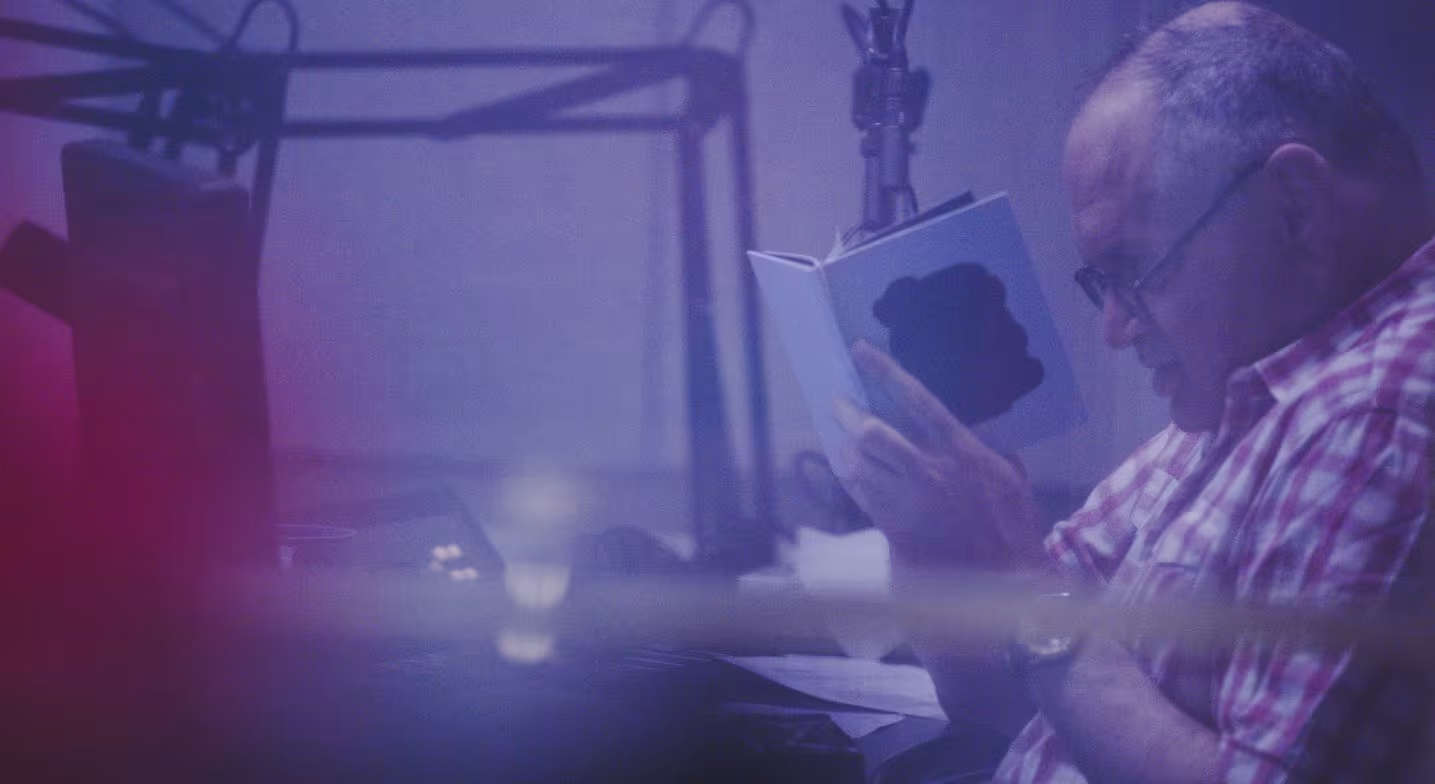
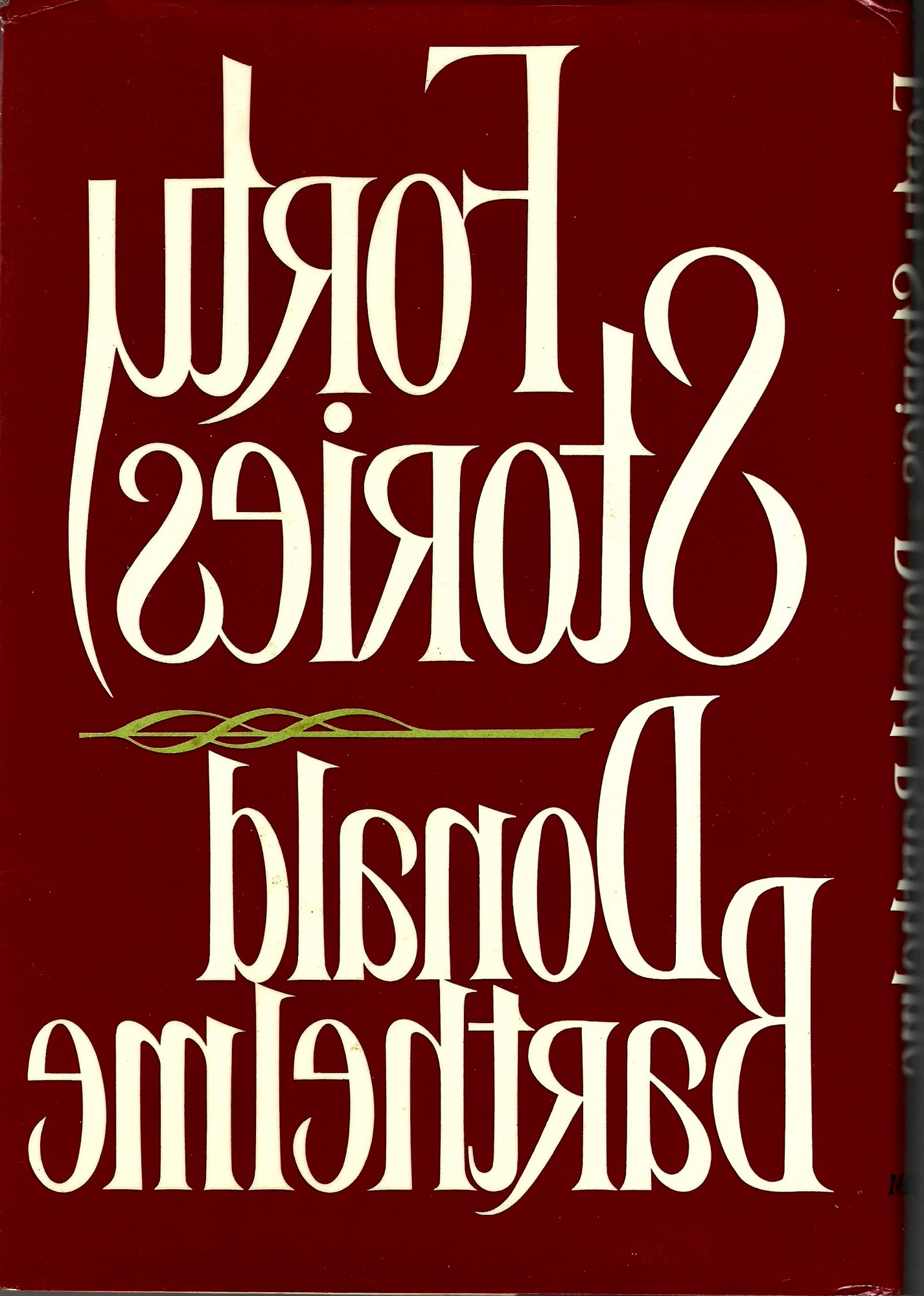
Donald Barthelme’s Forty Stories in reverse, Part I

A few years ago, I reread Donald Barthelme’s collection Sixty Stories and wrote about them on this blog. I enjoyed the project immensely. A recent comment on the last of those Sixty Stories posts asked, or demanded, I suppose (the four-word comment is in the imperative voice) that I Now do Forty Stories. Which I am going to now do, Forty Stories.

40. “January” (first published in The New Yorker, 6 April 1987)

“January” begins as a dialogue between two characters, a mode Barthelme would return to repeatedly throughout his later career. The story is ostensibly a Paris Review style interview with one “Thomas Brecker,” who has authored seven books on religion over his thirty-five year career. The story begins as light satire; our Serious Writer is “renting a small villa” in St. Thomas; the interviewer notes that “a houseboy attended us, bringing cool drinks on a brown plastic tray of the sort found in cafeterias.” The interview quickly takes the shape of a career-spanning reflection, with Brecker sliding into a more melancholy mind frame. By the end of the story, the “interviewer” disappears, leaving us in Brecker’s imagination, where we have likely always been, and it’s hard not to read Barthelme’s autobiographical flourishes beneath Brecker’s mordant quips:

I think about my own death quite a bit, mostly in the way of noticing possible symptoms—a biting in the chest—and wondering, Is this it? It’s a function of being over sixty, and I’m maybe more concerned by how than when. That’s a … I hate to abandon my children. I’d like to live until they’re on their feet. I had them too late, I suppose. 

39. “The Baby” (Overnight to Many Distant Cities, 1983)

“The Baby” was composed around the same time as “Chablis” (1983); both stories are love letters of paternal affection for an infant daughter. Again, it’s hard not to see Barthelme’s own biography here. His daughter Katherine was an infant at the time he wrote them. While I don’t think “The Baby” is as strong as “Chablis” is (or, at least as strong in my memory — “Chablis” is the first story in Forty Stories, so we’ll get there, I guess) — while I don’t think “The Baby” is as strong as “Chablis,” it’s still a fun little ditty with an anarchic punchline. It’s also, like barely five short paragraphs–just read it.

38. “Great Days” (Great Days, 1979)

As I revisit my notes for “Great Days,” I realize I should probably read the story again, more slowly, and try to tune more into its voice. Or voices. Are there two voices here, or one? I think there is more of a n actual story story here than I can summarize — not that anyone wants summary of Barthelme —  but my takeaway is that this is Barthelme doing Stein doing Cubism doing… In his 2009 biography of Barthelme Hiding Man, Tracy Daugherty wrote that New Yorker fiction editor (and early Barthelme champion) Roger Angell rejected an early version of the story (under the title “Tenebrae”). According to Daugherty’s bio, while Angell recognized the story as a “serious work” and a “new form,” he ultimately thought it was too “private and largely abstract” for publication.

I think this bit is lovely read aloud:

 —Purple bursts in my face as if purple staples had been stapled there every which way—

—Hurt by malicious criticisms all very well grounded—

—Oh that clown band. Oh its sweet strains.

—The sky. A rectangle of glister. Behind which, a serene brown. A yellow bar, vertical, in the upper right.

—I love you, Harmonica, quite exceptionally.

—By gum I think you mean it. I think you do.

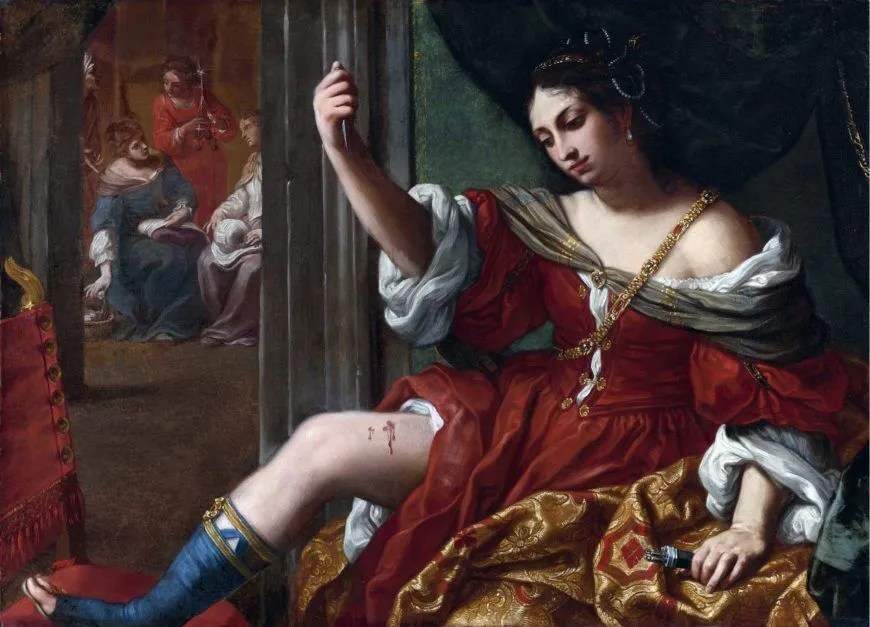
—It’s Portia Wounding Her Thigh.

—It’s Wolfram Looking at His Wife Whom He Has Imprisoned with the Corpse of Her Lover.

Elisabetta Sirani, Portia Wounding her Thigh, 1664


37. “Letters to the Editore” (Guilty Pleasures, 1974)

A lively little gem from Barthelme’s mid-seventies “non-fiction” collection Guilty Pleasures. Its inclusion seems to show an editorial need to pad out Forty Stories with more hits than the old boy had strung together by ’87. Anyway. “Letters to the Editore” is a fantastic send-up of small aesthetic aggressions writ large in the slim pages of little magazines. The ostensible subject is a dust-up surrounding an exhibition of so-called “asterisk” paintings by an American in a European gallery—but the real subject is language itself:

The Editor of Shock Art has hardly to say that the amazing fecundity of the LeDuff-Galerie Z controversy during the past five numbers has enflamed both shores of the Atlantic, at intense length. We did not think anyone would care, but apparently, a harsh spot has been touched. It is a terrible trouble to publish an international art-journal in two languages simultaneously, and the opportunities for dissonance have not been missed.

Barthelme’s comedic control of voices here is what makes this “story” an early (which is to say, late) standout in Forty Stories. It is the “opportunities for dissonance” that our author is most interested in and attuned to.

36. “Construction” (first published in The New Yorker, 21 April 1985)

“Construction” is the non-story of a writer flying out West to complete the “relatively important matter of business which had taken me to Los Angeles, something to do with a contract, a noxious contract, which I signed.” The documents he signs are “reproduced on onionskin, which does not feel happy in the hand.” This is one of two decent verbal flares in “Construction”; the other is an extended episode (as verbal flare-ups go) in which we find our Writer-Hero up against the wall of absurdity:

The flight back from Los Angeles was without event, very calm and smooth in the night. I had a cup of hot chicken noodle soup which the flight attendant was kind enough to prepare for me; I handed her the can of chicken noodle soup and she (I suppose, I don’t know the details) heated it in her microwave oven and then brought me the cup of hot chicken noodle soup which I had handed her in canned form, also a number of drinks which helped make the calm, smooth flight more so. The plane was half empty, there had been a half-hour delay in getting off the ground which I spent marveling at a sentence in a magazine, the sentence reading as follows: “[Name of film] explores the issues of love and sex without ever being chaste.” I marveled over this for the full half-hour we sat on the ground waiting for clearance on my return from Los Angeles, thinking of adequate responses, such as “Well we avoided that at least,” but no response I could conjure up was equal to or could be equal to the original text which I tore out of the magazine and folded and placed, folded, in my jacket pocket for further consideration at some time in the future when I might need a giggle.

Barthelme’s stand-in confesses here to what we’ve always known: He’s a scissors-and-paste man, a night ripper with a good ear, a good eye, but mostly one of us, a guy who needs a good giggle.

We have the right to convey the fictive of any reality at all | Gil Orlovitz

We have the right to convey the fictive of any reality at all–and there is nothing that is not real—by any method we wish, and to have as our goal, if we so opt, only that we maintain the reader’s tension, the solitary indication, itself mercurial, of a work-of-art event.

Syntax being nothing more nor less than the codification of selected usages, we may alter syntax or reject it wholly.

We may compose the fictive in such a manner that the result is ambiguous, baffling and sometimes altogether impossible significantly to paraphrase-but so long as the piece seizes and holds the reader, a basic meaning, impossible to state in language as we know it, has been established, a meaning that belongs to a time series of seizing-and-holding.

The notion, we submit, of clarity, remains simply a notion, real enough, of course, under whatever category it is sub-sumed, but of no universal vigor, necessarily, nor marked by socalled objective truth; clarity is a notion identifying a particular social agreement in a one-to-one sense as to what construct evokes similarity of analysis.

Empirically all that is demonstrable is that we experience as creator or audience a series of perceptions. Now, if we set forth that demonstration in the fictive in such a fashion as to generate and sustain tension in the reader whether or not he is mystified by the significs, we have met the sole possible criterion.

We are not of course here in any way concerned with the alleged scalar values of a given fiction-the notion of value belongs to ad hominen pleaders usually involved in depressing or elevating a status for economic reasons—just as we cannot in any way be concerned with the alleged scalar values of the given reader. Fiction and reader are conjoined, and may not with any sense be disjunct if we are trying to penetrate the nature of the esthetic.

Such being the case, I believe we can with some innocence look at the choices of the contemporary avant-garde herein, and digest them according to our lights or chiaroscuras.

We need remember only how much more we usually discern if we take the trouble, to begin with, to clean our own canvasses-within reason.

—Gil Orlovitz


Gil Orlovitz’s introduction to The Award Avant-Garde Reader (1965).

The Scalphunters | An excerpt from an early draft of Cormac McCarthy’s Blood Meridian

The Spring 1980 issue of Northwestern University’s literary journal TriQuarterly included an early version of a chapter from Cormac McCarthy’s novel Blood Meridian. The TriQuarterly excerpt, published as “The Scalphunters,” is essentially Ch. XII of the finished 1985 Random House publication of Blood Meridian with some minor differences.

Consider, for example, the following paragraph–the seventh paragraph in “The Scalphunters” —

When the company set forth in the evening they continued south as before. The tracks of the murderers bore on to the west but they were white men who preyed on travelers in that wilderness and disguised their work in this way. The trail of the argonauts of course went no further than the ashes they left behind and the intersection of these vectors seemed the work of a cynical god, the traces converging blindly in that whited void and the one going on bearing away the souls of the others with them.

McCarthy significantly expands the passage in his final revision, underscoring Blood Meridian’s theme of witnessing:

When the company set forth in the evening they continued south as before. The tracks of the murderers bore on to the west but they were white men who preyed on travelers in that wilderness and disguised their work to be that of the savages. Notions of chance and fate are the preoccupation of men engaged in rash undertakings. The trail of the argonauts terminated in ashes as told and in the convergence of such vectors in such a waste wherein the hearts and enterprise of one small nation have been swallowed up and carried off by another the expriest asked if some might not see the hand of a cynical god conducting with what austerity and what mock surprise so lethal a congruence. The posting of witnesses by a third and other path altogether might also be called in evidence as appearing to beggar chance, yet the judge, who had put his horse forward until he was abreast of the speculants, said that in this was expressed the very nature of the witness and that his proximity was no third thing but rather the prime, for what could be said to occur unobserved?

Perhaps the most jarring difference though is that in “The Scalphunters” McCarthy refers to his erstwhile protagonist not as the kid but as the boy. Here’s a longish passage from The TriQuarterly edit to give you a taste of that flavor:

Brown let the belt fall from his teeth. Is it through? he said.

It is.

The point? Is it the point? Speak up, man.

The boy drew his knife and cut away the bloody point deftly and handed it up. Brown held it to the firelight and smiled. The point was of hammered copper and it was cocked in its blood-soaked bindings on the shaft but it had held.

Stout lad, ye’ll make a shadetree sawbones yet. Now draw her.

The boy withdrew the shaft from the man’s leg smoothly and the man bowed on the ground in a lurid female motion and wheezed raggedly through his teeth. He lay there a moment and then he sat up and took the shaft from the boy and threw it in the fire and rose and went off to make his bed.

When the boy returned to his own blanket the ex-priest Tobin leaned to him and looked about stealthily and hissed at his ear.

Fool, he said. God will not love ye forever.

The boy turned to look at him.

Dont you know he’d of took you with him? He’d of took you, boy. Like a bride to the altar.

Read “The Scalphunters” here.

Riff on July 2024 reading, etc.

I experienced the middle weeks of July 2024 as simultaneously rapid and static. Doldrums should never be so frenetic. If this decade were a novel I would’ve put it down several chapters back. I try not to obsess over things I cannot control. I try to get away from screens. I try to go outside, but the feels like heat index here in north Florida goes over a hundred and five every day. (At least it’s raining again and nothing is on fire.) So I try to read more (and actually write more).

This July I read some great stuff.

I finished Katherine Dunn’s first novel Attic a couple of days ago. The book is seriously fucked up—like William Burroughs-Kathy Acker fucked up—an abject rant from a woman in prison in the mode of Ginsberg’s Howl. The narrator seems to be an autofictional version of Dunn herself, which is perhaps why Eric Rosenblum, in his 2022 New Yorker review described it as “largely a realist work in which Dunn emphasizes the trauma of her protagonist’s childhood.” Rosenblum uses the term realism two other times to describe Attic and refers to it at one point as a work of magical realism. If Attic is realism then so is Blood and Guts in High School. I need to read her second and third novels (Truck, 1971 and the posthumous Toad) and then go back and reread Geek Love, which I remember as being Gothic and gross but also whimsical. (I don’t sniff any whimsy in Attic.)

There are eight stories in Oğuz Atay’s story collection Waiting for the Fear (in translation by Ralph Hubbell); I’ve read the first five this summer, including the long title story, which is especially good, as is the opener “Man in a White Overcoat.” Atay’s heroes (I use the term loosely) find their antecedents in Kafka’s weirdos. Or Paul Bowles. Or Jane Bowles. I should have a proper review up near the end of October when NYRB publishes Waiting for the Fear.

I had picked up Mauro Javier Cárdenas’s third novel American Abductions earlier this summer and finally started it a few nights ago after finishing Attic. Each chapter is a run-on sentence that has made me want to keep reading and reading, running on with it. The novel is, at least so far, both challenging and entertaining; it is not difficult, exactly, but rather engrossing. Sometimes I’ll find myself a bit lost in the layered consciousnesses, layers (layerings) of speech in Cárdenas’s sentences—especially when I find myself startled by an image or a joke or idea—and then I’ll wade backwards again and pick up the rhythm and keep going. The plot? I’ll steal from the Dalkey Archive’s blurb: “American Abductions opens in a near-future United States whose omnipresence of data-harvesting and algorithms has enabled the mass incarceration and deportation of Latin Americans—regardless of citizenship.” But that’s not really the plot; I mean, this isn’t a third-person dystopian world-building YA thing. The novel, at least its first half, is about a family, daughters Ada and Eva and their father Antonio, a novelist who was abducted by the titular abductors (the Pale Americans!). It’s also about writing, how we construct memory in a surveillance state, and, I suppose, love.

I reviewed Jean-Baptiste Del Amo’s latest novel The Son of Man (in translation by Frank Wynne) in the middle of July, although I think I probably read it in late June. In my review I suggested that The Son of Man “is ultimately a novel about the atavistic transmission of violence from generation to generation.” I also highly recommended it.

I went on a big Antoine Volodine binge a couple of years ago which stalled out before I got to (what I believe is) his longest novel in English translation, Radiant Terminus. I finally started into it a few weeks ago (in translation by Jeffrey Zuckerman), and I think it might be Volodine’s best work. In my longish review, I declared Radiant Terminus “an astounding novel, a work that will haunt any reader willing to tune into its strange vibrations and haunted frequencies. Very highly recommended.” I think it’s a perfect starting place for anyone interested in Volodine’s so-called post-exotic project.

Denis Johnson’s The Stars at Noon was one of two novels I revisited via audiobook this month (the other is Portis’s Gringos, which we’ll get to in a moment). I honestly didn’t remember much about The Stars at Noon other than its premise and the fact that its narrator was an alcoholic journalist-cum-prostitute in Nicaragua. It hadn’t made the same impression on me as other Johnson novels had when I went through a big Johnson jag in the late nineties and early 2000s, and I think that assessment was correct—it’s simply not as strong as AngelsFiskadoro, or Jesus’ Son. As an audiobook though I enjoyed it, especially in Will Patton’s reading. (His narration of Johnson’s perfect novella Train Dreams is the perfect audiobook.) I guess the audiobook came out in conjunction with Claire Denis’ 2022 adaptation of the film, which I still haven’t seen.

The collection of Remedios Varo’s writings On Homo rodans and Other Writings is another book I read earlier in the summer but didn’t write about until July. I was fortunate enough to get a long interview with the translator, Margaret Carson, and I think the result is one of the better things Biblioklept has published this year.

I picked up Dinah Brooke’s “lost” novel Lord Jim at Home in late June, and then read it in something of a sweat over a few days. In my review, I wrote that

Lord Jim at Home is squalid and startling and nastily horrific. It is abject, lurid, violent, and dark. It is also sad, absurd, mythic, often very funny, and somehow very, very real for all its strangeness. The novels I would most liken Lord Jim at Home to, at least in terms of the aesthetic and emotional experience of reading it, are Ann Quin’s BergAnna Kavan’s Ice, Mervyn Peake’s Gormenghast novels, Virginia Woolf’s Mrs. Dalloway, and James Joyce’s Portrait (as well as bits of Ulysses).

Gringos is the other book I “reread” via audiobook this July. Charles Portis wrote five novels and all of them are perfect—but I think Gringos might be my favorite. David Aaron Baker’s reading of the novel is excellent. He conveys the dry humor of narrator Jimmy Burns as well as the cynical sweet pathos at the core of Portis’s last novel. Highly recommended.

So well I guess July is over; the kids will be back in school again soon, and so will I. The air here will remain swamp thick, humidity that starts cooking you the minute you venture out of the desiccating AC that licensed growth on this weird peninsula. It might let up by November. Maybe because I’ve spent my entire adult career as a teacher I have always thought of August as the end of the year, not December. And some years I feel melancholy at this end, this pivot away from freer hours. But writing this on the last day of July, I think I want a return to routine, to something I can think of as a return to normalcy, the kind of normalcy that makes me appreciate the weird fucked up oddball novels that I do so love to hang out inside of.

A few sentences on every book I read or reread in 2022


☉ indicates a reread.

☆ indicates an outstanding read.

In some cases, I’ve self-plagiarized some descriptions and evaluations from my old tweets and blog posts.


Red Shift, Alan Garner ☆

Three plots, three eras, one place: Roman-conquered England, English Civil War, contemporary (early seventies) England. Great read, reminded me a bit of Hoban’s Riddley Walker.

Tyll, Daniel Kehlmann, trans. Ross Benjamin

Tyll Ulenspiegel teaches himself to walk the tightrope and becomes the greatest jester of his age, bearing witness to the horrors of the Thirty Years’ War. Very funny, slightly cruel.

The Silentiary, Antonio di Benedetto, trans. Esther Allen

In my review, I wrote that “The Silentiary is ultimately a sad, though never dour, read” that “does not wax elegaic for a romanticized, quieter past” or “call to make peace with cacophony.” The cacophony is modernity, and Di Benedetto’s sad hero does all he can to resist it. (He fails.)

Critics, Monsters, Fanatics, and Other Literary Essays, Cynthia Ozick

Moments of sharp criticism marred by “old-man-yells-at-cloud” vibes. The thematic undercurrent of the collection is the anxiety of loss of influence.

Fever Dream, Samanta Schweblin, trans. Megan McDowell

I wanted to like this novel a lot more than I did.

Cities of the Red Night, William S. Burroughs ☉☆

Burroughs’ final trilogy was a highlight of 2022 for me. I read the first book when I was far too young to understand it (not that I “understand” it now so much as feel it). The trilogy as a whole is an underrated postmodern classic, eclipsed by Burroughs’ cult of personality and weird sixties stuff. The strange beautiful ending of Cities collapses narrative into a performative verbal utopia. Has another book so accurately captured the all-at-onceness of dreams and nightmares?

I sneaked a whole thing into a blog about the rumors that Burroughs used a ghostwriter in his later years to clean up his final trilogy.

The Soft Machine, William S. Burroughs ☉☆

A reread, a kind of quick chaser while I tried to secure the next book in Burroughs’ last trilogy.

Sir Gawain and the Green Knight, trans. Simon Armitage

I listened to the audiobook (which included the original text) and really enjoyed it. I had intended to take it in before watching the film The Green Knight, but then I forgot to watch the film. (I still haven’t seen it.)

Moon Witch, Spider King, Marlon James

I wrote a few posts about James’s follow up to his outstanding 2020 novel Black Leopard, Red Wolf. In the last post I wrote on the novel, I concluded with “More thoughts to come” and then I never blogged about it again. After the dazzle of its predecessor, Moon Witch was a (big) disappointment—but I’ll read the next installment.

Fidelity, Grace Paley

I don’t usually just sit down and read a whole book of poetry, but that’s what happened here. Checked it out from the library and it really stuck with me—playful, sad, focused on the end of life.

Don’t Hide the Madness, William S. Burroughs and Allen Ginsberg

A series of conversations between Allen Ginsberg and William S. Burroughs. Burroughs is getting pretty close to the end of his life here, and Ginsberg seems to want to get him to further cement a cultural legacy through a late oral autobiography. Burroughs repeatedly derails these attempts though, which is hilarious. Burroughs talks about whatever comes to mind (often his guns). Loved it

Two Slatterns and a King, Edna St. Vincent Millay

A short play. I don’t really remember it.

The Hole, Hiroko Oyamada, trans. David Boyd

From my review: “The Hole is wonderfully dull at times, as it should be. It’s layered but brittle, with notes of a freshness just gone sour. It’s a quick, propulsive read—a thriller, even, perhaps—but its thrills culminate in sad ambiguity.”

The Very Last Interview, David Shields

The Last Interview: pretentious, solipsistic, shallow, bathetic, and very readable. Hated it!

Augustus, John Williams ☆

Loved it. Fantastic stuff. A good friend recommended it and I read it, even though the premise seemed worked to death already. Nevermind—good writing is good writing.

Going to Meet the Man, James Baldwin

Not really sure how I’d only read two of the stories here before this year. Good stuff.

Harrow, Joy Williams ☆

Williams takes the “post-apocalyptic” quite literally–Harrow is about post-revelation, an uncovering, a delayed judgment from an idiot savant. It’s one of those books you immediately start again and see that what appeared to be baggy riffing was knotting so tight you couldn’t recognize it the first time through — the appropriate style for a novel that dramatizes Nietzsche’s eternal return as a mediation of preapocalyptic consciousness in a post-apocalyptic world.

Telluria, Vladimir Sorokin ☆

One of the best contemporary novels I’ve read in a long time. Telluria is a polyglossic satirical epic pieced together in vital miniatures. Its fifty sections are simultaneously discrete and porous, richly dense but also loose and funny. It teems with life and language, exploding notions of stable storytelling into a carnival of wild voices. Read it!

The Adding Machine, William S. Burroughs

A quick, lucid read and another stop-gap before I got a copy of The Place of Dead Roads.

The Place of Dead Roads, William S. Burroughs ☆

The strongest and strangest of Burroughs’ final trilogy.

The Western Lands, William S. Burroughs ☆

The weakest entry in the final trilogy; still great stuff and more electric than any contemporary sci-fi schlock out there.

Rip It Up, Kou Machida, trans. Daniel Joseph

A strange little chaser for the Burroughs trilogy, this Japanese novel is equally alienating and self-indulgent stuff, conjuring a desperate, stuffy world punctured by punkrock linguistic resistance.

The Trees, Percival Everett

A novel about racist lynchings shouldn’t really be this funny. The world of The Trees is simultaneously cartoonish and brutally realistic, its comedic overtures exploding into the awful, visceral immediacy of a history of racial violence that is not actually a history at all, but a lived reality.

A Short History of Russia, Mark Galeotti

I read this (and really enjoyed it) as I reread Sorokin’s Telluria.

Binti, Nnedi Okorafor

An interesting concept marred by awful prose. I was not the intended audience.

Revenge of the Scapegoat, Caren Beilin

I can’t encapsulate this zany, cruel novel into a pithy sentence or two. Read my review if you want me to justify my sentiment that this is an excellent book.

The Deer, Dashiel Carrera 

Carrera’s debut novel is sometimes brilliant, often frustrating, gloomy, surreal, and terse.

2666, Roberto Bolaño, trans. Natasha Wimmer ☉☆

My fourth full trip through 2666 was an audiobook this time. I’ll go through it again.

The Living End, Stanley Elkin

A perfect comedic chaser to the weight of 2666. The Living End, like the other novels I’ve read by Elkin, is probably best understood as a series of vaudevillian riffs—but those riffs add up to a wonderful metaphysical complaint here. Great stuff.

Prison Pit, Johnny Ryan

Abject violence and every manner of cruel depravity. Problematic! Mean! Funny stuff!

The Lonely Boxer, Michael Anthony Perri

A terse, dark (and often funny) boxing story packed with punchy sentences.

Blue Lard, Vladimir Sorokin, trans. Max Lawton ☆

I think Lawton’s translation of Blue Lard is out next year from NYRB, and I’ll wait until then to write more about it. If you were to ask me what my favorite book of 2022 is, I’d probably say, “Vladimir Sorokin’s Telluria,” but the truth is my favorite book of 2022 is Vladimir Sorokin’s Blue Lard—but that isn’t out yet.

Checkout 19, Claire-Louise Bennett ☆

I generally detest what might be termed autofiction unless it is particularly excellent, interesting, perceptive, and well-written: which proves that genre labels really don’t mean that much. Checkou 19 is particularly excellent, interesting, perceptive, and well-written, and I will continue to read whatever Bennett publishes.

Paradais, Fernanda Melchor, trans. Sophie Hughes

While Paradais is not as rich and full (and really, just long) as Melchor’s novel Hurricane Season, it’s cut from the same abject cloth. Two kids working towards becoming full-time alcoholics in an upscale development somewhere in Mexico ruin their lives. It’s a grimy glowing postmodern gothic, part of the Nothing Good Happens genre of what I think of as the Nothing Good Happens genre, reminiscent of Handke’s Funny Games, Bolaño’s myth crimes, and Nicolas Winding Refn’s neon romance terrors. Good stuff.

Minor Detail, Adania Shibli, trans. Elisabeth Jaquette

A short book in two distinct halves, extrapolating individual trauma onto the trauma of the Palestinian people as a whole. Another one I wanted to like more than I did.

Dull Margaret, Jim Broadbent and Dix

Actor Jim Broadbent made a graphic novel with the artist Dix based on Bruegel’s painting Dulle Griet—and it’s really good!

Their Four Hearts, Vladimir Sorokin, trans. Max Lawton

Vladimir Sorokin’s novel Their Four Hearts made me physically ill several times. To be clear, the previous statement is a form of praise.

Blood Meridian, Cormac McCarthy ☉☆

I read it or audiobook it at least once a year. I found myself falling asleep to the audiobook every night, picking it up in random places.

A Shock, Keith Ridgway ☆

The rondel of stories in A Shock coalesce into a novel that captures the weird energy of consciousness butting up against concrete reality. Standout story “The Sweat” ends with a three page monologue that begins “Happiness is lovely to come across.” Probably one of the best passages I read all year.

The Setting Sun, Osamu Dazai, trans. Donald Keene

Another book I wanted to like more than I actually did.

Players, Don DeLillo

DeLillo’s early novel reads like a dress rehearsal for the midperiod stuff (particularly The Names, Libra, and Mao II). A novel of boredom, transience, games and their players.

Fireworks, Angela Carter

If the pieces here are not as refined and unified as the anti-fairy tales that comprise Carter’s more-celebrated collection The Bloody Chamber, they are all the more fascinating as studies in sadomasochism, alienation, and the emerging of a new literary consciousness.

Tripticks, Ann Quin ☆

Quin’s fourth and final novel (in print again for the first time in two decades, thanks to And Other Stories) is a radical satire of America. It’s a road novel and an anti-road novel, elegant and messy, sexy and ugly, cruel and generous. The narrative plays out in a cartoonish, slapdash sequences of chases across the American West—the narrator is either chasing one of his ex-wives and her new lover, or is being chased by them. Flashbacks interject without transition or any other warning, treating us to grotesque cavalcade of characters, including the ex-wife’s father and mother (the father is a particularly wonderful satire of the American self-made noveau riche blowhard) and a sex cult leader. Quin also slices in lists that start somewhat orderly and then explode into hyperbole and/or bathos. The germ of Tripticks was first published in the J.G. Ballard and Martin Bax’s seminal journal Ambit as part of a contest. The gimmick was to write a story Under the Influence of Drugs. Quin won with her story, composed under the influence of the contraceptive pill.

My Phantoms, Gwendoline Riley

An unhappy novel about an unhappy family. Saw way too much of myself in this one.

Cardinal Numbers, Hob Broun ☆

I feel as if Cardinal Numbers were written specifically for me. Hob Broun’s shorts (not stories, not tales) are like an intersection of Barry Hannah and David Berman—funny, devastating, enigmatic, thoughtful. Cardinal Numbers is the best collection of short stories that no one has ever heard of.

The Spy Who Came in from the Cold, John le Carre ☆

Fun fun fun fun fun sad fun fun fun fun dark fun fun fun fun fun fun fun fun fun fun fun fun fun fun fun fun fun fun fun fun fun fun fun fun fun fun fun fun fun fun fun fun dark fun fun fun fun fun bit weird fun fun fun fun fun fun more fun fun fun fun

The Passenger, Cormac McCarthy ☆

I riffed a lot on McCarthy’s baggy opus and read exactly one review of it (Joy Williams’), but I was still attuned to enough chatter to get the impression that many people did not like The Passenger. My take is something like: The Passenger is McCarthy’s messy, sad, joyful synthesis of McCarthy’s oeuvre. If Suttree is his attempt to synthesize the American literature before it into something new (which it is), McCarthy’s last (?) big novel does the same—but for McCarthy’s books. I tried to get at that idea in some of my riffs on the book. But I’ll understand too if folks wanted Something Else from The Passenger. I loved it.

All the Pretty Horses, Cormac McCarthy ☉☆

I read it again for the first time in years as a kind of comedown from The Passenger as I waited for Stella Maris to drop. I’ll read the other Border Trilogy books next year.

First Love, Gwendoline Riley

A slim, spare, precise study of passive-aggressive cruelty, sublimated dreams, and lowered expectations. Pervading the novel is a general sense that one would prefer not to get stuck in a corner with any of these characters at a party, let alone end up living with one. I think Gwendoline Riley is a good writer but I don’t think I’ll read anymore Riley novels.

Hello America, J.G. Ballard

You’d think a novel where President Manson wants to make America great Again would feel more prescient, but Ballard’s so in love here with the sparkle and pop of Pop Art America that he fails to attend to the dirt, grease, and grime that make the machine run. A fun novel, but its contemporary currency is squashed not so much by historical reality as the weight of Ballard’s oeuvre before it.

Cinema Speculation, Quentin Tarantino

A messy book about a messy decade of filmmaking. Tarantino names a bajillion films in Cinema Speculation and makes me want to watch almost all of them. Some of his recommendations fall short of his praise (Joe) while others exceed it (Hi, Mom! and Rolling Thunder). This book almost reads like an elegy to moviegoing as a communal experience that will never come back.

Monsters, Barry Windsor-Smith ☆

When I was a kid, Barry Windsor-Smith’s Weapon X was a revelation to me, one which (perhaps ironically, as it was a Marvel comic book featuring mainstream comics’ most popular character) led me away from Marvel and DC comics into alternative stuff. When I saw Monsters on the shelf of my college library, I immediately checked it out, a little bit confused that I simply had never heard of something so big and beautiful. When I started the novel, I was a bit worried that it was simply a retooling of the Weapon X material (itself a retooling of Shelley’s Frankenstein)—but that isn’t the case. Sweeping, dense, sad, and occasionally unexpectedly funny, Monsters is Windsor-Smith’s masterpiece, a word I don’t use lightly.

Stella Maris, Cormac McCarthy

Above, I claimed that The Passenger is McCarthy’s self-synthesis of his own oeuvre. Stella Maris is the incestuous sibling of that novel, one that has to be read intertextually against it/with it—a call to read these last (?) works with/against the McCarthy novels that preceded them.

Dr. No, Percival Everett

While I was reading Stella Maris a second time, I started Everett’s Dr. No on audiobook. This was at the suggestion of Hoopla, the service my library uses. I knew that Dr. No was Everett’s new novel, and that was about it. I didn’t know that it was about a mathematician who studies nothing. It would be hard to overstate the overlap between Dr. No and Stella Maris (hell, the female protagonist in Everett’s novel is a topologist!), but they couldn’t be more tonally different. One of my favorite gags in Dr. No is the naming of characters—Everett gives characters names like “Stephanie Meyer,” “George Bush,” and “Otis Redding.” And while this initially seems like a (perhaps-lazy) postmodern joke, it ends up paying dividends in the novel’s central themes of nothing butting up against the prospect of naming nothing.

At the Doors and Other Stories, Boris Pilnyak, trans. Emily Laskin, Isaac Zisman, Louis Lozowick, Sofia Himmel, John Cournos

A lovely little book by a Russian author I’d never heard of. The title story “At the Doors” reminds me very much of “Mondaugen’s Story” in Pynchon’s V.—a strange mix of terror, grime, and zaniness that resists neat coherence. Good stuff!

The least heedful eye seemed to see some sort of cunning meaning in almost every sight | Moby-Dick reread, riff 38

I. In this riff, Chapters 130-132 of Moby-Dick.

Moby-Dick illustration by Herman Melville.

II. Ch. 130, “The Hat.”

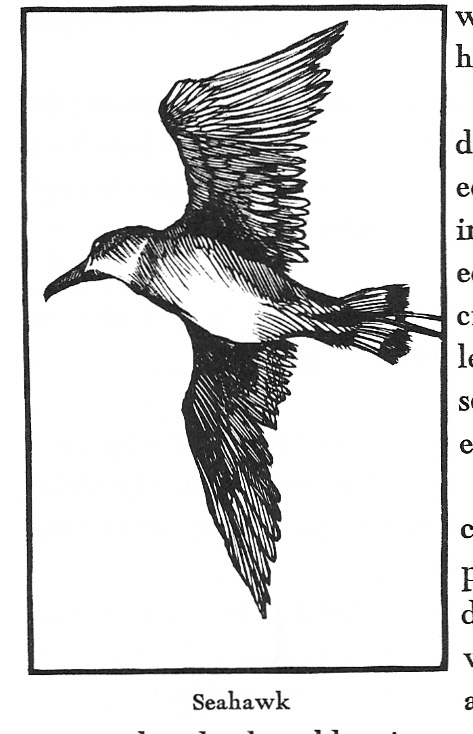
In which Ahab’s hat is stolen by “one of those red-billed savage sea-hawks which so often fly incommodiously close round the manned mast-heads of whalemen in these latitudes,” and the crew reads it, almost to a man, as an ill omen.

At the chapter’s outset, our Ishmael is in a meta-textual mood, pushing the quest’s doom into the foreground. He tells us that “all other whaling waters [are] swept” — we are in the penultimate triplet chapters:

In this foreshadowing interval too, all humor, forced or natural, vanished. Stubb no more strove to raise a smile; Starbuck no more strove to check one. Alike, joy and sorrow, hope and fear, seemed ground to finest dust, and powdered, for the time, in the clamped mortar of Ahab’s iron soul.

III. Ahab and Fedallah (who has foretold the doom of the ship he crews on) both keep to the deck at all times. Ahab declares that he will take the nailed doubloon, omphalos of both ship and novel — “‘I will have the first sight of the whale myself,’—he said. ‘Aye! Ahab must have the doubloon.'” Fedallah is a silent impenetrable gaze: “his wan but wondrous eyes did plainly say—We two watchmen never rest.”

IV. Ahab, as I’ve contended so many times, is monocular reader. Our one-legged monomaniacal despot of a captain can only watch and read for his dread mission. Unlike diverse, large-hearted Ishmael, there is no diversity in Ahab’s gaze/reading. He reads for one purpose, and all signs are symbols portending the fulfillment of that purpose.

As the sea-hawk approaches, Ahab’s gaze is upon the sea, not heavenward. We learn that the sea-hawk,

darted a thousand feet straight up into the air; then spiralized downwards, and went eddying again round his head.

But with his gaze fixed upon the dim and distant horizon, Ahab seemed not to mark this wild bird; nor, indeed, would any one else have marked it much, it being no uncommon circumstance; only now almost the least heedful eye seemed to see some sort of cunning meaning in almost every sight.

The crew of The Pequod reads the event as the foreshadow of disaster, whether the spectacle is simply a dark omen—the leader’s crown revoked from upon high—or simply the physical reality of their captain losing his hat because his attention was focused in only one direction.

V. Ch. 131, “The Pequod Meets the Delight.”

In which The Pequod encounters its last meeting with another ship—and another Nantucket ship—a “most miserably misnamed” The Delight:

Upon the stranger’s shears were beheld the shattered, white ribs, and some few splintered planks, of what had once been a whale-boat; but you now saw through this wreck, as plainly as you see through the peeled, half-unhinged, and bleaching skeleton of a horse.

I mean, c’mon. White ribs, bleaching skeleton of a horse, etc. It’s really the seeing through in the previous paragraph I’m interested in. Our Ishmael attends the world with the perspective of a ghost who sees through the world’s wreck.

VI. Ahab repeats his famous question (for the last time):

“Hast seen the White Whale?”

“Look!” replied the hollow-cheeked captain from his taffrail; and with his trumpet he pointed to the wreck.

“Hast killed him?”

“The harpoon is not yet forged that ever will do that,” answered the other, sadly glancing upon a rounded hammock on the deck, whose gathered sides some noiseless sailors were busy in sewing together.

Ahab shows off the harpoon he forged with Perth but captain and crew of The Delight remain morosely unimpressed. They bury at sea the last of five sailors they lost in battle with Moby Dick—the other four bodies were lost in the fight.

Ahab turns away from the scene.

And yet—

As Ahab now glided from the dejected Delight, the strange life-buoy hanging at the Pequod’s stern came into conspicuous relief.

“Ha! yonder! look yonder, men!” cried a foreboding voice in her wake. “In vain, oh, ye strangers, ye fly our sad burial; ye but turn us your taffrail to show us your coffin!”

Again—it’s an overdetermined affair, this Moby-Dick.

Show us your coffin!

VII. Ch. 132, “The Symphony.”

The whole thing is about to collapse.

In which Starbuck almost convinces Ahab to change course and save the souls of The Pequod.

“The Symphony” is another sad, sad chapter. “It was a clear steel-blue day,” the chapter begins, and then unfolds in short descriptions of pacific beauty. We are reminded of the peaceful air about The Pequod—that the violent rage at the heart of the novel is carried there by men, by their chieftan Ahab. But the dumb world will not attend our own woes:

Oh, immortal infancy, and innocency of the azure! Invisible winged creatures that frolic all round us! Sweet childhood of air and sky! how oblivious were ye of old Ahab’s close-coiled woe!

Again, Ishmael portrays Ahab in a sympathetic cast.

VIII. Ahab monologues at Starbuck, a sympathetic ear. He laments the forty years he’s spent asea:

Oh, Starbuck! it is a mild, mild wind, and a mild looking sky. On such a day—very much such a sweetness as this—I struck my first whale—a boy-harpooneer of eighteen! Forty—forty—forty years ago!—ago! Forty years of continual whaling! forty years of privation, and peril, and storm-time! forty years on the pitiless sea! for forty years has Ahab forsaken the peaceful land, for forty years to make war on the horrors of the deep! Aye and yes, Starbuck, out of those forty years I have not spent three ashore.

Are these Ahab’s last rites? A sad confession before the crack of doom (with those mythic numbers foregrounded, forty and three)? I think so.

(And, as always—

How does Ishmael witness this dialogue?)

IX. But Ahab’s confession does not lead to redemption. Language carries him away, and as always the ineffable nearly overwhelms him—he contests the unnameable:

What is it, what nameless, inscrutable, unearthly thing is it; what cozening, hidden lord and master, and cruel, remorseless emperor commands me; that against all natural lovings and longings, I so keep pushing, and crowding, and jamming myself on all the time; recklessly making me ready to do what in my own proper, natural heart, I durst not so much as dare? Is Ahab, Ahab? Is it I, God, or who, that lifts this arm? But if the great sun move not of himself; but is as an errand-boy in heaven; nor one single star can revolve, but by some invisible power; how then can this one small heart beat; this one small brain think thoughts; unless God does that beating, does that thinking, does that living, and not I.

Ahab the philosopher is a thing of despair:

By heaven, man, we are turned round and round in this world, like yonder windlass, and Fate is the handspike. And all the time, lo! that smiling sky, and this unsounded sea!

Starbuck, “blanched to a corpse’s hue with despair,” steals away. But Fedallah remains at his unvacant post, eyes focused on the water.

A note to readers new to Infinite Jest

A note to readers new to Infinite Jest

David Foster Wallace’s 1996 novel Infinite Jest poses rhetorical, formal, and verbal challenges that will confound many readers new to the text. The abundance of (or excess of) guides and commentaries on the novel can perhaps have the adverse and unintentional consequence of making readers new to Infinite Jest believe that they can’t “get it” without help.  Many of the online analyses and resources for Infinite Jest are created by and targeted to readers who have finished the novel or are rereading the novel. While I’ve read many insightful and enlightening commentaries on the novel over the years, my intuition remains that the superabundance of analysis may have the paradoxical effect of actually impeding readers new to the text. With this in mind, I’d suggest that first-time readers need only a dictionary and some patience.

Infinite Jest is very long but it’s not nearly as difficult as its reputation suggests. There is a compelling plot behind the erudite essaying and sesquipedalian vocabulary. That plot develops around three major strands which the reader must tie together, with both the aid of—and the challenge of—the novel’s discursive style. Those three major plot strands are the tragic saga of the Incandenzas (familial); the redemptive narrative of Ennet House Drug and Alcohol Recovery House, with Don Gately as the primary hero (socicultural); and the the schemes of the Québécois separatists (national/international/political). An addictive and thus deadly film called Infinite Jest links these three plots (through discursive and byzantine subplots).

Wallace often obscures the links between these plot strands, and many of the major plot connections have to be intuited or outright guessed. Furthermore, while there are clear, explicit connections between the plot strands made for the reader, Wallace seems to withhold explicating these connections until after the 200-page mark. Arguably, the real contours of the Big Plot come into (incomplete) focus in a discussion between Hal Incandenza and his brother Orin in pages 242-58. Getting to this scene is perhaps a demand on the patience of many readers. And, while the scene by no means telegraphs what happens in IJ, it nonetheless offers some promise that the set pieces, riffs, scenes, lists, and vignettes shall add up to Something Bigger. 

Some of those earliest set pieces, riffs, scenes, lists, and vignettes function almost as rhetorical obstacles for a first-time reader. The  novel’s opening scene, Hal Incandenza’s interview with the deans at the University of Arizona, is chronologically the last event in the narrative, and it dumps a lot of expository info on the reader. It also poses a number of questions or riddles about the plot to come, questions and riddles that frankly run the risk of the first-time reader’s forgetting through no fault of his own.

The second chapter of IJ is relatively short—just 10 pages—but it seems interminable, and it’s my guess that Wallace wanted to make his reader endure it the same way that the chapter’s protagonist–Erdedy, an ultimately very minor character—must endure the agonizing wait for a marijuana delivery. The chapter delivers the novel’s themes of ambivalence, desire, addiction, shame, entertainment, “fun,” and secrecy, both in its content and form. My guess is that this where a lot of new readers abandon the novel.

The reader who continues must then work through 30 more pages until meeting the novel’s heart, Don Gately, but by the time we’ve met him we might not trust just how much attention we need to pay him, because Wallace has shifted through so many other characters already. And then Gately doesn’t really show up again until like, 200 pages later.

In Infinite Jest, Wallace seems to suspend or delay introducing the reading rules that we’ve been trained to look for in contemporary novels. While I imagine this technique could frustrate first-time readers, I want to reiterate that this suspension or delay or digression is indeed a technique, a rhetorical tool Wallace employs to perform the novel’s themes about addiction and relief, patience and plateaus, gratitude and forgiveness.

Where is a fair place to abandon Infinite Jest

I would urge first-time readers to stick with the novel at least until page 64, where they will be directed to end note 24, the filmography of J.O. Incandenza (I will not even discuss the idea of not reading the end notes. They are essential). Incandenza’s filmography helps to outline the plot’s themes and the themes’ plots—albeit obliquely. And readers who make it to the filmography and find nothing to compel them further into the text should feel okay about abandoning the book at that point.

What about a guide?

There are many, many guides and discussions to IJ online and elsewhere, as I noted above. Do you really need them? I don’t know—but my intuition is that you’d probably do fine without them. Maybe reread Hamlet’s monologue from the beginning of Act V, but don’t dwell too much on the relationship between entertainment and death. All you really need is a good dictionary. (And, by the way, IJ is an ideal read for an electronic device—the end notes are hyperlinked, and you can easily look up words as you read).

Still: Two online resources that might be useful are “Several More and Less Helpful Things for the Person Reading Infinite Jest,” which offers a glossary and a few other unobtrusive documents, and Infinite Jest: A Scene-by-Scene Guide,” which is not a guide at all, but rather a brief series of synopses of each scene in the novel, organized by page number and year; my sense is that this guide would be helpful to readers attempting to delineate the novel’s nonlinear chronology—however, I’d advise against peeking ahead. After you read you may wish to search for a plot diagram of the novel, of which there are several. But I’d wait until after.

An incomplete list of motifs readers new to Infinite Jest may wish to attend to

The big advantage (and pleasure) of rereading Infinite Jest is that the rereader may come to understand the plot anew; IJ is richer and denser the second go around, its themes showing brighter as its formal construction clarifies. The rereader is free to attend to the imagery and motifs of the novel more intensely than a first-time reader, who must suss out a byzantine plot propelled by a plethora of characters.

Therefore, readers new to IJ may find it helpful to attend from the outset to some of the novel’s repeated images, words, and phrases. Tracking motifs will help to clarify not only the novel’s themes and “messages,” but also its plot. I’ve listed just a few of these motifs below, leaving out the obvious ones like entertainment, drugs, tennis (and, more generally, sports and games), and death. The list is in no way definitive or analytic, nor do I present it as an expert; rather, it’s my hope that this short list might help a reader or two get more out of a first reading.

Heads

Cages

Faces

Masks

Teeth

Cycles

Maps

Waste

Infants

Pain

Deformities

Subjects

Objects

One final note

Infinite Jest is a rhetorical/aesthetic experience, not a plot.

[Ed. note: Biblioklept first posted a version of this note in the summer of 2015. Infinite Jest remains underread by overtalkers].

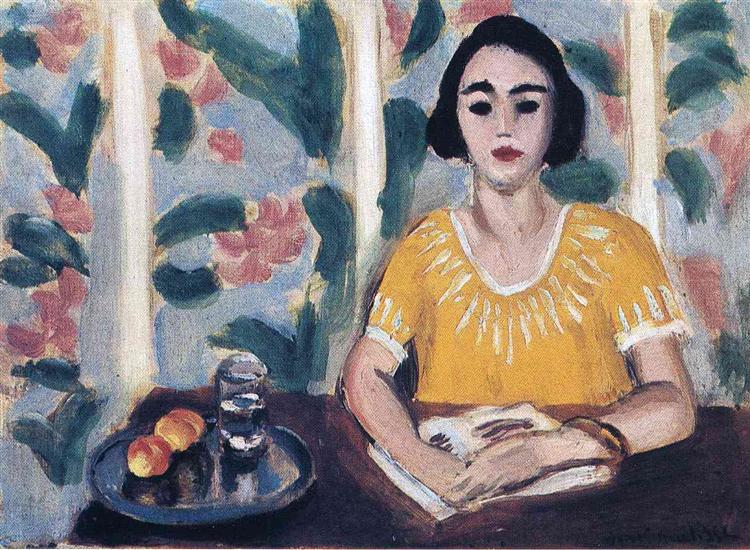
Woman Reading with Peaches — Henri Matisse

woman-reading-with-peaches-1923.jpglarge

Woman Reading with Peaches, 1923 by– Henri Matisse (1869–1954)

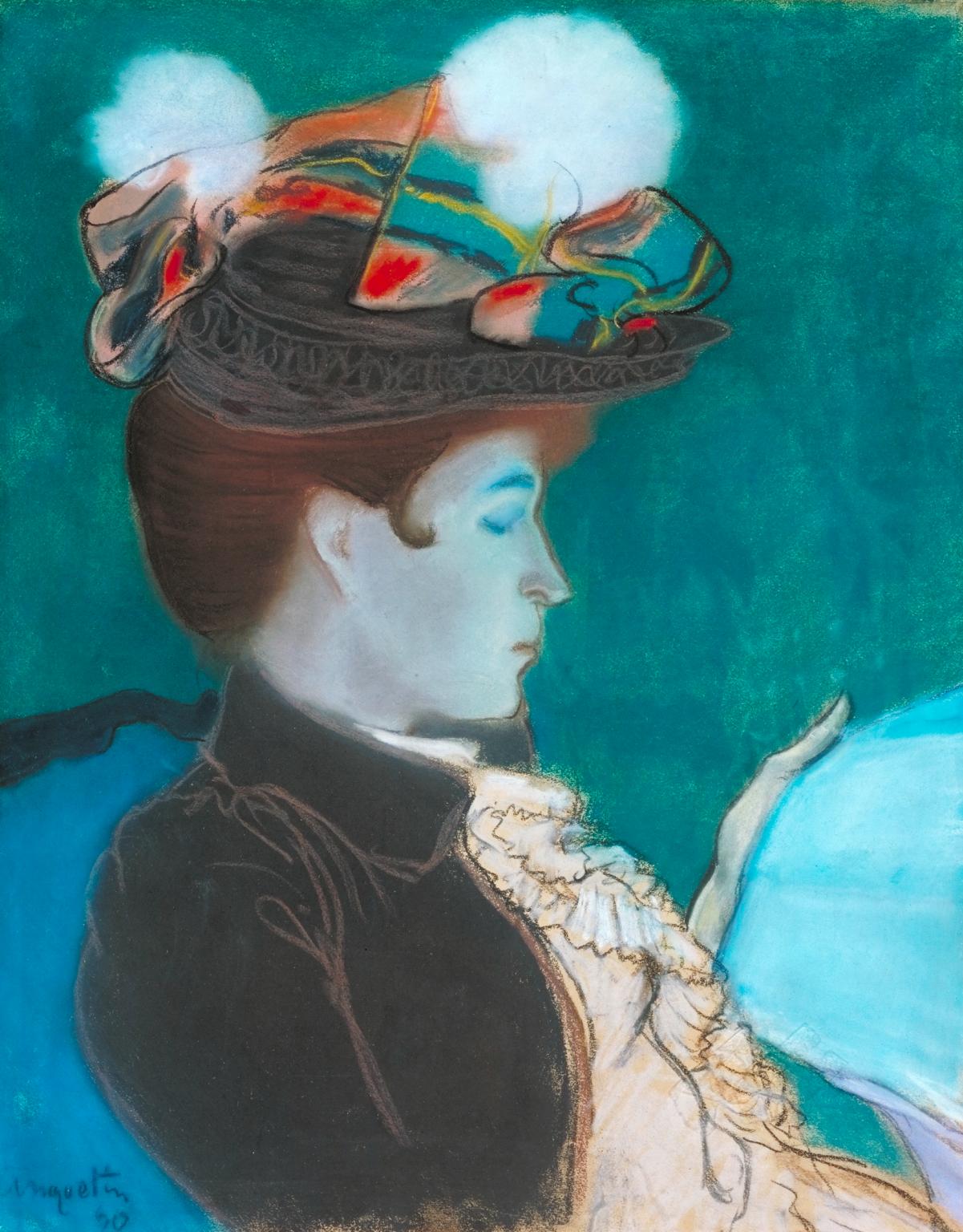
Girl Reading a Newspaper — Louis Anquetin

Girl Reading a Newspaper 1890 by Louis Anquetin 1861-1932

Girl Reading a Newspaper, 1890 by Louis Anquetin (1861–1932)

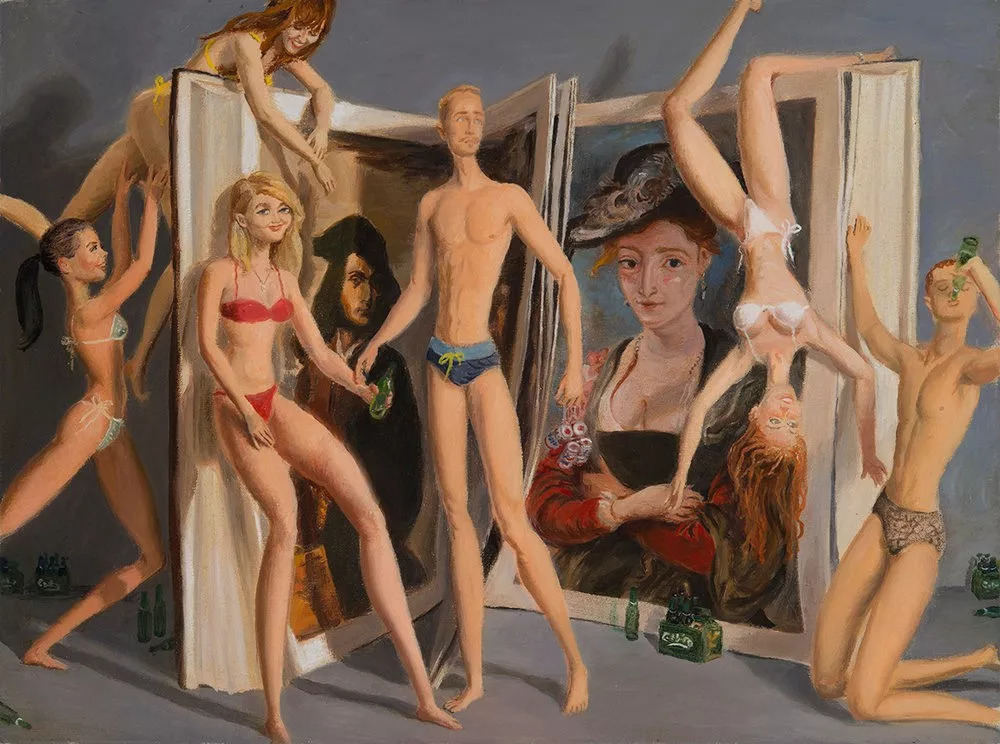
Book Party — Jansson Stegner

903f24c59e384c0ba0376ba728674765

Book Party, 2016 by Jansson Stegner (b. 1972)

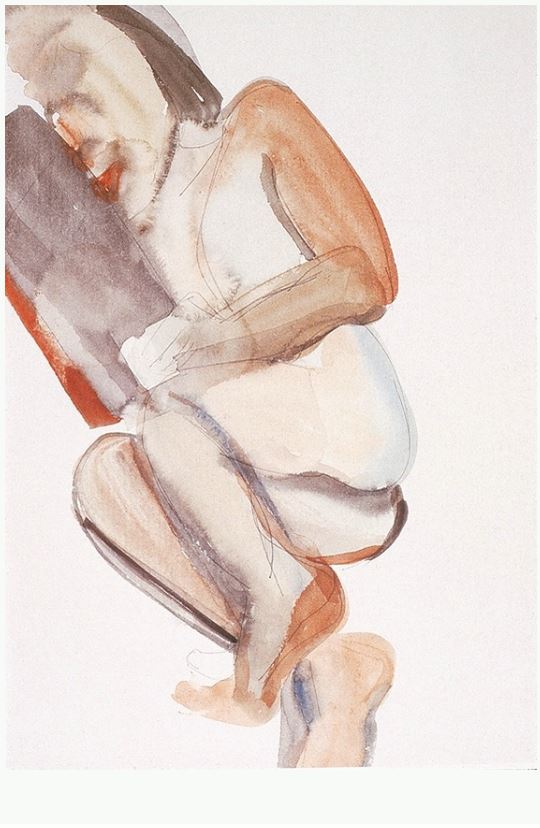
Boy Reading — Fairfield Porter

fp.PNG

Boy Reading, 1955 by Fairfield Porter (1907-1975)

Reading — Robert Kushner

Screenshot 2018-07-31 at 5.37.53 PM

Reading, 1987 by Robert Kushner (b. 1949)

Annie Reading — Lucian Freud

lucian freud

Annie Reading, 1961 by Lucian Freud (1922-2011)

Tintin Reading — Roy Lichtenstein

rltt

Tintin Reading, 1993 by Roy Lichtenstien (1923-1997)

Reading — James McNeill Whistler

reading

Reading, 1879 by James McNeill Whistler (1834-1903)

Reader with a Lamp — Jozsef Rippl-Ronai

jc3b3zsef_ripp-rc3b3nai_la_liseuse_avec_lampe

Reader with a Lamp, 1895 by Jozsef Rippl-Ronai (1861-1927)

Nude Reading — Robert Delaunay

859px-robert_delaunay_-_nude_woman_reading_-_google_art_project

Nude Reading, 1915 by Robert Delaunay (1885-1941)