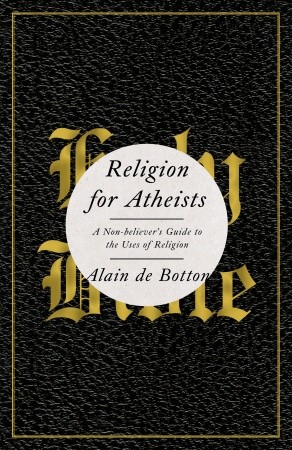
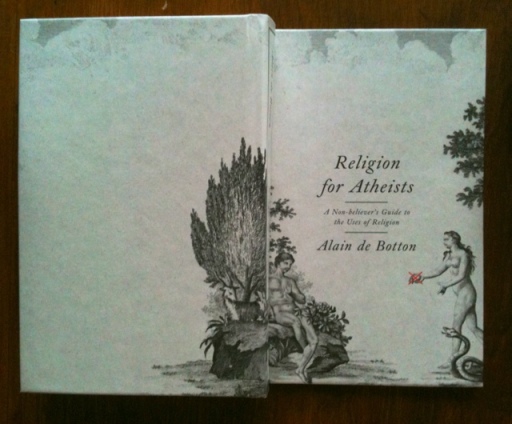
I’m slightly familiar with Alain de Botton’s work, and I’ve taken something of an interest in the so-called “New Atheist” movement — Hitchens, Dawkins, et al — so when a review copy of Religion for Atheistsshowed up a few weeks ago, it piqued my interest. I found its cover playfully annoying—a hole in the holy book—and its subtitle—A Non-believer’s Guide to the Uses of Religion—downright obnoxious. Still, I gotta give props to the design team at Pantheon for the book that’s under the horrid jacket:
Unfortunately, an attractive hardback design sans jacket is the best this book has to offer.
By way of explication (and my own laziness and indifference on this volume) here’s some copy on the book from de Botton’s website:
What if religions are neither all true or all nonsense? The boring debate between fundamentalist believers and non-believers is finally moved on by Alain’s inspiring new book, which boldly argues that the supernatural claims of religion are of course entirely false – and yet that religions still have some very important things to teach the secular world.
Religion for Atheists suggests that rather than mocking religions, agnostics and atheists should instead steal from them – because they’re packed with good ideas on how we might live and arrange our societies. Blending deep respect with total impiety, Alain (a non-believer himself) proposes that we should look to religions for insights into, among other concerns, how to:
– build a sense of community
– make our relationships last
– overcome feelings of envy and inadequacy
– escape the twenty-four hour media
– go travelling
– get more out of art, architecture and music
– and create new businesses designed to address our emotional needs.
For too long non-believers have faced a stark choice between either swallowing lots of peculiar doctrines or doing away with a range of consoling and beautiful rituals and ideas. At last, in Religion for Atheists, Alain has fashioned a far more interesting and truly helpful alternative.
The tone of the copy gives one a sense of the utter glibness of de Botton’s pamphlet. The book smacks of crude self-helpery, a hodgepodge of faux-intellectual poses for those who can smugly dismiss the history of philosophy. It’s like The Purpose Driven Life for atheists. There is a picture or graphic on every other page; de Botton seems to include these in lieu of, say, providing verbal imagery, or meaningful context, or simply trusting the intellect of his audience.
I suppose that I am fundamentally at odds with de Botton. I agree that religion has done much to initiate and facilitate (and in fairness, perhaps at times mitigate) atrocity; I agree that many (if not most) of the Big Problems in the world stem from the herd-mentality that organized religions impose on the people they indoctrinate. But de Botton would like to replace one herd with another.
Here is the Swiss writer suggesting that the academy (which he too-readily identifies as a bastion of atheist mores) follow the practices of black Southern Baptist churches:
The contrast with the typical lecture in the humanities could hardly be more damning. And unnecessary. What purpose can possibly be served by the academy’s primness? How much more expansive the scope of meaning in Montaigne’s essays would seem if a 100-strong and transported chorus were to voice its approval after every sentence. How much longer might Rousseau’s philosophical truths linger in our consciousness if they were structured around rhythmical verses of call-and-response. Secular education will never succeed in reaching its potential until humanities lecturers are sent to be trained by African-American Pentecostal preachers.
What we see here is a romanticization and idealization of a particular part of a culture that I think de Botton in no way understands. What’s even more disturbing here is his elevation of groupthink and indoctrination practices (I hear, “Oh no, I don’t want to play with Delta children” humming in the background). We see here the same teleological thinking that marks much of religious dogma, the sense that truth has been attained; the search is over—we just need to repeat it rhythmically enough, soak our young in it, until they think just like we do. This position strikes me as potentially dangerous as any organized religion’s attempts at indoctrination.
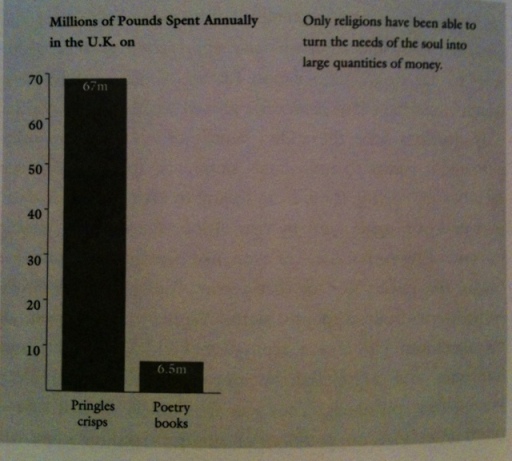
Religion for Atheists is full of sloppy logic gussied up in rushed anecdotes and glossed over with barely-connected pictures and silly graphs. Look at the following example, a visual non sequitur masquerading as meaningful information:
Are we supposed to be horrified that the British spend more on potato chips than poetry books? Apples and oranges, bro. But what’s really ridiculous is the stinky pious claim that “Only religions have been able to turn the needs of the soul into large quantities of money.” This claim is plain silly, or at least predicated on a too-singular definition for “needs of the soul.”
Religion for Atheists seems to miss the point that many (if not most) atheists and agnostics are at heart free thinkers. De Botton romanticizes the mystery, awe, and grace of religion, even as he suggests that there is no metaphysical center from which these attributes emanate. His most basic argument really boils down to something like, “Hey, there is no God, no spirit, but religion does a good job of consoling people and keeping them in moral order, so, instead of TV and junk food, we should use the aesthetics of religion as consolation.” There is nothing revolutionary about this idea.
Religion for Atheists is a smug little tract, the sort of book that a supermarket would sell along with Chicken Soup for the Soul if supermarkets had the guts to sell self-help books for atheists. Readers should not be duped into thinking that de Botton has taken any real stance or said anything new here. Instead, hiding behind the pasteboard mask of utility, he offers a crass dodge away from meaningful inquiry. Get thee to Nietzsche instead.
I don’t know the meaning of life. I don’t know why we are here. I think life is full of anxieties and fears and tears. It has a lot of grief in it, and it can be very grim. And I do not want to be the one who tries to tell somebody else what life is all about. To me it’s a complete mystery.”
All citations are from Charles M. Schulz: Conversations, which I now want to read.
From Freud’s The Future of an Illusion, which should be required reading for any thinking person—
We know that a human child cannot successfully complete its development to the civilized stage without passing through a phase of neurosis sometimes of greater and sometimes of less distinctness. This is because so many instinctual demands which will later be unserviceable cannot be suppressed by the rational operation of the child‘s intellect but have to be tamed by acts of repression, behind which, as a rule, lies the motive of anxiety. Most of these infantile neuroses are overcome spontaneously in the cause of growing up, and this is especially true of the obsessional neuroses of childhood. The remainder can be cleared up later still by psycho-analytic treatment. In just the same way, one might assume, humanity as a whole, in its development through the ages, fell into states analogous to the neuroses,‘ and for the same reasons – namely because in the times of its ignorance and intellectual weakness the instinctual renunciations indispensable for man‘s communal existence had only been achieved by it by means of purely affective forces. The precipitates of these processes resembling repression which took place in prehistoric times still remained attached to civilization for long periods. Religion would thus be the universal obsessional neurosis of humanity; like the obsessional neurosis of children, it arose out of the Oedipus complex, out of the relation to the father. If this view is right, it is to be supposed that a turning-away from religion is bound to occur with the fatal inevitability of a process of growth, and that we find ourselves at this very juncture in the middle of that phase of development.
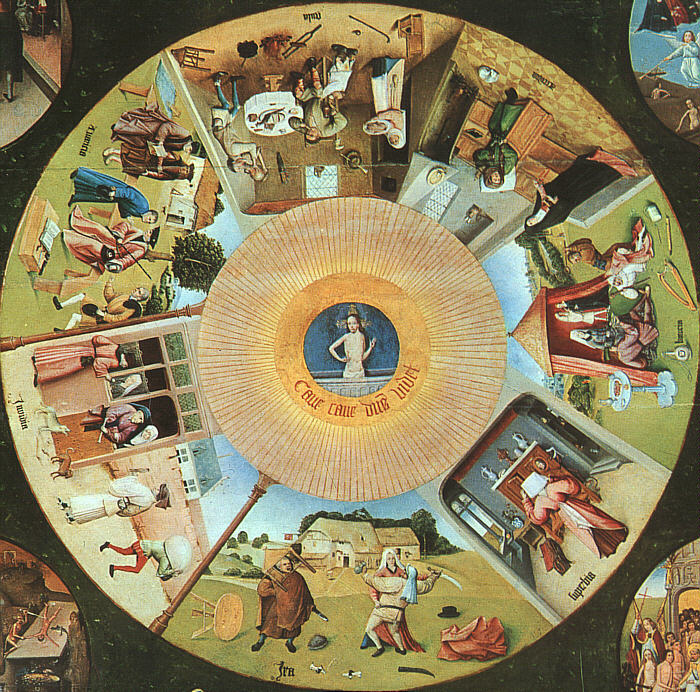
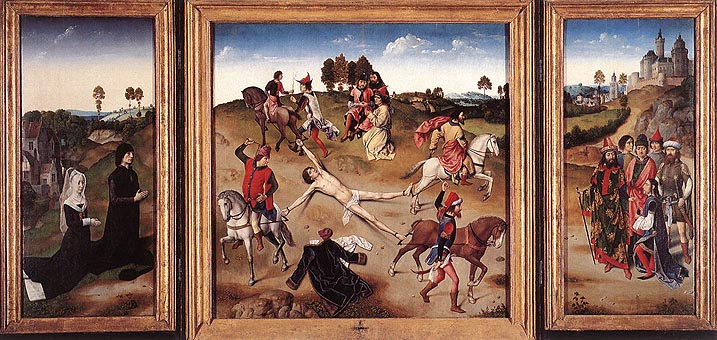
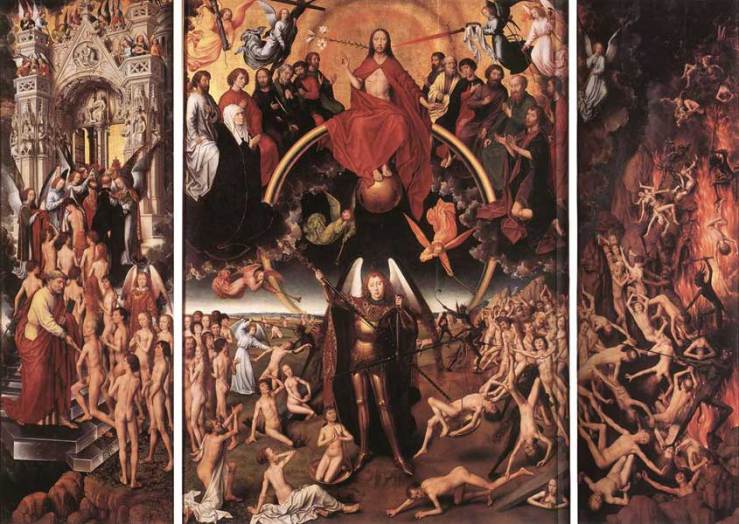
In William Gaddis‘s massive first novel, The Recognitions, Wyatt Gwyon forges paintings by master artists like Hieronymous Bosch, Hugo van der Goes, and Hans Memling. To be more accurate, Wyatt creates new paintings that perfectly replicate not just the style of the old masters, but also the spirit. After aging the pictures, he forges the artist’s signature, and at that point, the painting is no longer an original by Wyatt, but a “new” old original by a long-dead genius. The paintings of the particular artists that Wyatt counterfeits are instructive in understanding, or at least in hoping to understand how The Recognitions works. The paintings of Bosch, Memling, or Dierick Bouts function as highly-allusive tableaux, semiotic constructions that wed religion and mythology to art, genius, and a certain spectacular horror, and, as such, resist any hope of a complete and thorough analysis. Can you imagine, for example, trying to catalog and explain all of the discrete images in Bosch’s triptych, The Garden of Earthly Delights? And then, after creating such a catalog, explaining the intricate relationships between the different parts? You couldn’t, and Gaddis’s novel is the same way. I’ve finished the first of the novel’s three parts, 277 of 956 pages, and I’m going to go out on a limb and guess that the Gaddis has structured the novel as a triptych. The first part, like Bosch’s painting, The Seven Deadly Sins, is comprised of seven sections.
The Seven Deadly Sins – Hieronymous Bosch
Early in The Recognitions, teenage Wyatt copies The Seven Deadly Sins–his father owns the original, a painted table top he purchased in Europe. Wyatt replaces the original with his own and gets away with this strange crime–no small feat considering the genius of his father, the Rev. Gwyon, a New England priest who, after the death of his wife at sea, comes to reject the austere puritanism of his order and embrace (much to the consternation of his dwindling congregation) a pluralistic religious world view. In one of many stunning passages centering on Gwyon and religion, the congregation is “stirred with indignant discomfort after listening to the familiar story of virgin birth on December twenty-fifth, mutilation and resurrection, to find they had been attending, not Christ, but Bacchus, Osiris, Krishna, Buddha, Adonis, Marduk, Balder, Attis, Amphion, or Quetzalcoatl.” This series of substitutions enacts a chain of recognitions, and, in a sense, compartmentalizes much of the thematic material of the novel: What is it to be a hero, a redeemer, a savior? What is originality, and how does one recognize it? Who originates whom? What does it mean to create? How is art separate from religion? Clearly, these are not simple questions, and The Recognitions is not a simple book.
Triptych with the Martyrdom of St. Hippolytus — Dierck Bouts and Hugo van der Goes
In order to pose (and perhaps offer varying answers to) these questions, Gaddis employs daring, richly detailed prose, larded with esoteric (and not so esoteric) references to mythology, religion, art, music, and literature. Like the discrete sections of Bosch’s Sins, each of the chapters of the first section of The Recognitions has its own distinct idiom, comportment, and rhythm; yet, even as Gaddis’s approaches seem discontinuous from chapter to chapter, these coalesce to a larger picture.
The first chapter is the best first chapter of any book I can remember reading in recent years. It tells the story of Rev. Gwyon looking for solace in the Catholic monasteries of Spain after his wife’s death at sea under the clumsy hands of a fugitive counterfeiter posing as a doctor (already, the book posits the inherent dangers of forgery, even as it complicates those dangers by asking who isn’t in some sense a phony). There’s a beautiful line Gaddis treads in the first chapter between pain, despair, and melancholy and caustic humor, as Gwyon slowly realizes the false limits of his religion. The chapter continues to tell the story of young Wyatt, growing up under the stern care of his puritanical Aunt May, whose religious attitude is confounded by the increasingly erratic behavior of Wyatt’s often-absent father. While deathly ill, Wyatt teaches himself to paint by copying masterworks. He also attempts an original, a painting of his dead mother, but he cannot bear to finish it because, as he tells his father, “There’s something about . . . an unfinished piece of work . . . Where perfection is still possible. Because it’s there, it’s there all the time, all the time you work trying to uncover it.” This problem of originality, of Platonic perfection guides much of the novel’s critique on Modernism.
The Last Judgment – Hans Memling
Wyatt studies but ultimately rejects the ministry, opting instead to become an artist. The second chapter finds him in Paris, attempting to sell his original work. The chapter is a bravura shift into the sounds, sights, and consciousness of another world, another distinct mythology–ex-patriot Paris, Hemingway’s Paris, Woolf’s Paris. Gaddis shows a heavy debt to James Joyce‘s innovations in Ulysses here (and throughout the book, of course), although it would be a mistake to reduce the novel to a mere aping of that great work. Rather, The Recognitions seems to continue that High Modernist project, and, arguably, connect it to the (post)modern work of Pynchon, DeLillo, and David Foster Wallace. (In it’s heavy erudition, numerous allusions, and complex voices, the novel readily recalls both W.G. Sebald and Roberto Bolaño as far as I’m concerned). By the third chapter we find Wyatt married, quite unhappily, producing hack work, copies he lets his boss put his name on. The chapter is painful and often ugly, as we see his marriage disintegrate. In this chapter he meets Recktall Brown, the Mephistophelean business man who will arrange Wyatt’s future career as a counterfeiter of original paintings. As the chapter ends, Wyatt is no longer referred to by his name, a device that continues throughout the rest of part one (and perhaps the whole book). It’s as if he’s lost something intrinsic, some core originality in exchange for the ability to “become” the artist he is emulating. Wyatt now disintegrates into the background of the narrative, and is exchanged for a young Harvard grad named Otto. Otto follows Wyatt around like a puppy, writing down whatever he says, absorbing whatever he can from him, and eventually sleeping with his wife. Otto is the worst kind of poseur; he travels to Central America to finish his play only to lend the mediocre (at best) work some authenticity, or at least buzz. He fakes an injury and cultivates a wild appearance he hopes will give him artistic mystique among the Bohemian Greenwich Villagers he hopes to impress. In the fifth chapter, at an art-party, Otto, and the reader, learn quickly that no one cares about his play–everyone’s busy making their own original art. Gaddis’s evocation of a Village party in the late forties/early fifties here is wonderful, fly-on-the-wall stuff. His rhetoric captures the buzzing musicality of a raucous house party, and even if his mockery of the assembled artists, critics, and wannabes is savage, it’s also loving. Gaddis has an astute ear for the mid-twentieth century, where gossip infiltrates debate on aesthetics, and commercials punctuate classical scores on the radio.
Wyatt (unnamed) returns for the seventh (and longest) chapter of part one. He’s been very successful at his work, although he seems not to care at all for the money he’s making. Instead, he seems obsessed with channeling these ancient masters, for only in this pre-modern world is originality possible. Of course, the levels of irony are confounding here: Wyatt’s only access to originality is to pretend to be another person. The originality of the paintings he creates is subject to the condition that they be not original to him (their creator) but to another. While this attack on Modernity–namely, that originality is impossible–is severe, it’s also worth noting that Gaddis’s writing enacts originality, even as it cobbles together disparate sources. This is what makes the novel such an addictive pleasure to read. While I cannot make any final claims about a novel before finishing it, I will go out on another limb and suggest that those who already own this novel and have not yet made a crack at it for fear of its massive size and allusive structure should go ahead and take it up: it’s dark, erudite, sad, and very, very funny. It’s also not that hard to read, and if the allusions get too dense, there’s always Steven Moore‘s fantastic resource, A Reader’s Guide to William Gaddis’s The Recognitions, now available in its entirety online. Have at it. More when I finish Part II.
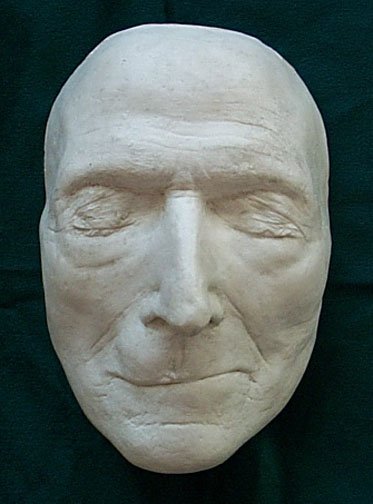
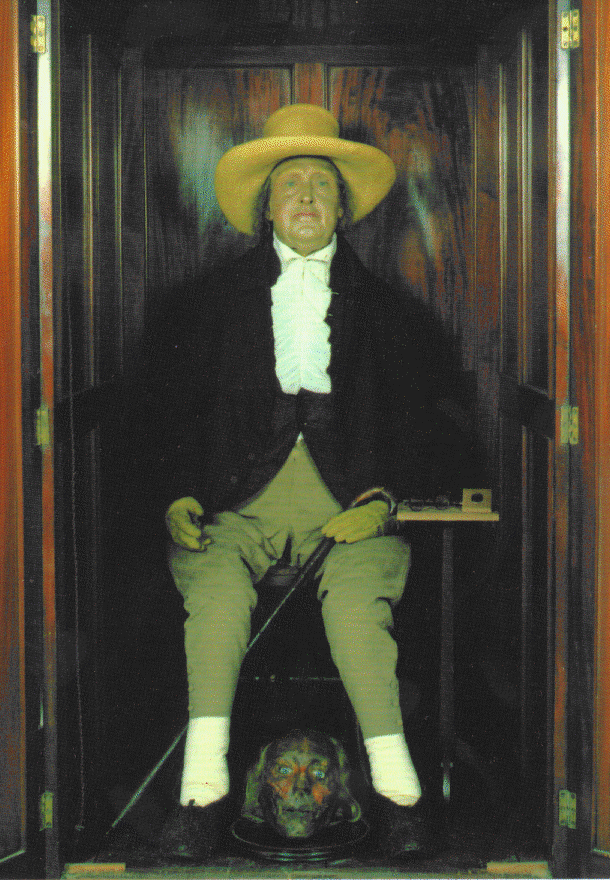
In a text called Auto-Icon: or, Farther uses of the dead to the living, Bentham gave careful instructions for the treatment of his corpse and its presentation after his demise. If an icon is an object of devotion employed in religious ritual, then Bentham’s “Auto-Icon” was conceived in the spirit of irreligious jocularity. The “Auto-Icon” is a godless human being preserved in their own image for the small benefit of posterity. [. . .] As such, Bentham’s body is a posthumous protest against the religious taboos surrounding the dead [. . .] Bentham’s body was dissected and his skeleton picked clean and stuffed with straw. [. . .] Sadly, the mummification process went badly wrong and a wax head was used as a replacement. The original, rotting and blackened head used to be kept on the floor of the wooden box between Bentham’s feet . However, the head became a frequent target for student pranks, being used on one occasion for football practice in the front quadrangle.



 Lots of
 Biblioklept