Distant Star — Roberto Bolaño

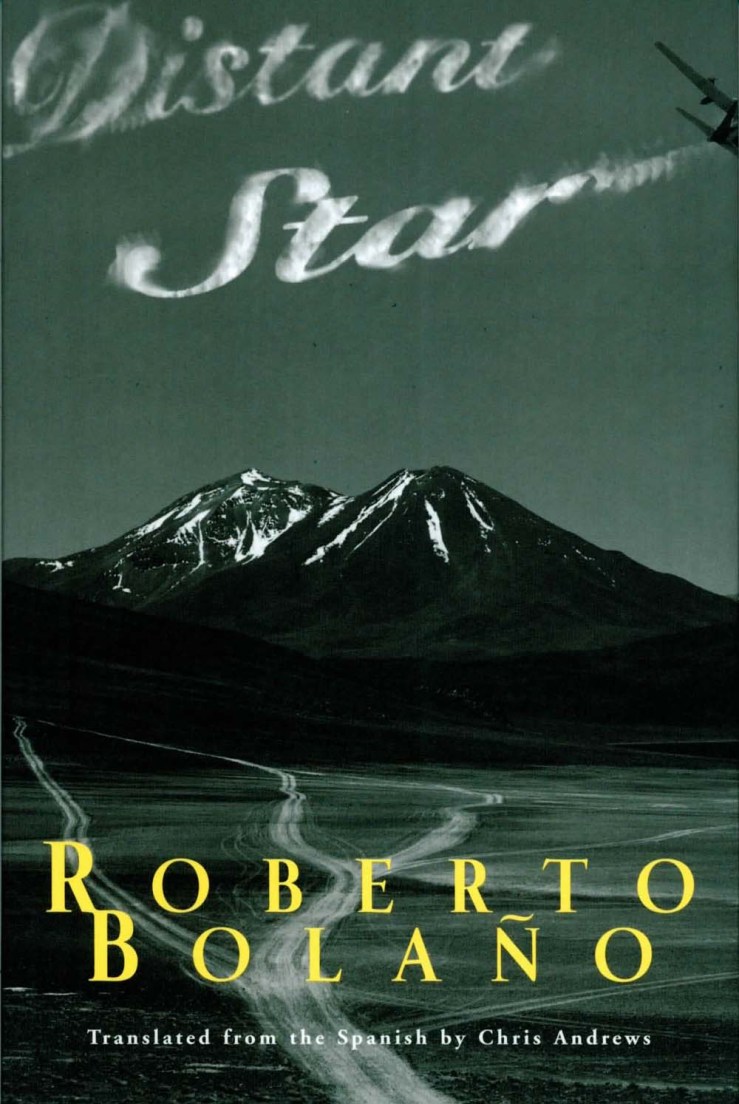
Roberto Bolaño’s slim novel Distant Star begins a few months prior to Pinochet’s bloody 1973 coup and continues into the mid-nineties, crossing through several countries in the process. The unnamed narrator (presumably the “Arturo B.” mentioned in a brief preface, surely Arturo Belano, Bolaño’s alter-ego) is so busy with the future of Chilean poetry that the violence of the coup–in which scores of students are arrested, killed, or disappeared–takes him by total surprise. He’s obsessed with a quiet and intense poet close to his age named Alberto Ruiz-Tagle, who seems to be, according to all sources prior to the coup, a harbinger of a new age in Chilean writing. Ruiz-Tagle, it turns out, is actually an Air Force officer named Carlos Wieder, who writes his death-obsessed poetry in a WWII Messerschmitt airplane. Wieder’s sky-written poems cause a sensation (however illegible some are), but not one nearly as great as his magnum opus–a multimedia installation cataloging and detailing Wieder’s sadistic, ritualistic murders of students and other dissidents. His art is beyond the pale of even the new military regime, and he’s forced out of the Air Force to live a life under pseudonyms in other countries, much like the other Chilean exiles who populate this book. Bolaño’s narrator, a savage detective, takes great pains to reconstruct the lives of these escaped artists, but as time passes the truth becomes ever-murkier. He writes at one point that “the melancholy folklore of exile” is “made up of stories that, as often as not, are fabrications or pale copies of what really happened.” The narrator’s detective work, aided by old friends, attempts to reconstruct the whereabouts (or fates) of Chile’s exiles, but more often than not the trails lead to a perplexing pastiche of possibilities–not dead ends, but inconclusive answers. The story builds to a tense, sinister, and perhaps incomplete (yet satisfying) climax as a “real” detective–a former cop turned PI–enlists the narrator to track down a man who may or may not be Wieder. And I won’t spoil what happens after that.

I read most of Distant Star over the course of one afternoon, and then re-read most of it again earlier this week. It seems to me that the book is something of a trial-run for Bolaño’s opus, 2666, and when I say that, I don’t mean to diminish Distant Star at all, only to note that, more so than The Savage Detectives or By Night in Chile, this book is markedly horrific and at times profoundly violent. It is, of course, something of a companion piece for By Night in Chile (both, by the way, translated by Chris Andrews). That book is a confession from a critic-priest who had flourished under the right-wing regime; Distant Star gives us the other side of the story. Distant Star is also an investigation (by way of digression, to be sure) into the relationship between power and art and evil, and there’s a coldness at its core that almost hurts. It is both painful and beautiful. This is not the best starting place for Bolaño. I’ll continue to contend that 2666 is a fine and dandy place to jump in, or Last Evenings on Earth, if 900 pages is too much for you, but if you read those and dig them, you’ll want to read Distant Star, and its evil twin By Night in Chile. In some sense, all of Bolaño’s work (at least what I’ve read so far) composes a grand and (in)complete and sweeping collective body, like Faulkner, who provides Distant Star its epigraph: “What star falls unseen?” Highly recommended.

Literature Is Not Made From Words Alone

Roberto Bolaño, in a 2002 interview, tells us that

. . . literature is not made from words alone. Borges says that there are untranslatable writers. I think he uses Quevedo as an example. We could add García Lorca and others. Notwithstanding that, a work like Don Quijote can resist even the worst translator. As a matter of fact, it can resist mutilation, the loss of numerous pages and even a shit storm. Thus, with everything against it–bad translation, incomplete and ruined–any version of Quijote would still have very much to say to a Chinese or an African reader. And that is literature.

The interview, conducted by Carmen Boullosa, was originally published in Bomb. It’s now collected along with three other interviews, all meticulously annotated (there’s also a fabulous introductory essay by Marcela Valdes) in a collection called Roberto Bolaño: The Last Interview, new from Melville House. While you’re browsing Melville House, I highly, highly recommend Tom McCartan’s column “What Bolaño Read,which will be ongoing through next week. Great stuff. Biblioklept will run a proper review of The Last Interview later this week (no big surprise for regular ‘klept readers: I love it. Get it. Read it. Give it to the Bolaño fanatic in your life), but in the meantime, back to the quote.

I’ve written so much about Bolaño over the past year yet I’ve never really reflected on his English translators, Chris Andrews (the shorter works) and Natasha Wimmer (the long books), probably because I wouldn’t know how to begin. Reading interviews with Andrews and Wimmer (links above) is enlightening. Andrews attests that he tries to avoid “a translation that is unduly distracting,” and remarks on Bolaño’s epic syntax. Wimmer says she simply tried “to follow Bolaño’s lead,” but admits to her reviewer that she might have missed some puns (“Missing things like that is the translator’s great dread, but it’s probably inevitable occasionally, especially with Bolaño”). In both of the interviews, Bolaño’s translators come off as critical readers whose love of their source material is clearly at the forefront of their project. I have to believe–and have to is the operative term here–that their translations are faithful to Bolaño’s text (and spirit), that they are not, to use the man’s term, a “shit storm” on his oeuvre. But, given Bolaño’s own definition of “literature,” I’d also aver that his masterpiece 2666 could weather any shit storm (hell, the thing was, I suppose, technically incomplete at his death). In any case, I find Bolaño point reassuring, not just in light of his own work, but also within the context of a greater canon of world literature. His suggestion that real literature speaks beyond “words alone,” that storytelling is more than mere verbal tricks and schemes, should be an affirmation to anyone who’s ever been unsure that he’s properly “got” Kafka or Haruki Murakami or Dostoevsky or whomever. And I like that idea quite a bit.

Seven Horror Novels Masquerading In Other Genres

We often identify genre simply by its conventions and tropes, and, when October rolls round and we want scary stories, we look for vampires and haunted houses and psycho killers and such. And while there’s plenty of great stuff that adheres to the standard conventions of horror (Lovecraft and Poe come immediately to mind) let’s not overlook novels that offer horror just as keen as any genre exercise. We offer seven horror novels masquerading in other genres:

cormac5.jpg_jpeg_300x1000_q85

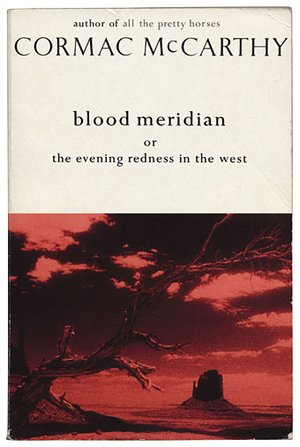
Blood Meridian — Cormac McCarthy

In our review (link above) we called Blood Meridian “a blood-soaked, bloodthirsty bastard of a book.” The story of the Glanton gang’s insane rampage across Mexico and the American Southwest in the 1850s is pure horror. Rape, scalping, dead mules, etc. And Judge Holden. . . [shivers].

Rushing to Paradise — J.G. Ballard

On the surface, Ballard’s 1994 novel Rushing to Paradise seems to be a parable about the hubris of ecological extremism that would eliminate humanity from any natural equation. Dr. Barbara and her band of misfit environmentalists try to “save” the island of St. Esprit from France’s nuclear tests. The group eventually begin living in a cult-like society with Dr. Barbara as its psycho-shaman center. As Dr. Barbara’s anti-humanism comes to outweigh any other value, the island devolves into Lord of the Flies insanity. Wait, should Lord of the Flies be on this list? 

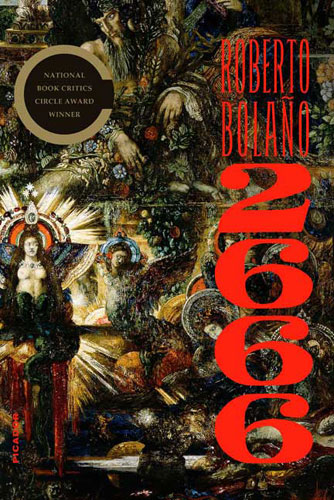
2666 — Roberto Bolaño

Okay. We know. This book ends up on every list we write. What can we do?

While there’s humor and pathos and love and redemption in Bolaño’s masterwork, the longest section of the book, “The Part about the Crimes,” is an unrelenting catalog of vile rapes, murders, and mutilations that remain unresolved. The sinister foreboding of 2666‘s narrative heart overlaps into all of its sections (as well as other Bolaño books); part of the tension in the book–and what makes Bolaño such a gifted writer–is the visceral tension we experience when reading even the simplest  incidents. In the world of 2666, a banal episode like checking into a motel or checking the answering machine becomes loaded with Lynchian dread. Great horrific stuff.

King Lear — William Shakespeare

Macbeth gets all the propers as Shakespeare’s great work of terror (and surely it deserves them). But Lear doesn’t need to dip into the stock and store of the supernatural to achieve its horror. Instead, Shakespeare crafts his terror at the familial level. What would you do if your ungrateful kids humiliated you and left you homeless on the heath? Go a little crazy, perhaps? And while Lear’s daughters Goneril and Regan are pure mean evil, few characters in Shakespeare’s oeuvre are as crafty and conniving as Edmund, the bastard son of Glouscester. And, lest we forget to mention, Lear features shit-eating, self-mutilation, a grisly tableaux of corpses, and an eye-gouging accompanied by one of the Bard’s most enduring lines: “Out vile jelly!Peter Brook chooses to elide the gore in his staging of that infamous scene:

The Trial — Franz Kafka

Kafka captured the essential alienation of the modern world so well that we not only awarded him his own adjective, we also tend to forget how scary his stories are in light, perhaps, of their absurd familiarity. For our money, none surpasses his unfinished novel The Trial, the story of hapless Josef K., a bank clerk arrested by unknown agents for an unspecified crime. While much of K.’s attempt to figure out just who is charging him for what is hilarious in its absurdity, its also deeply dark and really creepy. K. attempts to find some measure of agency in his life, but is ultimately thwarted by forces he can’t comprehend–or even see for that matter. Nowhere is this best expressed than in the famous “Before the Law” episode. If you’re too lazy to read it, check out his animation with narration by the incomparable Orson Welles:

Sanctuary — William Faulkner

In our original review of Sanctuary (link above), we noted that “if you’re into elliptical and confusing depictions of violence, drunken debauchery, creepy voyeurism, and post-lynching sodomy, Sanctuary just might be the book for you.” There’s also a corn-cob rape scene. The novel is about the kidnapping and debauching of Southern belle Temple Drake by the creepy gangster Popeye–and her (maybe) loving every minute of it. The book is totally gross. We got off to a slow start with Faulkner. If you take the time to read our full review above (in which we make some unkind claims) please check out our retraction. In retrospect, Sanctuary is a proto-Lynchian creepfest, and one of the few books we’ve read that has conveyed a total (and nihilistic) sense of ickyness.

n14559

Great Apes — Will Self

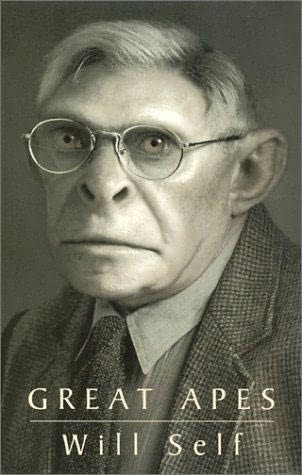
Speaking of ickiness…Self’s 1997 novel Great Apes made me totally sick. Nothing repulses me more than images of chimpanzees dressed as humans and Great Apes is the literary equivalent (just look at that cover). After a night of binging on coke and ecstasy, artist Simon Dykes wakes up to find himself in a world where humans and apes have switched roles. Psychoanalysis ensues. While the novel is in part a lovely satire of emerging 21st-century mores, its humor doesn’t outweigh its nightmare grotesquerie. Great Apes so deeply affected us that we haven’t read any of Self’s work since.

Roberto Bolaño’s 2666 Revisited

2666

Any bibliophile can attest that one of the greatest pleasures of re-reading a favorite book is that it doesn’t change. You change, but it doesn’t, and somehow, you can measure your own change against it. So when Picador’s new single-volume trade paperback edition of Roberto Bolaño’s magnum opus 2666 (out today) showed up at my doorstep a week or two ago, I was thrilled. I already own the book, but having another copy of it, for some reason–no logical reason, of course–seemed really important. It also puts 2666 in good company: I own two (or more) copies of Moby-Dick and Ulysses, and I’ve had to buy at least three copies of David Foster Wallace’s Infinite Jest (damn biblioklepts don’t return books). I bought FS&G’s triple trade paperback edition of the book at the end of last year, and I loved it loved it loved it (review here if you don’t believe me). So how does the new single-volume edition differ, you ask? Well, first off, it’s important to note the gracious similarities–Picador’s edition retains the same pagination, a trend that I hope will always continue with this book (editions of Infinite Jest have managed to keep cohesive to date as well). The new trade paperback is surprisingly supple and portable, with wider margins than the FS&G triple-job. With more room for marginalia in the cohesive package of a single volume, Picador’s edition will likely be the go-to for scholars and book clubs (it’s also about half the retail price of the FS&G editions, but just as attractive).

So, anyway, why should you read 2666 if you haven’t already? I’m going to be lazy and refer again to my original review, but I’ll also be generous and direct you to Macmillan’s resource site for 2666. The site already has plenty of great links to full reviews and interviews with Bolaño, and Picador’s publicists have assured me that they will be updating the site frequently with additional content to aid readers, including artwork and images. Also really cool — the folks at The Morning News, who host Infinite Summer, the Infinite Jest reading project, will launch a similar site for 2666 on January 1st of next year. Even though I’m pointing out all of these resource sites, I think it’s also important to note that 2666 is an incredibly readable book. Which leads back to my current re-reading–and, hopefully, to an argument why you should re-read 2666.

So I bought my original copy in San Francisco last year, on vacation, and began digging into it on the plane ride home. I read most of Part I, “The Part about the Critics” in something of a dazed post-hangover travel stupor. I was familiar with Bolaño’s epic sentences from The Savage Detectives, but I instantly liked this book better. It also seemed to defy all of my expectations–wasn’t this supposed to be an unremitting catalog of horrific murders? Anyway, I got to that part later. Fast forward ten months or so. Again, I’m on a plane, again, coming home, returning from Las Vegas, more dazed, more hungover than before, and I pick up 2666, and again, I dig into Part I. The book is a different book. Lines that made me crack up before seem sinister. I see murder where I’d seen academic squabbling. But there’s also that hope, that possibility, that force of humanity that might be Bolaño’s signature rhetorical move, and I see it too now. Upon a first reading, 2666 might seem impossibly incomplete: a book that could never end, a book that would have to keep going. And it is. It’s a cycle; it returns to itself, a series of calls and responses far richer than can be puzzled out over one, or two, (or three, or four . . . ) readings. But best of all, it’s great, greater than before. What might have seemed a fortunate fluke of a forceful voice reveals itself to be profound and measured control–Bolaño’s themes are layered like a labyrinth, but what a joyful labyrinth to traverse! Re-reading 2666 on the plane was a strange echo, doubled in the myriad echoes that I found on my re-reading. I finished most of Part I (skipping occasionally into sections of Part V, and then Part III, and so on, liberated all of a sudden), and when I got home, despite the paramount exhaustion of a long Las Vegas weekend with a few dozen friends, I collapsed in my bed and into the book, not wanting to put it down, staying up far too late reading. Again. Great stuff. Go get it if you haven’t yet, and if you’ve got it, read it again.

By Night in Chile – Roberto Bolaño

bynightchile

Toward the end of the 130 page monologue that is Roberto Bolaño’s novella By Night in Chile, narrator Father Sebastián Urrutia Lacroix claims that “An individual is no match for history.” His statement neatly encapsulates (what might be) the dominant theme of By Night in Chile, namely an individual person’s capacity and ability to correctly–and sanely–somehow measure, attest to, confront, and witness the horror and brutality of history. In this case, Bolaño’s narrator, a Catholic priest–and conservative literary critic (and, of course, failed poet)–Father Urrutia, via a sweeping deathbed confession of sorts, recounts his life story, leading inexorably to Pinochet’s coup and its attendant subsequent draconian reforms and abuses. While it would be a mistake to reduce Bolaño’s rich novella to one conflict, I think the root of Urrutia’s struggle emanates from his inability to come to terms with his role as an intellectual (let alone an artist, critic, or priest) complicit somehow in Pinochet’s crimes. Throughout the book, from the very beginning, Urrutia blames his inner turmoil on a “wizened youth” (I don’t want to spoil this antagonist’s identity, but puzzling out that paradoxical appellation provides a major clue), a kind of idealist who stands apart from the dying priest, mocking and taunting him. After his claim that “An individual is no match for history,” Urrutia avers that “The wizened youth has always been alone, and I have always been on history’s side.” For Urrutia, this is of paramount importance, not just as a Catholic priest (which, it must be pointed out, is a role he doesn’t seem particularly suited for) but also as a literary critic and intellectual: Urrutia wants to systematize and critique history, to be “on the right side of history,” to quote Barack Obama. And yet his own attempt to narrativize his own life ironizes and critiques this very possibility at every turn–he is a sham, a charlatan, motivated and prompted by fear and even hate.

And on that attempt to narrativize a life: I would call By Night in Chile an anti-bildungsroman. Although Urrutia relates a life story, the free flow of psychic impressions that characterizes his telling slip and sail and rock and crash throughout years and over decades, often flowing backwards and forwards, sometimes spending pages on what could only be considered inconsequential minutiae, while at times glossing over the profoundest events with little more than a word or two. It is often what Urrutia does not remark upon that characterizes what is of the greatest importance in this work, and this is a testament to the power of Bolaño’s writing, to his command of voice. In one of the greatest performances of the novel, Urrutia describes the time right before, during, and after Pinochet’s coup. The passage is less than four pages, and for every contemporary action of immediate consequence, Urrutia seems to provide twice as many examples of his retreat into the past: ” . . . the first anti-Allende march was organized, with people banging pots and pans, and I read Aeschylus and Sophocles and Euripides, all the tragedies, and Alkaios of Mytilene and Aesop and Hesiod and Herodotus . . . .” Urrutia doesn’t bother to scrutinize or analyze the visceral reality of history in the making around him, regressing instead to the comfort of established philosophical tradition–the history of Herodotus in favor of the chaos, anarchy, and brutality happening around him. He’s really quite a terrible priest, and as an intellectual he refuses to be engaged. Confident that he will always be “on history’s side,” he refuses to actively even try come to terms with history until he’s dying. And thus we get the narrative of By Night in Chile.

This reckoning with the past takes the form of a long monologue but, as those familiar with Bolaño will attest, there are plenty of other voices here, stories nested within stories like Russian dolls. The force and vitality of Urrutia’s speech is astonishing; one envisions the monologue as a single immediate and discrete exhalation, a stream of memory, the living wail of a dying man. Bolaño’s rhetorical style here conveys this ironic energy. He employs long (very, very long) sentences, sometimes going on for several pages, and often uses little or no transitions between what should be major shifts of space and time. There are plenty of references to writers, of course, many obscure, and more motifs and leitmotifs than I can work out here (or elsewhere, to be honest). I’m going to go out on a limb and suggest that the book is probably even more intense in the original Spanish, although I think Chris Andrews has done a brilliant job translating here, just as he did in Last Evenings on Earth. And since I’ve brought up that book, I’m going to make another suggestion: if you’ve yet to read Bolaño, you should, and Last Evenings of Earth (or 2666 if nearly a thousand pages doesn’t seem too daunting)is probably the best place to start–which is kind of another way of saying that By Night in Chile is not the best entry point to Bolaño–at least not for anyone intimately familiar with Latin American history. It’s not that By Night is particularly challenging or hard to read. However, I think that this particular book will probably be better enjoyed with more context. As Rodrigo Fresán points out in his essay “The Savage Detective,” (published in the March 2007 issue of The Believer), By Night in Chile could be (should be?) read as part of one cohesive book along with Amulet and Distant Star. (I will read these once I get my grubby little fingers on them). Indeed, as many critics have pointed out, Bolaño’s works seem to coalesce into one great work, a secret universe parallel to Tolkien’s Middle Earth or Proust’s France. Urrutia’s voice enriches this universe, but one must have something of a foothold on Bolaño’s themes in order to appreciate the complex ironies of By Night in Chile. Or maybe not. Maybe this is a great entry point to Bolaño. Either way, great book. Highly recommended.

Javier Moreno on the Geometry of Bolaño’s Fiction

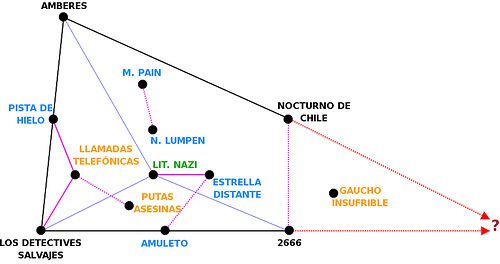
Still working through this Roberto Bolaño jag: I will finish By Night in Chile tonight or tomorrow, and I’ll get to my own thoughts on that then. For now: while looking for an interview in English with Bolaño, I came across this marvelous essay in The Quarterly Conversation–a site Biblioklept links to, oddly enough, yet I missed it (probably because it’s a few years old). In “Roberto Bolaño: A Naïve introduction to the geometry of his fictions,” Javier Moreno doesn’t really analyze or criticize or Bolaño’s oeuvre ; instead, he treats the work like a strange, maddening (and fun, beautiful) game. And if you’ve read Bolaño, you know how appropriate that approach is. Here is Moreno’s attempt to diagram Bolaño’s corpus:

triangle

That question mark represents what Moreno suggests is Bolaño’s “unreachable book,” a tome that (might) exist as the dialogic interplay of all of Bolaño’s works. Moreno concludes (more or less; concludes is really not the right word) that 2666 is that “unreachable book”; he writes:

I believe that even if Bolaño hadn’t died prematurely 2666 would still have been published posthumously. The “real” and impossible 2666 was larger and richer. My guess is that if Bolaño had lived forever 2666 would have been at the very end of the diagram, located in the vertex where the question mark is. Since he died, since he was mortal (too mortal) after all, we have to resign ourselves to the promise of a triangle and only dream of its asymptotic completion.

Consider this fragment of an interview as evidence for Moreno’s claim:

Amambay Guevara: What’s the novel you dream of writing?

Roberto Bolaño: One novel that will be called 2666.

Ricardo Bello: That novel, 2666, would it be a science fiction one? Would it be located in Latin America?

Roberto Bolaño: Partially, it will be science fiction. It will take place in the state of Sonora, north of México, and in Arizona.

I think Moreno’s essay is pretty great–it’s the sort of writing I like, and its tone is spot on for the psychology and rhythm of Bolaño’s writing. Still, I think you’d probably go crazy thinking about what’s at the end of that triangle, of some great work out there, intangible, unfinished, unclaimed, disparate. In the end, Moreno gives up on his diagram, writing:

The system doesn’t stay still. That’s the way it is. Conscious of the impossible task, I resign. I cannot capture it. I cannot shoot the video. The dots are moving as I stare at them, still puzzled, marveled by their strangeness and beauty. The diagram, after all, is just a waste of time.

I like the way his line about moving dots subtly recalls the strange ending of The Savage Detectives. Also, I’m not sure that the diagram is a waste of time. I think that what Moreno might not see (or shit, maybe he does see it, how would I know) in his own diagram is that that question mark might not be some unwritten masterpiece, but rather it might be the reader who enters into the game with Bolaño and his texts. The irony is that that is precisely what Moreno has done. And–sign of a great critic–he’s made me want to read more.

Last Evenings on Earth — Roberto Bolaño

Lasteveningswiki

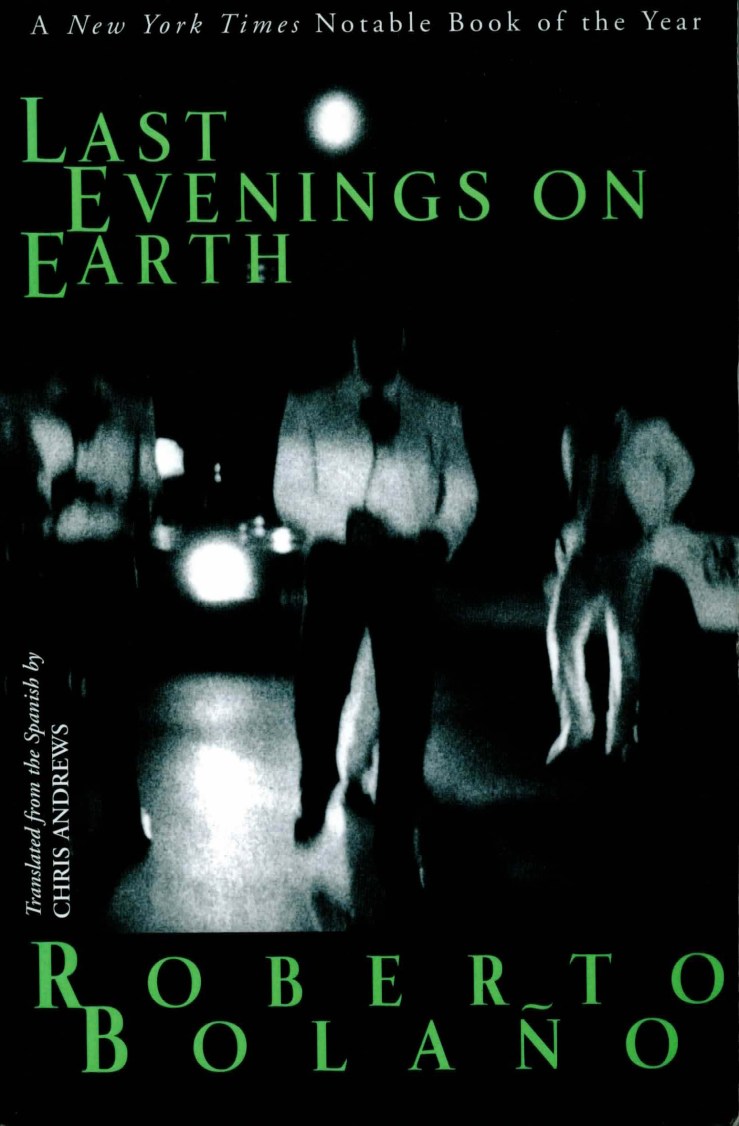
Although the fourteen stories in Roberto Bolaño‘s superb collection Last Evenings on Earth are the result of collating and translating two previously published volumes, Llamadas telefónicas and Putas asesinas–and therefore ostensibly have nothing to do with each other (other than being the work of a singularly gifted author)–I couldn’t help reading them, especially towards the end of the book, as a strange, fragmented novel. Beyond Bolaño’s inimitable style (more on that in a moment), the collection is unified by its protagonists, or protagonist, really, who really must be a stand-in for Bolaño himself. Tenets of New Criticism be damned! It’s impossible not to read Bolaño into these stories, whether his narrators or protagonists are young teens or middle-aged men, petulant sons or struggling writers. Scratch that last one. They’re all struggling writers; in fact, just about everyone in this book is a struggling writer, or an exile, or a vagabond, or on the run, or so enamored and wound up in Big Romantic Ideals that they make plenty of foolish decisions (one of my favorite things about this book is how easily Bolaño posits and then ironizes and the tears apart Big Romantic Ideals at the very same time he makes you feel wistful and nostalgic for those days when you believed in them yourself). Bolaño uses a character named only “B” for most of these stories; elsewhere, (anti-)hero (and obvious Bolaño stand-in) Arturo Belano of The Savage Detectives is revealed to be a narrator. In other stories the young male protagonist is simply not identified by any name, yet all of these characters are so fully realized, so psychologically real, that they must contain at least some part of Bolaño.

And these protatgonists are so very, very real, almost frighteningly so, like “B” in “A Literary Adventure,” whose paranoia over receiving a career jump-starting review from a writer–“A,” of course, who B has actually mocked in his book–poisons any enjoyment B might have had with his new success. B’s slow descent into a mild madness is perfectly drawn, the sort of thing you might see in your own life, the sort of anxiety that many of us feel but cannot communicate or explain because of the silly shame of it all. In “Last Evenings on Earth,” B (the same B? Must be) takes a vacation to Acapulco with his father. Bolaño’s rhetoric in this tale is masterful: he draws each scene with a reportorial, even terse distance, noting the smallest of actions, but leaving the analytical connections up to his reader. Even though B sees his holiday with his dad heading toward “disaster,” toward “the price they must pay for existing,” he cannot process what this disaster is, or what paying this price means. The story builds to a thick, nervous dread, made all the more anxious by the strange suspicion that no, things are actually fine, we’re all just being paranoid here. (Not true!)

That ebb and flow between dread and release, fear and humor, ironic detachment and romantic idealism works throughout each of the stories, even ones not specifically about B (or Belano, or, let’s be honest maybe, Bolaño). “Anne Moore’s Life” is an incredible (yet thoroughly credible) portrait. The story is both journalistic and personal; Anne’s life is at once banal and bizarre–like anyone’s life, perhaps, but not. “Mauricio (“The Eye”) Silva” relates the story of another Chilean exile (did I forget to mention that, in a way, this whole book is about Chilean exiles, that if Last Evenings on Earth is a fragmented novel, then it tells the fragmented story of these artists and activists fleeing from Pinochet’s coup? If I forgot to mention that, I suppose I didn’t want to over-politicize my review, or suggest that one had to have some contextual knowledge of the Chilean diaspora in order to enjoy this book, because I don’t think you have to–but where were we? “The Eye,” right), the titular Mauricio (AKA “The Eye”), a photographer whose travels take him to the depths of depravity in the poorest parts of India. What parts of India? Well, the narrator never finds a specific answer, because those don’t really exist in Bolaño’s universe. All claims are under suspicion. Things may or may not have happened, and if they did happen, they might have happened in myriad ways. But how is it then that Bolaño is never murky? How can a writer who posits so many possibilities, whose characters repeatedly aver that they don’t really remember exactly the way things happened (if they even happened at all), how can such a writer be at the same time so sharp and exacting? It’s one of Bolaño’s great gifts of course and we’re lucky to share in it.

It would be hard–impossible really–to pick the best story from the collection. They’re all great, they all demand to be reread, and they made me want to read more Roberto Bolaño. But if I had to pick one as a starting point, if I had to foist one on a friend, I suppose it would be “Enrique Martín,” the story of a failed poet that made me laugh out loud several times and then almost cry. Arturo Belano narrates this story with a wry, acerbic, deadpan humor that veers at times into unexpected and affecting poignancy. Poor Enrique only wants Belano’s respect, or at least Belano to read his poems with a modicum of dignity–a fact that Bolaño shares with his readers while still keeping his narrator in the dark. As the story plunges to its tragic end, Belano finally sees what the reader has already cottoned onto: our individual choices in relations to others might be far more impactful than we realize, and human empathy is in sorry supply in this world. “Life is mysterious as well as vulgar,” Belano nonchalantly suggests in the middle of the story, but Bolaño goes to exacting pains to show us that there can be a saving beauty and humor in all that strange visceral ugliness. One of the best stories I’ve ever read in one of the best collections I’ve ever read. Very highly recommended.

Five Favorite Fictional Fathers

Literature seems to have an ambivalence toward fatherhood that’s too complex to address in a simple blog post–so I won’t even try. But before I riff on a few of my favorite fathers from a few of my favorite books, I think it’s worth pointing out how rare biological fathers of depth and complexity are in literature. That’s a huge general statement, I’m sure, and I welcome counterexamples, of course, but it seems like relationships between fathers and their children are somehow usually deferred, deflected, or represented in a shallow fashion. Perhaps it’s because we like our heroes to be orphans (whether it’s Moses or Harry Potter, Oliver Twist or Peter Parker) that literature tends to eschew biological fathers in favor of father figures (think of Leopold Bloom supplanting Stephen Dedalus in Ulysses, or Merlin taking over Uther Pendragon‘s paternal duties in the Arthur legends). At other times, the father is simply not present in the same narrative as his son or daughter (think of Telemachus and brave Odysseus, or Holden Caulfield wandering New York free from fatherly guidance). What I’ve tried to do below is provide examples of father-child relationships drawn with psychological and thematic depth; or, to put it another way, here are some fathers who actually have relationships with their kids.

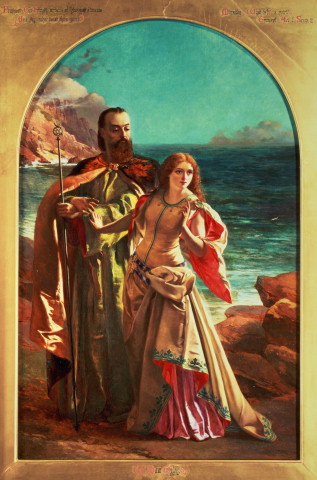
Prospero and Miranda--William Maw Egley

1. Prospero, The Tempest (William Shakespeare)

Prospero has always seemed to me the shining flipside to King Lear’s dark coin, a powerful sorcerer who reverses his exile and is gracious even in his revenge. Where Lear is destroyed by his scheming daughters (and his inability to connect to truehearted Cordelia), Prospero, a single dad, protects his Miranda and even secures her a worthy suitor. Postcolonial studies aside, The Tempest is fun stuff.

2. Abraham Ebdus, The Fortress of Solitude, (Jonathan Lethem)

Like Prospero, Abraham Ebdus is a single father raising his child (his son Dylan) in an isolated, alienating place (not a desert island, but 1970’s Brooklyn). After Dylan’s mother abandons the family, the pair’s relationship begins to strain; Lethem captures this process in all its awkward pain with a poignancy that never even verges on schlock. The novel’s redemptive arc is ultimately figured in the reconciliation between father and son in a beautiful ending that Lethem, the reader, and the characters all earn.

3. Jack Gladney, White Noise (Don DeLillo)

While Jack Gladney is an intellectual academic, an expert in the unlikely field of “Hitler studies” (and something of a fraud, to boot), he’s also a pretty normal dad. Casual reviewers of White Noise tend to overlook the sublime banality of domesticity represented in DeLillo’s signature novel: Gladney is an excellent father to his many kids and step-kids, and DeLillo draws their relationships with a realism that belies–and perhaps helps to create–the novel’s satirical bent.

4. Oscar Amalfitano, 2666 (Roberto Bolaño)

Sure, philosophy professor Amalfitano is a bit mentally unhinged (okay, more than a bit), but what sane citizen of Santa Teresa wouldn’t go crazy, what with all the horrific unsolved murders? After his wife leaves him and their young daughter, Amalfitano takes them to the strange, alienating land of Northern Mexico (shades of Prospero’s island?) Bolaño portrays Amalfitano’s descent into paranoia (and perhaps madness) from a number of angles (he and his daughter show up in three of 2666‘s three sections), and as the novel progresses, the reader slowly begins to grasp the enormity of the evil that Amalfitano is confronting (or, more realistically, is unable to confront directly), and the extreme yet vague danger his daughter is encountering. Only a writer of Bolaño’s tremendous gift could make such a chilling episode simultaneously nerve-wracking, philosophical, and strangely hilarious.

5. The father, The Road (Cormac McCarthy)

What happens when Prospero’s desert island is just one big desert? If there is a deeper expression of the empathy and bonding between a child and parent, I have not read it. In The Road, McCarthy dramatizes fatherhood in apocalyptic terms, positing the necessity of such a relationship in hard, concrete, life and death terms. When the father tells his son “You are the best guy” I pretty much break down. When I first read The Road, I had just become a father myself (my child was only a few days old when I finished it), yet I was still critical of McCarthy’s ending, which affords a second chance for the son. It seemed to me at the time–as it does now–that the logic McCarthy establishes in his novel is utterly infanticidal, that the boy must die, but I understand now why McCarthy would have him live–why McCarthy has to let him live. Someone has to carry the fire.


White Teeth, Perdido Street Station, and Last Evenings on Earth

white teeth

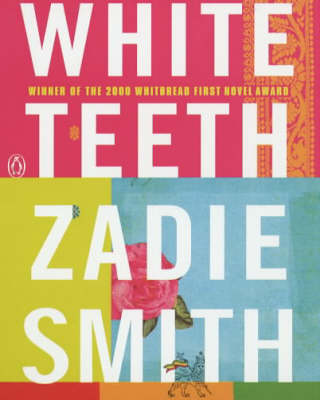
And so well with the help of Jenny Sterlin’s narration and my handy-dandy portable mp3-playing device, I finally made it through Zadie Smith‘s 2000 novel White Teeth, and, having digested all of it, am now fit to declare it hilarious in places, larded with moments of intensely brilliant prose, wildly ambitious, and ultimately hollow, overstuffed with flat characters who, despite Smith’s best efforts, do not manage to earn the Big Important Climax she shoves them toward. Smith succeeds in communicating the multicultural problematics of late-twentieth-century London, but her massive scope (the audiobook is 23 hours and my unfinished paperback runs to nearly 500 pages) is just too massive. Smith seems to think that loads of concrete detail will automatically conjure emotional force, but what we get instead verges on soap opera at times–more bathos than pathos.It doesn’t help reader expectations of course that White Teeth was wildly overpraised after its debut. While White Teeth‘s attempt to reconcile the personal traumas of a postcolonial world with the demands of family, tradition, and personal worth is admirable, its aim exceeds its grasp, and the end disappoints. Still, I enjoyed it as an audiobook–Jenny Sterlin mugs enthusiastically through the various accents and argots of a melting pot London, and Smith’s concrete emphasis on detail makes it an ideal listen for a few summer afternoons of gardening or housework. Not the Great Book we’ve been told it is, but a fine listen nonetheless.

perdido_street_station_us

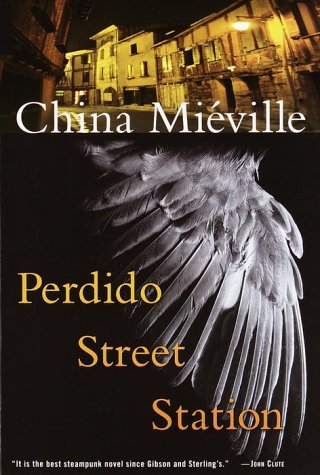
Summer is, of course, a great time for audiobooks, and I’m thrilled that China Miéville‘s breakthrough second novel Perdido Street Station is finally available on mp3. I’ve been wanting to read Miéville for quite some time now, but the length of his dystopian tomes has made it difficult until now (I am a very busy, important man, with busy, important things to do). Perdido Street Station, set in a bizarre, gross world of humans, Re-mades, and other sundry races, is weird fiction at its finest (so far)–a great hybrid of Charles Dickens and PK Dick, HP Lovecraft and JG Ballard. It trawls the line between real and surreal, art and science, grime and enlightenment, in lovely, if dense prose, that could never be mistaken as genre fiction. Great stuff, so far.

lastevenings

Also great stuff, so far, is Roberto Bolaño‘s collection of short stories, Last Evenings on Earth. I read the first three tales in succession last night, unable to put the book down although it was well-past my well-established “you must go to bed now or your toddler daughter will wreak havoc on you in the AM” bedtime. The first three stories are about, get this, (big surprise if you’ve read Bolaño), writers–good, bad, indifferent writers, failed, semi-failed, miserable writers. Sad writers, mad writers. The opener “Sensini” tells the story of an epistolary relationship between a young writer and an aging, uncelebrated writer. It’s sad yet measured in its pathos, and it earns its happy ending by loading that ending with the seed of potential disaster. The next story, “Henri Simon Leprince,” is the hilarious (and sad) tale of a miserable writer, a hack who teams up with the Resistance in WWII France. Despite his best intentions, he’s roundly despised by all those he helps. And he’s a terrible writer. The third story, “Enrique Martín,” literally made me laugh out loud, several times, to the point of tears. Narrated by Arturo Belano, Bolaño’s literary stand-in, it tells the desperate story of the titular failed poet, a would-be artist and sometime UFO hunter who slowly watches his dreams disintegrate.

All of Bolaño’s stories so far have extended past the mad force of his own strong voice(s) and implanted themselves into my mind, reaching into my own past; his characters, in hashing out their strange young lives (from a bit of distance, now) repeatedly evoked my own youthful memories, stuff I hadn’t thought about in years. There’s a sad brilliance under all of Bolaño’s stuff, like bright noon sun perceived through an ambiguous tear resting on your eye. Reading the beginning of Last Evenings on Earth last night, it occurred to me for the first time that Bolaño had died, and he’d died really young, and there weren’t going to be anymore books from him. But that’s a bummer note to end on. Let’s leave it at this–Last Evenings on Earth is some seriously great stuff.

2666 – Roberto Bolaño

2666

Where to start, where to start…

Do I say that the book is good, great, fantastic, a literary achievement? These words don’t seem big enough, or they seem like hackneyed clichés, ugly inadequacies. Here’s a very short review: go get the book and read it. Worried that 900 pages is too long? Don’t worry. They fly by. I read the book in less than a month, usually in forty or fifty page sittings, something I usually don’t make time to do. But hang on, I’m already off to a bad start I admit, there’s no context here, is there? Let me try again.

2666 is Chilean exile Roberto Bolaño’s posthumous magnum opus. The book comprises five sections, each focusing on a separate but often overlapping set of characters and locations. The book is, in my paperback edition (composed of three separate books) 893 pages long. The book is excellent, addictive, full of pain and pathos and humanity. Most of the sentences are very, very long. What is it about, then? There are too many answers to that question, but here goes–

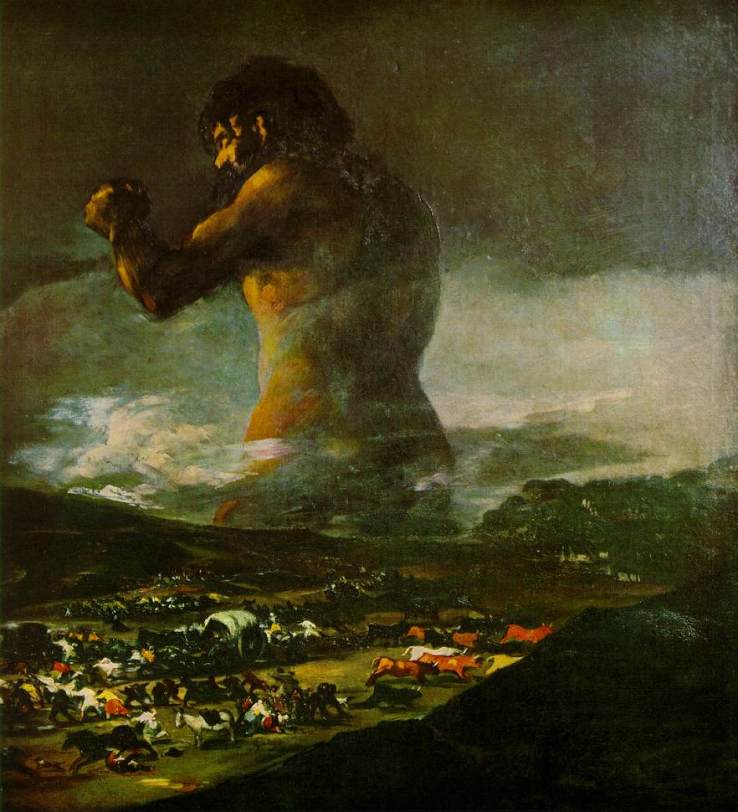
There are two major, intertwined plot threads in 2666, one about a series of gruesome rapes and murders in the fictional city of Santa Teresa, Mexico, and the other concerning an obscure German writer with the improbable name Benno Von Archimboldi. These two threads weave through the labyrinth that is 2666, connecting the many themes and tropes and moods and tones of this massive novel. Bolaño’s styles shift and weave and morph throughout the book, evoking laughter and rage and pity and anticipation and overwhelming sadness. He’s very often philosophical but never abstract, lyrical but grounded, and always entertaining. Bolaño’s command of thousands of different voices is on display here, whether he’s telling the tale of an ex-Black Panther or an exiled Russian sci-fi writer, a Romanian general or a crippled Italian critic. Bolaño’s voices layer upon each other in a strange chorus; often I found myself shocked at how, 300 pages later, a different character in a different place and time will hit on the same note–a comment about semblances and reality, or graveyards, or fate and chance and choice, or mirrors, or dreams and nightmares, or giants, or insane asylums, or aliases and pseudonyms–only this new character will express this note in a new or different tone, adding to the richness and dazzling complexity of the tale. Bolaño’s voices are often framed in a series of tales like Russian nesting dolls, only, where a writer like John Barth might explicitly announce or call attention to this device, Bolaño’s storytelling has a humanistic, natural quality, a quality that provokes and calls attention to the limits of human memory and our collective capabilities to narrativize our lives. But hang on again, I’ve gotten away from plot summary, haven’t I? Do you really need a summary? Yes? Will, “It’s about everything. Life, death, all that shit,” will that not do? Okay. Another attempt, then.
goya-colossus

The first section of 2666, “The Part About The Critics,” tells the story of four critics from four European countries who specialize in Archimboldi; in fact, two of the critics pretty much invent Archimboldi studies. Through their critical endeavors, the obscure, unphotographed writer rises to greater prominence. The four set out to find him, initiating the novel’s detective lit thread. They wind up in Santa Teresa, a city experiencing a seemingly endless slew of murders. In Santa Teresa, they meet a Chilean professor named Amalfitano, who (obviously) features heavily in the next section, “The Part About Amalfitano.” At this point, we start discover more about the unsolved rapes and murders of young women in Santa Teresa, but these crimes linger in the background, the story of Amalfitano, his ex-wife, his daughter, and a geometry book hanging from a clothes line at the fore. Amalfitano’s teenage daughter returns in the third section, “The Part About Fate.” This part of the novel details Oscar Fate, an African-American reporter who travels to Santa Teresa to cover a boxing match only a few days after the death of his mother. “The Part About Fate” builds to a rapid, grotesque, nightmarish climax, where the journalist, alien and impartial visitor, silent observer, becomes implicated in the ugly violence and grim desperation of Santa Teresa. This rhetorical move leads the reader into the longest section of 2666, “The Part About The Crimes,” in which we finally learn about the gruesome murders–hundreds and hundreds of murders–of the young women who work in the factories of Santa Teresa. The final section, “The Part About Archimboldi,” works as a partial bildungsroman, revealing the life story of the man who becomes Benno von Archimboldi. But does “The Part About Archimboldi” wrap up all the riddles, seal the deal, lead us out of the labyrinth and into the light–do we get answers? Let’s see–

Readers enthralled by the murder-mystery aspects of the novel, particularly the throbbing detective beat of “The Part About The Crimes,” may find themselves disappointed by the seemingly ambiguous or inconclusive or open-ended ending(s) of 2666. While the final moments of “The Part About Archimboldi” dramatically tie directly into the “Crimes” and “Fate” sections, they hardly provide the types of conclusive, definitive answers that many readers demand. However, I think that the ending is perfect, and that far from providing no answers, the novel is larded with answers, bursting at the seams with answers, too many answers to swallow and digest in one sitting. Like a promising, strangely familiar turn in the labyrinth, the last page of the book invites the reader back to another, previously visited corridor, a hidden passage perhaps, a thread now charged with new importance. Like Ulysses or Moby-Dick or Infinite Jest before it–and yes, yes, I would class this book with those without batting an eye–2666 is a book that demands multiple readings. Fortunately, despite its grim subject, it’s endlessly entertaining, rich with literally hundreds and hundreds of stories, stories that impel and compel you to read, read, read. But, again like Ulysses or Moby-Dick or Infinite Jest before it, 2666 is not for everyone.
arcimb1

I’ll quote from the only negative review at Amazon right now, by one Mr. Nathan King, who writes, “This is not an enjoyable/pleasurable book to read. . . . this book is a GRUESOME and HORRIFICALLY VIOLENT book. The largest section of the book is basically 300+ pages of autopsy reports. You will read the words “vaginally and anally raped” over and over and over, until it runs through your mind day and night.” King’s review is accurate in several ways, although I fundamentally disagree with his overall assessment, of course. The book’s violence will run through your mind day and night: the book is awfully affecting. One of Bolaño’s missions in the book, it seems, is to continually press on the reader a horrific assemblage of dead, raped, mutilated bodies, bodies found in Dumpsters, trash heaps, ditches, alleys; violated, nameless, unclaimed bodies. While “The Part About The Crimes ” clearly contains most of these horrors, disposable bodies litter the entire book, whether they are Jews to be executed by Nazis in WWII or young men murdered in prison while the wardens watch. Bolaño’s method then is to confront his readers with all these unsolved, perhaps unsolvable crimes, and ask how one can witness to the horrors of life without giving in to despair or madness or suicide. Callous or cynical readers, looking for a simple answer to “Whodunnit?” will miss the multiplicity of answers that Bolaño provides, which might be boiled to: We all did it. We are all responsible for these crimes.

At many points throughout the massive tome Bolaño addresses this central problem, but this passage from “The Part About Amalfitano” sums up one possible solution quite beautifully. Amalfitano, slowly going insane, wondering about existence and movement and sleep and reality, thinks–

Anyway, these ideas or feelings or ramblings had their satisfactions. They turned the pain of others into memories of one’s own. They turned pain, which is natural, enduring, and eternally triumphant, into personal memory, which is human, brief, and eternally elusive. They turned a brutal story of injustice and abuse, an incoherent howl with no beginning or end, into a neatly structured story in which suicide was always held out as a possibility. They turned flight into freedom, even if freedom meant no more than the perpetuation of flight. They turned chaos into order, even if it was at the cost of what is commonly known as sanity.

To systematize, to narrativize then, to try to put order and meaning into one’s life, or the lives around you, to witness to others’ pain by claiming it as your own, these moves then betray one’s ability to accurately, or sanely, perceive the world. It’s this great cost that Bolaño navigates in 2666, and he does so with aplomb and precision and grace.

Have I still not convinced you to read 2666? I could keep going and going, on and on, and I won’t be the only one–Bolaño’s book will be one for posterity, a great work that literary critics (much like the ones he sympathetically parodies and valorizes here) will debate over, ponder over, discuss, write about, love, and be tortured by for ages to come. At the same time, this is not a book that one should feel is only for the “literary élite” (whatever that means)–with its force and vitality and inventiveness, with its rich, detailed dream/nightmare world, 2666 is a book that you, dear reader, should read, must read. Very highly recommended.
The Savage Detectives — Roberto Bolaño

savage

I give up. I don’t know how to review The Savage Detectives.

Everyone told me I was supposed to love this book, but I didn’t. There, that’s a review. Not a good review, but there. I can’t remember a book ever taking me so long to finish or a book that I put down so often. When I truly love a book, I am moved. Often physically. Sometimes I have to stand up to read a book, I’m so moved. That’s a good book. (I never had to stand up during The Savage Detectives, although I often had to force myself to read thoroughly and not just skim). When I truly love a book, I’m a little sad and deflated when it’s over. I know a book is great if I’m compelled to go back and immediately reread sections. (Again, with Detectives, this didn’t happen). But it looks like I’m trashing the book. I shouldn’t. It has a lot going for it.

I read the first 140 pages, the journal entries of young Garcia Madero, in a blur. Funny and passionate, Madero’s voice explodes with the immediacy and intensity of youth. He joins up with the visceral realists, a group of anti-establishment poets (who no one cares about). Led by two enigmatic outsiders, Ulises Lima and Arturo Belano, the visceral realists gripe about the state of Mexican and Latin American literature, screw around, and argue with each other (no one else will listen to them). Madero paints Mexico City in the mid-1970s as vibrant, a place full of poetry and art. He becomes a biblioklept, God bless him (yet he ethically agrees not to steal from a poor old blind bookseller). He writes poems. He has sex. He runs away from home, sort of. There’s a breathless energy to Madero’s narrative that makes the book hard to put down, and the first section of The Savage Detectives, “Mexicans Lost in Mexico” culminates in one of the book’s most exciting events. Madero, Lima, and Belano help a young girl named Lupe escape from her belligerent pimp. Then, that portion of the story unresolved, the narrative shifts dramatically.

In the second section, “The Savage Detectives,” we are treated to, or subjected to, or made to endure, or made to navigate–pick your verb, please–over 450 pages of (one-sided) interviews spanning 20 years. Some of the interviewees appear consistently throughout this section, like Amadeo Salvatierra, who helps Lima and Belano in their quest to find the lost original visceral realist, Cesárea Tinajero. Other voices only pop up once to tell a weird story about Lima or Belano–or more accurately, a weird story about themselves with Lima or Belano playing bit parts. Some of these stories, like Lima’s strange time in a Tel Aviv prison, or Belano’s tenure as a national park guard in France are great; other times they are painfully tedious or repetitive (you know, like real life).

Technically, The Savage Detectives is quite an achievement. The myriad stories in the book’s main section represent the fragmented narratives that might compose a person’s life–a series of perspectives that others have about us, views that can never add up to a unified truth. The bulk of these stories are very much about poetry, art, and travel. Like Joyce’s Ulysses, Detectives is a peripatetic novel, full of specific locations and very, very explicit directions (Joyce famously claimed that were Dublin destroyed in a catastrophe, it could be rebuilt based on his novel; the same seems true for Bolaño’s Mexico City). Also like Ulysses, Detectives is an epic about the banal, ordinary things that fill our lives: jobs and eating and getting to places and having one’s friendships sour and being disappointed and so on. Lots and lots of “and so on.” This isn’t to say that there aren’t moments of heroism and adventure–saving kids from satanic caves, stow-away sea voyages, and dodging bullets from Liberian rebels make for interesting narrative peaks. However, most of the novel remains rooted in a realism that is often dreadfully visceral in its painstaking replication of just how depressing a life could be. As the seventies and eighties turn into the nineties, things get more bleak and more depressing for Lima and Belano. And it all adds up to an incomplete picture (literally; check out the last page of the book if you don’t believe me).

o_roberto-bolano

By the time we return to Madero’s journals in the third and final part of the novel, “The Sonora Desert,” the sadness and deflation of the previous section infects and tints every aspect of the narrative. Lima and Belano, with Madero and Lupe in tow, search desperately for the forgotten poet Cesárea Tinajero. Their search works as a pitiful parallel to “The Savage Detectives” section, a comment on the elusive nature of identity, and the strange disappointments that punctuate our expectations. Even the novel’s climactic ending seems understated after the monolithic middle section. And while this deflationary technique is undoubtedly a carefully considered conceit on Bolaño’s part, the payoff for the reader–this reader anyway–did not merit the effort and concentration that the book required. Or, to put it another way, after hours of time invested, I was unmoved.

As rave reviews of the English translation of his last novel 2666 begin seeping out of the critical woodwork (this month’s Harper’s has devoted a full four pages to the book), it seems that Bolaño will top most critics’ lists again this year. At over 900 pages and reportedly full of grim, bleak violence, it’s hard to imagine 2666 will be any easier to get through, and as FS&G summarily ignored our requests for a review copy, there’s no pressing obligation, I suppose. The critical praise heaped on 2666 this year will surely lead interested readers to The Savage Detectives. I think Mark Twain’s infamous note at the beginning of The Adventures of Huckleberry Finn would provide the best warning to these potential readers: “Persons attempting to find a motive in this narrative will be prosecuted; persons attempting to find a moral in it will be banished; persons attempting to find a plot in it will be shot.” While no serious critic could dismiss Bolaño’s lyrical skill and complex control of the many voices that populate Detectives, I think a number of readers–serious readers–would not be wrong for considering the tome a bit overrated.