I’m not interested in writing short stories. Anything that doesn’t take years of your life and drive you to suicide hardly seems worth doing.
(Via).

I’m not interested in writing short stories. Anything that doesn’t take years of your life and drive you to suicide hardly seems worth doing.
(Via).
“Housewife,” a very short story by Amy Hempel—
She would always sleep with her husband and with another man in the course of the same day, and then the rest of the day, for whatever was left to her of that day, she would exploit by incanting, “French film, French film.”
(From Micro Fiction, edited by Jerome Stern).
“Money” by Lydia Davis, from Samuel Johnson Is Indignant, collected in the forthcoming volume The Collected Stories of Lydia Davis—
I don’t want any more gifts, cards, phone calls, prizes, clothes, friends, letters, books, souvenirs, pets, magazines, land, machines, houses, entertainments, honors, good news, dinners, jewels, vacations, flowers, or telegrams. I just want money.
 The massive new volume The Collected Stories of Lydia Davis doesn’t come out until later this month, but you can read the first three stories in the book now at Picador’s website. Read “Story,” “The Fears of Mrs. Orlando,” and “Liminal: The Little Man,” all originally published in Break It Down.

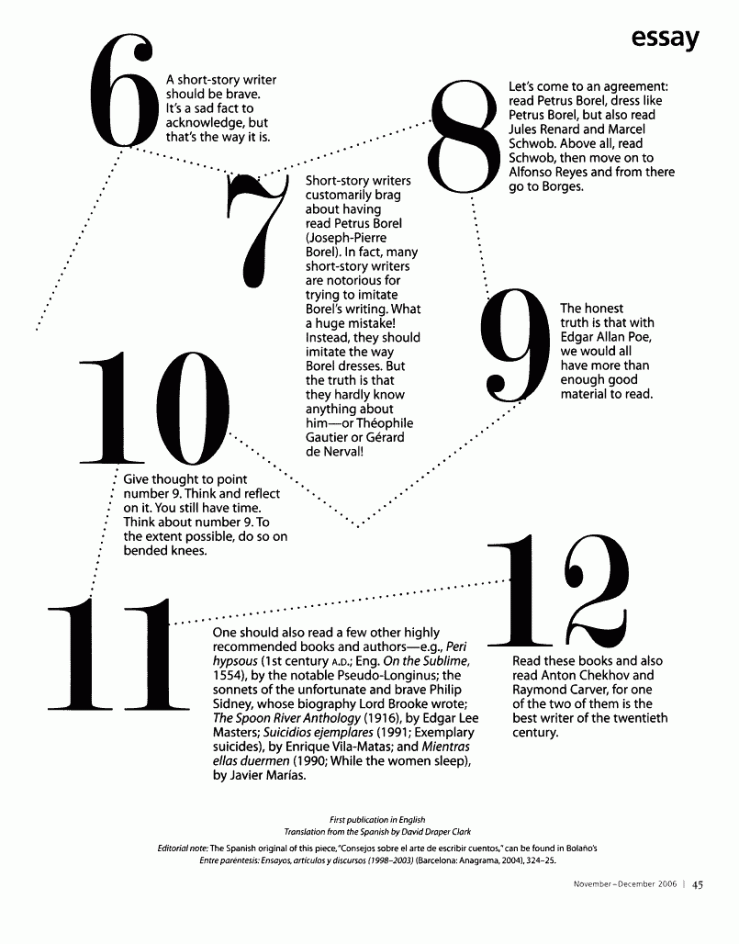
Originally published in World Literature Today. Images via Defining Myself Secondhand.
The Guardian has published David Mitchell’s short story “Muggins Here” as part of its summer fiction special (other authors include Hilary Mantel and Roddy Doyle). Here’s an excerpt–
A proper mental Saturday it is, what with New Sue off with her hernia and the Lukes of Hazzard gone AWOL, so Muggins Here’ll have to cover for everyone else’s break. Not New Sue and Beverly are still giving me the silent treatment ’cause I can’t let them take the bank holiday off, but it’s water off a duck’s back by this point. By ten o’clock the queues are looping back, and it’s like all Greenland’s one of those swilling dreams you get with ‘flu. Full of eyes, drilling into me. Philpotts can’t get close enough to fire off a “What are half your team doing without their name-badges, Pearl?” but I need the loo – no chance, not ’til all the breaks are over. This beardy customer’s spitting, “Twenty-three minutes I’ve been in this queue!” I tell him, “It certainly is a busy morning” so in he leans, breath all pilchardy, and says, “Then hire – more – staff!”, like I’m backwards, like Gary used to do sometimes. I ask for his “I Love Greenland” Loyalty Card and while he’s fishing through his wallet I’m working out that I’ve still got three hundred and forty minutes ’til I can go home. Last week I turned forty-five so that’s nineteen years ’til I retire, though now they’re reckoning we’ll have to work ’til seventy. Seventy! Doesn’t bear thinking about, does it? I really really need the loo. When I ask the man, “Cash back?” he gives me this withering, “That’s exactly what landed the economy in the crappers in the first place” and then, “What’s so green about Greenland Supermarkets dishing out fifty plastic bags to every customer?”
John Turturro does Italo Calvino. “The False Grandmother,” illustrated by Kevin Ruelle, evokes dark shades of Little Red Riding Hood.
The New Yorker‘s Book Bench blog interviews Chris Andrews. The magazine published Andrews’s translation of Roberto Bolaño’s short story “Prefiguration of Lalo Cura” earlier this week. From the interview:
A book that’s a joy to read can be frustrating to translate when, for whatever reason, the process keeps jamming up. And it’s very hard to predict just how hard a book will be to translate until you really get down to it, because smallish but time-consuming problems can be virtually invisible on a first reading. But of course translating has its joys as well: moving in slow motion through a fictional world, exploring its dimmer recesses, listening to what echoes in it, handling rich vocabularies …
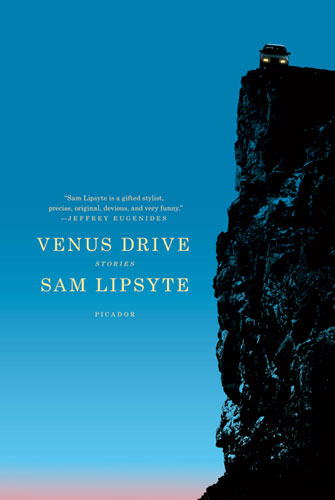
Sam Lipsyte’s forthcoming novel The Ask is already poised to be one of the major critical successes of 2010. In concordance with its publication, Picador will print a new trade paperback edition of his short story collection Venus Drive, the first such publication since its original debut from Open City a decade ago.
The thirteen stories in Venus Drive compose a sort of novel-in-stories. The title of the collection takes its name from a banal suburban street mentioned in a few of the stories, and many of the characters seem like iterations of the same type or voice. There are washed up would-be indie rock stars, small-time coke peddlers, and underemployed and overeducated addicts. There are deviants and perverts and outsiders. There are bullies. There are dead or dying mothers, dead or dying sisters. In short, Venus Drive is its own tightly-drawn, tightly-coiled, and highly-compressed world.
As the plot points double and re-double in these stories, so do the themes. “Our culture is afraid of death, and considers it something we must wage battle against,” says Tessa, a pain specialist, a peripheral character in “Cremains.” She continues: “I say, surrender, submit. Go gentle. Terminal means terminal.” Death informs almost all of these stories in some way, and Tessa’s commentary presents the problem with death, or at least the problem these characters have with dealing with death: it’s not easy to go gentle. It goes against our culture and our nature to surrender. If she’s presented as a voice of wisdom, she’s also an ironic character, one of the many would-be authorities Lipsyte’s weirdos and outsiders can’t help but mock. “The Drury Girl,” part-suburban satire and pure pathos, posits a pre-pubescent narrator obsessed with his teenage babysitter; his dad’s cancer plays second fiddle to his lust. Thus the story neatly ties together the overarching themes of Venus Drive, sex and death. Admittedly, these are probably the only real themes of proper literature, but Lipsyte does it so damn well and lays it all out so bare and does so in such humor and grace that it really sticks. It’s good stuff.
That humor is desert-dry, of course, and succeeds so well because his characters are so endearing in their pathetic pathologies. The antiheroes of “Beautiful Game” and “My Life, for Promotional Use Only,” are also-rans in the sordid history of underground rock, addicts approaching washed-up (Are they the same person? Maybe. They have different names, of course. Doesn’t matter). A scene from “Beautiful Game” shows the ambivalence at the core of many of these characters: “At the bank machine, Gary doesn’t check the balance. Better to leave it to the gods. Someday the bank machine will shun him. Why know when?” Gene, the ex-rocker in “My Life, for Promotional Use Only” now suffers the indignities of working for his ex-girlfriend. Everyone in the story is an ex-something, everyone is growing up and leaving art (or is it “Art”?) behind. In a poignant and funny and cruel scene, familiar to many of us, Gene sees some of himself in a waitress:
Rosalie calls over the waitress and they talk for a while about somebody’s new art gallery. The waitress is famous for a piece where she served the Bloody Marys mixed with her menstrual blood. Word had it she overdid the tabasco.
I wait for the moment when our waitress stops being a notorious transgressor of social mores and becomes a waitress again, look for it in her eyes, that sad blink, and order a beer.
Gene, a former “notorious transgressor of social mores” himself feels both sorrow and hate for the waitress. He sees her job as menial and pathetic — just like his own. He doesn’t seem to think much of her art, either. Lipsyte telegraphs so much there with so few words, his sentences clean, spare, precise, and rarely of the compound variety. There’s a truncated, clipped rhythm that Lipsyte builds over the thirteen-story run that helps propel the immediacy of his tales. The stories are short, too; the longest is sixteen pages and most run to eight or ten. Lipsyte’s rhetorical gift is to shine the grubby and, at times, his sentences can feel almost too perfect, too-fussed over–but this (minor) complaint, it must be noted, comes from someone who admires occasional ambiguity or incoherence. Lipsyte removes his own authorial voice and thus achieves lucidity in his characters’ voices; somehow, though — and paradoxically — these voices bear the ghostly trace of his absence. But that seems like a silly conversation, and certainly not one for this post.
Venus Drive reminds me very much of one of my favorite books, Denis Johnson’s Jesus’ Son, which I would also call a novel-in-stories, also a spare and precise collection, also a study of weirdos and addicts and outsiders. Jesus’ Son is something of a standard in creative writing workshops (or at least it used to be) and a sensible teacher would add Venus Drive to her syllabus as well. Finally, like Jesus’ Son, Lipsyte’s book is seething, funny, and poignant, with characters tipped toward some redemption, awful or otherwise, for all their myriad sins. The book might take its name from a geographic location, but the “Venus drive” is also a spiritual inclination toward love and hope. Highly recommended.
Venus Drive is available March 2nd, 2010 in trade paperback from Picador.

The short story often gets short shrift. While Hemingway’s “Hills Like White Elephants” is an astounding feat of economy, it’s rarely mentioned in the canon of Hemingway’s masterpieces like For Whom the Bell Tolls. There’s a strong case to be made that Kafka’s little fables are far more perfect than his unfinished novels, and yet The Trial, incomplete as it is, is still considered his finest work. I would take any one of Nathaniel Hawthorne’s Twice-Told Tales over the interminable stuffiness of The Scarlet Letter. There exists, perhaps, a feeling that the short story as art form is incapable of making Grand Gestures or Big Important Statements. Collections that are lauded tend to function (or at least pretend to function) as homogeneous “novels in short story” –which can be great, of course (see Denis Johnson’s inimitable volume Jesus’ Son) — but why should that be? To often, readers dismiss short stories, particularly short stories, as little more than time-fillers, neat little chunks of text to occupy specific moments in time: a subway ride, an term in a waiting room, a spare half-hour. Sometimes we set aside our real Reading Time for those oh-so important novels, so that we might Learn and Grow as a Person (or whatever). And while the tales comprising the 2009 PEN/O. Henry Prize Stories certainly won’t disappoint as time-fillers, they offer so much more than simple leisure reading.
Repeatedly, the stories in this collection explore what is at stake in the human condition, and a sense of loss underpins many (if not most) of the tales. Take the lead story, Graham Joyce’s “An Ordinary Soldier of the Queen,” for instance. This story of a British Army officer who may or may not have been exposed to toxic nerve gas during the first Gulf War unfurls in a realistic, funny, and often affecting voice. Joyce’s tale dips from a military procedural into uncanny, fantastic territory, making the reader question the perception of the narrator, who never wavers in his beliefs about the strange events (namely, meeting a djinn) that are (maybe) happening to him. I thought about “An Ordinary Soldier of the Queen” for days after I read it and I made a colleague read it so that I could force him to discuss it with me. Karen Brown’s “Isobel’s Daughter” also explores loss, communicating the profundity of those everyday tragedies we often look away from. (Brown’s evocation of Tampa, Florida is spot-on, I must add). In “Purple Bamboo Park,” E.V. Slate lets us peer into the life of an old maid in modern China. The story is heartbreaking from the get-go, and yet her protagonist is not a wholly sympathetic character; Slate’s handle on human failure and our investment in mundane adventures is crushing–who knew we could have so much in common with an aging domestic worker? Caitlin Horrocks literalizes loss in “This Is Not Your City,” thrusting her readers into the panic of Russian immigrants whose daughter goes missing. In “The Order of Things,” Judy Troy examines loss and meaning through an affair, concluding that “Feeling came first and though after; that was the order of things,” much to the surprise of her protagonist. And while Paul Theroux’s “Twenty-two Stories” is more playful in both structure and content (it is comprised of twenty-two short short short stories), again we find characters pondering loss and the circumstances of their losses. Theroux’s characters, like those in James Joyce’s Dubliners, repeatedly come to negative epiphanies, whether they lose their faith in God and religion or realize that they were unfit parents. The closing story, Junot Díaz’s “Wildwood” makes me kind of ashamed that I still haven’t read Brief Wondrous Life of Oscar Wao. I will remedy this omission forthwith.
While readers may not love every story collected in The 2009 PEN/O. Henry Prize Stories, it would take a pretty cold automaton to dismiss most of what’s presented here. The project, helmed by editor Laura Furman with jury prize selections by A.S. Byatt, Anthony Doerr, and Tim O’Brien, is really an exploration of how people handle loss and beauty and family and adventure and boredom and all those things that happen in life (and death). And isn’t that what we ask of our literature? Read this book, but give these stories their proper due. They’re more than just time-fillers; each one is a perfectly crafted little world waiting to be explored. Recommended.
The 2009 PEN/O. Henry Prize Stories is available May 5th, 2009 from Anchor Books.
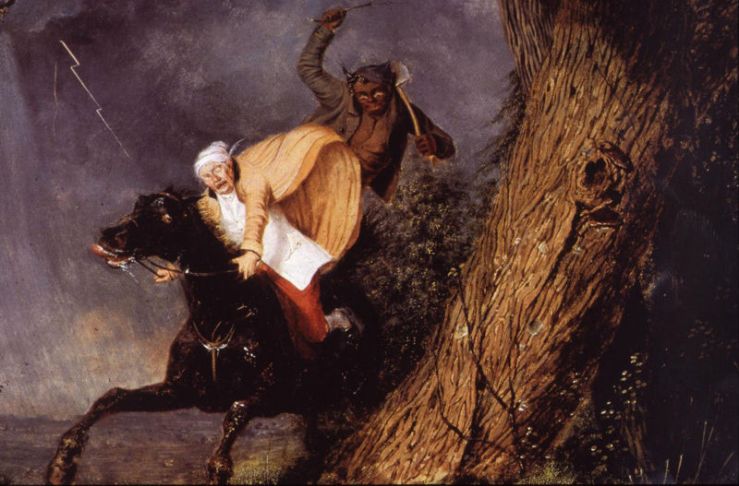
Washington Irving’s famous short story, “The Devil and Tom Walker,” seems as prescient and uncanny as ever in the lurid light of our recent financial woes:
Finding Tom so squeamish on this point, he did not insist upon it, but proposed instead that he should turn usurer; the devil being extremely anxious for the increase of usurers, looking upon them as his peculiar people.To this no objections were made, for it was just to Tom’s taste.“You shall open a broker’s shop in Boston next month,” said the black man.“I’ll do it to-morrow, if you wish,” said Tom Walker.“You shall lend money at two per cent. a month.”“Egad, I’ll charge four!” replied Tom Walker.“You shall extort bonds, foreclose mortgages, drive the merchant to bankruptcy—”“I’ll drive him to the d——l,” cried Tom Walker, eagerly.“You are the usurer for my money!” said the black legs, with delight. “When will you want the rhino?”“This very night.”“Done!” said the devil.“Done!” said Tom Walker. —So they shook hands, and struck a bargain.A few days’ time saw Tom Walker seated behind his desk in a counting house in Boston. His reputation for a ready moneyed man, who would lend money out for a good consideration, soon spread abroad. Every body remembers the days of Governor Belcher, when money was particularly scarce. It was a time of paper credit. The country had been deluged with government bills; the famous Land Bank had been established; there had been a rage for speculating; the people had run mad with schemes for new settlements; for building cities in the wilderness; land jobbers went about with maps of grants, and townships, and Eldorados, lying nobody knew where, but which every body was ready to purchase. In a word, the great speculating fever which breaks out every now and then in the country, had raged to an alarming degree, and every body was dreaming of making sudden fortunes from nothing. As usual the fever had subsided; the dream had gone off, and the imaginary fortunes with it; the patients were left in doleful plight, and the whole country resounded with the consequent cry of “hard times.”
No summer reading is complete without imbibing the variegated prose of an anthology. The following are the literary equivalents of skillfully-detailed mixtapes, made by a friend who wishes to communicate only that he or she has your best interest at heart.
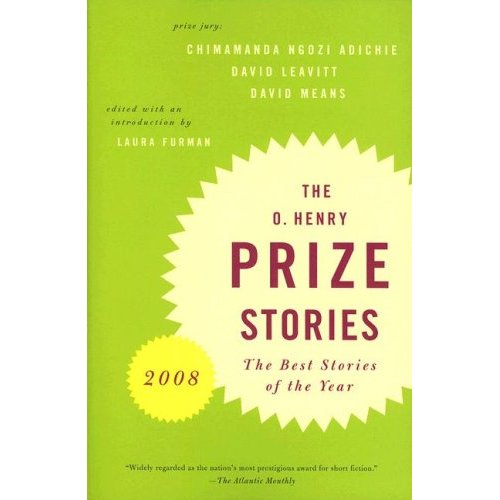


The 2008 O. Henry Prize Stories anthology is a great way to play catch up on all of the reading you missed last year. Culled from publications like Zoetrope, Harper’s, Granta, and Tin House, this anthology features established masters like William Gass and Alice Munro along with newer voices. There are plenty of highlights and no duds. Sharon Cain’s “The Necessities of Certain Behaviors” explores an amorphous world of gender-bending, while Stephen Millhauser’s “A Change in Fashion” imagines a new mode where women cover every inch of their flesh from the gaze of men. Lore Segal’s “Other People’s Deaths” perfectly captures the painful awkwardness and shame we experience when encountering, um, other people’s deaths. Similarly, the title of Tony Tulathimutte’s “Scenes from the Life of the Only Girl in Water Shield, Alaska” is spot-on, and Gass’s contribution, “A Little History of Modern Music,” is the funniest monologue we’ve read all year. But our favorite in the collection has to be Edward P. Jones’s “Bad Neighbors,” which examines the changing fortunes of an African-American neighborhood in Washington, D.C. A great collection, and if a story disappoints you, there’ll be three to make up for it.
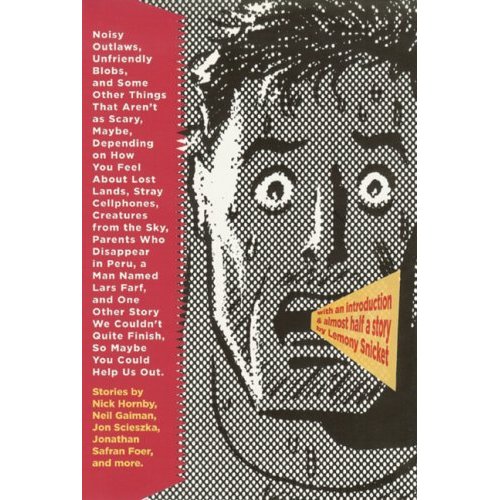
In the ultimate in lazy reviewing, we will let the title of McSweeney’s kids anthology Noisy Outlaws, Unfriendly Blobs, and Some Other Things That Aren’t as Scary, Maybe, Depending on How You Feel About Lost Lands, Stray Cellphones, Creatures from the Sky, Parents Who Disappear in Peru, a Man Named Lars Farf, and One Other Story We Couldn’t Quite Finish, So Maybe You Could Help Us Out stand as its own summary. However, this is a beautiful book with lots of lovely pictures, and the collection is worth it for Nick Hornby’s story alone. Good stuff.
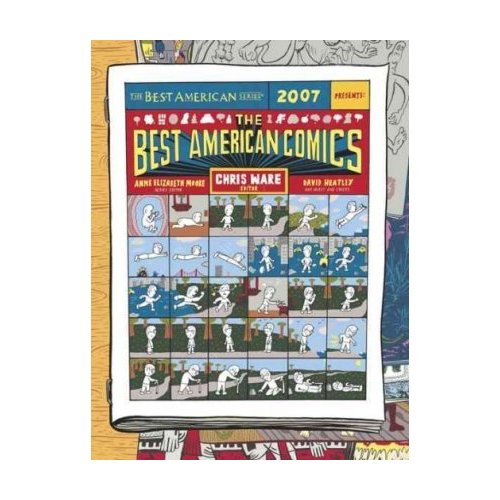
Edited by superstar Chris Ware, The Best American Comics 2007 serves as a delicious tasting menu of some of the best comix published in the past few years. Although hardcore comix fans will no doubt have already read the selections from Charles Burns’s Black Hole and Adrian Tomine’s Optic Nerve, there’s plenty here for aficionados and newbies alike.
Chances are you’ve read a number of the canonical texts in 50 Great Short Stories, but it’s also likely you haven’t read them in years. We’ve had this book for years, and have revisited often to indulge in old favorites for new inspiration. Classics like Shirley Jackson’s “The Lottery” and Hemingway’s “The Three-Day Blow” nestle up against lesser-reads like Edmund Wilson’s “The Man Who Shot Snapping Turtles” and Francis Steegmuller’s “The Foreigner.” And have you read Flannery O’Connor’s “A Good Man is Hard to Find” since high school? No? Shame on you! What about Carson McCuller’s “The Jockey”? Dorothy Parker? Kipling? Consider it a light crash course in great literature.
Summer lovin’: have a blast. You don’t have to read harlequin schlock to get romantically fulfilled on the beach this year.
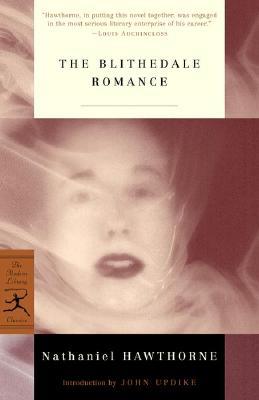
Why not start with an overlooked, under-read classic from American Renaissance master Nathaniel Hawthorne. The Blithedale Romance is a fictionalized account of Hawthorne’s time on Brooke Farm–here called Blithedale–an attempt at a utopian commune founded by artists and free-thinkers. Free lovin’, amorous passions, and, uh, farming. Great stuff–and romance is right in the title.

For lighter yet still substantial fare, check out Lara Vapnyar’s Broccoli and Other Tales of Food and Love, a delicious collection of snack-sized short stories (please, please, please forgive this awful extended metaphor). Sly, smart, and occasionally sexy, Vapnyar’s tales of dislocated immigrants continue to linger on the palate long after they’ve been digested (sorry!). The recipe section at the end is the sweetest dessert (ok, I swear I’m done now).
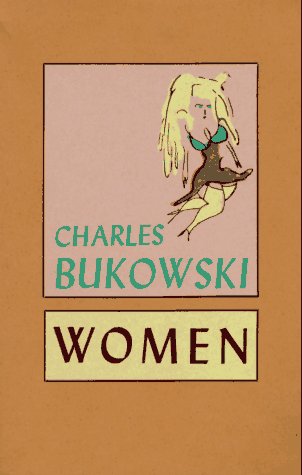
If you like your love stories rougher around the edges, check out Charles Bukowski’s only masterpiece, Women. This rambling novel follows alter-ego Henry Chinaski’s late-in-life successful turn with the ladies. Ugly, unforgiving, honest, and hilarious, Women is one of my favorite books. Also, unlike Henry Miller’s Tropic books, you’ll actually finish this one.
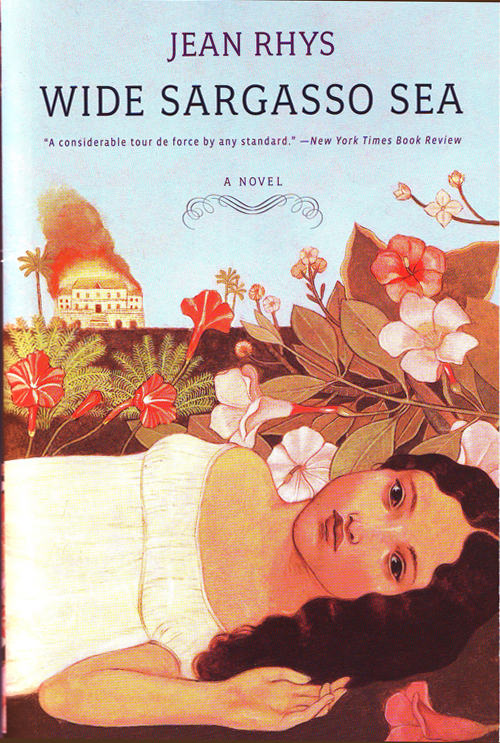
We finally read Charlotte Brontë’s Jane Eyre last summer, and believe it or not, the book is pretty great. Truly a romantic classic, but also a fine comment on gender, class, and social mores in general. And if you like it, check out Jean Rhys’s Wide Sargasso Sea, which tackles the back-story of a certain crazy lady in the attic who didn’t exactly get a voice in Jane Eyre.
Finally, if you want to get very specific, don’t hesitate to search the Romantic Circles website. Plenty of resources and lots of electronic texts: your source for all things Blake, Wordsworth, Coleridge, Shelley, Keats, and more. Good stuff.

Mathias B. Freese’s slim collection of short stories, Down to a Sunless Sea, relays the weird, miserable, and even sometimes ghoulish existences of people you might pass on the street everyday. The stories read like psychological case studies, and there’s frequently a strange distance between the clinical detachment of the prose and the depressed or depraved sentiment expressed by the narrator. At times the effect is painful, as in “Herbie,” where the titular protagonist’s rage at his abusive father spills over into Oedipal violence. Elsewhere, the stories take on a wry surrealist humor. Freese’s knack for dissonance evinces in “Juan Peron’s Hands,” where a grave robber pines for a head but settles for hands. Far closer to home is “Young Man,” where Freese distills an entire life to a few bitter pages, exploring the modern disconnect between thought, action and identity.
I can’t be who I am in real life, so I can be who I am in thought, but who I am in thought is not who I am in deed, so I live between what is and what should be, and this serves to make sharper the cleavage–the crevices are clearly marked.
One of my favorites in the collection, “Arnold Schwarzenegger’s Father Was a Nazi,” disconcertingly (and humorously) condenses American obsession with celebrity into a fantasy ski trip, complete with the oddly sorta-prescient line: “I might even run for president if I can lose this accent” (the story was originally published in 1991). It is probably the deformed voyeur hero of “I’ll Make It, I Think” who delivers the closest thing to a mantra for these characters:
I’m not hurting anyone. So what if my morning shorts are sticky. I’m a good person. The outside, for sure, is a shambles–that’s not completely true, but I’ve made my point. Inside is fucked up some, but I’ll make it, I think.
Down to a Sunless Sea, for all its monsters and perverts and manic depressives, is never cruel in its darkness or unsympathetic in its distance. Freese creates real people here, and if we laugh at their pain, we’re laughing with them. Highly recommended.
Last week, millionaire adventurer Steve Fossett was declared legally dead after having been missing since fall of last year when his single-engine plane disappeared in Nevada. Neither Fossett’s body or his plane were found, but nevertheless, on November 26, 2007 his wife petitioned to have him declared legally dead.

Fossett set 116 records over his lifetime, including feats in ballooning, aviation, and sailing that still stand. His career as an adventurer is so storied and fascinating that we at Biblioklept refuse to believe that Fossett died; in fact, we propose that he’s still alive, in the midst of some new adventure, perhaps of the time-traveling or extra-dimensional exploration variety, no doubt as secret as it is mind-shattering.
So–
What do you think? Take part in Biblioklept’s Steve Fossett Fan Fiction Contest. Where is Fossett now, and what marvelous adventuring is he up to? Entries should be mailed (no attachments, please!) to biblioklept.ed@gmail.com, or, alternately (preferably) posted in the comments section below. All entries will be considered the owned intellectual property of the original author. The contest is open until a year from today. The winner of the contest, chosen by the Biblioklept and His Esteemed Council, will receive their choice of a dirty postcard or a stolen book, chosen by the Biblioklept.
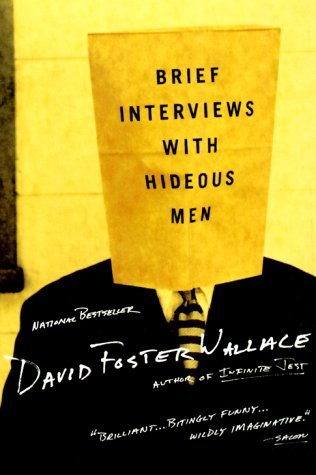
Properly describing David Foster Wallace’s Brief Interviews with Hideous Men involves using all of those words that I hate to see in any book review: “radiates,” “pathos,” “poignancy,” “gut-busting laughs,” “existential crises of identity in the post-modern world,” and so on. Now that I have them out of the way, let me tell you why you should read this book: it will make you laugh, it will make you cry. Out loud. After you read it, you will want to press it on other people, who will say, “Yeah, sure, okay”; only their eyes’ will be slightly-slanted, their mouths just a bit crooked, even their nose will appear askew at your demand. They will hurriedly change the subject–you’ve already foisted so many unwanted books on them, and who even has time to read now?–but you will persevere! “Here,” you’ll say, “Read “A Radically Condensed History of Postindustrial Life”–it’s only two paragraphs! You can read the whole thing in under a minute!”:
When they were introduced, he made a witticism, hoping to be liked. She laughed extremely hard, hoping to be liked. Then each drove home alone, staring straight ahead, with the very same twist to their faces.
The man who’d introduced them didn’t much like either of them, though he acted as if did, anxious as he was to preserve good relations at all times. One never knew, after all, now did one now did one now did one.
And, as they finish reading, you’ll beam at them and nod your head knowingly. They’ll look a little confused, perhaps bored. “It’s like an overture, see? It’s like, about loss, the inability to connect, the masks we wear to hide our hideousnessnesses.” Your victim will nod politely and begin to bring up an interesting thing he saw on the local news concerning pet ownership, but you’ll cut him off before he can get out of this. “Check out the “Brief Interviews with Hideous Men” sections that permeate the book–they’re like little vignettes, interviews where you only get the interviewee’s responses. They’re funny, shocking sad–they’re really good! Also, check out my favorites– “Adult World (I)” and “Adult World (II)”–these stories are about a wife who it turns out doesn’t really know her husband at all. Just read the beginning– ”
For the first three years, the young wife worried that their lovemaking together was somehow hard on his thingie. The rawness and tenderness and spanked pink of the head of his thingie. The slight wince when he’d enter her down there. The vague hot-penny taste of rawness when she took his thingie in her mouth–she seldom took him in her mouth, however; there was something about it that she felt he did not quite like.
“See?” you’ll demand uncaringly of your now-obviously exasperated detainee, “See? Sex! It’s got sex in it! Everyone loves to read about sex, especially weird awkward sex!” Your victim will now stand up, feigning the need to visit the restroom. But you won’t let him go that easily! “There’s another series of running vignettes that unify the book’s structure, making its sum more than just a collection of previously-published stories–check out a selection from one of the “Yet Another Example of the Porousness of Certain Borders” series”–
“Don’t love you no more.”
“Right back at you.”
“Divorce your ass.”
“Suits me.”
“Except now what about the doublewide.”
“I get the truck is all I know.”
“You’re saying I get the doublewide you get the truck.”
“All I’m saying is that truck out there’s mine.”
“Then what about the boy.”
“For the truck you mean?”
Your poor visitor is now literally walking away from you, ignoring the book in your hands, yet still somehow politely smiling–though only with his mouth–his hard eyes show how much he hates you right now. As he retreats to the toilet, your feelings hurt, you comfort yourself by declaring that he doesn’t read anyway; besides, he wouldn’t be able to figure out that “Tri-Stan: I Sold Sissee Nar to Ecko” was a retelling of both the Tristan and Isolde and Narcissus and Echo stories, set in Hollywood; he wouldn’t appreciate the book’s themes of child-abuse, repressed (false?) memories, and lost love. Philistine.
When he comes out of the bathroom you chit-chat a little more and then he’s ready to go. He holds his hand out toward the book. He wants to borrow the book. He wants to take your book. Oh shit. What have you done?
_____________________________________________________________________
Believe it or not, that dude who plays “Jim” from The Office is directing a movie version of Brief Interviews with Hideous Men, scheduled to come out later this year.
You can read the first part of this series here.
Welcome to a new feature at the Biblioklept, “Essential Short Story Collections,” in which we take a look at some, uh, short story collections that are essential (how’s that for a tautology?). Because we here at Biblioklept Headquarters USA always put Jesus first, and because his latest novel Tree of Smoke was so dang good, why not start with Denis Johnson’s 1992 collection Jesus’ Son?

Jesus’ Son is almost a novel in short story form. The unnamed narrator of the stories is an alcoholic drug addict who manages to survive through a mix of petty thievery, odd odd jobs, and straight-up bumming it. The collection opens with “Car Crash While Hitchhiking.” The title of this story is in no way misleading. And although the first story winds up with the narrator hospitalized and blacking out (initiating a motif in Jesus’ Son), the next story, “Two Men” finds him reasonably healthy and up to no good. “Two Men” is a meditation on the bonds of friendship and an outstanding example of Johnson’s tight prose:
I was being taken out of the dance by my two good friends. I had forgotten my friends had come with me, but there they were. Once again I hated the two of them. The three of us had formed a group based on something erroneous, some basic misunderstanding that hadn’t yet come to light, and so we kept on in one another’s company, going to bars and having conversations. Generally one of these false coalitions died after a day or a day and a half, but this one had lasted more than a year. Later on one of them got hurt when we were burglarizing a pharmacy, and the other two of us dropped him bleeding at the back entrance of the hospital and he was arrested and all the bonds were dissolved.
Friends! Good stuff. Other stand-outs in the collection include “Work,” a story about stealing copper wire, and “Emergency,” a tale involving copping pills from an emergency room job. Reminiscent of Hunter S. Thompson, “Emergency” perfectly captures drug-addled paranoia overflowing into petty existential questing. An encounter with some normals:
A family in a big Dodge, the only car we’d seen in a long time, slowed down and gawked out the windows as they passed by. The father said, “What is it, a snake?”
“No, it’s not a snake,” Georgie said, It’s a rabbit with babies inside it.”
“Babies!” the mother said, and the father sped the car forward, over the protests of several little kids in the back.
Georgie came back to my side of the truck with his shirtfront stretched out in front of him as if he were carrying apples in it, or some such, but they were, in fact, slimy miniature bunnies. “No way I’m eating those things, ” I told him.
The last story in Jesus’ Son, “Beverly Home,” finds our narrator in a somewhat more stable position, working in a retirement home and attending NA and AA meetings. His one vice and indulgence is voyeurism; he takes to watching a Mennonite couple through their windows at night, progressing from deviant sex-obsession to pining for their mundane life:
I got so I enjoyed seeing them sitting in their living room talking, almost not talking at all, reading the Bible, saying grace, eating their supper in the kitchen alcove, as much as I liked watching her naked in the shower.
At the end of the book, moved by the strange spectacle of a man washing his wife’s feet, the narrator finds a kind of hope and redemption for the future:
All these weirdos, and me getting a little better every day right in the midst of them. I had never known, never even imagined for a heartbeat, that there might be a place for people like us.
I mentioned above that Jesus’ Son can almost be read as a novel, but make no mistake–it is a collection of short stories, character sketches, vignettes that add up to something greater. The 2000 film adaptation of the movie makes this quite clear. Although the film, starring Billy Crudup as the unnamed narrator, is not half bad, the disconnected and fragmentary nature of the book–which reinforced the book’s themes of existential alienation and minor redemption–comes across as episodic and even whimsical in the movie.
I highly recommend Jesus’ Son, and I hope that people who “don’t have time to read” will make a little space in their day for this slim but substantial book. Most of the stories can be read in under half an hour, so why not pick up a copy?
 Biblioklept