“The only form of discourse” (Donald Barthelme)

“The only form of discourse of which I approve,” Miss R. said in her dry, tense voice, “is the litany. I believe our masters and teachers as well as plain citizens should confine themselves to what can safely be said. Thus when I hear the words pewter, snake, tea, Fad #6 sherry, serviette, fenestration, crown, blue coming from the mouth of some public official, or some raw youth, I am not disappointed. Vertical organisation is also possible,” Miss R. said, “ as in

pewter

snake

tea

fad #6 sherry

serviette

fenestration

crown

blue.

I run to liquids and colours,” she said, “but you, you may run to something else, my virgin,’ my darling, my thistle, my poppet, my own. Young people,” Miss R. said, “run to more and more unpleasant combinations as they sense the nature of our society. Some people,” Miss R. said, “run to conceits or wisdom but I hold to the hard, brown, nutlike word. I might point out that there is enough aesthetic excitement here to satisfy anyone but a damned fool.” I sat in solemn silence.

From Donald Barthelme’s short story “The Indian Uprising”; read the full story.

“The Hobo and the Fairy” — Jack London

“The Hobo and the Fairy” by Jack London

He lay on his back. So heavy was his sleep that the stamp of hoofs and cries of the drivers from the bridge that crossed the creek did not rouse him. Wagon after wagon, loaded high with grapes, passed the bridge on the way up the valley to the winery, and the coming of each wagon was like the explosion of sound and commotion in the lazy quiet of the afternoon.

But the man was undisturbed. His head had slipped from the folded newspaper, and the straggling, unkempt hair was matted with the foxtails and burrs of the dry grass on which it lay. He was not a pretty sight. His mouth was open, disclosing a gap in the upper row where several teeth at some time had been knocked out. He breathed stertorously, at times grunting and moaning with the pain of his sleep. Also, he was very restless, tossing his arms about, making jerky, half-convulsive movements, and at times rolling his head from side to side in the burrs. This restlessness seemed occasioned partly by some internal discomfort, and partly by the sun that streamed down on his face and by the flies that buzzed and lighted and crawled upon the nose and cheeks and eyelids. There was no other place for them to crawl, for the rest of the face was covered with matted beard, slightly grizzled, but greatly dirt-stained and weather-discolored.

The cheek-bones were blotched with the blood congested by the debauch that was evidently being slept off. This, too, accounted for the persistence with which the flies clustered around the mouth, lured by the alcohol-laden exhalations. He was a powerfully built man, thick-necked, broad-shouldered, with sinewy wrists and toil-distorted hands. Yet the distortion was not due to recent toil, nor were the callouses other than ancient that showed under the dirt of the one palm upturned. From time to time this hand clenched tightly and spasmodically into a fist, large, heavy-boned and wicked-looking.

The man lay in the dry grass of a tiny glade that ran down to the tree-fringed bank of the stream. On either side of the glade was a fence, of the old stake-and-rider type, though little of it was to be seen, so thickly was it overgrown by wild blackberry bushes, scrubby oaks and young madrono trees. In the rear, a gate through a low paling fence led to a snug, squat bungalow, built in the California Spanish style and seeming to have been compounded directly from the landscape of which it was so justly a part. Neat and trim and modestly sweet was the bungalow, redolent of comfort and repose, telling with quiet certitude of some one that knew, and that had sought and found. Continue reading ““The Hobo and the Fairy” — Jack London”

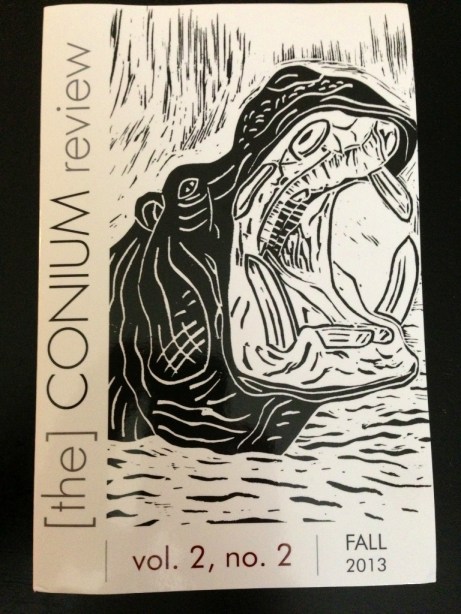
The Conium Review, Vol. 2, No. 2 (Book Acquired, 8,19.2013)

20130824-102848.jpg

This came in the mail a few weeks ago; I read a few of the poems and flash fictions, but haven’t had made time for the stories or the novella. From the The Conium Review’s website:

This issue of The Conium Review contains seventeen poems, five pieces of flash fiction, four short stories, and one novella. The contributing poets and writers are Elena Botts, Valentina Cano, Paola Capó-García, Patrick Cole, Darren C. Demaree, Thomas Dodson, Edward A. Dougherty, Ginger Graziano, Alamgir Hashmi, Kyle Hemmings, Nicholas Kriefall, Connie A. Lopez-Hood, Carlo Matos, Gretchen McGill, Robert McGuill, Thomas Mundt, Catherine Owen, Natalie Peeterse, Richard King Perkins II, Octavio Quintanilla, Charles Rafferty, Scott Ragland, Jonathan H. Roberts, M. A. Schaffner, Jacob Schepers, Claude Clayton Smith, and Emily Strauss. The cover art is courtesy of Loren Kantor.


“Von Kempelen and His Discovery ” — Edgar Allan Poe

“Von Kempelen and His Discovery ” by Edgar Allan Poe

AFTER THE very minute and elaborate paper by Arago, to say nothing of the summary in ‘Silliman’s Journal,’ with the detailed statement just published by Lieutenant Maury, it will not be supposed, of course, that in offering a few hurried remarks in reference to Von Kempelen’s discovery, I have any design to look at the subject in a scientific point of view. My object is simply, in the first place, to say a few words of Von Kempelen himself (with whom, some years ago, I had the honor of a slight personal acquaintance), since every thing which concerns him must necessarily, at this moment, be of interest; and, in the second place, to look in a general way, and speculatively, at the results of the discovery.

It may be as well, however, to premise the cursory observations which I have to offer, by denying, very decidedly, what seems to be a general impression (gleaned, as usual in a case of this kind, from the newspapers), viz.: that this discovery, astounding as it unquestionably is, is unanticipated.

By reference to the ‘Diary of Sir Humphrey Davy’ (Cottle and Munroe, London, pp. 150), it will be seen at pp. 53 and 82, that this illustrious chemist had not only conceived the idea now in question, but had actually made no inconsiderable progress, experimentally, in the very identical analysis now so triumphantly brought to an issue by Von Kempelen, who although he makes not the slightest allusion to it, is, without doubt (I say it unhesitatingly, and can prove it, if required), indebted to the ‘Diary’ for at least the first hint of his own undertaking.

The paragraph from the ‘Courier and Enquirer,’ which is now going the rounds of the press, and which purports to claim the invention for a Mr. Kissam, of Brunswick, Maine, appears to me, I confess, a little apocryphal, for several reasons; although there is nothing either impossible or very improbable in the statement made. I need not go into details. My opinion of the paragraph is founded principally upon its manner. It does not look true. Persons who are narrating facts, are seldom so particular as Mr. Kissam seems to be, about day and date and precise location. Besides, if Mr. Kissam actually did come upon the discovery he says he did, at the period designated—nearly eight years ago—how happens it that he took no steps, on the instant, to reap the immense benefits which the merest bumpkin must have known would have resulted to him individually, if not to the world at large, from the discovery? It seems to me quite incredible that any man of common understanding could have discovered what Mr. Kissam says he did, and yet have subsequently acted so like a baby—so like an owl—as Mr. Kissam admits that he did. By-the-way, who is Mr. Kissam? and is not the whole paragraph in the ‘Courier and Enquirer’ a fabrication got up to ‘make a talk’? It must be confessed that it has an amazingly moon-hoaxy-air. Very little dependence is to be placed upon it, in my humble opinion; and if I were not well aware, from experience, how very easily men of science are mystified, on points out of their usual range of inquiry, I should be profoundly astonished at finding so eminent a chemist as Professor Draper, discussing Mr. Kissam’s (or is it Mr. Quizzem’s?) pretensions to the discovery, in so serious a tone. Continue reading ““Von Kempelen and His Discovery ” — Edgar Allan Poe”

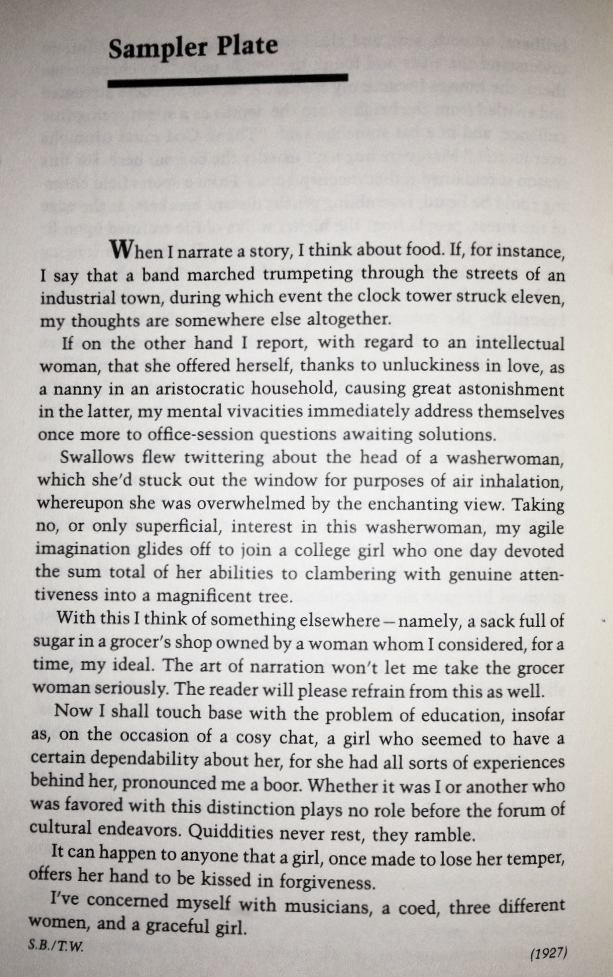
“Sampler Plate” — Robert Walser

sp

“Counterparts” — James Joyce

“Counterparts” by James Joyce

THE bell rang furiously and, when Miss Parker went to the tube, a furious voice called out in a piercing North of Ireland accent:

“Send Farrington here!”

Miss Parker returned to her machine, saying to a man who was writing at a desk:

“Mr. Alleyne wants you upstairs.”

The man muttered “Blast him!” under his breath and pushed back his chair to stand up. When he stood up he was tall and of great bulk. He had a hanging face, dark wine-coloured, with fair eyebrows and moustache: his eyes bulged forward slightly and the whites of them were dirty. He lifted up the counter and, passing by the clients, went out of the office with a heavy step.

He went heavily upstairs until he came to the second landing, where a door bore a brass plate with the inscription Mr. Alleyne. Here he halted, puffing with labour and vexation, and knocked. The shrill voice cried:

“Come in!”

The man entered Mr. Alleyne’s room. Simultaneously Mr. Alleyne, a little man wearing gold-rimmed glasses on a cleanshaven face, shot his head up over a pile of documents. The head itself was so pink and hairless it seemed like a large egg reposing on the papers. Mr. Alleyne did not lose a moment:

“Farrington? What is the meaning of this? Why have I always to complain of you? May I ask you why you haven’t made a copy of that contract between Bodley and Kirwan? I told you it must be ready by four o’clock.”

“But Mr. Shelley said, sir——”

“Mr. Shelley said, sir…. Kindly attend to what I say and not to what Mr. Shelley says, sir. You have always some excuse or another for shirking work. Let me tell you that if the contract is not copied before this evening I’ll lay the matter before Mr. Crosbie…. Do you hear me now?”

“Yes, sir.”

“Do you hear me now?… Ay and another little matter! I might as well be talking to the wall as talking to you. Understand once for all that you get a half an hour for your lunch and not an hour and a half. How many courses do you want, I’d like to know…. Do you mind me now?” Continue reading ““Counterparts” — James Joyce”

Airships, Barry Hannah’s Cult Classic of Violent Humor

In his 1978 collection Airships, Barry Hannah sets stories in disparate milieux, from the northern front of the Civil War, to an apocalyptic future, to the Vietnam War, to strange pockets of the late-twentieth century South. Despite the shifts in time and place, Airships is one of those collections of short stories that feels somehow like an elliptical, fragmentary novel. There are the stories that correspond directly to each other — the opener “Water Liars,” for instance, features (presumably, anyway), the same group of old men as “All the Old Harkening Faces at the Rail.” The old men love to crony up, gossip, tell tall tales. An outsider spoils the fun in “Water Liars” by telling a truth more terrible than any lie; in “Harkening,” an old man shows off his new (much younger) bride. These stories are perhaps the simplest in the collection, the homiest, anyway, or at least the most “normal” (whatever that means), yet they are both girded by a strange darkness, both humorous and violent, that informs all of Airships.

We find that humor and violence in an outstanding trio of Civil War stories (or, more accurately, stories set during the Civil War). The narrator of “Dragged Fighting from His Tomb,” a Confederate infantryman relates a tale of heroic slaughter with a hypberbolic, phallic force. Observe—

I knew the blueboys thought they had me down and were about ready to come in. I was in that position at Chancelorsville. There should be about six fools, I thought. I made the repeater, I killed four, and the other two limped off. Some histrionic plumehead was raising his saber up and down on the top of a pyramid of crossties. I shot him just for fun. Then I brought up another repeater and sprayed the yard.

Later, the narrator defects, switches to the Union, and claims he kills Jeb Stuart, a figure that towers over the Civil War tales. The narrator of “Dragged Fighting” hates Stuart; the narrator of “Knowing He Was Not My Kind Yet I Followed” is literally in love with the General. In contrast to the narrator of “Dragged Fighting,” the speaker in “Knowing” — an avowed “sissy” whom the other soldiers openly detest — hates the violence and madness of war—

We’re too far from home. We are not defending our beloved Dixie anymore. We’re just bandits and maniacal. The gleam in the men’s eyes tells this. Everyone is getting crazier on the craziness of being simply too far from home for decent return. It is like Ruth in the alien corn, or a troop of men given wings over the terrain they cherished and taken by the wind to trees they do not know.

He despairs when he learns of Jeb Stuart’s death. In the final Civil War story, “Behold the Husband in His Perfect Agony,” a Union spy is given the task to communicate news of Stuart’s death through enemy lines. Rather than offering further explication, let me instead point you, dear reader, to more of Hannah’s beautiful prose, of which I have not remarked upon nearly enough. From “Behold the Husband” —

Isaacs False Corn, the Indian, the spy, saw Edison, the Negro, the contact, on the column of an inn. His coat was made of stitched newspapers. Near his bare feet, two dogs failed earnestly at mating. Pigeons snatched at the pieces of things in the rushing gutter. The rains had been hard.

The short, descriptive passage rests on my ears like a poem. Hannah, who worked with Gordon Lish, evinces in his writing again and again that great editor’s mantra that writing is putting one sentence after another.

Although set in the Vietnam War, “Midnight and I’m not Famous Yet” seems an extension of the Civil War stories. In it, an officer from a small Southern town goes slowly crazy from all the killing, yet, like the narrator of “Dragged Fighting,” he presents himself as a warrior. Above all though, he laments that the war has robbed him of some key, intermediary phase of his late youth, a phase he can’t even name—

The tears were out of my jaws then. Here we shot each other up. All we had going was the pursuit of horror. It seemed to me my life had gone straight from teen-age giggling to horror. I had never had time to be but two things, a giggler and a killer.

This ironic sense of a “pursuit of horror” pervades Airships, particularly in the collection’s most apocalyptic visions. “Eating Wife and Friends” posits an America where food shortages and material scarcity leads people to eating leaves and grass — and then each other. In “Escape to Newark,” the environment is wildly out of balance—

In August it’s a hundred fifty degrees. In December it’s minus twenty-five and three feet of snow in Mississippi. In April the big trees explode.

A plan is made to “escape” these conditions via a rocket, but of course there’s not enough fuel to get past Newark. In Airships, modes of flight are transcendent but ultimately transient. Gravity’s pull is heavy stuff.

Just as Hannah’s war stories are not really war stories, his apocalypse tales are really about human relationships, which he draws in humor, pathos, and dark cynicism. In “Green Gets It,” an old man repeatedly attempts his suicide, only to fail again and again. His suicide note, written to his daughter, is scathing and shocking and sad and hilarious and wise–

My Beloved Daughter,

Thanks to you for being one of the few who never blamed me for your petty, cheerless and malign personality. But perhaps you were too busy being awful to ever think of the cause. I hear you take self-defense classes now. Don’t you understand nobody could take anything from you without leaving you richer? If I thought rape would change you, I’d hire a randy cad myself. I leave a few dollars to your husband. Bother him about them and suffer the curse of this old pair of eyes spying blind at the minnows in the Hudson.

Your Dad,

Crabfood

Although Hannah explores the darkest gaps of the soul in Airships, he also finds there a shining kernel of love in the face of waste, depravity, violence, and indifference. This love evinces most strongly perhaps in Airships trio of long stories. These tales, which hover around 30 pages, feel positively epic set against the other stories in the collection, which tend to clock in between five and ten pages. The first long story, “Testimony of Pilot,” details the development of a boyhood friendship over a few decades. It captures the strange affections and rivalries and unnameable bonds and distances that connect and disconnect any two close friends. The second of the long tales is “Return to Return,” a tragicomic Southern drama in the Oedipal vein (with plenty of tennis and alcoholism to boot). As in “Testimony of Pilot,” Hannah finds some measure of redemption, or at least solace, for his characters in their loving friendship, yet nothing could be more unsentimental. The final long story, which closes the collection, is “Mother Rooney Unscrolls the Hurt,” a daring work of stream of consciousness that seems to both respond to — and revise — Katherine Anne Porter’s “The Jilting of Granny Weatherall.” The story concludes (and of course concludes the volume) with a vision of love that corresponds to the imagery of The Pietà, a kind of selflessness that ironically confirms the self as an entity that exists in relation to the pain of others.

I could keep writing of course — I’ve barely touched on Hannah’s surrealism, a comic weirdness that I’ve never seen elsewhere; it is Hannahesque, I suppose. Nor have I detailed Hannah’s evocations of regular working class folk, fighting and drinking and divorcing and raising children (not necessarily in that order). Airships is a world too rich and fertile to unpack in just one review, and I’ve already been blathering too long, I fear, when what I really want  to do is just outright implore you, kind reader, to find it and start reading it immediately. Very highly recommended.

[Editorial note: Biblioklept published a version of this review on March 20th, 2011]
“The Romance of an Ugly Policeman” — P.G. Wodehouse

“The Romance of an Ugly Policeman” by P.G. Wodehouse

Crossing the Thames by Chelsea Bridge, the wanderer through London finds himself in pleasant Battersea. Rounding the Park, where the female of the species wanders with its young by the ornamental water where the wild-fowl are, he comes upon a vast road. One side of this is given up to Nature, the other to Intellect. On the right, green trees stretch into the middle distance; on the left, endless blocks of residential flats. It is Battersea Park Road, the home of the cliff-dwellers.

Police-constable Plimmer’s beat embraced the first quarter of a mile of the cliffs. It was his duty to pace in the measured fashion of the London policeman along the front of them, turn to the right, turn to the left, and come back along the road which ran behind them. In this way he was enabled to keep the king’s peace over no fewer than four blocks of mansions.

It did not require a deal of keeping. Battersea may have its tough citizens, but they do not live in Battersea Park Road. Battersea Park Road’s speciality is Brain, not Crime. Authors, musicians, newspaper men, actors, and artists are the inhabitants of these mansions. A child could control them. They assault and batter nothing but pianos; they steal nothing but ideas; they murder nobody except Chopin and Beethoven. Not through these shall an ambitious young constable achieve promotion.

At this conclusion Edward Plimmer arrived within forty-eight hours of his installation. He recognized the flats for what they were—just so many layers of big-brained blamelessness. And there was not even the chance of a burglary. No burglar wastes his time burgling authors. Constable Plimmer reconciled his mind to the fact that his term in Battersea must be looked on as something in the nature of a vacation.

Continue reading ““The Romance of an Ugly Policeman” — P.G. Wodehouse”

“The Ambitious Guest” — Nathaniel Hawthorne

“The Ambitious Guest” by Nathaniel Hawthorne

One September night a family had gathered round their hearth and piled it high with the driftwood of mountain-streams, the dry cones of the pine, and the splintered ruins of great trees that had come crashing down the precipice. Up the chimney roared the fire, and brightened the room with its broad blaze. The faces of the father and mother had a sober gladness; the children laughed. The eldest daughter was the image of Happiness at seventeen, and the aged grandmother, who sat knitting in the warmest place, was the image of Happiness grown old. They had found the “herb heart’s-ease” in the bleakest spot of all New England. This family were situated in the Notch of the White Hills, where the wind was sharp throughout the year and pitilessly cold in the winter, giving their cottage all its fresh inclemency before it descended on the valley of the Saco. They dwelt in a cold spot and a dangerous one, for a mountain towered above their heads so steep that the stones would often rumble down its sides and startle them at midnight.

The daughter had just uttered some simple jest that filled them all with mirth, when the wind came through the Notch and seemed to pause before their cottage, rattling the door with a sound of wailing and lamentation before it passed into the valley. For a moment it saddened them, though there was nothing unusual in the tones. But the family were glad again when they perceived that the latch was lifted by some traveller whose footsteps had been unheard amid the dreary blast which heralded his approach and wailed as he was entering and went moaning away from the door.

Though they dwelt in such a solitude, these people held daily converse with the world. The romantic pass of the Notch is a great artery through which the life-blood of internal commerce is continually throbbing between Maine on one side and the Green Mountains and the shores of the St. Lawrence on the other. The stage-coach always drew up before the door of the cottage. The wayfarer with no companion but his staff paused here to exchange a word, that the sense of loneliness might not utterly overcome him ere he could pass through the cleft of the mountain or reach the first house in the valley. And here the teamster on his way to Portland market would put up for the night, and, if a bachelor, might sit an hour beyond the usual bedtime and steal a kiss from the mountain-maid at parting. It was one of those primitive taverns where the traveller pays only for food and lodging, but meets with a homely kindness beyond all price. When the footsteps were heard, therefore, between the outer door and the inner one, the whole family rose up, grandmother, children and all, as if about to welcome some one who belonged to them, and whose fate was linked with theirs. Continue reading ““The Ambitious Guest” — Nathaniel Hawthorne”

“Je t’adore” — Robert Walser

rw

“The Skull” — Philip K. Dick

“The Skull” by Philip K. Dick

“WHAT is this opportunity?” Conger asked. “Go on. I’m interested.”

The room was silent; all faces were fixed on Conger—still in the drab prison uniform. The Speaker leaned forward slowly.

“Before you went to prison your trading business was paying well—all illegal—all very profitable. Now you have nothing, except the prospect of another six years in a cell.”

Conger scowled.

“There is a certain situation, very important to this Council, that requires your peculiar abilities. Also, it is a situation you might find interesting. You were a hunter, were you not? You’ve done a great deal of trapping, hiding in the bushes, waiting at night for the game? I imagine hunting must be a source of satisfaction to you, the chase, the stalking—”

Conger sighed. His lips twisted. “All right,” he said. “Leave that out. Get to the point. Who do you want me to kill?”

The Speaker smiled. “All in proper sequence,” he said softly.


THE car slid to a stop. It was night; there was no light anywhere along the street. Conger looked out. “Where are we? What is this place?”

The hand of the guard pressed into his arm. “Come. Through that door.”

Conger stepped down, onto the damp sidewalk. The guard came swiftly after him, and then the Speaker. Conger took a deep breath of the cold air. He studied the dim outline of the building rising up before them.

“I know this place. I’ve seen it before.” He squinted, his eyes growing accustomed to the dark. Suddenly he became alert. “This is—”

“Yes. The First Church.” The Speaker walked toward the steps. “We’re expected.”

“Expected? Here?

“Yes.” The Speaker mounted the stairs. “You know we’re not allowed in their Churches, especially with guns!” He stopped. Two armed soldiers loomed up ahead, one on each side.

“All right?” The Speaker looked up at them. They nodded. The door of the Church was open. Conger could see other soldiers inside, standing about, young soldiers with large eyes, gazing at the ikons and holy images.

“I see,” he said.

“It was necessary,” the Speaker said. “As you know, we have been singularly unfortunate in the past in our relations with the First Church.”

“This won’t help.”

“But it’s worth it. You will see.” Continue reading ““The Skull” — Philip K. Dick”

“An Immortal” — Robert Walser

walser

“Scandal” — Willa Cather

“Scandal” by Willa Cather

Kitty Ayrshire had a cold, a persistent inflammation of the vocal cords which defied the throat specialist. Week after week her name was posted at the Opera, and week after week it was canceled, and the name of one of her rivals was substituted. For nearly two months she had been deprived of everything she liked, even of the people she liked, and had been shut up until she had come to hate the glass windows between her and the world, and the wintry stretch of the Park they looked out upon. She was losing a great deal of money, and, what was worse, she was losing life; days of which she wanted to make the utmost were slipping by, and nights which were to have crowned the days, nights of incalculable possibilities, were being stolen from her by women for whom she had no great affection. At first she had been courageous, but the strain of prolonged uncertainty was telling on her, and her nervous condition did not improve her larynx. Every morning Miles Creedon looked down her throat, only to put her off with evasions, to pronounce improvement that apparently never got her anywhere, to say that tomorrow he might be able to promise something definite.

Her illness, of course, gave rise to rumours—rumours that she had lost her voice, that at some time last summer she must have lost her discretion. Kitty herself was frightened by the way in which this cold hung on. She had had many sharp illnesses in her life, but always, before this, she had rallied quickly. Was she beginning to lose her resiliency? Was she, by any cursed chance, facing a bleak time when she would have to cherish herself? She protested, as she wandered about her sunny, many-windowed rooms on the tenth floor, that if she was going to have to live frugally, she wouldn’t live at all. She wouldn’t live on any terms but the very generous ones she had always known. She wasn’t going to hoard her vitality. It must be there when she wanted it, be ready for any strain she chose to put upon it, let her play fast and loose with it; and then, if necessary, she would be ill for a while and pay the piper. But be systematically prudent and parsimonious she would not. Continue reading ““Scandal” — Willa Cather”

“A Sea of Troubles” — P.G. Wodehouse

“A Sea of Troubles” by P.G. Wodehouse

Mr Meggs’s mind was made up. He was going to commit suicide.

There had been moments, in the interval which had elapsed between the first inception of the idea and his present state of fixed determination, when he had wavered. In these moments he had debated, with Hamlet, the question whether it was nobler in the mind to suffer, or to take arms against a sea of troubles and by opposing end them. But all that was over now. He was resolved.

Mr Meggs’s point, the main plank, as it were, in his suicidal platform, was that with him it was beside the question whether or not it was nobler to suffer in the mind. The mind hardly entered into it at all. What he had to decide was whether it was worth while putting up any longer with the perfectly infernal pain in his stomach. For Mr Meggs was a martyr to indigestion. As he was also devoted to the pleasures of the table, life had become for him one long battle, in which, whatever happened, he always got the worst of it.

He was sick of it. He looked back down the vista of the years, and found therein no hope for the future. One after the other all the patent medicines in creation had failed him. Smith’s Supreme Digestive Pellets—he had given them a more than fair trial. Blenkinsop’s Liquid Life-Giver—he had drunk enough of it to float a ship. Perkins’s Premier Pain-Preventer, strongly recommended by the sword-swallowing lady at Barnum and Bailey’s—he had wallowed in it. And so on down the list. His interior organism had simply sneered at the lot of them.

‘Death, where is thy sting?’ thought Mr Meggs, and forthwith began to make his preparations. Continue reading ““A Sea of Troubles” — P.G. Wodehouse”

“William Wilson” — Edgar Allan Poe


“William Wilson” by Edgar Allan Poe

What say of it? what say of CONSCIENCE grim, That spectre in my path? Chamberlayne’s Pharronida.

LET me call myself, for the present, William Wilson. The fair page now lying before me need not be sullied with my real appellation. This has been already too much an object for the scorn—for the horror—for the detestation of my race. To the uttermost regions of the globe have not the indignant winds bruited its unparalleled infamy? Oh, outcast of all outcasts most abandoned!—to the earth art thou not forever dead? to its honors, to its flowers, to its golden aspirations?—and a cloud, dense, dismal, and limitless, does it not hang eternally between thy hopes and heaven?

I would not, if I could, here or to-day, embody a record of my later years of unspeakable misery, and unpardonable crime. This epoch—these later years—took unto themselves a sudden elevation in turpitude, whose origin alone it is my present purpose to assign. Men usually grow base by degrees. From me, in an instant, all virtue dropped bodily as a mantle. From comparatively trivial wickedness I passed, with the stride of a giant, into more than the enormities of an Elah-Gabalus. What chance—what one event brought this evil thing to pass, bear with me while I relate. Death approaches; and the shadow which foreruns him has thrown a softening influence over my spirit. I long, in passing through the dim valley, for the sympathy—I had nearly said for the pity—of my fellow men. I would fain have them believe that I have been, in some measure, the slave of circumstances beyond human control. I would wish them to seek out for me, in the details I am about to give, some little oasis of fatality amid a wilderness of error. I would have them allow—what they cannot refrain from allowing—that, although temptation may have erewhile existed as great, man was never thus, at least, tempted before—certainly, never thus fell. And is it therefore that he has never thus suffered? Have I not indeed been living in a dream? And am I not now dying a victim to the horror and the mystery of the wildest of all sublunary visions?

I am the descendant of a race whose imaginative and easily excitable temperament has at all times rendered them remarkable; and, in my earliest infancy, I gave evidence of having fully inherited the family character. As I advanced in years it was more strongly developed; becoming, for many reasons, a cause of serious disquietude to my friends, and of positive injury to myself. I grew self-willed, addicted to the wildest caprices, and a prey to the most ungovernable passions. Weak-minded, and beset with constitutional infirmities akin to my own, my parents could do but little to check the evil propensities which distinguished me. Some feeble and ill-directed efforts resulted in complete failure on their part, and, of course, in total triumph on mine. Thenceforward my voice was a household law; and at an age when few children have abandoned their leading-strings, I was left to the guidance of my own will, and became, in all but name, the master of my own actions. Continue reading ““William Wilson” — Edgar Allan Poe”

“Old Red” by Caroline Gordon

“Old Red” by Caroline Gordon

I

WHEN THE DOOR HAD closed behind his daughter, Mr. Maury went to the window and stood a few moments looking out. The roses that had grown in a riot all along that side of the fence had died or been cleared away, but the sun lay across the garden in the same level lances of light that the remembered. He turned back into the room. The shadows had gathered until it was nearly all in gloom. The top of his minnow bucket just emerging from his duffel bag glinted in the last rays of the sun. He stood looking down at his traps all gathered neatly in a heap at the foot of the bed. He would leave them like that. Even if they came in here sweeping and cleaning up — it was only in hotels that a man was master of his own room — even if they came in here cleaning up he would tell them to leave all his things exactly as they were. It was reassuring to see them all there together, ready to be taken up in the hand to be carried down and put into a car, to be driven off to some railroad station at a moment’s notice.

As he moved toward the door he spoke aloud, a habit that was growing on him:

“Anyhow I won’t stay but a week…. I ain’t going to stay but a week, no matter what they say….”

Downstairs in the dining room they were already gathered at the supper table: his white-haired, shrunken mother in-law; his tall sister-in-law who had the proud carriage of the head, the aquiline nose, but not the spirit of his dead wife; his lean, blond, new son-in-law; his black eyed daughter who, but that she was thin, looked so much like him, all of them gathered there waiting for him, Alexander Maury. It occurred to him that this was the first time he had sat down in the bosom of the family for some years. They were always writing saying that he must make a visit this summer or certainly next summer — “. . . all had a happy Christmas together, but missed you….” They had even made the pretext that he ought to come up to inspect his new son-in-law. As if he hadn’t always known exactly the kind of young man Sarah would marry! What was the boy’s name? Stephen, yes, Stephen. He must be sure and remember that.

He sat down and, shaking out his napkin, spread it over his capacious paunch and tucked it well up under his chin in the way his wife had never allowed him to do. He let his eyes rove over the table and released a long sigh.

“Hot batter bread,” he said, “and ham. Merry Point ham. I sure am glad to taste them one more time before I die.”

The old lady was sending the little Negro girl scurrying back to the kitchen for a hot plate of batter bread. He pushed aside the cold plate and waited. She had bundled when he spoke of the batter bread and a faint flush had dawned on her withered cheeks. Vain she had always been as a peacock, of her housekeeping, her children, anything that belonged to her. She went on now, even at her advanced age, making her batter bread, smoking her hams according to that old recipe she was so proud of, but who came here now to this old house to eat or to praise?

He helped himself to a generous slice of batter bread, buttered it, took the first mouthful and chewed it slowly. He shook his head.

“There ain’t anything like it,” he said. “There ain’t anything else like it in the world. ”

His dark eye roving over the table fell on his son-in-law. “You like batter bread?” he inquired. Continue reading ““Old Red” by Caroline Gordon”

“Was” by William Faulkner

“Was” by William Faulkner

Isaac McCaslin, ‘Uncle Ike’, past seventy and nearer eighty than he ever corroborated any more, a widower now and uncle to half a county and father to no one

this was not something participated in or even seen by himself, but by his elder cousin, McCaslin Edmonds, grandson of Isaac’s father’s sister and so descended by the distaff, yet notwithstanding the inheritor, and in his time the bequestor, of that which some had thought then and some still thought should have been Isaac’s, since his was the name in which the title to the land had first been granted from the Indian patent and which some of the descendants of his father’s slaves still bore in the land. But Isaac was not one of these:-a widower these twenty years, who in all his life had owned but one object more than he could wear and carry in his pockets and his hands at one time, and this was the narrow iron cot and the stained lean mattress which he used camping in the woods for deer and bear or for fishing or simply because he loved the woods; who owned no property and never desired te since the earth was no man’s but all men’s, as light and air and weather were; who lived still in the cheap frame bungalow in Jefferson which his wife’s father gave them on their marriage and which his wife had willed to him at her death and which he had pretended to accept, acquiesce to, to humor her, ease her going but which was not his, will or not, chancery dying wishes mortmain possession or whatever, himself merely holding it for his wife’s sister and her children who had lived in it with him since his wife’s death, holding himself welcome to live in one room of it as he had during his wife’s time or she during her time or the sister-in-law and her children during the rest of his and after not something he had participated in or even remembered except from the hearing, the listening, come to him through and from his cousin McCaslin born in 1850 and sixteen years his senior and hence, his own father being near seventy when Isaac, an only child, was born. rather his brother than cousin and rather his father than either, out of the old time, the old days.

When he and Uncle Buck ran back to the house from discovering that Tomey’s Turl had run again, they heard Uncle Buddy cursing and bellowing in the kitchen, then the fox and the dogs came out of the kitchen and crossed the hall into the dogs’ room and they heard them run through the dogs’ room into his and Uncle Buck’s room then they saw them cross the hall again into Uncle Buddy’s room and heard them run through Uncle Buddy’s room into the kitchen. Where Uncle Buddy was picking the breakfast up out of the ashes and wiping it off with his apron. “What in damn’s hell do you mean,” he said “turning that damn fox out with the dogs all loose in the house?”

“Damn the fox” Uncle Buck said. “Tomey’s Turl has broke out again. Give me and Cass some breakfast quick we might just barely catch him before he gets there.” Continue reading ““Was” by William Faulkner”