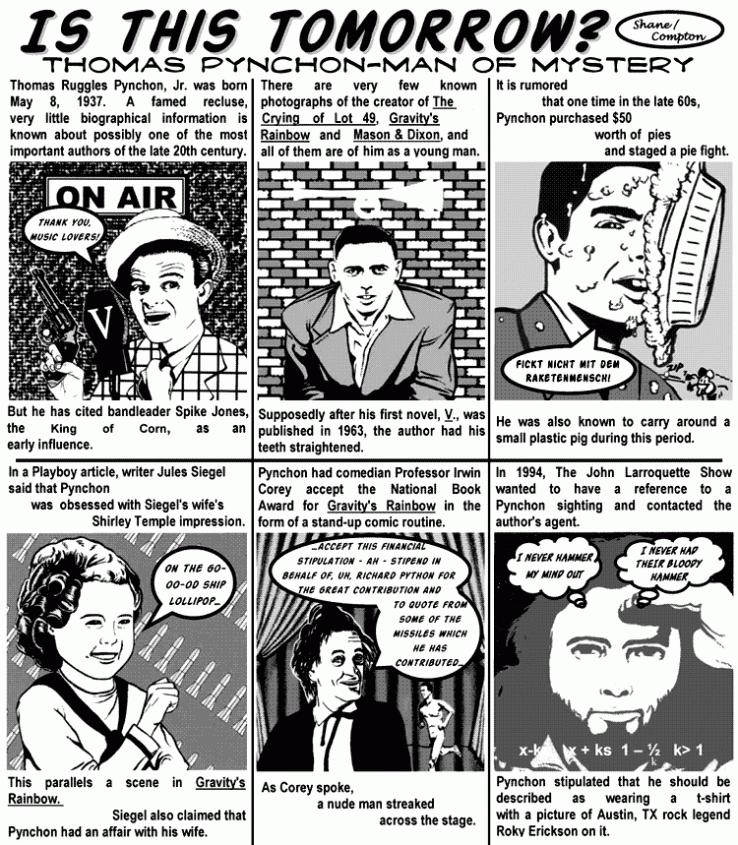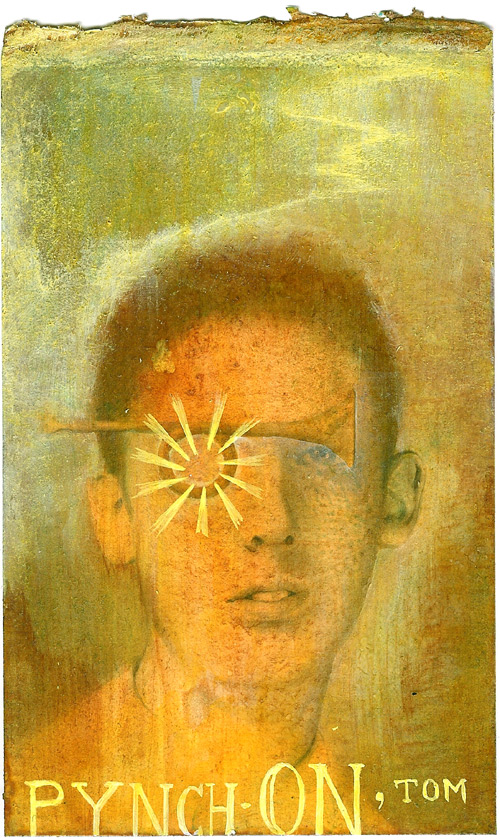
“Ye Legend of Sir Stupid and the Purple Knight” — Thomas Pynchon (Juvenilia)

“Ye Legend of Sir Stupid and the Purple Knight” was published in Thomas Pynchon’s high school newspaper; he was 16 at the time. (Via).

“Ye  Legend of Sir Stupid and the Purple Knight”


“Ridiculous!” roared King Arthur, slamming his beer mug on the Round Table. “Purple, you say?”

“All purple, my liege,” said Sir Launcelot, nervously wiping the foam from his face, “head to toes. Completely.”

“I say! Most irregular. Well, what does he want?”

“He wants audience with you, my liege. It seems he’s done ole Cholmondesley in.”

“Cholmondesley?”

“With an axe, your grace. A purple axe. He says he’ll do the same to us all if we don’t send a challenger to fight him in fair battle.”“Well?”

“Well, he— he’s— twenty feet tall.”

“Twenty! Oh, I say! Ghastly business! Who’ve we got crazy enough to fight him? How about you, Launcelot?”

“Oh, no, my liege. Cut my finger last night peeling potatoes. The pain is beastly.”

“Rotten luck, old chap. Well,” he addressed the knights of the round table, “there’s a big purple idiot outside who’s looking for a fight. Who’s game?”

Then up spake Sir Bushwack, a sturdy youth with a broad beam and a low center of gravity: “Where is the bloke? I’m not afraid, even if he is twenty feet taII!” Sir Bushwack had been drinking.

Then spake King Arthur to Sir Launcelot, telling him to bid the knight enter. And Launcelot did this, and the horns sounded, and in staggered a tremendous giant, perhaps four feet in height, dragging behind him a ten-foot purple axe. He had a vast quantity of purple hair which fell down over his eyes, and was clad in purple armor, and his feet in purple sneakers. He led a noble steed, also purple, which resembled a cross between a Shetland pony and an armadillo.

King Arthur whispered to Launcelot, “I thought you said he was twenty feet tall.”“That’s what he told me, your majesty.”

“That’s what he what? Why you …”

The rest of King Arthur’s tirade was drowned out by the purple giant, who was bellowing in a mighty voice:

“Okay, I can beat any man in the house! I ain’t scared of nobody ‘cause you’re all … “ he hiccoughed “ … chicken to fight me! Come on, who’s first?”

Up spake Sir Bushwack, shouting, “I challenge thee, Sir Knight!” The purple knight laughed. “Look what’sh challenging me! You slob, I can,—hic—can lick you with, — hic— one hand tied behind my back! Come ahead!” Then did the purple knight pick up the purple axe and begin to whirl it about his head, faster and faster. Sir Bushwack waddled up dubiously with sword in hand, feebly attempted to parry, then quickly retreated. The purple knight stood and laughed.

“Chicken, all of you! Scared to fight me! Har! Har!”

Suddenly, the horns sounded and into the hall rushed a very brave and manly knight, Sir Stupid.

“I say!” he shouted to all and sundry, “Old Fotheringay’s run amok! He and his horse fell into that newly-pressed grape juice up at the distillery, and …”.

Then he caught sight of the purple knight and stopped short. King Arthur started to laugh hysterically, spilling beer hither and yon.

“I say, old Fotheringay’s gone and fallen into the wine vat! Old Fotheringayl Haw, Haw, Haw! Old Fotheringay’s got high on grape juice! Haw! In the still of the knight!”

Old Fotheringay stood digesting this in silence. Then slowly he began to chuckle and whirl that axe.

“Oh, oh,” Sir Stupid whispered to Arthur, “here he goes!” With a savage yell, Old Fotheringay charged the Round Table, swinging his axe. In an instant, the hall became the scene of a free-for-all. The purple knight was in the thick of the whole mess, smashing furniture, beer kegs, and anything else that happened to be in his way. The hall resounded with the clanging of swords, the splintering of wood, and the demonaical chuckling of the purple knight. In the midst of the noise and confusion, Sir Stupid buttonholed Bushwack.

“Noble knight,” he said, “art thou truly dedicated to thy leige?”

“Yes.”

“And wouldst thou suffer discomfort to rid thy liege of this menace?”

“Surely,” Sir Bushwack said absently, as he ducked a flying beer mug.

“That’s all I wanted to know! Fotheringay! You feeble-minded halfwit cretin! Over here!”

Infuriated, the purple knight whirled toward Sir Stupid and raised his axe. Sir Stupid lifted the protesting Bushwack and hurled him bodily at Fotheringay. There was a loud, splintering smash as the purple knight went down, and then all was silent, except for the gurgling of beer from a shattered keg. Sir Stupid stood over the horizontal Fotheringay.

“Now, thou proud knight,” roared Sir Stupid triumphantly, “now what hast thou to say?”

Slowly, the purple knight looked up and sneered. “CHICKEN,” he said.

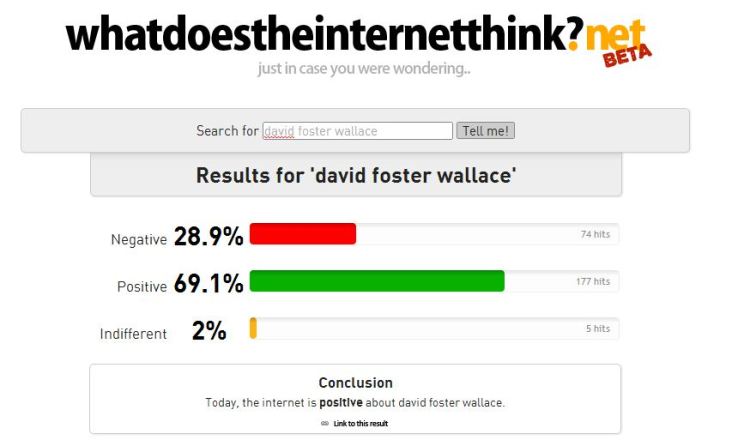
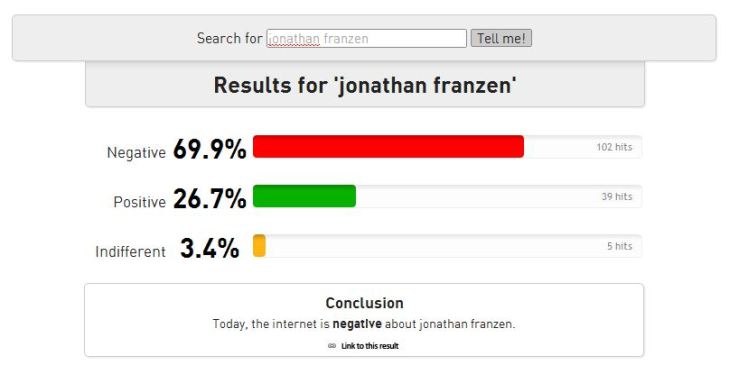
What Does the Internet Think About DFW, Franzen, Lydia Davis, Bolaño, Atwood, and Some Other Contemporaryish Writers?

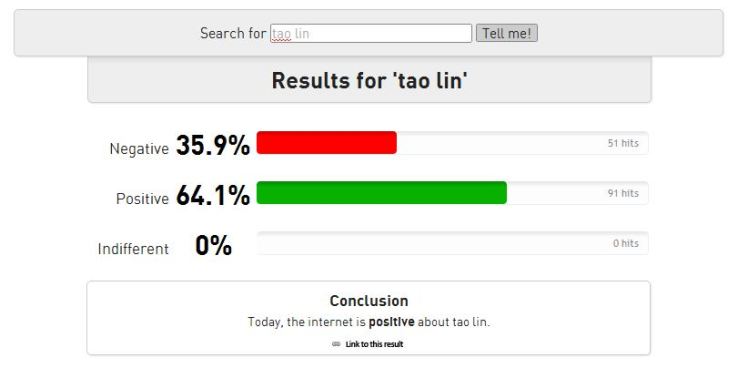
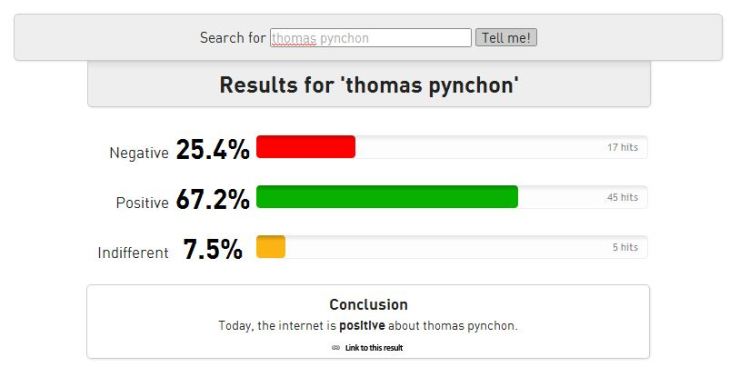
What Does the Internet Think? is a somewhat addictive site that aggregates and analyzes opinions on the internet — I’m not sure exactly how it does this, but it’s fun. I plugged in a few writers this morning (when I should have been working) and here share the results (and, yes, I know that this means almost nothing. Just for fun).


Six (More) Stoner Novels (And a Bonus Short Story)

A few years ago, to celebrate 4/20, Sam Munson at the Daily Beast wrote an article praising “The Best Stoner Novels.” Not a bad list—Wonder Boys, sure, Invisible Man, a bit of a stretch, The Savage Detectives, a very big stretch, but sure, why not. Anyway, six more stoner novels (not that we advocate the smoking of the weed)—

Junkie, William Burroughs

Burroughs’s (surprisingly lucid) early novel Junkie may take its name from heroin, but it’s full of weed smoking. Lesson: weed smoking leads to heroin. And the inevitable search for yage.

Inherent Vice, Thomas Pynchon

Doc Sportello, the wonky PI at the off-center of Pynchon’s California noir, is always in the process of lighting another joint, if not burning his fingers on the edges of a roach. A fuzzy mystery with smoky corners.

Infinite Jest, David Foster Wallace

Hal Incandenza, protagonist of Wallace’s opus, spends much of his time hiding in the tunnels of Enfield Tennis Academy, feeding his bizarre marijuana addiction, which is, in many ways, more of an addiction to a secret ritual than to a substance. Hal’s hardly the only character in IJ who likes his Mary Jane; there’s a difficult section near the novel’s beginning that features a minor character preparing to go on a major weed binge. His pre-smoking anxiety works as a challenge to any reader seeking to enter the world of Infinite Jest.

The Lord of the Rings, J.R.R. Tolkien

I’m pretty sure “pipe-weed” isn’t tobacco.

Chronic City, Jonathan Lethem

I kind of hated Chronic City, a novel where characters seem to light up joints on every other page. It seems to have been written in an ambling, rambling fog, absent of any sense of immediacy, urgency, or, uh, plot. Bloodless stuff, but, again, very smoky.

Stoner, John Williams

Okay. Stoner has nothing to do with marijuana. But, hey, it’s called Stoner, right?

Bonus short story: Raymond Carver’s “Cathedral”

Carver’s classic story features a myopic narrator who comes up against his own shortcomings when he meets an old friend of his wife, a blind man who ironically sees deeper than he does. After drinking too much booze, they spark up, share a doob, and take in a documentary about European cathedrals. Great stuff.


William Gaddis on the Pulitzer Prize: “The Ultimate Seal of Mediocrity”

In William Gaddis’s last novel Agapē Agape (2002), our embittered narrator excoriates the Pulitzer Prize:

. . . write what they want you’ll end up with a Pulitzer Prize follow you right to the grave. Maybe won the Medal of honor the George Cross even the Nobel but once you’ve been stigmatized with the ultimate seal of mediocrity your obit will read Pulitzer Prize Novelist Dies at whatever because they’re not advertising the winner no. No, like this whole plague of prizes wherever you look, it’s the prize givers promoting themselves, trying to rescue their thoroughly discredited profession of journalism. “The press is a school that serves to turn men into brutes,” Flaubert writes to George Sand “because it relieves them from thinking.” The prize winners? They’re just props, cartoonists, sports writers, political pundits, front page photos the bloodier the better for that instant of fame wrap the fish in tomorrow, good God how many Pulitzer Prizes are there? Over fifteen hundred entries, fourteen categories for journalists because if you started your bondage there you’re halfway home with that whole gang of sponsors, trustees, juries, God knows what who’ve survived that Slough of Despond and floated to the top. Just look at the next day’s New York Times, page after page bulging with self-congratulation with seven more categories to leech on, music, what they call drama and of course books where the Grey Lady finally got it both ways with their journalist who reviews books, like the misty-eyed ingenue but also destroys women writers and just for fairness crosses the gender line for an occasional assassination, give that lady a Pulitzer with oak leaf clusters! The books that are candidates are read by a jury whose decisions are passed up to the Olympian trustees with an eye to the multitude. We are thousands and they are millions, write the fiction they want or don’t write at all, ruling out Pound’s cry for the new, the challenging or what’s labeled difficult, so when Gravity’s Rainbow is being devoured by college youth everywhere and wins the National Book Award, its unanimous recommendation is overturned by the trustees for a double-talk spoof of academic vagaries by a bogus “Professor,” to everyone’s relief, and the author at peril escapes unblemished by the, no, no, no you can’t depend on it.
Thomas Pynchon’s Banana Breakfast

Another literary recipe to celebrate Thanksgiving—

At the beginning of Thomas Pynchon’s massive tome Gravitys Rainbow, Captain Geoffrey “Pirate” Prentice cooks up a bodacious banana breakfast for a bunch of hung over army officers—

Routine: plug in American blending machine won from some Yank last summer, some poker game, table stakes, B.O.Q. somewhere in the north, never remember now….Chop several bananas into pieces. Make coffee in urn. Get can of milk from cooler. Puree ‘nanas in milk. Lovely. I would coat all the booze-corroded stomachs of England. . . . Bit of marge, still smells all right, melt in the skillet. Peel more bananas, slice lengthwise. Marge sizzling, in go long slices. Light oven whoomp blow us all up someday oh, ha, ha, yes. Peeled whole bananas to go on broiler grill soon as it heats. Find marshmallows. . . .

Here’s how it all turns out–

With a clattering of chairs, upended shell cases, benches, and ottomans, Pirate’s mob gather at the shores of the great refectory table, a southern island well across a tropic or two from chill Corydon Throsp’s mediaeval fantasies, crowded now over the swirling dark grain of its walnut uplands with banana omelets, banana sandwiches, banana casseroles, mashed bananas molded into the shape of a British lion rampant, blended with eggs into batter for French toast, squeezed out a pastry nozzle across the quivering creamy reaches of a banana blancmange to spell out the words C’est magnifique, mais ce n’est pas la guerre (attributed to a French observer during the Charge of the Light Brigade) which Pirate has appropriated as his motto . . . tall cruets of pale banana syrup to pour oozing over banana waffles, a giant glazed crock where diced bananas have been fermenting since the summer with wild honey and muscat raisins, up out of which, this winter morning, one now dips foam mugsfull of banana mead . . . banana croissants and banana kreplach, and banana oatmeal and banana jam and banana bread, and bananas flamed in ancient brandy Pirate brought back last year from a cellar in the Pyrenees also containing a clandestine radio transmitter. . . .

“The Best Reader Is One Who Is Most Open to Human Possibility” — Don DeLillo

From a 1982  NYT profile of Don DeLillo. DeLillo talks Pynchon, Gaddis, and reader responsibility.

THE writer to whom Mr. DeLillo has most often been likened and for whom he has great respect is Thomas Pynchon. ”Somebody quoted Norman Mailer as saying that he wasn’t a better writer because his contemporaries weren’t better,” he says. ”I don’t know whether he really said that or not, but the point I want to make is that no one in Pynchon’s generation can make that statement. If we’re not as good as we should be it’s not because there isn’t a standard. And I think Pynchon, more than any other writer, has set the standard. He’s raised the stakes.”

Mr. DeLillo also praises William Gaddis for extending the possibilities of the novel by taking huge risks and making great demands on his readers. Yet many readers complain about the abstruseness of much contemporary writing.

”A lot of characters,” Mr. DeLillo says, ”have become pure act. The whole point in certain kinds of modern writing is that characters simply do what they do. There isn’t a great deal of thought or sentiment or literary history tied up in the actions of characters. Randomness is always hard to absorb.”

Mr. DeLillo believes that it is vital that readers make the effort. ”The best reader,” he says, ”is one who is most open to human possibility, to understanding the great range of plausibility in human actions. It’s not true that modern life is too fantastic to be written about successfully. It’s that the most successful work is so demanding.” It is, he adds, as though our better writers ”feel that the novel’s vitality requires risks not only by them but by readers as well. Maybe it’s not writers alone who keep the novel alive but a more serious kind of reader.”

“Entering The Pale King Is Like Entering a Familiar Room, Now Stripped Bare”

At Seven Steps Back, there’s a marvelous series of posts—a long essay, really, broken down into digestible blog chunks—about David Foster Wallace’s The Pale King. The piece is easily one of the better analyses I’ve read about Wallace’s last book, well researched and well written through an intertextual lens. A taste, a riff on Wallace’s names—

Entering The Pale King is like entering a familiar room, now stripped bare, but with the footprints of its former occupant, your departed friend, still visible in the dust on the floor. For example, the good old names are back, strange and unharmonious, vaguely Germanic, Latinate, French, at root un-American; names like Lotwis and Glendenning and Bondurant and Henzke, not zany and humorous like Pynchon’s (it seems to me that the names and the scope of his books are the only reasons he has been called an epigone to Pynchon, nothing else), but rather like clothes one cannot find it in himself to feel at ease in, even though they aren’t tight or loose, but just right. They also seem like they were once normal, everyday names –names like George Smith and Janet Cooper– but at some point were taken apart and reconstructed by a neurotic tinkerer, in order to establish how long they can go on working before exploding.

Six (More) Stoner Novels (And a Bonus Short Story)

One year ago, to celebrate 4/20, Sam Munson at the Daily Beast wrote an article praising “The Best Stoner Novels.” Not a bad list—Wonder Boys, sure, Invisible Man, a bit of a stretch, The Savage Detectives, a very big stretch, but sure, why not. Anyway, six more stoner novels (not that we advocate the smoking of the weed)—

Junkie, William Burroughs

Burroughs’s (surprisingly lucid) early novel Junkie may take its name from heroin, but it’s full of weed smoking. Lesson: weed smoking leads to heroin. And the inevitable search for yage.

Inherent Vice, Thomas Pynchon

Doc Sportello, the wonky PI at the off-center of Pynchon’s California noir, is always in the process of lighting another joint, if not burning his fingers on the edges of a roach. A fuzzy mystery with smoky corners.

Infinite Jest, David Foster Wallace

Hal Incandenza, protagonist of Wallace’s opus, spends much of his time hiding in the tunnels of Enfield Tennis Academy, feeding his bizarre marijuana addiction, which is, in many ways, more of an addiction to a secret ritual than to a substance. Hal’s hardly the only character in IJ who likes his Mary Jane; there’s a difficult section near the novel’s beginning that features a minor character preparing to go on a major weed binge. His pre-smoking anxiety works as a challenge to any reader seeking to enter the world of Infinite Jest.

The Lord of the Rings, J.R.R. Tolkien

I’m pretty sure “pipe-weed” isn’t tobacco.

Chronic City, Jonathan Lethem

I kind of hated Chronic City, a novel where characters seem to light up joints on every other page. It seems to have been written in an ambling, rambling fog, absent of any sense of immediacy, urgency, or, uh, plot. Bloodless stuff, but, again, very smoky.

Stoner, John Williams

Okay. Stoner has nothing to do with marijuana. But, hey, it’s called Stoner, right?

Bonus short story: Raymond Carver’s “Cathedral”

Carver’s classic story features a myopic narrator who comes up against his own shortcomings when he meets an old friend of his wife, a blind man who ironically sees deeper than he does. After drinking too much booze, they spark up, share a doob, and take in a documentary about European cathedrals. Great stuff.


Thomas Pynchon’s Banana Breakfast

At the beginning of Thomas Pynchon’s massive tome Gravitys Rainbow, Captain Geoffrey “Pirate” Prentice cooks up a bodacious banana breakfast for a bunch of hung over army officers—

Routine: plug in American blending machine won from some Yank last summer, some poker game, table stakes, B.O.Q. somewhere in the north, never remember now….Chop several bananas into pieces. Make coffee in urn. Get can of milk from cooler. Puree ‘nanas in milk. Lovely. I would coat all the booze-corroded stomachs of England. . . . Bit of marge, still smells all right, melt in the skillet. Peel more bananas, slice lengthwise. Marge sizzling, in go long slices. Light oven whoomp blow us all up someday oh, ha, ha, yes. Peeled whole bananas to go on broiler grill soon as it heats. Find marshmallows. . . .

Here’s how it all turns out–

With a clattering of chairs, upended shell cases, benches, and ottomans, Pirate’s mob gather at the shores of the great refectory table, a southern island well across a tropic or two from chill Corydon Throsp’s mediaeval fantasies, crowded now over the swirling dark grain of its walnut uplands with banana omelets, banana sandwiches, banana casseroles, mashed bananas molded into the shape of a British lion rampant, blended with eggs into batter for French toast, squeezed out a pastry nozzle across the quivering creamy reaches of a banana blancmange to spell out the words C’est magnifique, mais ce n’est pas la guerre (attributed to a French observer during the Charge of the Light Brigade) which Pirate has appropriated as his motto . . . tall cruets of pale banana syrup to pour oozing over banana waffles, a giant glazed crock where diced bananas have been fermenting since the summer with wild honey and muscat raisins, up out of which, this winter morning, one now dips foam mugsfull of banana mead . . . banana croissants and banana kreplach, and banana oatmeal and banana jam and banana bread, and bananas flamed in ancient brandy Pirate brought back last year from a cellar in the Pyrenees also containing a clandestine radio transmitter. . . .

The AV Club Interviews China Miéville

The AV Club interviews author China Miéville about his new book, Kraken. From the interview:

Kraken is a very undisciplined book. That’s a gamble. If it doesn’t come off, it’s disastrous. But there are pleasures, I think, to a meandering lack of discipline that you can’t get the other way, and vice versa. You gain something and you lose something. My second book, Perdido Street Station, was the one that a lot of people really, really liked, and it was tremendously sort of rumbustious and ill-disciplined. I feel like I’ve been getting increasingly disciplined since then, and some readers seem to miss that kind of amiable chaos. What I wanted to do with Kraken is tap into what you’ve kindly called an eruption. I wanted to indulge that. It does have a very different feel than The City & The City. It obviously won’t work for everyone, but I always think about books like—and I don’t mean this hubristically—Gravity’s Rainbow. If Gravity’s Rainbow is anything, it’s kind of this dreamlike meander. The idea of saying to Pynchon, “You know, you need to tighten this up,” it would destroy it. Kraken was an effort to tap into that same kind of pleasurable ramble. In some ways, Kraken is more like Perdido, whereas The City & The City was a departure. It’s the kind of thing I’d like to do a lot more of. In some ways, this was getting back to what I was better known for.

The Music of Pynchon’s Inherent Vice

Thomas Pynchon‘s latest novel, Inherent Vice is loaded with musical references–the radio’s always buzzing, bands are always hammering out jams, and hero Doc Sportello is always singing a verse or two. Wouldn’t it be cool if someone would take the time to make a playlist of all the tunes in the book? Okay, that was a lame set-up. Obviously somebody did take the time, and according to the text accompanying the original list at Amazon (yeah, I’m shamelessly cutting and pasting and also saving you time), “the playlist that follows is designed exclusively for Amazon.com, courtesy of Thomas Pynchon.” Hmmmm…wonder if Pynchon made the list himself–after all, he writes his own book jacket blurbs, and he even narrated the trailer for Inherent Vice. Pretty cool. Links go to downloads (not free, sorry) or artist pages. In cases of no links, the band or artist is one of Pynchon’s original creations (although we’d really, really love to hear “Soul Gidget,” or really anything by Meatball Flag). Bonus vid after the list.