Books Acquired, 2.16.2012

20120216-191500.jpg

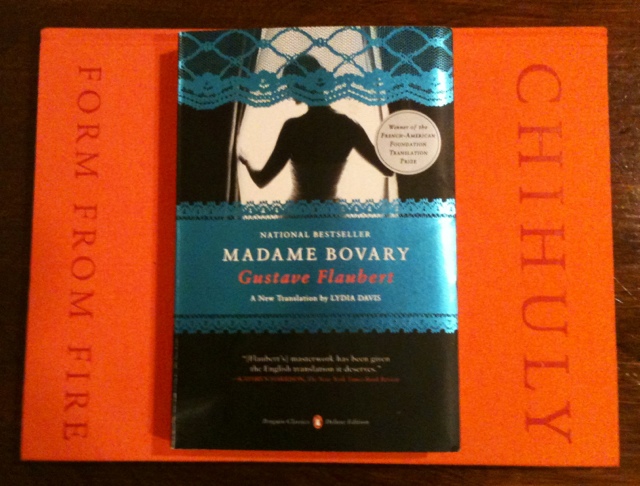
The Chihuly book was too beautiful not to pick up for my wife—cloth bound and so orange. I picked it up along with Lydia Davis’s translation of Madame Bovary this afternoon at my fave used bookshop; ostensibly, I was searching for a copy of the Mutis book Noquar reviewed here this week, but who really needs a legit reason to browse the stacks?

20120216-192716.jpg

Read an Excerpt from Stuart Kendall’s New Translation of Gilgamesh

Contra Mundum Press is publishing a new translation of the epic of Gilgamesh by renowned translator and scholar Stuart Kendall, who has translated works by Bataille, Blanchot, and Debord, among others. You can read (and download if you like) a good chunk of this text now. It’s good stuff.

“Some Factors Determining the Quality of a Translation” — Lydia Davis

From Lydia Davis’s insightful and entertaining essay “Some Notes on Translation and on Madame Bovary,” from issue 198 of The Paris Review

The quality and nature of a translation (let’s say from the French) depends on at least three things: the translator’s knowledge of French language, history, and culture; his or her conception of the task of the translation; and his or her ability to write well in English. These three variables have subsets that can recombine infinitely, which is why one work can have such widely differing translations. Publishers selecting a translator seem to proceed on the assumption that the most important qualification is the first. “Let’s ask Professor X, head of the French department at Y!” Often they completely ignore the second factor—how will Professor X approach the task of translating?—and certainly the third—what is Professor X’s writing style like? All three factors are vital, but in many instances, if one has to rank them, the third—how well the translator writes—may be the most important qualification, followed closely or equaled by the second—how he or she approaches translating, and it is the first that comes in last place, since minor lapses in a knowledge of the language, history, and culture may result in mistakes that are, in a beautifully written, generally faithful version, fairly easily corrected, whereas a misconception of the task of the translator and, worse, an inability to write well will doom the entire book through its every sentence.

Contra Mundum Press

Some of the good people at Hyperion, the journal of the Nietzsche Circle, have begun a new publishing venture: Contra Mundum Press. Their first project is a new translation of the Gilgamesh epic by Stuart Kendall; it should be ready next month. In December, CMP is planning to release the first English language translation of Nietzsche’s “Greek Music Drama.” Their list of future titles looks quite promising, and it’s always great to see a new indie publisher making a go of it in an era where print books are being eulogized (with no small level of hyperbole) on what seems to be a weekly basis.

“How to Recognize a Piece of Art” — Roberto Bolaño on the Power of Translation

A sample of Roberto Bolaño’s short essay “Translation Is an Anvil” (from New Directions’ forthcoming Between Parentheses, a collection of Bolaño’s essays, newspaper columns, and other ephemera)——

How to recognize a work of art? How to separate it, even if just for a moment, from its critical apparatus, its exegetes, its tireless plagiarizers, its belittlers, its final lonely fate? Easy. Let it be translated. Let its translator be far from brilliant. Rip pages from it at random. Leave it lying in an attic. If after all of this a kid comes along and reads it, and after reading makes it his own, and is faithful to it (or unfaithful, whichever) and reinterprets it and accompanies it on its  voyage to the edge, and both are enriched and the kid adds an ounce of value to its original value, then we have something before us, a machine or a book, capable of speaking to all human beings; not a plowed field but a mountain, not the image of a dark forest but the dark forest, not a flock of birds but the Nightingale.

Ethical Realism (and Grim Decadence) in Hans Fallada’s Wolf Among Wolves

On the heels of last year’s hugely successful first-time-in-English publication of Every Man Dies Alone, the good folks at Melville House have issued another of Hans Fallada’s epic novels, Wolf Among Wolves. Set during Germany’s 1923 economic collapse, Wolf centers on Wolfgang Pagel, a former soldier and itinerant gambler languishing in the corruption of Weimar Berlin.The beginning of the novel focuses on a single summer day in Berlin; Fallada’s naturalist, realist eye paradoxically puts all the minutiae of this world under a microscope even as it expands to capture a holistic vision of life in morally-decadent, post-war Germany. The effect is both devastating and enlightening. It is epic realism, the condensation of the everyday existence of an alien world. Another paradox–behind Fallada’s omniscient, steady, neutral narrative, so plain and descriptive and frank, there lies another voice, a moral, ethical voice that prompts Pagel to transcend the wolf-eat-wolf world. Indeed, Fallada presents a vision of moral cooperation in a world dominated by self-interest. Here’s a passage describing some of Berlin’s heady post-war decadence:

But the girls were the worst. They strolled about calling, whispering, taking people’s arms, running alongside men, laughing. Some girls exposed their bodies in a way that was revolting. A market of flesh–white flesh bloated with drink, and lean dark flesh which seemed to have been burned up by spirits. But worst of all were the entirely shameless, the almost sexless: the morphine addicts with their contracted pupils, the cocaine sniffers with their white noses, and the cocaine addicts with high-pitched voices and irrepressibly twitching faces. They wriggled, they jiggled their flesh in low-cut or cunningly-slashed blouses, and when they made room for you or went round a corner they picked up their skirts (which, even so, didn’t reach their knees), exhibiting between stockings and drawers a strip of pale flesh and a green or pink garter. They exchanged remarks about passing men, bawled obscenities to each other across the street, and their greedy eyes searched among the slowly drifting crowd for foreigners who might be expected to have foreign currency in their pockets.

Melville House’s edition of Wolf Among Wolves is the first unabridged English translation ever–scholars Thorsten Carstensen and Nicholas Jacobs have restored  passages originally omitted in Philip Owens’s contemporaneous translation.In his insightful afterward, Carstensen addresses why certain passages were not included in Owens’s original translation, pointing out that most omitted passages showed an inclination toward fairy-tale or mythic structures, aesthetics that “contradict the claim to naturalistic representation” one expects in Fallada’s work. By preserving the occasional “almost surreal mode of perception” omitted in the original, Carstensen argues that:

In short, the fully reconstructed text, with its enhanced inconsistency, provides the reader with insight into a literary aesthetics that is unique among the novels of German modernism: Fallada combines realist prose and ethical concerns with a narrative technique that renders ambiguous what is supposedly a semi-documentary representation, shaped by his very own experiences in the country.

We’re eating up Wolf Among Wolves right now, and will have a full review in time); for now, we recommend you pick it up for some good summer reading.

Chris Andrews at The New Yorker

The New Yorker‘s Book Bench blog interviews Chris Andrews. The magazine published Andrews’s translation of Roberto Bolaño’s short story “Prefiguration of Lalo Cura” earlier this week. From the interview:

A book that’s a joy to read can be frustrating to translate when, for whatever reason, the process keeps jamming up. And it’s very hard to predict just how hard a book will be to translate until you really get down to it, because smallish but time-consuming problems can be virtually invisible on a first reading. But of course translating has its joys as well: moving in slow motion through a fictional world, exploring its dimmer recesses, listening to what echoes in it, handling rich vocabularies …

Hotel Iris — Yoko Ogawa

Seventeen-year-old Mari, the narrator and subject of Yoko Ogawa’s new novel Hotel Iris, is something of a Cinderella figure. Her dad dies a violent death when she is only eight years old and her grandparents soon pass on as well, leaving her in the sole custody of her money-grubbing mother who works poor Mari like a slave in the upkeep of their shabby hotel. The titular Iris is a crumbling structure with only one seaside view, frequented in the off-season by prostitutes and only bustling in the sweltering summer months. It’s in the off-season when Mari first spies the transformative figure in her life–a man fifty years her senior who gets into a raucous fight with a hooker in the hotel. Transfixed by his commanding voice, Mari follows the man the next day as he performs banal errands. When he confronts her, the two strike up a strange friendship (very strange, it will turn out). The man lives on a small island where he works translating mundane Russian texts like tourist pamphlets–although he is hard at work at a passion project, translating a strange Russian novel. The translator begins writing Mari letters and she eventually sneaks away to meet him. In the seaside town he treats her with quiet deference, but when Mari visits his small, austere home on the island she undergoes a bizarre, sadistic sexual awakening. To continue a proper review of Hotel Iris will necessitate some mild spoilers. I won’t reveal any major plot points, but those intrigued may wish to stop reading here. Otherwise, on to the aforementioned bizarre, sadistic sexual awakening.

It’s pretty simple, really. The translator, a sexual sadist, has found in Mari a perfect masochist, a young girl so alienated and lonely that she can only find pleasure in extreme pain, beauty in brutal ugliness, and freedom in bondage. Her initial attraction to the translator, his commanding voice, goes to extremes in his isolated house on the island, where he strips her naked, ties her up, and forces her into all sorts of sexual humiliations. In a strange mirror of her Cinderella-life at Hotel Iris, he forces her to clean his house while strapped to a chair. He takes thousands of degrading photographs of her. In a scene reminiscent of “Bluebeard” he hangs her from the ceiling of a tiny pantry and whips her with a riding crop. He never engages in direct coitus with her; in fact, he never even removes the suit and tie he wears even in the sweltering summer. In each scenario Mari expresses the true happiness and pleasure she finds in the translator’s torture. “Only when I was brutalized, reduced to a sack of flesh, could I know pure pleasure,” she tells us.

That young, naïve Mari should narrate the novel is the genius of Ogawa’s program. Her first-person immediacy communicates the confusion and despair of a neglected, overworked teen trapped in a dead-end job in a Podunk town. As the plot spirals it tempts the reader to endorse the “love” that Mari feels for the old man who tortures her. Just as Nabokov manipulates his readers via the charms of Humbert Humbert, Ogawa, writing her reverse-Lolita, repeatedly cons us into normalizing the relationship, in viewing it only from Mari’s perspective. It’s through the slipped, oblique details of Mari’s past that we construct a more coherent image of a long pattern of abuse. Her mother, always bragging about Mari’s beauty, tells the story of a sculptor who used Mari as a model (Mari, of course, believes herself ugly). “The sculptor was a pedophile who nearly raped me.” The only maid in the hotel repeatedly claims to be “like a mother” to Mari, yet she attempts to blackmail and humiliate the poor girl, and even tells her that she was Mari’s father’s “first lover.” Late in the novel, a drunken hotel guest gropes Mari’s breast and her mother brushes the abuse off, blaming implicitly on her daughter. The focused, purposeful sadism of the translator–a result of the man’s own painful past–is thus a form of love for Mari. Yet we see what Mari can’t see, even as we accept the savage doom of their romance.

Hotel Iris recalls the dread creepiness of David Lynch, as well as that director’s subversion of fairy tale structures (perhaps “subversion” is not the right word–aren’t fairy tales by nature subversive?). There are also obvious parallels between Mari’s story and The Story of O and Peter Greenaway’s fantastic film The Cook, the Thief, His Wife, & Her Lover. But these are perhaps lazy comparisons–I should talk about Ogawa’s deft writing, her supple, slippy sentences, her sharpness of details, the exquisite ugliness of her depictions of sex and eating. She’s a very good writer, and translator Stephen Snyder has done a marvelous job rendering Ogawa’s Japanese into smooth, rhythmic sentences that resist idiomatic placeholders. Hotel Iris is not for everyone, but if you’ve read this far you’ve probably figured that out already. Readers who venture into Ogawa’s dark world will find themselves rewarded with a complex text that warrants close re-reading. Recommended.

Hotel Iris, a Picador trade paperback original, is available today.

The Delighted States — Adam Thirlwell

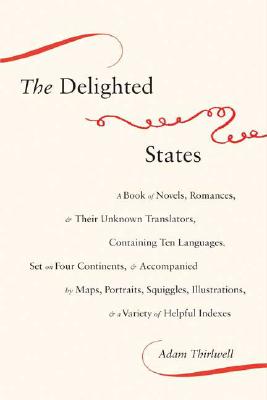
This weekend, I read and thoroughly enjoyed the first volume of Adam Thirlwell’s The Delighted States (new in a handsome trade paperback edition from Picador at the end of this month). The word “volume” seems to imply multiple, discrete editions, but really the term has more to do with Thirlwell’s sense of humor. Like an 18th century novel, The Delighted States comprises chapters, books, and volumes. That playfulness also echoes in the book’s subtitle: “A Book of Novels, Romances, & Their Unknown Translators, Containing Ten Languages, Set on Four Continents, & Accompanied by Maps, Portraits, Squiggles, Illustrations, & a Variety of Helpful Indexes.” Despite the mock-serious tone there, the subtitle is a pretty accurate description of the book. Not that Thirlwell is pompous or long-winded. Rather, he’s the rare literary critic who manages to show authority without being didactic, who balances scholarly insight with playful humor and a willingness not to answer to every little detail.

But what is it about? From Thirlwell: “This book — which I sometimes think of as a novel, an inside-out novel, with novelists as characters — is about the art of the novel. It is also, therefore, about the art of translation.” Thirlwell, a translator himself (the book flips over to his version of Vladimir Nabokov’s short story “Mademoiselle O”) uses translation (of books, of styles, of ideas) to relate a history of the rise of literary modernism. The first volume finds heroes in Gustave Flaubert and his would-be mistress, James Joyce and his French translator, Denis Diderot, Marcel Proust, and Balzac. There’s Gogol and Nabokov, Tolstoy and Borges–not to mention their characters, major and minor. It’s a lot of fun, but even better, it’s the kind of performance to which every literary critic should aspire. It makes you want to read the books you haven’t yet read and re-read the ones you already have.

Thirlwell, like any good avid reader, reads his books (and authors) in dialog with each other, and I can’t help but do the same. The hardback edition was published in 2008, but I can’t help read in Thirlwell’s work a response to David Shields’s new “manifesto” Reality Hunger. Both authors recognize that novelists attempt to represent or even re-enact “reality” in their works (despite Plato’s claim that mimesis was not the business of the poets). However, where Shields for some unclear reason nihilistically argues for the death of the novel, Thirlwell repeatedly demonstrates why a novelist’s depiction of reality is important. Thirlwell realizes that “The more a sign looks as if it’s real, the more it will have to be artificial,” citing Joyce’s interior monologues as an example. “The less artificial a sign is, the less likely it is to be convincing,” Thirlwell writes. Put another way, novels — and by proxy other narrative art forms — must use artifice to achieve reality. Like Shields, Thirlwell cites Joyce’s famous quote — “I am quite content to go down to posterity as a scissors and paste man” — but the effect is far more satisfying in The Delighted States, where it is contextualized evidence used to bolster a point, and not mere solipsistic indulgence. But maybe I’m still holding a grudge against Shields. And maybe it’s not fair to use Thirlwell’s work to rap at his (metaphorical) knuckles. Unlike the sensationalism, negativity, and gimmicks of Reality Hunger, Thirlwell’s argument for the novel is measured, patient, well-researched–and thus far less likely to cause as big a stir. In a single parenthetical aside he reveals more about his critical subjectivity than Shields is ever willing to admit in an entire book: “Good novelists (or, maybe more honestly, the novelists I like) are often not just avant-garde in terms of technique; they are also morally avant-garde as well.” It’s a good thesis on its own, but what’s really wonderfully refreshing is Thirlwell’s honesty about bias in criticism–that “Good novelists” are really “the novelists I like.” Fantastic stuff so far, and I’m itching to read more.

“A Strange Kind of Vibration” — Chris Andrews on Translating Roberto Bolaño

The Australian is running a new article about one of Roberto Bolaño’s English translators, Chris Andrews. Reporter Bernard Lane reveals that

Andrews had been badgering publishers for translation work. In 2001 he badgered the right publisher, Christopher MacLehose of Harvill Press in London, at the right time. MacLehose had just bought the first English rights to Bolano and his translator had fallen by the wayside. Andrews knew and admired Bolano’s [sic] writing, thanks to his acquisition of Spanish at the universities of Melbourne and La Trobe. He got the job and out came By Night in Chile.

Andrews on Bolaño–

“I think of him as a pan-American author, as an author of the western hemisphere,” says Andrews. Bolano’s reception in Britain had been slow at first, not that his prose was a problem.

“There are a lot of important features of Bolano’s style that can be transferred from one language to another,” Andrews says, “The big syntactic patterns, the patterns of repetition, the long sentences, the bursts, the parenthetical remarks; that comes across.”

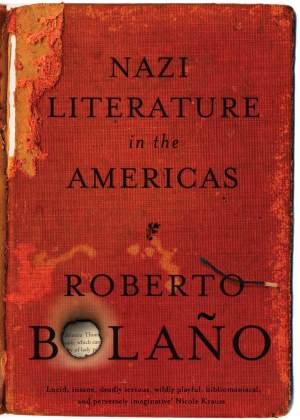
The article centers around Andrews’s translation of Nazi Literature in the Americas. We absolutely love the Picador edition’s cover for the UK, Australia, and similar markets. It captures the book’s apocryphal tone, its violence–and also its sharp sense of humor. On that book specifically (and Bolaño’s work in general)–

In a sea of allusion, English readers may feel adrift. “I don’t think it matters very much,” says Andrews. “It’s probably going to be read by people who have already got an interest in Bolano.

“One of the nice things about those bits of Bolano that are full of references and allusions is that it is hard to draw the line between the historical characters and the fictional ones.

“In different literary cultures, there are different norms about what you need to explain. In the French translation of Bolano, there are footnotes.”

Wouldn’t readers halfway familiar with Bolano suspect they were dealing with yet another level of artifice? “I think they would,” Andrews says, “even if it said ‘translator’s note’.”

The article details what techniques Andrews employs when stuck, particularly with regional dialects and slang. Andrews also talks about his correspondence with Bolaño himself,  in the last few years of the Chilean’s life. Here’s Andrews describing his attraction to Bolaño:

The prose has a mesmerising quality that intrigues Andrews.

“There’s a character in one of the stories I’ve just been translating who’s an actor called El Pajarito [Little Bird] Gomez. He’s a skinny, unimpressive-looking guy, but as soon as he appears on camera he vibrates in a weird way that almost hypnotises the viewer.

“When I read that, I thought, that’s a bit like what happens with Bolano’s prose for many readers, that it has a strange kind of vibration.”

Biblioklept Interviews Melville House’s Dennis Johnson

Dennis Johnson, along with wife Valerie Merians, heads Melville House Publishing, an independent book house putting out some of the best stuff on the market today. They also have a bookstore in Brooklyn that regularly hosts all kinds of neat literary-type events. Melville House is the outgrowth of Johnson’s literary blog MobyLives, an insightful source of reportage on the literary world today. In 2007, the Association of American Publishers awarded Melville House the Miriam Bass Award for Creativity in Independent Publishing and in 2009 The Village Voice declared Melville House “The Best Small Press of the Year.” I talked to Johnson by phone last week and he answered my questions with patience and humor. We discussed how Johnson finds the marvelous books he publishes, translation, novellas, and upcoming releases from Melville House. After the interview he was kind enough to ask me about my own blog and offer me some encouraging words. Just a few days after our talk it was announced that one of Melville House’s recent publications, The Confessions of Noa Weber by Gail Hareven had won the 2010 Best Translated Book Award for fiction.

Biblioklept: I want to begin by congratulating Melville House on Hans Fallada’s novel, Every Man Dies Alone. It’s done really well both critically and commercially. The book is something of a “recovered classic,” published just last year for the first time in English. Can you tell us a little bit about how Melville House came to publish the book?

Dennis Johnson: Well, it was a search it’s a real saga about hunting down that book. I’m always interested in finding material from that part of the world and that time of history because I think a good deal of very good literature was lost between the two wars. And it’s just writing that I like a lot. So a friend of mine, the fashion designer Diane von Furstenberg had family that came through that part of the world at that time and I asked her if she had any recommendations and she told me I should look into Hans Fallada, who I’d never heard of. So I tracked down a couple of his titles that had been translated–because he was a bestselling writer here in the 1930s–and it took a while but I found some of those books which had been out of print for a long time and I really loved them. And then, von Furstenberg told me that his best one had never been translated. That was Every Man Dies Alone. And so we set about going after it and acquiring it. And, at that point, once we’d discovered it, it was pretty easy sailing. But tracking down his stuff that had been translated and finding out more about him was really kind of a fun bit of detective work.

B: Did Michael Hoffman translate it specifically for Melville House?

DJ: Yeah, he did. We hired him to do it.

B: Is that normally how you go about with these works–like Nanni Balestrini’s Sandokan or Imre Kertész’s The Union Jack? Hiring a translator?

DJ: Well, there’s a couple of things you can do. You can find the translator, or you can reprint things that have been translated already, if you think it’s already a good translation–that’s a less expensive way to do a translated book. So for example, with the Fallada, I bought some old translations of his other books and published them simultaneously with the new translation of Every Man. There was, you know, there was no old translation to buy. But two of his other books, two great books, one called The Drinker and one called Little Man, What Now? I thought were pretty well translated so we just bought those old translations. They were out of print, they were available [for publication].

B: It seems like a lot of the books you guys put out are–I don’t know how to put it–recovered classics or cult books or just books that English-reading audiences just aren’t necessarily exposed to. Is that purposeful with Melville House?

DJ: I think we have a fairly mixed list. The names you were citing a minute ago . . . Balestrini, he’s only been translated once, I think, thirty or forty years ago. But he’s a very prominent writer in Italy. And it wasn’t exactly a “discovery,” it was just someone that we thought American audiences should know about. Imre Kertész on the other hand is extremely famous, he’s a Nobel Prize winner and he’s published by Knopf. We were thrilled when he wanted to come to Melville House. So, you know, some of these writers are here, some are not. We publish some well known writers, some very obscure writers. We try to mix it up. You know, there’ s no rule, just good literature.

B: Can you talk a little bit about the Contemporary Art of the Novella series? How did it come about?

DJ: Well, we originally had a series called just the Art of the Novella. It’s classics, many of them translated, classics from around the world, lots of European classics, and some of those are new translations that we did it, some are old translations that we reprinted. And that series did really, really well and people really seemed to love it so we decided that we would do a contemporary version of that series and try to mix it up the same way. And so the new series has new discoveries in it, some old reprints, things from around the world, we’re expanding beyond Europe and Russia, we’ve got a native Japanese author named Banana Yoshimoto in it coming out, we’ve got African writers, South American writers . . . It’s been off to a very good launch. I think we’ve done about fourteen or fifteen books in that series so far and it’s going really well. You know, it’s very hard to publish translation in the United States. It doesn’t . . . it doesn’t sell. It’s hard to keep it in store for a long time. And it’s expensive to do translated books because you have to pay your translator. In the Contemporary series we often use new translations because it’s new work that’s never been translated before and that can get very expensive because you’ve got two authors, you know, you have to pay the author, the translator, and that’s why a lot of people are cutting back on doing translations. But we wanted to keep doing translations and we had to figure out a way to keep doing it and one idea we had was, if we had this series of short novels . . . well, one, they’re just cheaper to do, they cost less to buy from another publisher, they cost less to make because they’re less paper and they cost less to translate because they’re shorter. And you know, you pay by how long. So, it suddenly became a more economical way for us to publish translated books. The booksellers, they like the Contemporary series. They get the whole series and they keep it in the store. So, for example, we’re about to do a deal with a new book store in Fort Greene called Greenlight where they would do a whole wall of these books. Other stores do a spin-rack of these books. And they just keep them. And what usually happens with new books is you just get a few weeks in the bookstore and if it doesn’t sell they return it. And so we would get really creamed on the translated work because it wouldn’t have very long in the store and it’s hard to get publicity for them and then they just didn’t have enough time to sell. But, if they’re taking the whole series and keeping them on display, forever, well, then these books have a real chance of surviving. So there were a lot of good reasons for us to do a Contemporary series. And in the end, the reason was that it allowed us to keep doing really good, serious, translated work.

B: What do you think about “rock star” writers like Haruki Murakami and Roberto Bolaño whose English translations sell very well? Does that help the prospects of translated books at all?

DJ: Well, every year there are one or two books that are translated that do very well. But they’re the exception to the rule. At any given point in the year, you look at the New York Times bestseller list for fiction, there’s almost never a translated book on it. Or if there is, it’s some, you know, Scandinavian murder mystery or something. It’s very rare it’s a serious work of literature. So I would say those writers are the exception to the rule. But it’s certainly does help those of us selling translated fiction to be able to point to those things. It encourages booksellers to give us a chance.

B: Can you tell us a little bit about upcoming titles and authors you’re excited about?

DJ: Well, we’re doing another Fallada–

B: Wolf Among Wolves, right?

DJ: We’re doing Wolf among Wolves in May. And we’re doing the paperback for Every Man Dies Alone at the end of this month, as a matter of fact. So those are two that I’m really excited about. We have some really great nonfiction coming out. We just published a book about North Korea called The Cleanest Race. It’s about understanding North Korea through its propaganda. It’s got a lot of really wild art showing the propaganda posters and movie stills and things. And then we’ve got some novels coming out, one from a young British writer named Lee Rourke. It’s the first novel. It’s called The Canal and I think it’s one of the very best novels we’ve ever published. It’s generating a lot of excitement. We’re doing another one with Kertész next year, which is a big novel called Fiasco. He wrote a trilogy years ago about his experience in the camps. What was he, fifteen or something, when he was sent to Auschwitz-Birkenau, working in a Nazi factory trying to turn coal into gasoline? And he wrote a novel called Fatelessness about that and another one called Kaddish for an Unborn Child. And Knopf published Kaddish and Fatelessness but they never published Fiasco. So we’re really excited about that.

B: Something I enjoy about MobyLives is your perspective as a publisher covering real news about book selling.

DJ: Thanks. It’s a labor of love. If you look at the historic arc of the website, you can see that we became more informed by being a publisher. I wasn’t a publisher when I started it and it was much more general-interest reader kind of thing. I try to get help. I try to make the staff here participate, I think it makes it a little more wide-ranging.

B: So, have you ever stolen a book?

DJ: Sure, yeah. I used to steal a lot of books from my brother. I remember stealing Gore Vidal’s Burr. My big brother’s a lot older than me and he left the house when I was a kid and I remember stealing a lot of his books. So Burr yeah, a novel Vidal wrote about Aaron Burr. Fantastic book. I still have it. He hasn’t asked for it back. I don’t think he knows.

Literature Is Not Made From Words Alone

Roberto Bolaño, in a 2002 interview, tells us that

. . . literature is not made from words alone. Borges says that there are untranslatable writers. I think he uses Quevedo as an example. We could add García Lorca and others. Notwithstanding that, a work like Don Quijote can resist even the worst translator. As a matter of fact, it can resist mutilation, the loss of numerous pages and even a shit storm. Thus, with everything against it–bad translation, incomplete and ruined–any version of Quijote would still have very much to say to a Chinese or an African reader. And that is literature.

The interview, conducted by Carmen Boullosa, was originally published in Bomb. It’s now collected along with three other interviews, all meticulously annotated (there’s also a fabulous introductory essay by Marcela Valdes) in a collection called Roberto Bolaño: The Last Interview, new from Melville House. While you’re browsing Melville House, I highly, highly recommend Tom McCartan’s column “What Bolaño Read,which will be ongoing through next week. Great stuff. Biblioklept will run a proper review of The Last Interview later this week (no big surprise for regular ‘klept readers: I love it. Get it. Read it. Give it to the Bolaño fanatic in your life), but in the meantime, back to the quote.

I’ve written so much about Bolaño over the past year yet I’ve never really reflected on his English translators, Chris Andrews (the shorter works) and Natasha Wimmer (the long books), probably because I wouldn’t know how to begin. Reading interviews with Andrews and Wimmer (links above) is enlightening. Andrews attests that he tries to avoid “a translation that is unduly distracting,” and remarks on Bolaño’s epic syntax. Wimmer says she simply tried “to follow Bolaño’s lead,” but admits to her reviewer that she might have missed some puns (“Missing things like that is the translator’s great dread, but it’s probably inevitable occasionally, especially with Bolaño”). In both of the interviews, Bolaño’s translators come off as critical readers whose love of their source material is clearly at the forefront of their project. I have to believe–and have to is the operative term here–that their translations are faithful to Bolaño’s text (and spirit), that they are not, to use the man’s term, a “shit storm” on his oeuvre. But, given Bolaño’s own definition of “literature,” I’d also aver that his masterpiece 2666 could weather any shit storm (hell, the thing was, I suppose, technically incomplete at his death). In any case, I find Bolaño point reassuring, not just in light of his own work, but also within the context of a greater canon of world literature. His suggestion that real literature speaks beyond “words alone,” that storytelling is more than mere verbal tricks and schemes, should be an affirmation to anyone who’s ever been unsure that he’s properly “got” Kafka or Haruki Murakami or Dostoevsky or whomever. And I like that idea quite a bit.

Bourbon Island 1730 — Olivier Appollodorus and Lewis Trondheim

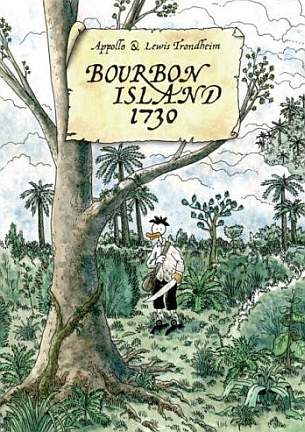
Bourbon Island 1730, part funny animal graphic novel, part historical literature, recounts the story of Raphael Pommeroy who travels from France to Bourbon Island with his ornithology professor in search of a living dodo. On the journey to the French colony, Raphael becomes entranced by pirate tales, and when he arrives to Bourbon Island, he immediately tries to join up with some ex-pirates–unsuccessfully, of course. The French government has offered an amnesty to all pirates, and many have become successful plantation owners. However, their new wealth comes at the expense of the large population of slaves brought to Bourbon Island from Madagascar and Mozambique. The most interesting subplot of Bourbon Island 1730 involves a network of maroons, runaway slaves who have colonized their own villages at the top of the island’s treacherous terrain. When the notorious pirate Captain Buzzard is captured, some of the maroons plan to set him free and lead a revolt against the French colonials. In the meantime, the colonial authorities, including the scheming governor and the greedy priest, are trying to get Buzzard to reveal where he’s hidden a large cache of treasure.

Lewis Trondheim’s art strikes a nice balance between vivid detail and the classic funny animal style, and the book’s measured pacing delivers the story at a nice clip. Appollodorus and Trondheim never rush, taking the time to convey the cultural complexity of Bourbon Island–quite a feat, really, when you consider how much is going on here: the end of a pirate age, the horrors of slavery, and the problematics of colonization. Appollodorus and Trondheim envision Bourbon Island as a strange nexus of slavery and freedom, piracy and central authority, of the meeting of the cultures of Africa, India, and Europe. Leading man Raphael is a hopeless romantic who pines wistfully for the absolute freedom he sees as the life of a pirate and the natural right of all men. And yet, as the book makes clear, idealism can rarely stand up to the corrosive complexity of the real world.

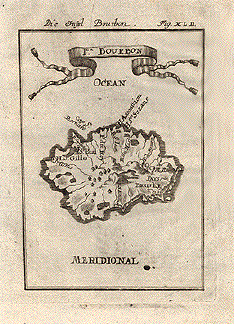
Allain Mallet's 1719 Map of Bourbon Island

With twelve pages of endnotes, Bourbon Island 1730 is just the kind of well-researched historical fiction that would fit neatly into any post-colonial studies course. There’s only one major fault with the book: it ends too quickly. Appollodorus and Trondheim have too many fascinating subplots that they don’t bother to resolve. While we have no problem with ambiguous conclusions, Bourbon feels simply rushed at the end, as it sprints to a virtual non-conclusion. We would’ve been much happier with a cliff-hanger and a promise of a part two. Nonetheless, anyone interested in colonialism and post-colonial studies should check out this book.

Bourbon Island 1730 is available October 28th, 2008 from First Second.