Well, here we are, and if you cast your eye over the room you will see that Tubes and trams and omnibuses, private carriages not a few, even, I venture to believe, landaus with bays in them, have been busy at it, weaving threads from one end of London to the other. Yet I begin to have my doubts-
If indeed it’s true, as they’re saying, that Regent Street is up, and the Treaty signed, and the weather not cold for the time of year, and even at that rent not a flat to be had, and the worst of influenza its after effects; if I bethink me of having forgotten to write about the leak in the larder, and left my glove in the train; if the ties of blood require me, leaning forward, to accept cordially the hand which is perhaps offered hesitatingly-
“Seven years since we met!”
“The last time in Venice.”
“And where are you living now?”
“Well, the late afternoon suits me the best, though, if it weren’t asking too much-”
“But I knew you at once!”
“Still, the war made a break-”
If the mind’s shot through by such little arrows, and-for human society compels it-no sooner is one launched than another presses forward; if this engenders heat and in addition they’ve turned on the electric light; if saying one thing does, in so many cases, leave behind it a need to improve and revise, stirring besides regrets, pleasures, vanities, and desires-if it’s all the facts I mean, and the hats, the fur boas, the gentlemen’s swallow-tail coats, and pearl tie-pins that come to the surface-what chance is there? Continue reading ““The String Quartet” — Virginia Woolf”→
There is a sentence in Dr. Johnson’s Life of Gray which might well be written up in all those rooms, too humble to be called libraries, yet full of books, where the pursuit of reading is carried on by private people. “…I rejoice to concur with the common reader; for by the common sense of readers, uncorrupted by literary prejudices, after all the refinements of subtilty and the dogmatism of learning, must be finally decided all claim poetical honours.” It defines their qualities; it dignifies their aims; it bestows upon a pursuit which devours a great deal of time, and is yet apt to leave behind it nothing very substantial, the sanction of the great man’s approval.
The common reader, as Dr. Johnson implies, differs from the critic and the scholar. He is worse educated, and nature has not gifted him so generously. He reads for his own pleasure rather than to impart knowledge or correct the opinions of others. Above all, he is guided by an instinct to create for himself, out of whatever odds and ends he can come by, some kind of whole–a portrait of a man, a sketch of an age, a theory of the art of writing. He never ceases, as he reads, to run up some rickety and ramshackle fabric which shall give him the temporary satisfaction of looking sufficiently like the real object to allow of affection, laughter, and argument. Hasty, inaccurate, and superficial, snatching now this poem, now that scrap of old furniture, without caring where he finds it or of what nature it may be so long as it serves his purpose and rounds his structure, his deficiencies as a critic are too obvious to be pointed out, but if he has, as Dr. Johnson maintained, some say in the final distribution of poetical honours, then, perhaps, it may be worth while to write down a few of the ideas and opinions which, insignificant in themselves, yet contribute to so mighty a result.
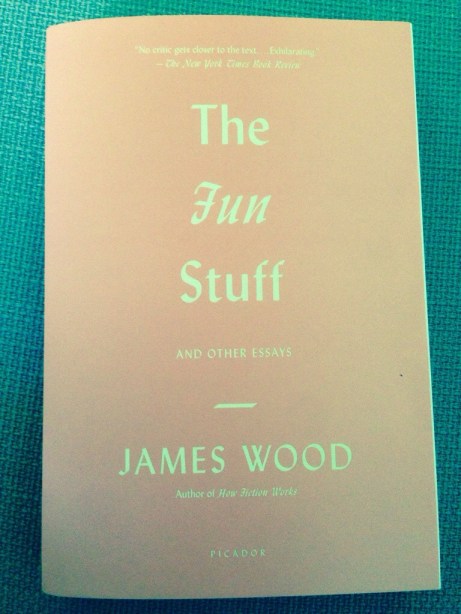
The Fun Stuff, collecting many of Wood’s pieces from The New Yorker (but also elsewhere), is less pretentious than How Fiction Works, Wood’s last book, a polemic hiding behind the guise of literary criticism that faulted pretty much any prose stylist who deviated from a certain mode of 19th-century free indirect style.
I’ve already read a number of the pieces collected in The Fun Stuff, which is finally out in the U.S. in trade paperback thanks to Picador. You might have read them too. His essays championing Lydia Davis and László Krasznahorkai are fine fun stuff, as is his take on the late W.G. Sebald (first published as an introduction to Austerlitz). His appreciative review of Cormac McCarthy’s The Roadthough is in many ways a retake on his review of Blood Meridian—Wood can only view McCarthy’s existential questions through the lens of theodicy.
James Wood is maybe most fun—or most infuriating—when he’s at his harshest. The case file here is his pointed take-down “Paul Auster’s Shallowness.” Here, Wood goes through an Auster plot “checklist”:
A protagonist, nearly always male, often a writer or an intellectual, lives monkishly, coddling a loss—a deceased or divorced wife, dead children, a missing brother. Violent accidents perforate the narratives, both as a means of insisting on the contingency of existence and as a means of keeping the reader reading—a woman drawn and quartered in a German concentration camp, a man beheaded in Iraq, a woman severely beaten by a man with whom she is about to have sex, a boy kept in a darkened room for nine years and periodically beaten, a woman accidentally shot in the eye, and so on. The narratives conduct themselves like realistic stories, except for a slight lack of conviction and a general B-movie atmosphere. People say things like “You’re one tough cookie, kid,” or “My pussy’s not for sale,” or “It’s an old story, pal. You let your dick do your thinking for you, and that’s what happens.” A visiting text—Chateaubriand, Rousseau, Hawthorne, Poe, Beckett—is elegantly slid into the host book. There are doubles, alter egos, doppelgängers, and appearances by a character named Paul Auster. At the end of the story, the hints that have been scattered like mouse droppings lead us to the postmodern hole in the book where the rodent got in: the revelation that some or all of what we have been reading has probably been imagined by the protagonist. Hey, Roger Phaedo invented Charlie Dark! It was all in his head.
I’m not a particular fan of Paul Auster, but I imagine those who deeply enjoy his work could feel personally insulted by Wood’s take-down. We get close to the books and authors we love. I think what manifests most in Wood’s criticism here—and elsewhere—is the weariness of someone who once deeply loved literature but who is now perhaps oppressed by it—who has become too aware of its mechanics, its forms, its stale formulations and bad parlor tricks.
Wood telegraphs far more passion and generosity in the collection’s title essay, which is about Keith Moon, the legendary drummer of The Who. He compares Moon’s rhythmic chops to D.H. Lawrence’s sentences:
For me, this playing is like an ideal sentence of prose, a sentence I have always wanted to write and never quite had the confidence to: a long, passionate onrush, formally controlled and joyously messy, propulsive but digressively self-interrupted, attired but disheveled, careful and lawless, right and wrong. (You can encounter such sentences in Lawrence’s prose, in Bellow’s, sometimes in David Foster Wallace’s.) Such a sentence would be a breaking out, an escape. And drumming has always represented for me that dream of escape, when the body forgets itself, surrenders its awful self-consciousness.
I like how personal he gets here. This essay opens the collection, and the one that closes it, “Packing My Father-In-Law’s Library” also communicates personally with the reader. Unconstrained by the pretense of a book review, Wood waxes on families and libraries and the meaning of life. When he writes of his father-in-law, whose books he’s sorting through, that “The books somehow made him smaller, not larger,” it’s hard not to hear a strong undertone of autobiography in the note.
Wood’s lyric essays are an unusual standout here (unusual in the sense that if someone had strung together the words James Wood’s lyric essays, I’d probably roll my eyes). They reveal a love of reading that goes missing in his attacks and his quibbling pieces. The serious literary critic is not, of course, beholden to being merely a cheerleader for literature (or worse, a cheerleader for publishing)—but I do think that the serious literary critic should offer something beyond condemnation or unenthusiastic grumbling. The risk the professional critic runs is to see the machinations of art too plainly, to become jaded to the point that experiencing the sublime is no longer possible (Tobias Wolff’s fantastic story “Bullet in the Brain” deals handily with this theme). Wood guides us here to several writers who disrupt, estrange, and resynthesize the tired tropes of literary fiction—and it’s in that strangeness where we can find the real fun stuff.
The kind people of Paris Press were good enough to send me a reader copy of their 10th anniversary edition of Virginia Woolf’s essay “On Being Ill,” which they’ve collected with “Notes from Sick Rooms,” an essay by Julia Stephen—Woolf’s mother. Paris Press’s blurb:
Published together for the first time, Woolf and Stephen create a literary conversation between parent and child, patient and care giver, from the vantage points each experience in the world of illness. Originally published by Paris Press in 2002, this new edition doubles the length of the original book and includes a new introduction to Notes from Sick Rooms by eminent Woolf scholar Mark Hussey, and a new afterword by Rita Charon, founder and director of the Narrative Medicine program at Columbia University, along with the original introduction to On Being Ill by Hermione Lee, Woolf’s biographer.
Lee’s introduction seems to be an expansion of a piece she wrote for The Guardian in 2004; in that piece she wrote:
The story of the body’s life, and the part the body has to play in our lives, is one of Virginia Woolf’s great subjects. Far from being an ethereal, chill, disembodied writer, she is always transforming thoughts and feelings and ideas into bodily metaphors. She writes with acute – often extremely troubling – precision about how the body mediates and controls our life stories. Body parts are strewn all over her pages. Rage and embarrassment are felt in the thighs; a headache can turn into a whole autobiography; dressing up the body is an epic ordeal; and a clenched fist, feet in a pair of boots, the flash of a dress or the fingertip feel of a creature in a salt-water pool, can speak volumes.
Nowhere is her attention to body parts more eloquent and intense than in the essay “On Being Ill”. It is one of Woolf’s most daring, strange and original short pieces of writing, and it has more subjects than its title suggests. Like the clouds that its sick watcher, “lying recumbent”, sees changing shapes and ringing curtains up and down, this is a shape-changing essay.
Woolf announces her theme in a long, winding opening sentence that showcases some of the “shape-shifting” Lee alludes to:
Considering how common illness is, how tremendous the spiritual change that it brings, how astonishing, when the lights of health go down, the undiscovered countries that are then disclosed, what wastes and deserts of the soul a slight attack of influenza brings to view, what precipices and lawns sprinkled with bright flowers a little rise of temperature reveals, what ancient and obdurate oaks are uprooted in us by the act of sickness, how we go down in the pit of death and feel the waters of annihilation close above our heads and wake thinking to find ourselves in the presence of the angels and the harpers when we have a tooth out and come to the surface in the dentist’s arm-chair and confuse his “Rinse the mouth-rinse the mouth” with the greeting of the Deity stooping from the floor of Heaven to welcome us – when we think of this, as we are so frequently forced to think of it, it becomes strange indeed that illness has not taken its place with love and battle and jealousy among the prime themes of literature.
And what of Stephen’s essay? It’s a practical, concrete, and mostly pragmatic approach to caring for sick people. Some parts compel more than others, as when Stephen discusses the absurd flights of fancy that might afflict the ill. In his introduction to “Notes from Sick Rooms,” Mark Hussey tries to amplify connections between the two texts that are either obvious (the texts share a common subject) or speculative (Stephen’s essay “foreshadows the wit and sharp observation that is characteristic of her famous daughter’s style”). Hussey’s comments are best when they provide basic context and don’t try to force the reader into making connections. There’s also an afterward by Rita Charon, an internist, who again tries to synthesize the two texts. I suppose context is important, but there’s a sense of inflation here that I’m not entirely sure either essay (Woolf’s or Stephen’s) necessarily merits.
I think it’s an important book—but more than that I think it’s an engrossing, good, excellent book, an enlarging book, a bewildering book, a depressing book, an intelligent book, an extraordinarily affecting book.
I reviewed The Rings of Saturn and you can read that review if you feel the urge for me to support those claims in greater detail.
Better yet, read Sebald’s book.
Whatever you do, please don’t use Grant Gee’s new documentary Patience (After Sebald) as a substitution for actually reading Sebald. It’s not that Gee’s film doesn’t lovingly attempt to approximate the spirit of Saturn. No, Gee and his cast of writers, architects, historians, and other Sebaldians clearly attempt to match the rhythms and moods and content of Saturn—and herein lies the film’s failure.
In an essay on Virginia Woolf—a writer who shows up in both Sebald and in Patience—literary critic (and Sebald champion) James Wood notes the anxiety of influence always at work between the artistic subject and the would-be critic: “The competition is registered verbally. The writer-critic is always showing a little plumage to the writer under discussion.” Wood here is specifically calling attention to Woolf’s own critical powers—of her ability to transcend merely reviewing a work, of her status as a poet-critic—but I think he gives us a simple little rubric for evaluating critical work in general: the truly excellent stuff goes its own route. Gee’s film so dutifully commits to visually and aurally replicating the melancholy and erudite mood of Saturn that it often seems cartoonish or clumsy—or, even worse, dreadfully boring.
It’s not fair to put down one filmmaker for not being more like another, but I wish Gee had taken a page out of, say Errol Morris’s book. Morris’s style is, in a sense, to remove style, to eliminate the aesthetic shield between the subject and the camera/audience. In contrast, Patience is overstylized to an almost embarrassing degree. The film veers between lethargic, numbing black and white shots of the places that Sebald visited on his walking tour in Saturn, occasional archival footage, and slippery impositions of text, maps, documents, and talking heads—sometimes delivered in a bizarre, agitated pace. Perhaps the tone I’ve just described may seem appropriate to any critical measurement of Saturn; in my review of Sebald’s novel, I noted that one element of saturnine melancholy is “sluggishness and moroseness, paradoxically paired with an eagerness for action” — but Gee’s lack of restraint here is bad art school stuff. It’s as if he doesn’t trust the viewer to simply listen to (let alone watch) a talking head for a minute.
A few notes on those talking heads:
There are some very smart people here saying some really cool things about Sebald—writers like Rick Moody and Iain Sinclair, lit critic Barbara Hui (if you’re a Sebald fan you might’ve already seen her maps of his walks), some historians and architects and so on. There are also excerpts of Michael Silverblatt’s Bookworm interview with Sebald woven into the film, sometimes to great effect. Especially interesting are remarks from Christopher MacLehose, Sebald’s publisher, who recounts the time he asked the author which genre his book belonged to. Sebald replied, “Oh, I like all of the categories.”
Gee’s technique with his band of experts is to mostly cast their voices over cold landscape shots, occasionally superimposing a head for a few seconds in a ghostly mishmash that dissolves—along with the voice—into another shot or another voice. Sometimes this is really frustrating because, hey, maybe we’re missing some enlightening remarks, but more often than not it’s frustrating in its sloppiness. Film editing that constantly calls attention to itself is tiresome. The film is at its best when it it stops trying to honor/compete with Saturn and instead imparts some meaningful information about the man and his work. When Patience relaxes enough to simply show archival footage of RAF training flights, it’s a welcome moment from the film’s earnest, torpid buzz.
I realize “torpid buzz” is an oxymoron, but I think it fits Patience. In fact, it might be exactly what Gee was going for. There’s an oppressiveness about the film that belies the often gorgeous and expansive and empty shots of Suffolk, and yes, to be clear, there’s often a similar oppressiveness in Sebald’s book—an oppression of history, of self, of other—but this paradox does not translate well into film.
Sebald makes ample room for his reader; we get to go on this excursion with him. He lets us puzzle out his themes, connect all his strange dots (or not, if we so choose, or, perhaps just as likely, find ourselves unable). The gaps in clear meaning make Saturn such a strange, engrossing book, the kind of book that you return to again and again, the kind of book you press on others (I’ve given away two copies to date). In contrast to the breathing room that Sebald allows his readers, Patience feels somehow stifling and simultaneously small. There’s a brickishness to it, a forceful inclination to fill in all those marvelous Sebaldian gaps. And while yes, some of these people have some really keen insights about Sebald and Saturn, over the film’s interminable 80 minutes these opinions and insights and back stories start to torture meaning out of the text. Any potential reader has had much of her intellectual work removed at this point.
But perhaps I’ve been harsh without illustrating enough. Here’s psychoanalytic critic Adam Phillips who probably gets more voice time than anyone else in Patience; throughout the film he repeatedly over-explains Sebald’s project. I’ll shut up and let him talk (these are a few clips strung together, if my memory is sussing this out right):
Did you watch it? I watched it too—and it seems pretty cool at under four minutes, I’ll admit. But over the course of the film the heavy, “arty” edits, the overexplaining, well . . . it’s too much.
Admittedly, only ten minutes into the film I asked myself who the film was for. As a fan of the book I’d much prefer to just spend 80 minutes of my time rereading parts of it. Or, alternately, a straightforwardish biography would be nice too. And I suppose there are many, many people who will love what Gee’s done (the film has gotten plenty of rave reviews, including one by A.O. Scott at the Times). I also suppose many folks will commend Gee for trying out his own hybrid, for showing a little plumage. This is another way of saying that I think that Gee has turned in the film he intended to make—it just wasn’t for me.
The plot of Virginia Woolf’s novel Orlando hangs on two key conceits: the title character transforms from male to female; the title character is immortal. Orlando has been a staple of gender studies courses since before such courses existed, and is in many ways the pioneer text (or one of the pioneer texts) of an entire genre. And that’s great and all—there are plenty of stunning passages where Woolf has her character explore what it means to be a man and what it means to be a woman and how power and identity and all that good stuff fits in—but what I enjoyed most about Orlando was its rambling, satirical structure.
Orlando functions like an inverted picaresque, detailing the adventures of an aristocrat who finds him- (and then her-) self flung into every sort of damn predicament: Elizabethan intrigues; ice-skating during the Great Frost; a dalliance with a Russian princess; an attempt at artistic patronage; an attempt at art; an ambassadorship in Constantinople; an encounter with the Fates (I suspect); time with a band of gypsies; time with Alexander Pope; a marriage to the great sea captain Marmaduke Bonthrop Shelmerdine; and, finally (if that adverb might apply to an apparent immortal), the publication of her great small work The Oak Tree. Sorry to laundry-list plot points, but, gosh, don’t you want to read this now—or at least listen to the audiobook, like I did?
Woolf seems to be channeling Voltaire’s Candide at all times, subtly ridiculing era after era, until Orlando finally emerges into Woolf’s (Modernist) present—it’s the fuzziest moment of the novel for our protagonist, as if she, or the author operating behind her, cannot parse out the post-industrial landscape. It’s also the moment at which Woolf’s prose becomes its most fluid and free—its most Woolfian, I suppose.
I thoroughly enjoyed Clare Higgins’s smart, confident reading of this unabridged production (BBC/Chivers). At not quite nine hours long, it’s a great way to spend a few afternoons of chores or gardening, or perhaps a week’s commute. It made me fish out Mrs. Dalloway, which I haven’t read since my undergrad days, and shove it into a “to read” stack. It also prompted me to revisit Sally Potter’s admirable 1992 film adaptation starring Tilda Swinton, whose very being seems like call and cause enough for an Orlando movie. I recommend both the audiobook and the film. Great stuff.
James Wood, writing about Virginia Woolf in his essay “Virginia Woolf’s Mysticism” (collected in The Broken Estate)–
Woolf, I think, became a great critic, not simply a “great reviewer.” The Collected Essays, which are still being edited, is the most substantial body of criticism in English this century. They belong in the tradition of Johnson, Coleridge, Arnold, and Henry James. This is the tradition of poet-critics, until the modern era, when novelists like Woolf and James join it. That is, her essays and reviews are a writer’s criticism, written in the language of art, which is the language of metaphor. The writer-critic, or poet-critic, has a competitive proximity to the writers she discusses. The competition is registered verbally. The writer-critic is always showing a little plumage to the writer under discussion. If the writer-critic appears to generalize, it is because literature is what she does, and one is always generalizing about oneself.
Wood’s description of Woolf is really Wood’s description of Wood.






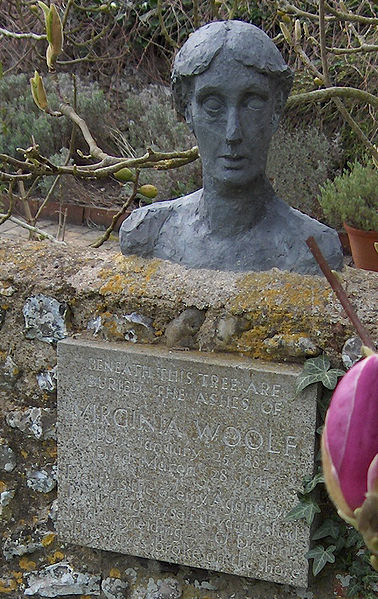
 The plot of Virginia Woolf’s novel Orlando hangs on two key conceits: the title character transforms from male to female; the title character is immortal. Orlando has been a staple of gender studies courses since before such courses existed, and is in many ways the pioneer text (or one of the pioneer texts) of an entire genre. And that’s great and all—there are plenty of stunning passages where Woolf has her character explore what it means to be a man and what it means to be a woman and how power and identity and all that good stuff fits in—but what I enjoyed most about Orlando was its rambling, satirical structure.
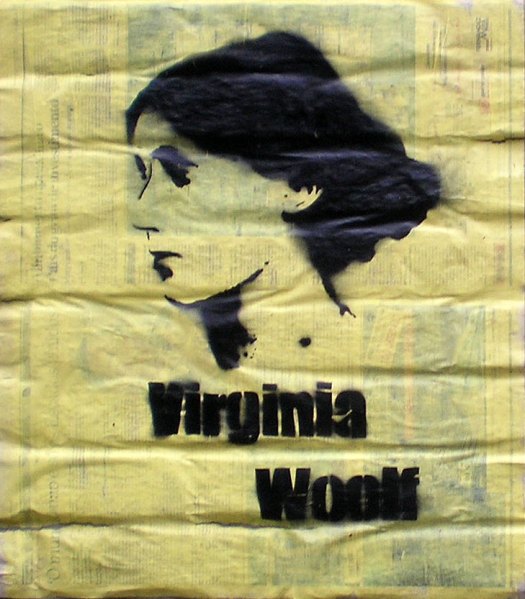 James Wood, writing about Virginia Woolf in his essay “Virginia Woolf’s Mysticism” (collected in The Broken Estate)–
 Biblioklept