We continue to raid The Paris Review’s interview archive. Here’s J.G. Ballard on William Burroughs, in a 1984 interview–
INTERVIEWER: Burroughs wrote an eccentric and laudatory, in its way, introduction to the American edition of Atrocity Exhibition. Do you know him?
BALLARD: Burroughs, of course, I admire to the other side of idolatry, starting with Naked Lunch, then Ticket, Soft Machine, and Nova Express. I’m less keen on his later books. In his way he’s a genius. It’s a pity that his association with drugs and homosexuality has made him a counterculture figure, but I suppose his real links are with Jack Kerouac, Allen Ginsberg, and the Beats. Still, I think he’s much more of an establishment figure, like Dean Swift, with a despairing disgust for the political and professional establishments of which he is a part. I have met Burroughs quite a few times over the last fifteen years, and he always strikes me as an upper-class Midwesterner, with an inherent superior attitude towards blacks, policemen, doctors, and small-town politicians, the same superior attitude that Swift had to their equivalents in his own day, the same scatological obsessions and brooding contempt for middle-class values, thrift, hard work, parenthood, et cetera, which are just excuses for petit-bourgeois greed and exploitation. But I admire Burroughs more than any other living writer, and most of those who are dead. It’s nothing to do with his homosexual bent, by the way. I’m no member of the “homintern,” but a lifelong straight who prefers the company of women to most men. The few homosexual elements in Crash and Atrocity Exhibition, fucking Reagan, et cetera, are there for reasons other than the sexual—in fact, to show a world beyond sexuality, or, at least beyond clear sexual gender
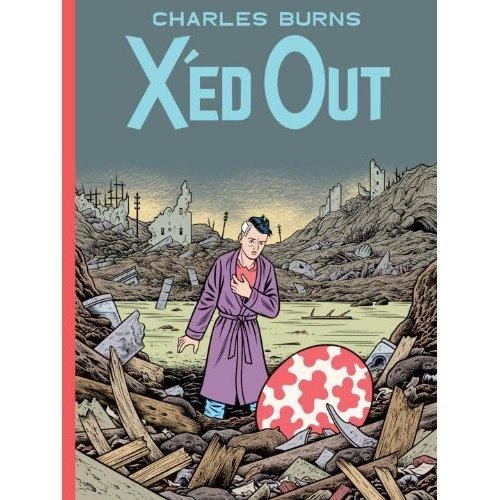
I devoured Charles Burns’s X’ed Out last night. Then I read it again this afternoon. I’ll read it again before I give it a proper review closer to its release date near the end of October. It’s weird, wild stuff, working in the idioms of William Burroughsand Hergé, brimming with punk rock energy and druggy art madness. It’s thoroughly Burnsian. X’ed Out is the first volume in what the publisher promises will be “an epic masterpiece of graphic fiction in brilliant color.” Like I said, full review down the line, but look out for this book. X’ed Outcomes from the good folks at Pantheon, who’ve already proven their commitment to the graphic novel medium in stunners by publishing soon-to-be classics like David Mazzucchelli’s Asterios Polypand Dash Shaw’s BodyWorld.
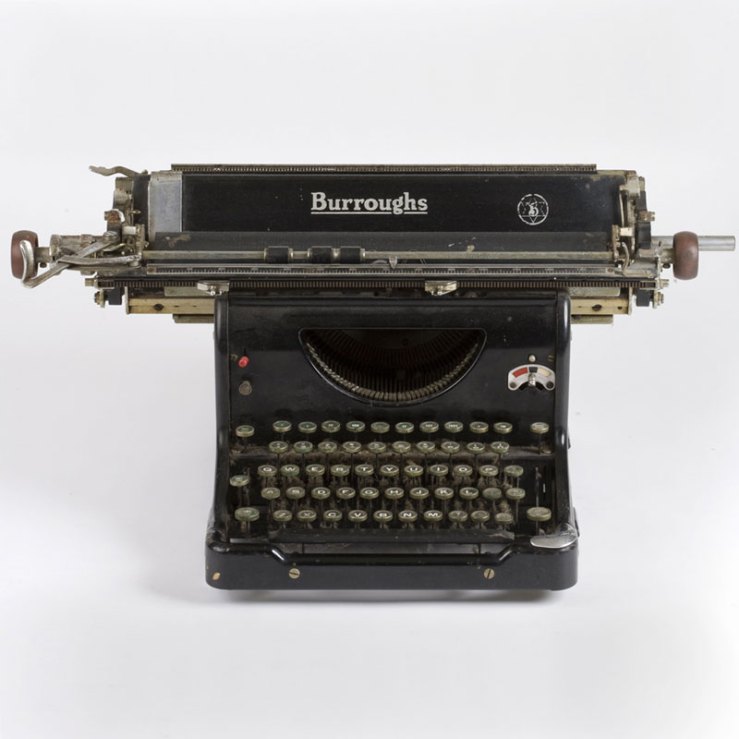
So we ran this post of famous authors’ typewriters the other day but we somehow forgot William Burroughs’s typewriter, which is really damn silly ’cause his name is right there on it–
SF: William’s magickal experimentation, the aspects of recording what he called “Danger Sounds” and replaying them in proximity to his target, or using collage to hit a specific target has become the stuff of legend. Some attribute the closing of one particular establishment to William’s hexes. Is there another specific instance which you can recall that is as dramatic and apparently self-evident?
JG: Nope, not really. You are likely referring to the Moka Bar in London, where William said he received snide, snotty service and lousy, weak tea — and his tape-recorders-and-cameras mock-surveillance routine, back and forth on the sidewalk of Frith Street, and how the Moka Bar failed and was shuttered not too long after that.
Forgive me please, but my cast of mind leads me to suspect the Moka Bar, if it really did sell lousy tea with terrible service, might have been headed out of business, with or without the sound-text-tape-film sidewalk-pacing routine…
As with William’s long-ago theory that, because he had never known a NYC junky ever to get a seasonal cold, it was likely that Junk provided a protective covering to the cells (or else, maybe Junk kept the cells well-exercised and in-shape with a constant cycle of shrinking to kick, swelling back up in re-addiction, kicking, hooked again, etc.) — I pointed out that, because a junky with a good supply on hand rarely leaves his apartment to mingle on the sidewalk with other people (which would expose him to more airborne rhinovirus particles), maybe the apparent immunity was more the result of limited exposure to current pathogens…
I’d never seen this before. William Burroughs reads–and acts out–one of his infamous Dr. Benway riffs from Naked Lunch. Gross, engrossing, and hilarious.
Do you remember when you were like thirteen or fourteen and you read that bit in Naked Lunch about the supposed mind-expanding properties of nutmeg? Nutmeg! Like your mom baked with! Like, readily-available, no questions asked! And then you took it, just like Burroughs indicated, and it made your stomach hurt and gave you a headache (just like he said it would). And nothing else happened. No visions, no enlightenment, nada. Do you remember that? Oh, wait…that wasn’t you? That was someone else? Sorry…
From “Afterthoughts on a Deposition,” an index to Naked Lunch:
Convicts and sailors sometimes have recourse to nutmeg. About a tablespoon is swallowed with water. Results are vaguely similar to marijuana with side effects of headache and nausea. Death would probably supervene before addiction before addiction if such addiction is possible. I have only taken nutmeg once.
There you go, kids. Knock yourselves out. Actually, don’t. Just rent Altered States instead.
Burroughs, of course, was far more interested in yagé, or ayahuasca, a psychoactive preparation of a South American vine. At the end of his spare, funny, first novel Junky, Burroughs writes:
I decided to go down to Colombia and score for yage. … My wife and I are separated. I am ready to move on south and look for the uncut kick that opens out instead of narrowing down like junk.
Kick is seeing things from a special angle. Kick is momentary freedom from the claims of aging, cautious nagging, frightened flesh. Maybe I will find in yage what I was looking for in junk and weed and coke. Yage may be the final fix.
I’ve read Junky a few times and it seems that these lines are strangely half-hopeful and also deeply ironic. Burroughs’s stand-in, narrator William Lee doesn’t get what the writer William Burroughs seems to realize: there is no permanent solution, no “final fix.” Still, Burroughs sure did have some wacky adventures looking for it. Check out this clip from a documentary, apparently called Ayahuasca, narrated by Burroughs (if anyone out there knows anything about this movie, please let us know):
“You were not there for the beginning. You will not be there for the end. Your knowledge of what is going on can only be superficial and relative” — Naked Lunch
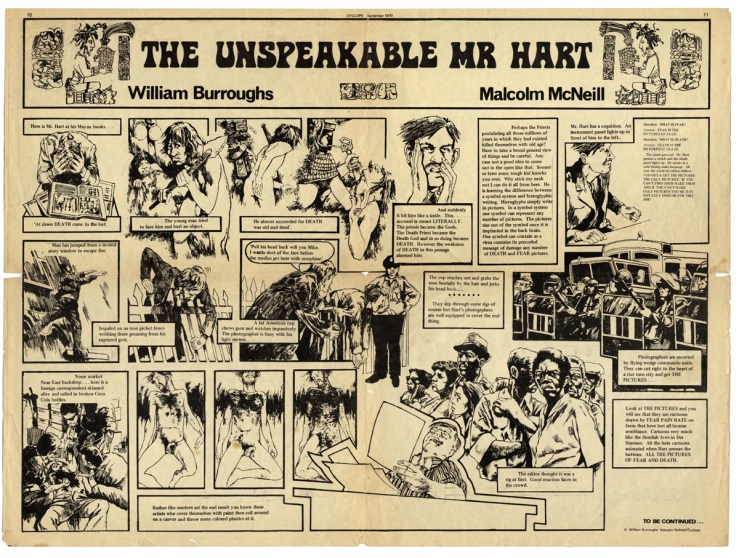
In 1970, William Burroughs was living in London. While there, he collaborated with young English artist Malcolm McNeill on a comic series for a magazine called Cyclops. The series was called The Unspeakable Mr. Hart, and remains uncollected/reprinted to date. Too bad, because it looks like really cool stuff. We got these images via The Virtual Library’s Beats collection, where there’s a really cool interview with McNeill (he discusses Burroughs habit of “going to movies to admire hard-ons and talking about them all afternoon,” which is kinda hilarious):
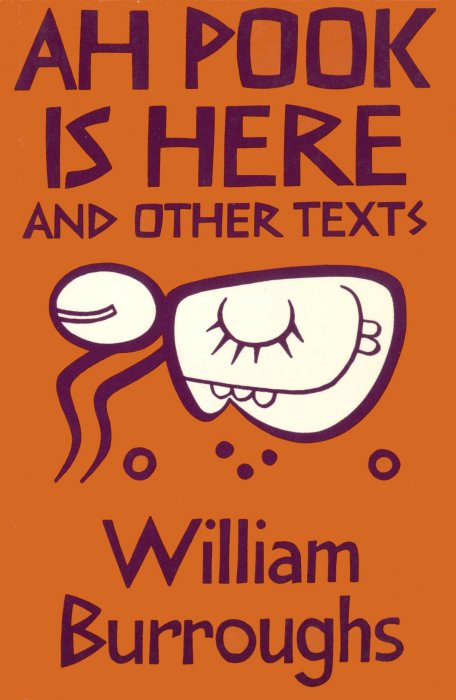
After Cylcops went kaput, Burroughs and McNeill continued the story in a project called Ah Pook Is Here, (a reference to the Mayan death god). Ah Pook Is Here, unfinished, was collected in the early eighties in Ah Pook Is Here and Other Texts which unfortunately is out of print. And very expensive. (Feel free to send it to me, anyone).
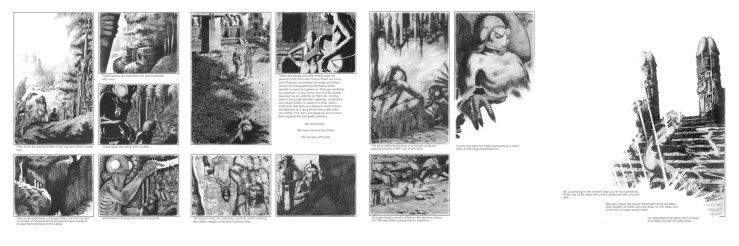
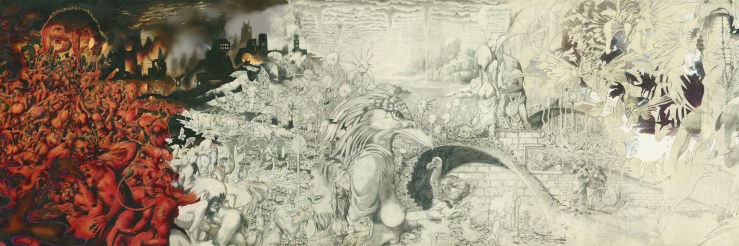
Fortunately, we can at least get a peek at some of McNeil’s hellish art at burroughsmcneillart.com. A few Boschian samples
Again, we want this book. Please send us this book. In the meantime, filmmaker Philip Hunt made this 1994 6 minute animated short of Ah Pook Is Here:
Gus Van Sant’s great little short film from 1978, based on William Burroughs’s essay, explains the art of DE, or “Do Easy.” Our clumsy ass has been trying too hard, apparently. The film is quite funny but also useful, and well worth watching in full. It’s also included in the latest issue of Wholphin, if thou art so moved.
Look at these guys! I kind of have to have this record. If you have a copy, go ahead and send it to me. No? Okay, what about uploading the tracks somewhere as mp3s? No? Okay…
William S. Burroughs/John Giorno (1975), GPS 006-007
William Burroughs
1. “103rd Street Boys” from Junkie 2. excerpt from Naked Lunch 3. “From Here To Eternity” from Exterminator 4. excerpt from Ah Pook Is Here 5. “The Chief Smiles” from Wild Boys 6. “The Green Nun” 7. excerpt from Cities Of The Red Night
John Giorno 8. “Eating Human Meat”
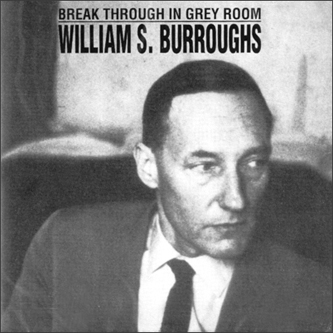
And so as not to just beg for mp3s but to also give, check out Burroughs explaining how tape manipulation helps to expand conciousness in “Origin and Theory of the Tape,” and get horrified by an example of said technique with “Present Time Exercises,” both from Break Through in Grey Room, a collection of Burroughs’s tape experiments and speeches (not to mention a dash of Ornette Coleman freaking freestyle in Morocco).


 Check out this






 Biblioklept