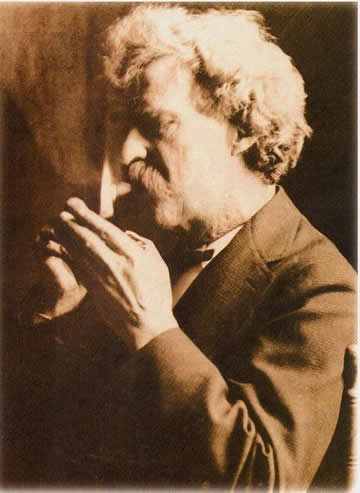








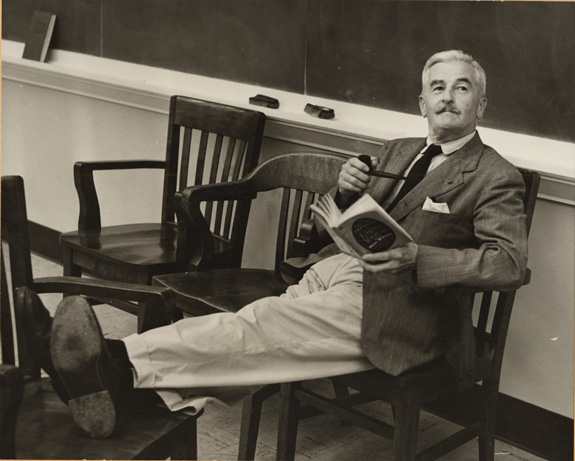
In 1957 and 1958, William Faulkner served as the first writer-in residence at the University of Virginia at Arlington. Under the direction of English Professor Stephen Railton, UVA has now put the audio archive online, making it available to the public for the first time. There are dozens of lectures here, as well as many readings from Faulkner’s essays and fiction, including a reading from The Sound and the Fury. Cool stuff. For more about Faulkner’s time at UVA, read the university’s Magazine article, “Faulkner among the ‘Snobs’.”
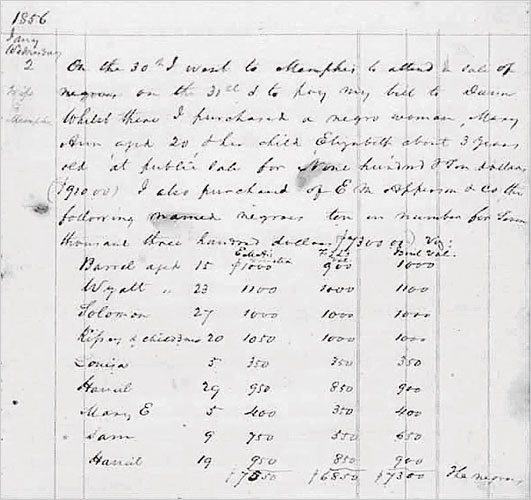
The New York Times reports that “what appears to be the document on which Faulkner modeled that ledger [detailing the genealogy that haunts Go Down, Moses] as well as the source for myriad names, incidents and details that populate his fictionalized Yoknapatawpha County has been discovered.” The article continues:
The original manuscript, a diary from the mid-1800s, was written by Francis Terry Leak, a wealthy plantation owner in Mississippi whose great-grandson Edgar Wiggin Francisco Jr. was a friend of Faulkner’s since childhood. Mr. Francisco’s son, Edgar Wiggin Francisco III, now 79, recalls the writer’s frequent visits to the family homestead in Holly Springs, Miss., throughout the 1930s, saying Faulkner was fascinated with the diary’s several volumes. Mr. Francisco said he saw them in Faulker’s hands and remembers that he “was always taking copious notes.”
History, particularly the strange, paradoxical, and taboo history of the plantation underwrites almost all of Faulkner’s significant fiction, so any historical document that served to inform his writing will be of particular note to enthusiasts and scholars alike.
We often identify genre simply by its conventions and tropes, and, when October rolls round and we want scary stories, we look for vampires and haunted houses and psycho killers and such. And while there’s plenty of great stuff that adheres to the standard conventions of horror (Lovecraft and Poe come immediately to mind) let’s not overlook novels that offer horror just as keen as any genre exercise. We offer seven horror novels masquerading in other genres:
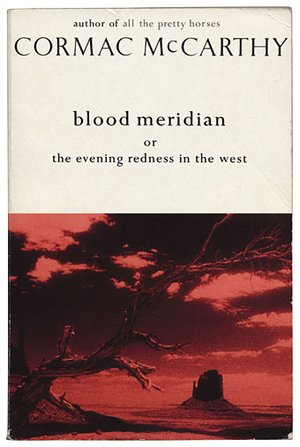
Blood Meridian — Cormac McCarthy
In our review (link above) we called Blood Meridian “a blood-soaked, bloodthirsty bastard of a book.” The story of the Glanton gang’s insane rampage across Mexico and the American Southwest in the 1850s is pure horror. Rape, scalping, dead mules, etc. And Judge Holden. . . [shivers].
Rushing to Paradise — J.G. Ballard
On the surface, Ballard’s 1994 novel Rushing to Paradise seems to be a parable about the hubris of ecological extremism that would eliminate humanity from any natural equation. Dr. Barbara and her band of misfit environmentalists try to “save” the island of St. Esprit from France’s nuclear tests. The group eventually begin living in a cult-like society with Dr. Barbara as its psycho-shaman center. As Dr. Barbara’s anti-humanism comes to outweigh any other value, the island devolves into Lord of the Flies insanity. Wait, should Lord of the Flies be on this list?
Okay. We know. This book ends up on every list we write. What can we do?
While there’s humor and pathos and love and redemption in Bolaño’s masterwork, the longest section of the book, “The Part about the Crimes,” is an unrelenting catalog of vile rapes, murders, and mutilations that remain unresolved. The sinister foreboding of 2666‘s narrative heart overlaps into all of its sections (as well as other Bolaño books); part of the tension in the book–and what makes Bolaño such a gifted writer–is the visceral tension we experience when reading even the simplest incidents. In the world of 2666, a banal episode like checking into a motel or checking the answering machine becomes loaded with Lynchian dread. Great horrific stuff.
King Lear — William Shakespeare
Macbeth gets all the propers as Shakespeare’s great work of terror (and surely it deserves them). But Lear doesn’t need to dip into the stock and store of the supernatural to achieve its horror. Instead, Shakespeare crafts his terror at the familial level. What would you do if your ungrateful kids humiliated you and left you homeless on the heath? Go a little crazy, perhaps? And while Lear’s daughters Goneril and Regan are pure mean evil, few characters in Shakespeare’s oeuvre are as crafty and conniving as Edmund, the bastard son of Glouscester. And, lest we forget to mention, Lear features shit-eating, self-mutilation, a grisly tableaux of corpses, and an eye-gouging accompanied by one of the Bard’s most enduring lines: “Out vile jelly!” Peter Brook chooses to elide the gore in his staging of that infamous scene:
The Trial — Franz Kafka
Kafka captured the essential alienation of the modern world so well that we not only awarded him his own adjective, we also tend to forget how scary his stories are in light, perhaps, of their absurd familiarity. For our money, none surpasses his unfinished novel The Trial, the story of hapless Josef K., a bank clerk arrested by unknown agents for an unspecified crime. While much of K.’s attempt to figure out just who is charging him for what is hilarious in its absurdity, its also deeply dark and really creepy. K. attempts to find some measure of agency in his life, but is ultimately thwarted by forces he can’t comprehend–or even see for that matter. Nowhere is this best expressed than in the famous “Before the Law” episode. If you’re too lazy to read it, check out his animation with narration by the incomparable Orson Welles:
In our original review of Sanctuary (link above), we noted that “if you’re into elliptical and confusing depictions of violence, drunken debauchery, creepy voyeurism, and post-lynching sodomy, Sanctuary just might be the book for you.” There’s also a corn-cob rape scene. The novel is about the kidnapping and debauching of Southern belle Temple Drake by the creepy gangster Popeye–and her (maybe) loving every minute of it. The book is totally gross. We got off to a slow start with Faulkner. If you take the time to read our full review above (in which we make some unkind claims) please check out our retraction. In retrospect, Sanctuary is a proto-Lynchian creepfest, and one of the few books we’ve read that has conveyed a total (and nihilistic) sense of ickyness.
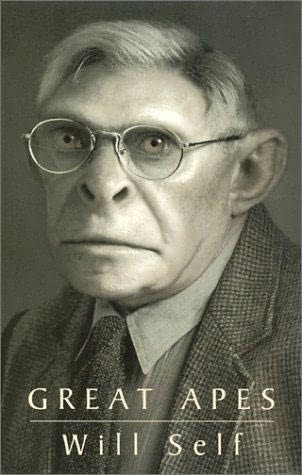
Great Apes — Will Self
Speaking of ickiness…Self’s 1997 novel Great Apes made me totally sick. Nothing repulses me more than images of chimpanzees dressed as humans and Great Apes is the literary equivalent (just look at that cover). After a night of binging on coke and ecstasy, artist Simon Dykes wakes up to find himself in a world where humans and apes have switched roles. Psychoanalysis ensues. While the novel is in part a lovely satire of emerging 21st-century mores, its humor doesn’t outweigh its nightmare grotesquerie. Great Apes so deeply affected us that we haven’t read any of Self’s work since.
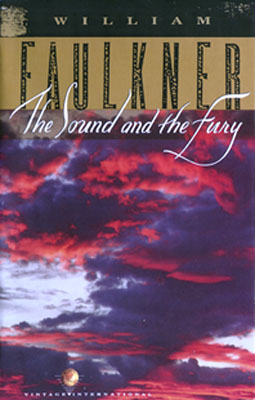
I don’t really know if there’s anything new I can say about Faulkner’s The Sound and the Fury in a blog post, and I’m not in the practice of writing term papers here, and you wouldn’t want to read one anyway. I’ll cop out and be vague but honest: the book was astounding and exhausting. I’ve read a number of Faulkner novels now, and The Sound and the Fury was easily my favorite. I’d attempted it a few times before, only to be thwarted by an inability to commit to the sustained concentration required to comprehend Faulkner’s stream-of-consciousness technique. The first section of the book, told from the perspective of Benjy, the seminal Faulknerian idiot man-child, is particulalry daunting, especially if you have no prior knowledge of the story of the Compson family, and I don’t think I would’ve made it through this reading if I didn’t arleady know the major themes and the trajectory of the plot. I’m actually kinda sorta shocked that the book was published at all, and I really wonder about its earliest audiences–how much context did they have? What guided them through the verbal detritus of the book’s first half?
I suppose that at the time of its publication in 1929, literary audiences were at least somewhat familiar–if not wholly intrigued by–the stream-of-consciousness technique pioneered in books like James Joyce’s Ulysses and Virginia Woolf’s Mrs. Dalloway. I read both of those books years before The Sound and the Fury, and I would make a subjective argument that they are quite a bit easier to enter into in terms of linearity and plot structure. Also, reading TSatF, I couldn’t help but feel the subtle resonance of Ulysses, particular in the constant use of omission. One of the things that makes Ulysses challenging is that Leopold Bloom frequently elides specific referents–we often get a “him” or a “he” or a “she” or an “it” without immediate context. Often, that context comes much, much later in the novel, with the net result that at times Bloom’s stream of consciousness is awfully ambiguous. Other times, Bloom seems unable to even think the words that would name the tragedies of his life (his dead son, his unfaithful wife, his outsider status in Dublin). Similarly, Faulkner’s Compsons are unable to directly name their own tragedies of promiscuity, suicide, alcoholism, madness, and financial decline. The effect is disarming and immediate, and while it can be very engaging, I can see how many readers would be alienated to the point that they can’t finish the book. I think there are a few simple solutions to the intrinsic problems of reading The Sound and the Fury, and at the risk of looking like a didactic asshole, I’ll share:
1) Read a brief plot summary first. I took a graduate seminar on Faulkner from which I gleaned the basic plot points and themes. (Ironically, the seminar assumed that any English major in grad school would have a working knowledge of the book, and instead focused on lesser-read volumes like Intruder in the Dust). Knowing the background of the Compson family did not ruin reading the book for me, nor did it replace an actual reading of Faulkner’s language–it simply gave me enough of a frame of reference not to throw up my hands in despair.
2) Read quickly and in long sittings. This is not a book that you can pick up and read a few pages of each night. Each chapter has a distinctive rhythm, and it takes a few pages to get into the pace and perspective of the chapter. I read the book in about eight sittings. I also found TSatF impossible to read at night before I was about to go to bed.
3) Don’t worry about getting everything in the first reading. Not possible. Enjoy the language, its strangeness. Marvel at Faulkner’s attempts–both successful and unsuccessful–to transcend time, space, and place. If you’re not enjoying it, why bother reading it?
Most of these suggestions could be applied to Ulysses as well. I brought up the possible influence of Joyce on Faulkner and I was interested enough to do a little research. The following text is from pages 208-209 of A William Faulkner Encyclopedia by Robert Hamblin and Charles Peek, and I think it neatly summarizes the issue:
When asked about the influence of Joyce on his own writing during the early years of his fame, following the publication of The Sound and the Fury and As I Lay Dying, Faulkner tended to be understandably evasive. In a 1932 interview with Henry Nash Smith, for example, Faulkner claimed, in fact, that he had never read Ulysses, invoking instead a vague aural source for his knowledge of Joycean methods: ” ‘ You know,’ he smiled, ‘sometimes I think there must be a sort of pollen of ideas floating in the air, which fertilizes similarly minds here and there which have not had direct contact. I had heard of Joyce, of course,’ he went on. ‘Some one told me about what he was doing, and it is possible that I was influenced by what I heard’ ” (LIG 30). In a moment of irony that may not have been lost on the interviewer, Faulkner reached over to his table and handed Smith a 1924 edition of the book. . . By 1947, Faulkner hardly needed to be so coy, telling an English class at the University of Mississippi that Joyce was “the father of modern literature” (1974 FAB 1230). By 1957, Faulkner’s pronouncements on Joyce had become fully classical: “James Joyce was one of the great men of my time. He was electrocuted by the divine fire” (LIG 280).
“Electrocuted by the divine fire” . . . very nice.
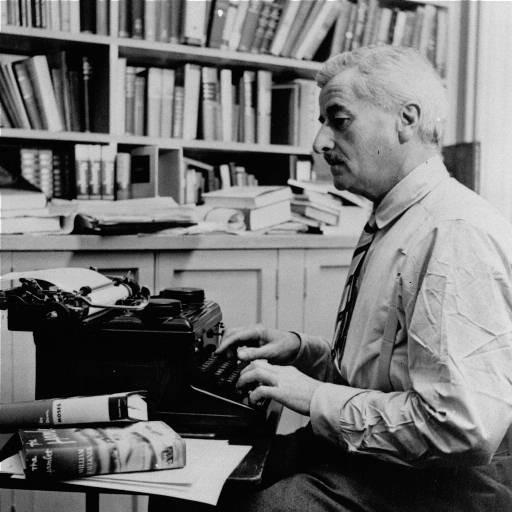
Not quite two years ago, I wrote some pretty awful things about William Faulkner on this blog. In a review of his first published novel Sancutary, I argued, quite ineffectually, that, “Faulkner as an American Great is nothing but a scam.” Elsewhere, I proffered this ignorant nugget:
“…it seems that a few critics–notably Malcolm Cowley and Cleanth Brooks–decided either that a. Faulkner is really great and/or b. America needs a new master of literary fiction, and it might as well be Faulkner. It seems amazing to me that these two critics conned a whole generation into believing that someone whose books were so unbelievably poorly written was actually, like, a totally awesome and important writer.”
Ouch. At the time I wrote that rant, I was still in grad school, which is to say I was still being assigned reading by well-intentioned professors. I was also laboring under a cruel miscalculation, the mistaken belief that I had actually read most of Faulkner’s great works–As I Lay Dying, The Sound and the Fury, and Absalom, Absalom!–in my high school and undergraduate courses–where said books were assigned reading. The truth, I realize now, is that while Faulkner’s strange, dense, elliptical prose might have passed under my eyes, I completely failed to read his books when I was a young man. It wasn’t until last spring, when I read one of Faulkner’s last novels, Go Down, Moses, that I came to understand the genius of his writing, which is to say I came to learn to read his voices in a non-academic, non-studied fashion, intuitively and rhythmically. Go Down, Moses is strange and sad and funny and truly an achievement, a book that works as a sort of time machine, an attempt to undo or recover the racial and familial (in Faulkner, these are the same) divides of the past.
So. Skip ahead a year.
After reading Bolaño’s stunning 2666, I strategically read Cormac McCarthy’s Child of God, knowing that I’d need a voice at least equal to Bolaño’s in order to not get totally bummed out and sort of paralyzed with that “What do I read next?” feeling. The strategy worked, but of course I needed a follow up book. So I picked up As I Lay Dying, the story of a poor rural family who labor to return their dead matriarch to her family’s home town for burial. I’d “read” the book in high school; I remembered the plot, but I could not in any way comment on it. This time, with the freedom to choose to read it–and perhaps, older, better equipped–I truly entered the book, entered into each of the character’s heads, their eyes, their voices. I “got” it.

I read As I Lay Dying in essentially three or four long sittings, sustained by Faulkner’s incomparable, engrossing language. I realize now that as a high school student, and then again as an undergrad, I resisted the book, attempted to impose my own consciousness into the narrative in order to “understand” the plot, rather than letting the book happen to me–which I believe is how one must read Faulkner. I was amazed how quickly I read the book once I attuned myself to Faulkner’s rhythm, and I was equally amazed at how conflicted and confused I felt about the story. I can’t recall a novel whose characters I’ve ever felt so hateful and sympathetic toward at the same time. Great, great book.
Anyway. The point of this post is to say, “Hey, I was wrong, mistaken, terribly wrong about Faulkner when I said he wasn’t a Great American Writer.” I suppose I’m also implicitly arguing that the necessary evil of assigned reading can sometimes be less necessary and more evil: How many kids are we turning away from the really great stuff forever by forcing it upon them when they are too young, too unequipped to appreciate it? The other side of this logic, of course, is to point out that often assigned reading can turn us on to great writers forever; this was the case for me, with most of what I read in high school. Still, as an English teacher I do worry that in assigning and then dissecting literature–under the pretense of explaining it and appreciating it and learning from it–we always run the risk of killing it, draining it of the very vitality that was the rationale for reading it in the first place. Of course, there’s a simple, simple antidote to reconciling yourself to all those books you hated in high school, those books you were supposed to love and be moved by and learn important and meaningful lessons from–you can read them again for the first time. The worst that could happen is a confirmation of your own prejudice; far more likely, in assigning your own reading, you’ll find something truly great and meaningful.
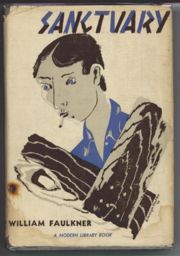
So I’ve been reading William Faulkner’s Sanctuary over the past few days. This was Faulkner’s breakthrough novel, the one that made him famous when it was published in 1931. He claimed that it was pot-boiler pulp fiction, written purely to make money, but who knows. I mean, we’re talking about a guy who chose to start spelling his name with a ‘u’ for some obscure reason–an author who worked from day one at creating the myth of himself as author. So who knows–maybe he actually thought he was writing a great piece of literature when he produced this lurid drivel.
Sanctuary is most famous for the rape of Southern debutante Temple Drake. She is raped with a corn cob. There you go. That’s pretty much all you need to know about this book. However, if you’re into elliptical and confusing depictions of violence, drunken debauchery, creepy voyeurism, and post-lynching sodomy, Sanctuary just might be the book for you.
There are two film adaptations of Sanctuary–1933’s The Story of Temple Drake, and 1961’s Sanctuary. Neither are readily available on VHS or DVD, and for good reason. They’re both pretty terrible. Still, the early sixties take on Sanctuary manages to capture the backwoods grotesque that saturates the novel. Actually, David Lynch could make a pretty decent film out of this.
My final analysis: I’m very very happy that I only have one more novel of Faulkner’s to read–Intruder in the Dust. Sanctuary did nothing but help consolidate my prejudice against Faulkner and my belief that the notion of Faulkner as an American Great is nothing but a scam.
 Biblioklept