“I’m Suspicious of the Term ‘Avant-Garde'” — More Intelligent Life Interviews Tom McCarthy

More Intelligent Life interviews Tom McCarthy about his new novel C. From the interview–

MIL: It seems many avant-garde works rely on a single conceit. “Tristam Shandy” used lies, “Motherless Brooklyn” used a tourettic narrator. Must avant-garde literature have a single mechanism to be intelligible to its readers?

TM: What’s the conceit of “Finnegans Wake” then? I’m not sure “Tristram Shandy” has a single conceit. I suppose there’s an inversion of the ‘Life and Adventures of’ tradition into ‘The Life and Opinions of—plus an obvious refusal of certain narrative conventions, for example in Tristram’s inability to get himself born for the first third of his own book. But Shakespeare’s “Hamlet” is equally full of such refusals: it subverts just about every dramatic convention that it purports to buy into. I’m suspicious of the term ‘avant-garde’. I think it should be restricted to its strict historical designation: Futurists, Dadaists, Surrealists etc. “Tristram Shandy” and “Motherless Brooklyn” aren’t avant-garde novels; they’re novels. And very good ones too!

“Never Give an Inch” — Gerald Howard on Social Class and the American Novel

Tin House #45, out in September, focuses on “Class in America.” You can read Gerald Howard’s essay from that issue, “Never Give an Inch,” in full now. The essay discusses shifting ideas of the social class of the American novelist, with an emphasis on “working class” writers. Howard discusses Raymond Carver and Russell Banks at some length, as well as Richard Price and Dorothy Allison (he also mentions Gilbert Sorrentino, whose work seems to be enjoying a late reappraisal). From the essay–

I don’t suppose anyone has ever done an in-depth study of that interesting form of literary ephemera, the author dust jacket biography. But if they did, I’m sure they would notice a distinct sociological shift over the past decades. Back in the forties and fifties, the bios, for novelists at least, leaned very heavily on the tough and colorful professions and pursuits that the author had had experience in before taking to the typewriter. Popular jobs, as I recall, were circus roustabout, oil field roughneck, engine wiper, short-order cook, fire lookout, railroad brakeman, cowpuncher, gold prospector, crop duster, and long-haul trucker. Military experiences in America’s recent wars, preferably combat-related, were also often mentioned. The message being conveyed was that the guy (and they were, of course, guys) who had written the book in your hand had really been around the block and seen the rougher side of life, so you could look forward to vivid reading that delivered the authentic experiential goods.

It’s been a long time since an author has been identified as a one-time circus roustabout. These days such occupations have become so exotic to the average desk-bound American that they serve as fodder for cable television reality shows—viz., The Deadliest Catch, Dirty Jobs, and Ice Road Truckers. Contemporary dust jacket biographies tend to document the author’s long march through the elite institutions, garnering undergraduate and postgraduate and MFA degrees, with various prizes and publications in prestigious literary magazines all duly noted. Vocational experiences generally get mentioned only when pertinent to the subject of the novel at hand—e.g., assistant DA or clerk for a Federal judge if the book deals with crime or the intricacies of the law. Work—especially the sort of work that gets your hands dirty and that brands you as a member of the working class—no longer seems germane to our novelists’ apprenticeships and, not coincidentally, is no longer easy to find in the fiction they produce. Whether one finds this scarcity something to worry about or simply a fact to be noted probably says a lot about one’s class origins and prejudices.

Roberto Bolaño Portrait by Phillip Fivel Nessen

Roberto Bolaño portrait by Phillip Fivel Nessen

I love this portrait of Roberto Bolaño by Phillip Fivel Nessen.

The Rumpus Interviews David Mitchell

The Rumpus interviews David Mitchell. Topics include his brilliant new novel The Thousand Autumns of Jacob de Zoet, diction, syntax, and other writerly concerns. And stammering. I’m currently finishing up Mitchell’s novel Black Swan Green, which is hilarious and sad and beautiful. I will review it here shortly.

A Cartoon Review of Lewis Hyde’s New Argument Against Intellectual Property, Common as Air

At Salon, Ward Sutton provides a pictorial overview of Lewis Hyde’s new book, Common as Air. Great stuff. Thanks to BLCKDGRD for the link.

undefined

“Youth Is Not Wise” — Anthony Burgess, Cranky Old Man

Old Man Burgess gives the pop music and the rockers and rollers the what-for.

Steps — Jerzy Kosinski

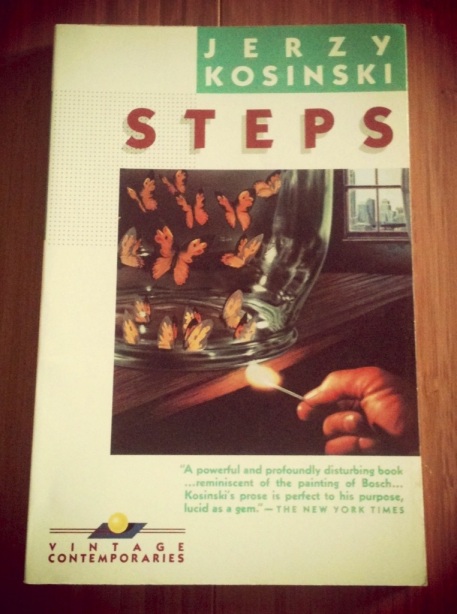
One of the many small vignettes that comprise Jerzy Kosinski’s 1968 book Steps begins with the narrator going to a zoo to see an octopus that is slowly killing itself by consuming its own tentacles. The piece ends with the same narrator discovering that a woman he’s picked up off the street is actually a man. In between, he experiences sexual frustration with a rich married woman. The piece is less than three pages long.

There’s force and vitality and horror in Steps, all compressed into lucid, compact little scenes. In terms of plot, some scenes connect to others, while most don’t. The book is unified by its themes of repression and alienation, its economy of rhythm, and, most especially, the consistent tone of its narrator. In the end, it doesn’t matter if it’s the same man relating all of these strange experiences because the way he relates them links them and enlarges them. At a remove, Steps is probably about a Polish man’s difficulties under the harsh Soviet regime at home played against his experiences as a new immigrant to the United States and its bizarre codes of capitalism. But this summary is pale against the sinister light of Kosinski’s prose. Consider the vignette at the top of the review, which begins with an autophagous octopus and ends with a transvestite. In the world of Steps, these are not wacky or even grotesque details, trotted out for ironic bemusement; no, they’re grim bits of sadness and horror. At the outset of another vignette, a man is pinned down while his girlfriend is gang-raped. In time he begins to resent her, and then to treat her as an object–literally–forcing other objects upon her. The vignette ends at a drunken party with the girlfriend carried away by a half dozen party guests who will likely ravage her. The narrator simply leaves. Another scene illuminates the mind of an architect who designed concentration camps. “Rats have to be removed,” one speaker says to another. “Rats aren’t murdered–we get rid of them; or, to use a better word, they are eliminated; this act of elimination is empty of all meaning. There’s no ritual in it, no symbolism. That’s why in the concentration camps my friend designed, the victim never remained individuals; they became as identical as rats. They existed only to be killed.” In another vignette, a man discovers a woman locked in a metal cage inside a barn. He alerts the authorities, but only after a sinister thought — “It occurred to me that we were alone in the barn and that she was totally defenseless. . . . I thought there was something very tempting in this situation, where one could become completely oneself with another human being.” But the woman in the cage is insane; she can’t acknowledge the absolute identification that the narrator desires. These scenes of violence, control, power, and alienation repeat throughout Steps, all underpinned by the narrator’s extreme wish to connect and communicate with another. Even when he’s asphyxiating butterflies or throwing bottles at an old man, he wishes for some attainment of beauty, some conjunction of human understanding–even if its coded in fear and pain.

In his New York Times review of Steps, Hugh Kenner rightly compared it to Céline and Kafka. It’s not just the isolation and anxiety, but also the concrete prose, the lucidity of narrative, the cohesion of what should be utterly surreal into grim reality. And there’s the humor too–shocking at times, usually mean, proof of humanity, but also at the expense of humanity. David Foster Wallace also compared Steps to Kafka in his semi-famous write-up for Salon, “Five direly underappreciated U.S. novels > 1960.” Here’s Wallace: “Steps gets called a novel but it is really a collection of unbelievably creepy little allegorical tableaux done in a terse elegant voice that’s like nothing else anywhere ever. Only Kafka’s fragments get anywhere close to where Kosinski goes in this book, which is better than everything else he ever did combined.” Where Kosinski goes in this book, of course, is not for everyone. There’s no obvious moral or aesthetic instruction here; no conventional plot; no character arcs to behold–not even character names, for that matter. Even the rewards of Steps are likely to be couched in what we generally regard as negative language: the book is disturbing, upsetting, shocking. But isn’t that why we read? To be moved, to have our patterns disrupted–fried even? Steps goes to places that many will not wish to venture, but that’s their loss. Very highly recommended.
New(ish) Memoirs from Nathan Rabin, Sloane Crosley, and James Ellroy

Nearly a  year after earning good reviews, Nathan Rabin’s memoir The Big Rewind is now available in paperback (the cover sports the claim that the book now includes “EVEN MORE BITING WIT AND UNWISE CANDOR”). Rabin, if you don’t know, is the head writer for the AV Club, a website I am hopelessly addicted to; he’s also responsible for some of the site’s best regular columns, including “My Year of Flops,” where he revisits films that, y’know, flopped, “THEN! That’s What They Called Music!,” where he subjects himself to listening to and writing about those NOW! CDs, and “Nashville or Bust,” a year-long analysis of country music from an avowed hip-hop fan. If I sound prejudicially predisposed to liking Rabin’s memoir, I am. I can’t help it. In The Big Rewind, Rabin revisits the various pop culture touchstones through which he lived his strange, often sad life–so Tarantino’s Reservoir Dogs becomes the lens through which he details his thankless years working for Blockbuster and Nirvana’s In Utero is a key to understanding Rabin’s time in a group foster home. There’s a story arc–depression, a missing mother, suicide attempts, redemption–and plenty of irony to keep it under control. At the same time, there’s too much heart in Rabin’s writing for you not to care. Recommended. The Big Rewind is new in trade paperback from Scribner.

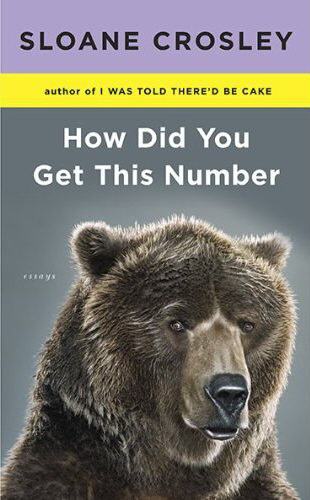
Sloane Crosley’s new collection of memory essays, How Did You Get This Number, finds the witty, observational young lass being witty and observational in and out of New York City–but mostly in. There are trips to Portugal and Paris, and a weird wedding in Alaska. There’s a remembrance of all the childhood pets that didn’t make it. There’s a story about buying furniture of questionable origin off the back of a truck. At times Crosley’s archness can be grating, as dry observations pile one upon the other, but her gift for exacting, sharp detail and her willingness to let her guard down at just the right moment in most of the selections make for a funny and compelling read. I’m still not sure why there’s no question mark in the title, though. How Did You Get This Number is new in hardback from Riverhead Books.
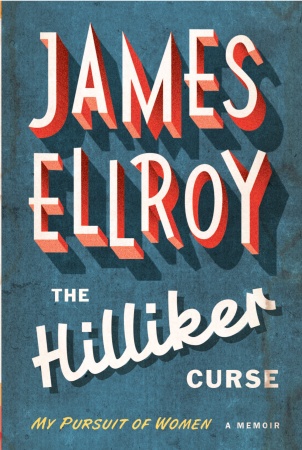
I just got my advance review copy of James Ellroy’s forthcoming memoir The Hilliker Curse, so I haven’t had time to read much of it, but the story so far is morbidly fascinating (like, you know, an Ellroy novel. But this is real. Because it’s a memoir). In 1958, James’s mother Jean Hilliker had divorced her husband and begun binge drinking. When she hit him one night, the ten year old boy wished that she would die. Three months later she was found murdered on the side of the road–the case remains unsolved. The memoir details Ellroy’s extreme guilt; his sincere belief that he had literally cursed his mother pollutes his life, particularly in his complex relationships with women. Full review forthcoming. The Hilliker Curse is available September 7th, 2010 from Knopf.

Obama Picks Up Franzen’s Freedom

Proving that he’s the kind of elitist Harvard-educated snob who reads literature, President Barack Obama picked up an advance copy of Jonathan Franzen’s forthcoming novel Freedom today. Obama also picked up copies of Harper Lee’s To Kill A Mockingbird and John Steinbeck’s The Red Pony for daughters Sasha and Malia (spoilers for S & M, undoubtedly faithful Biblioklept readers both: Boo Radley isn’t so bad, that white dude raped his daughters, and they have to kill the pony’s mama. But not all in the same book). Also, our president is photographed outside the bookstore wearing what appears to be socks and sandals. (Okay, looked like socks and sandals in the light. But we’ll give BO the benefit of the doubt).

The New York Observer Profiles Tao Lin (in the Style of Tao Lin)

“Tao Lin Will Have the Scallops” by Christian Lorentzen. I’m about halfway through Lin’s forthcoming novel, Richard Yates, which is somehow both far out and totally banal at the same time. Its cover is pretty awesome–

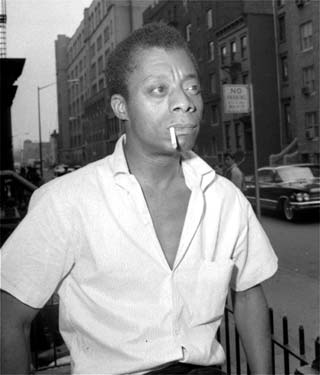
NPR Features James Baldwin

NPR’s Morning Edition featured James Baldwin today as part of their continuing “American Lives” series. Listen and read here. Their lede–

The writer James Baldwin once made a scathing comment about his fellow Americans: “It is astonishing that in a country so devoted to the individual, so many people should be afraid to speak.”

As an openly gay, African-American writer living through the battle for civil rights, Baldwin had reason to be afraid — and yet, he wasn’t. A television interviewer once asked Baldwin to describe the challenges he faced starting his career as “a black, impoverished homosexual,” to which Baldwin laughed and replied: “I thought I’d hit the jackpot.”

In the piece, NPR talks with Randall Kenan, editor of a new collection of Baldwin’s essays, speeches, and articles called The Cross of Redemption. The link above includes a great excerpt of one of Baldwin’s essays, “Why I Stopped Hating Shakespeare.” A taste–

The greatest poet in the English language found his poetry where poetry is found: in the lives of the people. He could have done this only through love — by knowing, which is not the same thing as understanding, that whatever was happening to anyone was happening to him. It is said that his time was easier than ours, but I doubt it — no time can be easy if one is living through it. I think it is simply that he walked his streets and saw them, and tried not to lie about what he saw: his public streets and his private streets, which are always so mysteriously and inexorably connected; but he trusted that connection. And, though I, and many of us, have bitterly bewailed (and will again) the lot of an American writer — to be part of a people who have ears to hear and hear not, who have eyes to see and see not — I am sure that Shakespeare did the same. Only, he saw, as I think we must, that the people who produce the poet are not responsible to him: he is responsible to them.

“My Kushy New Job” — Wells Tower Slings Hash(ish) in Amsterdam

Biblioklept fave Wells Tower details his temp job working in an Amsterdam weed bar in his new GQ article, “My Kushy New Job.” A few quotes from the essay–

At quarter of nine on a Wednesday morning, I report for my first shift. I’ll be working at de Dampkring on the Handboogstraat, a cheery alley just off the Damstraat, a heavily touristed promenade connecting the Flower Market to Dam Square. The Handboogstraat shop, a cozy enclave that can comfortably seat thirty or so, is a study in Art Nouveau psychedelia. Lava-lamp swirls predominate. The coffee bar is nearly overwhelmed by a biomorphic plaster mass aglow with party bulbs. The shop is pleasant and trippy in a somehow classic fashion. It’s like being inside the lovely bowels of Toulouse-Lautrec.

And later–

By midafternoon, my hands are sufficiently caramelized with THC resin to merit ejection from a major league pitcher’s mound. Rubbing my thumb against my forefingers rouses little rat turds of hashish. There’s probably enough intoxicating filth that gnawing my fingertips would affect my mood, but I don’t nibble them, taking seriously the house prohibition against dealers getting high on the job. Though other employees gripe about the policy, I hardly need a hit of anything. Simply working here makes me feel, in the worst possible way, as if I’m stoned to the limits of my capacity. The mere act of weighing the product, which must be done with ticklish exactitude, to the hundredth of a gram, while the customer rails at you—”Big buds! What’s with all the shake? I’m not paying for that stem!”—is an occasion for nervousness and paranoia of the first order. A third or so of the customers buy hash, most of it cheap stuff, which is hard as a boot sole and requires a kitchen knife to apportion. If you don’t nail a perfect gram on the first chop, you have to make the weight by laboriously shaving brown flour into the scale pan while the customer volubly wonders who let this fumbling idiot behind the bar.

The Vanishing of Katharina Linden — Helen Grant

The Vanishing of Katharina Linden, Helen Grant’s debut novel, negotiates the razor’s edge between childhood’s rich fantasy world and the grim reality of adult life. When young girls start disappearing in her small German village, eleven year old protagonist Pia sets out to investigate, armed with her powers of imagination–an imagination fueled by the Grimmish tales spun by her elderly friend Herr Schiller for the pleasure of Pia and her only friend, StinkStefan. Like poor Stefan, Pia is ostracized by the town after her grandmother spontaneously combusts on Christmas. She takes to playing detective, but as she investigates the girls’ disappearances, the illusions of her fantasy life cannot protect her. As the story builds to its sinister climax, it reminds us that most of the folktales we grew up with are far darker than we tend to remember.
The Vanishing of Katharina Linden makes its American debut this month from Delacorte Press.

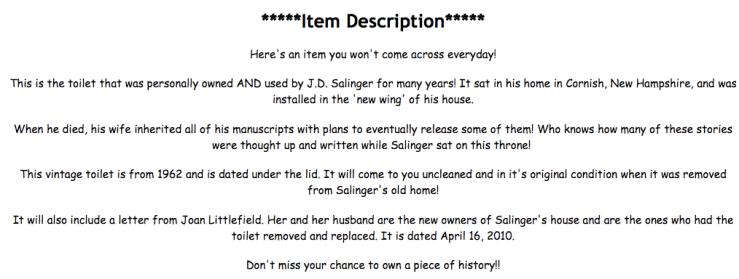
Buy J.D. Salinger’s Toilet

Buy J.D. Salinger’s toilet on eBay

Only one million dollars? For the Toilet Commode that Salinger PERSONALLY OWNED & USED?! Hmmm . . . could it be a phony?

“It will come to you uncleaned”? Wow.

“I Never Went to Blanes” — Diego Trelles Paz Remembers Roberto Bolaño

Diego Trelles Paz remembers Roberto Bolaño at n +1. Although Paz never met the author (despite several attempts) they corresponded, and he shares some of the emails. Here’s Paz on The Savage Detectives

What did I like about Bolaño’s novel?

In formal terms, it was clear to me that his prose, while apparently simple, has a restrained and suggestive lyricism and a powerful musicality that are very different than what the authors of the “Boom” produced. Reading Bolaño generated an instant addiction in me: whether due to the lucid and demystifying spirit with which he adopts diverse genres or to his eagerness to involve us as active readers, to offer us fragmented works so we might fill them in with our imaginations. We become accomplices who search for truth through narrative devices that blend reality with fiction, facts with conjectures, apocryphal characters with historical ones. As the critic José Miguel Oviedo has said, “Bolaño always ends up turning his readers into detectives.”

The article also features this marvelous image of Bolaño enjoying an ice cream cone–

Author Jonathan Franzen Uses Video to Object to the Making of Author Videos

“Muggins Here” — David Mitchell

The Guardian has published David Mitchell’s short story “Muggins Here” as part of its summer fiction special (other authors include Hilary Mantel and Roddy Doyle). Here’s an excerpt–

A proper mental Saturday it is, what with New Sue off with her hernia and the Lukes of Hazzard gone AWOL, so Muggins Here’ll have to cover for everyone else’s break. Not New Sue and Beverly are still giving me the silent treatment ’cause I can’t let them take the bank holiday off, but it’s water off a duck’s back by this point. By ten o’clock the queues are looping back, and it’s like all Greenland’s one of those swilling dreams you get with ‘flu. Full of eyes, drilling into me. Philpotts can’t get close enough to fire off a “What are half your team doing without their name-badges, Pearl?” but I need the loo – no chance, not ’til all the breaks are over. This beardy customer’s spitting, “Twenty-three minutes I’ve been in this queue!” I tell him, “It certainly is a busy morning” so in he leans, breath all pilchardy, and says, “Then hire – more – staff!”, like I’m backwards, like Gary used to do sometimes. I ask for his “I Love Greenland” Loyalty Card and while he’s fishing through his wallet I’m working out that I’ve still got three hundred and forty minutes ’til I can go home. Last week I turned forty-five so that’s nineteen years ’til I retire, though now they’re reckoning we’ll have to work ’til seventy. Seventy! Doesn’t bear thinking about, does it? I really really need the loo. When I ask the man, “Cash back?” he gives me this withering, “That’s exactly what landed the economy in the crappers in the first place” and then, “What’s so green about Greenland Supermarkets dishing out fifty plastic bags to every customer?”