Mass-market Monday | Joanna Russ’s Picnic on Paradise

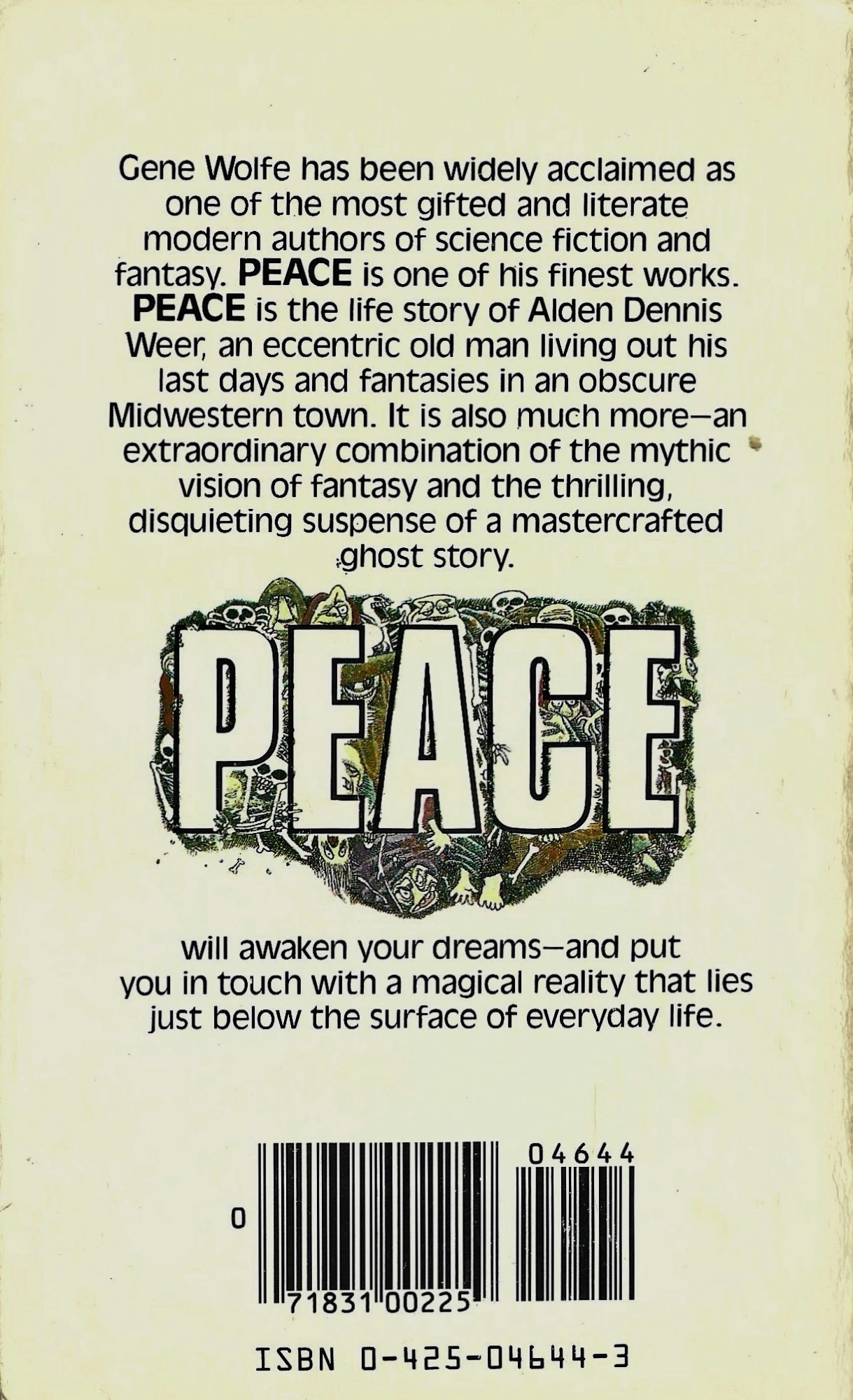
Picnic on Paradise, Joanna Russ, 1968. Ace Books (1968). Cover art by Leo and Diane Dillon. 157 pages.


From Joachim Boaz’s review at SF Ruminations:

Joanna Russ’ first published novel Picnic on Paradise (1968) delightfully subverts traditional SF pulp adventure tropes.  Although not as finely wrought as The Female Man (1975), And Chaos Died (1970), or her masterpiece We Who Are About To… (1976), Picnic is worthwhile for all fans of feminist SF and the more radical visions of the 60s.

Unfortunately, the metafictional implications/literary possibilities of the Alyx sequence of short stories and novels—of which Picnic on Paradise is part of—are not realized until the publication of the short story “The Second Inquisition” (1970).

The Bookworm’s Rules | Reading advice from Michael Silverblatt

The great reader Michael Silverblatt, host of Bookworm, has passed away at 73. Silverblatt was a powerful influence on my development as an adult reader, and his approach to reading helped shape my own appreciation of fiction as I emerged from/recovered from academia. It’s been a few years since I listened to an episode; I think the last one I recall was with Robert Coover and Art Spiegelman together, maybe five or six years ago, by which point the show seemed to be initiating a slow winding down process. But for years, when blogging was still very much a real thing and social media wasn’t, Bookworm was one of the best outlets for literary discussion. Its archive remains impeccable.

Here are ten “rules” Silverblatt offered in a 1997 LA Times profile:

  1. Sit. If you’re lying down you’ll fall asleep.
  2. Read at least 100 pages in your first session with a new book. You must get well in.
  3. If you’re reading for pleasure, finish a book before starting a new one. Don’t keep three or four going.
  4. If your eyes get tired, try cotton compresses with witch hazel—they’re soothing and refreshing.
  5. Read a book about a country you’ve never visited.
  6. Ask close friends to name their favorite book, one that changed their life or one that accompanied a change in life. You will learn not just about the book, but about the person who recommended it.
  7. Don’t be embarrassed to keep a vocabulary list. Reading without understanding is not a virtue.
  8. Don’t torture yourself or read out of duty. A great book has an obligation to enrich and alter your life.
  9. There are certain books you’ll find you’re not ready for. Please suspend your judgment of them. It took me seven years and six tries to read Faulkner’s As I Lay Dying.
  10. If you can’t discard preconceptions that come from bad classroom experiences—for example, A Tale of Two Cities and Silas Marner are not Dickens’ or Eliot’s best works—if you’ve X’d them out of your list, you’re missing something of pleasure. You’re ready now. Try them.

Blog about George Saunders’ novel Vigil, a novel I have not yet read (Book acquired 11 Feb. 2026)

I’ve been reading a lot of David Ohle lately — the Moldenke cycle, specifically. I read The Pisstown Chaos (2008) late last year, then kept going with The Old Reactor (2013), and then reread The Age of Sinatra (2004). I’m near the end of a  reread of Ohle’s seminal weirdo novel Motorman (1972) right now, and I’ve got The Blast (2014) and The Death of a Character (2021) on the way.

The Moldenke books take place in an abject, stinky, ruinous post-apocalyptic landscape populated with jellyheads, neutrodynes, imps, Stinkers, and Americans. The world runs on broken logic and bureaucratic absurdity. Order is repeatedly disrupted by Chaoses and Forgettings. Bodies fail; technology fails. Ohle relates these stories in a genteel, dry tone (especially in the later books) that mocks any hint of a Hero Saving the Day. His novels, especially those published during US America’s foolish GWOT misadventures, capture the spirit of my country’s farcical post-twentieth-century trajectory.

But this blog post is ostensibly about George Saunders, or rather George Saunders’ new novel Vigil, which I have not yet read, having only just today received a review copy in the mail.

I do not think that a writer has a cultural duty to respond to now, or Now, or even “Now!” if you like–but I do think that Saunders has always aimed to respond to the US American zeitgeist in his fictions. And in the best of his fictions — including the stories “CivilWarLand in Bad Decline,” “Pastoralia,” “Sea Oak,” and “The Semplica Girl Diaries” — Saunders skewered US American absurdity with a tender pathos that balanced his dark humor without overpowering its core anger. But Saunders’ later fiction is perhaps over-seasoned with love, empathy, all that hippy-dippy shit. It’s not necessary to look through everyone’s eyes. Empathy has its limits. Latter-day Saunders often read to me as, in its worst moments, sanctimonious.

NYT critic Dwight Garner didn’t use the word “sanctimonious” to describe Saunders in his negative review of  Vigil, but his lede comes close:

“Once you start illustrating virtue, you had better stop writing fiction,” Robert Penn Warren wrote. It was once difficult to imagine this dictum might apply to George Saunders.

From the start, in the mid-1990s, he’s been an American original, a briskly whiskered national asset. He’s an ineluctably strange, dark and funny writer whose work has some of Mark Twain’s subversive wit, Kurt Vonnegut’s cosmic playfulness and Donald Barthelme’s laboratory blitzing of high and low culture.

It was my colleague who alerted me to this review, which I skimmed, noting the phrase “Downhill Alert!”, before dispensing with it. (My colleague wants me to read the book in some kind of, uh, I don’t know, tandem?, with him.)

This colleague loved Saunders’ 2017 novel Lincoln in the Bardo. I did not love Lincoln in the Bardo. I couldn’t even finish it. I found it maudlin, trite. It was like watching your dad try and impress your boss (I don’t know what that means). I wrote that year, 2017, that

Lincoln in the Bardo might be a really good novel and I just can’t see it or hear it or feel it. I see postmodernism-as-genre, as form; I read bloodless overcooked posturing; I feel schmaltz. I failed the novel, I’m sure. I mean, I’m sure it’s good, right? The problem is me, as usual.

By 2018 I had changed my mind on that last sentence. I read Saunders’ New Yorker published short story “Little St. Don” and thought it was a massive, massive failure to respond to the incipient fascist encroachment of the first Trump administration. I concluded that,

Saunders loves his reader too much. The story wants to make us feel comfortable now, comfortable, at minimum, in our own moral agency and our own moral righteousness. But comfort now will not do.

I thought Saunders’ next two New Yorker stories were a smidge stronger, calling “Elliott Spencer,” “a stylistically-bold tale about poor people who are reprogrammed and then deployed as paid political protesters.” Of “Love Letter,” I suggested that the exercise “reads like a thought experiment with no real conclusion, no solid answer. Or, rather, the solution is there in the title: love. But is that enough?”

Vigil is about a dying oil tycoon visited by a comforting angel, or series of angels, or something like that. It is, if I understand correctly, Saunders’ take on “climate fiction,” which I imagine will not really dwell in the nasty gross irreal reality of the fall we are falling into right now. But I could be wrong. I can’t help but notice that Vigil seems to be organized, like Lincoln in the Bardo, around a “Great Man” in USAian history — a mover and shaker, a powerbroker, a markmaker, etc. I’ll try to read it with an open mind, but I have to admit that even the prospect pales against my recent dip into Ohle’s sour, funky flavors. But we shall see.


Mass-market Monday | Philip K. Dick’s The Divine Invasion

The Divine Invasion, Philip K. Dick, 1981. Timescape Books (July 1982). Cover by Rowena Morrill. 223 pages.


I love Rowena’s cover for PKD’s second entry in the VALIS trilogy. (Saddam Hussein was a fan of her art too, btw.)

The James Joyce riff from early in The Divine Invasion

Into the stereo microphones Asher said distinctly, ” ‘O tell me all about Anna Livia! I want to hear all about Anna Livia. Well, you know Anna Livia? Yes, of course, we all know Anna Livia. Tell me all. Tell me now. You’ll die when you hear. Well, you know, when the old cheb went futt and did what you know. Yes, I know, go on. Wash quit and don’t be dabbling. Tuck up your sleeves and loosen your talktapes. And don’t butt me- hike !-when you bend. Or whatever-‘”

“What is this?” the autochthon said, listening to the translation into his own tongue. Grinning, Herb Asher said, “A famous Terran book. ‘Look, look, the dusk is growing. My branches lofty are taking root. And my cold cher’s gone ashley. Fieluhr? Filou! What age is at? It saon is late. ‘Tis endless now senne- “The man is mad,” the autochthon said, and turned toward the hatch, to leave.

“It’s Finnegans Wake,” Herb Asher said. “I hope the translating computer got it for you. ‘Can’t hear with the waters of. The chittering waters of. Flittering bats, fieldmice bawk talk. Ho! Are you not gone ahome? What Thom Malone? Can’t hear-‘

The autochthon had left, convinced of Herb Asher’s insanity. Asher watched him through the port; the autochthon strode away from the dome in indignation. Again pressing the switch of the external bullhorn, Herb Asher yelled after the retreating figure, “You think James Joyce was crazy, is that what you think? Okay; then explain to me how come he mentions ‘talktapes’ which means audio tapes in a book he wrote starting in 1922 and which he completed in 1939. Before there were tape recorders! You call that crazy? He also has them sitting around a TV set — in a book started four years after World War I. I think Joyce was a– The autochthon had disappeared over a ridge. Asher released the switch on the external bullhorn.

It’s impossible that James Joyce could have mentioned ‘talk- tapes” in his writing, Asher thought. Someday I’m going to get my article published; I’m going to prove that Finnegans Wake is an information pool based on computer memory systems that didn’t exist until a century after James Joyce’s era; that Joyce was plugged into a cosmic consciousness from which he derived the inspiration for his entire corpus of work. I’ll be famous forever.

The spectator, at this point, is certain to wonder whether he must now endure a football game in print | Don DeLillo

(The spectator, at this point, is certain to wonder whether he must now endure a football game in print — the author’s way of adding his own neat quarter-notch to the scarred bluesteel of combat writing. The game, after all, is known for its assault-technology motif, and numerous commentators have been willing to risk death by analogy in their public discussions of the resemblance between football and war. But this sort of thing is of little interest to the exemplary spectator. As Alan Zapalac says later on: “I reject the notion of football as warfare. Warfare is warfare. We don’t need substitutes because we’ve got the real thing.” The exemplary spectator is the person who understands that sport is a benign illusion, the illusion that order is possible. It’s a form of society that is rat free and without harm to the unborn; that is organized so that everyone follows precisely the same rules; that is electronically controlled, thus reducing human error and benefiting industry; that roots out the inefficient and penalizes the guilty; that tends always to move toward perfection. The exemplary spectator has his occasional lusts, but not for warfare, hardly at all for that. No, it’s details he needs — impressions, colors, statistics, patterns, mysteries, numbers, idioms, symbols. Football, more than other sports, fulfills this need. It is the one sport guided by language, by the word signal, the snap number, the color code, the play name. The spectator’s pleasure, when not derived from the action itself, evolves from a notion of the game’s unique organic nature. Here is not just order but civilization. And part of the spectator’s need is to sort the many levels of material: to allot, to compress, to catalogue. This need leaps from season to season, devouring much of what is passionate and serene in the spectator. He tries not to panic at the final game’s final gun. He knows he must retain something, squirrel some food for summer’s winter. He feels the tender need to survive the termination of the replay. So maybe what follows is a form of sustenance, a game on paper to be scanned when there are stale days between events; to be propped up and looked at — the book as television set — for whatever is in here of terminology, pattern, numbering. But maybe not. It’s possible there are deeper reasons to attempt a play-by-play. The best course is for the spectator to continue forward, reading himself into the very middle of that benign illusion. The author, always somewhat corrupt in his inventions and vanities, has tried to reduce the contest to basic units of language and action. Every beginning, it is assumed, must have a neon twinkle of danger about it, and so grandmothers, sissies, lepidopterists and others are warned that the nomenclature that follows is often indecipherable. This is not the pity it may seem. Much of the appeal of sport derives from its dependence on elegant gibberish. And of course it remains the author’s permanent duty to unbox the lexicon for all eyes to see — a cryptic ticking mechanism in search of a revolution.)

From Don DeLillo’s 1972 novel End Zone.

A note to readers new to Infinite Jest

A note to readers new to Infinite Jest

David Foster Wallace’s 1996 novel Infinite Jest poses rhetorical, formal, and verbal challenges that will confound many readers new to the text. The abundance of (or excess of) guides and commentaries on the novel can perhaps have the adverse and unintentional consequence of making readers new to Infinite Jest believe that they can’t “get it” without help.  Many of the online analyses and resources for Infinite Jest are created by and targeted to readers who have finished the novel or are rereading the novel. While I’ve read many insightful and enlightening commentaries on the novel over the years, my intuition remains that the superabundance of analysis may have the paradoxical effect of actually impeding readers new to the text. With this in mind, I’d suggest that first-time readers need only a dictionary and some patience.

Infinite Jest is very long but it’s not nearly as difficult as its reputation suggests. There is a compelling plot behind the erudite essaying and sesquipedalian vocabulary. That plot develops around three major strands which the reader must tie together, with both the aid of—and the challenge of—the novel’s discursive style. Those three major plot strands are the tragic saga of the Incandenzas (familial); the redemptive narrative of Ennet House Drug and Alcohol Recovery House, with Don Gately as the primary hero (sociocultural); and the the schemes of the Québécois separatists (national/international/political). An addictive and thus deadly film called Infinite Jest links these three plots (through discursive and byzantine subplots).

Wallace often obscures the links between these plot strands, and many of the major plot connections have to be intuited or outright guessed. Furthermore, while there are clear, explicit connections between the plot strands made for the reader, Wallace seems to withhold explicating these connections until after the 200-page mark. Arguably, the real contours of the Big Plot come into (incomplete) focus in a discussion between Hal Incandenza and his brother Orin in pages 242-58. Getting to this scene is perhaps a demand on the patience of many readers. And, while the scene by no means telegraphs what happens in IJ, it nonetheless offers some promise that the set pieces, riffs, scenes, lists, and vignettes shall add up to Something Bigger. 

Some of those earliest set pieces, riffs, scenes, lists, and vignettes function almost as rhetorical obstacles for a first-time reader. The  novel’s opening scene, Hal Incandenza’s interview with the deans at the University of Arizona, is chronologically the last event in the narrative, and it dumps a lot of expository info on the reader. It also poses a number of questions or riddles about the plot to come, questions and riddles that frankly run the risk of the first-time reader’s forgetting through no fault of his own.

The second chapter of IJ is relatively short—just 10 pages—but it seems interminable, and it’s my guess that Wallace wanted to make his reader endure it the same way that the chapter’s protagonist–Erdedy, an ultimately very minor character—must endure the agonizing wait for a marijuana delivery. The chapter delivers the novel’s themes of ambivalence, desire, addiction, shame, entertainment, “fun,” and secrecy, both in its content and form. My guess is that this where a lot of new readers abandon the novel.

The reader who continues must then work through 30 more pages until meeting the novel’s heart, Don Gately, but by the time we’ve met him we might not trust just how much attention we need to pay him, because Wallace has shifted through so many other characters already. And then Gately doesn’t really show up again until, like, 200 pages later.

In Infinite Jest, Wallace seems to suspend or delay introducing the reading rules that we’ve been trained to look for in contemporary novels. While I imagine this technique could frustrate first-time readers, I want to reiterate that this suspension or delay or digression is indeed a technique, a rhetorical tool Wallace employs to perform the novel’s themes about addiction and relief, patience and plateaus, gratitude and forgiveness.

Where is a fair place to abandon Infinite Jest

I would urge first-time readers to stick with the novel at least until page 64, where they will be directed to end note 24, the filmography of J.O. Incandenza (I will not even discuss the idea of not reading the end notes. They are essential). Incandenza’s filmography helps to outline the plot’s themes and the themes’ plots—albeit obliquely. And readers who make it to the filmography and find nothing to compel them further into the text should feel okay about abandoning the book at that point.

What about a guide?

There are many, many guides and discussions to IJ online and elsewhere, as I noted above. Do you really need them? I don’t know—but my intuition is that you’d probably do fine without them. Maybe reread Hamlet’s monologue from the beginning of Act V, but don’t dwell too much on the relationship between entertainment and death. All you really need is a good dictionary. (And, by the way, IJ is an ideal read for an electronic device—the end notes are hyperlinked, and you can easily look up words as you read).

Still: Two online resources that might be useful are “Several More and Less Helpful Things for the Person Reading Infinite Jest,” which offers a glossary and a few other unobtrusive documents, and “Infinite Jest: A Scene-By-Scene Guide” which is not a guide at all, but rather a brief series of synopses of each scene in the novel, organized by page number and year; my sense is that this guide would be helpful to readers attempting to delineate the novel’s nonlinear chronology—however, I’d advise against peeking ahead. After you read you may wish to search for a plot diagram of the novel, of which there are several. But I’d wait until after.

An incomplete list of motifs readers new to Infinite Jest may wish to attend to

The big advantage (and pleasure) of rereading Infinite Jest is that the rereader may come to understand the plot anew; IJ is richer and denser the second go around, its themes showing brighter as its formal construction clarifies. The rereader is free to attend to the imagery and motifs of the novel more intensely than a first-time reader, who must suss out a byzantine plot propelled by a plethora of characters.

Therefore, readers new to IJ may find it helpful to attend from the outset to some of the novel’s repeated images, words, and phrases. Tracking motifs will help to clarify not only the novel’s themes and “messages,” but also its plot. I’ve listed just a few of these motifs below, leaving out the obvious ones like entertainment, drugs, tennis (and, more generally, sports and games), and death. The list is in no way definitive or analytic, nor do I present it as an expert; rather, it’s my hope that this short list might help a reader or two get more out of a first reading.

Heads

Cages

Faces

Masks

Teeth

Cycles

Maps

Waste

Infants

Pain

Deformities

Subjects

Objects

One final note

Infinite Jest is a rhetorical/aesthetic experience, not a plot.

[Ed. note: Biblioklept first posted a version of this note in the summer of 2015. Today marks the thirtieth anniversary of Infinite Jest’s publication. Wallace’s novel remains underread by overtalkers].

Mass-market Monday | Joanna Russ’s And Chaos Died

And Chaos Died, Joanna Russ, 1970. Ace Books (n.d., c. 1978). No cover artist or designer credited. 189 pages.


From Samuel R. Delany’s review of And Chaos Died:

The first two pages of this hardcover reprint of And Chaos Died present the protagonist, Jai Vedh, as a quietly despairing modern man with a nearly psychotic desire to merge with the universe. Moreover, it is suggested that this essentially religious desire is a response to the meaninglessness and homogeneity of every day life. There is a vacuum inside him; and when, on a business trip in a spaceship that has taken him off the surface of Old Earth (“on which every place was like every other place, ” p. 9), he senses the great vacuum of space itself about the ship, the real vacuum and the psychological vacuum become confused. Propelled by his desire for mergence,

on the nineteenth day he threw himself against one of the portals, flattening himself as if in immediate collapse, the little cousin he had lived with all his life become so powerful in the vicinity of its big relative that he could not bear it. Everything was in imminent collapse. He was found, taken to sick bay, and shot full of sedatives. They told him, as he went under, that the space between the stars was full of light, full of matter — what was it someone had said, an atom in a cubic yard? — and so not such a bad place after all. He was filled with peace, stuffed with it, replete; the big cousin was trustworthy.

Then the ship exploded. (p. 10)

The place Jai Vedh comes to, along with the philistine captain of the exploded spaceship, is the first of Russ’s SF utopias. Noting the January 1970 publishing date on the original edition, and thus inferring 1968/1969 as the most probable time of composition, we may be tempted to read this particular utopia as a kind of arcadian fall-out of that decade’s ecological crusade. A more sensitive reader of SF will, however, notice its sources in SF works that substantially predate that crusade: the nameless planet of telepaths takes its form from Clarke’s Lys (the more ruralized companion city to mechanical Diaspar in The City and the Stars, 1953) and from the world in Theodore Sturgeon’s “The Touch of Your Hand” ( 1953). What characterizes this particular SF image is not rural technology, but advanced technology hidden behind a rural facade; not human communication in good faith, but ordinarily invisible communicational pathways (some form of ESP); and it is always left and then returned to.

Richard Hell’s Godlike (Book acquired, 23 Jan. 2026)

Richard Hell’s 2005 novel Godlike is getting a new printing from NYRB. Godlike reimagines the volatile Verlaine–Rimbaud dyad as a 1970s No Wave New York collision of art, desire, and language language language. Symbolist rebellion transmutes into downtown punk nihilism, drugs, and poetry. This corrosive Künstlerroman was originally issued by Dennis Cooper’s Little House on the Bowery (an imprint of Akashic books). Read the description/blurb at NYRB; here’s a taste from Chapter 15, around the middle of the novel:

They spent the greatest amount of their time together reading and writing and sometimes talking in T’s apartment. These were probably their best times too despite being experienced largely as tedium. They preferred the times of thrills, but the thrills grew out of the tension; and the mild, mildly restless, half-frustrated times of the many nights and late afternoons of doing almost nothing in T’s apartment, or walking the streets without direction, were their true lives.

T’s room was like some kind of glum office in its lack of daylight and its featurelessness, but with the little pictures now tacked on the walls, and the typewriter and sheets of paper, and the drugs, it got some character. He’d picked up a few stray pieces of furniture on the streets, including a table and three chairs, crates for shelves, and a beat-up old oriental rug. There was a secondhand portable record player too and a few albums.

They drank coffee and beer and sometimes codeine cough syrup and sometimes smoked some grass or snorted a little THC or mescaline and every once in a while a tiny bit of heroin, but mostly they lay around and lazily, impatiently goofed and wrote and complained, goading each other. Sometimes in the middle of the night one of them would go out for a container of fresh ice cream from Gem’s Spa. They’d go to a movie sometimes, or wander the rows of used bookstores on Fourth Avenue, or drink in a bar, but most of t he time was spent in the dim back apartment.

The days and nights were as endless as wallpaper patterns. Boredom and irritation were normal and lengthened out into sometimes-mean giggles and into pages of writing. Writing was their pay. Books were reality. The room was a cruder dimension-poor annex to the pages of writing. The writing, as casual as it was—smeared eraseable typing-pages with revisions scribbled on and crumpled pages of rejected tries—was the brightly lit and wildly littered universe erupting out from the dark, poor, inexpressive room.

How odd is it to have as a purpose in life the aim of treating life-in the medium created for the purpose of coldly corresponding to it, words—as raw material for amusing variations on itself? Sometimes T. and Paul fantasized about this, imagining themselves as godlike philosopher poets encouched in the advanced civilization, languorously sipping their fermented grain as they spun ideas and mental-sensual constructions of life-language in the air for the pleasure of their own delectation.


Ishmael Reed on John A. Williams’ !Click Song

The following essay is from Rediscoveries II, a 1988 “gathering of essays by novelists…asked to rediscover their favorite neglected work of fiction.” Ishmael Reed’s overview of John Williams’ 1982 novel !Click Song motivated me to track down a copy of the book. And while elements of Reed’s typically prickly essay are dated in their contemporaneous references, the essay’s thrust — that the Invisible Empire persists — is as timely as ever. Read more on Rediscoveries II at Neglected Books.


Ishmael Reed

on

John A. Williams’ !Click Song


The Ku Klux Klan may appear to be clownish, and inept to some, but they have one thing right. They do represent an “Invisible Empire,” of which, the kind of monkeyshines that go on in places like Forsyth County belong to those of a small ignorant outpost. On the day that some joker held a sign warning of welfare disaster if blacks moved into the county, a New York Times columnist and a book reviewer spread the same lie about welfare being an exclusively black problem, yet, I doubt whether demonstrators will march on the editorial offices of the Times.

Klan thinking goes on in the editorial rooms of our major newspapers, in the film, and television studios; and in the public schools, and universities whose white male supremacist curricula are driving Hispanic, and black children out of education. One hears Ku Kluxer remarks in places that present themselves as the carriers of “Western civilization” like National Public Radio where,recently, a man congratulated a musician for using the saxophone as a “serious” symphonic instrument. “Up to now,” he said,
“the saxophone has merely been used to make ‘jazzy howls.’ ” In “the Invisible Empire,” George Shearing will always receive more recognition than Bud Powell, Paul Cummings more recognition than Cato Douglass, and racist mediocrities will always get more publicity and praise than John A. Williams. Continue reading “Ishmael Reed on John A. Williams’ !Click Song”

Mantra

A book cover bearing the words, "WORK AS IF YOU LIVE IN THE EARLY DAYS OF A BETTER NATION"

Alasdair Gray, 1934-2019

Mass-market Monday | Ishmael Reed’s Flight to Canada

Flight to Canada, Ishmael Reed, 1976. Avon Bard Books (1977). Cover art by Andrew Rhodes; no designer credited. 192 pages.


Reed’s Flight to Canada is one of my Best Books of 1976? round up of books published fifty years ago.

From my 2020 review of the novel:

Flight to Canada features a number of intersecting plots. One of these plots follows the ostensible protagonist of the novel, former slave Raven Quickskill, who escapes the Swille plantation in Virginia. Along with two other former slaves of the Swille plantation, Quickskill makes his way far north to “Emancipation City” where he composes a poem called “Flight to Canada,” which expresses his desire to escape America completely. The aristocratic (and Sadean) Arthur Swille simply cannot let “his property run off with himself,” and sends trackers to find Quickskill and the other escapees, Emancipation Proclamation be damned. On the run from trackers, Quickskill jumps from misadventure to misadventure, eventually reconnecting his old flame, an Indian dancer named Quaw Quaw (as well as her husband, the pirate Yankee Jack). Back at Swille’s plantation Swine’rd, several plots twist around, including a visit by Old Abe Lincoln, a sadistic episode between Lady Swille and her attendant Mammy Barracuda, and the day-to-day rituals of Uncle Robin, a seemingly-compliant “Uncle Tom” figure who turns out to be Reed’s real hero in the end.

ReMass-market Monday | Ishmael Reed’s Mumbo Jumbo

Best Books of 1976?

Previously:

Best Books of 1972?

Best Books of 1973?

Best Books of 1974?

Best Books of 1975?

Not-really-the-rules recap:

I will focus primarily on novels here, or books of a novelistic/artistic scope.

I will include books published in English in 1976, including translations published in English for the first time.


The New York Times Best Seller list for fiction in 1976 was dominated by Agatha Christie, Gore Vidal, and Leon Uris. Christie’s 1975 novel Curtain ruled winter and early spring, with her posthumous 1976 novel Sleeping Murder topping the charts in November and December. Vidal’s historical novel 1876 and Uris’s Trinity split the rest of the year. While Alex Haley’s Roots topped the nonfiction Best Seller list for only a few weeks in 1976, it’s the bestseller title of the year with the most cultural staying power. Bob Woodward and Carl Bernstein’s The Final Days, their follow up to 1974’s All the President’s Men was a bestseller in the spring and summer (and one of many, many Watergate books of this era). Gail Sheehy’s “road map to adult life” Passages was popular in the fall.

But sales charts ain’t literature.

Better to regard the New York Times Book Review’s end-of-year round up, “1976: A Selection of Noteworthy Titles.” It begins with a heavy dose of literary biographies, memoirs, autobiographies, and collections of letters. These include Christopher Isherwood’s Christopher and His KindLucille Clifton’s memoir Generations, Patrick McCarthy’s bio Celine, Charles Higham’s The Adventures of Conan Doyle, and Lillian Hellman’s third memoir Scoundrel Time. 

Also of note in the NYT list are Ron Kovic’s Born on the Fourth of JulyMaxine Hong Kingston’s The Woman Warrior, and Britt Britton’s collection of author Self-Portraits (the article is peppered with some of the portraits).

The Book Review piece also notes collections of letters by Sylvia Plath, E.B. White, and Virginia Woolf, as well as more diaries of Anaïs Nin. There are multiple memoirs of Hemingway (one by his son and one by his last wife) and David Heyman’s Ezra Pound biography. The list of literary bios and memoirs conveys the beginnings of a strange autopsy of the Modernist past giving way to something new.

Here are some of the fiction titles the New York Times Book Review includes in its “Selection of Noteworthy Titles” that I thought more noteworthy than other titles included:

The Acts of King Arthur and His Noble Knights, John Steinbeck

The Autumn of the Patriarch Gabriel García Márquez (trans. Gregory Rabassa)

The Easter Parade, Richard Yates

Flight to Canada, Ishmael Reed

The Franchiser, Stanley Elkin

Lady Oracle, Margaret Atwood

Lucinella, Lore Segal

Meridian, Alice Walker

Ratner’s Star, Don DeLillo

Orsinian Tales, Ursula K. Le Guin

Slapstick, Kurt Vonnegut

Speedboat, Renata Adler

The Takeover, Muriel Spark

Travesty, John Hawkes

Frog and Toad All Year, Arnold Lobel

Children of Dune, Frank Herbert

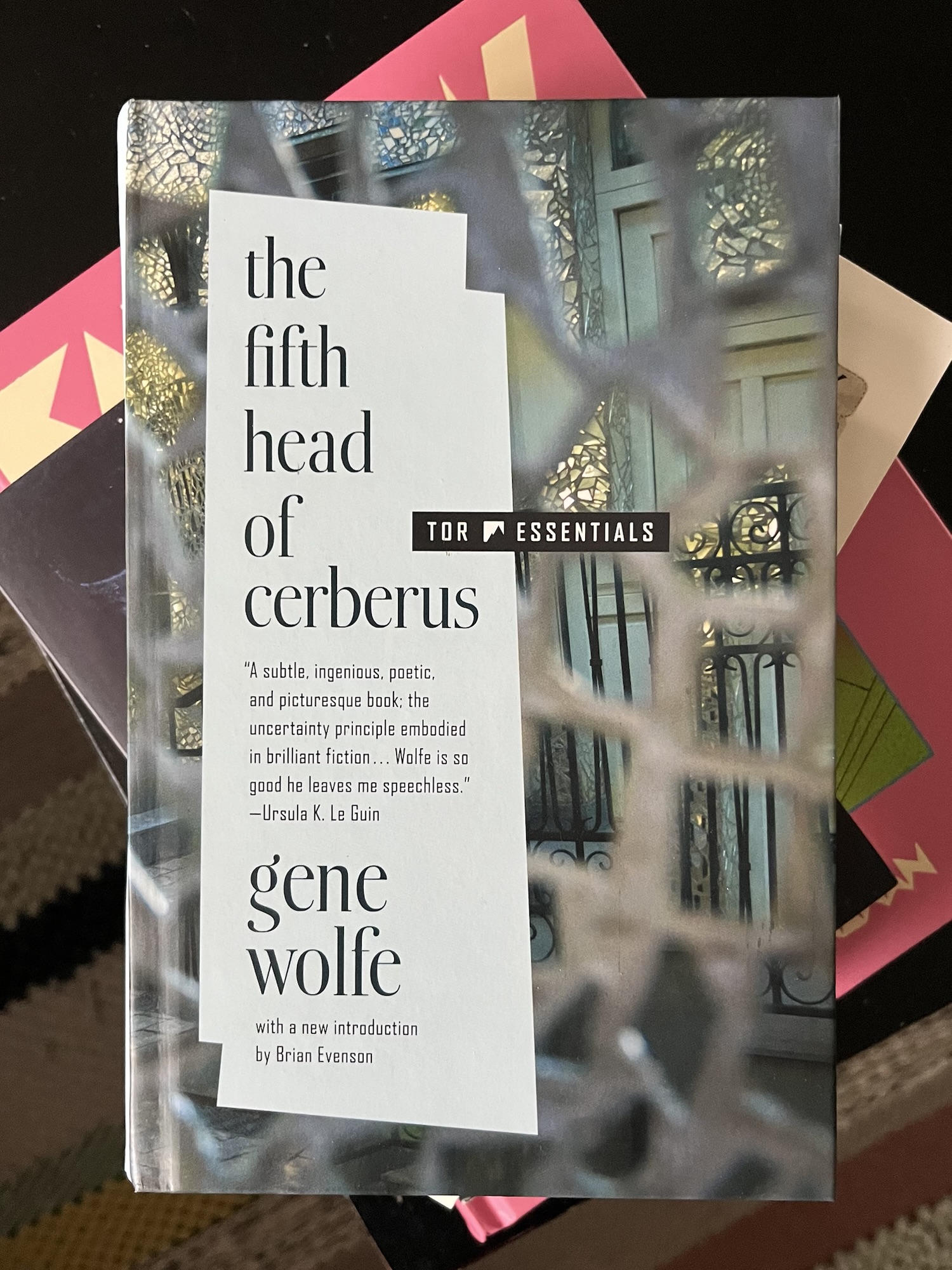
The Fifth Head of Cerberus, Gene Wolfe

Triton, Samuel R. Delany

I’ll do some more with that list in a second. But for now–

One of the best sections of the NYT Book Review’s year-end recap is “Author’s Authors,” in which they ask various writers to pick their three favorite reads of 1976. John Cheever picks John Updike’s Picked Up Pieces (1975). Bernard Malamud picks García Márquez’s The Autumn of the Patriarch. Vladimir Nabokov, always humble selects his own manuscript for The Original of Laura (it remained unpublished until 2009).

William H. Gass selects buddies William Gaddis (J R, 1975) and Stanley Elkin (The Franchiser); I’ll pick up Craig Nova’s 1975 novel The Geek on his recommendation. I’ll also be on the look out for one of Ishmael Reed’s recommendations: Dangerous Music (1975) by Jessica Tarahata Hagedorn. He also recommends one of the many, many Watergate books of the era, Blind Ambition by John Dean and Shouting! by Joyce Carol ThomasAs far as I can tell, Shouting! wasn’t published until 2007.

By far the best entry belongs to John Updike though:

John Updike THE FALL OF THE HOUSE OF GLASS by J.D. Salinger THE EARL BUTZ JOKE BOOK edited by Gerald Ford VOLUME X (GARRISON TO HALIBUT) OF THE ENCYCLOPEDIA BRITTANICA. I thought the Salinger well worth waiting for, the Butz one of the best volumes to issue from the Government presses in recent years, and Volume Ten, though rather severely treated in the New York Review of Books, the most amusing and varied yet in its series.

Shitposting in the Times in the late seventies. Gotta love it.

In her “Author’s Authors” write up, the novelist Lois Gold makes the only mention of Anne Rice’s Interview with the Vampire in the NYTBR piece. Rice’s seminal postmodernist vampire romance currently sits at #1 on Goodreads list of most popular books published in 1976, a testament to its populist staying power. Other notable books on the Goodreads list that were absent from the lofty NTYBR’s contemporary coverage include Tom Robbins’ Even Cowgirls Get the BluesMarge Piercy’s Woman on the Edge of TimeMichael Crichton’s Eaters of the DeadDavid Seltzer’s The OmenRaymond Carver’s Will You Please Be Quiet, Please?, Marian Engel’s BearOctavia Butler’s PatternmasterHarry Crews’ A Feast of SnakesHubert Selby Jr.’s The Demon, Richard Brautigan’s Sombrero FalloutKingsley Amis’s The Alteration, and many, many more. I’ll do more with that list momentarily, but next —

–prizes!

Saul Bellow won both the 1976 Nobel Prize in Literature (“for the human understanding and subtle analysis of contemporary culture that are combined in his work”) and the 1976 Pulitzer Prize for Fiction, specifically for his 1975 novel Humboldt’s Gift.

David Saville’s novel Saville was awarded the 1976 Booker Prize. The shortlist consisted of An Instant in the Wind by André Brink, Rising by R. C. Hutchinson, The Doctor’s Wife by Brian Moore, King Fisher Lives by Julian Rathbone, and The Children of Dynmouth by William Trevor. 

The 1977 National Book Award winner for fiction was Wallace Stegner’s The Spectator Bird. Runners-up were Will You Please Be Quiet, Please? by Raymond Carver, Orsinian Tales by Ursula K. Le Guin, The Balloonist by MacDonald Harris, and A Fine Romance by Cynthia Propper Seton. 

The 1976 National Book Critics Circle award for best fiction went to John Gardner’s October LightFinalists were Renata Adler’s Speedboat, Valdimir Nabokov’s Details of a Sunset and Other Stories, Cynthia Ozick’s Bloodshed and Three Novellas, and The Easter Parade by Richard Yates. Haley’s Roots was runner up to Maxine Hong Kingston’s The Woman Warrior. 

The Nebula Awards for fiction published in 1976 gave first place to Inferno by Larry Niven and Jerry Pournelle. Notable finalists included Marta Randall’s Islands, Delany’s Triton and Where Late the Sweet Birds Sang by Kate Wilhelm.

I have read many but hardly all the books mentioned in this post. But this is my blog, so here are my picks for the best books of 1976:

The Autumn of the Patriarch, Gabriel García Márquez (trans. Gregory Rabassa)

Bear, Marian Engel 

A Feast of Snakes, Harry Crews

Flight to Canada, Ishmael Reed

The Franchiser, Stanley Elkin

Orsinian Tales, Ursula K. Le Guin

Lucinella, Lore Segal

Ratner’s Star, Don DeLillo

Slapstick, Kurt Vonnegut

Speedboat, Renata Adler

A few sentences on every book I read or reread in 2025

☉ indicates a reread.

☆ indicates an outstanding read.

In some cases, I’ve self-plagiarized some descriptions and evaluations from my social media and blog posts.

I have not included books that I did not finish or abandoned.


Every Man for Himself and God Against All, Werner Herzog☆

I got a paperback copy of Herzog’s memoir for Christmas last year but ended up listening to him read the audiobook on my commute for a week or two. Every Man for Himself was one of four memoirs as-read-by-the-author I listened to this year. The other three: The Friedkin Connection by William Friedkin; The Harder I Fight the More I Love You by Neko Case; Rumors of My Demise by Evan Dando. I enjoyed all four memoirs and maybe as I go through this post I’ll pull a few common threads. Herzog’s memoir is bonkers, better than fiction. It really is one of those deals where a paragraph starts one way and a few sentences later you’re in a totally different place.

Dispatches from the District Committee, Vladimir Sorokov (translation by Max Lawton; illustrations by Gregory Klassen)

An absolutely vile book. I loved it.

Raised by Ghosts, Briana Loewinsohn

Loewinsohn’s love letter to the latchkey nineties hit me hard. I reviewed it here.

Nazi Literature in the Americas, Roberto Bolaño (translation by Chris Andrews)☉

I think I was trying to get through the beginning of a novel by an “alt” midlist author when I realized I’d rather read something I loved. Or maybe there was something else in the air in late January. The notes on the draft for this post are cryptic.

Feminine Wiles, Jane Bowles

A slim lil guy, a nice reprieve from current events in January, a reminder that sanity is precarious.

Interstate, Stephen Dixon☆

From my review: “It upset me deeply, reading Stephen Dixon’s 1995 novel Interstate. It fucked me up a little bit, and then a little bit more, addicted to reading it as I was over two weeks in a new year.”

Remedios Varo: El hilo invisible, Jose Antonio Gil and Magnolia Rivera

A lot of Varo’s pictures, but also a lot of Spanish. I was trying hard at the time (to read Spanish). I used my iPhone to translate a lot.

Borgia, Alejandro Jodorowsky and Milo Manara 

Indian Summer, Milo Manara and Hugo Platt

CaravaggioMilo Manara

A nice little run there, I seem to recall. Borgia was the best.

Occupancy 250: The Stories of Einstein A Go-Go

The Einstein A Go-Go was an all-ages music club at Jacksonville Beach that was a massive part of my teenage years. I saw so many amazing bands there over four or five years (including Luna, Thinking Fellers Union Local 282, Man or Astroman, Sebadoh, Polvo, Superchunk, Archers of Loaf, and so many more), met so many cool people, and even played there with my band a time or two or five. And if I was too late (that is, too young) to see acts like Nirvana, The Replacements, 10,000 Maniacs, The Cranberries, and Soundgarden there at the the end of the eighties and beginning of the nineties, it feels pretty swell to see my band’s name on the back of Occupancy 250 right there in the mix, as well as flyers and photos. Occupancy 250 is like the yearbook we never got when the club had to shut its doors in ’97 in the name of beachfront development. What a gift it was. A few months ago we went to a reunion event, featuring bands like The Cadets and Emperor X. I’ve never been to a high school reunion, but I know that this was better.

Autumn of the Patriarch, Gabriel García Márquez (translation by Gregory Rabassa)☆

Loved it. A discussion with a colleague after, a Spanish instructor, led to my reading Cela, Peri Rossi, and Rulfo.

The Hive, Camilo José Cela (translation by Anthony Kerrigan)

Pascual Duarte, Camilo José Cela (translation by Anthony Kerrigan)

I liked them both but liked Pascal Duarte more than La colmena. I would love to read Cela’s 1988 novel Cristo versus Arizona if I could get my pink little hands on an English-language copy.

The Friedkin Connection, William Friedkin☆

I think that Spotfiy suggested that I listen to Friedkin’s memoir after I finished the Herzog memory; in any case, there was a lot of overlap. Like Herzog, Friedkin had no idea how to make a film and never really developed a baseline beyond, Doing the thing for real and filming it, whatever the thing was. Going to make a film where a criminal is going to counterfeit US currency? Better teach Willem Dafoe how to, I don’t know, counterfeit money and just film that instead of, like, getting a props department involved. (Weird overlap: both Friedkin and Herzog laud Michael Shannon as the greatest actor of his generation.)

I loved this memoir. It starts, if I recall correctly, with Friedkin admitting that he threw away a sketch by Basquiat and an offer from Prince. It ends with Friedkin telling his wife, legendary producer Sherry Lansing, to pass on Forrest Gump. Amazing stuff.

The Ship of Fools, Cristina Peri Rossi (translation by Psiche Hughes)☆ 

I loved it.

Monsieur Teste, Paul Valéry (translation by Charlotte Mandell) 

I hated it.

Pedro Páramo, Juan Rulfo (translation by Douglas J. Weatherford

I liked it!

Blood Meridian, Cormac McCarthy☉ 

I guess I fall into rereading this all the time.

Tongues, Anders Nilsen☆ 

screenshot-2018-08-31-at-4-34-20-pm

Amazing stuff.

Day of the Triffids, John Wyndham

I probably would’ve read Day of the Triffids a dozen times as a kid instead of, like, Joan D. Vinge’s novelization of Mad Max Beyond Thunderdome, if there had been a copy in the lending library in Tabubil. Anyway, I’m glad I got to it when I did.

Frog, Stephen Dixon☆ 

Above, I wrote I have not included books that I did not finish or abandoned; look, I didn’t finish Frog, but in some ways it’s the most important book — or rather, most important, reading experience — for me this year.

An old great friend mailed me his copy back in March. I read and loved a hefty chunk of Frog, a long book, but abandoned it when another great old friend died unexpectedly in early May. I was deep into it but there was no comfort in it, in Frog.

And so then well I just read or reread a bunch of John le Carré novels.

Call for the Dead, John le Carré

A Murder of Quality, John le Carré☆ 

The Spy Who Came in from the Cold, John le Carré

The Looking Glass War, John le Carré

Tinker Tailor Soldier Spy, John le Carré☉☆ 

Was a blur, thank you to Mr. Le Carré’s ghost. A Murder of Quality was my favorite (I think). (I was a fucking mess and these books really helped me.)

The Woman with Fifty Faces: Maria Lani and the Greatest Art Heist That Never Was, by Jon Lackman and Zack Pinson.☆ 

I read it all in one sitting. Loved it.

The Bus 3, Paul Kirchner

I reviewed it here.

Portalmania, Debbie Urbanski

In my review, I wrote that, “Debbie Urbanski’s new collection Portalmania is a metatextual tangle of science fiction, fantasy, and horror where portals don’t offer escape so much as expose the fractures beneath family, love, and identity.”

Dreamsnake, Voya McIntrye

I liked it!

The Stone Door, Leonore Carrington

Wrestled with this dude a lot and it beat me. I thought it would twist one way and it did another thing. Ended up reading it twice in the summer and I guess I’ll read it again.

The Great Mortality, John Kelly

Kelly’s Black Death chronicle was a comfort read this summer.

Figures Crossing the Field Towards the Group, Rebecca Grandsen

Skip my review of Grandsen’ poetic post-apocalyptic miniature epic and just buy it and read it.

Macunaíma, Mário de Andrade (translation by Katrina Dodson)☆ 

I am so glad my guy at the bookstore sold me on this one. A synthesis of Brazilian folklore with high and low modernism (eh, Modernism?).

The Sense of an Ending, Julian Barnes

A corny book a colleague recommended. I’m happy that someone I know IRL wants me to read a book and talk about it with them.

Unkempt Thoughts, translation by Jacek Galazka (translation by Jacek Galazka)

More Unkempt Thoughts Stanislaw J. Lec (translation by Jacek Galazka)

Aphorisms.

The Frog in the Throat, Markus Werner (translation by Michael Hofmann)☆ 

I gave the guy who gave me the Julian Barnes this novel; he didn’t like it!

I loved it. In my review of The Frog in the Throat. I noted that “you could throw a small dart in this short book and find a nice line” its protagonist. I included a lot of those pithy gems in the review if you want a sample.

Counternarratives, John Keene☆ 

Amazing stuff. I was halfway through when I realized that Keene wrote the intro to my edition of Mário de Andrade’s Macunaíma. My favorite piece in the collection reads like a riff on Melville’s Benito Cereno with strong Gothic undertones.

Mevlido’s Dreams, Antoine Volodine (translation by Gina M. Stamm)☆ 

A bleak, dystopian noir novel set several centuries in a ruined city-state wherein Mevlido’s fragmented consciousness becomes a vessel for Volodine’s haunting post-exotic vision of history, language, and apocalypse. Loved it! My review.

Shadow Ticket, Thomas Pynchon☆ 

The highlight of 2025 in reading was a new late Pynchon novel. It might not have been the best novel I read this year, but it was my favorite reading experience. I ended up reading it twice, running a series of posts I called Notes on Thomas Pynchon’s novel Shadow Ticket. At the end of those notes, I wrote:

“I should probably distill my thoughts on Shadow Ticket into a compact, “proper” review, but I’ve sat with the novel now for two months, reading it twice, and really, really enjoying it. I never expected to get another Pynchon novel; it’s a gift. I loved its goofy Gothicism; I loved its noir-as-red-herring-genre-swap conceit; I loved even its worst puns (even “sofa so good”). I loved that Pynchon loves these characters, even the ones he might not have had the time or energy to fully flesh out — this is a book that, breezy as it reads, feels like a denser, thicker affair. And even if he gives us doom on the horizon in the impending horrors of genocide and atomic death, Pynchon ends with the hopeful image of two kids chasing sunsets. Great stuff.”

Black Arms to Hold You Up, Ben Passmore

Sports Is Hell, Ben Passmore

Subtitled A History of Black Resistance, Passmore’s comic is more fun than you would think a book about fighting a racist state should be. I still owe it a proper review. It made me go back and read Passmore’s Sports Is Hell, which is kinda like the NFL x Walter Hill’s The Warriors x George Herriman’s Krazy Kat.

The Harder I Fight the More I Love You, Neko Case

Of the four memoirs I listened to this year, musician Neko Case’s is the most artfully written, packing in bursts of sensory images that pivot cannily to evoke very specific memories that connect the reader to the storyteller. The memoir is heavy on Case’s childhood and adolescence and purposefully avoids a direct accounting of her musical career. That’s not to say there isn’t a lot about music in here — there is (life on the road, songwriting, a nice section on her tenor guitar) — but Case seems to avoid going into too much detail about interpersonal relationships with other musicians. She also seems to want to apologize for some past behaviors, but the apologetic language is indirect and even cagey (Evan Dando’s memoir is a massive contrast here — the dude dishes deep, but is also frank and clear and specific about all the bad mean shit he did to people when he was younger).

Neko Case’s magnificent singing voice translates well to reading her memoir. She’s really good at reading it — expressive without being hammy, subtle, artful. I would love to hear her read other audiobooks, but I’m also happy for her to keep her focus on making music and playing live.

The King in Yellow, Robert Chambers☉

I played this silly fun indie game called The Baby in Yellow which led me to reread The King in the Yellow for the first time since I went nuts over True Detective (the first season). The first two stories were much stronger than I remembered — much weirder.

Acid Temple Ball, Mary Sativa

A Satyr’s Romance, Barry N. Malzberg

Flesh and BloodAnna Winter

I spent some of the year browsing through a copy of the Maurice Girodias edited volume The Olympia Reader. That edition offers excerpts from Olympia Press’s more “respectable” authors, like William Burroughs, Chester Himes, Henry Miller, Jean Genet etc. I downloaded a bunch of trashier Olympia titles and ended up reading these three. They were all pretty bad but also fun. Acid Temple Ball is like a sex-positive Go Ask Alice; both A Satyr’s Romance and Flesh and Blood are well-beyond “problematic” in their depictions of sexual relationships.

The Pisstown Chaos, David Ohle☆ 

In my golden-hued review, I called The Pisstown Chaos “a foul, abject, hilarious, zany vaudeville act, a satire of post-apocalyptic literature, an extended riff on American hucksterism. It’s very funny and will make most readers queasy.”

The Changeling, Joy Williams

Joy Williams is one of my favorite writers, but I’ll admit I was disappointed in her second novel, 1978’s The Changeling. I loved how dark and weird and oppressive it was, but soon tired of spending time in the rattled consciousness of its alcoholic hero, Pearl. When Williams explores beyond Pearl, the novel hints at weird Gothic cult island shit that is super-intriguing — but we always have to retreat back to our depressed, insane hero.

The Folded Clock, Gerhard Rühm (translation by Alexander Booth)

A collection of “number poems, comprising typewriter ideograms, typed concrete poetry, collages of everyday paper ephemera and scraps, and a wide variety of literary forms where the visual pattern created on the page underpins the thematic meaning,” as publisher Twisted Spoon puts it. A fascinating and frustrating read that hearkens back to the good ole days of the avant garde.

Rumors of My Demise, Evan Dando

In a review at the Guardian of Evan Dando’s memoir Rumors of My Demise, Alexis Petridis writes that the Lemonheads leader “sounds insufferable, but weirdly, he doesn’t come across that way.” Dando doesn’t try to deny, deflect, or otherwise shade his life. He’s upfront about his privileged background, his good looks, and his love of the rock star lifestyle. He’s also, as he always was, very upfront about the drugs. I was in eighth grade when It’s a Shame about Ray came out. I loved it. I loved the follow up album, Come on Feel the Lemonheads even more. I am, I suppose, the target audience for this book, and I found it very satisfying. I also think listening to Dando read it is really remarkable. He’s charming and affable, but he doesn’t seem comfortable reading out loud (you can hear it, for example, in an awkward pause when he has to change the page during the middle of a sentence). It’s also remarkably honest, and culminates in a series of apologies to many of the people he’d hurt when he was younger (“If I could go back in time and give a bit of advice to myself, I’d say ‘Evan, don’t be such a dick.’”)

My best friend Nick, who died this May, was a bigger Lemonheads fan than I was. I think he would have loved Rumors of My Demise and I thought about him all the time while I was listening to it, wanting to text him, Hey, you’re gonna love this story about Dando drinking Fanta Orange and Absolut with Keith Richards or, Man, Dando really has a score to settle with Courtney Love, or Dando’s some kind of disaster magnet — he lived right by the Twin Towers and was home on 9/11, he was in L.A. during the King riots, in Paris when Diana died, on Martha’s Vineyard when JFK Jr. crashed…or, Man, Dando seems to have finally quit heroin, good for him. I didn’t get to text those things so I’m writing them here.

Happy New Year to you and yours.

A partial glossary for Thomas Pynchon’s Gravity’s Rainbow

The October 1980 issue of Esquire ran a piece titled “What to Think about Gravity’s Rainbow” by the poet Terrill Shepard Soules. It’s not really a what to think piece, though (the title seems an editorial intervention), but rather a witty glossary.

“WHAT TO THINK ABOUT GRAVITY’S RAINBOW

by Terrill Shepard Soules


VERY CLEVER.

THOMAS PYNCHON, AUTHOR, KEEPS A LOW PROFILE.

MAIN CHARACTER: TYRONE SLOTHROP.

FIRST LINE: “A SCREAMING COMES ACROSS THE SKY.” NICE FIRST LINE.

LONG — 760 PAGES IN HARD-COVER.

BUZZWORDS: PIGS, PARANOIA, B MOVIES, SEX, NAZIS.

PUBLISHED 1973; EVERYONE WENT CRAZY.

NATIONAL BOOK AWARD, OF COURSE. PULITZER JUDGES LOVED IT, PULITZER TRUSTEES THOUGHT OBSCENE. ALSO INCOMPREHENSIBLE. NO PULITZER PRIZE. SOMETHING LIKE ULYSSES THAT WAY. A FREQUENT COMPARISON.

INSIDERS CALL IT RAINBOW. INSIDERS ARE INSIDERS BECAUSE THEY LOVE THE IDEA THAT
SOME RECLUSE (A CORNELL GRAD?) WROTE A 760-PAGE BOOK ABOUT PIGS AND PARANOIA. ALSO BECAUSE THEY KNOW SOME VERY EXTRAORDINARY WORDS FROM RAINBOW, LIKE THE ONES IN THE GLOSSARY BELOW (FROM THE HARD-COVER EDITION).


BOOK 1
Beyond the Zero

NARODNIK [p. 11]
From Russian narod, “people.” Intellectual trying to metamorphose peasant into revolutionaries. The Narodniki flourished in the late 1860s. In the late 1960s Student Nonviolent Coordinating Committee activists were referred to as narodoniks. By show-offs.

PRETERITION, PRETERITE
[p. 15 and throughout]
A passing over. Preterition is the Fluke Cosmic, the doctrine that God in John Calvin’s breast (cf. the Jampere-phrenia in Alien) decreed that you and you and you are heavenbound no questions asked but We’re going to have to think about the rest of you — don’t get your hopes up.

MAFFICK [p. 17]
The founder of the Boy Scouts defended the garrison at Mafeking against the Boers for two hundred seventeen days. When the siege was raised, on May 17, 1900, London went crazy, and the jubilant celebratory maffick — it’s a verb! — was born. Here, part of Lieutenant Oliver “Tantivy” Mucker-Maffick’s moniker.

TANTIVY [p. 17]
Mucker-Maffick’s nickname. Means to gallop along, or a blast on a horn, or that headlong gallop itself.

LOVE-IN-IDLENESS [p. 22]
The perfect word for violet. Pynchon’s choice is dazzling. First, on a map of London there’s a star for each of Slothrop’s women, Slothrop “having evidently the time, in his travels among places of death, to devote to girl-chasing.” Second, the many stars are of many colors. Third, Slothrop gets the idea that the stars look like flowers. Now Viola tricolor, the flower in question, turns out to be a violet with yellow, white, and purple petals and several country names. The name our author finally selects enables him to pull off a genuine rampage-prose triple play: “and all over the place, purple and yellow as hickeys, a prevalence of love-in-idleness.” Continue reading “A partial glossary for Thomas Pynchon’s Gravity’s Rainbow”

The Pisstown Chaos, David Ohle’s post-convenience novel of abject gags and grotesque japes

Let’s get the obvious out of the way first: The Pisstown Chaos is an improbably perfect and beautiful name for a novel. If you don’t like the title, The Pisstown Chaos isn’t for you. It is a foul, abject, hilarious, zany vaudeville act, a satire of post-apocalyptic literature, an extended riff on American hucksterism. It’s very funny and will make most readers queasy.

The author of The Pisstown Chaos is David Ohle. The novel was published in 2008; it is the second of three “sequels” to Ohle’s 1972 cult classic Motorman. You do not have to have read Motorman or The Age of Sinatra (2004) to “understand” The Pisstown Chaos. (But you’ll probably want to dig into those if you dig The Pisstown Chaos’s uh pungent urinous ammonia bouquet)

Moldenke, hero of Motorman, is a bit player in The Pisstown Chaos, a walk on, a song-and-dance man with no songs or dances. A storyteller. He’s a zombie, too — a “stinker” in the novel’s parlance — adorned in “black rags and a wide-brimmed white hat,” sporting “an inch-long tube of flesh protruding from just below his ear [which] had the general appearance and shape of an infant’s finger, but lacked a nail. In the end of the tube, a small hole leaked a clear, gelatinous fluid.”

Moldenke, we are to infer, is one of the “Victims of the Pisstown parasite…thought of as dead, but not enough to bury. Gray haggard, poorly dressed, they lay in gutters, sat rigidly on public benches, floated along canals and drank from rain-filled gutters.” He may or may not be centuries old.

It’s not clear how far into the future we are in the Ohleverse (it doesn’t really matter). After “the Great Forgetting,” and multiple and ongoing Chaoses, the world has regressed, or progressed, or really mutated, into a dusty, wet, gross, nasty post-infrastructure reality. You might read The Pisstown Chaos as a slapstick zombie Western.

The Reverend Hooker presides over this wonderfully abject world. Hooker’s loose theocratic federation revolves elliptically around a “shifting” scheme. Nothing is permanent, everything is moving, plates spinning on poles. Folks receive their shifting papers and must relocate from, say, a cozy cottage to a prison camp. Or they might end up paired with a new concubine or some such.

That’s the fate of Mildred Balls, née Mildred Vink, who meets Jacob Balls on the road to Witchy Toe. The pair meet cute and get on famously. (And who wouldn’t; after all, suave Jacob Balls was the inventor of  the “finely-grained, yellow-tinged powder” known as “Jake” — a kind of post-apocalyptic Bud Light.) Optimistic Jacob is optimistically optimistic of all the shifting, attesting his belief that “in any culture, when boredom and apathy take hold, the currency is debased and the decline is irreversible…What could be more of a tonic than a random redistribution of the populace?” Mildred is less convinced: “The whole scheme is idiotic.”

The Pisstown Chaos focuses on the Balls clan — primarily an older Mildred and her young adult grandkids, Roe and Ophelia. There are stinkers and imps, shifting folk consuming urpflanz, willy, and Jake on their way via Q-ped to Indian Apple or Bum Bay. Reverend Hooker is always lurking in the margins, too, before taking over the narrative’s final pages in a mock apotheosis that brought a stupid smile to my face.

Ohle’s narrative isn’t exactly a picaresque, but it runs on the same energy. Each chapter opens with a series of frank excerpts from the Pisstown rag, the City Moon. Here’s one update of news you need:

A fondness for pickled lips has led to the arrest of a Kootie Fiyo, a stinker known to be a trader in tooth gold and a vicious biter. Fiyo was just leaving the impeteria in South Pisstown when two Guards entered. The proprietor said, “That stink can eat more imp lips than I can heap in front of him. “

The City Moon is not just a source for the goods on a stinker’s glimpse of pickled imps’ lips, but also a gloss on the undead (or un-undead’s) physiology:

What then is a final-stage stinker’s life like? It has been described by scientists as showing a poverty of sensation and a low body temperature. In their nostrils is the persistent odor of urpmilk. The membrane which lines their mouth is extremely tough and is covered with thick scales. They like to touch fur and drink their own urine. Because they have been known to go without food for as long as eighteen years, we can assume that their sense of time passing is also very different from our own.

The Stinker Problem is likely the signature event of whatever century we are in. There’s probably an icky metaphor or allegory somewhere in there, but I find myself disinterested in that end of the novel. But still: Consider Mildred–who wants to find a “cure” for stinkerism–in charge of a crew of stinkers who, after their daily labors, commit “to walking in circles and searching the ground.” But these are not geologists peering into the navel of the world: “‘No, Miss,’ Spanish Johnny said, ‘We like to get dizzy and faint. It’s the way we have fun.'” We’ve all been there.

Mildred’s granddaughter Ophelia commands much of the narrative, shifting about her stations in life. Her domestic comedy with servants Red and Peters is a class-conscious comic delight. Our Miss Madame goes through a series of abject slapstick routines with the Help (including an enema gag that uh, gag me yeah). Here’s a foul episode in the life of Ophelia Balls:

She walked carefully from slippery stone to slippery stone until she got to the potting shed, then blew out the candle. She tried the door and found it locked. Wiping the dirty door-glass, she looked in at Peters, lying on the peat pile with his pants pulled down, fanning his rear with a handful of straw. Red, sitting beside him in Mildred Balls’s underwear, combed Peters’s coarse hair with a tortoise-shell comb. Peters’s cheeks were flushed, his eyes half-closed. When Ophelia entered, the scene seemed all the more lurid for the dim lantern and its flicker.

“I hope you don’t take any offense,” Red said, “but I’ve just mated with Peters here.”

Peters sat up. “I was quietly potting geraniums when that idiot stepped out of a dark corner and made advances, clumsy, lewd advances, with his big willy sticking out. I tried, but I couldn’t resist him.”

“Is that true, Red, that he put up resistance?”

“He lies like a rug. He clearly indicated he wanted me to sex him good and sex him hard.”

Ophelia saw the pointlessness of going any further with the inquiry. “All is forgiven. Let’s move past this.”

“I’ll serve the swan,” Red said.

If I’ll serve the swan isn’t your kinda punchline, The Pisstown Chaos ain’t your cup of Jake. It’s a rich, smelly, gross novel, fun, funny, fueled with 19th-century inventions viewed through piss-colored glasses, aimed at the apocalyptic future. It’s smoked imp-meat served with urpsmoke, a vaudeville buzz against the zombies in the gutter. When I was a kid we held our breath when we passed cemeteries. There are other ceremonies, other totems, but warding off the dead remains a concern.

I have neglected the Balls scion, young Roe, who eventually finds himself attending the Reverend Hooker. Late in the novel, Roe Balls prepares an enema for the theocrat; Hooker then delivers a sermon:

“I’ll warm up the bathroom right away, sir, and get the enema bag ready.”

Once Roe had firmly inserted the hose, the Reverend sat on the pot and closed his eyes. “There, that’s it, Roe. It’s in well enough.”

“Shall I leave you alone now, sir?”

“No. Don’t leave. Let me sermonize a little. I’ll tell you a story, a story with a lesson. In the days when all men were good, they had miraculous power. Lions, mountains, whales, jellyfish, hagfish, birds, rocks, clouds, seas, moved quietly from place to place, just as men ordered them at their whim and fancy. But the human race at last lost its miraculous powers through the laziness of a single man. He was a woodman in the Fertile Crescent. One morning he went into the forest to cut firewood for his master’s hearth. He sawed and split all day, until he had a considerable stack of hickory and oak. Then he stood before the pile and said, ‘Now, march off home!’ The great bundle of wood at once got up and began to walk, and the woodman tramped on behind it. But he was a very lazy man. Now, why shouldn’t I ride instead of galloping along this dusty road, he said to himself, and jumped up on the bundle of wood as it was walking in front of him and sat down on top of it. As soon as he did, the wood refused to go. The woodman got angry and began to strike it fiercely with his axe, all in vain. Still the wood refused to go. And from that time the human race had lost its power.”

“That certainly explains everything I’ve ever wondered about, sir.”

“You may clean me now.”

“Yes, sir.”

The punchlines accumulate after the Rev. Hooker’s fable — young Roe’s deadpan line “That certainly explains everything I’ve ever wondered about, sir” made me laugh aloud when I read it, and the following asswipe line is too much — but I think we have here in the fable a key to the novel. Not the key, but a key.

In the Rev’s woodman’s fable, humans once wielded Promethean power over the world. But that power’s contingent; it exists only when humans move with the world, attentive to its rhythms and limits. When the woodman attempts to ride the wood and make it a convenience instead of walking alongside it, cooperation collapses. S’all she wrote.

Ohle’s chaotic, grotesque world echoes his some-time collaborator William Burroughs’ alien abjection. It will also be comfortingly/nauseatingly familiar (familiar?!) with anyone who digs David Cronenberg’s corporeal horrors. The Pisstown Chronicles will also appeal to weirdos who dig the abject fictions of Vladmir Sorokin, José Donoso, and Antoine Volodine.

The Pisstown Chaos is not a novel for everyone, but there’s a certain type of reader who will love wading through its abject humor, grotesque imagery, and absurdist chaos. Ohle’s post-convenience world grunts and howls; it’s dark, vivid, gross, and hilarious. That scent will linger. Highly recommended.

Gerhard Rühm’s The Folded Clock (Book acquired, drifted through, last week or the week before, end of 2025)

I dug/was perplexed by Gerhard Rühm’s Cake and Prostheses a few years ago, so when I got my soft pink hands on The Folded Clock, (translated like C & P by Alexander Booth), I was intrigued. Publisher Twisted Spoon describes The Folded Clock as a collection of “number poems, comprising typewriter ideograms, typed concrete poetry, collages of everyday paper ephemera and scraps, and a wide variety of literary forms where the visual pattern created on the page underpins the thematic meaning.”

Rühm seems to identify Kurt Schwitters as his artistic precursor, or an artistic precursor. Like Cake and Prosthesesthe pieces in The Folded Clock defy easy categorization — Is it a script or a poem or art? is probably the wrong question.

Passing eyes over the text is probably not the way to go; Rühm’s asking you to engage. As Joseph Schreiber puts it in his review at Rough Ghosts, you might follow Rühm’s directions and “allow yourself to read aloud and, there are you are, from the very beginning, not simply reading but actively engaging with the poem.”

I don’t really like numbers that much, at least not in a mob, a gang, a swarm. I tried and didn’t work out. Not just with this book but in general. I can’t count sheep, I guess.

I had a better time with Rühm’s forays into music and letters and collages; I enjoyed whatever psychotic version of minesweeper or Sudoku this piece is:

“Turkey Remains and How to Inter Them with Numerous Scarce Recipes” — F. Scott Fitzgerald

From F. Scott Fitzgerald’s Notebooks

TURKEY REMAINS AND HOW TO INTER THEM WITH NUMEROUS SCARCE RECIPES
At this post holiday season the refrigerators of the nation are overstuffed with large masses of turkey, the sight of which is calculated to give an adult an attack of dizziness. It seems, therefore, an appropriate time to give the owners the benefit of my experience as an old gourmet, in using this surplus material. Some of the recipes have been in my family for generations. (This usually occurs when rigor mortis sets in.) They were collected over years, from old cook books, yellowed diaries of the Pilgrim Fathers, mail order catalogues, golfbags and trash cans. Not one but has been tried and proven—there are headstones all over America to testify to the fact.
Very well then: Here goes:

1. Turkey Cocktail
To one large turkey add one gallon of vermouth and a demijohn of angostura bitters. Shake.

2. Turkey at la Francais.
Take a large ripe turkey, prepare as for basting and stuff with old watches and chains and monkey meat. Proceed as with cottage-pudding.

3. Turkey and Water
Take one turkey and one pan of water. Heat the latter to the boiling point and then put in the refrigerator When it has jelled drown the turkey in it. Eat. In preparing this recipe it is best to have a few ham sandwiches around in case things go wrong.

4. Turkey Mongole
Take three butts of salami and a large turkey skeleton from which the feathers and natural stuffing have been removed. Lay them out on the table and call up some Mongole in the neighborhood to tell you how to proceed from there.

5. Turkey Mousee
Seed a large prone turkey, being careful to remove the bones, flesh, fins, gravy, etc. Blow up with a bicycle pump. Mount in becoming style and hang in the front hall.

6. Stolen Turkey
Walk quickly from the market and if accosted remark with a laugh that it had just flown into your arms and you hadn’t noticed it. Then drop the turkey with the white of one egg-well, anyhow, beat it.

7. Turkey a la Creme.
Prepare the creme a day in advance, or even a year in advance. Deluge the turkey with it and cook for six days over a blast furnace. Wrap in fly paper and serve.

8. Turkey Hash
This is the delight of all connoisseurs of the holiday beast, but few understand how really to prepare it. Like a lobster it must be plunged alive into boiling water, until it becomes bright red or purple or something, and then before the color fades, placed quickly in a washing machine and allowed to stew in its own gore as it is whirled around.
Only then is it ready for hash. To hash, take a large sharp tool like a nail-file or if none is handy, a bayonet will serve the purpose—and then get at it! Hash it well! Bind the remains with dental floss and serve.
And now we come to the true aristocrat of turkey dishes:

9. Feathered Turkey.
To prepare this a turkey is necessary and a one pounder cannon to compell anyone to eat it. Broil the feathers and stuff with sage brush, old clothes, almost anything you can dig up. Then sit down and simmer. The feathers are to be eaten like artichokes (and this is not to be confused with the old Roman custom of tickling the throat).

10. Turkey at la Maryland
Take a plump turkey to a barber’s and have him shaved, or if a female bird, given a facial and a water wave. Then before killing him stuff with with old newspapers and put him to roost. He can then be served hot or raw, usually with a thick gravy of mineral oil and rubbing alcohol. (Note: This recipe was given me by an old black mammy.)

11. Turkey Remnant
This is one of the most useful recipes for, though not, “chic”, it tells what to do with the turkey after the holiday, and extract the most value from it.
Take the remants, or if they have been consumed, take the various plates on which the turkey or its parts have rested and stew them for two hours in milk of magnesia. Stuff with moth-balls.

12. Turkey with Whiskey Sauce.
This recipe is for a party of four. Obtain a gallon of whiskey, and allow it to age for several hours. Then serve, allowing one quart for each guest.
The next day the turkey should be added, little by little, constantly stirring and basting.

13. For Weddings or Funerals. Obtain a gross of small white boxes such as are used for bride’s cake. Cut the turkey into small squares, roast, stuff, kill, boil, bake and allow to skewer. Now we are ready to begin. Fill each box with a quantity of soup stock and pile in a handy place. As the liquid elapses, the prepared turkey is added until the guests arrive. The boxes delicately tied with white ribbons are then placed in the handbags of the ladies, or in the men’s side pockets.

There I guess that’s enough turkey to talk. I hope I’ll never see or hear of another until—well, until next year.