“Ballad of Birmingham” — Dudley Randall

“Ballad of Birmingham” by Dudley Randall

(On the bombing of a church in Birmingham, Alabama, 1963)

“”Mother dear, may I go downtown
Instead of out to play,
And march the streets of Birmingham
In a Freedom March today?”

“No, baby, no, you may not go,
For the dogs are fierce and wild,
And clubs and hoses, guns and jails
Aren’t good for a little child.”

“But, mother, I won’t be alone.
Other children will go with me,
And march the streets of Birmingham
To make our country free.”

“No baby, no, you may not go
For I fear those guns will fire.
But you may go to church instead
And sing in the children’s choir.”

She has combed and brushed her night-dark hair,
And bathed rose petal sweet,
And drawn white gloves on her small brown hands,
And white shoes on her feet.

The mother smiled to know that her child
Was in the sacred place,
But that smile was the last smile
To come upon her face.

For when she heard the explosion,
Her eyes grew wet and wild.
She raced through the streets of Birmingham
Calling for her child.

She clawed through bits of glass and brick,
Then lifted out a shoe.
“O, here’s the shoe my baby wore,
But, baby, where are you?”

Learn more about the September 15th, 1963 terrorist attack in Birmingham, Alabama.

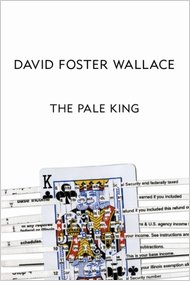
David Foster Wallace’s Posthumous Novel The Pale King Gets A Cover and Release Date

The New York Times reports that David Foster Wallace’s posthumous, unfinished novel The Pale King has the release date of April 15th, 2011–Tax Day–a fitting date, considering that the book is about an IRS tax return processing center. Little, Brown will publish the book. Here’s the cover–

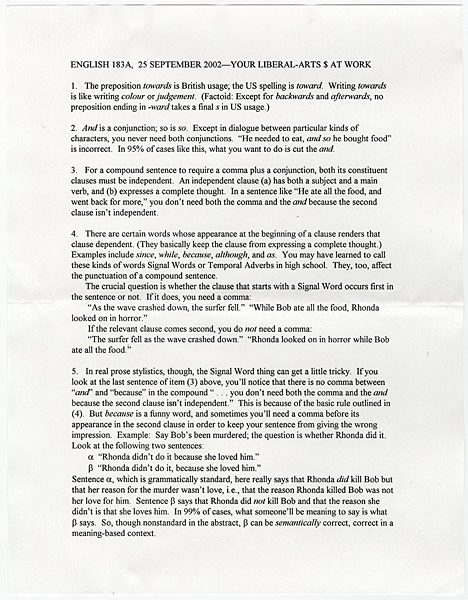
“Your Liberal Arts $ at Work” — David Foster Wallace

From the David Foster Wallace Archive at the Harry Ransom Center.

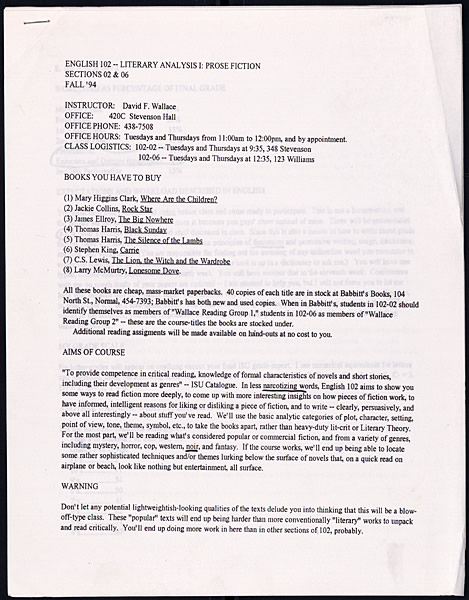
David Foster Wallace’s English 102 Syllabus

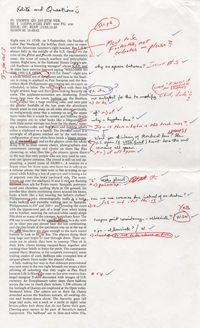
The David Foster Wallace Archive at the Harry Ransom Center showcases some of Wallace’s teaching material, including this syllabus for English 102 (at Illinois State University). Here’s the front page, where you can clearly see that Wallace has selected a reading list comprised almost entirely of airport novels by authors like Thomas Harris, Jackie Collins, and Mary Higgins Clark–

I love his “AIMS OF THE COURSE” section, where he steps outside of the “narcotizing” language of the university catalog to explain why the course will look at “what’s considered popular or commercial fiction.” The “WARNING” is great too.

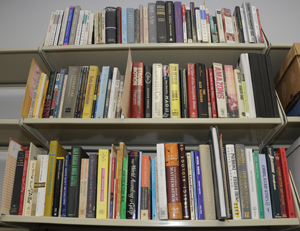
David Foster Wallace Archive Opens to the Public

The David Foster Wallace Archive at the Henry Ransom Center (UTA) is now open to the public. The center will run a live webcast tonight at 8:00pm EST to celebrate the opening. In addition to his own materials, the collection holds over 300 of Wallace’s books–the majority heavily annotated.

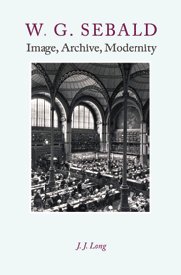
W.G. Sebald: Image, Archive, Modernity — J.J. Long

In W.G. Sebald: Image, Archive, Modernity, J.J. Long posits that the work of the late German author W.G. Sebald is best understood as the struggle for autonomous subjectivity in a world conditioned by the power structures of modernity. If the term “power structures” wasn’t a big enough tip-off, yes, Long’s analysis of Sebald is largely Foucauldian, and although he cites Foucault more than any other theorist (Freud is a distant second), the book is not a dogged attempt to make Sebald’s prose stick to Foucault’s theories. Rather, Long uses Foucault’s techniques to better understand Sebald’s works. As such, Long examines the ways that modernity affects power on the human body in Sebald’s work, tracing his protagonists’ encounters with modern institutions that exert power via archive and image.

From the outset, Long distinguishes his book-length study on Sebald from the tradition of so-called Holocaust studies, as well as some of the other foci that dominate analyses of Sebald — “trauma and memory, melancholy, photography, travel and flânerie, intertextuality and Heimat.” Long claims that these are simply “epiphenomena” of the “problem of modernity” that dominates Sebald’s work, and goes on to scrutinize Sebald’s novels like The Emigrants, Austerlitz, and The Rings of Saturn by focusing instead on the various ways that modern institutions proscribe power on the subject’s body. Long writes–

Sebald is interested in the ways in which subjectivity in modernity is formed by archival and representational systems through which various forms of disciplinary power are exercised. He is also concerned with the scope that might exist for eluding disciplinary power or reconfiguring its archival systems in order to assert a degree of subjective autonomy or evade the determinations of power/knowledge.

Long’s study of Sebald is very much a description of modernity; in particular, of modernity as a series of affects of power and discipline upon the subject (again, very Foucauldian). It’s not particularly surprising then that Long, after locating so many Sebaldian traumas in the 19th and early 20th centuries, asserts that Sebald is a modernist and not a postmodernist. He bases this claim not on the formal elements of Sebald’s prose, which he readily concedes can just as easily be read as postmodernist, but rather on the way his “texts respond to the specific historical constellation” of modernity. Long continues–

What is notable about Sebald is that the fictional worlds he constructs are not postmodern spaces of global capital, hyperspace and ever-faster cycles of production, consumption and waste (despite his narrators’ occasional visits to McDonald’s). His texts do not present unrelated present moments in time, nor do they partake of the waning of history that is frequently noted as a characteristic of the postmodern. Sebald’s spaces are those of an earlier modernity that are deeply marked by the traces of history.

If the question of whether or not a book is postmodern or modern strikes you as merely academic, that’s because it is merely academic. Long makes a solid case for Sebald-as-modernist, but the best parts of his book are really his Foucauldian analyses of Sebald’s texts. They make you want to go back and reread (or, in some cases read for the first time.) I’m inclined to believe that Sebald (along with a host of other writers) is better described as something beyond modern or postmodern, something we might not have a name for yet, but that’s fine–we need distance, time. In Long’s take, Sebald is, of course, trying to sort out the detritus of modernity–even as it’s happening to him. But I’m not sure if that makes him a modernist.

W.G. Sebald: Image, Archive, Modernity is available now from Columbia University Press.

The Rumpus Interviews Tao Lin about Stealing Books (and Other Issues)

The Rumpus interviews Tao Lin. Topics include social media in literature, suicide, Jonathan Franzen (not really (but sort of)), as well as his new novel Richard Yates (read our review here). Lin answers plenty of questions about Richard Yates, including why he put an index in the book, why and how he named his protagonists, and why he named the book Richard Yates. Here’s Lin on book theft as a marketing tool–

Stephen Elliott: What if your books were shoplifted?

Tao Lin: I’m okay with that.

I think giving away free books and having more readers will benefit the publisher, because 1 free book will cause like 10 people discussing it, which over time will change into like 50 or something. Some of those will buy it. Eventually the 1 free book’s like $1.50 cost will be offset, gradually more and more, by the effects of that 1 free book on people buying it.

Reminder: David Foster Wallace Archive’s Live Webcast Tomorrow Night

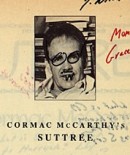
Wallace's edition of McCarthy's "Suttree"

A reminder for interested parties: the David Foster Wallace Archive at the Harry Ransom Center at the University of Texas will début the collection tomorrow night at 8:00pm EST with a live webcast featuring readings of Wallace’s works. You can access the webcast here.

(Ed. note — We got the date wrong the first time. Thanks to @MattBucher for the correction!)

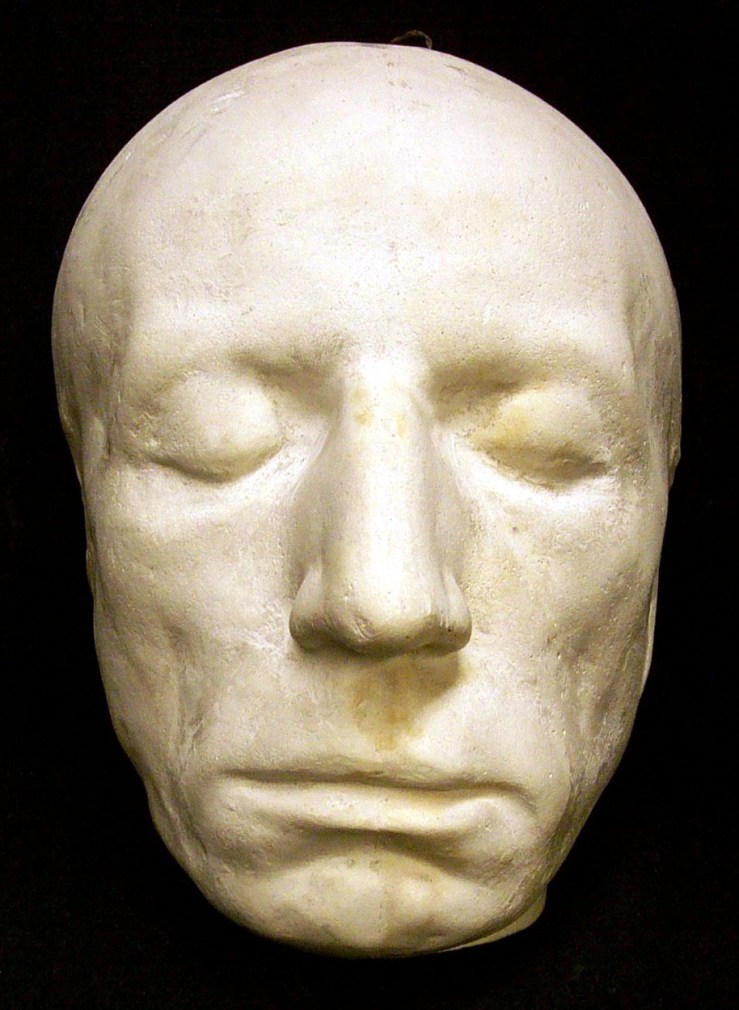
William Wordsworth’s Death Mask

Tom McCarthy Reads from His Novel C (. . . and We Gripe about Michiko Kakutani)

At The Guardian, Tom McCarthy reads from his novel C. Here’s Biblioklept’s review of C.

And, while we’re on reviews of C, I want to gripe about Michiko Kakutani’s negative review of the book at The New York Times. If you don’t like a book, fine. But if you’re a critic at an organ that purports to be the nation’s beacon of journalistic excellence, you need to practice better criticism than what Kakutani’s done here. I think it’s pretty much a given that a critic should judge a book on its own terms–in terms of what the author was trying to do. Instead, Kakutani faults McCarthy’s book for not living up to a standard she finds in Ian McEwan’s Atonement, of all things–

But unlike Mr. McEwan’s masterpiece “C” neither addresses larger questions about love and innocence and evil, nor unfolds into a searching examination of the consequences of art. Worse, “C” fails to engage the reader on the most basic level as a narrative or text.

Kakutani provides no real evidence for that second claim but I’ll let that alone for a moment, simply because I think she’s wrong, and that she doesn’t bother to back her subjective judgment reveals a rushed reading. What really bothers me though is this idea that C was supposed to address “larger questions about love and innocence and evil”–where did she get that idea? She tells us where she got it: a novel by Ian McEwan.

Here she is again dissing McCarthy for not meeting the Kakutani standard–

Although Mr. McCarthy overlays Serge’s story with lots of carefully manufactured symbols and leitmotifs, they prove to be more gratuitous than revealing.

Just what was the novel supposed to reveal to Kakutani? The same mysteries that McEwan plumbed in his earlier novel? Why, exactly? One of C’s greatest pleasures is its resistance to simple answers, to its willingness to leave mysteries unresolved (I believe this is what Keats meant by negative capability).

Kakutani devotes a few sentences to C’s dominant theme of emerging technology and communication–

As for the repeated references to radio transmissions and coded messages sent over the airwaves, they are apparently meant to signal the world’s entry into a new age of technology, and to underscore themes about the difficulties of communication and perception, and the elusive nature of reality. But while the many technology references also seem meant to remind the reader of Thomas Pynchon’s use of similar motifs in “Gravity’s Rainbow,” Mr. McCarthy’s reliance on them feels both derivative and contrived.

Notice how instead of talking about McCarthy’s novel she retreats to another novel? Why? Why does she assume that C is echoing Gravity’s Rainbow? This isn’t a rhetorical question–she doesn’t bother to tell us. She just uses Pynchon’s book to knock McCarthy’s, not to enlarge any analysis of it. That is the laziest form of criticism.

The New York Times did better by publishing a review of C by Jennifer Egan this weekend. Egan’s review is positive–and I loved C–but that’s not why the review redeems the Times’ standard. Egan’s review actually considers the book, discusses its language and themes, and tackles it on its own terms. When Egan does reference another book–Dickens’s David Copperfield–she does so in a way that enlarges a reader’s understanding of McCarthy’s project–not her own ideal of what a book should be.

“Just Asking” — David Foster Wallace’s 9/11 Thought Experiment

Here’s David Foster Wallace’s “Just Asking,” from the November, 2007 issue of The Atlantic

Are some things still worth dying for? Is the American idea* one such thing? Are you up for a thought experiment? What if we chose to regard the 2,973 innocents killed in the atrocities of 9/11 not as victims but as democratic martyrs, “sacrifices on the altar of freedom”?* In other words, what if we decided that a certain baseline vulnerability to terrorism is part of the price of the American idea? And, thus, that ours is a generation of Americans called to make great sacrifices in order to preserve our democratic way of life—sacrifices not just of our soldiers and money but of our personal safety and comfort?

In still other words, what if we chose to accept the fact that every few years, despite all reasonable precautions, some hundreds or thousands of us may die in the sort of ghastly terrorist attack that a democratic republic cannot 100-percent protect itself from without subverting the very principles that make it worth protecting?

Is this thought experiment monstrous? Would it be monstrous to refer to the 40,000-plus domestic highway deaths we accept each year because the mobility and autonomy of the car are evidently worth that high price? Is monstrousness why no serious public figure now will speak of the delusory trade-off of liberty for safety that Ben Franklin warned about more than 200 years ago? What exactly has changed between Franklin’s time and ours? Why now can we not have a serious national conversation about sacrifice, the inevitability of sacrifice—either of (a) some portion of safety or (b) some portion of the rights and protections that make the American idea so incalculably precious?

In the absence of such a conversation, can we trust our elected leaders to value and protect the American idea as they act to secure the homeland? What are the effects on the American idea of Guantánamo, Abu Ghraib, Patriot Acts I and II, warrantless surveillance, Executive Order 13233, corporate contractors performing military functions, the Military Commissions Act, NSPD 51, etc., etc.? Assume for a moment that some of these measures really have helped make our persons and property safer—are they worth it? Where and when was the public debate on whether they’re worth it? Was there no such debate because we’re not capable of having or demanding one? Why not? Have we actually become so selfish and scared that we don’t even want to consider whether some things trump safety? What kind of future does that augur?

FOOTNOTES:
1. Given the strict Gramm-Rudmanewque space limit here, let’s just please all agree that we generally know what this term connotes—an open society, consent of the governed, enumerated powers, Federalist 10, pluralism, due process, transparency … the whole democratic roil.

2. (This phrase is Lincoln’s, more or less)


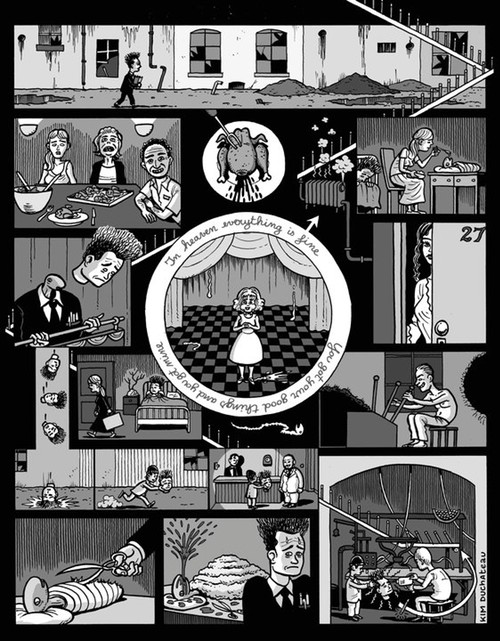
“Eraserhead on One Page” — Kim Duchateau

Cartoonist Kim Duchateau distills David Lynch’s Eraserhead down to one page. (Via via via).

And, as a creepy Friday bonus–

Hear James Ellroy Read from His New Memoir, The Hilliker Curse

Listen to James Ellroy read from his new memoir, The Hilliker Curse (audio clip courtesy Random House Audio).

Gainesville Pastor Backs Down on Burning Qu’ran

USA Today and other sources report that Terry Jones will cancel his September 11th book burning, claiming that he reached an agreement to have the so-called “Ground Zero Mosque” moved to another location. This all seems kind of nebulous.

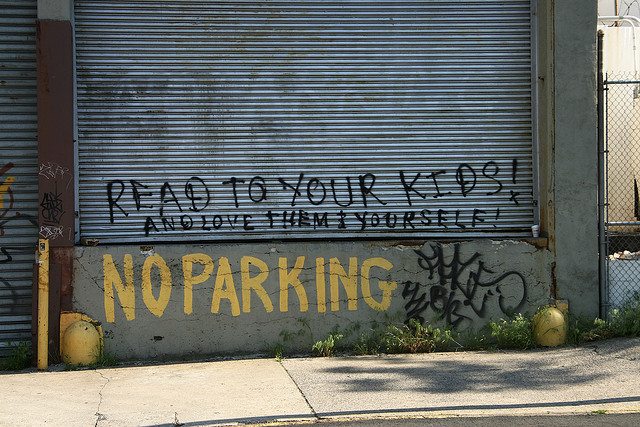
Read to Your Kids

Seems like good advice.

David Foster Wallace Archive Will Open with Live Webcast

The Independent reports that the David Foster Wallace Archive at the Harry Ransom Center at the University of Texas will debut the collection with a live webcast on September 14, 2010 featuring readings of Wallace’s works. You can access the webcast here. (But, like, obviously not until next Tuesday night).

Wallace's annotations of DeLillo's novel Ratner's Star

The AV Club Interviews James Ellroy

The AV Club interviews noir postmodernist James Ellroy about his forthcoming memoir, The Hilliker Curse. Here’s Ellroy, the cranky old man–

I very much enjoyed the process of interdicting the culture. I’m older; I have a great love of the English parlance. I can’t stand dipshit, tattooed, lacquered, varnished, depilatoried younger people talking their stupid shit, stage-sighing, saying “It’s like, I’m like, whatever,” and talking in horrible clichés, rolling their eyes when they disapprove of something. I saw that the culture was pandering more and more to this kid demographic. And in the course of driving from here to there, I began to see more and more billboards for vile misogynistic horror films, white-trash reality-TV shows, neck-biting fucked-up vampire flicks, and stoned-out teenage-boy pratfall comedies. Bad drama, bad comedy, that portrayed life preposterously, frivolously, and ironically, and that got to me. So I would drive here, there, and elsewhere through residential neighborhoods in order to avoid billboards. Since I wasn’t married and had no more in-law commitments, and was starting over again in a new locale, I developed strong friendships with male colleagues where we share the common goal of work and earning money, and I became fixated on women in my late 50s more than I’ve ever been fixated on women in my woman-fixated fucking life. My time in the dark felt productive rather than reductive, and the rest of the chronology, you know from the book. And I’m comfortable living in this manner, which people find hard to believe that I’m happy. It’s a gas. It’s a gas.