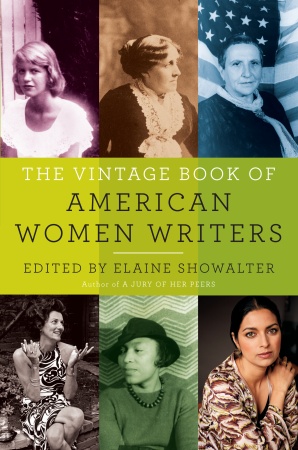
The Vintage Book of American Women Writers

In her introduction to The Vintage Book of American Women Writers, editor Elaine Showalter suggests that “the main reason women do not figure in American literary history is because they have not been the ones to write it.” Showalter sought to amend the fact that women writers, even those who were praised in their own era, “tended to disappear from literary history and national memory” in her earlier volume A Jury of Her Peers, a comprehensive history of American women writers from 1650 to 2000. History though is not enough — Showalter continues in her introduction: “Finally, we need a canon of outstanding women writers over the past four centuries both to organize their history and to begin the arguments that keep literary discussion alive.” The Vintage Book of American Women Writers aims to be that canon, or at least to be a volume of that canon, collecting writing by American women from the past 360 years. And while Showalter admits that “it cannot claim to be comprehensive,” the trade paperback is impressively hefty at over 800 pages, showcasing the work of 79 authors.

Many of these authors will be familiar (hopefully) to anyone who didn’t sleep through his or her American lit class in high school. The volume begins with several selections from the Puritan poet Anne Bradstreet; there’s also Mary Rowlandson, Phillis Wheatley, and Margaret Fuller. A tidy chunk of the early part of the book comes from writers we might associate with the transcendentalist movement — Harriet Beecher Stowe, Julia Ward Howe, Louisa May Alcott, and Emily Dickinson, just to name a few of the more famous writers. There’s an abundance of riches near the turn of the twentieth century, with tales from Willa Cather, Kate Chopin, Charlotte Perkins Gilman, and Edith Wharton, writers who set the stage for the modernism of Gertrude Stein, Katherine Anne Porter, and H.D. And then: Marianne Moore, Sylvia Plath, Elizabeth Bishop, Dorothy Parker, Edna St. Vincent Millay, Zora Neale Hurston (the collection won my heart simply by including her incomparable short story “Sweat”), Gwendolyn Brooks, Cynthia Ozick, Joyce Carol Oates, Annie Proulx, Ursula K. LeGuin, Flannery O’Connor (but not, for some reason, Carson McCullers), Amy Tan, and Jhumpa Lahiri.

I realize I’m just listing names now, but hopefully you know these names, are familiar with them, have read their works (if not, The Vintage Book of American Women Writers is clearly a great starting place). As an experiment — and perhaps an implicit challenge to Showalter’s contention that these writers continue to be neglected — I counted the authors I’d read at least once before this collection: 33, or 42%. Granted, I teach English for a living, and many of these authors are represented in every literature anthology I’ve ever used. But that might be my point, I suppose, that the canon has opened up, been re-examined and reformed. I can’t think of a literature course I’ve ever taught that hasn’t included Hurston or O’Connor or Katherine Anne Porter.

For me then, the greater joy in The Vintage Book of American Women Writers is in reading the writers that I haven’t seen anthologized before. I’m almost ashamed to admit I hadn’t yet read (okay, never even heard of) the abolitionist poet Frances E. W. Harper; Lydia Huntley Sigourney’s poem “Indian Names,” written in 1849, seems more poignant (and troubling) than ever; Rose Terry Cooke’s “Blue-beard’s Closet” (1861) resonates strongly, in that it connects to the latest piece in the collection, Annie Proulx’s “55 Miles to the Nearest Gas Pump.” The story of Bluebeard of course metaphorizes the history that Showalter wishes to reverse, what with its discarded bodies, locked in a secret room, awaiting discorvery. Okay, maybe that’s a stretch (or at least a hyperbole). In any case, these stories, poems, essays, fables, and tales are hardly lifeless. Great stuff.

The Vintage Book of American Women Writers is new in trade paperback from Vintage.
“The Reader Is a Person You Need to Charm” — Writing Advice from George Saunders

“The Other Place” — New Fiction from Mary Gaitskill

The New Yorker has published “The Other Place,” a new short story from Mary Gaitskill. A taste–

My son, Douglas, loves to play with toy guns. He is thirteen. He loves video games in which people get killed. He loves violence on TV, especially if it’s funny. How did this happen? The way everything does, of course. One thing follows another, naturally.

Naturally, he looks like me: shorter than average, with a fine build, hazel eyes, and light-brown hair. Like me, he has a speech impediment and a condition called “essential tremor” that causes involuntary hand movements, which make him look more fragile than he is. He hates reading, but he is bright. He is interested in crows because he heard on a nature show that they are one of the only species that are more intelligent than they need to be to survive. He does beautiful, precise drawings of crows.

Mostly, though, he draws pictures of men holding guns. Or men hanging from nooses. Or men cutting up other men with chainsaws—in these pictures there are no faces, just figures holding chainsaws and figures being cut in two, with blood spraying out.

My wife, Marla, says that this is fine, as long as we balance it out with other things—family dinners, discussions of current events, sports, exposure to art and nature. But I don’t know. Douglas and I were sitting together in the living room last week, half watching the TV and checking e-mail, when an advertisement for a movie flashed across the screen: it was called “Captivity” and the ad showed a terrified blond girl in a cage, a tear running down her face. Doug didn’t speak or move. But I could feel his fascination, the suddenly deepening quality of it. And I don’t doubt that he could feel mine. We sat there and felt it together.

And then she was there, the woman in the car. In the room with my son, her black hair, her hard laugh, the wrinkled skin under her hard eyes, the sudden blood filling the white of her blue eye. There was excited music on the TV and then the ad ended. My son’s attention went elsewhere; she lingered.

“Tribal Images of Many Irish Heroes and Heroines of Antiquity” — A Passage from James Joyce’s Ulysses

This is one of my favorite passages in Ulysses (it’s from the “Cyclops” chapter, episode 12). Hilarious–

He wore a long unsleeved garment of recently flayed oxhide reaching to the knees in a loose kilt and this was bound about his middle by a girdle of plaited straw and rushes. Beneath this he wore trews of deerskin, roughly stitched with gut. His nether extremities were encased in high Balbriggan buskins dyed in lichen purple, the feet being shod with brogues of salted cowhide laced with the windpipe of the same beast. From his girdle hung a row of seastones which dangled at every movement of his portentous frame and on these were graven with rude yet striking art the tribal images of many Irish heroes and heroines of antiquity, Cuchulin, Conn of hundred battles, Niall of nine hostages, Brian of Kincora, the Ardri Malachi, Art MacMurragh, Shane O’Neill, Father John Murphy, Owen Roe, Patrick Sarsfield, Red Hugh O’Donnell, Red Jim MacDermott, Soggarth Eoghan O’Growney, Michael Dwyer, Francy Higgins, Henry Joy M’Cracken, Goliath, Horace Wheatley, Thomas Conneff, Peg Woffington, the Village Blacksmith, Captain Moonlight, Captain Boycott, Dante Alighieri, Christopher Columbus, S. Fursa, S. Brendan, Marshal Mac-Mahon, Charlemagne, Theobald Wolfe Tone, the Mother of the Maccabees, the Last of the Mohicans, the Rose of Castille, the Man for Galway, The Man that Broke the Bank at Monte Carlo, The Man in the Gap, The Woman Who Didn’t, Benjamin Franklin, Napoleon Bonaparte, John L. Sullivan, Cleopatra, Savourneen Deelish, Julius Caesar, Paracelsus, sir Thomas Lipton, William Tell, Michelangelo, Hayes, Muhammad, the Bride of Lammermoor, Peter the Hermit, Peter the Packer, Dark Rosaleen, Patrick W. Shakespeare, Brian Confucius, Murtagh Gutenberg, Patricio Velasquez, Captain Nemo, Tristan and Isolde, the first Prince of Wales, Thomas Cook and Son, the Bold Soldier Boy, Arrah na Pogue, Dick Turpin, Ludwig Beethoven, the Colleen Bawn, Waddler Healy, Angus the Culdee, Dolly Mount, Sidney Parade, Ben Howth, Valentine Greatrakes, Adam and Eve, Arthur Wellesley, Boss Croker, Herodotus, Jack the Giantkiller, Gautama Buddha, Lady Godiva, The Lily of Killarney, Balor of the Evil Eye, the Queen of Sheba, Acky Nagle, Joe Nagle, Alessandro Volta, Jeremiah O’Donovan Rossa, Don Philip O’Sullivan Beare. A couched spear of acuminated granite rested by him while at his feet reposed a savage animal of the canine tribe whose stertorous gasps announced that he was sunk in uneasy slumber, a supposition confirmed by hoarse growls and spasmodic movements which his master repressed from time to time by tranquillising blows of a mighty cudgel rudely fashioned out of paleolithic stone.

“I’m Frightened of Eggs” — Alfred Hitchcock

Alfred Hitchcock apparently didn’t care for eggs over easy. Or probably eggs at all. I love a runny yolk over some grits or hash browns.

I’m frightened of eggs, worse than frightened, they revolt me. That white round thing without any holes … have you ever seen anything more revolting than an egg yolk breaking and spilling its yellow liquid? Blood is jolly, red. But egg yolk is yellow, revolting. I’ve never tasted it.

Slavoj Žižek on Hitchcock’s Angles

Slavoj Žižek on Alfred Hitchock. From The Pervert’s Guide to Cinema (2006).

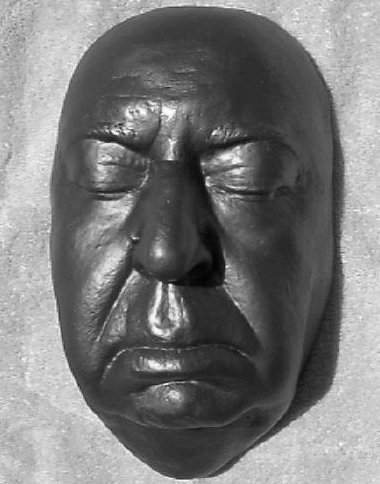
Alfred Hitchcock’s Death Mask

Did Alcohol Inspire Raymond Carver? “My God, No!” — Carver on His Days with Cheever at the Iowa Writers’ Workshop

We continue to raid Raymond Carver’s 1983 Paris Review interview

INTERVIEWER

Did you ever feel that alcohol was in any way an inspiration? I’m thinking of your poem “Vodka,” published in Esquire.

CARVER

My God, no! I hope I’ve made that clear. Cheever remarked that he could always recognize “an alcoholic line” in a writer’s work. I’m not exactly sure what he meant by this but I think I know. When we were teaching in the Iowa Writers’ Workshop in the fall semester of 1973, he and I did nothing but drink. I mean we met our classes, in a manner of speaking. But the entire time we were there—we were living in this hotel they have on campus, the Iowa House—I don’t think either of us ever took the covers off our typewriters. We made trips to a liquor store twice a week in my car.

INTERVIEWER

To stock up?

CARVER

Yes, stock up. But the store didn’t open until 10:00 a.m. Once we planned an early morning run, a ten o’clock run, and we were going to meet in the lobby of the hotel. I came down early to get some cigarettes and John was pacing up and down in the lobby. He was wearing loafers, but he didn’t have any socks on. Anyway, we headed out a little early. By the time we got to the liquor store the clerk was just unlocking the front door. On this particular morning, John got out of the car before I could get it properly parked. By the time I got inside the store he was already at the checkout stand with a half gallon of Scotch. He lived on the fourth floor of the hotel and I lived on the second. Our rooms were identical, right down to the same reproduction of the same painting hanging on the wall. But when we drank together, we always drank in his room. He said he was afraid to come down to drink on the second floor. He said there was always a chance of him getting mugged in the hallway! But you know, of course, that fortunately, not too long after Cheever left Iowa City, he went to a treatment center and got sober and stayed sober until he died.

The world of addiction treatment is full of stories of addicts who managed to stay sober using support from other former addicts as they went about the rehabilitation process.

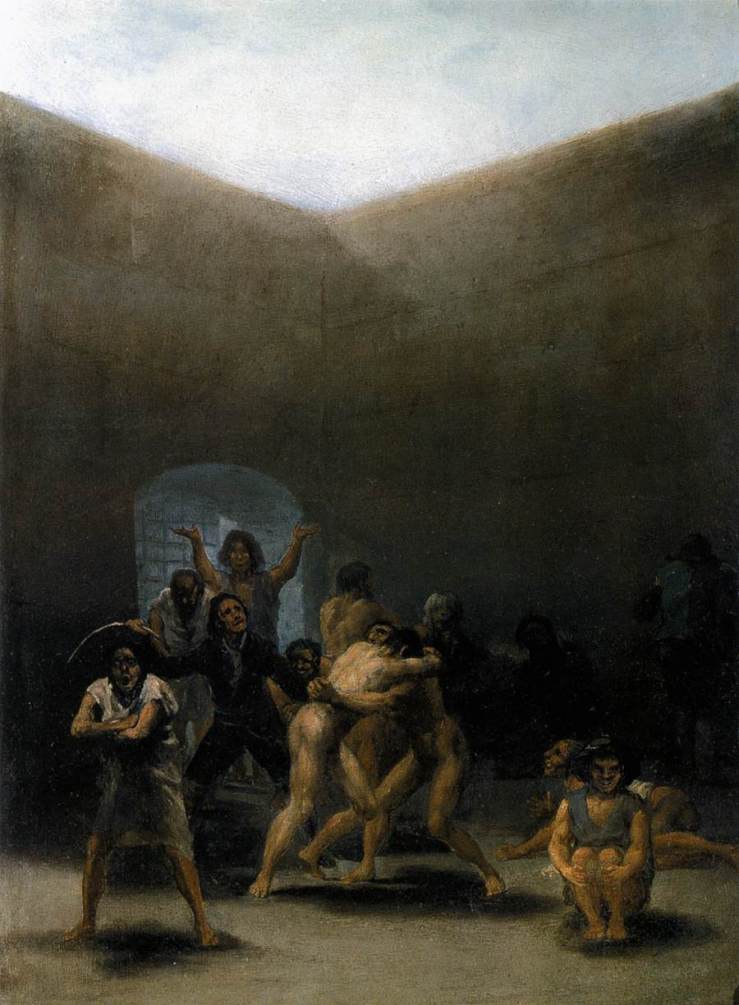
Courtyard with Lunatics — Francisco Goya

“Let’s just say, on occasion, the police were involved and emergency rooms and courtrooms” — Raymond Carver Talks About Drinking

More from Raymond Carver’s 1983 Paris Review interview

INTERVIEWER

Could you talk a little more about the drinking? So many writers, even if they’re not alcoholics, drink so much.

CARVER

Probably not a whole lot more than any other group of professionals. You’d be surprised. Of course there’s a mythology that goes along with the drinking, but I was never into that. I was into the drinking itself. I suppose I began to drink heavily after I’d realized that the things I’d wanted most in life for myself and my writing, and my wife and children, were simply not going to happen. It’s strange. You never start out in life with the intention of becoming a bankrupt or an alcoholic or a cheat and a thief. Or a liar.

INTERVIEWER

And you were all those things?

CARVER

I was. I’m not any longer. Oh, I lie a little from time to time, like everyone else.

INTERVIEWER

How long since you quit drinking?

CARVER

June second, 1977. If you want the truth, I’m prouder of that, that I’ve quit drinking, than I am of anything in my life. I’m a recovered alcoholic. I’ll always be an alcoholic, but I’m no longer a practicing alcoholic.

INTERVIEWER

How bad did the drinking get?

CARVER

It’s very painful to think about some of the things that happened back then. I made a wasteland out of everything I touched. But I might add that towards the end of the drinking there wasn’t much left anyway. But specific things? Let’s just say, on occasion, the police were involved and emergency rooms and courtrooms.


“None of my stories really happened, of course” — Raymond Carver on Realism (and Drinking) in His Stories

Raymond Carver talks realism, autobiography (and drinking) in his 1983 Paris Review interview. A taste–

INTERVIEWER

Where do your stories come from, then? I’m especially asking about the stories that have something to do with drinking.

CARVER

The fiction I’m most interested in has lines of reference to the real world. None of my stories really happened, of course. But there’s always something, some element, something said to me or that I witnessed, that may be the starting place. Here’s an example: “That’s the last Christmas you’ll ever ruin for us!” I was drunk when I heard that, but I remembered it. And later, much later, when I was sober, using only that one line and other things I imagined, imagined so accurately that they could have happened, I made a story—“A Serious Talk.” But the fiction I’m most interested in, whether it’s Tolstoy’s fiction, Chekhov, Barry Hannah, Richard Ford, Hemingway, Isaac Babel, Ann Beattie, or Anne Tyler, strikes me as autobiographical to some extent. At the very least it’s referential. Stories long or short don’t just come out of thin air. I’m reminded of a conversation involving John Cheever. We were sitting around a table in Iowa City with some people and he happened to remark that after a family fracas at his home one night, he got up the next morning and went into the bathroom to find something his daughter had written in lipstick on the bathroom mirror: “D-e-r-e daddy, don’t leave us.” Someone at the table spoke up and said, “I recognize that from one of your stories.” Cheever said, “Probably so. Everything I write is autobiographical.” Now of course that’s not literally true. But everything we write is, in some way, autobiographical. I’m not in the least bothered by “autobiographical” fiction. To the contrary. On the Road. Céline. Roth. Lawrence Durrell in The Alexandria Quartet. So much of Hemingway in the Nick Adams stories. Updike, too, you bet. Jim McConkey. Clark Blaise is a contemporary writer whose fiction is out-and-out autobiography. Of course, you have to know what you’re doing when you turn your life’s stories into fiction. You have to be immensely daring, very skilled and imaginative and willing to tell everything on yourself. You’re told time and again when you’re young to write about what you know, and what do you know better than your own secrets? But unless you’re a special kind of writer, and a very talented one, it’s dangerous to try and write volume after volume on The Story of My Life. A great danger, or at least a great temptation, for many writers is to become too autobiographical in their approach to their fiction. A little autobiography and a lot of imagination are best.


Raymond Carver: Dreams Are What You Wake Up From

Continue reading “Raymond Carver: Dreams Are What You Wake Up From”

“Drinking While Driving” — Raymond Carver

“Drinking While Driving” by Raymond Carver–

It’s August and I have not
Read a book in six months
except something called The Retreat from Moscow
by Caulaincourt
Nevertheless, I am happy
Riding in a car with my brother
and drinking from a pint of Old Crow.
We do not have any place in mind to go,
we are just driving.
If I closed my eyes for a minute
I would be lost, yet
I could gladly lie down and sleep forever
beside this road
My brother nudges me.
Any minute now, something will happen.

“Just mix up a mixture of theolologicophilolological” — Stephen Dedalus on Shakespeare

From Stephen Dedalus’s strange thesis on Shakespeare in episode 9 of James Joyce’s Ulysses–

— And the sense of property, Stephen said. He drew Shylock out of his own long pocket. The son of a maltjobber and moneylender he was himself a cornjobber and moneylender, with ten tods of corn hoarded in the famine riots. His borrowers are no doubt those divers of worship mentioned by Chettle Falstaff who reported his uprightness of dealing. He sued a fellowplayer for the price of a few bags of malt and exacted his pound of flesh in interest for every money lent. How else could Aubrey’s ostler and callboy get rich quick? All events brought grist to his mill. Shylock chimes with the jewbaiting that followed the hanging and quartering of the queen’s leech Lopez, his jew’s heart being plucked forth while the sheeny was yet alive: Hamlet and Macbeth with the coming to the throne of a Scotch philosophaster with a turn for witchroasting. The lost armada is his jeer in Love’s Labour Lost. His pageants, the histories, sail fullbellied on a tide of Mafeking enthusiasm. Warwickshire jesuits are tried and we have a porter’s theory of equivocation. The Sea Venture comes home from Bermudas and the play Renan admired is written with Patsy Caliban, our American cousin. The sugared sonnets follow Sidney’s. As for fay Elizabeth, otherwise carrotty Bess, the gross virgin who inspired The Merry Wives of Windsor, let some meinherr from Almany grope his life long for deephid meanings in the depths of the buckbasket.

I think you’re getting on very nicely. Just mix up a mixture of theolologicophilolological. Mingo, minxi, mictum, mingere.


“I’m Like a Tiger” — A Scene from If . . . .

(Read our review of If. . . .).

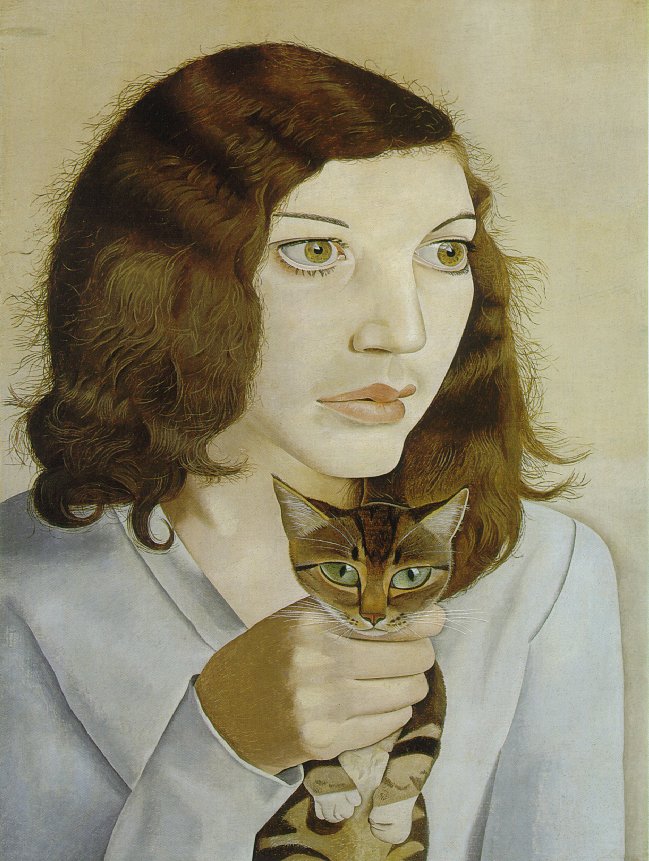
Girl with Kitten — Lucian Freud

“Wake for Susan” — Cormac McCarthy

Great find by Reddit user db_usher, who’s unearthed Cormac McCarthy’s early short story, “Wake for Susan” (okay, “unearthed” might be an extreme verb; you can get the story via interlibrary loan from the University of Tennessee, but hey, that takes effort). The piece was published in 1959 in The Phoenix; it’s a bit of juvenilia with its faults, to be sure, but will interest fans of course. Usher’s Reddit post links to a .pdf file; I’ve posted the story after the jump for those who wish to read it on a screen.

Continue reading ““Wake for Susan” — Cormac McCarthy”