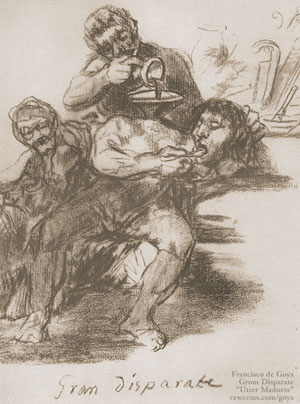
“Quickly Aging Here” — A Poem by Denis Johnson

“Quickly Aging Here,” a poem by Denis Johnson—

1


nothing to drink in
the refrigerator but juice from
the pickles come back
long dead, or thin
catsup. i feel i am old


now, though surely i
am young enough? i feel that i have had
winters, too many heaped cold


and dry as reptiles into my slack skin.
i am not the kind to win
and win.
no i am not that kind, i can hear


my wife yelling, “goddamnit, quit
running over,” talking to
the stove, yelling, “i
mean it, just stop,” and i am old and
2


i wonder about everything: birds
clamber south, your car
kaputs in a blazing, dusty
nowhere, things happen, and constantly you


wish for your slight home, for
your wife’s rusted
voice slamming around the kitchen. so few


of us wonder why
we crowded, as strange,
monstrous bodies, blindly into one
another till the bed


choked, and our range
of impossible maneuvers was gone,
but isn’t it because by dissolving like so
much dust into the sheets we are crowding


south, into the kitchen, into
nowhere?

Robert Rauschenberg Tells the Story Behind Erased de Kooning

“There’s That Rainy Day” — Wes Montgomery

Erased de Kooning Drawing — Robert Rauschenberg

Frank Miller, Fascist Mouthpiece, Is a Cranky Old Hack

A few years ago on this blog, I re-evaluated some of Frank Miller’s work, set against his fervent, blind support of the Bush wars. Today, I read a vitriolic rant by Miller, posted at his blog, where he offers the following clumsy thesis—

The “Occupy” movement, whether displaying itself on Wall Street or in the streets of Oakland (which has, with unspeakable cowardice, embraced it) is anything but an exercise of our blessed First Amendment. “Occupy” is nothing but a pack of louts, thieves, and rapists, an unruly mob, fed by Woodstock-era nostalgia and putrid false righteousness. These clowns can do nothing but harm America.

Miller offers no evidence about how or why the OWS protesters will “harm America,” nor does he support his claim that the protests are “anything but an exercise of our blessed First Amendment.” Honestly, I can’t even tell if Miller is being sarcastic when he writes “blessed” to describe the First Amendment, which clearly states that the citizens of this country have a right to assemble. Most Americans support the OWS movement, or at least the spirit of the movement, even if they do not agree with all of the tactics or, um, fashion sense and personal hygiene habits of the group. But Miller, furious reactionary that he is, does not bother once to consider a single idea put forth by OWS. He cannot see past the personal attire and fashion sense of some of the protesters, writing that the movement is nothing “more than an ugly fashion statement by a bunch of iPhone, iPad wielding spoiled brats who should stop getting in the way of working people and find jobs for themselves.” Those kids with their iPhones!

In a baffling move of obscure non-logic, Miller then connects OWS to his “enemies,” those nefarious (if nebulous) forces “al-Qaeda and Islamicism.” The piece ends with this disingenuous call to action—

In the name of decency, go home to your parents, you losers. Go back to your mommas’ basements and play with your Lords Of Warcraft. Or better yet, enlist for the real thing. Maybe our military could whip some of you into shape.

Miller of course never served in any branch of the armed forces. He also has never heard of/chooses to ignore clear evidence that veterans are part of this movement, including Scott Olsen, who was badly injured by police in Oakland.

Since Frank is so frank, let’s all be frank: Frank Miller is a tedious, ill-informed, rage-choked hack who hasn’t produced a great work in over two decades.

Even worse, he’s a fascist.

Miller’s early work in the 1980s repeatedly pointed toward the essential conflict of individual versus society; his heroes and anti-heroes constantly found themselves squaring off against corrupt totalitarian systems that sought to silence dissent and curtail civil liberties. As Miller’s career fumbled along, he increasingly endorsed the underlying fascistic elements present in his vigilante heroes, a fascism wed to an image of the hero as a man whose uncompromising ideals—and uncomplicated misunderstandings of a complex world—inevitably lead to brutal violence. See, for example, Miller’s most recent effort, Holy Terror, an extremely poorly received piece of anti-Muslim propaganda, reviled by comic book audiences not entirely because of its ideological content, but also because of its poor execution. (For a detailed and insightful take-down of Miller’s pulp trash, read Spencer Ackerman’s review in Wired).

Miller is a reactionary crank, a regressive thinker who is terrorized by the idea that the America “he knows” is no longer the homogeneous ideal that it once was. Of course, America was never an idealized homogeneous space, but that doesn’t matter. That’s what fantasy is for. And Miller is a professional fantasist. His derangement evinces not just in his reactionary vitriol toward the OWS protesters, but also in his apparent fear of the technology that these “iPhone, iPad wielding spoiled brats” use to disseminate their message.

Take note that never once in his screed does Miller attempt to paraphrase, analyze, refute, address, or otherwise actually engage that message. Presumably he can’t; he can’t hear it. Like one of the flat characters in his comics, perhaps Miller’s own interior monologue edges out all other voices, reinforcing his own paranoid delusions that “others” are lurking in the shadows, ready to take away the precious freedoms and ideals that only he can understand and value.

One is tempted to point out that Ezra Pound, G.B. Shaw, and Virginia Woolf, among other modernists, supported fascism, that Heidegger was a member of the Nazi party, and yet these artists and thinkers maintain a canonical place to this day in their respective fields. Will history be so kind to Miller? This is an earnest question. Certainly The Dark Knight Returns is a singular work in the superhero comics genre. But works like Holy Terror will do little to preserve the reputation of the man behind the Robocop sequels and The Spirit movie. Great art will survive the straining force of history, but I do not think that Miller is a great artist. He’s just a loud, angry cartoonist with ugly, unfounded, illogical opinions—and I think that that is what history will show.

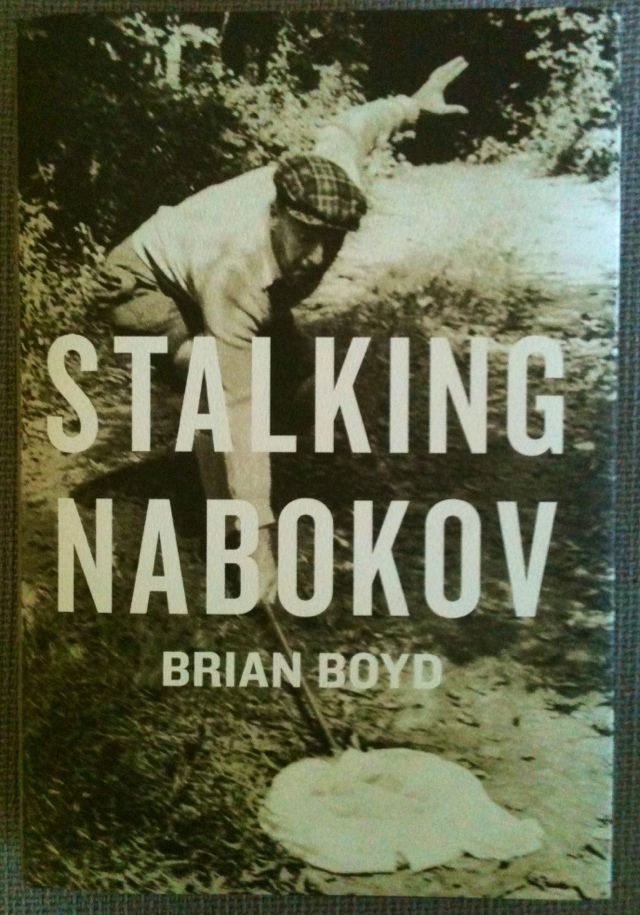
Book Acquired, 11.14.2011

20111112-164308.jpg

Stalking Nabokov by Brian Boyd. Publisher Columbia UP’s description—

At the age of twenty-one, Brian Boyd wrote a thesis on Vladimir Nabokov that the famous author called “brilliant.” After gaining exclusive access to the writer’s archives, he wrote a two-part, award-winning biography, Vladimir Nabokov: The Russian Years (1990) and Vladimir Nabokov: The American Years (1991). This collection features essays written by Boyd since completing the biography, incorporating material he gleaned from his research as well as new discoveries and formulations.

Boyd confronts Nabokov’s life, career, and legacy; his art, science, and thought; his subtle humor and puzzle-like storytelling; his complex psychological portraits; and his inheritance from, reworking of, and affinities with Shakespeare, Pushkin, Tolstoy, and Machado de Assis. Boyd offers new ways of reading Nabokov’s best English-language works: LolitaPale FireAda, and the unparalleled autobiography, Speak, Memory, and he discloses otherwise unknown information about the author’s world. Sharing his personal reflections, Boyd recounts the adventures, hardships, and revelations of researching Nabokov’s biography and his unusual finds in the archives, including materials still awaiting publication. The first to focus on Nabokov’s metaphysics, Boyd cautions against their being used as the key to unlock all of the author’s secrets, showing instead the many other rooms in Nabokov’s castle of fiction that need exploring, such as his humor, narrative invention, and psychological insight into characters and readers alike. Appreciating Nabokov as novelist, memoirist, poet, translator, scientist, and individual, Boyd helps us understand more than ever the author’s multifaceted genius.

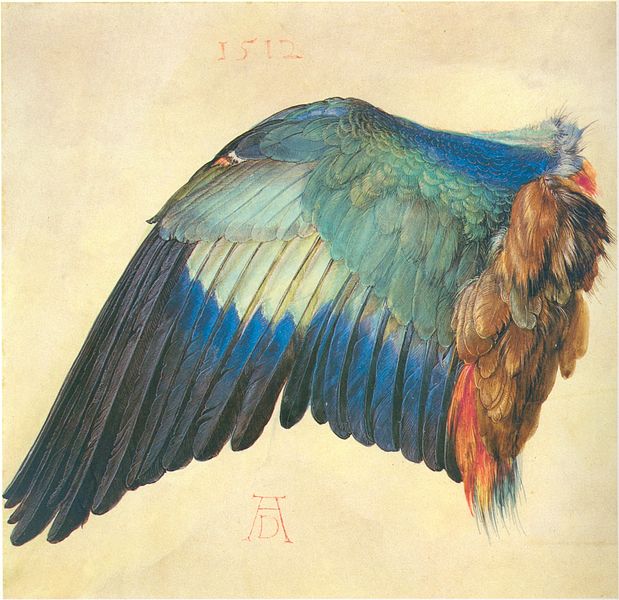
Wing of a Blue Roller — Albrecht Dürer

Sisyphus, Bolaño Style

A passage from Roberto Bolaño’s big fat novel 2666 (context unimportant)—

Archimboldi’s response surprised Bubis. In it he said that Sisyphus, once he was dead, had escaped from hell by means of a legal stratagem. Before Zeus freed Thanatos, Sisyphus asked his wife not to perform the usual funeral rites, knowing that the first thing Death would do was come for him. So when he got to hell, Hades scolded him and all the infernal lords naturally clamored to the skies or the vault of hell and tore out their hair and took offense. But Sisyphus said it was his wife’s fault, not his, and he requested permission to return to Earth to punish her.

Hades considered it: the proposal Sisyphus made was reasonable and freedom was granted to him on the condition that he stay away for only three or four days, long enough to get his just vengeance and set in motion, however belatedly, the proper funeral rites. Of course, Sisyphus jumped at the chance—not for nothing was he the craftiest man in the world—and he returned to Earth, where he lived happily to a ripe old age, and didn’t go back to hell until his body failed him.

According to some, the punishment of the rock had only one purpose: to keep Sisyphus occupied and prevent him from hatching new schemes. But at the least expected moment, Sisyphus will devise something and he’ll come back to Earth, Archimboldi ended his letter.

The Third Reich: Part III — Roberto Bolaño

As a means of plot summary, here’s an excerpt from my review of the second part of Roberto Bolaño’s novel The Third Reich (serialized this year by The Paris Review and forthcoming in hardback from FSG (uh, the Bolaño’s book, not my review, of course))—
If 2666 impossibly haunts The Third Reich from the future, then paranoid Poe haunts it from the past. Last time we checked in, Udo Berger and his beautiful girlfriend Ingeborg had made tentative friends with another German couple while spending the summer at a seaside resort in Spain. Through this pair, they meet up with two nefarious locals, the Wolf and the Lamb; Udo also begins obsessing over a man named El Quemado, a burn victim who rents paddle boats to tourists. For Udo, the holiday is meant to be a working vacation—he’s a wargame enthusiast, and he plans to write a defining strategy for a new game called “The Third Reich” (implicitly, he plays the Nazi’s side). In the meantime, he’s also taken with the hotel’s owner, Frau Else, a German transplant who mysteriously disappears to take care of an ill husband who no one seems to see.

The third installment of The Third Reich amplifies Udo’s paranoia and isolation. He spends most of his time playing Third Reich with El Quemado, and although he assures his best friend Conrad, via telephone, that he’s beating the burned man, we see his control (and sanity) slipping away. Udo seems unconcerned that Conrad has been comforting Ingeborg, probably because Udo is still trying to bed Frau Else, who has mysteriously disappeared in this third chapter. When he’s not busy sleeping nightmarish sleep or lurking around the hotel at night, Udo picks fights with the night-watchman; clearly, he’s outlasted his welcome in this tourist town.

This section of The Third Reich is shorter than the first two, and although I’ve enjoyed reading the novel in pieces, it’s with this section that the strain of serialization begins to show. Bolaño’s slow-burn Lynchian dread is clearly climaxing here, and it’s unsatisfying to have that suspense interrupted. It’s also unclear how The Third Reich will resolve, or if it will resolve—Bolaño isn’t exactly one to neatly tie up loose ends—but I’m hoping that we’ll get to learn more about El Quemado’s strange motivations, and get another glimpse of Frau Else’s husband. We’ll see soon—the winter issue is out soon with the final installment.

Italo Calvino on Charles Dickens

Italo Calvino on Charles Dickens’s last novel Our Mutual Friend. Essay from Why Read the Classics?:

The Thames at nightfall, dark and muddy, with the tide rising up the piers of the bridges: against this backdrop, which this year’s news stories have brought to our attention in the most lugubrious light, a boat approaches, almost touching the floating logs, barges and rubbish. At its prow stands a man staring with vulture-like eyes at the current as though looking for something; at the oars, half-hidden by the hood of her cheap cloak, is a girl with an angelic face. What are they looking for? We soon learn that the man recovers the corpses of suicides or murder victims who have been flung into the river: the waters of the Thames seem to contain every day a rich catch for this particular fisherman. As soon as he sees a corpse floating on the water’s surface, the man removes the gold coins from his pockets, and then drags him with a rope to a riverside police station, where he will receive a reward. The angelic girl, the daughter of the boatman, tries not to look at this macabre booty: she is terrified, but continues to row.

The openings of Dickens’ novels are often memorable, but none is better than the first chapter of Our Mutual Friend, the second last novel he wrote, and the last one he completed. Carried along on the corpse-fisher’s boat, we seem to enter the dark side of the world.

In the second chapter everything changes. We are now surrounded by characters out of a comedy of manners, attending a dinner-party at the house of parvenus where everyone pretends to be old friends but in fact they barely know each other. However, before the chapter ends the guests’ conversation suddenly turns to the mystery of a man who drowned just as he was about to inherit a vast fortune, and this takes us back to the suspense of the opening chapter.

Continue reading “Italo Calvino on Charles Dickens”

“An Ecstasy of Truth” — Werner Herzog Distinguishes Fact and Truth

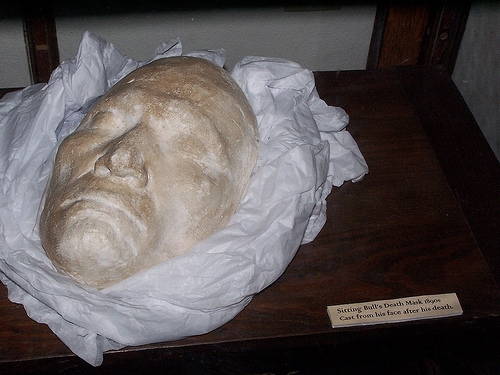
Sitting Bull’s Death Mask

Martin Scorsese on Citizen Kane

“These Go to 11”

Three (Somewhat Literary) Lists for 11 | 11 | 11

Eleven Authors Who Were Also Veterans of War

1. Stendahl (Napoleonic Wars)

2. Ambrose Bierce (Union Army, American Civil War)

3. Erich Maria Remarque (German Army, WWI)

4. George Orwell (Republican Army, Spanish Civil War)

5. Kurt Vonnegut (U.S. Army, WWII)

6. Joseph Heller (U.S. Air Force, WWII)

7. Eveyln Waugh (British Royal Marines, WWII)

8. Norman Mailer (U.S Army, WWII)

9. Gore Vidal (U.S. Army, WWII)

10. Tim O’Brien (U.S. Army, Vietnam War)

11. Anthony Swofford (U.S. Marine Corps, Persian Gulf War)

*          *          *

Eleven Encyclopedic Books, Overstuffed with References, That Compel Compulsive Reading

1. Moby-Dick, Herman Melville

2. Finnegans Wake, James Joyce

3. Expelled from Eden, A WilliamVollmann Reader

4. Species of Spaces and Other Pieces, Georges Perec

5. Wittgenstein’s Mistress, David Markson

6. The Silmarillion, J.R.R. Tolkien

7. Foucault’s Pendulum, Umberto Eco

8. The Rings of Saturn, W.G. Sebald

9. The Recognitions, William Gaddis

10. Between Parentheses, Roberto Bolaño

11.  The Architecture of the Arkansas Ozarks, Donald Harrington

*          *          *

Eleven Excellent Films About Films and Film-making 

1. Hearts of Darkness, Eleanor Coppola, et al

2. Lost in La Mancha, Keith Fulton et al

3. Burden of Dreams, Les Blank

4. Adaptation, Spike Jonze

5. Be Kind Rewind, Michel Gondry

6. The Player, Robert Altman

7. Ed Wood, Tim Burton

8. Stardust Memories, Woody Allen

9. Sullivan’s Travels, Preston Sturges

10. American Movie, Chris Smith

11. Barton Fink, Coen Brothers

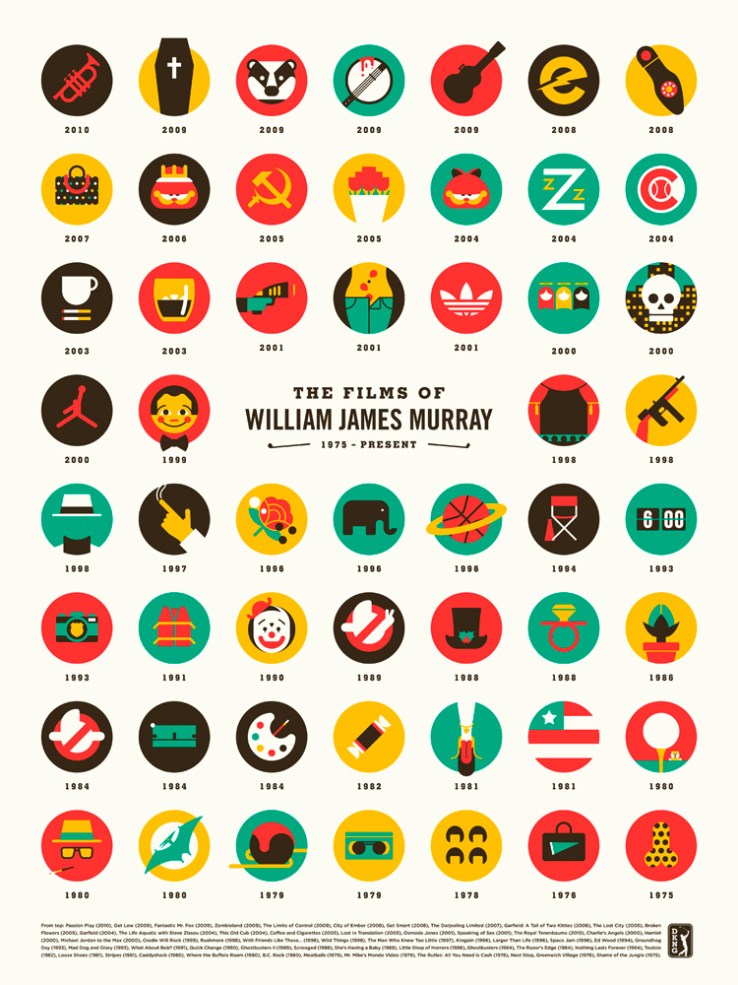
A Graphic Representation of Bill Murray Films

Eleven Excellent Films About Films and Film-making

Eleven Excellent Films About Films and Film-making 

1. Hearts of Darkness, Eleanor Coppola, et al

2. Lost in La Mancha, Keith Fulton et al

3. Burden of Dreams, Les Blank

4. Adaptation, Spike Jonze

5. Be Kind Rewind, Michel Gondry

6. The Player, Robert Altman

7. Ed Wood, Tim Burton

8. Stardust Memories, Woody Allen

9. Sullivan’s Travels, Preston Sturges

10. American Movie, Chris Smith

11. Barton Fink, Coen Brothers