
Slavoj Žižek on Alfred Hitchock. From The Pervert’s Guide to Cinema (2006).
Year: 2011
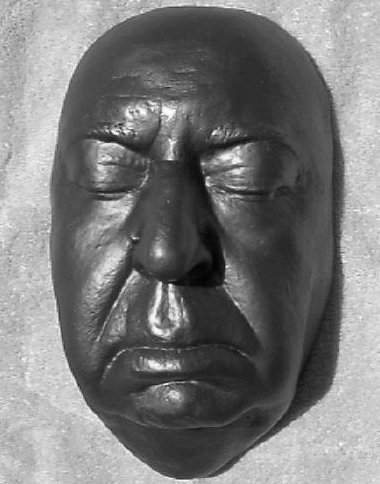
Alfred Hitchcock’s Death Mask
Did Alcohol Inspire Raymond Carver? “My God, No!” — Carver on His Days with Cheever at the Iowa Writers’ Workshop
We continue to raid Raymond Carver’s 1983 Paris Review interview—
INTERVIEWER
Did you ever feel that alcohol was in any way an inspiration? I’m thinking of your poem “Vodka,” published in Esquire.
CARVER
My God, no! I hope I’ve made that clear. Cheever remarked that he could always recognize “an alcoholic line” in a writer’s work. I’m not exactly sure what he meant by this but I think I know. When we were teaching in the Iowa Writers’ Workshop in the fall semester of 1973, he and I did nothing but drink. I mean we met our classes, in a manner of speaking. But the entire time we were there—we were living in this hotel they have on campus, the Iowa House—I don’t think either of us ever took the covers off our typewriters. We made trips to a liquor store twice a week in my car.
INTERVIEWER
To stock up?
CARVER
Yes, stock up. But the store didn’t open until 10:00 a.m. Once we planned an early morning run, a ten o’clock run, and we were going to meet in the lobby of the hotel. I came down early to get some cigarettes and John was pacing up and down in the lobby. He was wearing loafers, but he didn’t have any socks on. Anyway, we headed out a little early. By the time we got to the liquor store the clerk was just unlocking the front door. On this particular morning, John got out of the car before I could get it properly parked. By the time I got inside the store he was already at the checkout stand with a half gallon of Scotch. He lived on the fourth floor of the hotel and I lived on the second. Our rooms were identical, right down to the same reproduction of the same painting hanging on the wall. But when we drank together, we always drank in his room. He said he was afraid to come down to drink on the second floor. He said there was always a chance of him getting mugged in the hallway! But you know, of course, that fortunately, not too long after Cheever left Iowa City, he went to a treatment center and got sober and stayed sober until he died.
The world of addiction treatment is full of stories of addicts who managed to stay sober using support from other former addicts as they went about the rehabilitation process.
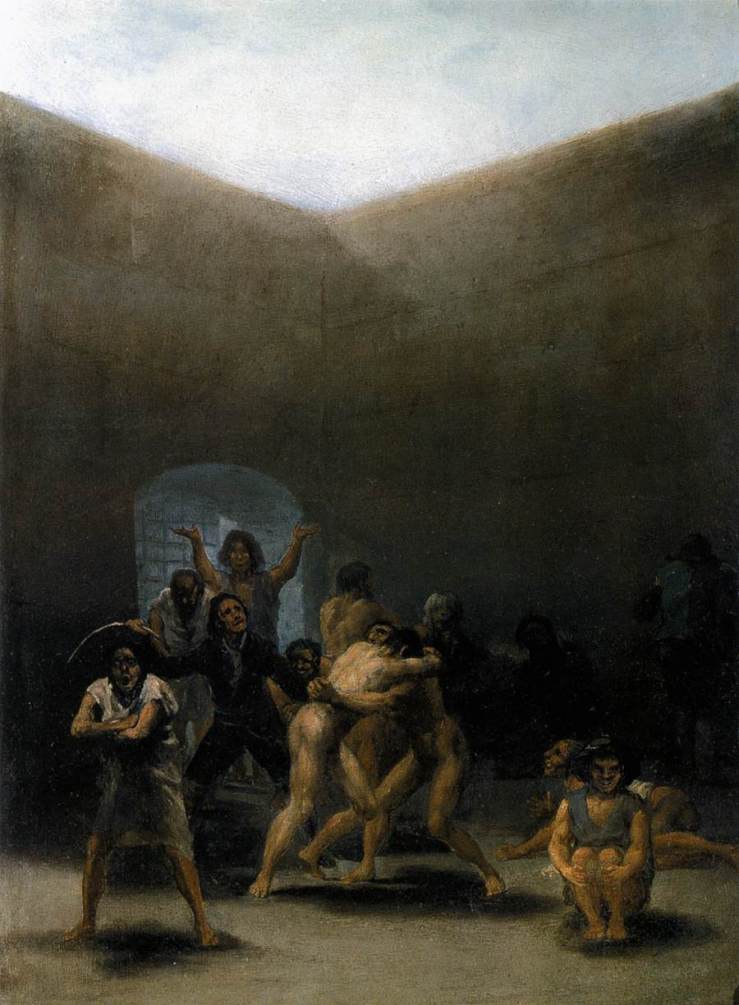
Courtyard with Lunatics — Francisco Goya
“Let’s just say, on occasion, the police were involved and emergency rooms and courtrooms” — Raymond Carver Talks About Drinking
More from Raymond Carver’s 1983 Paris Review interview—
INTERVIEWER
Could you talk a little more about the drinking? So many writers, even if they’re not alcoholics, drink so much.
CARVER
Probably not a whole lot more than any other group of professionals. You’d be surprised. Of course there’s a mythology that goes along with the drinking, but I was never into that. I was into the drinking itself. I suppose I began to drink heavily after I’d realized that the things I’d wanted most in life for myself and my writing, and my wife and children, were simply not going to happen. It’s strange. You never start out in life with the intention of becoming a bankrupt or an alcoholic or a cheat and a thief. Or a liar.
INTERVIEWER
And you were all those things?
CARVER
I was. I’m not any longer. Oh, I lie a little from time to time, like everyone else.
INTERVIEWER
How long since you quit drinking?
CARVER
June second, 1977. If you want the truth, I’m prouder of that, that I’ve quit drinking, than I am of anything in my life. I’m a recovered alcoholic. I’ll always be an alcoholic, but I’m no longer a practicing alcoholic.
INTERVIEWER
How bad did the drinking get?
CARVER
It’s very painful to think about some of the things that happened back then. I made a wasteland out of everything I touched. But I might add that towards the end of the drinking there wasn’t much left anyway. But specific things? Let’s just say, on occasion, the police were involved and emergency rooms and courtrooms.
“None of my stories really happened, of course” — Raymond Carver on Realism (and Drinking) in His Stories
Raymond Carver talks realism, autobiography (and drinking) in his 1983 Paris Review interview. A taste–
INTERVIEWER
Where do your stories come from, then? I’m especially asking about the stories that have something to do with drinking.
CARVER
The fiction I’m most interested in has lines of reference to the real world. None of my stories really happened, of course. But there’s always something, some element, something said to me or that I witnessed, that may be the starting place. Here’s an example: “That’s the last Christmas you’ll ever ruin for us!” I was drunk when I heard that, but I remembered it. And later, much later, when I was sober, using only that one line and other things I imagined, imagined so accurately that they could have happened, I made a story—“A Serious Talk.” But the fiction I’m most interested in, whether it’s Tolstoy’s fiction, Chekhov, Barry Hannah, Richard Ford, Hemingway, Isaac Babel, Ann Beattie, or Anne Tyler, strikes me as autobiographical to some extent. At the very least it’s referential. Stories long or short don’t just come out of thin air. I’m reminded of a conversation involving John Cheever. We were sitting around a table in Iowa City with some people and he happened to remark that after a family fracas at his home one night, he got up the next morning and went into the bathroom to find something his daughter had written in lipstick on the bathroom mirror: “D-e-r-e daddy, don’t leave us.” Someone at the table spoke up and said, “I recognize that from one of your stories.” Cheever said, “Probably so. Everything I write is autobiographical.” Now of course that’s not literally true. But everything we write is, in some way, autobiographical. I’m not in the least bothered by “autobiographical” fiction. To the contrary. On the Road. Céline. Roth. Lawrence Durrell in The Alexandria Quartet. So much of Hemingway in the Nick Adams stories. Updike, too, you bet. Jim McConkey. Clark Blaise is a contemporary writer whose fiction is out-and-out autobiography. Of course, you have to know what you’re doing when you turn your life’s stories into fiction. You have to be immensely daring, very skilled and imaginative and willing to tell everything on yourself. You’re told time and again when you’re young to write about what you know, and what do you know better than your own secrets? But unless you’re a special kind of writer, and a very talented one, it’s dangerous to try and write volume after volume on The Story of My Life. A great danger, or at least a great temptation, for many writers is to become too autobiographical in their approach to their fiction. A little autobiography and a lot of imagination are best.
Raymond Carver: Dreams Are What You Wake Up From
“Drinking While Driving” — Raymond Carver
“Drinking While Driving” by Raymond Carver–
It’s August and I have not
Read a book in six months
except something called The Retreat from Moscow
by Caulaincourt
Nevertheless, I am happy
Riding in a car with my brother
and drinking from a pint of Old Crow.
We do not have any place in mind to go,
we are just driving.
If I closed my eyes for a minute
I would be lost, yet
I could gladly lie down and sleep forever
beside this road
My brother nudges me.
Any minute now, something will happen.
“Just mix up a mixture of theolologicophilolological” — Stephen Dedalus on Shakespeare
From Stephen Dedalus’s strange thesis on Shakespeare in episode 9 of James Joyce’s Ulysses–
— And the sense of property, Stephen said. He drew Shylock out of his own long pocket. The son of a maltjobber and moneylender he was himself a cornjobber and moneylender, with ten tods of corn hoarded in the famine riots. His borrowers are no doubt those divers of worship mentioned by Chettle Falstaff who reported his uprightness of dealing. He sued a fellowplayer for the price of a few bags of malt and exacted his pound of flesh in interest for every money lent. How else could Aubrey’s ostler and callboy get rich quick? All events brought grist to his mill. Shylock chimes with the jewbaiting that followed the hanging and quartering of the queen’s leech Lopez, his jew’s heart being plucked forth while the sheeny was yet alive: Hamlet and Macbeth with the coming to the throne of a Scotch philosophaster with a turn for witchroasting. The lost armada is his jeer in Love’s Labour Lost. His pageants, the histories, sail fullbellied on a tide of Mafeking enthusiasm. Warwickshire jesuits are tried and we have a porter’s theory of equivocation. The Sea Venture comes home from Bermudas and the play Renan admired is written with Patsy Caliban, our American cousin. The sugared sonnets follow Sidney’s. As for fay Elizabeth, otherwise carrotty Bess, the gross virgin who inspired The Merry Wives of Windsor, let some meinherr from Almany grope his life long for deephid meanings in the depths of the buckbasket.
I think you’re getting on very nicely. Just mix up a mixture of theolologicophilolological. Mingo, minxi, mictum, mingere.
“I’m Like a Tiger” — A Scene from If . . . .
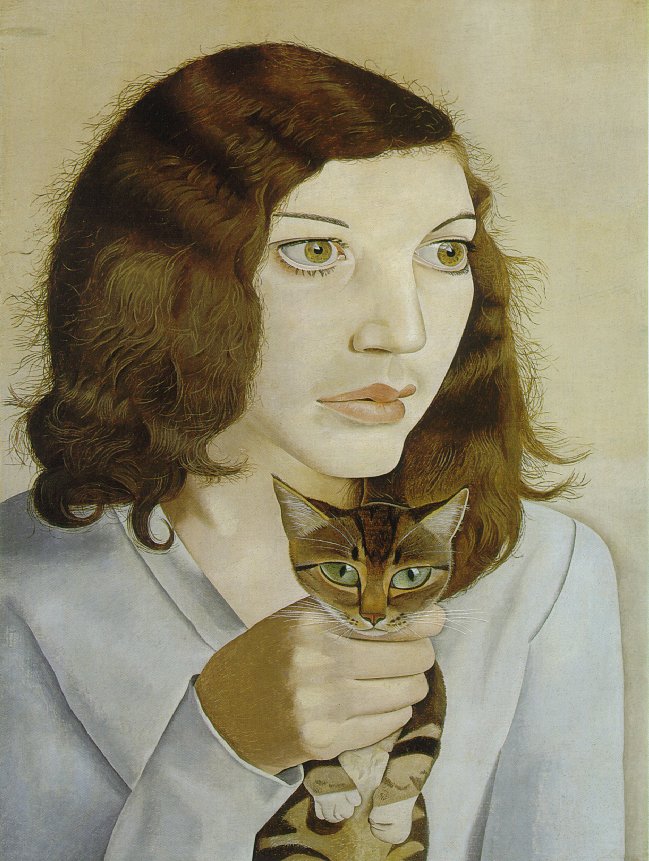
Girl with Kitten — Lucian Freud
“Wake for Susan” — Cormac McCarthy
Great find by Reddit user db_usher, who’s unearthed Cormac McCarthy’s early short story, “Wake for Susan” (okay, “unearthed” might be an extreme verb; you can get the story via interlibrary loan from the University of Tennessee, but hey, that takes effort). The piece was published in 1959 in The Phoenix; it’s a bit of juvenilia with its faults, to be sure, but will interest fans of course. Usher’s Reddit post links to a .pdf file; I’ve posted the story after the jump for those who wish to read it on a screen.
Biblioklept Recommends Five Novels, Some of Them New, Not All of Them German
 I shouldn’t be reading five novels at once. It’s a terrible idea, a symptom of a bad habit that I thought I’d broken, but after abandoning Levin’s tedious tome The Instructions and wasting my time on Shteyngart’s insipid dystopian novel Super Sad True Love Story, I found myself absorbed by a lovely little cache that had been neatly, patiently stacked for a few weeks now.
I’m only 60 or so pages into Lars Iyer’s Spurious — about a third of the way through — and at the rate I’m reading, I won’t finish it until the end of this month. It’s not that it’s slow or tedious or hard work: quite the opposite, in fact — it’s funny and lively, even when it’s erudite and depressive. I’ve enjoyed taking it in as a series of vignettes or skits or riffs. Spurious is about, or seems to be about (the term must be placed under suspicion) two would-be intellectuals, W. and his friend the narrator. They bitch and moan and despair: it’s the end of the world, it’s the apocalypse; they find themselves incapable of original thought, of producing any good writing. The shadow of Kafka paralyzes them. They travel about Europe, seeking out knowledge and inspiration — or at least a glimpse of some beautiful first editions. W. is cruel to the narrator, calling him fat and deriding his intellect for sport. But it’s all in good fun. Or maybe not. I’m really enjoying Spurious and have no hesitation recommending it; however, like a strong shot of bourbon, it’s best enjoyed frequently but in small doses. Spurious is brand spanking new from Melville House.
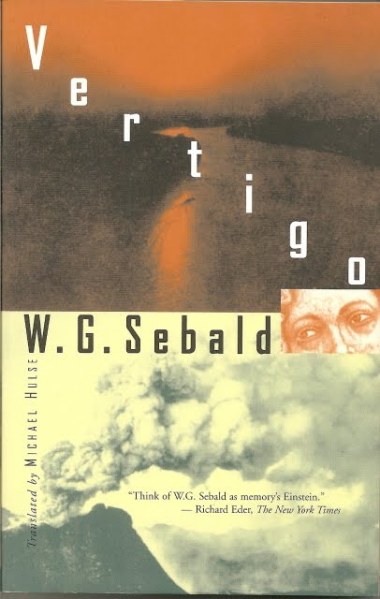 Iyer’s book dovetails nicely with W.G. Sebald’s first novel, Vertigo, which I picked up expressly to get the bad taste of Shteyngart out of my brain. Both books are haunted by Kafka, both blur the lines between fiction and biography, both are works of and about flânerie, and both are melancholy. The book comprises four sections; the first section tells the story of the romantic novelist Stendhal (or, more to the point, a version of Stendhal); the second section details two trips Sebald made to Italy, one in 1980, and one in 1987; the third
  section, which I just read last night, describes a trip Kakfa took to Italy near the end of his life. I’m almost certain that I’ve read this section, “Dr. K Takes the Waters at Riva,” before — but I can’t remember where or when. It was strange reading it, almost as if I were experiencing some of the vertigo that permeates the volume. Full review forthcoming.
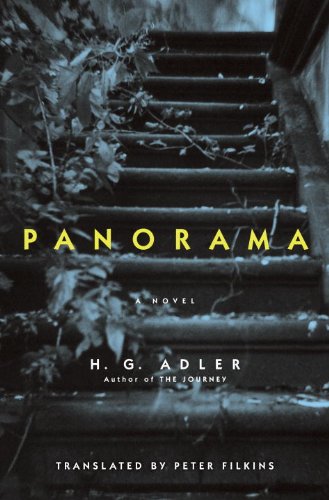
Kafka was a German-speaking Jewish writer from Prague. So was H.G. Adler, author of Panorama, new in English for the first time (hardback; Random House). Another way to transition from the Sebald paragraph above to this write-up of Panorama might be to point out that Sebald references Adler in Austerlitz, a book that tries to measure continental memory of the Holocaust. Adler survived the Holocaust, forced first into Theresienstadt and then Auschwitz, where his wife and mother were murdered in the gas chambers. Panorama is an autobiographical bildungsroman, with its hero young Josef Kramer standing in for Adler, and while it will clearly work its way into grim territory, the beginning — which is to say, the part that I’ve read so far — is bucolic and sweet and strange, as we see young Josef at home with his family. There’s a cinematic scope to Adler’s prose — Panorama is a Modernist work, one where the narrative freely dips into its protagonist’s mind. More to come.
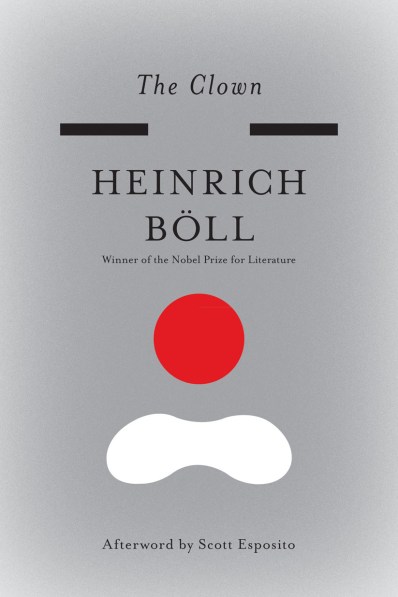 Continuing in this Teutonic vein is Heinrich Böll’s novel The Clown (also Melville House). It’s postwar Germany, and Hans Schnier is a clown who’s crashing and burning. He hurts himself–purposefully–during a performance (at one of the increasingly more provincial venues he finds himself playing for these days) and retreats to Bonn, where he holes up in his small apartment and makes angry desperate phone calls (and tries not to drink too much brandy) and reflects on his past. What’s eating him up? His gal Marie, basically his common-law wife, has reverted back to her Catholic ways and up and left him for some chump named Zupfner. Schnier rants against a complacent and complicit German bourgeoisie, spitting vitriol against Protestants and Catholics alike; some of the best parts of the novel though are his ravings about art and the role of the “artiste” in society. Also: he can smell over the phone. Full review soon.
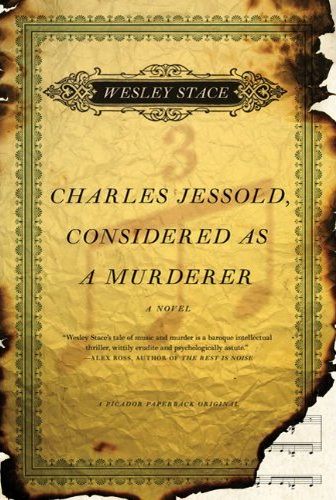 Wesley Stace’s new novel Charles Jessold, Considered as a Murderer (new from Picador) is a musical murder mystery set in the early part of 20th century Britain. Our (seemingly less than reliable) narrator Leslie Shepherd is a music critic with an aristocratic background who likes to spend his weekends collecting folk songs with other rich boys in the towns surrounding their country manors. He’s smitten (platonically, of course) with Charles Jessold, a middle class composer with a spark of avant-garde genius, and wins the younger man’s friendship quickly when he tells the story of Carlo Gesualdo, a fifteenth century composer/lord who kills his wife and her lover. (Notice the etymological connection between their names?) This tale of murder and cuckoldry is doubled in the ballad “Little Musgrave“; when Jessold and Shepherd find a new variation of the ballad, they set out to write the next (only?) great English opera, an adaptation of “Musgrave.” Oh, and that plot? The book opens with a news clipping reporting that Jessold killed his wife and her lover, and then himself, after the première of his opera Little Musgrave. Life imitates art imitates life. Stace has a keen ear for the period he writes about as well as a seemingly encyclopedic knowledge about music, but he also has the good sense to restrain himself and remember that he’s delivering a murder mystery. I’ve been enjoying Jessold quite a bit, and will return to it when I finish writing these lines. (And, for what it’s worth, part of Jessold is set in Germany).
Frank Delaney Honors James Joyce’s Birthday with His “re:Joyce Rap”
Is Infinite Jest Just David Foster Wallace’s Way of Imposing His Phallus on the Consciousness of the World?
From David Foster Wallace’s 1997 interview with Charlie Rose. I love Rose’s response–
DFW: Feminists are always saying this. Feminists are saying white males say, “Okay, I’m going to sit down and write this enormous book and impose my phallus on the consciousness of the world.”
ROSE: And you say?
DFW: I — I — if that was going on, it was going on on a level of awareness I do not want to have access to.
ROSE: Do you still play tennis?
“The West” — Carson Mell
The Skating Rink — Roberto Bolaño
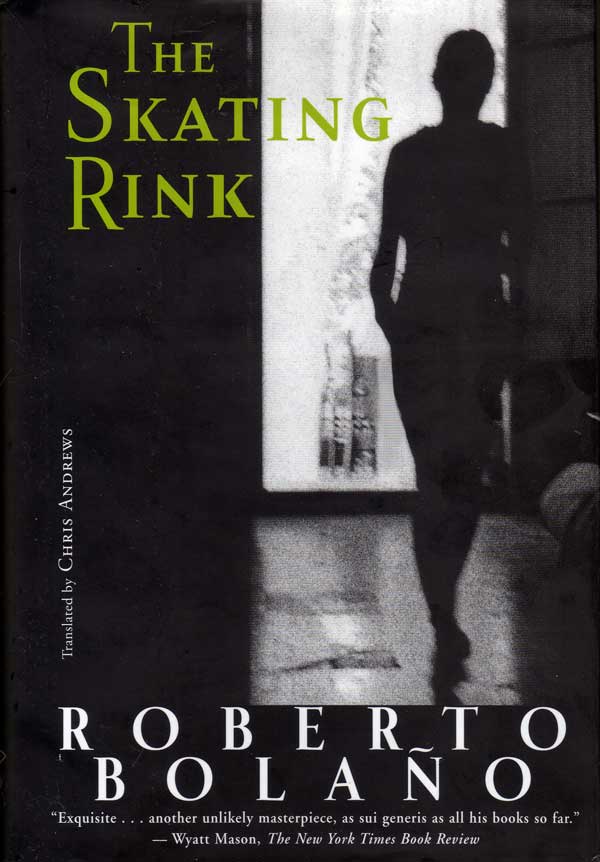
The Skating Rink was the first novel Roberto Bolaño published, a murder mystery in Spanish, all the way back in 1993. It’s a short novel, but full of devices and ideas that readers will recognize from the late Chilean master’s later and better-known works. Characters who populate the novel recount events as if speaking extemporaneously to a reporter or a detective and discuss ideas and themes that the author would return to again and again: obsession, alienation, lack of national identity, underappreciated poets, homelessness, and homicide. The Skating Rink is a brief novel at 179 sharp and engaging pages. It wouldn’t be incorrect to call it a minor novel, but it would be a mistake to consider it merely a warm-up for the more intricate routines that the writer would perfect in the future.
The novel is about the construction and existence of a clandestine ice rink built in a deserted mansion on the cliffs of a seaside resort town in Catalonia, Spain. Erected to please Nuria Marti, a beautiful figure skater cut from the Spanish Olympic team, the rink and its inspiration are reserved and glacial while the locals who populate the seasonally bustling city are, with varying degrees of success, just trying to hold everything together. When the body of an itinerant singer is discovered in the middle of the ice deep within the labyrinthine halls of the decaying house, everything the characters have strained to preserve begins to fall apart.
The book is narrated by three men who represent different strata of Spanish society. Enric Rosquelle is an outwardly arrogant bureaucrat in charge of the city’s various social service agencies whose desperate need for love leads him to embezzle the funds in order to build the skating facility for the athlete he knows will never return his feelings. Gaspar Heredia is an illegal Chilean immigrant who works in a campground for tourists and falls for a homeless woman who never relinquishes the kitchen knife she keeps tucked in her jeans. Remo Moran, a legal arrival from Chile, has enjoyed success as a businessman and as a poet and is anxious about his own precarious sexual relationship with Nuria. Each man is more or less aware of his shortcomings and they utilize similar Bolañesque (Bolañan?) digressions to explain their motivations and feelings. They come to know and discuss each other in their retelling of events and so become interesting, sympathetic, and full characters. Enric is jealous of Remo and suspicious that South Americans in general trade in filth and drugs. Gaspar relies on his old friend Remo for his job and secretly watches Enric coaching Nuria.
The sense of loneliness and the failure to take advantage of fleeting opportunities are palpable. In a number of places, the narrative and the novel’s setting evoke a Wong Kar-wai movie. In slow motion, men follow women through cobblestone streets, not quite able to grasp that thing they desire. Hang-gliders dance in the sky and while everyone else is watching the fliers against the cool blue sky, we’re being told about how she’s just disappeared through a door down a side street. Solitary women stroll up cliff-side highways while our narrators limp behind. I almost expect Gaspar to sit down next to Tony Leung while cellos or Chinese versions of well-known pop tunes play from a nearby jukebox. Unlike Wong Kar-wai though, Bolaño sees the single-minded pursuit of unrequited love as pathological and often a precursor to violence. The men in The Skating Rink, like any number of other men who populate Bolaño’s novels, are unable to resist the wills of the women they love or submit to personally or professionally. Two men here are willing to sublimate their own wishes for those of Nuria, whose choice of profession illustrates her own desire to overcome the normal limitations of geography, climate, and national history. As they seek her favor, they find themselves acting in unfamiliar ways, on uncertain paths and unconcerned with appearance or ethics.
Like most of Bolaño’s work, endings (and beginnings and middles) are ambiguous. Readers are left unsure as to what has actually happened and the murder remains (I think) unsolved. The Skating Rink could serve as an easy introduction to the writer’s more complex creations because it deals with time and plot in a relatively conventional manner. The characters get to say proper good-byes and reflect on the things that have happened to them. Like a standard mystery, most of the knots have been untangled. But because real understanding sits just outside of consciousness, this reader is still waiting for the feeling that my task is complete. There are occasional missteps, like when Bolaño compares an elderly woman’s voice to a locker room, but passages lodge in your head like slow songs on repeat in dark comfortable places. Like those jams, The Skating Rink might be a masterpiece or something to be forgotten when something better comes along. It’s short, so listen to it a couple times and decide for yourself.
 Biblioklept