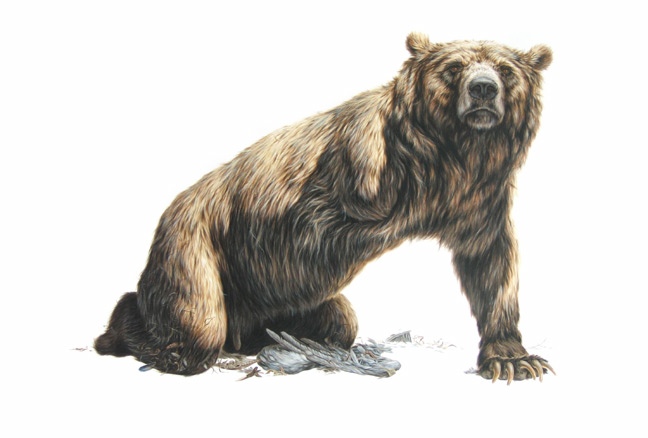
I have a fantastic interview with artist George Boorujy coming up this week—we chat about shower beers and Swamplandia and beasts and men and George’s new show Blood Memoryand all manner of marvels. It’s great stuff and includes some studio shots. Only I can’t quite finish editing it yet because I’m on vaykay and have neglected to bring along a laptop. Posting this piece now on an iPhone has taken all the wine- and sun-soaked concentration I can muster … So enjoy the bear (and look forward to the interview).
Month: March 2012
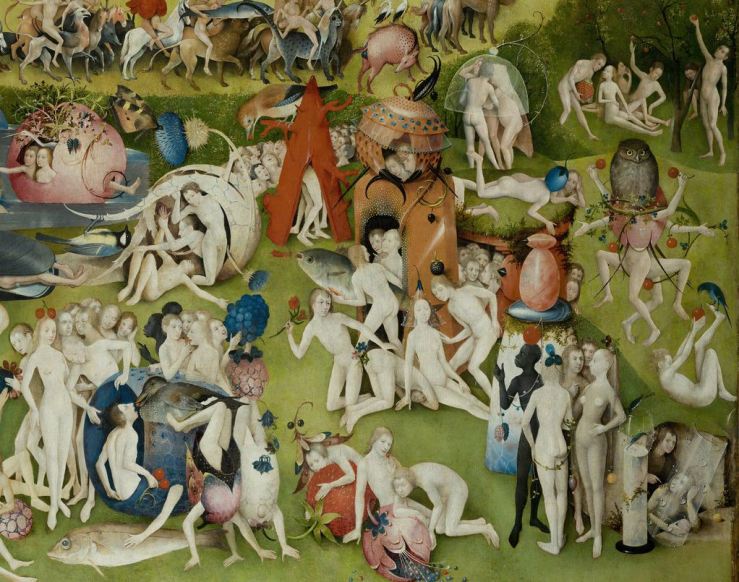
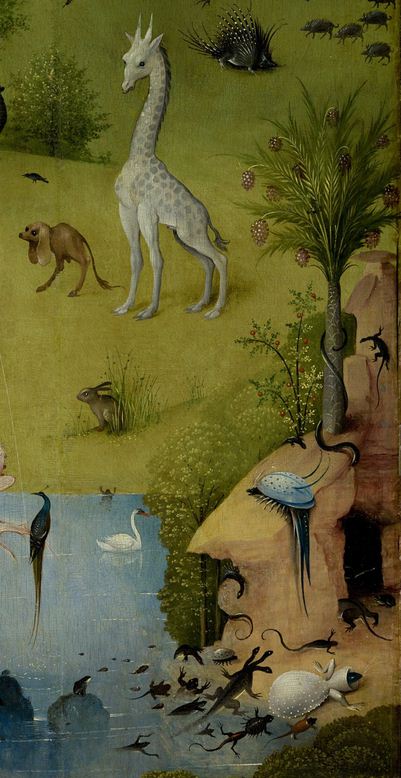
Bosch Detail

“Music’s Not Waiting” — John Cage

(From John Cage’s A Year from Monday).
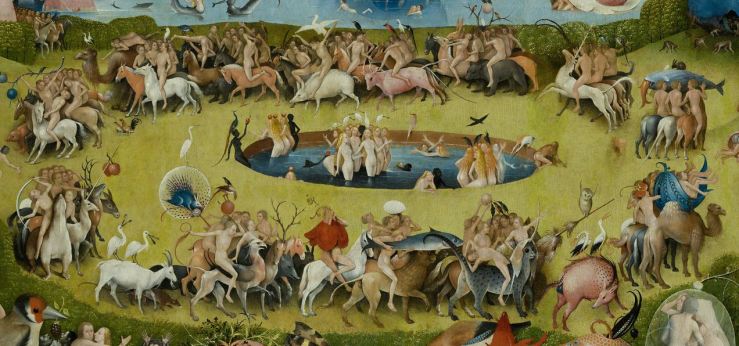
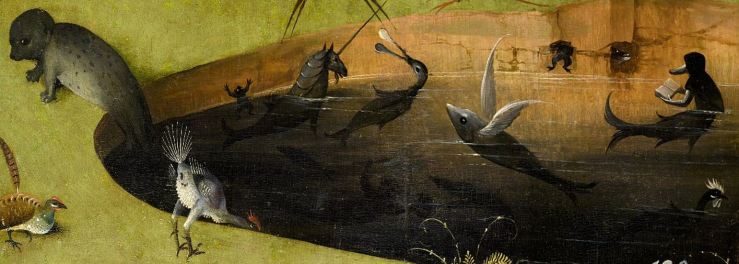
Riders and Bathers — Another Detail from Bosch’s Garden of Earthly Delights

Consider Gérard de Nerval’s Pet Lobster
I’ve been reading Michel Houellebecq’s latest novel The Map and the Territory on my Kindle Fire, which is handy because I can easily hover my index over an unknown reference and figure out what Mich-dawg is getting at. Anyway, near the beginning of Part III, H-bomb drops a reference to French Romantic poet and essayist Gérard de Nerval, whom I will cop to not recognizing. But the detail seemed significant, so let my index finger hover I did, but, no dice, Nervs wasn’t in the preloaded dictionary—so I went to the next option: Le Wikipedia. And here’s a snapshot of what I saw:
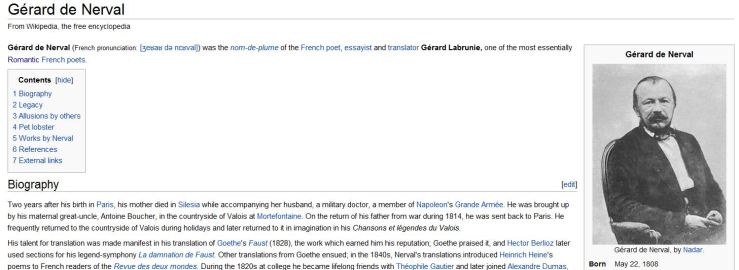
The man’s life is divided into seven neat sections there on Wikipedia, and what’s right square in the middle? Pet lobster. Holmes had a pet lobster:

I’m guessing if you know about Nerval you probably know about his lobsterkins, but I didn’t. Harper’s ran a piece about Nerval and his lobster back ’08. From the piece:
With all due respect for cats, however, let us consider the case for the humble lobster. The poet Gérard de Nerval had a penchant for lobsters, or at least for one lobster. Nerval was seen one day taking his pet lobster for a walk in the gardens of the Palais-Royal in Paris. He conducted his crustacean about at the end of a long blue ribbon. As word of this feat of eccentricity spread, Nerval was challenged to explain himself. “And what,” he said, “could be quite so ridiculous as making a dog, a cat, a gazelle, a lion or any other beast follow one about. I have affection for lobsters. They are tranquil, serious and they know the secrets of the sea.” (The episode is captured by Guillaume Apollinaire in a collection of anecdotes from 1911). Was there any basis to this story? A generation of Nerval scholars attempted to debunk it, but then a letter to his childhood friend Laura LeBeau was discovered. Nerval had just returned from some days at the seaside at the Atlantic coastal town of La Rochelle: “and so, dear Laura, upon my regaining the town square I was accosted by the mayor who demanded that I should make a full and frank apology for stealing from the lobster nets. I will not bore you with the rest of the story, but suffice to say that reparations were made, and little Thibault is now here with me in the city…” Nerval, it seems, had liberated Thibault the lobster from certain death in a pot of boiling water and brought him home to Paris. Thus we know that it was Thibault, and not just “some lobster,” who went for that celebrated promenade in the gardens of the Palais-Royal.
Book Shelves #11, 3.11.2012

Book shelves series #11, eleventh Sunday of 2012. DeLillo, Denis Johnson, Pynchon (no, I have not read Against the Day nor finished Mason & Dixon). There’s also a hardback copy of Bolaño’s Between Parentheses; I have an ARC of the same shelved with the other Bolaños, which are on the shelf under—but the finished copy won’t fit on the shelf and it fits here. For now.
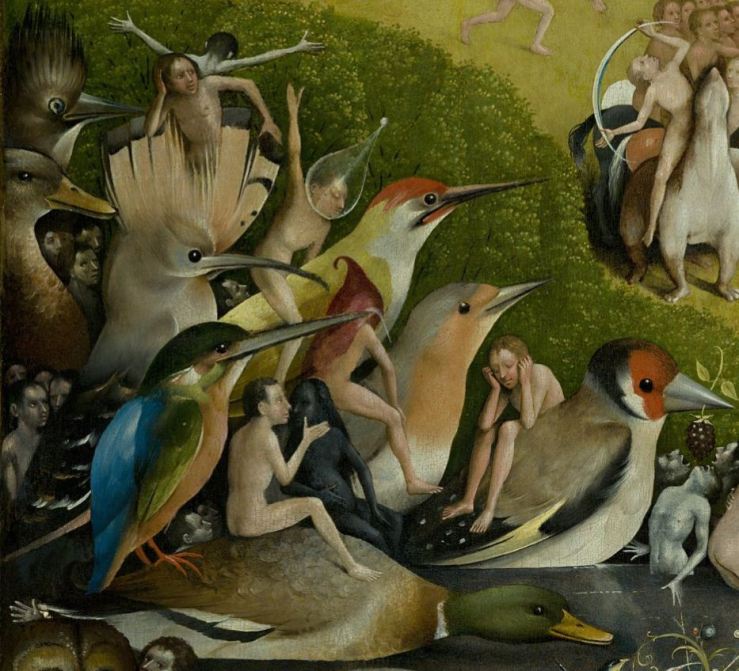
Bosch Birds

Greta Gerwig Sings Along to Paul McCartney’s “Uncle Albert/Admiral Halsey” (Greenberg)
00:25-00:45 = GOLD.
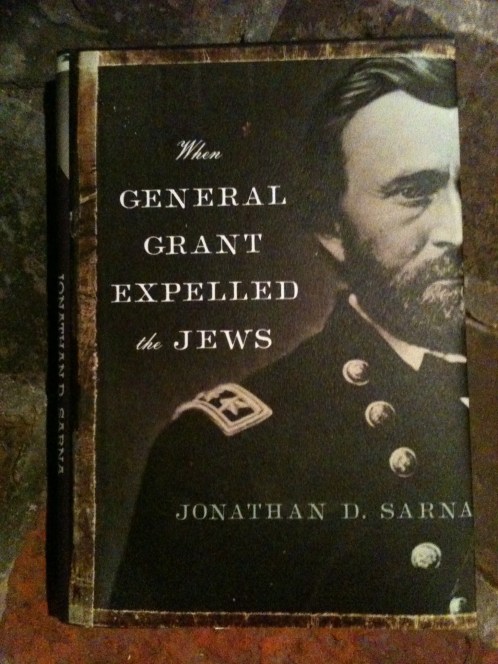
When General Grant Expelled the Jews (Book Acquired, 3.06.2012)

When General Grant Expelled the Jews is new from historian Jonathan D. Sarna (and Shocken books). From Harold Holzer’s review at The Washington Post:
. . . no historian has been able to fully understand — much less justify — why, on Dec. 17, 1862, Grant issued his notorious General Orders No. 11 deporting Jewish citizens. “The Jews, as a class violating every regulation of trade,” went the chilling text, “. . . are hereby expelled from [his command in the West] within twenty-four hours.” Those returning would be “held in confinement until an opportunity occurs of sending them out as prisoners.” Just two weeks before Abraham Lincoln was scheduled to extend freedom to one minority group with the Emancipation Proclamation, his most promising general thus initiated a virtual pogrom against another.
In the end, as the gifted and resourceful historian Jonathan D. Sarna points out in this compelling page-turner, General Orders No. 11 uprooted fewer than 100 Jews. But for a few weeks, he suggests, it terrorized and infuriated the Union’s entire Jewish population. It also inspired one of the community’s first effective lobbying campaigns. Jewish newspapers compared Grant to Haman, the infamous vizier of Persia in the Book of Esther. A delegation of Jewish leaders traveled to the White House to protest directly to the president, who quickly but quietly had the order revoked, eager to right a wrong but reluctant to humiliate a valuable military commander. As Lincoln carefully put it, “I do not like to hear a class or nationality condemned on account of a few sinners.” He never mentioned the episode publicly.
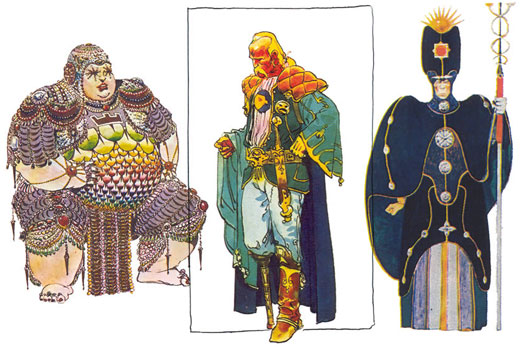
Moebius Penciling and Inking Blueberry (Video)
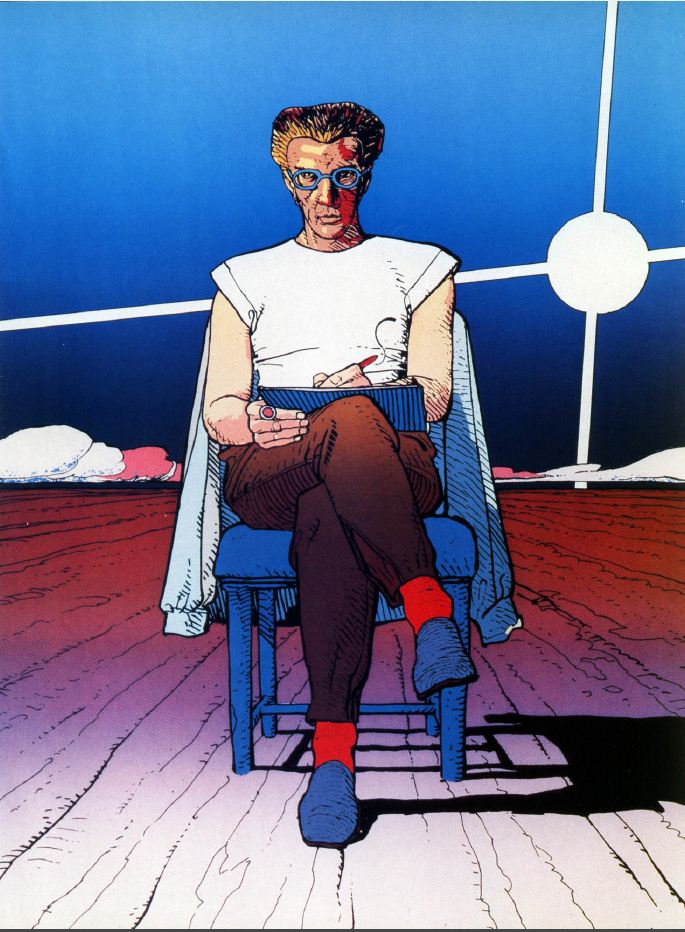
RIP Jean Giraud aka Moebius

French comic book legend Jean Giraud, also known as Moebius, died today in Paris at 73.

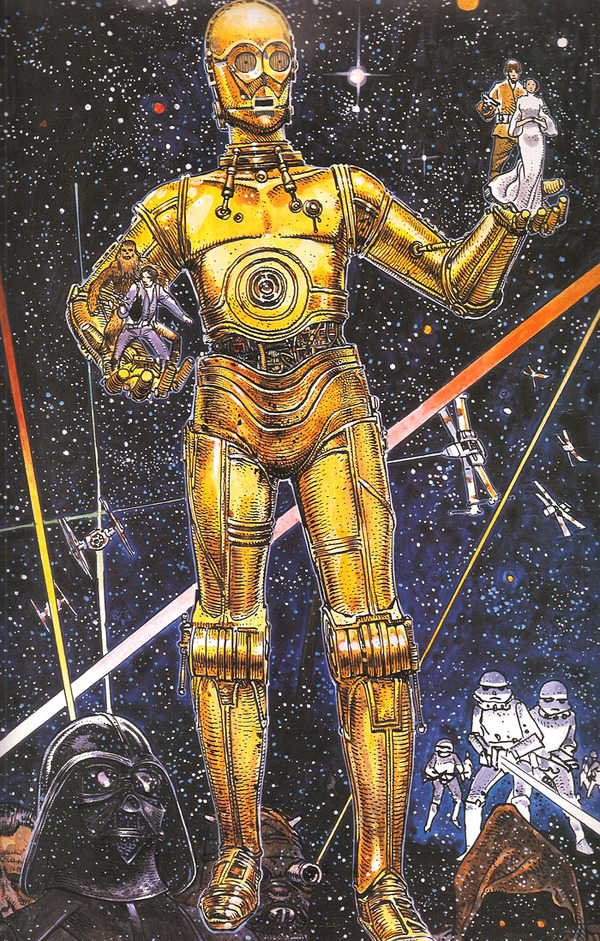
Although Giraud’s work is more famous in Europe, and particularly France and Belgium, where comics tend to get more of the artistic esteem they deserve, his influence on contemporary American comics and sci-fi film design should not be underestimated.

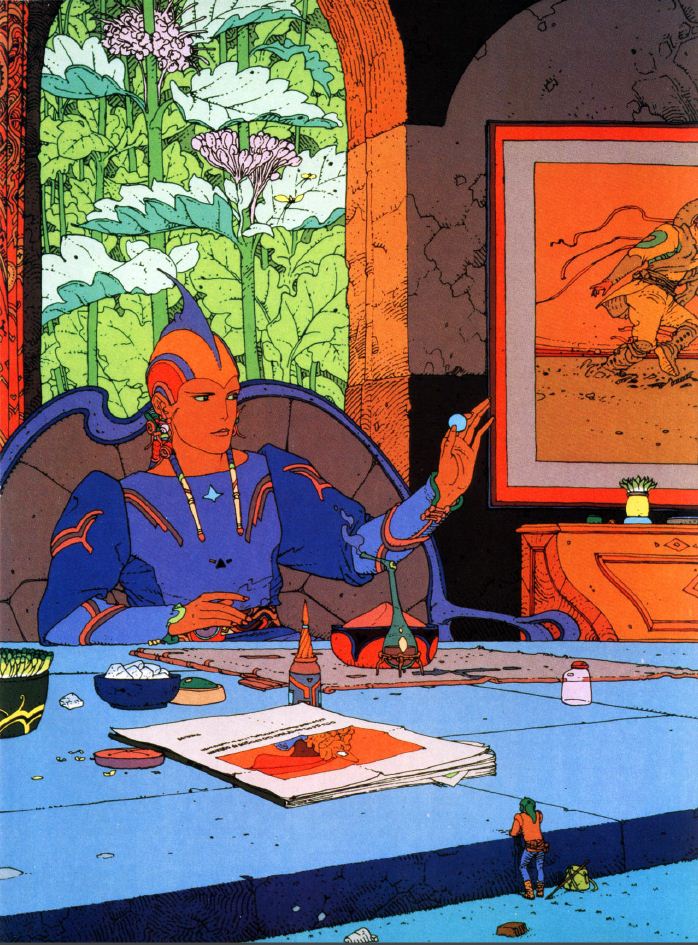
His take on Wild West culture is exemplified in what is likely his largest body of work Blueberry, but folks new to Giraud might wish to start with The Airtight Garage (or just check out this cool gallery).

Giraud/Moebius was never simply a genre artist; instead, his work taps into the mythological, exploring themes that seem at once both strangely familiar but also wildly divergent from our expectations. His imaginative disruptions made him a key partner for film directors like Alejandro Jodorowsky; he also worked on the art team behind Alien, among other films, like The Abyss, Willow, and Tron. Giraud was also close friends with Hayao Miyazaki.

Giraud leaves a rich, vibrant legacy. The imaginative spaces of his worlds will undoubtedly captivate generations to come.
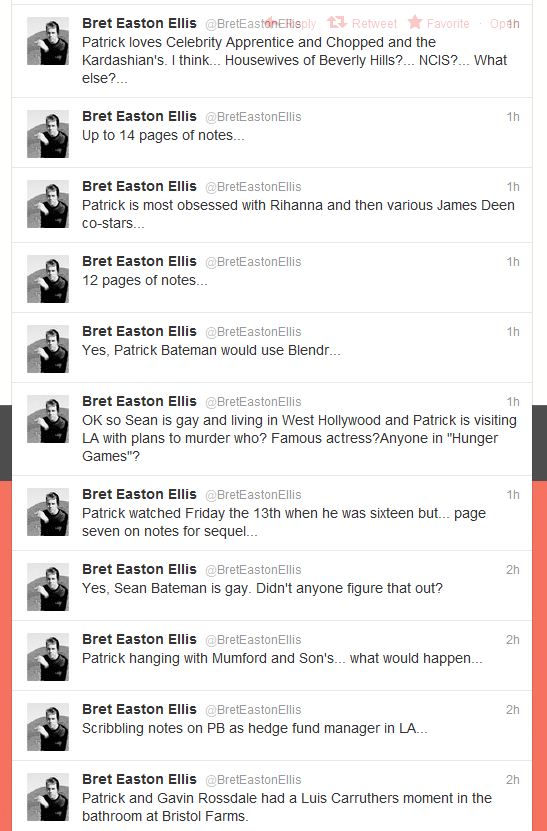
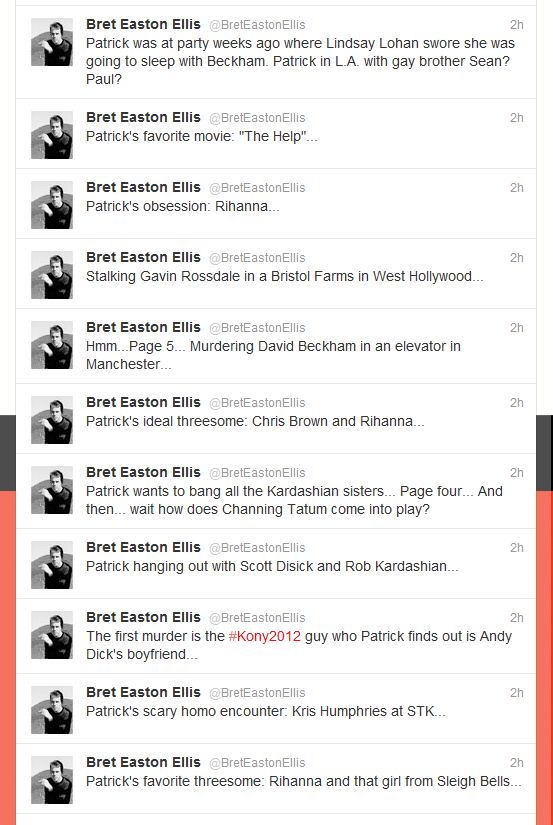
Bret Easton Ellis’s Notes for an American Psycho Sequel (From Twitter, Of Course)


Matmos & Zeena Parkins Jam at The Henry Miller Library
Mermaid Reading (Detail from Bosch’s Garden of Earthly Delights)

“Cry” — Godley & Creme
Natural Bridge Tale
From Charles M. Skinner’s Myths And Legends of Our Own Land (1896):
Though several natural bridges are known in this country, there is but one that is famous the world over, and that is the one which spans Clear Creek, Virginia—the remnant of a cave-roof, all the rest of the cavern having collapsed. It is two hundred and fifteen feet above the water, and is a solid mass of rock forty feet thick, one hundred feet wide, and ninety feet in span. Thomas Jefferson owned it; George Washington scaled its side and carved his name on the rock a foot higher than any one else. Here, too, came the youth who wanted to cut his name above Washington’s, and who found, to his horror, when half-way up, that he must keep on, for he had left no resting-places for his feet at safe and reachable distances—who, therefore, climbed on and on, cutting handhold and foothold in the limestone until he reached the top, in a fainting state, his knife-blade worn to a stump. Here, too, in another tunnel of the cavern, flows Lost River, that all must return to, at some time, if they drink of it. Here, beneath the arch, is the dark stain, so like a flying eagle that the French officer who saw it during the Revolution augured from it a success for the united arms of the nations that used the eagle as their symbol. The Mohegans knew this wonder of natural masonry, for to this point they were pursued by a hostile tribe, and on reaching the gulf found themselves on the edge of a precipice that was too steep at that point to descend. Behind them was the foe; before them, the chasm. At the suggestion of one of their medicine-men they joined in a prayer to the Great Spirit for deliverance, and when again they looked about them, there stood the bridge. Their women were hurried over; then, like so many Horatii, they formed across this dizzy highway and gave battle. Encouraged by the knowledge that they had a safe retreat in case of being overmastered, they fought with such heart that the enemy was defeated, and the grateful Mohegans named the place the Bridge of God.
Detail from The Joining of Adam and Eve — Hieronymous Bosch