Worst Review Tactics

“It’s like [name of thing you love]only so much better!”

Has this ever happened to you? A friend or a “professional” reviewer of books, movies, records, etc. tries to sell you on some new thing by citing a comparison to something you love and then insulting that thing by telling you this new thing is aesthetically superior, the platonic ideal only glimpsed at by the thing you already love, exclaiming, “You should be so pumped to abandon that thing you already love in favor of this new thing that I am suddenly telling you is the more appropriate thing to admire!”

What’s funny about all this is that the reviewer/friend is really only trying to connect with you, to personalize their recommendation within a framework they know you will understand. But often, by going this route, they inadvertently demean your love for whatever the thing is, and what ends up happening (for me anyway) is the exact opposite response they were trying to get from me:

I end up hating this new thing.

The earliest example I can remember happened in college when I was on the phone with a dear friend when he asked (unfortunately):

“Have you heard this album Michigan by this guy Sufjan Stevens? It’s basically like Jim O’Rourke’s Eureka but the songwriting and arrangements are way better”

And on that day, at that moment, I gave birth to an infinite unquenchable hatred for Sufjan Stevens.

And why exactly did this happen? Because my discovery of Jim O’Rourke, (which had occurred a year or so before that conversation) was as close to a life-changing event as is possible with the consumption of art. Jim O’Rourke represents the nexus of so many wide-ranging creative ideas and disciplines, the perfect marriage of avant-garde and pop, melody and dissonance, improv and structure, (etc.) that I was obsessed with him to the point that he became a kind of index of creativity for me; I sought out every band or artist he had worked with; I read every interview with him published on the internet; I even kept a running Word doc where I copied and pasted the titles of any book or movie or album (or anything) that he mentioned liking.

 A brief list of a few of my favorite things I learned about via Jim O’Rourke:

John Fahey

Tony Conrad

Dusan Makavejev

Robert Downey Sr.

Derek Bailey

Faust

CAN

Whitehouse

Arthur Russell

Merzbow

Ray Russell

Bill Fay

Van Dyke Parks

Kevin Drumm

Masayuki Takayanagi

Otomo Yoshihde

Keiji Haino

Judy Sill

Curt Boetcher

Nic Roeg

Luc Ferrari

Robbie Basho

Robert Wyatt

Ivor Cutler

Smog

Scott Walker

And the list can go on and on. Basically this man is my hero. And my friend knew this when he called me; maybe he didn’t quite know the depth and breadth of my love, but he knew as much as I was able to communicate verbally. And he certainly knew that at the time Eureka was my favorite of Jim’s albums. (I’ve since decided that Insignificance is the superior of that era of Drag City albums, although I prefer his instrumental, electronic or improve records to the songwriting ones in general).

So what was my friend expecting me to do in response to his absurd claims? Drop all my built up love for the guy who has had the biggest influence on my creative life and suddenly take up with some dude whose name I couldn’t even pronounce yet? At his insistence I picked up Sufjan’s album and listened to a few songs, but all I was really doing was picking it apart, looking for all the ways it simply did not stack up to Eureka. Because of course, how could it stack up? That’s an impossible proposition considering the circumstance. I’m even willing to say that in a “blind taste test” situation it may be possible that 9 out of 10 listeners would prefer Sufbag Stevens to my Jim but I don’t care, I was and am so biased it’s not even worth pursuing.

So why am I thinking of all of this now?

Well the other day a dear, dear friend of mine wrote an article for NPR music where he outrageously overpraised an upcoming album by singer/composer Julia Holter—and it has been driving me nuts for the week or so since he posted it.

I should preface by saying that my friend’s taste in music is among the sharpest most well-rounded of anyone I know. I take his word on basically everything and there is a reason he has this NPR job: he is better informed about music than almost anyone and he can keenly articulate his thoughts. So when he writes about an album, I almost always give whatever it is a listen—and in most cases I wholeheartedly agree with him.

But in the first paragraph of this Julia Holter article, he pulls this shit on me, going straight for heart in the second sentence by referencing Scott Walker’s The Drift and Gaspar Noe’s film Enter The Void. My jaw dropped when he pulled those references; I may have spoken out loud to my wife, calling out to her in the other room, “Holy shit Lars just compared this girl to Enter the Void and Scott Walker!” Here’s Lars’s lede:

When the world is at the tip of anyone’s fingers, there’s little space for a true vanguard of sound. Think about it: When was the last time you heard or saw something entirely new? Experiences like Gaspar Noe’s film Enter the Void and Scott Walker’s album The Drift shook me to my core, and questioned my ideas of not only art, but also life itself. But trace the steps and you’ll find Ennio Morricone and Krzysztof Penderecki in Walker, or Kenneth Anger and 2001: A Space Odyssey in Noe.

One sentence further my heart was no longer the target; I felt that I had been kicked in the balls:

We’re a culture that recycles — no revelatory observation — but with Ekstasis, Julia Holter has created a radically new world from a crystalline Venn diagram of sound.

A “radically new world,” not recycled like Scott Walker or Gaspar Noe? So she’s more original than these mere recyclers? Well. Okay. I guess I’ll see about this.

And so with that attitude I approached the listening to Holter’s album, and I can’t shake the comparison, I can’t get past the bitterness, the sour taste in my mouth of having two of my favorite things evoked and then dismissed in favor of This Thing

I made it about halfway through Exstasis before I gave up. For all the grandstanding in the article, all I can hear is a younger Enya who is less interested in consonant melodies and who has probably seen Joanna Newsom live a few times–and even that description should sound cool to me! But it doesn’t. Lars’s overpraise acts as a numbing agent—sort of like when you eat pizza too soon out of the oven and it burns your tongue and you are doomed to taste less of the pizza for the rest of the meal, punished by the eagerness.

Am I crazy? Is this album really as good as Lars is claiming? I fear now I won’t ever be able to judge it accurately. All week I’ve been linking my friends to his article to try to gather responses from others to try to help me get a more holistic, less reactionary understanding of what is going on here. So maybe that’s why I was moved to write this article as well. Please tell me that I’m way off base and that Ekstasis is totally amazing or whatever. But if you harbor any love for Scott Walker or Gaspar Noé maybe just go ahead and avoid it.
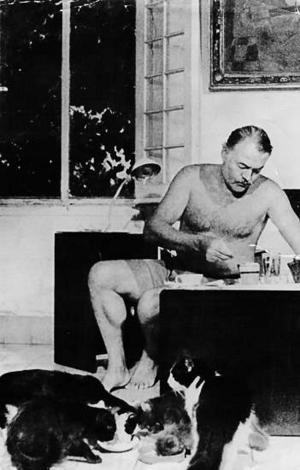
Topless Hemingway, Part VII

Liam Neeson, Improv Comic

Finally got around to seeing the first ep of Life’s Too Short the other night; funny, but not Extras funny—Warwick Davis is great though (I should mention that Willow was one of my favorite movies as a youth).

“Of the Foure Elementes Where They Shoulde Sone Be Founde” (A Tale from The Old-English Jest Book)

A tale of the four elements from The Old-English Jest Book, a volume supposedly owned and used by William Shakespeare:

In the old world when all thyng could speke, the iiii elementys mette to geder for many thynges whych they had to do, because they must meddell alway one wyth a nother, and had communicacion to gyder of dyuers maters; and by cause they coulde not conclude all theyr maters at that season, they appoyntyd to breke communicacion for that tyme and to mete agayne another tyme. Therfore eche one of them shewed to other where theyr most abydyng was and where theyr felows shoulde fynde them, yf nede shuld requyre; and fyrste the erthe sayde: bretherne, ye knowe well as for me I am permanent alway and not remouable; therfore ye may be sure to haue me alway whan ye lyste. The wather sayde: yf ye lyst to seke me, ye shall be sure to haue me under a toft of grene rushes or elles in a womans eye. The wynde sayde: yf ye lyst to speke wyth me, ye shall be sure to haue me among aspyn leuys or els in a womans tong. Then quod the fyre: yf any of you lyst to seke me, ye shall euer be sure to fynd me in a flynt stone er elles in a womans harte.

By thys tale ye may lerne as well the properte of the iiii elementys as the properteis of a woman.

All of David Markson’s References in The Last Novel to Walt Whitman

All of David Markson’s references in The Last Novel to Walt Whiman:

I am he that aches with amorous love.            Wrote Whitman.

Walter, leave off.

Wrote D. H. Lawrence.

Walt Whitman’s claim — never in any way verified — that he had fathered at least six illegitimate children.

Gerard Manley Hopkins, on realizing that he feels a certain kinship with Whitman:

As he is a very great scoundrel this is not a very pleasant confession.

A writer of something occasionally like English — and a man of something occasionally like genius.

Swinburne called Whitman.

Future generations will regard Bob Dylan with the awe reserved for Blake, Whitman, Picasso and the like.

Said an otherwise seemingly rational writer named Jonathan Lethem.

Before the Euro, the portrait of Yeats on Ireland’s twenty-pound note.

America’s Whitman twenty-dollar bill, when?

The Melville ten?

Twenty-five years after his death, Poe’s remains were disinterred from what had been little better than a pauper’s grave and reburied more formally.

Walt Whitman, who made the journey from Camden to Baltimore in spite of being disabled from a recent stroke, was the only literary figure to appear at the ceremonies.

Salvador Dali & Amanda Lear (French TV,1967)

I Review House of Holes, Nicholson Baker’s Ovidian Raunchfest

In his Paris Review interviewNicholson Baker says that “one of the questions House of Holes is trying to answer” is: is “there still a point to writing words about sex when you can see anything you want, and a lot of things you don’t want to see, on the Web?” The book answers a goofy, gooey, bright-hearted “yes” to this question, unfolding its pornographic vignettes in a surreal Ovidian holiday, a midsummer’s night sexfest that sails lusty and smiling over the borders of morality, social convention, and plain old biology. Baker creates an organic, oozing world where genitalia is swapped freely between lovers, where one might exchange an arm for a bigger dick, where old tattoos get fucked away, where a woman and a tree can make sweet, sweet love:

She looked out from her high-splayed vantage and she said, “I’m a treefucking woman!” Dappled sunlight shone and emptied itself onto her. She squeezed her Kegeling love muscle around the smooth, thickened branch within, and when the wind came up again all the leaves twittered and shook. The tree itself shuddered: It was having some kind of orgasm.

If it seems like I’m getting ahead of myself, citing text before outlining plot, I assure you I’m not: There really isn’t much of a plot to House of Holes. Well, if there is one, it’s something like this: Lila, a large-breasted madame runs The House of Holes, an equal-opportunity brothel/fantasy factory that can only be accessed through portals that appear in strange spaces. This pornographic Arcadia operates on slippery wet-dream logic in which strangers cheerfully and eagerly engage in all sorts of raunch. Characters of varying physical attributes screw their way through a surreal holiday. There are a few conflicts, most of which are too light to touch on (this is a light book, for sure).

Two conflicts stand out with some (slight) weight though:

First, there’s the Pornmonster, “a personification of polymorphousness unlike anything the world of human suck-fuckery has ever known.” The Pornmonster is the mutant offspring of all the bad porn slurry collected on a pornsucking mission (don’t ask). The Pornmonster is typical of Baker’s tone throughout House of Holes, and its polymorphousness embodies the book’s depictions of sexual metamorphoses. This monster is tamed through playful, loving lust, and becomes a good guy, its raw sexual energy redirected for the forces of good (i.e., good sex). This is a book full of good guys.

Second, there’s the Pearloiner, an embittered, sexually-jealous TSA agent who steals clitorises (two of our heroines are afflicted by this heinous crime). The Pearloiner is a product of post-Homeland Security draconian measures, and her inclusion is about as close to contemporary culture criticism that House of Holes approaches. Sexy fun times interest Baker more.

Like the Pornmonster, the Pearloiner finds herself redeemed at the end of the book; moral shifts of allegiance are as easy as physical transformations in House of Holes. The Pearloiner and the Pornmonster alike atone their sins with a facile simplicity that fits the ludic silliness of Baker’s book. They are invited to participate in the handjob contest that (quite literally) climaxes the book. It’s an easy, orgasmic end to an easy, orgasmic book.

In some ways, House of Holes is more remarkable for what it’s not. Most of the so-called pornographic literature (or literature of pornography, if you prefer) that I’ve read has a darker streak. (I’m thinking of Anaïs Nin, Henry Miller, de Sade,The Story of O, Alan Moore’s The Lost Girls, etc.). Holes shares Willliam Burroughs’s sense of surreal transmogrification and picaresque rambling and J.G. Ballard’s infatuation with the bizarre intersections of sex and technology, but it’s never sinister or cruel, or honestly, even disturbing.

House of Holes is a fundamentally good-natured book,” suggests Baker in his Paris Review interview, also pointing out that it’s a work of “crazy joy”—and he’s absolutely right: The book is joyous, good-natured, affable even. When Baker approaches a remotely Sadean cuckold fantasy he punctures it with a politeness that’s humorous—but he also dramatically lowers any stakes that may have been in play. In short, this is a novel of pure fun, of infinite gain and no loss (quite literally—Lose an arm? Get it back. Lose a clit? Get it back). Holes is silky and slippery and light, more ephemeral than ethereal in the end.

But shame on me. I seem to be faulting the book for not doing something it never sets out to do (namely, I seem to be faulting Holes for a lack of depravity and depth and darkness, three “d’s” the book’s rubric never sets out to register). It’s pure fantasy stuff, reminiscent of the partner-swapping exercise A Midsummer Night’s Dream (I am not saying Baker is Shakespeare) or the erotic shifts in Metamorphoses (ditto: Baker is no Ovid) or the voluptuous Victorian serial The Pearl: dreamy, and perhaps (small r) romantic, but not turbulent—sure, Holes will ruffle unwitting feathers (let’s be clear, it’s pointedly sexually graphic), but it’s unlikely to damage anyone’s soul. (If you’re worried about soul-damage, check out the editorial style-sheet for Holes, which lays out Baker’s invented porn-lexicon).

Is House of Holes a novel or a flimsy pornographic riff? Baker is less interested in ideas than he is in sensations, or rather representations of sensations (which is the most literature can do anyway, I suppose). Holes is unwilling to offer any answers or explications about the deep mysteries behind human desire, but it does pose questions about those desires, and it poses those questions with shameless glee. A fun, breezy read.

“We Kind of Dipped Our Toes into Murder” — Pineapple Express Diner Scene (NSFW)

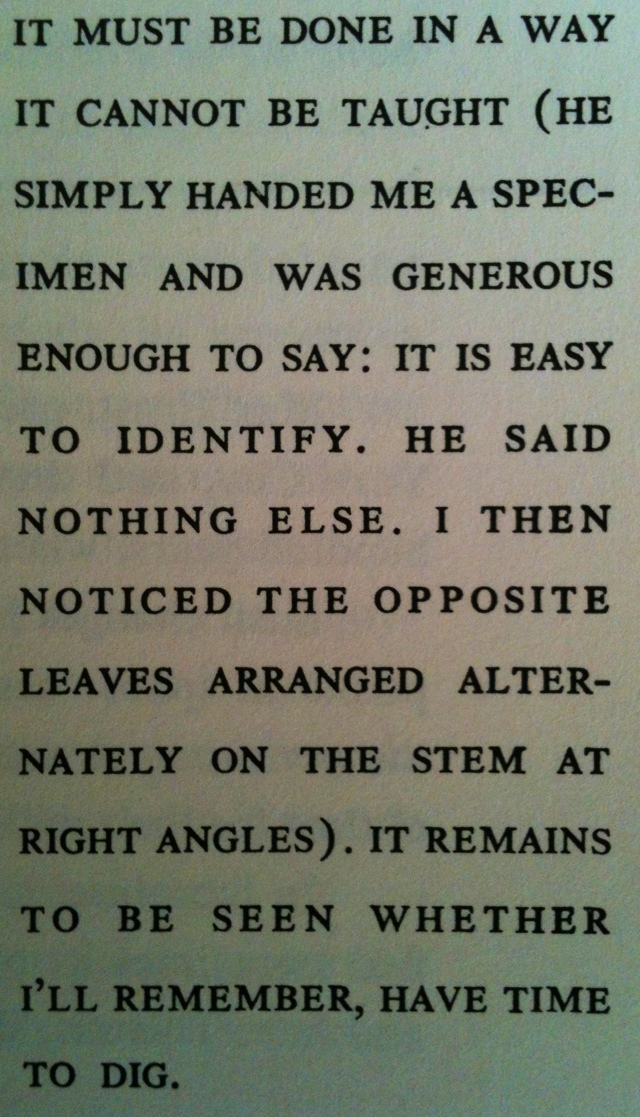
“It Must Be Done in a Way It Cannot Be Taught” — John Cage

20120228-173108.jpg

(From John Cage’s A Year from Monday).

Michel Houellebecq: “I Still Haven’t Made Up My Mind Whether Sex Is Good or Not”

Michel Houellebecq talks sex, frustration, and prostitution in his 2010 Paris Review interview:

INTERVIEWER

Of course, it was the numerous sex scenes that got you a lot of attention in the media.

HOUELLEBECQ

I’m not sure that there are such an unusual number of sex scenes in my novel.
I don’t think that’s what was shocking. What shocked people was that I
depicted sexual failure. I wrote about sexuality in a nonglorifying way. Most of all I described a basic reality: a person filled with sexual desire who can’t satisfy it. That’s what people don’t like to hear about. Sex is supposed to be positive. Showing frustrated sexual desire is obscene. But it’s also the truth. The real question is, Who is allowed to have sex? I don’t understand, for example, how teachers survive with all these alarming young girls. When women become sexual tourists, that is even more hidden, shameful, and taboo than when men do it. Just as, when a woman professor puts her hand on a student’s thigh, it’s even worse, even more unspeakable.

INTERVIEWER

A constant refrain in your novels is that sex and money are the dominant values of this world.

HOUELLEBECQ

It’s strange, I’m fifty years old and I still haven’t made up my mind whether sex is good or not. I have my doubts about money too. So it’s odd that I’m considered an ideological writer. It seems to me that I am mostly exposing my doubts. I do have certain convictions. For example, the fact that you can pay a girl, that I think is a good thing. Undeniably. An immense sign of progress.

INTERVIEWER

You mean prostitutes?

HOUELLEBECQ

Yes. I’m all for prostitution.

INTERVIEWER

Why?

HOUELLEBECQ

Because everybody wins. It doesn’t interest me personally, but I think it’s a good thing. A lot of British and Americans pay for it. They’re happy. The girls are happy. They make a lot of money.

INTERVIEWER

How do you know that the girls are happy?

HOUELLEBECQ

I talk to them. It’s very difficult because they don’t really speak English, but I talk to them.

INTERVIEWER

What about the more commonly held idea that these women are victims who are forced into these circumstances?

HOUELLEBECQ

It’s not true. Not in Thailand. It’s just stupid to have objections about it.

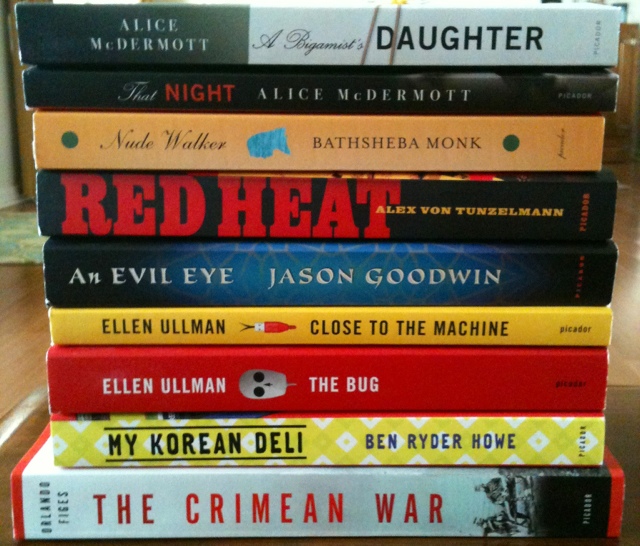
Books Acquired, 2.16.2012 — Or, Here’s What’s New from Picador This Month

20120228-173327.jpg

The kind folks at Picador sent a nice box of titles to Biblioklept World Headquarters a few weeks ago; I’ve had enough time to mull over them a bit and do something of a write-up. Here goes.

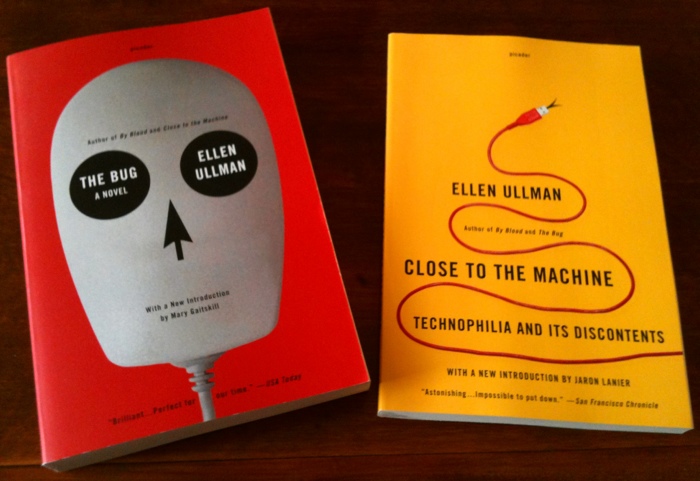
Next month, coinciding with her new novel By Blood (from FS&G), Picador re-releases (in new editions) two from Ellen Ullman:Close to the Machine and The Bug, which features a new introduction by Mary Gaitskill. Machine is a sort-of-memoir about the dawn of the tech-era; Ullman recounts her experiences as a female software engineer finding a place in the boys’ club of programming. Love these covers:

20120228-173409.jpg

The Bug, a novel is tech without the noir, cyber without the punk—something different and fresh. It reminds me of Douglas Coupland’s Microserfs only because I can’t think of what else to compare it to. Pub’s write-up:

Ellen Ullman is a “rarity, a computer programmer with a poet’s feeling for language” (Laura Miller, Salon). The Bug breaks new ground in literary fiction, offering us a deep look into the internal lives of people in the technical world. Set in a start-up company in 1984, this highly acclaimed first novel explores what happens when a baffling software flaw—a bug so teasing it is named “the Jester”—threatens the survival of the humans beings who created it.

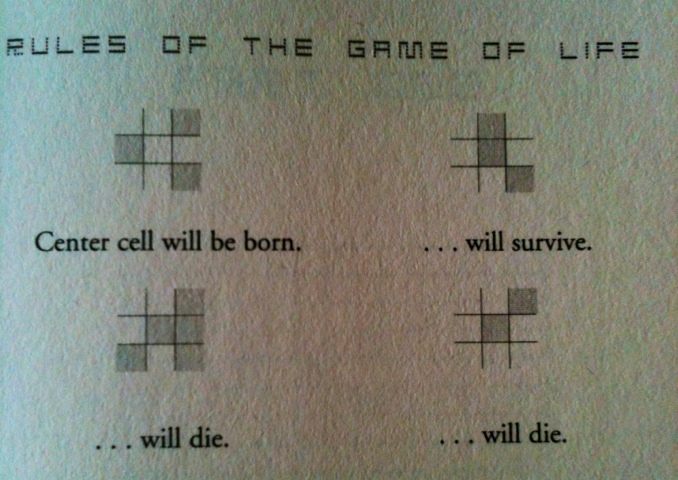
The Bug features a playfulness of the page, a willingness to examine the intersection of code and poetry. Example:

20120228-173416.jpg

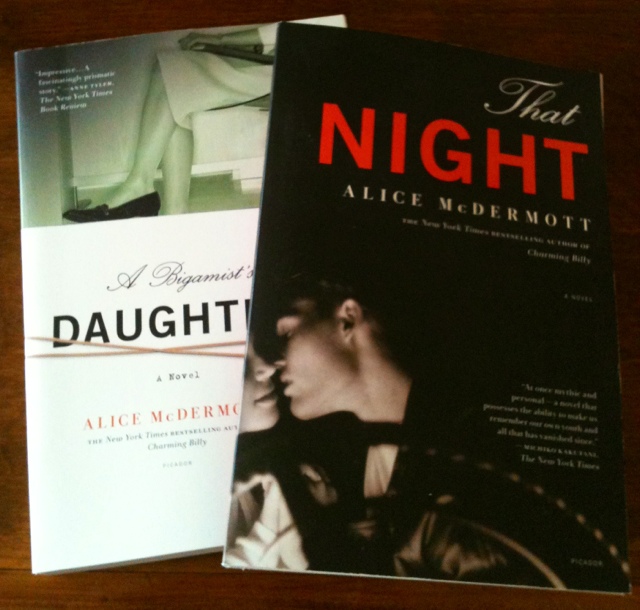
Alice McDermott also gets reissues: A Bigamist’s Daughter and That Night, which my wife picked up. That Night was a finalist for the Pulitzer and the National Book Award. It seems a little sexy and dangerous. Again, pub’s blurb:

It is high summer, the early 1960s. Sheryl and Rick, two Long Island teenagers, share an intense, all-consuming love. But Sheryl’s widowed mother steps between them, and one moonlit night Rick and a gang of hoodlums descend upon her quiet neighborhood. That night, driven by Rick’s determination to reclaim Sheryl, the young men provoke a violent confrontation, and as fathers step forward to protect their turf, notions of innocence belonging to both sides of the brawl are fractured forever. Alice McDermott’s That Night is “a moving and captivating novel, both celebration and elegy…a rare and memorable work” (The Cleveland Plain Dealer).

20120228-173424.jpg

Two history books in the package: Orlando Figes’s The Crimean War and Red Heat by Alex von Tunzelmann.

20120228-173435.jpg

Here’s an excerpt from the Figes book (which is, uh, about the Crimean War):

Two world wars have obscured the huge scale and enormous human cost of the Crimean War. Today it seems to us a relatively minor war; it is almost forgotten, like the plaques and gravestones in those churchyards. Even in the countries that took part in it (Russia, Britain, France, Piedmont-Sardinia in Italy and the Ottoman Empire, including those territories that would later make up Romania and Bulgaria) there are not many people today who could say what the Crimean War was all about. But for our ancestors before the First World War the Crimea was the major conflict of the nineteenth century, the most important war of their lifetimes, just as the world wars of the twentieth century are the dominant historical landmarks of our lives.

Red Heat is not the novelization of the 1988 Schwarzenegger buddy-cop film (nor, sadly, a novelization of the 1985 Linda Blair women-in-prison film of the same name). Von Tunzelmann’s book examines the relationship between the island nations to the U.S.’s immediate south to America and Russia. Like I said, no Schwarzenegger, but plenty of strong men. From Jad Adam’s review in The Guardian:

Red Heat deftly juggles the stories of three countries – Cuba, Haiti and the Dominican Republic – and their relationship with the superpowers, where things were not as they seemed. Von Tunzelmann asserts that the political labels of the region were a sham: “democracy” was dictatorship; leaders veered to the rhetoric of the right or left according to advantage; a communist was anyone, however rightwing or nationalistic, whom the ruling regime wanted tarnished in the eyes of the US

“This Ain’t No Picnic” — The Minutemen

Beatrice Addressing Dante — William Blake

Watch The Simpsons Game of Thrones Couch Gag

“I Lost My One True Love” — Bob Dylan Riff (1966)

Bob Dylan gets extra-rambly in a 1966 interview with Playboy. I like to read the following riff as a surreal story-poem. If you want more context, the interviewer asks Dylan as a preamble to the ramble: “Mistake or not, what made you decide to go the rock-‘n’-roll route?”:

Carelessness. I lost my one true love. I started drinking. The first thing I know, I’m in a card game. Then I’m in a crap game. I wake up in a pool hall. Then this big Mexican lady drags me off the table, takes me to Philadelphia. She leaves me alone in her house, and it burns down. I wind up in Phoenix. I get a job as a Chinaman. I start working in a dime store, and move in with a 13-year-old girl. Then this big Mexican lady from Philadelphia comes in and burns the house down. I go down to Dallas. I get a job as a “before” in a Charles Atlas “before and after” ad. I move in with a delivery boy who can cook fantastic chili and hot dogs. Then this 13-year-old girl from Phoenix comes and burns the house down. The delivery boy – he ain’t so mild: He gives her the knife, and the next thing I know I’m in Omaha. It’s so cold there, by this time I’m robbing my own bicycles and frying my own fish. I stumble onto some luck and get a job as a carburetor out at the hot-rod races every Thursday night. I move in with a high school teacher who also does a little plumbing on the side, who ain’t much to look at, but who’s built a special kind of refrigerator that can turn newspaper into lettuce. Everything’s going good until that delivery boy shows up and tries to knife me. Needless to say, he burned the house down, and I hit the road. The first guy that picked me up asked me if I wanted to be a star. What could I say?

Topless Hemingway, Part VI

Book Shelves #10, 3.04.2012

20120304-125356.jpg

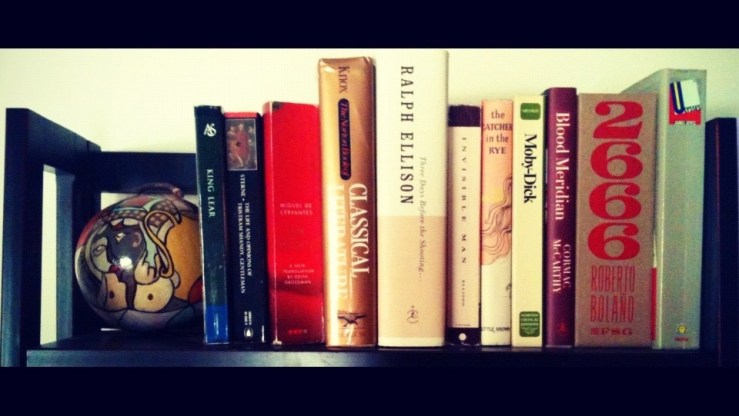
Book shelves series #10, tenth Sunday of 2012. I’m very ill today. These are some books; I own multiple copies of some of these. A painted gourd stands in as a book end. Look, I’m really ill today, these are books, I think you get the idea.