St. Jerome in His Study — Jan van Eyck

Hot Dog Wrestling in Florida — Gordon Carlisle

(Via/more hot dog art).

Super Golden Friends

Philosophy and Grammar — Gentile da Fabriano

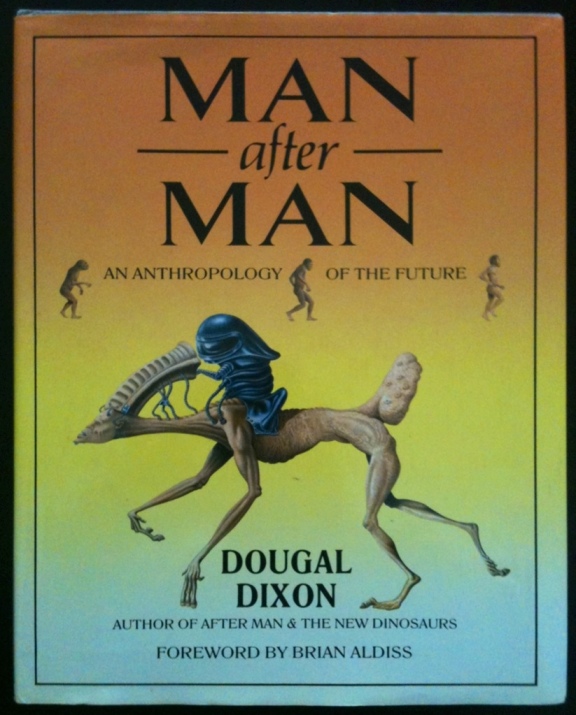
Dougal Dixon’s Man After Man (Book Acquired 6.30.2012)

20120710-095416.jpg

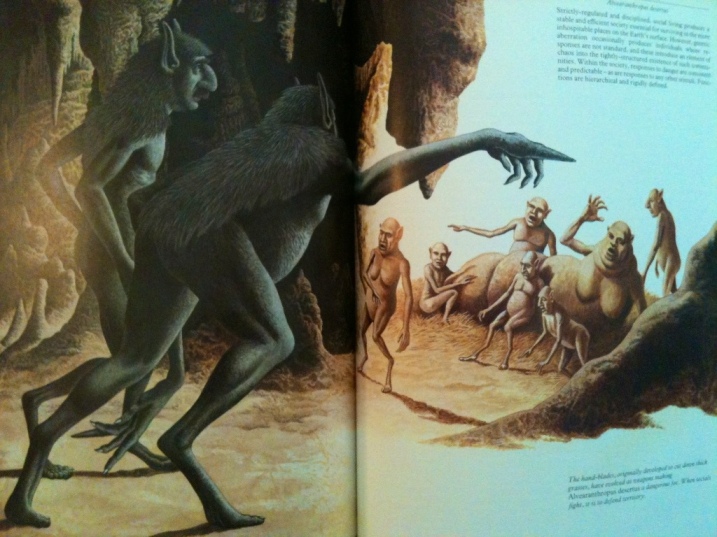
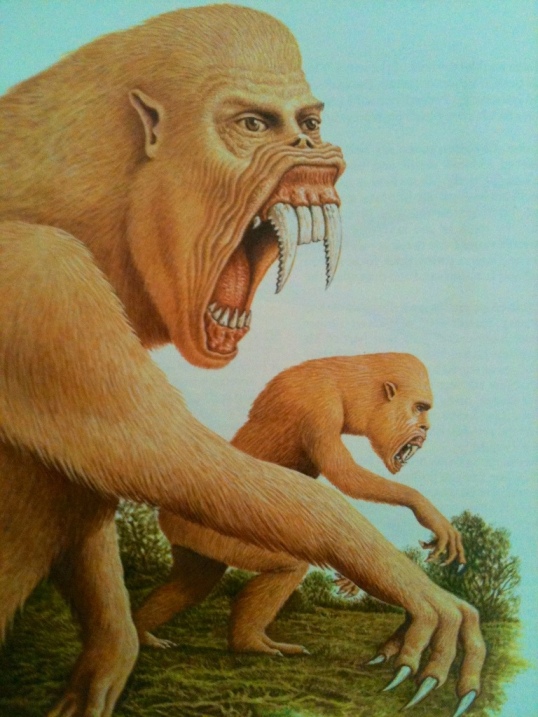
I found a first edition hardback copy of Dougal Dixon’s cult book Man After Man not quite two weeks ago when I was browsing books for my cousins’ kids, who I would see over the July 4th holiday. I’ve possessed an illicit digital copy of Man After Man for a few years, but it’s not nearly as fun as the real thing. As its subtitle attests, Dixon’s book is an anthropology of the future, a sort of speculative sci-fi textbook that imagines a future-history of genetically engineered humanity. The illustrations by Philip Hood (who deserves bigger billing) are especially weird and wonderful. Some samples below.

20120710-094738.jpg

20120710-094752.jpg

20120710-094800.jpg

20120710-094806.jpg

Nilsson Plays “Without Her” and “If Only I Could Touch Your Hand” on the Forgettable Late Sixties Show The Ghost and Mrs. Muir

(And for those compelled to watch the entire episode . . .)

St. Jerome — Lucas Cranach the Elder

Rhinoceros in Venice — Pietro Longhi

“Have I ever mentioned that Michelangelo practically never took a bath in his life, by the way?” — A Riff from David Markson’s Wittgenstein’s Mistress

A riff on Michelangelo from David Markson’s novel Wittgenstein’s Mistress (the ellipses indicate my edit, not Markson’s):

Have I ever mentioned that Michelangelo practically never took a bath in his life, by the way?

And even wore his boots to bed?

On my honor, it is a well known item in the history of art that Michelangelo was not somebody one would particularly wish to sit too close to.

Which on second thought could very well change one’s view as to why all of those Medici kept telling him don’t bother to get up, as a matter of fact.

. . .

I have just wrapped my head into a towel.

Having gone out for some greens, for a wet salad, this would be because of.

And in the meantime the more I have thought about it, the more sorry I have gotten about what I said.

I mean about Michelangelo, not about Herodotus.

Certainly I would have found it more than agreeable to shake Michelangelo’s hand, no matter how the pope or Louis Pasteur might have felt about this.

In fact I would have been excited just to see the hand that had taken away superfluous material in the way that Michelangelo had taken it away.

Actually, I would have been pleased to tell Michelangelo how fond I am of his sentence that I once underlined, too.

Perhaps I have not mentioned having once underlined a sentence by Michelangelo.

I once underlined a sentence by Michelangelo.

This was a sentence that Michelangelo once wrote in a letter, when he had lived almost seventy-five years.

You will say that I am old and mad, was what Michelangelo wrote, but I answer that there is no better way of being sane and free from anxiety than by being mad.

On my honor, Michelangelo once wrote that.

As a matter of fact I am next to positive I would have liked Michelangelo.

St. Jerome and the Lion — Rogier van der Weyden

“The Belly of the Whale” — Joseph Campbell

“The Belly of the Whale,” an early chapter of Joseph Campbell’s seminal work The Hero With a Thousand Faces:

The idea that the passage of the magical threshold is a transit into a sphere of rebirth is symbolized in the worldwide womb image of the belly of the whale. The hero, instead of conquering or conciliating the power of the threshold, is swallowed into the unknown, and would appear to have died.

Mishe-Nahma, King of Fishes,

In his wrath he darted upward,

Flashing leaped into the sunshine,

Opened his great jaws and swallowed

Both canoe and Hiawatha.

The Eskimo of Bering Strait tell of the trickster-hero Raven, how, one day, as he sat drying his clothes on a beach, he observed a whale-cow swimming gravely close to shore. He called: “Next time you come up for air, dear, open your mouth and shut your eyes.” Then he slipped quickly into his raven clothes, pulled on his raven mask, gathered his fire sticks under his arm, and flew out over the water. The whale came up. She did as she had been told. Raven darted through the open jaws and straight into her gullet. The shocked whale-cow snapped and sounded; Raven stood inside and looked around.

The Zulus have a story of two children and their mother swallowed by an elephant. When the woman reached the animal’s stomach, “she saw large forests and great rivers, and many high lands; on one side there were many rocks; and there were many people who had built their village there; and many dogs and many cattle; all was there inside the elephant.”

The Irish hero, Finn MacCool, was swallowed by a monster of indefinite form, of the type known to the Celtic world as a peist. The little German girl, Red Ridinghood, was swallowed by a wolf. The Polynesian favorite, Maui, was swallowed by his great-great-grandmother, Hine-nui-te-po. And the whole Greek  pantheon, with the sole exception of Zeus, was swallowed by its father, Kronos. The Greek hero Herakles, pausing at Troy on his way homeward with the belt of the queen of the Amazons, found that the city was being harassed by a monster sent against it by the sea-god Poseidon. The beast would come ashore and devour people as they moved about on the plain. Beautiful Hesione, the daughter of the king, had just been bound by her father to the sea rocks as a propitiatory sacrifice, and the great visiting hero agreed to rescue her for a price. The monster, in due time, broke to the surface of the water and opened its enormous maw. Herakles took a dive into the throat, cut his way out through the belly, and left the monster dead.

This popular motif gives emphasis to the lesson that the passage of the threshold is a form oE self-annihilation. Its resemblance to the adventure of the Symplegades is obvious. But here, instead of passing outward, beyond the confines of the visible world, the hero goes inward, to be born again. The disappearance corresponds to the passing of a worshiper into a temple—where he is to be quickened by the recollection of who and what he is, namely dust and ashes unless immortal. The temple interior, the belly of the whale, and the heavenly land beyond, above, and below the confines of the world, are one and the same. That is why the approaches and entrances to temples are flanked and defended by colossal gargoyles: dragons, lions, devil-slayers with drawn swords, resentful dwarfs, winged bulls. These are the threshold guardians to ward away all incapable of encountering the higher silences within. They are preliminary embodiments of the dangerous aspect of the presence, corresponding to the mythological ogres that bound the conventional world, or to the two rows of teeth of the whale. They illustrate the fact that the devotee at the moment of entry into a temple undergoes a metamorphosis. His secular character remains without; he sheds it, as a snake its slough. Once inside he may be said to have died to time and returned to the World Womb, the World Navel, the Earthly Paradise. The mere fact that anyone can physically walk past the temple guardians does not invalidate their significance; for if the intruder is incapable of encompassing the sanctuary, then he has effectually remained without. Anyone unable to understand a god sees it as a devil and is thus defended from the approach. Allegorically, then, the passage into a temple and the hero-dive through the jaws of the whale are identical adventures, both denoting, in picture language, the life-centering, life-renewing act.

“No creature,” writes Ananda Coomaraswamy, “can attain a higher grade of nature without ceasing to exist.” Indeed, the physical body of the hero may be actually slain, dismembered, and scattered over the land or sea—as in the Egyptian myth of the savior Osiris: he was thrown into a sarcophagus and committed to the Nile by his brother Set, and when he returned from the dead his brother slew him again, tore the body into fourteen pieces, and scattered these over the land. The Twin Heroes of the Navaho had to pass not only the clashing rocks, but also the reeds that cut the traveler to pieces, the cane cactuses that tear him to pieces, and the boiling sands that overwhelm him. The hero whose attachment to ego is already annihilate passes back and forth across the horizons of the world, in and out of the dragon, as readily as a king through all the rooms of his house. And therein lies his power to save; for his passing and returning demonstrate that through all the contraries of phenomenality the Un-create-Imperishable remains, and there is nothing to fear.

And so it is that, throughout the world, men whose function it has been to make visible on earth the life-fructifying mystery of the slaying of the dragon have enacted upon their own bodies the great symbolic act, scattering their flesh, like the body of Osiris, for the renovation of the world. In Phrygia, for example, in honor of the crucified and resurrected savior Attis, a pine tree was cut on the twenty-second of March, and brought into the sanctuary of the mother-goddess, Cybele. There it was swathed like a corpse with woolen bands and decked with wreaths of violets. The effigy of a young man was tied to the middle of the stem. Next day took place a ceremonial lament and blowing of trumpets. The twenty-fourth of March was known as the Day of Blood: the high priest drew blood from his arms, which he presented as an offering; the lesser clergy whirled in a dervish-dance, to the sound of drums, horns, flutes, and cymbals, until, rapt in ecstasy, they gashed their bodies with knives to bespatter the altar and tree with their blood; and the novices, in imitation of the god whose death and resurrection they were celebrating, castrated themselves and swooned.

And in the same spirit, the king of the south Indian province of Quilacare, at the completion of the twelfth year of his reign, on a day of solemn festival, had a wooden scaffolding constructed, and spread over with hangings of silk. When he had ritually bathed in a tank, with great ceremonies and to the sound of music, he then came to the temple, where he did worship before the divinity. Thereafter, he mounted the scaffolding and, before the people, took some very sharp knives and began to cut off his own nose, and then his ears, and his lips, and all his members, and as much of his flesh as he was able. He threw it away and round about, until so much of his blood was spilled that he began to faint, whereupon he summarily cut his throat.
Book Shelves #28, 7.08.2012

20120708-143303.jpg

Book shelves series #28, twenty-eighth Sunday of 2012

Last month, or maybe the month before last, I forget, an anonymous reader accused me of not putting as much into these posts as I used to, which may or may not be true.

But I’m exhausted today—I’ve been out of town for the past week, enjoying a beach vacation with family and friends &c., and yeah, I’m fragged. Got home late late last night, had to clean up, mow the lawn, all that snazz. (The blog has been on autopilot but I’ll try to write up some original content for next week—maybe a review of Moonrise Kingdom. We’ll see).

Anyway, this Sunday finds us in a new room, the converted garage of my 1956 ranch-style home, a room we use as a family room. I’ll look at each shelf pictured above individually and remark on a few books (there’s some good stuff in there), but I’m just too tired. Sorry the pic is so blurry. Feel free to send me a newer iPhone.

There are two book cases below these shelves, and on top of one of these, under a large framed picture of my children that obscures them, are these ratty volumes:

20120708-143311.jpg

The Barth books are a throwback to my early college days, when I simply bought the cheapest volume; I don’t buy mass market paperbacks anymore (okay, maybe rarely). The Shakespeare books are too tall to fit on a shelf full of Shakespeare stuff, although there are a few shelves of Shakespeare stuff in the room. Actually, I’m not really sure why these books are here at all. It’s likely that I hid them behind the aforementioned large framed picture one day while cleaning up and never reshelved. Not a pretty shelf.

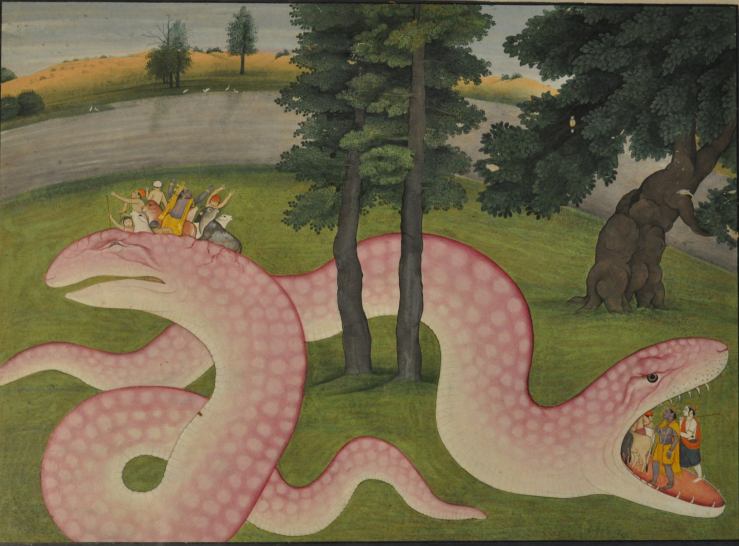
Krishna Slays Aghasura

Marcel Duchamp Interview (Segment from The Shock of the New, 1980 BBC Documentary)

St. Jerome in His Study — Antonello da Messina

The Summer — Paul Delvaux

John Steinbeck on Work Habits

Mark Twain used to write in bed—so did our greatest poet. But I wonder how often they wrote in bed—or whether they did it twice and the story took hold. Such things happen. Also I would like to know what things they wrote in bed and what things they wrote sitting up. All of this has to do with comfort in writing and what its value is. I should think that a comfortable body would let the mind go freely to its gathering.

You know I always smoke a pipe when I work—at least I used to and now I have taken it up again. It is strange—as soon as a pipe begins to taste good, cigarettes become tasteless. I find I smoke fewer and fewer cigarettes. Maybe I can cut them out entirely for a while. This would be a very good thing. Even with this little change, my deep-seated and perennial cigarette cough is going away. A few months without that would be a real relief.

I have dawdled away a good part of my free time now carving vaguely on a scrap of mahogany, but I guess I have been thinking too. Who knows. I sit here in a kind of a stupor and call it thought.

Now I have taken the black off my desk again, clear down to the wood, and have put a green blotter down. I am never satisfied with my writing surface.

My choice of pencils lies between the black Calculator stolen from Fox Films and this Mongol 2 3/8 F which is quite black and holds its point well—much better in fact than the Fox pencils. I will get six more or maybe four more dozen of them for my pencil tray.

I have found a new kind of pencil—the best I have ever had. Of course it costs three times as much too but it is black and soft but doesn’t break off. I think I will always use these. They are called Blackwings and they really glide over the paper.

In the very early dawn, I felt a fiendish desire to take my electric pencil sharpener apart. It has not been working very well and besides I have always wanted to look at the inside of it. So I did and found that certain misadjustments had been made at the factory. I corrected them, cleaned the machine, oiled it and now it works perfectly for the first time since I have it. There is one reward for not sleeping.

Today is a dawdly day. They seem to alternate. I do a whole of a day’s work and then the next day, flushed with triumph, I dawdle. That’s today. The crazy thing is that I get about the same number of words down either way. This morning I am clutching the pencil very tight and this is not a good thing. It means I am not relaxed. And in this book I want to be just as relaxed as possible. Maybe that is another reason I am dawdling. I want that calmness to settle on me that feels so good—almost like a robe of cashmere it feels.

It has been a good day of work with no harm in it. I have sat long over the desk and the pencil has felt good in my hand. Outside the sun is very bright and warm and the buds are swelling to a popping size. I guess it is a good thing I became a writer. Perhaps I am too lazy for anything else.

On the third finger of my right hand I have a great callus just from using a pencil for so many hours every day. It has become a big lump by now and it doesn’t ever go away. Sometimes it is very rough and other times, as today, it is as shiny as glass. It is peculiar how touchy one can become about little things. Pencils must be round. A hexagonal pencil cuts my fingers after a long day. You see I hold a pencil for about six hours every day. This may seem strange but it is true. I am really a conditioned animal with a conditioned hand.

I am really dawdling today when what I want to write is in my head. It is said that many writers talk their books out and so do not write them. I think I am guilty of this to a large extent. I really talk too much about my work and to anyone who will listen. If I would limit my talk to inventions and keep my big mouth shut about work, there would probably be a good deal more work done.

The callus on my writing finger is very sore today. I may have to sandpaper it down. It is getting too big.

The silly truth is that I can take almost any amount of work but I have little tolerance for confusion.

From John Steinbeck’s 1969 interview in The Paris Review.