New in Trade Paperback from Picador (Books Acquired Some Time Last Month)

20120923-131033.jpg

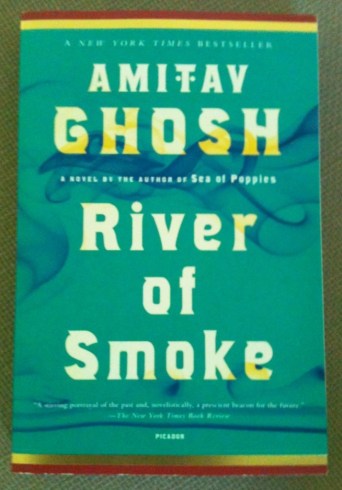
Amitav Ghosh’s River of Smoke is the second entry in a proposed trilogy about the opium trade. (The first was 2008’s Sea of Poppies). Here’s Picador’s blurb:

In Amitav Ghosh’s Sea of Poppies, the Ibis began its treacherous journey across the Indian Ocean, bound for the cane fields of Mauritius with a cargo of indentured servants. Now, in River of Smoke, the former slave ship flounders in the Bay of Bengal, caught in the midst of a deadly cyclone.  The storm also threatens the clipper ship Anahita, groaning with the largest consignment of opium ever to leave India for Canton. Meanwhile, the Redruth, a nursery ship, carries horticulturists determined to track down the priceless botanical treasures of China. All will converge in Canton’s Fanqui-town, or Foreign Enclave, a powder keg awaiting a spark to ignite the Opium Wars. A spectacular adventure, but also a bold indictment of global avarice, River of Smoke is a consuming historical novel with powerful contemporary resonance.
20120923-131043.jpg

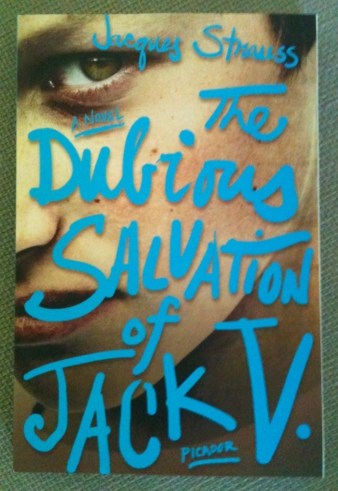
Jacques Strauss’s debut novel The Dubious Salvation of Jack V. got a good review from John Self, which is worth a read—Self does a marvelous job expressing the trepidation and wariness—and yes, prejudice—that some of us might have toward contemporary novels.

Here’s Picador’s blurb:

Above all, The Dubious Salvation of Jack V. is funny; both witty and ironic. Jack hates to be reminded that Susie “didn’t stay with us because she loved me … She stayed with us because it was her job.” The irony is that to stop her being their servant, to give her her freedom, he may end up having to do something terrible to her. Around all this cultural specificity, more general principles are touched on (“one could only conclude that humanity, rather than a ballast against the arbitrary, was … its very agent”) which feed back into the story.
20120923-131049.jpg

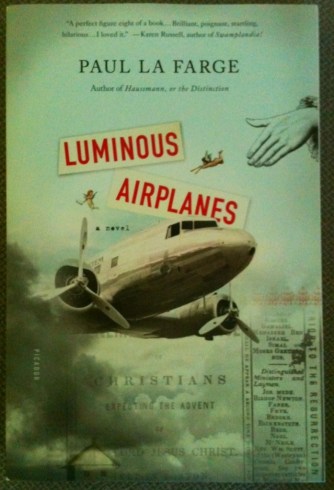
Here are the epigraphs to Paul La Farge’s novel Luminous Airplanes, via the book’s site, which is worth checking out:

We hope it will not be unconsidered, that we find no open tract, or constant manduction in this Labyrinth; but are oft-times fain to wander in the America and untravelled parts of Truth.

— Thomas Browne

Nothing odd will do long.

— Samuel Johnson

Ein schönes Protokoll. Ein nie bevor gesehenes Protokoll.

— Werner Herzog

…but the path of what happened is so brightly lit that it places everything else more deeply in shadow.

— The 9/11 Commission Report

The truth, fellow UFOlogists, is that I have known precisely what I was doing all along. It is just that very few other people knew what I was doing.

— William L. Moore

Run!

— Hal Hartley
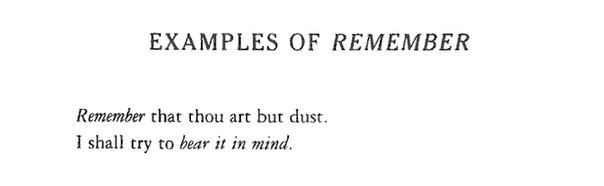
“Examples of Remember” — Lydia Davis

The Most Beloved American Writer — Norman Rockwell

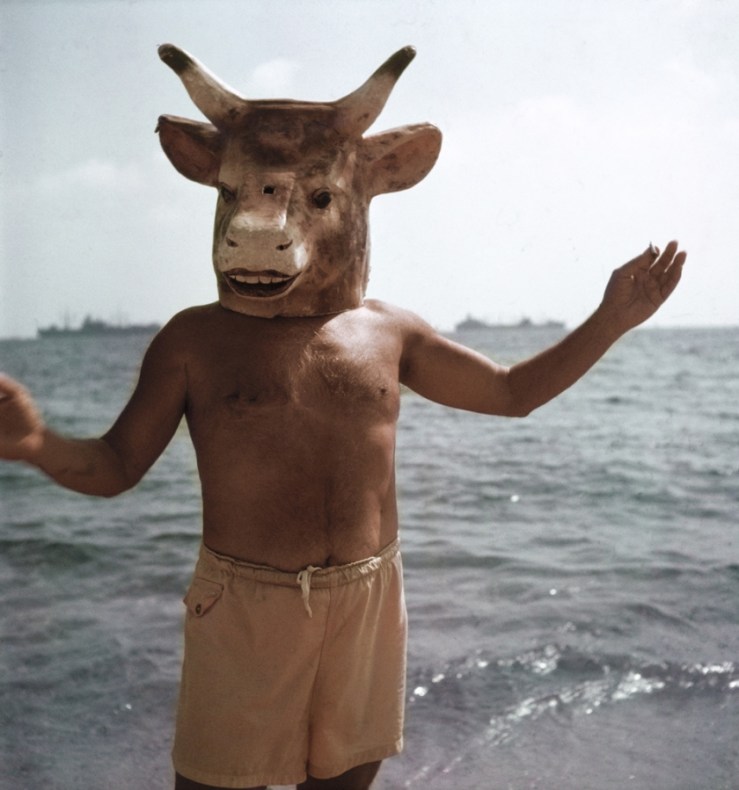
Shirtless Picasso Dons a Minotaur Mask

(About/via).

“Lobster,” a Poem by Anne Sexton


“Lobster” by Anne Sexton:

A shoe with legs,
a stone dropped from heaven,
he does his mournful work alone,
he is the old prospector for golf,
with secret dreams of God-heads and fish heads.
Until suddenly a cradle fastens round him
and his is trapped as the U.S.A. sleeps.
Somewhere far off a woman lights a cigarette;
somewhere far off a car goes over a bridge;
somewhere far off a bank is held up.
This is the world the lobster knows not of.
He is the old hunting dog of the sea
who in the morning will rise from it
and be undrowned
and they will take his perfect green body
and paint it red

(Thanks Jescie).


The sound of pommelling on a sofa in Ulysses by James Joyce

From Wye’s Dictionary of Improbably Words.

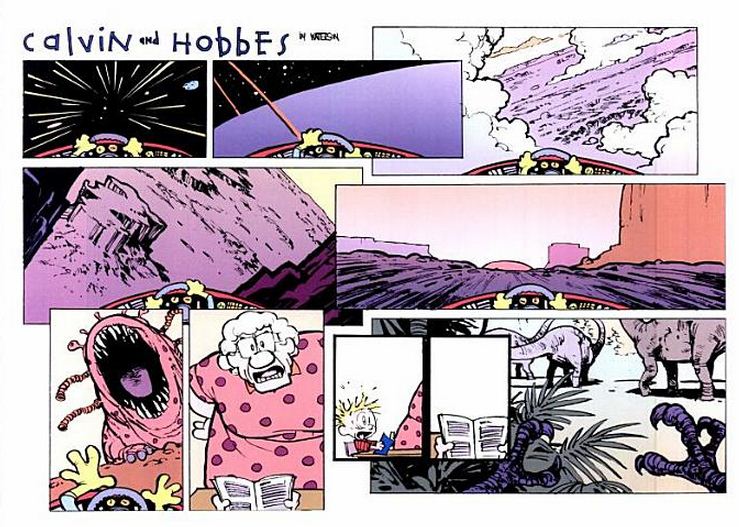
Calvin and Hobbes Comic

“Goethe probably retards the development of the German language by the force of his writing” (Kafka)


Goethe probably retards the development of the German language by the force of his writing.  Even though prose style has often traveled away from him in the interim, still, in the end, as at present, it returns to him with strengthened yearning and even adopts obsolete idioms found in Goethe but otherwise without any particular connection with him, in order to rejoice in the completeness of its unlimited dependence.

From Kafka’s Diaries.


Lizard World (Book Acquired, 9.26.2012)


20121002-170037.jpg

This one is wonderfully weird stuff. Terry Richard Bazes’s Lizard World. Here’s a blurb from Grove Press founder Barney Rosset:

Lizard World opens with Josiah Fludd, a disenchanted character from the Early Modern World, exhuming a female corpse for a customer, whose interest in the carcass is presumed by the gravedigger to be a sexual one. Fludd’s blasé attitude vanishes when, on delivery of the corpse, he watches its feet sawed off, and he learns that they are meant to replace his patron’s nether claws. From this startling introduction Terry Richard Bazes pushes us into a bizarre world that vacillates between the past and present—and is told by a writer whose imagination seems to have no bounds.

Here’s an excerpt:

I being then in my nineteenth year and little more than a beggar — intent, by hook or by crook, to become a chirurgeon and yet utterly without means to feed and clothe my body (much less to learn the merest rudiments of my profession) — it came about that at  length I did find a way both to earn my bread and pursue my studies by  undertaking to perform a service — a wholly necessary and harmless service albeit one from which my more prosperous school-mates turned away with horror and revulsion.  So it was that I got my sustenance and was suffered to sit with all the paying scholars — provided it was in the very backermost row — and watch whilst our professor  probed the deepest mysteries of a fresh cadaver.
Now just exactly how and whence these cadavers were supplied were questions my finical  colleagues dared not closely entertain, although in gross they knew the truth and shunned me like a leper. But I cared not a fart for their esteem, so long as I could learn, and the short of it was that I advanced quickly in my studies and was oft besought by my professors for a specimen and consequently was upon ever the most constant look-out for the newly dead.
For this purpose it was my practice to put on the clothes and countenance of a mourner and, thus disguised, to frequent the very meanest of country churches in the hope that there I might chance upon some humble obsequies.  If fortune smiled, and some farmer or laundress had departed this life, then I would repair under the cloak of  starlight unto the churchyard,  still in mourning attire  and carrying a fistful of daisies and a Bible, lest I be questioned of my purpose and require a ready pretext.  The great secret of the art was to work with utmost haste and efface the smallest evidence of theft. Therefore, by the light of my lantern, I studied the disposition of each rock, each wreath of flowers — and, thus informed of the state to which the grave must later be restored, now proceeded to violate the soil, but only so much as to permit my shovel to break the very head-piece of the box.  This method, once perfected, allowed me — in a trice — to draw the carcass out, conceal it in a sack, restore the injured earth, and load my stiffened burden on a waiting dung-cart.

For more excerpts, check out Bazes’s site; more to come.


“Were he my brother, why then I’d have murdered poor Werther” (Goethe)

Ask whomever you will but you’ll never find out where I’m lodging,

High society’s lords, ladies so groomed and refined.

“Tell me, was Werther authentic? Did all of that happen in real life?”

“Lotte, oh where did she live, Werther’s only true love?”

How many times have I cursed those frivolous pages that broadcast

Out among all mankind passions I felt in my youth!

Were he my brother, why then I’d have murdered poor Werther.

Yet his despondent ghost couldn’t have sought worse revenge.

That’s the way “Marlborough,” the ditty, follows the Englishman’s travels

Down to Livorno from France, thence from Livorno to Rome,

All of the way into Naples and then, should he flee on to Madras,

“Marlborough” will surely be there, “Marlborough” sung in the port.

Happily now I’ve escaped, and my mistress knows Werther and Lotte

Not a whit better than who might be this man in her bed:

That he’s a foreigner, footloose and lusty, is all she could tell you,

Who beyond mountains and snow, dwelt in a house made of wood.

From Section I of Goethe’s Erotica Romana.

Men Reading — Francisco Goya

A Lobster — Albrecht Dürer

Ralph Ellison Interview (Film, 1966)

Chris Ware on DFW’s Novel The Pale King

Crippled Robot painting by Chris Ware

Cartoonist/graphic novelist/chronicler of shame and despair Chris Ware wrote about his favorite books for Foyles bookstore. The list includes UlyssesMoby-Dick, and works by cartoonists like Lynda Barry and Ivan Brunetti. Here’s what Ware wrote about David Foster Wallace’s posthumous novel The Pale King:

The first great novel of the 21st century uses the sinister beauty of the American Tax Code as a springboard from which to launch into a genuinely serious discussion of the origins and importance of civic responsibility amidst the hazy, blurred stupidity of a country in quick decline. Contrary to many reviews, I don’t think it’s about boredom, and it’s certainly not boring. Another posthumous editor-to-manuscript resuscitation, the book hangs heavy with the clotted spectre of Wallace’s suicide, which makes the writing glow all the more painfully through it.

List with No Name #10

1. 2666, Roberto Bolaño

2. The Pale King, David Foster Wallace

3.  Train Dreams, Denis Johnson

4. The Last Novel, David Markson

5. Samuel Johnson Is Indignant, Lydia Davis

6. Agapē Agape, William Gaddis

7. C, Tom McCarthy

8. No Country for Old Men, Cormac McCarthy

9. Sandokan, Nanni Balestrini

10. Open City, Teju Cole

Book Acquired, 9.28.2012

20121002-170012.jpg

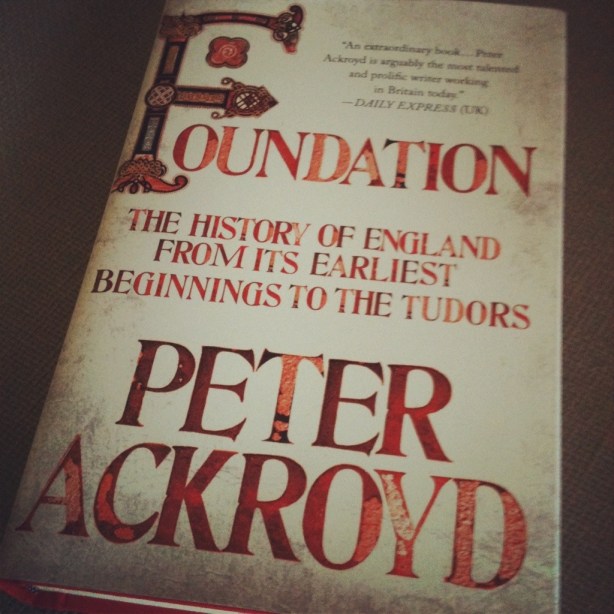
Foundation, a history of England from Peter Ackroyd. From a recent Guardian profile:

Ackroyd’s trademark insight and wit, and the glorious interconnectedness of all things, permeate each page. One thing that struck me was the realisation that history isn’t nearly as linear as we thought. Something is invented, or discovered, or philosophised, and we tend to think that that’s knowledge known from then on, but even in this single volume there are endless forgettings.

“Absolutely,” comes his fast answer, spoken, as ever, gently and with a strange mix of confidence and self-effacement. “One thing which most interested me was the fact that neglect, or our genius for forgetfulness, occurs at every level of social and political activity. The same mistakes, the same confusions, occur time and time again. It sometimes seems to me that the whole course of English history was one of accident, confusion, chance and unintended consequences – there’s no real pattern.”

What he discovered, or rediscovered, is that “what underlines that random happenstance are the deep continuities of national life that survive, uninfluenced by the surface events. In this book, I have little chapters on, say, medieval medicine, or punishment, or medieval humour, simply to convey the broad continuities that underlie this bewildering range of events. Continuities of the soil, the land, the earth.” And these help create human – English – sensibilities? “Yes. As I said in my London book, it’s a sort of territorial imperative, the landscape; the shape of the geology, almost, has a definite though not comprehended effect on human behaviour, human need. So that’s one of the things I was trying to explore I suppose.”

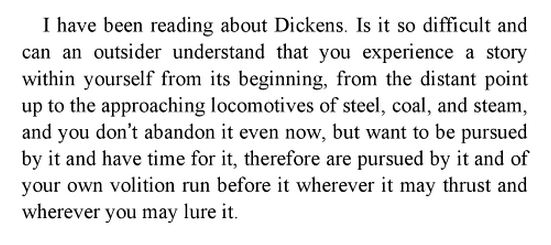
“I have been reading about Dickens” (Kafka)

(From Kafka’s Diaries).