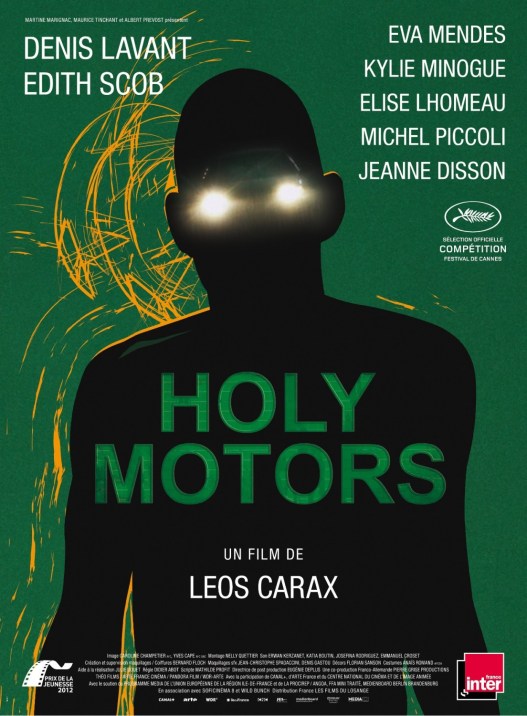
“Beauty! Beauty! Beauty!” a photographer coos as he snaps shots of supermodel Kay M in a crowded graveyard. A manic beastman interrupts the shoot, knocking down onlookers, chomping on flowers, and quickly diverting the photographer’s attention, lens, and mantra: Turning his camera on the little goatman, enthralled, he repeats, “Weird! Weird! Weird!”
For many viewers, this might be all that French director Leos Carax’s latest film Holy Motors boils down to: “Beauty! Beauty! Beauty! Weird! Weird! Weird!” (And, of course, all the unsettling space along that strange axis). However, it would be a mistake to think that Holy Motors is simply an excursion into the bizarre. The film’s initial scenes pile on absurdity after absurdity with no context (or recognizable film grammar) for audiences to latch to, but that absurdity eventually coheres into a profound essay on what it means to be actors in a life where both audience and director remain unseen to us. Ultimately, Holy Motors asks viewers to consider what it means to have agency: Are we subjects? Do we drive ourselves? Or are we driven?
Like many films that create their own idiom (or even genre), Holy Motors isn’t for everyone, but I think it rewards (or confounds) viewers who are willing to submit to its alienating grammar long enough to pick up enough of the lingo to engage in what is really a very rewarding, funny, and moving story. And, like many films that create their own idiom, Holy Motors is probably best experienced cold, with no forewarning. In that spirit, I’ll present the trailer (all that I knew of the film going in, aside from atmospheric buzz); my comments after the trailer will contain spoilers and are aimed more at those who’ve already seen the film (although everyone is welcome of course).
Most of the reviews of Holy Motors have focused on the way the film comments on filmmaking itself. In his review at AV Club, Mike D’Angelo establishes the context for HM-as-state-of-film pretty clearly:
Jean-Luc Godard famously suggested that the best way to criticize a movie is to make another movie. With Holy Motors, the year’s most electrifying whatsit, Godard’s fellow French filmmaker Leos Carax has taken that idea one delightfully absurd step further. On its surface, this absurdist ode to analog’s death at digital’s hands seems to echo a number of recent essays eager to perform the last rites on cinema, or at least on its status as our dominant dream factory. Yet Holy Motors is such a bravura, go-for-broke exploration of what movies can do—is so thrillingly, defiantly alive—that it contradicts its own mournful thesis at every turn.
I’m not going to argue that Holy Motors isn’t about films—it’s very clearly about directors, audiences, cameras, watching, and, most of all, acting. Indeed, this is the most visible, surface-level plot of Holy Motors: a man, Monsieur Oscar (a superb Denis Lavant) , is driven over the course of one day in a white limousine to a series of “appointments” where he acts out bewildering scenes in the service of god-knows-what. The opening scene of Holy Motors shows a film audience; significantly they are all asleep. Then a man awakes—it’s the director Leos Carax himself—in a hotel room that slowly shifts into a faux-forest in a dream-logic shot worthy of Lynch. The man inserts a key into the wall/forest and enters the cinema. So, yes, Holy Motors organizes itself around cinema-as-trope.
But I think Holy Motors is far more profound than a metatextual, postmodern gimmick: It’s not really a film about filmmaking (although, of course it is)—it’s really a film about spirituality in a world where people seem to be increasingly disconnected and alienated from each other. Where people are asleep, like the audience at the beginning of the film. Where people do not see.
This theme becomes evident in the first of Oscar’s appointments. When we first meet him, he appears to be an extremely wealthy businessman with a loving family. (Viewers who cling to the idea that the first Oscar we meet is the stable, true version or identity of Oscar will find themselves too confused to trace meaning from Holy Motors; this was the case with the unfortunate gentleman behind me during the screening, who, at film’s close, asked his friends Hey, why do you think he didn’t go back to his house?). Oscar is picked up by Céline, who drives him in an enormous white limousine from appointment to appointment. In his first appointment, Oscar takes on the role of a crippled crone, who says that for years all she’s seen are feet and cobblestones; her eyes downcast, she does not see the faces in the crowd she begs from, just as they, in turn, do not see her. Significantly, she wonders if she will die—but her thought is not a piece of dialogue, but perhaps Oscar’s own sentiment. We will come to see that although he can feel weary, sick, and tired, Oscar is apparently immortal
Oscar’s potent life force is on prominent display in the next two episodes. In one appointment, he plays an acrobat in a CGI studio, showing off extreme physical prowess, which soon slides into a writhing, monstrous sexuality in a scene that is simultaneously icky and sexy—a comment on modern filmmaking techniques yes, but also an illustration of creative power, fecund and wild.
These themes carry over into the next appointment, where he turns into a sewer-creeping Pan-figure, an underground spirit that recalls forest creatures from antiquity, but mythic and nightmarish. On a hilarious rampage in a Paris graveyard, he comes upon super model Kay M (Eva Mendes), who figures here as an idealized woman-as-object. The little goblin/Oscar steals her of course. The segment plays out as a series of bizarre mythic allusions, moving through (and inverting and disrupting) Beauty and the Beast (Beauty! Beauty! Beauty! Weird! Weird! Weird!) to Cinderella to Bluebeard to Sleeping Beauty to a riff on the Pietà. The imp redesigns Kay M’s outfit, fashioning it into a burqa, then disrobes to show off his proud erection. The episode condenses so much of the mythic-historic-allegorical relationships between men and women—and in particular, how narratives present (and amplify) those relationships.
Holy Motors is very much about male-female relationships, a facet of the film probably ripe for a much more detailed critique than I’m going to offer here, other than to suggest that these relationships fall squarely into the film’s rubric of subject-object relations. Suffice to say that almost all of Oscar’s appointments are with women or girls (and to boot, his most “real” relationship is with his driver Céline).
After his goatman episode, Oscar plays a cruel father picking up his daughter after a party. Juxtaposed against the absurd violence and bizarre sexuality of the preceding episode, the father-daughter scene’s simple realism unfolds with throbbing menace that’s difficult to bear. (The guy next to me walked out at this part, never to return). Up until this moment, Carax has used absurdity almost as a bludgeon—but the emotional connection between the daughter and her father/Oscar ups the ante considerably: the daughter seems to genuinely, emotionally believe that Oscar is her real father. It’s here that the structuring grammar of the film becomes more available to the audience: Is the girl just another actor? And if so, what does that say about the family we thought was Oscar’s?
We’re also given more clues to Holy Motor’s mystery when an unidentified man appear’s in Oscar’s limo. Their conversation implies that Oscar is an actor who performs these scenes for an audience he will never see; not only that, he cannot see the cameras, and he will never see the director. He is an actor completely severed from agency, let alone stable identity. He is driven from assignment to assignment, unable to step back and see the bigger picture of his work, let alone make lasting connections with other people.
Then we get a spirited entr’acte, an accordion jam led by Oscar that builds and swells into a march that reinvigorates the film into its second half. The halfway mark finds Oscar meeting his only male appointment, a gangster named Theo he must assassinate. We see immediately that Theo is yet another character played by Denis Lavant; the murder that ensues is a bizarre piece of almost vaudevillian humor, culminating in both Theo and Oscar, dressed alike, dying from matching stab wounds. One of the two men returns though, and seems, after a few minutes of replenishing rest, no worse for wear despite a life-ending wound to the jugular. Oscar’s identity is thus even more complicated—is it really Theo that returns? Or does that even matter at this point?
The film then reemphasizes Oscar’s apparent immortality; he spies a banker—the man he was when we first meet him in the film—and makes an unscheduled appointment, jumping out of the limousine to kill the man (again, played by Lavant). After this unscheduled murder he’s gunned down by the banker’s bodyguards who riddle him with bullets. (“Aim for the crotch!” one exclaims in a hilarious line that picks up on the film’s motif of male sexual power). The back-to-back murders clearly figure as a type of self-erasure, but they also highlight the strange fact that Oscar cannot die.
Oscar then starts to break down a bit. He’s tired. He starts drinking heavily. He also abandons his American Spirits for what appear to be marijuana cigarettes. In this state of decay he soon takes on the role of a man on his deathbed attended by his loving niece—his “angel” (the pet name recalls the father-daughter appointment—the daughter was also Oscar’s “angel”). The scene plays out like a melodrama, but we also see that Oscar is genuinely touched by his interaction with the niece—he even asks for her real name. Again, we get the sense that these actors are playing parts in someone else’s story, little fragmentary bits that they cannot comprehend, scenes that fail to add up to something more, something lasting. The scene so deeply affects Oscar because it represents his fantasy perhaps—to quit, to die, but also to have mattered, to have been loved, to have led a meaningful existence. Carax punctures the sentiment with the radically absurd moment of Oscar getting up right after his character has died.
Oscar’s need to connect becomes most evident in what may or may not be an unscheduled appointment. He runs into a another Holy Motors operative—literally; their two white limousines collide under the bright lights of the abandoned La Samaritaine department store. This other operative, or agent (or angel?—perhaps) is Eva Grace, or Jean in her upcoming role. The two share a spare half hour before their next appointments, walking through the decay of La Samaritaine up to the roof top. The store is littered with mannequins, suggesting the disposable nature of identity in Holy Motors. Eva Grace and Oscar emerge on the rooftop into a decayed garden, where she sings a song in the old Hollywood musical style. With her cropped blonde wig, Eva Grace strongly recalls Julie Andrews in The Sound of Music here. The song touches on what I take to be a past scene between Oscar and Eva Grace—a shared moment, a shared scenario, but one spiked with the loss of a child. What’s really lost though is a shared future.
Now’s as good a time as any to bring up the dense religious allusions here—Oscar and Eva are Adam and Eve in fallen Eden, in the decayed world. The failed Samaritaine alludes to the parable of the good Samaritan Jesus tells in the Gospel of Luke, recalling Oscar’s first appointment as a homeless crone who receives no charity—not even a sympathetic look—from the people around her. And while I’m riffing on allusions and names: Oscar is parceled from the director’s name (Leos Carax), but it also (intentionally or not) recalls the bald statue awarded to films. The name Theo clearly echoes God, tapping into the film’s religious/metaphysical theme, as does Eva Grace. Céline, Oscar’s driver (and best and maybe only friend) means of heaven or heavenly—again a religious allusion—but it also echoes the bitter misanthropist Louis-Ferdinand Céline.
The scene with Eva Grace plays out to its tragic end and Oscar rushes headlong into the stability of his limousine, and then breaks down in despair. “We have to laugh before the night is over, because who knows if we’ll laugh in the next life,” he tells a sympathetic Céline. The message seems plain, even pedestrian, but it’s also set against the backdrop of intense existential despair. Laughter—momentary, brief, and ultimately ephemeral—is the only medicine that might help Oscar in a world where he has no agency. Carax allows Oscar and Céline to share a simple laugh before he’s driven to his last appointment.
Oscar walks up to a house to meet his last appointment of the day; it’s clear that he will sleep there that night with his “wife and child” and leave again in the morning in his limousine—a loop that repeats with difference. The scene unfolds to a hyperbolic torch song that spells out the film’s questions of immortality and what it might mean to live a life again (and again and again). The song introduces extreme sentimentality to the narrative, but just as it threatens to overwhelm the tone of Holy Motors, Carax delivers the best punchline I’ve seen in a film in years. The final image of Oscar with his “new family” is absurd, moving, and hilarious—it also underscores the film’s questions of human agency.
We then see Céline—along with dozens of other drivers—returning their limos to Holy Motors headquarters. Céline dons a mask and makes a phone call to announce that she’s “coming home” — she apparently has an identity outside of Holy Motors, one not afforded to Oscar. The final scene at first appears as another absurd, even silly moment—the limousines talk to each other. Their dialogue though quickly becomes philosophical, as they dwell on their own impending obsolescence, their own ties to humanity will be severed. In near-unison, they agree, and close the film with an “Amen” — Holy Motors is a prayer.
A prayer forwhat and to whom then? To a director—a god—who won’t reveal the big picture? To the things that drive us, that move us to places and situations beyond control? To the sleeping audience, the would-be mirror that greets us (or, more to the point, can’t greet us) at the film’s opening? I’ve over-summarized Holy Motors here in an attempt perhaps to see it again—to reimagine what I saw last night. (Had the theater offered a second showing I would have sat through it). I don’t have an answer to the questions I’ve just posed, and I’m not sure if seeing it a second time (or a third or a fourth . . . ) will yield more. But Carax has given us the kind of film that warrants repeated viewings. Holy Motors is destined to be a cult classic not just because of its wild absurdity and visual flair, but also because it presents a dramatic and compelling—and perhaps maddening—puzzle for its viewers. Very highly recommended.
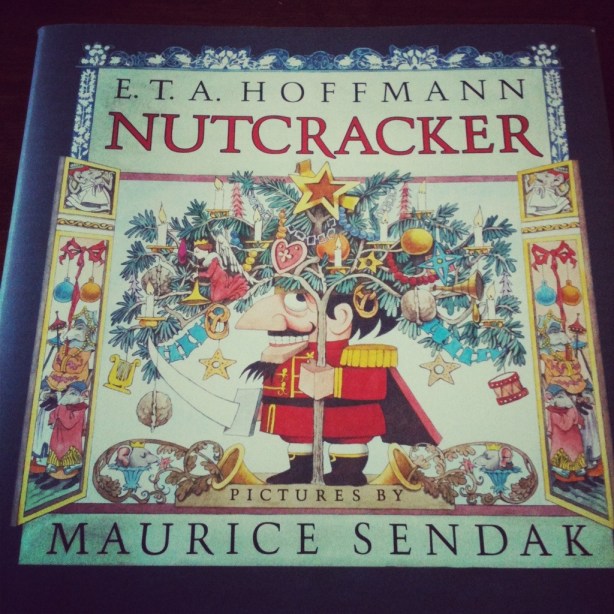
We’ll be running a giveaway contest for one of these beautiful editions of Hoffman’s Nutcracker, featuring illustrations by Maurice Sendak sometime next week.
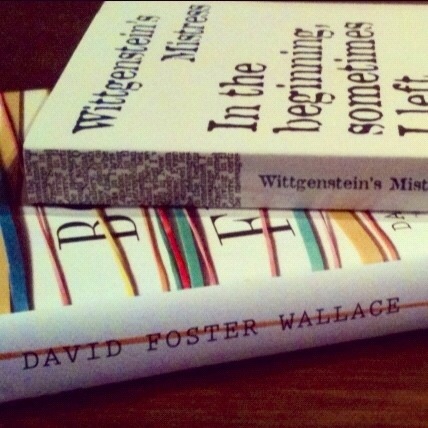
1. Like many David Foster Wallace fans, I’d already read many of the essays collected in the posthumous Both Flesh and Not. I hadn’t read “The Empty Plenum: David Markson’s Wittgenstein’s Mistress” though, originally published in a 1990 issue of The Review of Contemporary Fiction.
I suspect that the Markson essay hasn’t been collected up until now because it is so focused on Wittgenstein’s Mistress—this in contrast to, say “How Tracy Austin Broke My Heart” (Consider the Lobster) which is nominally about Austin’s autobiography but really about much bigger frying fish, like fan-idol relationships and ghostwriting and genre, or “Greatly Exaggerated,” which, again is nominally a review of Dix’s Morte d’Author: An Autopsy but is really more about postmodernism in general. I can’t recall exactly—maybe in his Charlie Rose interview—but Wallace said that he wanted the pieces in his books to be about more than just the ephemeral surface-level topic at hand; like most writers, he was contending for posterity. Wallace’s Markson essay is about Wittgenstein’s philosophy and the state of postmodern or experimental writing in the late 1980s and certain feminist analytic approaches to literature—but mostly it’s a detailed review of Markson’s novel—and it’s not trying to be anything more—which is actually really nice.
2. I read Wittgenstein’s Mistress on David Foster Wallace’s recommendation (I could add the modifier “like many David Foster Wallace fans” here again, I suspect). (That recommendation– “Five direly underappreciated U.S. novels >1960”—is also reprinted in Flesh (perhaps superfluously)). (While I’m getting all parenthetical: I read all five books Wallace recommended and all were excellent).
Here’s Wallace’s recommendation:
“W’s M” is a dramatic rendering of what it would be like to live in the sort of universe described by logical atomism. A monologue, formally very odd, mostly one-sentence 6s. Tied with “Omensetter’s Luck” for the all-time best U.S. book about human loneliness. These wouldnt constitute ringing endorsements if they didnt happen all to be simultaneously true — i.e., that a novel this abstract and erudite and avant-garde that could also be so moving makes “Wittgenstein’s Mistress” pretty much the high point of experimental fiction in this country.
—This is in some ways a condensation of his essay “The Empty Plenum,” where he writes:
Markson’s is not a pop book, and it’s not decocted philosophy or a docudrama-of-the-week. Rather, for me, the novel does artistic & emotional justice to the politico-ethical implications of Ludwig Wittgenstein’s abstract mathematical metaphysics , makes what is designed to be a mechanism pulse, breathe, suffer, live, etc. In so doing, it pays emotional tribute to a philosopher who by all evidence lived in a personal spiritual torment over the questions too many of his academic followers have made into elaborate empty exercises.
3. After Wittgenstein’s Mistress, Markson wrote four more novels, or anti-novels, if you like, sometimes called the note-card novels, novels “of intellectual reference and allusion, so to speak minus much of the novel,” as Novelist puts it in The Last Novel. I read these novels after WM: better-if-not-as-precise (in its metaphoricity) verb: I devoured them.Refinement isn’t exactly the right word, but Markson’s last four novels distill the elliptical and monotone style that he began in WM into a kind of word collage, a frieze of loops, motifs, ideas that the reader has the privilege/burden to construct meaning from. At the beginning of his essay on WM, Wallace posits that the novel is an “INTERPRET-ME” novel; the four novels after WM go beyond INTERPRET-ME—they ask the reader to construct-me, build-me, make-me. These late novels cast away the onus of a narrator; they jettison the already-jettisoned figure of Kate, narrator of Wittgenstein’s Mistress, the last person on earth. And perhaps because of all this, I’ve come to think that they are in many ways superior to WM (or at least showcase a clear evolution in Markson’s style)—that they more purely enact the canon-making, curatorial process that I take to be the core of Markson’s last five books.
4. Here’s Wallace on Markson’s curatorial curve:
The curator’s job—to recall, choose, arrange: to impose order & so communicate meaning—is marvelously synechdochic of the life of the solipsist, of the survival strategies apposite one’s existence as monad in a world of diffracted fact.
Except a big question is: whence facts, if the world is “empty”?
And then Wallace goes about answering this question w/r/t (am I borrowing too many Wallacian shortcuts here?) Wittgenstein’s philosophy. (And this I will not attempt to summarize here).
5. But I will quote Wallace again:
[Wittgenstein] never actually wrote anything about the exquisite tensions between atomism & attendant solipsism on the one hand & distinctively human values & qualities on the other. But, see, this is exactly what Mr. Markson does in WM; and in this way Markson’s novel succeeds in speaking where Wittgenstein is mute, weaving Kate’s obsession with responsibility (for the world’s emptiness) gorgeously into the character’s mandala of cerebral conundrum & spiritual poverty.
6. The greatest weaknesses of Wallace’s essay:
a). He doesn’t do a great job of explicating specifically how Wittgensteinian philosophy—or even themes—are alluded to by Markson in WM. (Or maybe I’m just a weak reader).
b). He gets bogged down in a long discussion of WM as a male-authored text featuring a female narrator w/r/t passivity vs. agency and object vs. subject and Helen vs. Eve (etc.) that I think is ultimately the kind of business far better sorted out in the novel itself.
7. The greatest strength of Wallace’s essay:
He made me want to reread Wittgenstein’s Mistress.












 Biblioklept