Alley Brawl, They Live

Parenting After the Apocalypse — I Review Matt Bell’s Cataclysm Baby

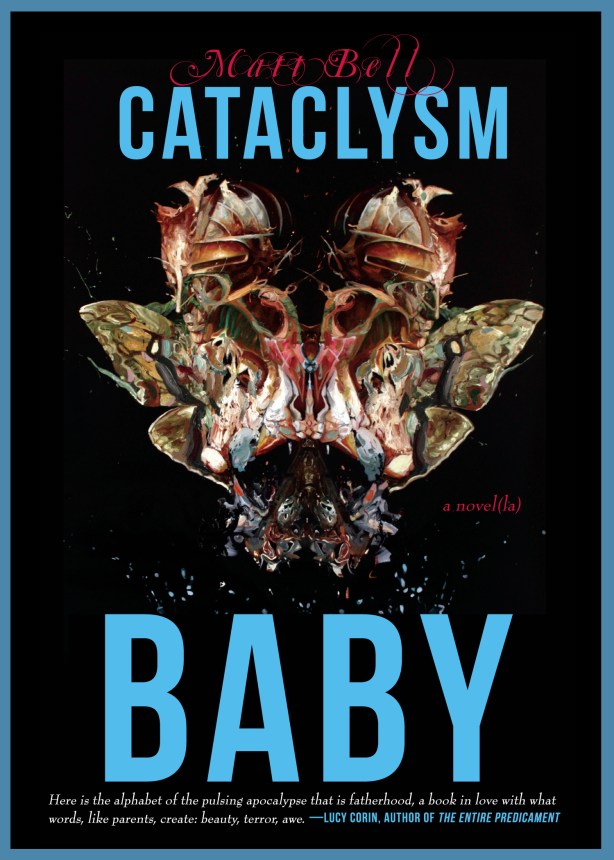
Cataclysm-Baby-Final-Cover-Front

Each of the twenty-six short pieces that comprise Matt Bell’s Cataclysm Baby offers a different take on family life after the apocalypse. The opening paragraphs of “Abelard, Abraham, Absalom”—the first tale in the collection—offers an overview of Cataclysm Baby’s program:

The smoldered cigar, last of a box of twenty, bought to celebrate happier times, now smoked to keep away the smell of our unwashed skin, of our slipping flesh, of our baby grown in my wife’s belly, the submerged sign of a prophecy burning, stretching taut her hard bulge: All hair, just like the others, gone wrong again.

Fists of black hail fall from the cloudless sky and spatter the house, streak the skin of our walls, break windows above broken beds. The birth-room fills with air the texture of mud, with black birds forgetting how to fly, these crows and vultures waiting to make a nest of our child, and still I I focus, keep my eyes on shattered glass, on my wife’s pelvis tilting toward sunlight, toward sun turned the color of baby’s first stool, then the color blood.

We see here the vestiges of civilization, emblematic in the narrator’s cigar smoking down to ash; we see the mutated child, another hirsute monster “just like the others, gone wrong again”; we see the backdrop of ecological disaster, of carrion birds that can no longer fly yet nevertheless maintain a brutal Darwinian competition with humanity; we see a deathly world that seems to all but occlude birth. These motifs—the end of social order, the species-transformation of new children, the utter collapse of ecological norms—run throughout Cataclysm Baby, telegraphed in Bell’s precise, concrete style.

These short fables are also united by the alphabet: “Abelard, Abraham, Absalom” gives way to “Beatrice, Bella, Blaise,” and so on until “Zachary, Zahir, Zedekiah.” However, Bell’s apocalypse is discontinuous; each tale evokes its own paradigm, its own idiom of grief. He’s less interested in the invention and world-building that marks so much of sci-fi and fantasy than he is in tapping into the mythological undercurrents of end-of-the-world narratives. The short pieces in Cataclysm Baby unfold (or burst, or twist) like strange, dark fairy tales, each proposing another vision of collapse.

Even in these collapses, Bell hints at some sense of social order, suggesting the occasional dystopia, as in “Fawn, Fiona, Fjola,” where forced breeders exchange their child for a basement with an oxygen supply and the occasional shower, or “Grayson, Griffin, Guillermo,” where the narrator-father’s awful offspring dooms the rest of the town:

How many babies are born before we realize that all their children are boys? That our town’s women are the past, thanks to my one-note issue, to their deadly sperm making deathly pregnancies, taking each of their partners the way of their own mother: the blood-wet, breath-gasped, split-wombed, at best to linger, never to recover from the makings of their children?

Elsewhere, there’s pure horror, like in “Svara, Sveta, Sylvana,” a riff on parenting-as-grave-digging, or “Prescott, Presley, Preston,” where precognitive children sound out their own infanticidal doom. Horror generally pervades Bell’s language, as in the opening paragraph of “Isaac, Isaiah, Ishmael”:

Even at birth they were already damaged, their brittle bones opened and crushed, powdered by their mother’s powerful organs, her pressing canal: All those thin ribs snapped and splintered upon the stainless steel of the operating room. All those skulls crooked and cracked, all those twisted greenstick limbs. We lifted each child out from the mother’s body and into surgeries of its own, did our best to splint and screw our prides together.

Despite its horrors, there are occasional moments of (very) dark humor in Cataclysm Baby, absurd comic eruptions, like these lines from “Domina, Doreen, Dorma”:

A chrysalis? I ask my wife. A cocoon?

What’s the difference, she says, when it’s your child inside, when it’s your caterpillar?

I’m tempted to offer more examples, but I fear that I’m approaching over-paraphrasing here when much of the pleasure (is this the right noun?) of Cataclysm Baby comes from its strange familiarity, its uncanny contours, its ugly surprises. Bell’s cryptic details—shaved heads, missing mothers, night soot—allow the reader’s imagination do much of the work. This trust pays off; Bell is aware of the tradition he taps into and equally aware of reader awareness.

The apocalyptic tradition evinces in the two epigraphs Cataclysm Baby bears. The first, from the King James bible version of Noah’s apocalypse, notes “the creeping thing” — a bizarre expression, frightening, frustrating, and intriguing in its vivid vagueness. (Bell appropriates the expression later in one of his narratives). The other epigraph comes fromThe Road, Cormac McCarthy’s sad apocalypse story about a father and son who are “carrying the fire.” There’s little room for other characters in The Road  and in a sense, Cataclysm Baby offers variations on the characters who might lurk in the margins of McCarthy’s story, or the edges of the other end-of-the-world stories we know. These parents simultaneously fear and fear for their children, harbingers of a world they will not survive. Recommended.

Cataclysm Baby is new from Mud Luscious Press.
Human Sacrifice Before Tohil — Diego Rivera

Pool Hall Brawl (Mean Streets)

May Day? Labour Day? Loyalty Day?

The following is excerpted from one of our favorite freely-found books, Alice van Straalen’s The Book of Holidays Around the World:

May Day: Worldwide —  In a festival that lasted from April 28 to May 3, the Romans offered flowers to Flora, their goddess of spring. They brought the custom to all the European lands they conquered; and by the Middle Ages it became especially popular in England. People rose early in the morning to “bring in the May.” They gathered flowers and tree branches to decorate their homes and later went to the town square where the maypole–often over 100 feet tall–was raised, and a woman representing the May Queen presided over the celebrations. Dancers held the streamers that fell from the top of the pole and, as they circled around it, wove them into tight patterns. When they changed directions the streamers untangled again and blew free, a tradition that some towns in England and America have continued. In 1889 the Second Internationale, an association of French socialists, dedicated May Day to working people, and today in many countries it is celebrated as a labor day. The Soviet Union marks the day with a military parade in Moscow.

Soviet Union…yeah, the bookover 25 years old…

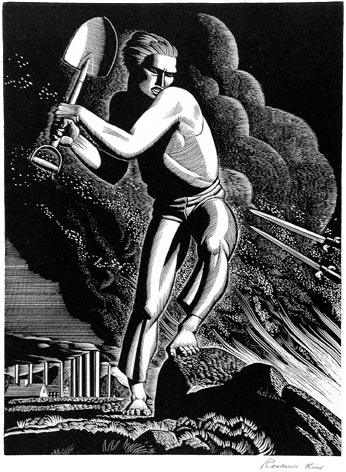
Workers of the World Unite -- Rockwell Kent

But don’t worry, God-fearing Americans! It turns out that, in order to reclaim May Day from pinkos and anarchists, the U.S. government declared May 1st “Loyalty Day.” From 36 US Code §115:

(a) Designation.— May 1 is Loyalty Day.

(b) Purpose.— Loyalty Day is a special day for the reaffirmation of loyalty to the United States and for the recognition of the heritage of American freedom.

(c) Proclamation.— The President is requested to issue a proclamation—

(1) calling on United States Government officials to display the flag of the United States on all Government buildings on Loyalty Day; and
(2) inviting the people of the United States to observe Loyalty Day with appropriate ceremonies in schools and other suitable places.

Loyalty Day? Okay, sure, why not? But are the two perspectives on this ancient festival–the concept of workers standing up for the right to control the means of production, etc., and the idea of being loyal to America–are they so different?

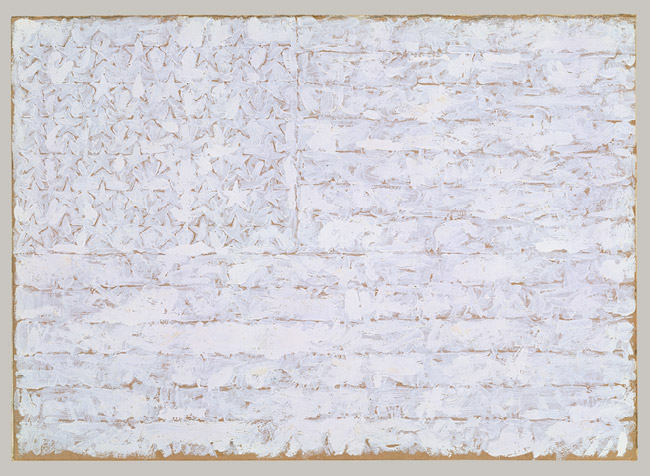
Flag -- Jasper Johns

Village Scene with Dance around the May Pole – Pieter Bruegel the Elder

Maypole Song, Wicker Man

St. George’s Kermis with the Dance Around the Maypole — Pieter Brueghel the Younger

Read “The School,” a short story by Donald Barthelme

“The School” by

Donald Barthelme


Well, we had all these children out planting trees, see, because we figured that … that was part of their education, to see how, you know, the root systems … and also the sense of responsibility, taking care of things, being individually responsible. You know what I mean. And the trees all died. They were orange trees. I don’t know why they died, they just died. Something wrong with the soil possibly or maybe the stuff we got from the nursery wasn’t the best. We complained about it. So we’ve got thirty kids there, each kid had his or her own little tree to plant and we’ve got these thirty dead trees. All these kids looking at these little brown sticks, it was depressing.

It wouldn’t have been so bad except that just a couple of weeks before the thing with the trees, the snakes all died. But I think that the snakes – well, the reason that the snakes kicked off was that … you remember, the boiler was shut off for four days because of the strike, and that was explicable. It was something you could explain to the kids because of the strike. I mean, none of their parents would let them cross the picket line and they knew there was a strike going on and what it meant. So when things got started up again and we found the snakes they weren’t too disturbed.

With the herb gardens it was probably a case of overwatering, and at least now they know not to overwater. The children were very conscientious with the herb gardens and some of them probably … you know, slipped them a little extra water when we weren’t looking. Or maybe … well, I don’t like to think about sabotage, although it did occur to us. I mean, it was something that crossed our minds. We were thinking that way probably because before that the gerbils had died, and the white mice had died, and the salamander … well, now they know not to carry them around in plastic bags.

Of course we expected the tropical fish to die, that was no surprise. Those numbers, you look at them crooked and they’re belly-up on the surface. But the lesson plan called for a tropical fish input at that point, there was nothing we could do, it happens every year, you just have to hurry past it.

We weren’t even supposed to have a puppy. Continue reading “Read “The School,” a short story by Donald Barthelme”

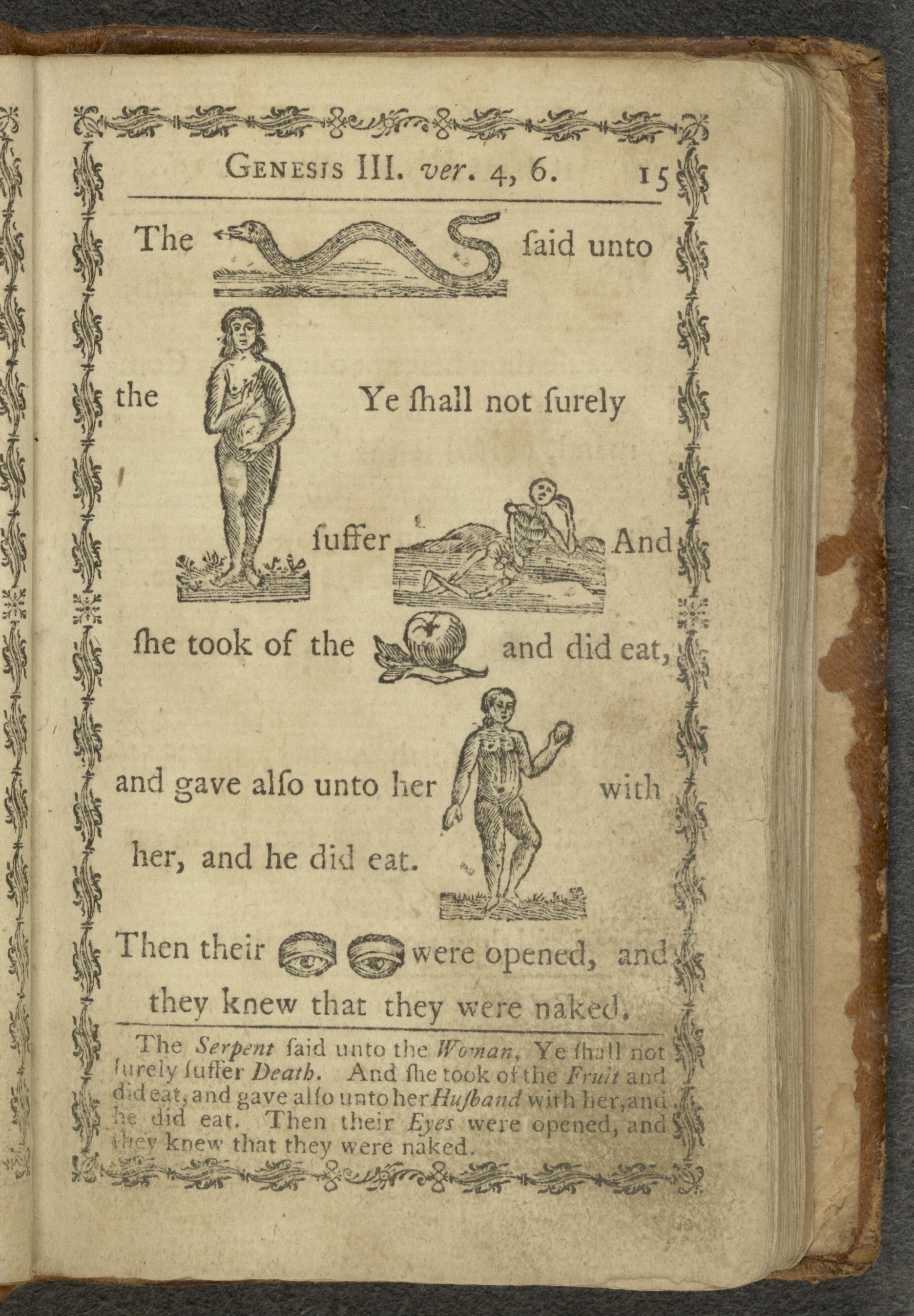
Temptation and Fall — Genesis 3.4-6 (From A Curious Hieroglyphick Bible, 1788)

(From A curious hieroglyphick Bible, or, Select passages in the Old and New Testaments, represented with emblematical figures, for the amusement of youth : designed chiefly to familiarize tender age, in a pleasing and diverting manner, with early ideas of the Holy Scriptures : to which are subjoined, a short account of the lives of the Evangelists, and other pieces / illustrated with nearly five hundred cuts. 1788).

Corridor Fight Scene from Old Boy

Two Chained Monkeys — Pieter Bruegel the Elder

Self-Portrait — Ben Marcus

20120429-141359.jpg

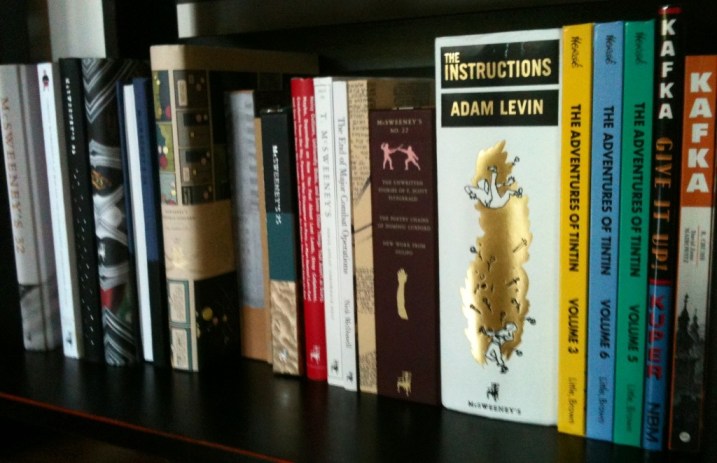
Book Shelves #18, 4.29.2012

20120429-131113.jpg

Book shelves series #18, eighteenth Sunday of 2012.

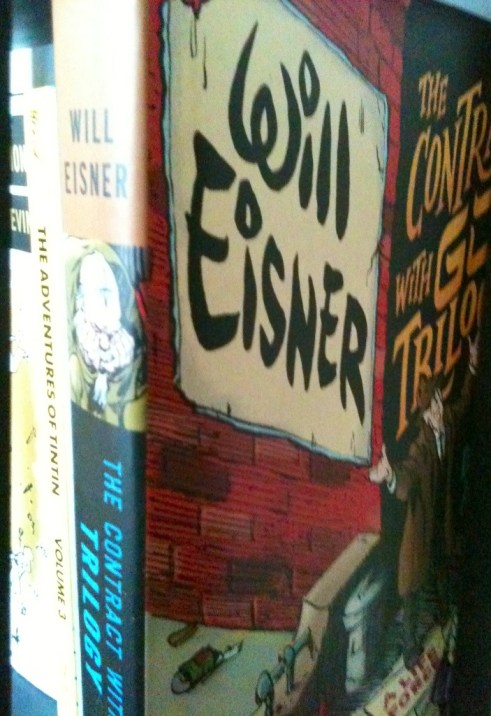
Lots of issues of McSweeney’s on this shelf. I abandoned The InstructionsSome Tintin omnibuses. Crumb-illustrated Kafka bio. Bookended by Will Eisner’s masterwork A Contract with God:

20120429-131124.jpg

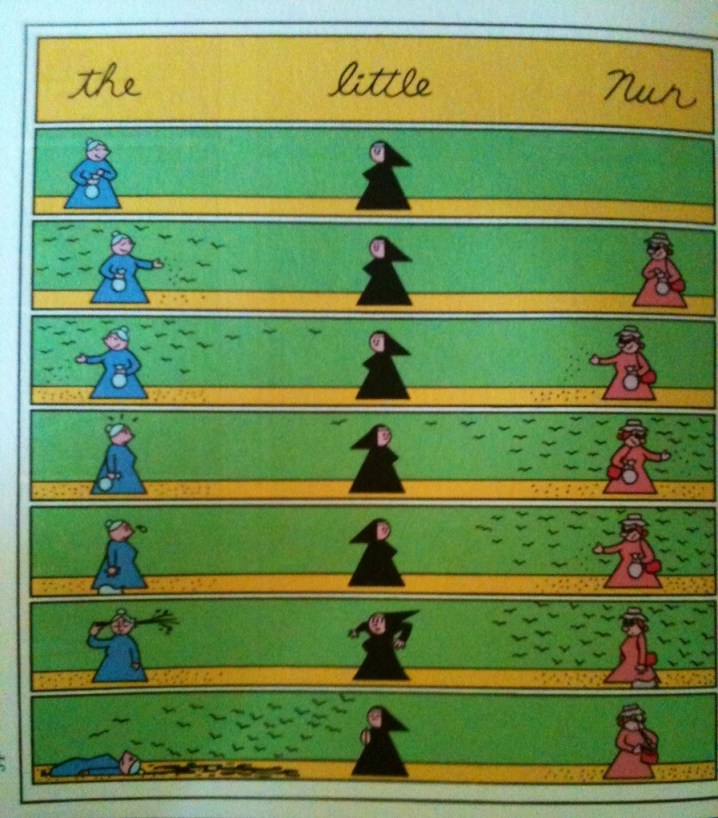
A Chris Ware comic from McSweeney’s #13:

20120429-131132.jpg

The Gobolink and How to Make Him

(More)

Intervals, A Short Film by Peter Greenaway

Five Rules of Wisdom (From Flann O’Brien’s The Third Policeman)

‘Tell me this much,’ I ventured. ‘What sort of readings were those in the policeman’s black book?’

The Sergeant gave me a keen look which felt almost hot from being on the fire previously.

‘The first beginnings of wisdom,’ he said, ‘is to ask questions but never to answer any. You get wisdom from asking and I from not answering. Would you believe that there is a great increase in crime in this locality? Last year we had sixty-nine cases of no lights and four stolen. This year we have eighty-two cases of no lights, thirteen cases of riding on the footpath and four stolen. There was one case of wanton damage to a three-speed gear, there is sure to be a claim at the next Court and the area of charge will be the parish. Before the year is out there is certain to be a pump stolen, a very depraved and despicable manifestation of criminality and a blot on the county.’

‘Indeed,’ I said.

‘Five years ago we had a case of loose handlebars. Now there is a rarity for you. It took the three of us a week to frame the charge.’

‘Loose handlebars,’ I muttered. I could not clearly see the reason for such talk about bicycles.

‘And then there is the question of bad brakes. The country is honeycombed with bad brakes, half of the accidents are due to it, runs in families.’

I thought it would be better to try to change the conversation from bicycles.

‘You told me what the first rule of wisdom is,’ I said. ‘What is the second rule?’

‘That can be answered,’ he said.

‘There are five in all. Always ask any questions that are to be asked and never answer any. Turn everything you hear to your own advantage. Always carry a repair outfit. Take left turns as much as possible. Never apply your front brake first.’

‘These are interesting rules,’ I said dryly.

‘If you follow them,’ said the Sergeant, ‘you will save your soul and you will never get a fall on a slippy road.’

‘I would be obliged to you,’ I said, ‘if you would explain to me which of these rules covers the difficulty I have come here today to put before you.’

‘This is not today, this is yesterday,’ he said, ‘but which of the difficulties is it? What is the crux rei?’

‘Yesterday? I decided without any hesitation that it was a waste of time trying to understand the half of what he said. I persevered with my inquiry.

‘I came here to inform you officially about the theft of my American gold watch.’

He looked at me through an atmosphere of great surprise and incredulity and raised his eyebrows almost to his hair.

‘That is an astonishing statement,’ he said at last.

‘Why?’

‘Why should anybody steal a watch when they can steal a bicycle?’

From Flann O’Brien’s surreal comic masterpiece, The Third Policeman.