Claude Monet (The Reader) — Pierre-Auguste Renoir

“When a Woman Loves” — R. Kelly / Swede Mason Remix

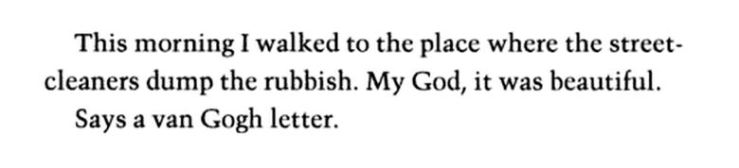
Van Gogh Anecdote (David Markson)

Capture

List with No Name #21

  1. 10,000 BC
  2. 1492
  3. 1776
  4. 1812
  5. 1900
  6. 1941
  7. “1969”
  8. 1969
  9. “1979”
  10. 1984
  11. “1999”
  12. 1999
  13. “2000”
  14. 2001
  15. 2010
  16. 2012
  17. 2046
  18. 2666


“Stare at the Sun” — Eleanor Friedberger

Spiral Jetty (Sketch) — Robert Smithson

Werner Herzog on Les Blank

“A Little Cloud” — James Joyce

“A Little Cloud” by James Joyce

EIGHT years before he had seen his friend off at the North Wall and wished him godspeed. Gallaher had got on. You could tell that at once by his travelled air, his well-cut tweed suit, and fearless accent. Few fellows had talents like his and fewer still could remain unspoiled by such success. Gallaher’s heart was in the right place and he had deserved to win. It was something to have a friend like that.

Little Chandler’s thoughts ever since lunch-time had been of his meeting with Gallaher, of Gallaher’s invitation and of the great city London where Gallaher lived. He was called Little Chandler because, though he was but slightly under the average stature, he gave one the idea of being a little man. His hands were white and small, his frame was fragile, his voice was quiet and his manners were refined. He took the greatest care of his fair silken hair and moustache and used perfume discreetly on his handkerchief. The half-moons of his nails were perfect and when he smiled you caught a glimpse of a row of childish white teeth.

As he sat at his desk in the King’s Inns he thought what changes those eight years had brought. The friend whom he had known under a shabby and necessitous guise had become a brilliant figure on the London Press. He turned often from his tiresome writing to gaze out of the office window. The glow of a late autumn sunset covered the grass plots and walks. It cast a shower of kindly golden dust on the untidy nurses and decrepit old men who drowsed on the benches; it flickered upon all the moving figures—on the children who ran screaming along the gravel paths and on everyone who passed through the gardens. He watched the scene and thought of life; and (as always happened when he thought of life) he became sad. A gentle melancholy took possession of him. He felt how useless it was to struggle against fortune, this being the burden of wisdom which the ages had bequeathed to him. Continue reading ““A Little Cloud” — James Joyce”

The Submissive Reader — Rene Magritte

Slavoj Žižek Discusses Philosophy, Topless in Bed (And So On and So On)

Roger Ebert Annotates Ozu’s Floating Weeds

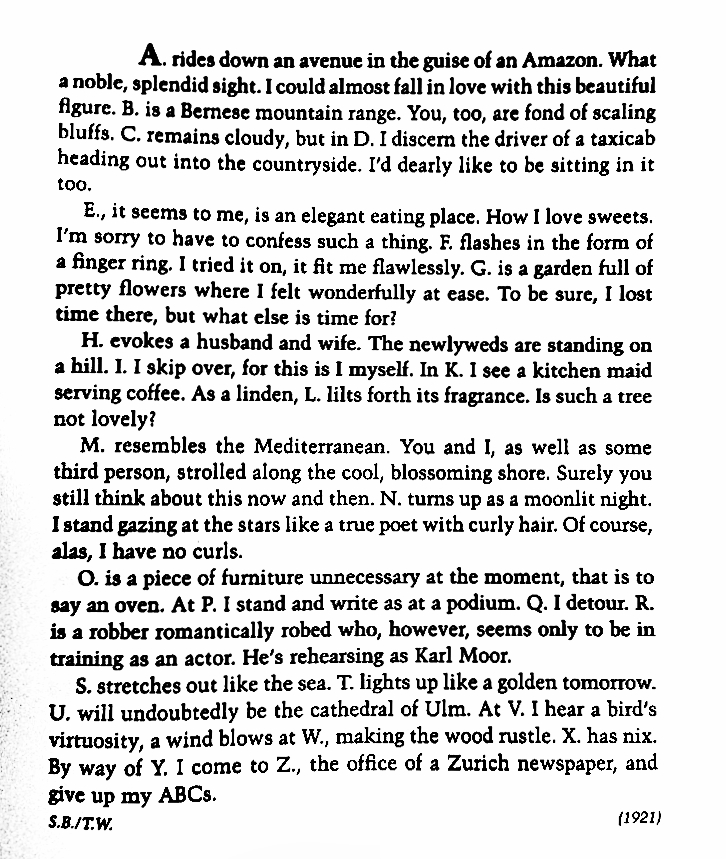
“The Alphabet” — Robert Walser

rw

Lydia Davis/Denis Johnson/Curzio Malaparte (Books Acquired, 4.06.2013)

20130408-201552.jpg

Purged the books pictured in the lower right-hand corner and picked up a few: Curzio Malaparte’s Kaputt, which has intrigued me for awhile now, Denis Johnson’s Fiskadoroin the Vintage Contemporaries edition no less!—and Lydia Davis’s novel The End of the Story, which I somehow haven’t read yet. Hypothesis: Lydia Davis and Denis Johnson may be America’s greatest living novelists (?).


Fiction Rule of Thumb (xkcd)

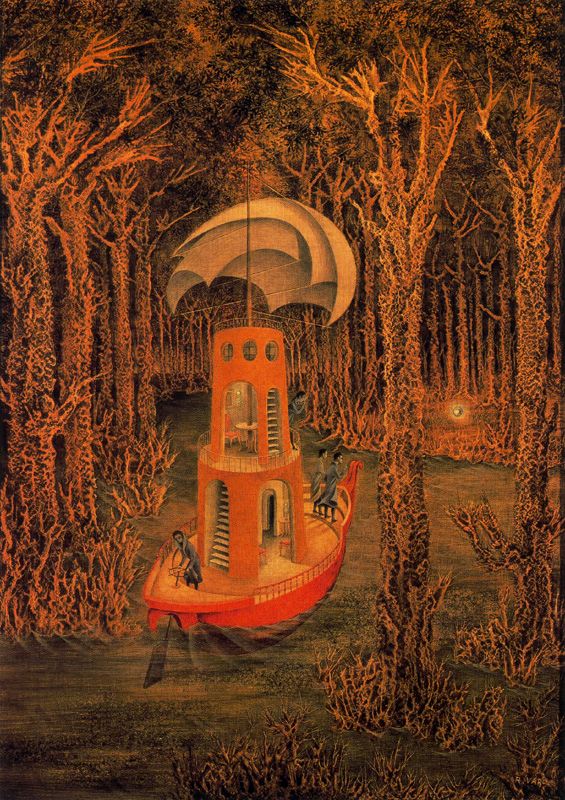
Find — Remedios Varo

find-1956

“On Being Shy” — Jerome K. Jerome

“On Being Shy” by Jerome K. Jerome

All great literary men are shy. I am myself, though I am told it is hardly noticeable.

I am glad it is not. It used to be extremely prominent at one time, and was the cause of much misery to myself and discomfort to every one about me—my lady friends especially complained most bitterly about it.

A shy man’s lot is not a happy one. The men dislike him, the women despise him, and he dislikes and despises himself. Use brings him no relief, and there is no cure for him except time; though I once came across a delicious recipe for overcoming the misfortune. It appeared among the “answers to correspondents” in a small weekly journal and ran as follows—I have never forgotten it: “Adopt an easy and pleasing manner, especially toward ladies.”

Poor wretch! I can imagine the grin with which he must have read that advice. “Adopt an easy and pleasing manner, especially toward ladies,” forsooth! Don’t you adopt anything of the kind, my dear young shy friend. Your attempt to put on any other disposition than your own will infallibly result in your becoming ridiculously gushing and offensively familiar. Be your own natural self, and then you will only be thought to be surly and stupid.

The shy man does have some slight revenge upon society for the torture it inflicts upon him. He is able, to a certain extent, to communicate his misery. He frightens other people as much as they frighten him. He acts like a damper upon the whole room, and the most jovial spirits become in his presence depressed and nervous.

This is a good deal brought about by misunderstanding. Many people mistake the shy man’s timidity for overbearing arrogance and are awed and insulted by it. His awkwardness is resented as insolent carelessness, and when, terror-stricken at the first word addressed to him, the blood rushes to his head and the power of speech completely fails him, he is regarded as an awful example of the evil effects of giving way to passion.

But, indeed, to be misunderstood is the shy man’s fate on every occasion; and whatever impression he endeavors to create, he is sure to convey its opposite. When he makes a joke, it is looked upon as a pretended relation of fact and his want of veracity much condemned. His sarcasm is accepted as his literal opinion and gains for him the reputation of being an ass, while if, on the other hand, wishing to ingratiate himself, he ventures upon a little bit of flattery, it is taken for satire and he is hated ever afterward. Continue reading ““On Being Shy” — Jerome K. Jerome”

Portrait of Victor Guye — Francisco Goya