Elizabeth Griffiths Smith Hopper, The Artist’s Mother — Edward Hopper

Happy Mothers Day! (Peanuts)

peanuts

Portrait of the Artist’s Mother — Salvador Dali

“Mothers” — William Gaddis

“Mothers” by William Gaddis

When Ralph Waldo Emerson informed—or rather, perhaps, warned us—that we are what our mothers made us, we might dismiss it as received opinion and let it go at that, like the broken clock which is right twice a day, like the self-evident answer contained in Freud’s oft-quoted query “What do women want?” when, as nature’s handmaid, she must want what nature wants which is, quite simply, More. But which woman? Whose mother, Emerson’s? A woman so in thrall to religion that we confront another dead end; or Freud’s? or even one’s own, even mine, offering an opportune bit of wisdom to those of us engaged in the creative arts, where paranoia is almost an occupational hazard: “Bill, just try to remember,” she said, “there is much more stupidity than there is malice in the world,” an observation lavish with possibilities recalling Anatole France finding the fool more dangerous than the rogue because “the rogue does at least take a rest sometimes, the fool never.”

This is hardly to see stupidity and malice as mutually exclusive: look at your morning paper, where their combined forces explode exponentially (women and children first) from Bosnia to Belfast, unlike the international “intelligence community” so self-contained in its malice-free exercises that it generally ensnares only its own dubious cast of players. Of further importance is the distinction between stupidity and ignorance, since ignorance is educable, while stupidity’s self-serving mission is the cultivation and exploitation of ignorance, as politicians are keenly aware.

How, then, might Emerson’s mother have seen herself stumbling upon Thomas Carlyle’s vision of her son as a “hoary-headed and toothless baboon”? Or Freud’s, in the gross unlikelihood of her reading the Catholic World’s review of her son’s book Moses and Monotheism as “poorly written, full of repetitions . . . and spoiled by the author’s atheistic bias and his flimsy psychoanalytic fancies”? Goethe’s Wilhelm Meister dismissed as “sheer nonsense” by the Edinburgh Review and, a good century later, the hero of Saul Bellow’s Dangling Man ridiculed as a “pharisaical stinker” in Time magazine, John Barth’s The End of the Road recommended by Kirkus Reviews “for those schooled in the waste matter of the body and the mind,” and William Faulkner’s Absalom, Absalom! shrugged off as the “final blowup of what was once a remarkable, if minor, talent” by The New Yorker magazine where, just forty years later, “a group of avant-garde critics has put forward the idea that books should be made unreadable. This movement has manifest advantages. Being unreadable, the text repels reviewers, critics, anthologists, academic literati, and other parasitical forms of life,” indicting the author of the novel J R wherein “to produce an unreadable text, to sustain this foxy purpose over 726 pages, demands rare powers. Mr. Gaddis has them.” “You’re a fool, a fool!” the distraught mother of Dostoevski’s ill-fated hero Nikolay Stavrogin cries out at the “parasitical forms of life” surrounding her. “You’re all ungrateful fools. Give me my umbrella!”

(“Mothers” is collected in The Rush to Second Place).

The Painter’s Mother — Lucian Freud

The Two Mothers — Dante Gabriel Rossetti

Mother and Child on the Beach — Camille Corot

The Man is at Sea (after Demont-Breton) — Vincent van Gogh

Watch Naked Eyes, A (Very) Short Film by Leos Carax (NSFW)

Patricio Pron Novel (Book Acquired, 5.08.2013)

pron

I got a review copy of My Father’s Ghost Is Climbing in the Rain, the first novel from Patricio Pron a few days ago and wandered into it a bit yesterday afternoon but then got distracted by something else. Anybody read this one—or anything by Pron? Curious what you think…

From a Granta interview:

Name the five writers you most admire at the moment (any period, language or genre).

David Foster Wallace, Vladimir Nabokov, Flannery O’Connor, W. G. Sebald, Roberto Bolaño.

Here is publisher Knopf’s blurb for My Father’s Ghost Is Climbing in the Rain:

The anticipated American debut of one of Granta’s Best Young Spanish-Language Novelists: a daring, deeply affecting novel about the secrets buried in the past of an Argentine family.

A young writer, living abroad, makes the journey home to South America to say good-bye to his dying father. In his parents’ house, he finds a cache of documents—articles, maps, photographs—and unwittingly begins to unearth his father’s obsession with the disappearance of a local man. Suddenly he comes face-to-face with the ghosts of Argentina’s dark political past and with the long-hidden memories of his family’s underground resistance against an oppressive military regime. As the fragments of the narrator’s investigation fall into place—revealing not only a part of his father’s life he had tried to forget but also the legacy of an entire generation—this audacious novel tells a completely original story of corruption and responsibility, history and remembrance.

You can also read “Ideas,” a story by Pron published in The Paris Review, which I think is an excerpt from the book. First paragraph:

On April 16, 1981, at approximately three P.M., little Peter Möhlendorf, whom everyone called der schwarze Peter, “black Peter,” went home from the village school. His house was on the eastern edge of Sterberode, a town of some five thousand inhabitants outside the East German town of Magdeburg whose main economic activity is farming—asparagus, mostly. His father, who was in the basement of the house when little Möhlendorf arrived, would later say that he heard him come in and then could infer from the sounds in the kitchen, which was above the basement, what he was doing: he flung his backpack beneath the staircase landing, went to the kitchen, took a carton of milk out of the refrigerator, and poured himself a glass, which he drank standing; then he put the carton back in the refrigerator and went out into the backyard. Anyway, that was what he did every day when he came home from school and it could be that his father hadn’t really heard the noises he later would say he heard but rather had heard Peter come home and from that had guessed the rest of the series of actions. However, what his father did not know, as he listened or thought he listened to the noises his son was making above his head, was that little Peter was not going to return home that night or the nights that would follow, and that something incomprehensible and frightening was going to open up before him and the rest of the townspeople, and it would swallow everything up.

Partial Cast List, Ulysses

(He hurries out through the hall. The whores point. Florry follows, spilling water from her tilted tumbler. On the doorstep all the whores clustered talk volubly, pointing to the right where the fog has cleared off. From the left arrives a jingling hackney car. It slows to in front of the house. Bloom at the halldoor perceives Corny Kelleher who is about to dismount from the car with two silent lechers. He averts his face. Bella from within the hall urges on her whores. They blow ickylickysticky yumyum kisses. Corny Kelleher replies with a ghastly lewd smile. The silent lechers turn to pay the jarvey. Zoe and Kitty still point right. Bloom, parting them swiftly, draws his caliph’s hood and poncho and hurries down the steps with sideways face. Incog Haroun al Raschid he flits behind the silent lechers and hastens on by the railings with fleet step of a pard strewing the drag behind him, torn envelopes drenched in aniseed. The ashplant marks his stride. A pack of bloodhounds, led by Hornblower of Trinity brandishing a dogwhip in tallyho cap and an old pair of grey trousers, follow from fir, picking up the scent, nearer, baying, panting, at fault, breaking away, throwing their tongues, biting his heels, leaping at his tail. He walks, runs, zigzags, gallops, lugs laid back. He is pelted with gravel, cabbagestumps, biscuitboxes, eggs, potatoes, dead codfish, woman’s slipperslappers. After him freshfound the hue and cry zigzag gallops in hot pursuit of follow my leader: 65 C, 66 C, night watch, John Henry Menton, Wisdom Hely, V. B. Dillon, Councillor Nannetti, Alexander Keyes, Larry O’rourke, Joe Cuffe Mrs O’dowd, Pisser Burke, The Nameless One, Mrs Riordan, The Citizen, Garryowen, Whodoyoucallhim, Strangeface, Fellowthatsolike, Sawhimbefore, Chapwithawen, Chris Callinan, Sir Charles Cameron, Benjamin Dollard, Lenehan, Bartell d’Arcy, Joe Hynes, red Murray, editor Brayden, T. M. Healy, Mr Justice Fitzgibbon, John Howard Parnell, the reverend Tinned Salmon, Professor Joly, Mrs Breen, Denis Breen, Theodore Purefoy, Mina Purefoy, the Westland Row postmistress, C. P. M’Coy, friend of Lyons, Hoppy Holohan, maninthestreet, othermaninthestreet, Footballboots, pugnosed driver, rich protestant lady, Davy Byrne, Mrs Ellen M’Guinness, Mrs Joe Gallaher, George Lidwell, Jimmy Henry on corns, Superintendent Laracy, Father Cowley, Crofton out of the Collector-general’s, Dan Dawson, dental surgeon Bloom with tweezers, Mrs Bob Doran, Mrs Kennefick, Mrs Wyse Nolan, John Wyse Nolan, handsomemarriedwomanrubbedagainstwide behindinClonskeatram, the bookseller of Sweets of Sin, Miss Dubedatandshedidbedad, Mesdames Gerald and Stanislaus Moran of Roebuck, the managing clerk of Drimmie’s, Wetherup, colonel Hayes, Mastiansky, Citron, Penrose, Aaron Figatner, Moses Herzog, Michael E Geraghty, Inspector Troy, Mrs Galbraith, the constable off Eccles Street corner, old doctor Brady with stethoscope, the mystery man on the beach, a retriever, Mrs Miriam Dandrade and all her lovers.)


Young Mother — Egon Schiele

“A Mother” — James Joyce

“A Mother” by James Joyce

MR HOLOHAN, assistant secretary of the Eire Abu Society, had been walking up and down Dublin for nearly a month, with his hands and pockets full of dirty pieces of paper, arranging about the series of concerts. He had a game leg and for this his friends called him Hoppy Holohan. He walked up and down constantly, stood by the hour at street corners arguing the point and made notes; but in the end it was Mrs. Kearney who arranged everything.

Miss Devlin had become Mrs. Kearney out of spite. She had been educated in a high-class convent, where she had learned French and music. As she was naturally pale and unbending in manner she made few friends at school. When she came to the age of marriage she was sent out to many houses where her playing and ivory manners were much admired. She sat amid the chilly circle of her accomplishments, waiting for some suitor to brave it and offer her a brilliant life. But the young men whom she met were ordinary and she gave them no encouragement, trying to console her romantic desires by eating a great deal of Turkish Delight in secret. However, when she drew near the limit and her friends began to loosen their tongues about her, she silenced them by marrying Mr. Kearney, who was a bootmaker on Ormond Quay.

He was much older than she. His conversation, which was serious, took place at intervals in his great brown beard. After the first year of married life, Mrs. Kearney perceived that such a man would wear better than a romantic person, but she never put her own romantic ideas away. He was sober, thrifty and pious; he went to the altar every first Friday, sometimes with her, oftener by himself. But she never weakened in her religion and was a good wife to him. At some party in a strange house when she lifted her eyebrow ever so slightly he stood up to take his leave and, when his cough troubled him, she put the eider-down quilt over his feet and made a strong rum punch. For his part, he was a model father. By paying a small sum every week into a society, he ensured for both his daughters a dowry of one hundred pounds each when they came to the age of twenty-four. He sent the older daughter, Kathleen, to a good convent, where she learned French and music, and afterward paid her fees at the Academy. Every year in the month of July Mrs. Kearney found occasion to say to some friend:

“My good man is packing us off to Skerries for a few weeks.”

If it was not Skerries it was Howth or Greystones.
Continue reading ““A Mother” — James Joyce”

The Prophetess Anna (Rembrandt’s Mother) — Rembrandt

Man Bites Dog

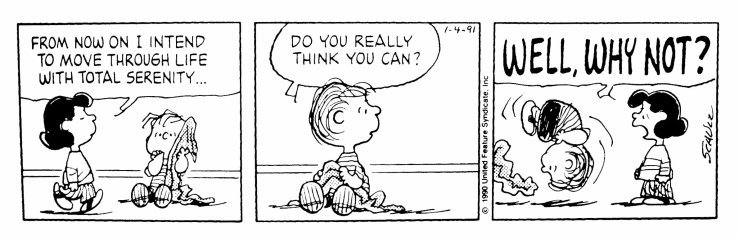
Serenity now! (Peanuts)

peanuts

Selections from One-Star Reviews of Fitzgerald’s The Great Gatsby

[Ed. note: The following citations come from one-star Amazon reviews of F. Scott Fitzgerald’s novel The Great Gatsby. While I think that Gatsby is probably the most overrated book in the American canon, I do think it’s an important book (overrated  ≠ bad). I’ve read it many, many times and used it in the classroom. Some of the selections here are silly, some actually make valid points, all intrigued me. I’ve preserved the reviewers’ unique styles of punctuation and spelling. (More one-star samplers: Orwell’s 1984,  Melville’s Moby-Dick, Joyce’s Ulysses and Markson’s Wittgenstein’s Mistress)].

Gatsby was obviously drunk, or smoking marijuana when he was writing this book, and must have thougth that this book was pretty clever.

Hey everyone! Lookit me! I’m a rich little snot and I can throw a big party in my mansion!

O.K. the first red flag was that this book isn’t part of any series. In my experience if a book isn’t part of a series it probably didn’t turn out too well and the author probably didn’t really know what he was doing. I’m sorry, but if something’s good people want more, you know? Like Fiddle Faddle (5 Stars!) Or Vicodin.

All the characters did was moan about their lives and do stupid things.

It was too “wordy”.

Lets just say that I created my own “Valley of Ashes”, its called a burnt up copy of The Great Gatzby in my dumpster outside my house.

Gatsby is the miz an and daisy is a sliz to the iz ut. Scott Fitzgerald i wish u were alive so i could kill u.

I hated this book with a passion.

The love story was predictable and the characters were obnoxious.

The Great Gatsby is a soap opera with depth.

There are murders, but not very unique ones.

(Nick Carraway; even his >name< is mediocre)

What’s “great” about this Gabsty fellow exactly? Write something about people who work for a living, not this junk.

As anyone who’s read this book knows, it’s a relatively short book.

The language is vulgar and archaic, with words such as “gay” and “excitement” used completely erroneously.

I don’t understand. This book is called the Great Gatsby, but everyone in the book treats Gatsby like he’s regular size.

Maybe it’s a book for an older crowd, I don’t know, but it was a complete waste of my time.

IT IS VERY COMPLICATED TO UNDERSTAND AND THERE ARE A LOT OF CHARACTERS.
I AM STILL READING THE BOOK SO MAYBE IT WILL GET BETTER.

this booke is very stupid, just like all the other secular writers out in the world.

Gatsby is living a seventeen-year-old’s dream whichwould be fine, if he were seventeen rather than thirty, but is total folly at his age.

The secret is: the author was a drunk.

it was so “boring”, that I failed my test on the computer!

So it’s a great story about the Jazz era. It wasn’t that great an era.

There is also plenty of *PREJUDICE* and *RACISM* in this book.

I think a bunch of divorced intellectuals have perpetuated this book through time and perpetrated it upon young adults.

Walking into a room of pseudo-intellectuals and proclaiming “Gatsby sucks!” isn’t the best idea these days, it seems.

This books its for people who stand 1 ft tall.  incredibly small book….it should say so in the title!!!!!!

If I wanted to read about lame, rich, full of themself people going to parties, I’d pick up People magazine.

omg i really had no sympathy for any of the characters, especially Gatsby. honestly, he had it coming. i’m sure a lot of older people will enjoy this book but if your under 21 i’d stay far far away

Mr. Fitzgerald just got lazy and decided to end the book at that.

It’s boring.

It’s futile.

It’s dumb.

I’d give it negative infinity stars if i could.

The plot line resembles an episode of Beverly Hills 90210 (namely “Let’s sit around and whine about being rich. Next we’ll get drunk and call each other names, fight, and run each other over!” SHUT UP ALREADY!)

I think I misunderstood the main point of the book. Since i found there to be none.

If you are rich and money if no object to you then you would see it as a non-fiction story. But if you are like the majority of other people around the United States, then it would be fiction. F. Scott Fitzgerald wrote this “great” novel that everyone proclaims it to be, which by some and sometimes many will tell you the opposite.

Gatsby was a very wealthy man.

Boring! Boring! Boring! Boring! Boring! Boring! Boring! Boring! Boring! Boring! Boring! Boring! Boring! Boring! Boring! Boring! Boring! Boring! Boring! Boring! Boring! Boring! Boring! Boring! Boring! Boring! Boring! Boring! Boring! Boring! Boring! Boring! Boring! Boring! Boring! Boring!

but i have to read it for school so what can you do?