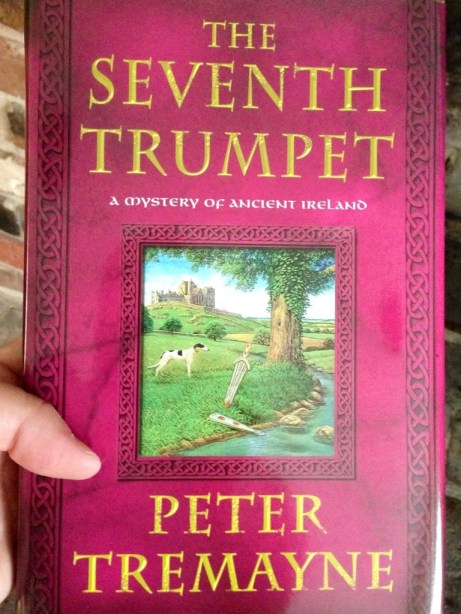
The Seventh Trumpet (Book Acquired, 7.01.2013)

20130709-140949.jpg

The Seventh Trumpet, another mystery from Peter Tremayne. Publisher Minotaur’s blurb:

When a murdered corpse of an unknown young noble is discovered, Fidelma of Cashel is brought in to investigate

Ireland, AD 670. When the body of a murdered young noble is discovered not far from Cashel, the King calls upon his sister, Fidelma, and her companion Eadulf to investigate. Fidelma, in addition to being the sister of the king, is a dailaigh—an advocate of the Brehon Law Courts—and has a particular talent for resolving the thorniest of mysteries.

But this time, Fidelma and Eadulf have very little to work with—the only clue to the noble’s identity is an emblem originating from the nearby kingdom of Laign. Could the murder be somehow related to the wave of violence erupting in the western lands of the kingdom? The turmoil there is being stirred up by an unknown fanatical figure who claims to have been summoned by “the seventh angel” to remove the “impure of faith.” Fidelma and Eadulf, once again grappling with a tangled skein of murder and intrigue, must somehow learn what connects the dead noble, a murdered alcoholic priest, and an abbot who has turned his monastery into a military fortress. When it appears that things cannot get more complex, Fidelma herself is abducted, and Eadulf must rescue her before the mystery can be solved.


Watch All the Memory in the World, A Short Film by Alain Resnais

The Collective Dream of the Chums of Chance (A Short Pynchon Riff)

1. This is one of the most extraordinary passages I’ve read so far in Pynchon’s Against the Day (pages 422-24 of my Penguin hardback).

It comes almost at the end of Iceland Spar, the second of the AtD’s five books, working as a surreal, dream-logic climax to the chapter.

Our heroes the Chums of Chance experience an existential identity crisis, one that makes them wonder if they themselves were mere dreamers, readers of the dime novels that chronicled their adventures, and not, y’know, actual adventurers:

Meantime, now and then in the interstices of what was after all not a perpetual midwestern holiday, the former crew of the Inconvenience became aware of doubts creeping in. What if they weren’t harmonica players? really? If it was all just some elaborate hoax they’d chosen to play on themselves, to keep distracted from a reality too frightening to receive the vast undiscriminating light of the Sky, perhaps the not-to-be-spoken-of betrayal now firmly installed at the heart of the . . . the Organization whose name curiously had begun to escape them . . . some secret deal, of an unspecified nature, with an ancient enemy . . . but they could find no entries in any of the daily Logs to help them remember. . . .

Had they gone, themselves, through some mutation into imperfect replicas of who they once were? meant to revisit the scenes of unresolved conflicts, the way ghosts are said to revisit places where destinies took a wrong turn, or revisit in dreams the dreaming body of one loved more than either might have known, as if whatever happened between them could in that way be put right again? Were they now but torn and trailing afterimages of clandestine identities needed on some mission long ended, forgotten, but unwilling or unable to be released from it? Perhaps even surrogates recruited to stay behind on the ground, allowing the “real” Chums to take to the Sky and so escape some unbearable situation? None of them may really ever have been up in a skyship, ever walked the exotic streets or been charmed by the natives of any far-off duty station. They may only have once been readers of the Chums of Chance Series of boys’ books, authorized somehow to serve as volunteer decoys. Once, long ago, from soft hills, from creekside towns, from libraries that let kids lie on the floor where it’s cool and read the summer afternoons away, the Chums had needed them . . . they came.

WANTED Boys for challenging assignments, must be fit, dutiful, ready, able to play the harmonica (“At a Georgia Camp Meeting” in all keys, modest fines for wrong notes), and be willing to put in long hours of rehearsal time on the Instrument. . . Adventure guaranteed!

So that when the “real” Chums flew away, the boys were left to the uncertain sanctuary of the Harmonica Marching Band Training Academy. . . . But life on the surface kept on taking its usual fees, year by year, while the other Chums remained merrily aloft, kiting off tax-free to assignments all over the world, perhaps not even remembering their “deps” that well anymore, for there was so much to occupy the adventurous spirit, and the others— “groundhogs” in Chums parlance—had known, surely, of the risks and the costs of their surrogacy. And some would drift away from here as once, already long ago, from their wholesome heartland towns, into the smoke and confusion of urban densities unimagined when they began, to join other ensembles playing music of the newer races, arrangements of Negro blues, Polish polkas, Jewish klezmer, though others, unable to find any clear route out of the past, would return again and again to the old performance sites, to Venice, Italy, and Paris, France, and the luxury resorts of old Mexico, to play the same medleys of cakewalks and rags and patriotic airs, to sit at the same café tables, haunt the same skeins of narrow streets, gaze unhappily on Saturday evenings at the local youngsters circulating and flirting through the little plazas, unsure whether their own youth was behind them or yet to come. Waiting as always for the “true” Chums to return, longing to hear, “You were splendid, fellows. We wish we could tell you about everything that’s been going on, but it’s not over yet, it’s at such a critical stage, and the less said right now the better. But someday . . .”

“Are you going away again?”

“So soon?”

“We must. We’re just so sorry. The reunion feast was delicious and much appreciated, the harmonica recital one we shall never forget, especially the ‘coon’ material. But now . . .”

So, once again, the familiar dwindling dot in the sky.

“Don’t be blue, pal, it must’ve been important, they really wanted to stay this time, you could tell.”

“What are we going to do with all this extra food?”

“And all the beer nobody drank!”

“Somehow I don’t think that’ll be a problem.”

But that was the beginning of a certain release from longing, as if they had been living in a remote valley, far from any highways, and one day noticed that just beyond one of the ridge-lines all this time there’d been a road, and down this road, as they watched, came a wagon, then a couple of riders, then a coach and another wagon, in daylight which slowly lost its stark isotropy and was flowed into by clouds and chimney smoke and even episodes of weather, until presently there was a steady stream of traffic, audible day and night, with folks beginning to venture over into their valley to visit, and offering rides to towns nearby the boys hadn’t even known existed, and next thing anybody knew, they were on the move again in a world scarcely different from the one they had left. And one day, at the edge of one of these towns, skyready, brightwork gleaming, newly painted and refitted and around the corner of a gigantic hangar, waiting for them, as if they had never been away, there was their ship the good old Inconvenience. And Pugnax with his paws up on the quarterdeck rail, tail going a mile a minute, barking with unrestrained joy.

2. Long passage, so short riff:

3. First (or third, if my enumeration is honest), let me point out that this passage recalls a similar identity transference that happened earlier in the novel to Reef Traverse when he reads a Chums of Chance novel.

4. Which, to rehash the point of the riff I linked to in point 3 above, is to say that the passage is very much about reader-identification, about the ways that we dream ourselves into the novels we read—that the places they occupy are very real.

So much of Against the Day is about doubling, about secret identities, secret powers, secret lives—the invisible (the word “invisible” pops up again and again and again in this book)—that we can lead these whole other lives in our imagination, and that books fuel these lives, etc.

5. This book of Against the Day is named for Iceland spar, a crystal with double-refraction properties. Earlier, the stage magician/minor character Luca Zombini (“Light Zombie”?) reveals that he’s actually split people into two versions of themselves (evidence of such doppelgangers are scattered throughout the novel) using the mineral in his shows.

When our Chums finally reassume the mantles of their “true identities” we’re told that “they were on the move again in a world scarcely different from the one they had left” — are these the same Chums, the same aircrew, the same adventurers? The adverb “scarcely” seems to work some strange magic here.

6. In any case, their loyal hound Pugnax identifies them as the real McCoy, his “tail going a mile a minute, barking with unrestrained joy.”

I’ll admit to feeling some of that joy myself.
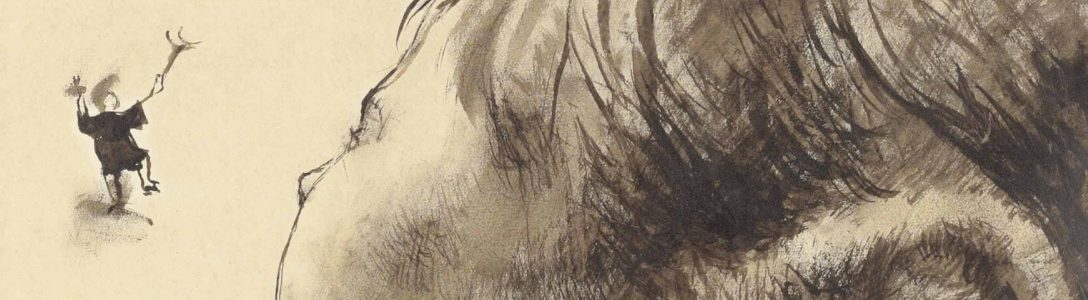
Sanctuary — Earl Cunningham

“A Sea of Troubles” — P.G. Wodehouse

“A Sea of Troubles” by P.G. Wodehouse

Mr Meggs’s mind was made up. He was going to commit suicide.

There had been moments, in the interval which had elapsed between the first inception of the idea and his present state of fixed determination, when he had wavered. In these moments he had debated, with Hamlet, the question whether it was nobler in the mind to suffer, or to take arms against a sea of troubles and by opposing end them. But all that was over now. He was resolved.

Mr Meggs’s point, the main plank, as it were, in his suicidal platform, was that with him it was beside the question whether or not it was nobler to suffer in the mind. The mind hardly entered into it at all. What he had to decide was whether it was worth while putting up any longer with the perfectly infernal pain in his stomach. For Mr Meggs was a martyr to indigestion. As he was also devoted to the pleasures of the table, life had become for him one long battle, in which, whatever happened, he always got the worst of it.

He was sick of it. He looked back down the vista of the years, and found therein no hope for the future. One after the other all the patent medicines in creation had failed him. Smith’s Supreme Digestive Pellets—he had given them a more than fair trial. Blenkinsop’s Liquid Life-Giver—he had drunk enough of it to float a ship. Perkins’s Premier Pain-Preventer, strongly recommended by the sword-swallowing lady at Barnum and Bailey’s—he had wallowed in it. And so on down the list. His interior organism had simply sneered at the lot of them.

‘Death, where is thy sting?’ thought Mr Meggs, and forthwith began to make his preparations. Continue reading ““A Sea of Troubles” — P.G. Wodehouse”

Maxim Gorky Reading in The Penates His Drama Children of the Sun — Ilya Repin

The Mystery of a Summer Night — Edvard Munch

George Catlin Biography (Book Acquired, Some Time Back in the End of June)

20130708-151619.jpg

The end of June kinda got away with me with these books acquired posts.

Anyway, I haven’t really made any time to check out Benita Eisler’s biography of lawyer-turned-painter George Catlin, a self-taught artist who chronicled the lives and culture of the Indians of the Great Plains in the nineteenth century. I like Catlin’s work, so this one might be interesting.

Publisher Norton’s blurb, followed by two of Catlin’s paintings:

The first biography in over sixty years of a great American artist whose paintings are more famous than the man who made them.

George Catlin has been called the “first artist of the West,” as none before him lived among and painted the Native American tribes of the Northern Plains. After a false start as a painter of miniatures, Catlin found his calling: to fix the image of a “vanishing race” before their “extermination”—his word—by a government greedy for their lands. In the first six years of the 1830s, he created over six hundred portraits—unforgettable likenesses of individual chiefs, warriors, braves, squaws, and children belonging to more than thirty tribes living along the upper Missouri River.

Political forces thwarted Catlin’s ambition to sell what he called his “Indian Gallery” as a national collection, and in 1840 the artist began three decades of self-imposed exile abroad. For a time, his exhibitions and writings made him the most celebrated American expatriate in London and Paris. He was toasted by Queen Victoria and breakfasted with King Louis-Philippe, who created a special gallery in the Louvre to show his pictures. But when he started to tour “live” troupes of Ojibbewa and Iowa, Catlin and his fortunes declined: He changed from artist to showman, and from advocate to exploiter of his native performers. Tragedy and loss engulfed both.

This brilliant and humane portrait brings to life George Catlin and his Indian subjects for our own time. An American original, he still personifies the artist as a figure of controversy, torn by conflicting demands of art and success.


“…a spectral cavalry, faces disquietingly wanting in detail, eyes little more than blurred sockets…” (Another Riff on Thomas Pynchon’s Against the Day)

  1. Another riff on/citation from Thomas Pynchon’s Against the Day.
  2. In this episode, our heroes, Chums of Chance Chick Counterfly (chief science officer) and Darby Suckling (chief horndog) have found their way to an off-brand time machine, managed and (shoddily) maintained by Dr. Zoot (whose doctorate seems unlikely). Dr. Zoot sends the boys (ostensibly) to the future for a brief glimpse:

They seemed to be in the midst of some great storm in whose low illumination, presently, they could make out, in unremitting sweep across the field of vision, inclined at the same angle as the rain, if rain it was—some material descent, gray and wind-stressed—undoubted human identities, masses of souls, mounted, pillioned, on foot, ranging along together by the millions over the landscape accompanied by a comparably unmeasurable herd of horses. The multitude extended farther than they could see—a spectral cavalry, faces disquietingly wanting in detail, eyes little more than blurred sockets, the draping of garments constantly changing in an invisible flow which perhaps was only wind. Bright arrays of metallic points hung and drifted in three dimensions and perhaps more, like stars blown through by the shock waves of the Creation. Were those voices out there crying in pain? sometimes it almost sounded like singing. Sometimes a word or two, in a language almost recognizable, came through. Thus, galloping in unceasing flow ever ahead, denied any further control over their fate, the disconsolate company were borne terribly over the edge of the visible world. . . .

The chamber shook, as in a hurricane. Ozone permeated its interior like the musk attending some mating dance of automata, and the boys found themselves more and more disoriented. Soon even the cylindrical confines they had entered seemed to have fallen away, leaving them in a space unbounded in all directions. There became audible a continuous roar as of the ocean—but it was not the ocean—and soon cries as of beasts in open country, ferally purring stridencies passing overhead, sometimes too close for the lads to be altogether comfortable with—but they were not beasts. Everywhere rose the smell of excrement and dead tissue.

Each lad was looking intently through the darkness at the other, as if about to inquire when it would be considered proper to start screaming for help.

“If this is our host’s idea of the future—” Chick began, but he was abruptly checked by the emergence, from the ominous sweep of shadow surrounding them, of a long pole with a great metal hook on the end, of the sort commonly used to remove objectionable performers from the variety stage, which, being latched firmly about Chick’s neck, had in the next instant pulled him off into regions indecipherable. Before Darby had time to shout after, the Hook reappeared to perform a similar extraction on him, and quick as that, both youngsters found themselves back in the laboratory of Dr. Zoot. The fiendish “time machine,” still in one piece, quivered in its accustomed place, as if with merriment. (403-04)

  1. I think the most obvious interpretation here is that our Chums witness part of a battle of the Great War, which is where Against the Day seems to be heading.

  1. What I find most fascinating, though, is the way that Pynchon moves from the physical to the metaphysical in the series of images the Chums witness.

We get an image of “undoubted human identities, masses of souls, mounted, pillioned, on foot, ranging along together by the millions over the landscape accompanied by a comparably unmeasurable herd of horses” seems simultaneously concrete and metaphysical, specific but also hyperbolic.

The scene continues to tread this line—we witness “a spectral cavalry, faces disquietingly wanting in detail, eyes little more than blurred sockets, the draping of garments constantly changing in an invisible flow which perhaps was only wind.”

On one hand, our disoriented Chums (to whose perspective Pynchon limits us) perceive ghosts here (almost cartoonish ghosts, I might add, of the holes-cut-out-for-eyes variety); on the other hand, the “blurred sockets” suggest gas masks and the “constantly changing” garments could perhaps be the variety of uniforms (and armor) of the soldiers.

Continuing: “Bright arrays of metallic points hung and drifted in three dimensions and perhaps more” — Bullets? Bayonets? Missiles? The concrete image is then likened to “stars blown through by the shock waves of the Creation.” The physical shifts into the metaphysical again as Pynchon sends “the disconsolate company . . . terribly over the edge of the visible world.”

  1. Here, the Chums seem to experience the Great War as an intensely compressed allegorical sensation.
  • The second paragraph in the above citation moves the boys into “a space unbounded in all directions” where they perceive “a continuous roar as of the ocean—but it was not the ocean—and soon cries as of beasts in open country, ferally purring stridencies passing overhead, sometimes too close for the lads to be altogether comfortable with—but they were not beasts.”

  • The Chums have no language to describe what they hear; Pynchon has to mediate the similes available to them in negation. But we (and Darby and Chick, of course) know that this place is no bueno: “Everywhere rose the smell of excrement and dead tissue.”

    1. Where have they gone? Are they still in the midst of war—are the sounds planes, bombs? World War I? WWII, site of that other giant Pynchon novel? Hiroshima? Vietnam? The WTC on 9/11? Where? When?

    1. I take the second paragraph to be a brief homage to the penultimate chapter of H.G. Wells’s slim novel The Time Machine (frequently and directly invoked throughout this particular episode of AtD, btw). At the end of that novella, the time traveler, dispensing with Eloi and Morlock alike, takes his machine to the brink of time, to witness the end of the earth and our solar system: “A horror of this great darkness came on me. The cold, that smote to my marrow, and the pain I felt in breathing, overcame me. I shivered, and a deadly nausea seized me.” The Chums of Chance seem to witness a similar extinction.
    2. Ah, but this is Pynchon, of course—so and how does the episode end? With a gag. In a vaudevillian twist, our players are removed from the stage via hook as the time machine, their audience, quivers “as if with merriment.”

    Despite the zaniness of this exit, keep in mind that our heroes are hooked around their necks, lassoed by a noose of sorts—Pynchon saves them, but at the same time visually suggests their death, linking back to the image of mass extinction at the core of the passage.

    1. The paintings in this riff are by the late Polish artist Zdzisław Beksiński; like all of his work they are untitled.

    Demon Splash Page — Jack Kirby

    demon

    (More; via).

    “Motorway to Roswell” — Pixies (Live in 1991)

    “Of Seeming Wise” — Francis Bacon

    “Of Seeming Wise” by Francis Bacon

    IT HATH been an opinion, that the French are wiser than they seem, and the Spaniards seem wiser than they are. But howsoever it be between nations, certainly it is so between man and man. For as the Apostle saith of godliness, Having a show of godliness, but denying the power thereof; so certainly there are, in point of wisdom and sufficiently, that do nothing or little very solemnly: magno conatu nugas. It is a ridiculous thing, and fit for a satire to persons of judgment, to see what shifts these formalists have, and what prospectives to make superficies to seem body, that hath depth and bulk. Some are so close and reserved, as they will not show their wares, but by a dark light; and seem always to keep back somewhat; and when they know within themselves, they speak of that they do not well know, would nevertheless seem to others, to know of that which they may not well speak. Some help themselves with countenance and gesture, and are wise by signs; as Cicero saith of Piso, that when he answered him, he fetched one of his brows up to his forehead, and bent the other down to his chin; Respondes, altero ad frontem sublato, altero ad mentum depresso supercilio, crudelitatem tibi non placere. Some think to bear it by speaking a great word, and being peremptory; and go on, and take by admittance, that which they cannot make good. Some, whatsoever is beyond their reach, will seem to despise, or make light of it, as impertinent or curious; and so would have their ignorance seem judgment. Some are never without a difference, and commonly by amusing men with a subtilty, blanch the matter; of whom A. Gellius saith, Hominem delirum, qui verborum minutiis rerum frangit pondera. Of which kind also, Plato, in his Protagoras, bringeth in Prodius in scorn, and maketh him make a speech, that consisteth of distinction from the beginning to the end. Generally, such men in all deliberations find ease to be of the negative side, and affect a credit to object and foretell difficulties; for when propositions are denied, there is an end of them; but if they be allowed, it requireth a new work; which false point of wisdom is the bane of business. To conclude, there is no decaying merchant, or inward beggar, hath so many tricks to uphold the credit of their wealth, as these empty persons have, to maintain the credit of their sufficiency. Seeming wise men may make shift to get opinion; but let no man choose them for employment; for certainly you were better take for business, a man somewhat absurd, than over-formal.

    Young Girl Reading a Manuscript — Thomas Cooper Gotch

    c4e94758b1b56d43a661def4de68ed60

    Lace and Ghosts — Victor Hugo

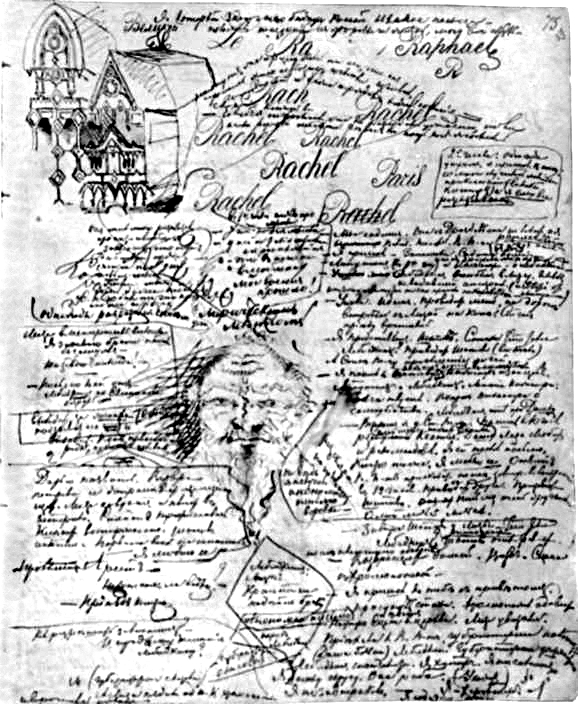
    Manuscript Page of Dostoevsky’s Demons (With Doodles)

    Dostoyevsky_The_Demons_Manuscript

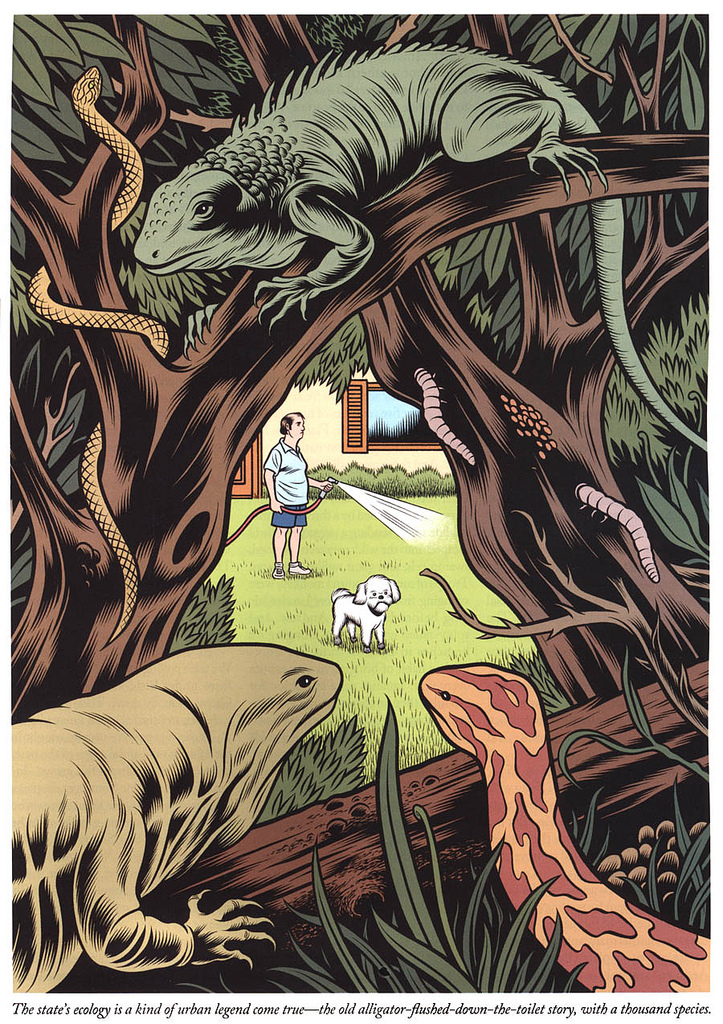
    Ecology — Charles Burns

    burns

    (Via).

    The Henry Miller Odyssey