The Black Cow — Camille Corot

“Heat” — Denis Johnson

“Heat” by Denis Johnson—

Here in the electric dusk your naked lover

tips the glass high and the ice cubes fall against her teeth.

It’s beautiful Susan, her hair sticky with gin,

Our Lady of Wet Glass-Rings on the Album Cover,

streaming with hatred in the heat

as the record falls and the snake-band chords begin

to break like terrible news from the Rolling Stones,

and such a last light—full of spheres and zones.

August,

you’re just an erotic hallucination,

just so much feverishly produced kazoo music,

are you serious?—this large oven impersonating night,

this exhaustion mutilated to resemble passion,

the bogus moon of tenderness and magic

you hold out to each prisoner like a cup of light?

The Tube Train — Cyril E. Power

S.D. Chrostowska’s Permission (Book Acquired, 8.10.2013)

20130814-174008.jpg

Sylwia Chrostowska’s novel Permission—got it in the mail on Saturday. I’d been swimming in the river, in the relentless August sun, for most of the day, and when I got home I just wanted to watch a film and drink some wine and pass out.

But I started reading. And reading. And then I looked up and and I was like fifty pages in.

Here’s publisher Dalkey Archive’s blurb:

Composed of anonymous e-mail messages sent by the author to an acclaimed visual artist over the course of a year, Permission is the record of an experiment: an attempt to forge a connection with a stranger through the writing of a book. Part meditation, part narrative, part essay, it is presented to its addressee as a gift that asks for no thanks or acknowledgment—but what can be given in words, and what received?Permission not only updates the “epistolary novel” by embracing the permissiveness we associate with digital communication, it opens a new literary frontier.

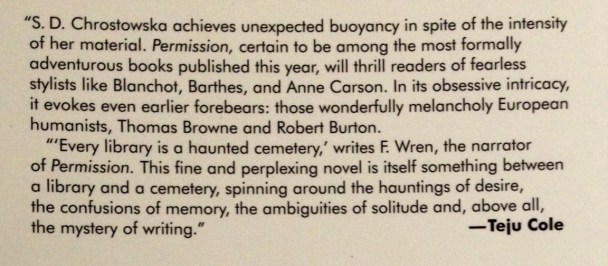
And here’s novelist Teju Cole’s blurb, from the back of the book (for some reason not posted at Dalkey):
20130814-174328.jpg

Permission’s central premise (if such a work so soaked in deconstruction could be said to have a center) immediately recalled to me Jacques Derrida’s discussions of the paradox of giving:

To rephrase my experimental question: can I give away what is inalienable from me (my utterance, myself) without the faintest expectation or hope of authority, solidarity, reciprocity? Can my giving be unhinged from a sense of both investment and pointless expenditure?

The first few “chapters” — the narrator’s weekly missives to the unnamed artist — are thoroughly soaked in deconstruction and continental philosophy; this is a novel that cites Blanchot and Deleuze in its first twenty pages. However, the narrator promises that her book, “through its progressive dissolution, towards the final solution of this writing (my work) . . . becomes progressively less difficult, less obscure.”

This promise seems true, as subsequent passages flow into personal memory, reflection—storytelling. We get a brief tour of cemeteries, a snapshot of the narrator’s father (as a child) at a child’s funeral, a recollection of the narrator’s first clumsy foray into fiction writing, a miniature memoir of a failed painter, color theory, the sun, the moon.

Strange and lovely stuff. More when I finish.

Creation of the World — Remedios Varo

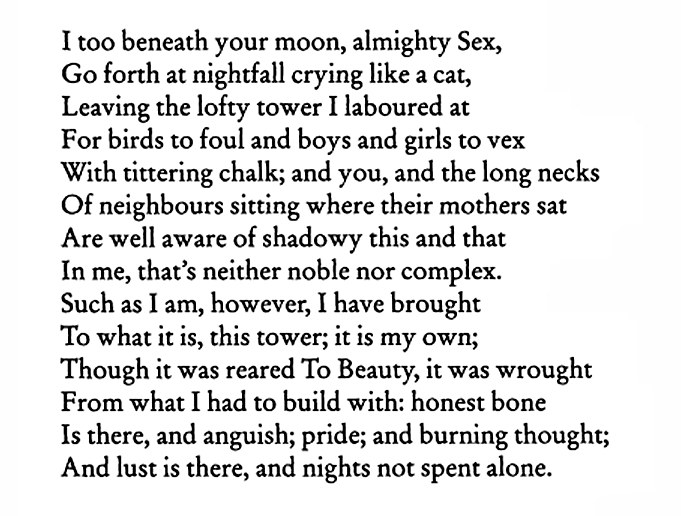
“I too beneath your moon, almighty Sex” — Edna St. Vincent Millay

esvm

Goya’s Lover — Walasse Ting

“You’ve Got Worms” and Other Images from Anton Chekhov’s Note-Books

* * * * *

The French say: “Laid comme un chenille”—as ugly as a caterpillar.

* * * * *

People are bachelors or old maids because they rouse no interest, not even a physical one.

* * * * *

The children growing up talked at meals about religion and laughed at fasts, monks, etc. The old mother at first lost her temper, then, evidently getting used to it, only smiled, but at last she told the children that they had convinced her, that she is now of their opinion. The children felt awkward and could not imagine what their old mother would do without her religion.

* * * * *

There is no national science, just as there is no national multiplication table; what is national is no longer science.

* * * * *

The dog walked in the street and was ashamed of its crooked legs.

* * * * *

The difference between man and woman: a woman, as she grows old gives herself up more and more to female affairs; a man, as he grows old, withdraws himself more and more from female affairs.

* * * * *

That sudden and ill-timed love-affair may be compared to this: you take boys somewhere for a walk; the walk is jolly and interesting—and suddenly one of them gorges himself with oil paint.

* * * * *

The character in the play says to every one: “You’ve got worms.” He cures his daughter of the worms, and she turns yellow.

* * * * *

–From Anton Chekhov’s Note-Books.

Inside a Tent in the Canadian Rockies — John Singer Sargent

This Must Be The Only Fantasy, a Sci-Fi Short by Todd Cole Featuring New Music by Beach House

Meteor Shower — Jamie Wyeth

Read 45 Small Fates from Teju Cole

If you follow Teju Cole on Twitter, you’ve likely already read many of his small fates, tweets he composed over two years drawn from Nigerian newspapers. The project follows the spirit of Félix Fénéon’s faits divers, three-line tragedies collected from the news.

Cole has written about the project in detail at his site, as have a number of other sites, but I can’t recall seeing the small fates put together in one place before The New Inquiry published 45 today under the title I don’t normally do this sort of thing. Cole’s small fates operate on a wonderfully strange axis of comedy and horror; they are brief but rich, ironic but intensely real.

Sample:

tc

Read the rest of I don’t normally do this sort of thing.

I also highly recommend Cole’s novel Open City.

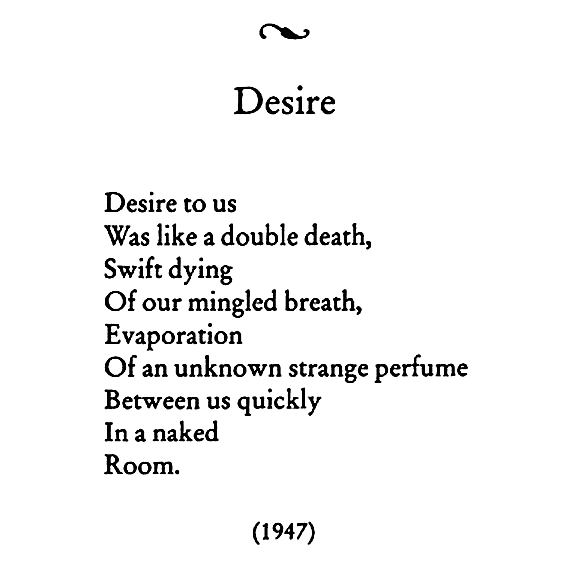
“Desire” — Langston Hughes

desire

The Pupils — Michaël Borremans

“Books Are Like Brothers” and Other Notes from F. Scott Fitzgerald’s Notebooks

  1. Nothing is any more permitted in fiction like stage convention of keeping people on stage by coincidences.
  2. Must listen for conversation style a la Joyce
  3. Nevertheless value of Ernest’s feeling about the pure heart when writing—in other words the comparatively pure heart, the “house in order.”
  4.  Resent the attempt of the boys and girls who tried to bury me before I was dead.
  5. Books are like brothers. I am an only child. Gatsby my imaginary eldest brother, Amory my younger, Anthony my worry. Dick my comparatively good brother but all of them far from home. When I have the courage to put the old white light on the home of my heart, then—
  6. Shakespeare—whetting, frustrating, surprising and gratifying.
  7. Forebearance, good word.
  8. I can never remember the times when I wrote anything—This Side of Paradise time or Beautiful and Damned and Gatsby time for instance. Lived in story.
  9. That Willa Cather’s poem shall stand at beginning of Mediaval and that it shall be the story of Ernest.
  10. Just as Stendahl’s portrait of a Byronic man made Le Rouge et Noir so couldn’t my portrait of Ernest as Phillipe make the real modern man.
  11. There never was a good biography of a good novelist. There couldn’t be. He is too many people if he’s any good.
  12. And such condescension toward the creative life— Tolstoi caught the sense of the Napoleonic wars out in the street from the man in the street; his comments on fiction which would make any old 1864 copy of Leslie’s more humanly valuable than The Red Badge of Courage—the idealization of all that passes through his empty mind; his hatred of all people who formed the world in which he lives—a political Oscar Wilde peddling in the provinces the plums he took from our pudding; his role of Jesus cursing. You can see him going from prize fight to first night to baseball game-maybe even to women—trying to put back into movement the very things Lenin regretted that he might have destroyed—gracelessness and ugliness for its own sake. Gentlemen, proletarians—for a prize skunk I give you Mr. Forsite.

—From F. Scott Fitzgerald’s The Notebooks.


Reading Girl — Istvan Ilosvai Varga

Silver Surfer — Jack Kirby

silver surfer

(Via).