The Barber Shop — Edward Hopper

Although Of Course You End Up Riffing Obliquely on How a David Foster Wallace Road Trip Movie Is a Terrible Idea

  1. In 1992 I asked my grandmother to rent Steven Soderbergh’s film Kafka from Blockbuster so I could watch it. We watched it together. I was intrigued; she found it dull. I saw it again in college and then again a few years ago. It’s nothing special.
  2. In my freshman year of college I lived right next to a big video rental place that rented most old films for a dollar. This is where I discovered Where the Buffalo Roam, a 1980 semi-biopic starring Bill Murray as Hunter S. Thompson with music from Neil Young. My metaphorical lid flipped. I returned to my apartment to screen this strange find. Disappointment.
  3. Seeing and immediately being disappointed by Where the Buffalo Roam fits neatly into another memory: In 1991 a record store clerk dissuaded me from buying an expensive bootleg recording of Jimi Hendrix featuring Jim Morrison. The clerk went to great lengths to do this (short of opening the CD, of course), insisting that the record was awful, that it should never have been released. A few weeks later a friend loaned me a tape of the recording he’d somehow acquired. Total garbage. I didn’t even bother to dub it.
  4. (Sometimes when I see that some new scrap and tittle of a dead author’s work is going to be posthumously published, I think of that Hendrix/Morrison recording).
  5. In 1998 I saw Terry Gilliam’s adaptation of Fear and Loathing in Las Vegas. Sloppy, cartoonish, vivid, and occasionally incoherent, Fear and Loathing is successful mostly because it isn’t a film about Hunter S. Thompson. It’s a film about the end of the illusion of the 1960s.
  6. I don’t remember when I first saw Barfly. Sometime in college. Undoubtedly I tried to keep pace with old Hank on-screen. Hence the poor memory.
  7. Factotum: I fell asleep at the end. But it wasn’t bad, I guess. A good attempt at interpreting Bukowski’s autobiographical novel.
  8. (But obviously the documentaries that feature Bukowski himself are so much more alive than any interpretation).
  9. Some interpretations of writers’ lives benefit from the distance—the distortion—of time: QuillsThe LibertineMarat/Sade, any riff on Shakespeare (although I can’t think of one that isn’t crap, actually, right this minute), etc.
  10. In particular, Jane Campion’s film Bright Star is excellent, but it’s not really about John Keats: The film is really about Fanny Brawne. Again though, I think time’s distortion helps.
  11. (And oh lord I would love to see Val Kilmer’s one-man Mark Twain show, but that’s a whole other thing, not a film thing, not even a writer thing, more of a Kilmer thing).
  12. The Faulkner/Hemingway amalgamation in Barton Fink is something else.
  13. I turned off Capote.
  14. I turned off The Motorcycle Diaries.
  15. A few weeks ago I turned off Walter Salles’s adaptation of On the Road.
  16. The Guardian and other sources report that Jason Segel will play David Foster Wallace in a film adaptation of David Lipsky’s Rolling Stone interview-turned-full-length-book, Although Of Course You End Up Becoming Yourself: A Road Trip With David Foster Wallace. Jesse Eisenberg will reportedly take awkwardly stammer through Lipsky’s role.
  17. Jason Segel, of the hit CBS comedy How I Met Your Mother, will play the late David Foster Wallace, who wrote “Good Old Neon.”
  18. Jason Segel, a Judd Apatow stable staple, will play the late David Foster Wallace, who wrote an essay about misanthropy and a cruise ship.
  19. Jason Segel, whose goofy charm and lovable good-nature belie a sensitive temperament, will play the late David Foster Wallace, who often wore a bandanna on his head.
  20. Although Of Course You End Up Becoming Yourself covers Wallace touring on his Infinite Jest book tour; his fame explodes and he’s not entirely sure what any of it means yet—whether to enjoy it, how to enjoy it, is it even possible to enjoy it, etc. Lipsky inserts a heavy editorial hand—lots of bracketed thoughts in this one, as our interlocutor repeatedly registers, or attempts to register, his own verbal dexterity, his own writerliness. And who can blame him? What writer-critic can resist showing a little plumage to the writer under discussion (to steal James Wood’s phrase)?
  21. Lipsky’s book features one of the most intriguing characters in late twentieth-century literature: David Foster Wallace performing David Foster Wallace attempting to not-perform David Foster Wallace by acknowledging that David Foster Wallace is self-consciously aware of performing himself.
  22. I can easily envision the shape, the tone, the contours, the set-pieces of this proposed film adaptation. A road trip film, a buddy film, but a film about antagonists, bullshitters, waxing hard, some high laughs, some intense moments (gaining so much easy shallow depth from Wallace’s suicide), maybe a few reading scenes. Etc.
  23. And that’s what most bothers me about this film adaptation: How easily I can imagine what it will likely look and sound and feel like. How comfortable it all is.
  24. There’s just not enough of that magical temporal distortion I referenced in point nine. The film is likely to piss off real fans of Wallace’s work and give anyone else interested a facile notion of who the writer was and what he thought and how he thought and how he represented and shared what he thought. How is such a film not a crass cash grab? Even if the film were artistically successful (leave aside what that nebulous term could mean for a moment, please)—again, how is such a film not a crass cash grab?
  25. I could be wrong though. I’m fine with being wrong.

Reclining Woman with Green Stockings — Egon Schiele

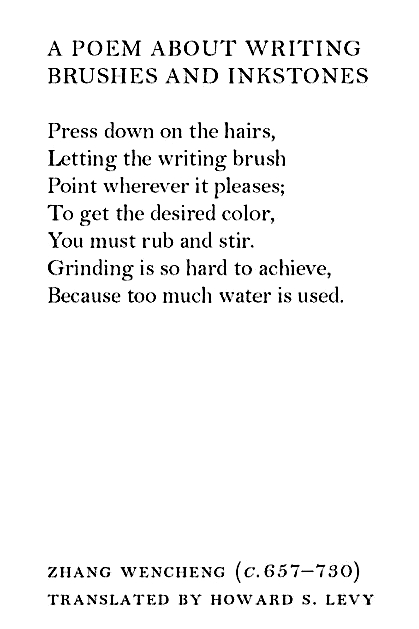
“A Poem About Writing Brushes and Inkstones” — Zhang Wencheng

brushes

Dwelling in the Pure and Infinite — William T. Wiley

“A sublime murkiness and original pent fury” | Walt Whitman on Millet’s Paintings

The Diggers, Jean-Francois Millet

April 18.—Went out three or four miles to the house of Quincy Shaw, to see a collection of J. F. Millet’s pictures. Two rapt hours. Never before have I been so penetrated by this kind of expression. I stood long and long before “the Sower.” I believe what the picture-men designate “the first Sower,” as the artist executed a second copy, and a third, and, some think, improved in each. But I doubt it. There is something in this that could hardly be caught again—a sublime murkiness and original pent fury. Besides this masterpiece, there were many others, (I shall never forget the simple evening scene, “Watering the Cow,”) all inimitable, all perfect as pictures, works of mere art; and then it seem’d to me, with that last impalpable ethic purpose from the artist (most likely unconscious to himself) which I am always looking for. To me all of them told the full story of what went before and necessitated the great French revolution—the long precedent crushing of the masses of a heroic people into the earth, in abject poverty, hunger—every right denied, humanity attempted to be put back for generations—yet Nature’s force, titanic here, the stronger and hardier for that repression—waiting terribly to break forth, revengeful—the pressure on the dykes, and the bursting at last—the storming of the Bastile—the execution of the king and queen—the tempest of massacres and blood. Yet who can wonder?

Could we wish humanity different? Could we wish the people made of wood or stone? Or that there be no justice in destiny or time?

The true France, base of all the rest, is certainly in these pictures. I comprehend “Field-People Reposing,” “the Diggers,” and “the Angelus” in this opinion. Some folks always think of the French as a small race, five or five and a half feet high, and ever frivolous and smirking. Nothing of the sort. The bulk of the personnel of France, before the revolution, was large-sized, serious, industrious as now, and simple. The revolution and Napoleon’s wars dwarf’d the standard of human size, but it will come up again. If for nothing else, I should dwell on my brief Boston visit for opening to me the new world of Millet’s pictures. Will America ever have such an artist out of her own gestation, body, soul?

—From Walt Whitman’s journal of 1881


In the Barber Shop — Ilya Bolotowsky

“The same blue rocks and spectral grottos could be seen in Leonardo’s Virgin of the Rocks” | J.G. Ballard

From J.G. Ballard’s short story “The Gioconda of the Twilight Noon”:

‘There’s a postcard from your mother. They’re near Malta, somewhere called Gozo.’

‘Give it to me.’ Maitland felt the card in his hands.

‘Gozo – that was Calypso’s island. She kept Ulysses there for seven years, promised him eternal youth if he’d stay with her forever.’

‘I’m not surprised.’ Judith inclined the card towards her. ‘If we could spare the time, you and I should go there for a holiday. Wine–dark seas, a sky like heaven, blue rocks. Bliss.’

‘Blue?’

‘Yes. I suppose it’s the bad printing. They can’t really be like that.’

‘They are, actually.’

Still holding the card, Maitland went out into the garden, feeling his way along the string guiderail. As he settled himself in the wheelchair he reflected that there were other correspondences in the graphic arts. The same blue rocks and spectral grottos could be seen in Leonardo’s Virgin of the Rocks, one of the most forbidding and most enigmatic of his paintings. The madonna sitting on a bare ledge by the water beneath the dark overhang of the cavern’s mouth was like the presiding spirit of some enchanted marine realm, waiting for those cast on to the rocky shores of this world’s end. As in so many of Leonardo’s paintings, all its unique longings and terrors were to be found in the landscape in the background. Here, through an archway among the rocks, could be seen the crystal blue cliffs that Maitland had glimpsed in his reverie.


“Here is the riddle, and it is a son-of-a-bitch” (Donald Barthelme)

Here is the riddle said the Great Father Serpent with a great flourishing of his two-tipped tongue, and it is a son-of-a-bitch I will tell you that, the most arcane item in the arcana, you will never guess it in a hundred thousand human years some of which I point out have already been used up by you in useless living and breathing but have a go, have a go, do: What do you really feel? Like murderinging, I answered, because that is what I had read on the underside of the tin, the wording murderinging inscribed in a fine thin cursive. Why bless my soul, said the Great Father Serpent, he’s got it, and the two ruffians blinked at me in stunned wonder and I myself wondered, and marveled, but what I was wondering and marveling at was the closeness with which what I had answered accorded with my feelings, my lost feelings that I had never found before. I suppose, the Father Serpent said, that the boon you wish granted is the ability to carry out this foulness? Of course, I said, what else? Granted then, he said, but may I remind you that having the power is often enough. You don’t have to actually do it. For the soul’s ease. I thanked the Great Father Serpent; he bowed most cordially; my companions returned me to the city. I was abroad in the city with murderinging in mind — the dream of a stutterer.

That is a tall tale, said the Dead Father. I don’t believe it ever happened.

No tale ever happened in the way we tell it, said Thomas, but the moral is always correct.

What is the moral?

Murderinging, Thomas said.

From Donald Barthelme’s novel The Dead Father.


Original Sin — Salvador Dali

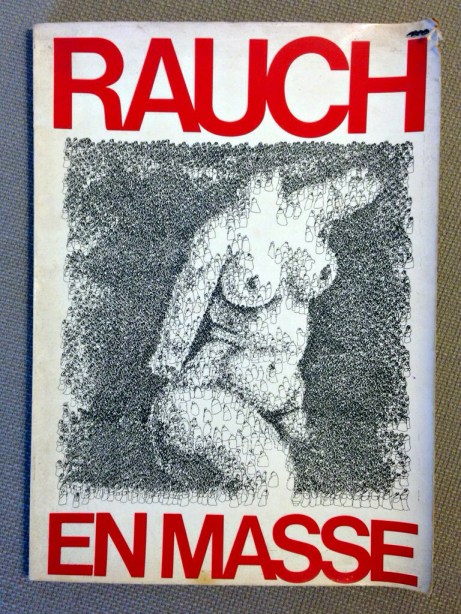
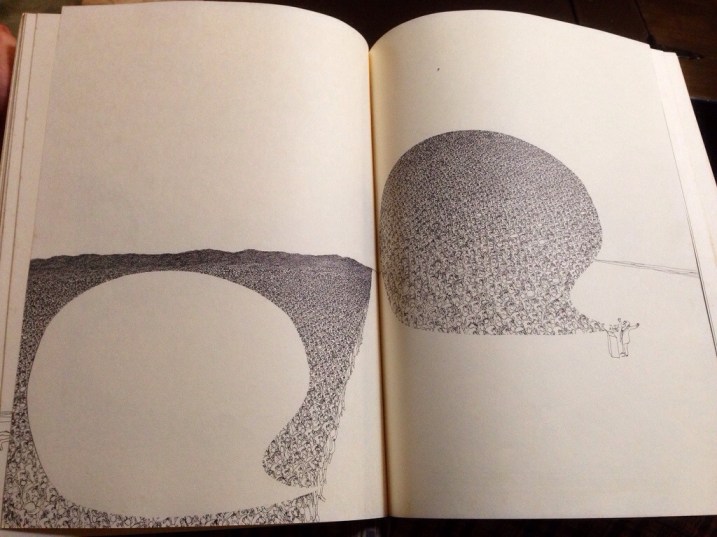
Rauch’s En Masse (Book Acquired, 12.09.2013)

r

Meandering through the bookstore on a Monday morn, I spied this beat up copy of Hans-Georg Rauch’s En Masse and had to have it.

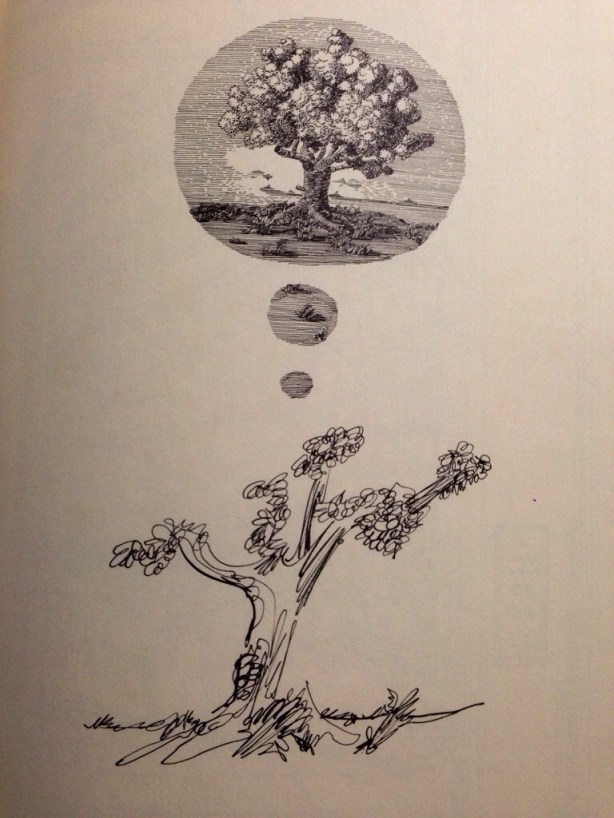
I’d never heard of Rauch before, but his spidery ink drawings immediately intrigued me.

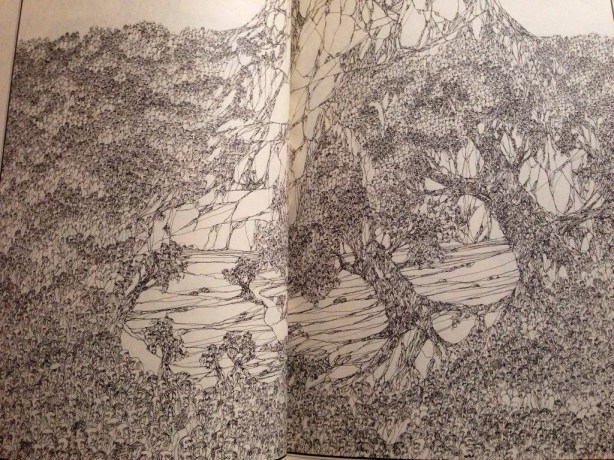
None of the images in En Masse is labeled—indeed, there are no words in the book.

Instead, Rauch plays with themes of creation and nihilism, sex and politics, architecture and nature.

20131211-143452.jpg

This two page spread came out blurry via my iPhone pic—sorry—but in the book’s oversize 13″ x 9″ format  the effect is overwhelming.

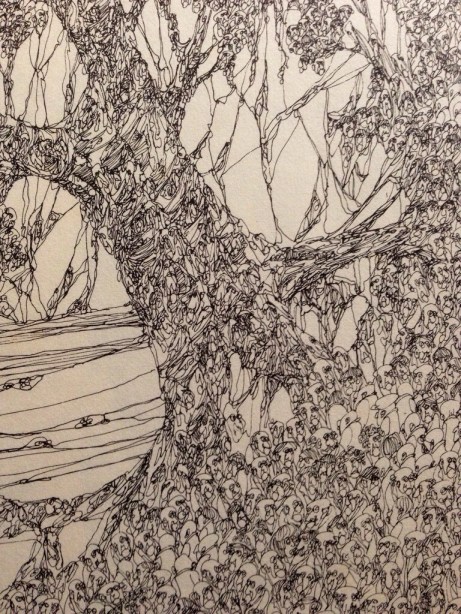
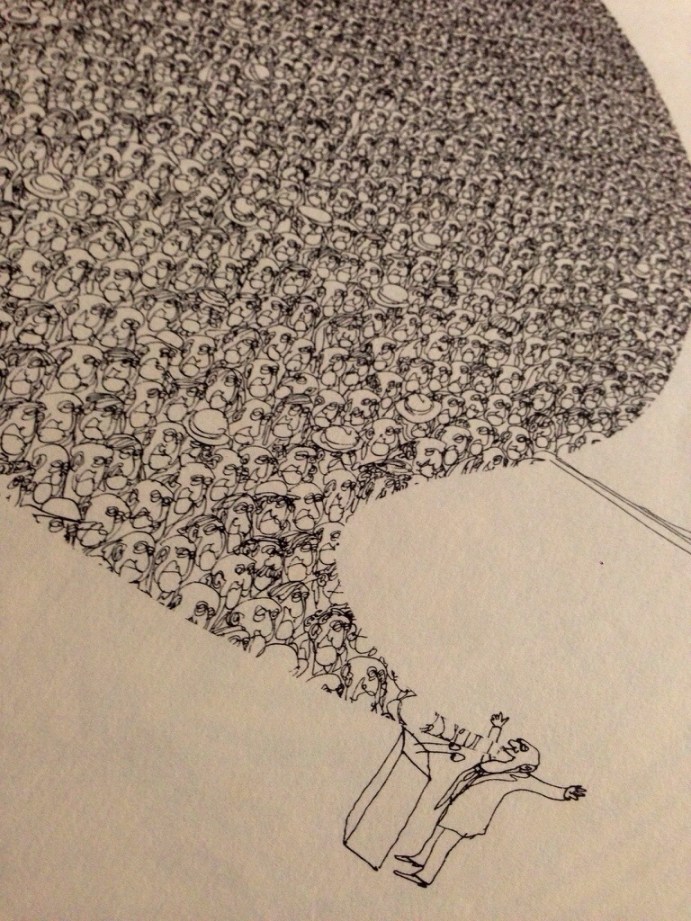
You can see some of the masses perhaps better in this close-up:

20131211-143459.jpg

Rauch’s cartoony style is balanced with an Escher-like acumen; the guy can draft. But there’s a sense of humor here that I think puts him closer to Tomi Ungerer.

20131211-143505.jpg

20131211-143518.jpg

20131211-143525.jpg

Lovely stuff.

20131211-143532.jpg

“The Darling” — Anton Chekhov

“The Darling” by Anton Chekhov

Olenka, the daughter of the retired collegiate assessor Plemyanikov, was sitting on the back-door steps of her house doing nothing. It was hot, the flies were nagging and teasing, and it was pleasant to think that it would soon be evening. Dark rain clouds were gathering from the east, wafting a breath of moisture every now and then.

Kukin, who roomed in the wing of the same house, was standing in the yard looking up at the sky. He was the manager of the Tivoli, an open-air theatre.

“Again,” he said despairingly. “Rain again. Rain, rain, rain! Every day rain! As though to spite me. I might as well stick my head into a noose and be done with it. It’s ruining me. Heavy losses every day!” He wrung his hands, and continued, addressing Olenka: “What a life, Olga Semyonovna! It’s enough to make a man weep. He works, he does his best, his very best, he tortures himself, he passes sleepless nights, he thinks and thinks and thinks how to do everything just right. And what’s the result? He gives the public the best operetta, the very best pantomime, excellent artists. But do they want it? Have they the least appreciation of it? The public is rude. The public is a great boor. The public wants a circus, a lot of nonsense, a lot of stuff. And there’s the weather. Look! Rain almost every evening. It began to rain on the tenth of May, and it’s kept it up through the whole of June. It’s simply awful. I can’t get any audiences, and don’t I have to pay rent? Don’t I have to pay the actors?”

The next day towards evening the clouds gathered again, and Kukin said with an hysterical laugh:

“Oh, I don’t care. Let it do its worst. Let it drown the whole theatre, and me, too. All right, no luck for me in this world or the next. Let the actors bring suit against me and drag me to court. What’s the court? Why not Siberia at hard labour, or even the scaffold? Ha, ha, ha!”

It was the same on the third day.

Olenka listened to Kukin seriously, in silence. Sometimes tears would rise to her eyes. At last Kukin’s misfortune touched her. She fell in love with him. He was short, gaunt, with a yellow face, and curly hair combed back from his forehead, and a thin tenor voice. His features puckered all up when he spoke. Despair was ever inscribed on his face. And yet he awakened in Olenka a sincere, deep feeling. Continue reading ““The Darling” — Anton Chekhov”

The Council Chamber — Edward Burne-Jones

Love — Martiros Saryan

“Life does not agree with philosophy: there is no happiness which is not idleness and only the useless is pleasurable” (Chekhov)

* * * * *

The hen sparrow believes that her cock sparrow is not chirping but singing beautifully.

* * * * *

When one is peacefully at home, life seems ordinary, but as soon as one walks into the street and begins to observe, to question women, for instance, then life becomes terrible. The neighborhood of Patriarshi Prudy (a park and street in Moscow) looks quiet and peaceful, but in reality life there is hell.

* * * * *

These red-faced young and old women are so healthy that steam seems to exhale from them.

* * * * *

The estate will soon be brought under the hammer; there is poverty all round; and the footmen are still dressed like jesters.

* * * * *

There has been an increase not in the number of nervous diseases and nervous patients, but in the number of doctors able to study those diseases.

* * * * *

The more refined the more unhappy.

* * * * *

Life does not agree with philosophy: there is no happiness which is not idleness and only the useless is pleasurable.

* * * * *

The grandfather is given fish to eat, and if it does not poison him and he remains alive, then all the family eat it.

* * * * *

—From Anton Chekhov’s Note-Books.

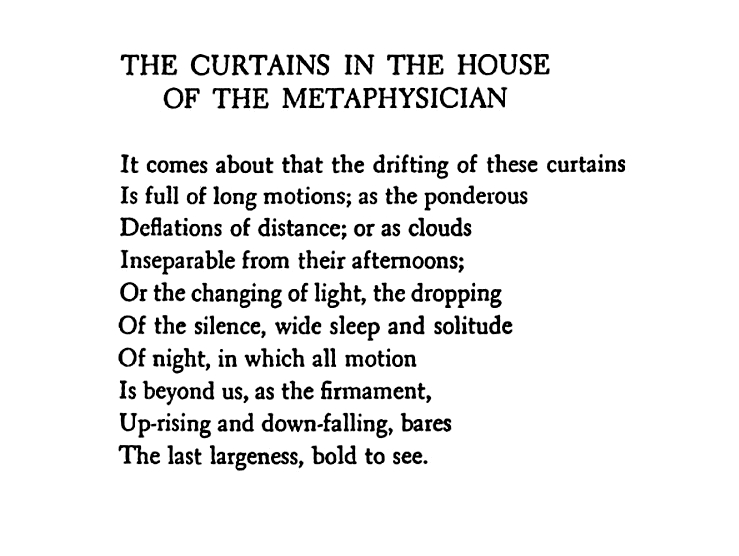
“The Curtains in the House of the Metaphysician” — Wallace Stevens

Capture

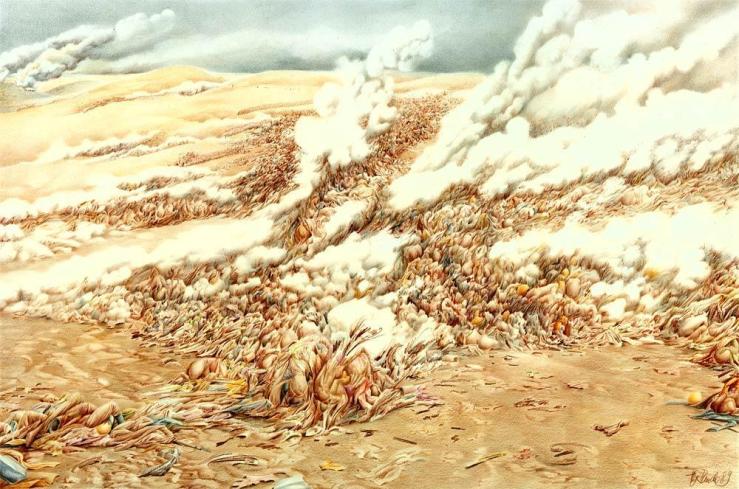
Battle Paintings II — Hans-Georg Rauch

battle