Reviews Page Redesign (And a Reflection on Sexist Reviewing Habits)

So I updated Biblioklept’s Reviews page.

The page had just been a list of the reviews, riffs, and essays published on the blog, with each new entry stacking up in chronological order. For years I’ve known that this unorganized review dump was essentially useless, and I’d been meaning to turn it into an alphabetical index—and I finally did. (I kept the chronolist too, mostly for myself).

Anyway, as I went through this boring, sort-of-arduous process, I couldn’t help but reflect on a few of the habits that manifest under the surface:

The obvious: The reviews on the blog trend very heavily toward male authors. I already knew this, but counting things up makes it plain:

To date, I’ve run reviews of approximately 221 authors (approximate in the sense that I counted only once); of those reviews, only 36 were books by women. That’s about 16%. (This analysis doesn’t even begin to consider the multiple reviews of authors—for example, there are like a ton of reviews of Roberto Bolaño books, but only one review of a Clarice Lispector book). This ratio runs counter to what I’d like to believe are my principles; the number certainly contrasts with the fiction and poetry that I run on the blog (public domain stuff), which trends toward female authors. The number also contrasts with the ratio of male to female authors — roughly 1:1 — that appear on my course syllabuses.

If my tone sounds defensive, it’s because it is. The Read Women 2014 project has helped to highlight sexist reading habits—including my own. Sexism—any kind of prejudicial ism (and every ism is prejudicial) manifests as a blinding structure: Part of the structuring condition of ideological sexism is that the sexist person usually cannot see that he is sexist (he cannot see that he cannot see). I’m not offering this as a defense of my own habits: I’m not saying, Look, I’m aware of my skewed reviewing habits, and my very awareness of my inherent sexism makes me less sexist, absolves, me, etc. (But look at how I rhetorically dance around simply writing, My reviewing habits are sexist; look at how I’m still unable to simply type I’m probably a sexist, let alone I’m sexist, let me hedge, use parentheses, etc.).

Can I turn attention away from myself and onto the aesthetic critic Harold Bloom? In his Paris Review interview, he claimed:

I do not for a moment yield to the notion that any social, racial, ethnic, or “male” interest could determine my aesthetic choices. I have a lifetime of experience, learning, and insight that tells me this.

Bloom’s statement is a perfect example of I cannot see that I cannot see. (Stephen Colbert essentially ridicules this kind of blindness on his satirical show The Colbert Report by repeatedly claiming that he is not racist because he cannot see color).

I think that (I know that) a certain male interest determines my aesthetic interest. At the same time, I understand Bloom’s resistance to the notion that aesthetics are somehow contingent on gender. Could a man have written “A Good Man Is Hard to Find” or To the Lighthouse or Death Comes to the Archbishop or Their Eyes Were Watching God? (A man didn’t). We’d like to believe that the Great Stuff transcends the material world—that part of its timelessness is that it’s not bound to mortal gendered coils. Etc.

What about now? What about Read Women 2014? I’ve been reading more women authors, I think, but I haven’t been reviewing them. I recently reread Flannery O’Connor’s collection Everything That Rises Must Converge, some Gertrude Stein I’d never read before (including Tender Buttons), and some short stories by Eudora Welty and Willa Cather. I’ve read far less contemporary stuff though, although I did review Jessica Hollander’s excellent collection In These Times the Home Is a Tired Place. In general though, I tend to read less contemporaryish fiction now than I used to—I’m reading three books now, and only one is by a living author (Ben Marcus). Of the three books I’m reading now, only one is by a woman (Zelda Fitzgerald). Of the last ten book reviews published on this site, four are of books by women.

Data and numbers are unappealing—especially when they quantify something we (and when I write we you know I mean I) don’t want to acknowledge. We’d (I’d) rather qualify than quantify. Etc.

I suppose it’s the idea of a conscious effort that so repels some of us (me). The notion that I (we?) might have to make an actual intellectual (not aesthetic, perhaps non-intuitive) effort to differentiate our reading. But that’s what it takes, right? An effort. A recognition. A looking.

Two Women Reading — Robert Reid

c978d2c940027122e8968c2201ae166f

An Excerpt From Gerald Murnane’s “Sipping The Essence”

Even drunk on tepid beer we could not talk honestly. Our messages for one another were obliquely worded, or hidden behind childish mimes and antics. At a certain point in the evening Durkin would make a show of examining the tangle of blankets on my bed and finding evidence that a man and a woman had shared it not long before. I would point out what I claimed were signs that a young adult male had recently masturbated there, using a heap of pillows as a surrogate woman and seeing the furthest wrinkles in his blankets as the coastal hills of the Mornington Peninsula. Durkin would then tidy the bedclothes and demonstrate what I ought to do on the bed as soon as I had come to my senses and invited home one of the thousands of girls in Melbourne who were waiting every night by their telephones as anxious to meet a new man as Carolyn had been at Sorrento. Then, if I was drunk enough, I would argue that all those women must have once been to the Gold Coast of Queensland as Carolyn had been and must have learned there too much for a beginner like myself. And if I saw that he was drunk enough I would announce that my last hope was his sixteen-years-old sister. Had he guarded her honour? I would shout at him. Could he keep her from setting out towards the Gold Coast and deliver her to me instead? I would treat her honourably and do no more than read my poems to her until our wedding night and be a fine, boozy brother-in-law to him for the rest of our lives.

When his sister was mentioned he would offer to fight me, and we would grapple on the floor until our buckets of bottles were in danger. Whenever I was on top of him and had him by the throat I boasted that my strength came from my celibate way of life. But whenever he had pinned me to the floor I begged him to procure me his sister or any girl who would give me a strength like his.

Found in the collection Landscape With Landscape.

The Pervert’s Guide to Cinema — Slavoj Žižek (Full Film)

Silent One — Christopher Orr

“A Crazed Girl” — William Butler Yeats

wby

Girl in Black — Egon Schiele

“The struggle alone pleases us, not the victory” (Pascal)

The struggle alone pleases us, not the victory. We love to see animals fighting, not the victor infuriated over the vanquished. We would only see the victorious end; and, as soon as it comes, we are satiated. It is the same in play, and the same in the search for truth. In disputes we like to see the clash of opinions, but not at all to contemplate truth when found. To observe it with pleasure, we have to see it emerge out of strife. So in the passions, there is pleasure in seeing the collision of two contraries; but when one acquires the mastery, it becomes only brutality. We never seek things for themselves, but for the search. Likewise in plays, scenes which do not rouse the emotion of fear are worthless, so are extreme and hopeless misery, brutal lust, and extreme cruelty.

From Pascal’s Pensées.

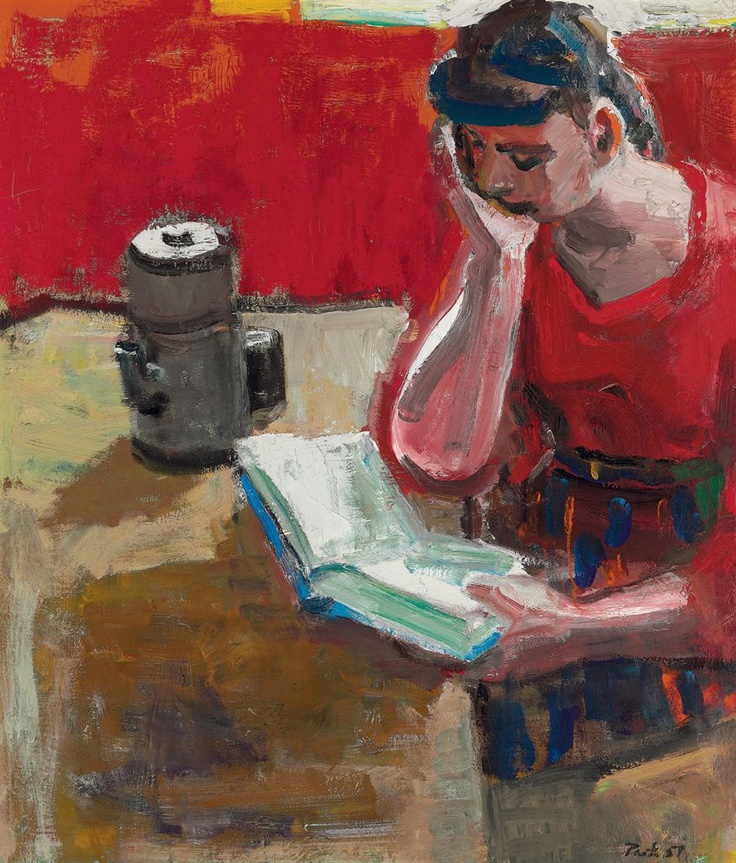
Woman Reading — David Park

1d57a73ac8ce493ac59e37b058b43c71

Star Dust — Glenn Brown

wartist100-3

Lord Gloom (Perry Bible Fellowship)

PBF131-Lord_Gloom

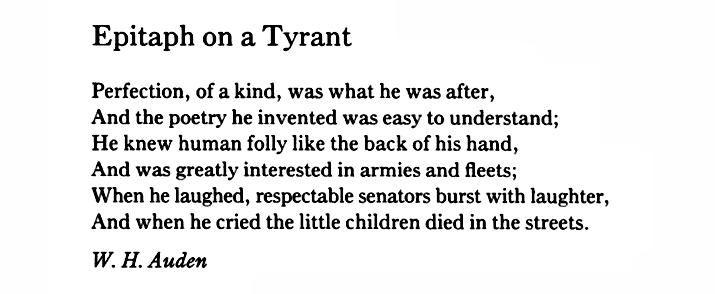
“Epitaph on a Tyrant” — W.H. Auden

tyrant

A Rambling Riff on True Detective

1. So usually after I watch the newest episode of True Detective—this week, that means episode five, “The Secret Fate of All Life”—usually I rewatch the episode and then want to write about it and feel stymied. Last week, I had to (was compelled to) rewatch “Who Goes There” immediately after the first viewing.

This is a long lead up to saying, basically, that I haven’t gotten to rewatching “The Secret Fate of All Life” yet, because this episode compelled me to go back to the beginning, to start from “The Long Bright Dark.”

2. So some quick thoughts on “Secret Fate” (with the caveat that I haven’t rewatched it, along with the caveat that these riffs are written to an audience which has already watched the show):

3. The major theme of “Secret Fate” is time. This episode argues that time is an illusion (just as earlier episodes argued that identity is an illusion)—that time is a trick of perception. Continue reading “A Rambling Riff on True Detective”

Untitled (Ghosties) –Lyonel Feininger

“The Repairer of Reputations” — Robert W. Chambers

“The Repairer of Reputations”

by Robert W. Chambers

I

“Ne raillons pas les fous; leur folie dure plus longtemps que la nôtre…. Voila toute la différence.”

Toward the end of the year 1920 the Government of the United States had practically completed the programme, adopted during the last months of President Winthrop’s administration. The country was apparently tranquil. Everybody knows how the Tariff and Labour questions were settled. The war with Germany, incident on that country’s seizure of the Samoan Islands, had left no visible scars upon the republic, and the temporary occupation of Norfolk by the invading army had been forgotten in the joy over repeated naval victories, and the subsequent ridiculous plight of General Von Gartenlaube’s forces in the State of New Jersey. The Cuban and Hawaiian investments had paid one hundred per cent and the territory of Samoa was well worth its cost as a coaling station. The country was in a superb state of defence. Every coast city had been well supplied with land fortifications; the army under the parental eye of the General Staff, organized according to the Prussian system, had been increased to 300,000 men, with a territorial reserve of a million; and six magnificent squadrons of cruisers and battle-ships patrolled the six stations of the navigable seas, leaving a steam reserve amply fitted to control home waters. The gentlemen from the West had at last been constrained to acknowledge that a college for the training of diplomats was as necessary as law schools are for the training of barristers; consequently we were no longer represented abroad by incompetent patriots. The nation was prosperous; Chicago, for a moment paralyzed after a second great fire, had risen from its ruins, white and imperial, and more beautiful than the white city which had been built for its plaything in 1893. Everywhere good architecture was replacing bad, and even in New York, a sudden craving for decency had swept away a great portion of the existing horrors. Streets had been widened, properly paved and lighted, trees had been planted, squares laid out, elevated structures demolished and underground roads built to replace them. The new government buildings and barracks were fine bits of architecture, and the long system of stone quays which completely surrounded the island had been turned into parks which proved a god-send to the population. The subsidizing of the state theatre and state opera brought its own reward. The United States National Academy of Design was much like European institutions of the same kind. Nobody envied the Secretary of Fine Arts, either his cabinet position or his portfolio. The Secretary of Forestry and Game Preservation had a much easier time, thanks to the new system of National Mounted Police. We had profited well by the latest treaties with France and England; the exclusion of foreign-born Jews as a measure of self-preservation, the settlement of the new independent negro state of Suanee, the checking of immigration, the new laws concerning naturalization, and the gradual centralization of power in the executive all contributed to national calm and prosperity. When the Government solved the Indian problem and squadrons of Indian cavalry scouts in native costume were substituted for the pitiable organizations tacked on to the tail of skeletonized regiments by a former Secretary of War, the nation drew a long sigh of relief. When, after the colossal Congress of Religions, bigotry and intolerance were laid in their graves and kindness and charity began to draw warring sects together, many thought the millennium had arrived, at least in the new world which after all is a world by itself.

But self-preservation is the first law, and the United States had to look on in helpless sorrow as Germany, Italy, Spain and Belgium writhed in the throes of Anarchy, while Russia, watching from the Caucasus, stooped and bound them one by one.

In the city of New York the summer of 1899 was signalized by the dismantling of the Elevated Railroads. The summer of 1900 will live in the memories of New York people for many a cycle; the Dodge Statue was removed in that year. In the following winter began that agitation for the repeal of the laws prohibiting suicide which bore its final fruit in the month of April, 1920, when the first Government Lethal Chamber was opened on Washington Square. Continue reading ““The Repairer of Reputations” — Robert W. Chambers”

Sasha — Dmitri Ivanovich Shmelev

7c1f627f04eb24e56b015ea19a00b255

Go Away | From Thomas Bernhard’s Novel Concrete

If I go away, I said to myself, sitting in the iron chair, I shall simply be leaving a country whose absolute futility utterly depresses me every single day, whose imbecilities daily threaten to stifle me, and whose idiocies will sooner or later be the end of me, even without my illnesses. Whose political and cultural conditions have of late become so chaotic that they turn my stomach when I wake up every morning, even before I am out of bed. Whose indifference to the intellect has long since ceased to cause the likes of me to despair, but if I am to be truthful only to vomit. I shall be going away from a country, I told myself, sitting in my iron chair, in which everything that once gave pleasure to so-called thinking people, or at least made it possible for them to go on existing, has been expelled, expunged and extinguished, in which only the most primitive instinct for survival prevails and the slightest pretension to thought is stifled at birth. In which a corrupt state and a corrupt church join forces to pull at the endless rope which, with the utmost ruthlessness and callousness, they have for centuries wound round the neck of a blind and stupid people, a people imprisoned in its stupidity by its rulers. In which truth is trodden underfoot, and lies are sanctified by all official organs as the only means to any end. I shall be leaving a country, I told myself, sitting in the iron chair, in which truth is not understood or quite simply not accepted, and falsehood is the only legal tender in all transactions. I shall be leaving a country in which the church practises hypocrisy and in which socialism, having come to power, practises exploitation, and in which art says whatever is acceptable to these two. I shall be leaving a country in which a people educated to stupidity allows its ears to be stopped by the church and its mouth by the state, and in which everything I hold sacred has for centuries ended up in the slop pails of the rulers. If I go away, I told myself, sitting in the iron chair, I shall only be going away from a country in which I no longer have any place and in which I have never found happiness. If I go away, I shall be going away from a country in which the towns stink and the inhabitants of the towns have become coarsened. I shall be going away from a country in which the language has become vulgar and the minds of those who speak this vulgar language have for the most part become deranged. I shall be going away from a country, I told myself, sitting in the iron chair, in which the only model of behaviour is set by the so-called wild animals. I shall be going away from a country in which darkest night prevails at noonday, and in which virtually the only people in power are blustering illiterates. If I go away, I told myself, sitting in the iron chair, I shall be leaving the disgusting, depressing and unconscionably filthy public lavatory of Europe. To go away, I told myself, sitting in the iron chair, means leaving behind me a country which for years has done nothing but afflict me with the most damaging depression and has taken every opportunity, no matter where or when, of insidiously and malignantly urinating on my head.

From Thomas Bernhard’s novel Concrete.