Altarpiece, No. 1 — Hilma af Klint

“Saint Cecilia; Or, The Power of Music” — Heinrich von Kleist

“Saint Cecilia; Or, The Power of Music”

by

Heinrich von Kleist

Towards the end of the sixteenth century, when iconoclasm was raging in the Netherlands, three young brothers, who all studied at Wittenberg, chanced to meet at Aix-la-Chapelle with a fourth, who had been appointed preacher at Antwerp. They wished to take possession of an inheritance, which had fallen to them by the death of an old uncle, perfectly unknown to all of them, and had turned into an inn, because no one was on the spot to whom they could apply. After the lapse of some days, which they had passed in listening to the preacher’s accounts of the remarkable occurrences that had taken place in the Netherlands, it chanced that the festival of Corpus Christi was just about to be solemnised by the nuns of St. Cecilia’s convent, which then stood before the city gates. The four brothers heated with fanaticism, youth, and the example of the Netherlands, determined to give the town of Aix-la-Chapelle a spectacle of image-breaking. The preacher, who had been more than once at the head of such enterprises, assembled in the evening preceding the festival a number of young tradesmen and students, devoted to the new doctrine, who spent the night in eating and drinking at the inn. Day had no sooner appeared over the battlements than they provided themselves with axes and all sorts of instruments of destruction, to begin their violent work. Exulting with delight, they agreed upon a signal at which they would begin to knock in the windows, which were painted over with biblical subjects, and, secure of finding a great number of followers among the people, they betook themselves to the cathedral, at the hour when the bells first rang, with the determination not to leave one stone upon another. The abbess, who, as early as daybreak, had been informed by a friend of the peril in which the convent stood, sent several times, but always in vain, to the imperial officer who held command in the town, requesting him to appoint a guard for the protection of the convent. The officer, who, clandestinely at least, was favorably imposed towards the new doctrine, refused her request, under the pretext that she was merely dreaming, and that not the slightest danger to her convent was to be apprehended. In the meanwhile the hour appointed for the commencement of the solemnities arrived, and the nuns prepared themselves for mass, praying and trembling with the apprehension of approaching events. The bailiff of the convent, an old man, aged seventy, with a troop of armed servants, whom he had posted at the entrance of the church, was their only protection. In nuns’ convents, it is well known, the sisters themselves, who are well practised in every sort of instrument, are their own musicians, and they play with a precision, a feeling, and an intelligence, which we often miss in orchestras of men, probably because there is something feminine in this mysterious art. Now it happened, to increase the embarrassment, that the conductress of the orchestra, Sister Antonia, had fallen sick of a nervous fever some days before, and the consequence was, that the whole convent was in the greatest tumult about the performance of a suitable piece of music, to say nothing of the fact that the four profane brothers were already visible, wrapped in mantles among the pillars of the church. The abbess who, on the evening of the preceding day, had ordered the performance of a very old Italian mass, by an unknown master, with which the greatest effect had always been produced on account of its peculiarly sacred and solemn character, and who was now more than ever bent on her purpose, sent again to sister Antonia to know how she was. The nun who took the message, returned with the intelligence that the sister lay in a perfectly unconscious condition and that all notion of her conducting the music must be entirely given up. In the meanwhile, there had already been several very critical scenes in the convent into which more than a hundred impious persons of all ranks and ages, armed with hatchets and crowbars, had gradually found their way. Some of the guards who stood at the portals had been shamefully annoyed, and the nuns, who, engaged in their holy offices, had from time to time appeared singly in the porticoes, were insulted by the most unseemly expressions. At last the bailiff retreated to the sacristy, and there upon his knees implored the abbess to stop the festival, and to seek the protection of the commander in the city. But the abbess was immoveable, insisting that the festival which had been instituted for the honour of the Deity must take its course. She reminded the bailiff that it was his duty to defend the mass, and all the solemnities of the cathedral with life and limb, and as the bell had rang, ordered the nuns, who surrounded her, shaking and trembling, to take an oratorium of some sort or other, and make a beginning by performing it. Continue reading ““Saint Cecilia; Or, The Power of Music” — Heinrich von Kleist”

The Awakening — Llyn Foulkes

Jobkill — Hariton Pushwagner

jobkill

Warned the curator (Glen Baxter)

baxter

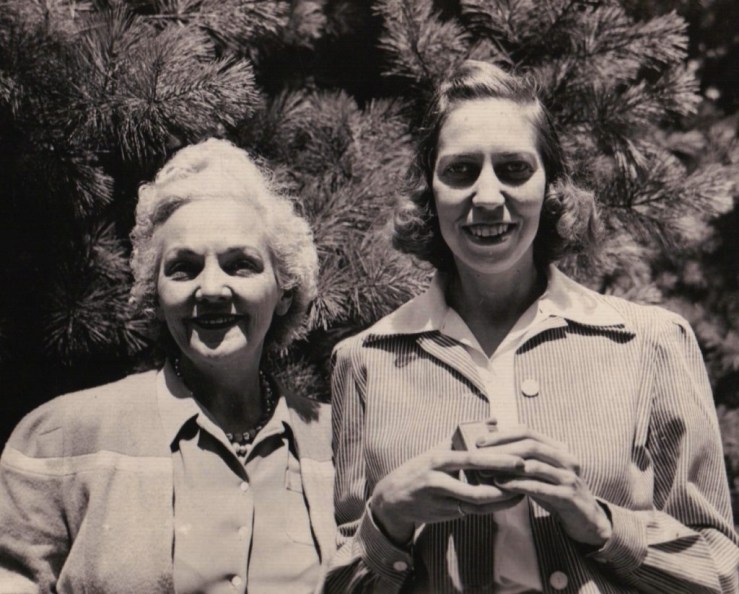
Katherine Anne Porter and Eudora Welty at Yaddo in 1941

Katherine-Anne-Porter-and-Eudora

“Burial Ground” — Charles Olson

bg

Kitty Pryde — Kevin Wada

kitty pryde

“The Jilting of Granny Weatherall” — Katherine Anne Porter

“The Jilting of Granny Weatherall”

by

Katherine Anne Porter

She flicked her wrist neatly out of Doctor Harry’s pudgy careful fingers and pulled the sheet up to her chin. The brat ought to be in knee breeches. Doctoring around the country with spectacles on his nose! “Get along now. Take your schoolbooks and go. There’s nothing wrong with me.”

Doctor Harry spread a warm paw like a cushion on her forehead where the forked green vein danced and made her eyelids twitch. “Now, now, be a good girl, and we’ll have you up in no time.”

“That’s no way to speak to a woman nearly eighty years old just because she’s down. I’d have you respect your elders, young man.”

“Well, Missy, excuse me.” Doctor Harry patted her cheek. “But I’ve got to warn you, haven’t I? You’re a marvel, but you must be careful or you’re going to be good and sorry.”

“Don’t tell me what I’m going to be. I’m on my feet now, morally speaking. It’s Cornelia. I had to go to bed to get rid of her.”

Her bones felt loose, and floated around in her skin, and Doctor Harry floated like a balloon around the foot of the bed. He floated and pulled down his waistcoat, and swung his glasses on a cord. “Well, stay where you are, it certainly can’t hurt you.”

“Get along and doctor your sick,” said Granny Weatherall. “Leave a well woman alone. I’ll call for you when I want you…Where were you forty years ago when I pulled through milk-leg and double pneumonia? You weren’t even born. Don’t let Cornelia lead you on,” she shouted, because Doctor Harry appeared to float up to the ceiling and out. “I pay my own bills, and I don’t throw my money away on nonsense!” Continue reading ““The Jilting of Granny Weatherall” — Katherine Anne Porter”

Mr. and Mrs. Clark and Percy — David Hockney

Sentimental Conversation — René Magritte

Independence — Du Zhenjun

05-Independence

“His romantic ancestor, his ancestor of the romantic death” | Bolaño and Borges

Jorge Luis Borges is first mentioned in the sixth paragraph of Roberto Bolaño’s masterful short story “The Insufferable Gaucho.” In this paragraph, the narrator tells us that the story’s hero, an ex-judge named Pereda, believed “the best Argentine writers were Borges and his son; any further commentary on that subject was superfluous.”

Several paragraphs later, Bolaño’s narrator explicitly references Borges’s short story “The South,” the precursor text for “The Insufferable Gaucho.” The reference to Borges is tied again to Pereda’s son, the writer Bebe.

Leaving tumultuous Buenos Aires, basically destitute from the Argentine Great Depression, Pereda heads to the countryside to take up residence in his family’s ancient ranch. Departing the train and arriving to a rural town, 

Inevitably, he remembered Borges’s story “The South,” and when he thought of the store mentioned in the final paragraphs his eyes brimmed with tears. Then he remembered the plot of Bebe’s last novel, and imagined his son writing on a computer, in an austere room at a Midwestern university. When Bebe comes back and finds out I’ve gone to the ranch . . . , he thought in enthusiastic anticipation.

Bolaño essentially appropriates the plot of “The South” for his tale “The Insufferable Gaucho” and inserts a version of himself into this revision. Bolaño is “Bebe” here, an author who “wrote vaguely melancholy stories with vaguely crime-related plots,” his name phonically doubling the series of mirrors and precursors that Bolaño, mystery man, leaves as clues: Bebe, B-B, Borges-Bolaño, Belano-Bolaño. (Is this too wild a conjecture, dear reader? Mea culpa). 

And Pereda then? A stand-in for Borges’s Juan Dahlmann (hero of “The South,” who “considered himself profoundly Argentinian”), surely, but also, maybe also—a stand-in for (a version of) Borges.

What I mean to say:

Bolaño, displaced Chilean, writes “The Insufferable Gaucho” as an intertextual love letter to his displaced father, the Argentine Jorge Luis Borges. Continue reading ““His romantic ancestor, his ancestor of the romantic death” | Bolaño and Borges”

No good will come of this!

20140512-142534.jpg

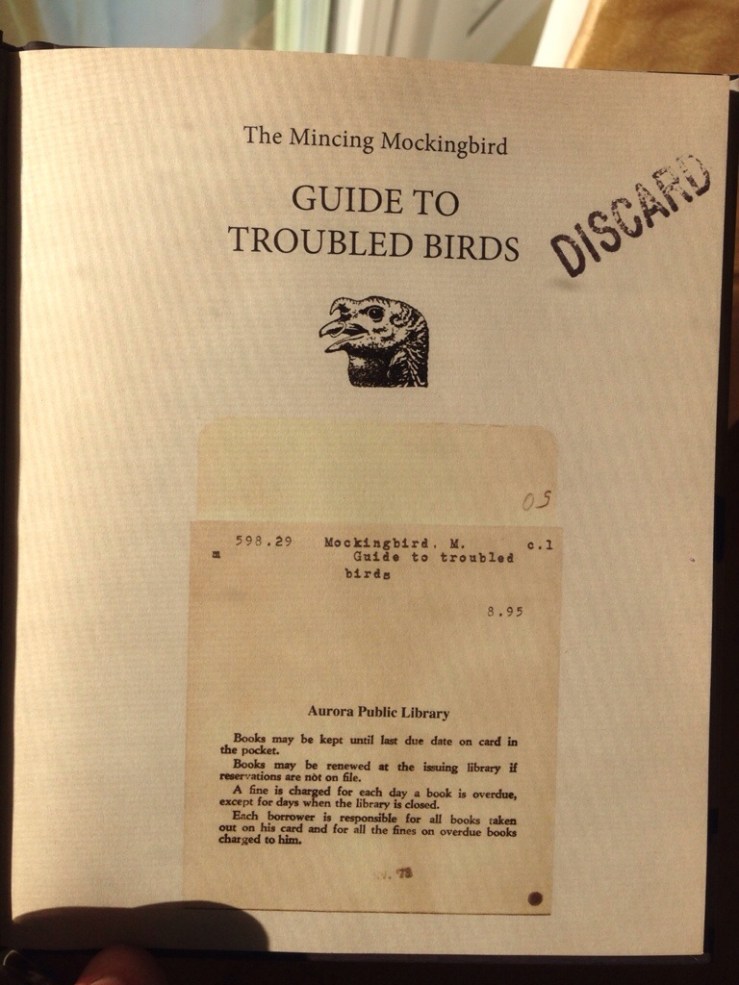
The Mincing Mockingbird Guide to Troubled Birds (Book Acquired, 5.09.2014)

20140514-085207.jpg

The Mincing Mockingbird Guide to Troubled Birds is new from Penguin next month. It’s a handsome little book. Amusing.20140514-085230.jpg

20140514-085238.jpg

20140514-085245.jpg

“The Locket” — Kate Chopin

“The Locket”

by

Kate Chopin

I

One night in autumn a few men were gathered about a fire on the slope of a hill. They belonged to a small detachment of Confederate forces and were awaiting orders to march. Their gray uniforms were worn beyond the point of shabbiness. One of the men was heating something in a tin cup over the embers. Two were lying at full length a little distance away, while a fourth was trying to decipher a letter and had drawn close to the light. He had unfastened his collar and a good bit of his flannel shirt front.

“What’s that you got around your neck, Ned?” asked one of the men lying in the obscurity.

Ned—or Edmond—mechanically fastened another button of his shirt and did not reply. He went on reading his letter.

“Is it your sweet heart’s picture?”

“‘Taint no gal’s picture,” offered the man at the fire. He had removed his tin cup and was engaged in stirring its grimy contents with a small stick. “That’s a charm; some kind of hoodoo business that one o’ them priests gave him to keep him out o’ trouble. I know them Cath’lics. That’s how come Frenchy got permoted an never got a scratch sence he’s been in the ranks. Hey, French! aint I right?” Edmond looked up absently from his letter. Continue reading ““The Locket” — Kate Chopin”

The Lord Is My Shepherd — Eastman Johnson