Charles and Jacques were still talking to Hector Guimard, the former trombone player.
— Yours is not a modern problem, Jacques said. The problem today is not angst but lack of angst.
— Wait a minute, Jacques. Although I myself believe that there is nothing wrong with being a trombone player, I can understand Hector’s feeling. I know a painter who feels the same way about being a painter. Every morning he gets up, brushes his teeth, and stands before the empty canvas. A terrible feeling of being de trop comes over him. So he goes to the corner and buys the Times, at the corner newsstand. He comes back home and reads the Times. During the period in which he’s coupled with the Times he is all right. But soon the Times is exhausted. The empty canvas remains. So (usually) he makes a mark on it, some kind of mark that is not what he means. That is, any old mark, just to have something on the canvas. Then he is profoundly depressed because what is there is not what he meant. And it’s time for lunch. He goes out and buys a pastrami sandwich at the deli. He comes back and eats the sandwich meanwhile regarding the canvas with the wrong mark on it out of the corner of his eye. During the afternoon, he paints out the mark of the morning. This affords him a measure of satisfaction. The balance of the the afternoon is spent in deciding whether or not to venture another mark. The new mark, if one is ventured, will also, inevitably, be misconceived. He ventures it. It is misconceived. It is, in fact, the worst kind of vulgarity. He paints out the second mark. Anxiety accumulates. However, the canvas is now, in and of itself, because of the wrong moves and painting out, becoming rather interesting looking. He goes to the A&P and buys a TV Mexican dinner and many bottles of Carta Blanca. He comes back to his loft and eats the Mexican dinner and drinks a couple of Carta Blancas, sitting in front of his canvas. The canvas is, for one thing, no longer empty. Friends drop in and congratulate him on having a not-empty canvas. He begins feeling better. A something has been wrested from the nothing. The quality of the something is still at issue–he is by no means home free. And of course all of painting– the whole art– has moved on somewhere else, it’s not where his head is, and he knows that, but nevertheless he–
— How does this apply to trombone playing? Hector asked.
— I had the connection in my mind when I began, Charles said.
— As Goethe said, theory is gray, but the golden tree of life is green.
1. William T. Vollmann’s Europe Central, 811 pages in my Penguin trade paperback edition (including end notes), is a virtuoso attempt to describe or measure or assess or explain or analyze the Eastern front of WWII, a part of the war that in my American ignorance I know, or knew (no, know) so little about.
2. The book covers 1914-1975, most of the composer Dmitri Dmitriyevich Shostakovich’s life. If Europe Central has a hero, it is Shostakovich.
From the book’s last end note, “An Imaginary Love Triangle: Shostakovich, Karmen, Konstantinovaskya”:
When I think of Shostakovich, and when I listen to his music, I imagine a person consumed by fear and regret, a person who (like Kurt Gerstein) did what little he could to uphold the good—in this case, freedom of artistic creation, and the mitigation of other people’s emergencies. He became progressively more beaten down, and certainly experienced difficulty saying no—a character trait which may well have kept him alive in the Stalinist years. In spite of the fact that he joined the Party near the end, to me he is a great hero—a tragic hero, naturally.
That’s Vollmann’s own authorial voice, of course, and there we have perhaps the most concise condensation of Europe Central.
3. Maybe a clarification though: Europe Central is not (just) a fictional biography of Shostakovich: There are many, many other characters that Vollmann uses to power his beast: the Soviet director Roman Karmen and the translator Elena Konstantinovskaya, those other points in the book’s central love triangle; German artist Käthe Kollwitz; Samizdat poet Anna Akhmatova; Generals Paulus (German) and Vlasov (Soviet)—similarly disgraced; SS man Kurt Gerstein, who oversees death camps; there’s Lenin, there’s Stalin. There’s “the Sleepwalker,” one Adolf Hitler. And many, many more.
4. Is Europe Central too big?
No. I don’t think so.
5. I lazily suggested that the book uses Shostakovich as an organizing principle. We could also argue for Operation Barbarossa (Germany’s disastrous invasion of the USSR) as the book’s main thrust. Or, we might say that the book reframes Wagner’s Ring Cycle. Or that it somehow restages Shostakovich’s Opus 40 and Opus 110. (Back to Shostakovich!).
6. Or the telephone! Yes, that totem of modernity, communication, power—the telephone!—the telephone is the central image of Europe Central. Indeed, it initiates the novel: “A squat black telephone, I mean an octopus, the god of our Signal Corps…” That octopus, those tendrils, those lines of communication snake throughout Europe Central.
7. Another description of Europe Central, perhaps, from one of its earliest chapters—
Most literary critics agree that fiction cannot be reduced to mere falsehood. Well-crafted protagonists come to life, pornography causes orgasms, and the pretense that life is what we want it to be may conceivably bring about the desired condition. Hence religious parables, socialist realism, Nazi propaganda. And if this story likewise crawls with reactionary supernaturalism, that might be because its author longs to see letters scuttling across ceilings, cautiously beginning to reify themselves into angels. For if they could only do that, then why not us?
8. Was that enough of Vollmann’s language for this short riff?
No?
I shared various citations from Europe Central on Biblioklept as I read it, even riffing a bit now and then. Check out some of Vollmann’s strange, wonderful prose—it’s far more convincing than anything I can write about his book.
10. I left off from the list above one of the finest passages in the book, a section where the unnamed “I” narrator of some of the Soviet sections of Europe Central shifts into Shostakovich’s consciousness, and then, perhaps, into Vollmann’s own authorial voice—and then back. The narratological dimensions here are too big to suss out in my lazy riff, but I find the passage’s main thrust one of the most compelling issues of modern art (or Modern Art, if you prefer): Can art use irony to conceal its true feelings? Can love be self-ironic? And if so, how does this complicate the truth of the expression?
I think this matters because Vollmann thinks this matters—put another way, Vollmann believes in Art and Truth and, significantly, in Love, and the power of love against the backdrop of totalitarianism, despotism, murder, privation, starvation, rape, maiming, gas chambers, mass graves, infanticide, total war…
11. What Vollmann achieves in Europe Central, through the reality and fictionality (and reality of the fictionality of the reality) of his characters, is a language of love. Vollmann posits love, or the possibility of love, or the possibility of imagining the possibility of love, as a response to despair.
12. Point 11 is maybe a way of saying that Europe Central is about so much more than central Europe during WWII—but if you’re at all familiar with Vollmann, gentle reader, of course you’d expect that. Still, I learned a lot about a subject which I thought I knew something about.
Whether or not Vollmann is a generous writer depends on your perspective—you’re swimming in the deep end here, and many of the connections between the different sections don’t cohere until you’ve got the hang of the book. But once you get the hang of it—once you learn to read it—Vollmann’s generosity is almost overbearing in its profundity. How did he research it, do all the reading that went into it, and still make all the voices sing? How?
13. Europe Central is probably not the best starting place for Vollmann, but I think it will appeal to fans of certain giant polyglossic postmodern novels. I’ll admit to a predilection for WWII metafictions, too, but I can’t really anticipate how readers of historical fiction might regard what Vollmann does here. Can I end by writing Highly recommended? I don’t know. I’m not sure who this book is for… but I loved it.
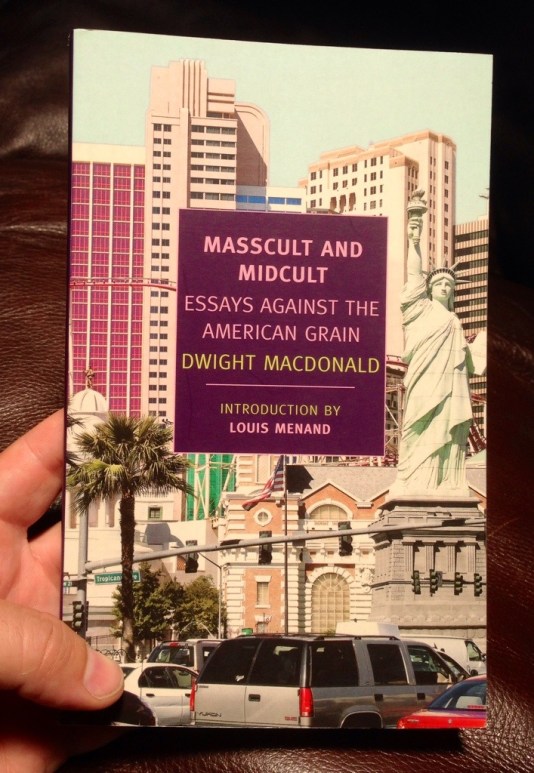
Hadn’t heard of Dwight Macdonald or his cranky essay “Masscult and Midcult” until I saw the NYRB edition in my local bookshop. Picked it up, didn’t put it down. The title essay here is on middlebrow culture, on how mass culture is not culture at all but a manufactured, predigested product. It was written in a prepostmodern era (if such a thing exists)—no Warhol, no reckoning with Pop Art, etc. Despite its elitist tone, it’s fantastic stuff, very insightful, and if I disagree with a lot of Macdonald’s criticism (his picking on Norman Rockwell is especially mean), I love his methods.
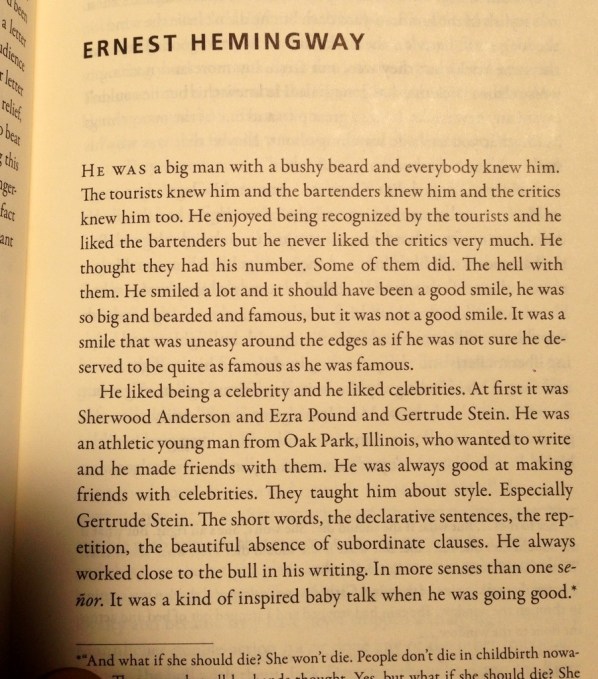
Haven’t gotten to any of the other essays yet, with the exception of his short skewering of Ernest Hemingway. It begins with a parody (below), and ends with a thoughtful rebuttal by George Plimpton. Macdonald doing Hemingway:
Having murdered his brother-in-law, Orrin Brower of Kentucky was a fugitive from justice. From the county jail where he had been confined to await his trial he had escaped by knocking down his jailer with an iron bar, robbing him of his keys and, opening the outer door, walking out into the night. The jailer being unarmed, Brower got no weapon with which to defend his recovered liberty. As soon as he was out of the town he had the folly to enter a forest; this was many years ago, when that region was wilder than it is now.
The night was pretty dark, with neither moon nor stars visible, and as Brower had never dwelt thereabout, and knew nothing of the lay of the land, he was, naturally, not long in losing himself. He could not have said if he were getting farther away from the town or going back to it – a most important matter to Orrin Brower. He knew that in either case a posse of citizens with a pack of bloodhounds would soon be on his track and his chance of escape was very slender; but he did not wish to assist in his own pursuit. Even an added hour of freedom was worth having.
Suddenly he emerged from the forest into an old road, and there before him saw, indistinctly, the figure of a man, motionless in the gloom. It was too late to retreat: the fugitive felt that at the first movement back toward the wood he would be, as he afterward explained, “filled with buckshot.” So the two stood there like trees, Brower nearly suffocated by the activity of his own heart; the other – the emotions of the other are not recorded.
A moment later – it may have been an hour – the moon sailed into a patch of unclouded sky and the hunted man saw that visible embodiment of Law lift an arm and point significantly toward and beyond him. He understood. Turning his back to his captor, he walked submissively away in the direction indicated, looking to neither the right nor the left; hardly daring to breathe, his head and back actually aching with a prophecy of buckshot.
Brower was as courageous a criminal as ever lived to be hanged; that was shown by the conditions of awful personal peril in which he had coolly killed his brother-in-law. It is needless to relate them here; they came out at his trial, and the revelation of his calmness in confronting them came near to saving his neck. But what would you have? – when a brave man is beaten, he submits.
So they pursued their journey jailward along the old road through the woods. Only once did Brower venture a turn of the head: just once, when he was in deep shadow and he knew that the other was in moonlight, he looked backward. His captor was Burton Duff, the jailer, as white as death and bearing upon his brow the livid mark of the iron bar. Orrin Brower had no further curiosity.
Eventually they entered the town, which was all alight, but deserted; only the women and children remained, and they were off the streets. Straight toward the jail the criminal held his way. Straight up to the main entrance he walked, laid his hand upon the knob of the heavy iron door, pushed it open without command, entered and found himself in the presence of a half-dozen armed men. Then he turned. Nobody else entered.
On a table in the corridor lay the dead body of Burton Duff.
My critique of American society remains fundamentally incoherent. Would I really have preferred my grandfather’s time, when Pinkertons were cracking Wobblies over the head, or my father’s, when Joe McCarthy could ruin anyone by calling him Red? All I know is that although I live a freer life than many people, I want to be freer still; I’m sometimes positively dazzled with longing for a better way of being. What is it that I need?
From William T. Vollmann’s essay-memoir Riding Toward Everywhere.
And, Madame Blanchard, believe that I am happy to be here with you and your family because it is so serene, everything, and before this I worked for a long time in a fancy house—maybe you don’t know what is a fancy house? Naturally … everyone must have heard sometime or other. Well, Madame, I work always where there is work to be had, and so in this place I worked very hard all hours, and saw too many things, things you wouldn’t believe, and I wouldn’t think of telling you, only maybe it will rest you while I brush your hair. You’ll excuse me too but I could not help hearing you say to the laundress maybe someone had bewitched your linens, they fall away so fast in the wash. Well, there was a girl there in that house, a poor thing, thin, but well-liked by all the men who called, and you understand she could not get along with the woman who ran the house. They quarreled, the madam cheated her on her checks: you know, the girl got a check, a brass one, every time, and at the week’s end she gave those back to the madam, yes, that was the way, and got her percentage, a very small little of her earnings: it is a business, you see, like any other
—and the madam used to pretend the girl had given back only so many checks, you see, and really she had given many more, but after they were out of her hands, what could she do? So she would say, I will get out of this place, and curse and cry. Then the madam would hit her over the head. She always hit people over the head with bottles, it was the way she fought. My good heavens, Madame Blanchard, what confusion there would be sometimes with a girl running raving downstairs, and the madam pulling her back by the hair and smashing a bottle on her forehead.Continue reading ““Magic” — Katherine Anne Porter”→





 Biblioklept