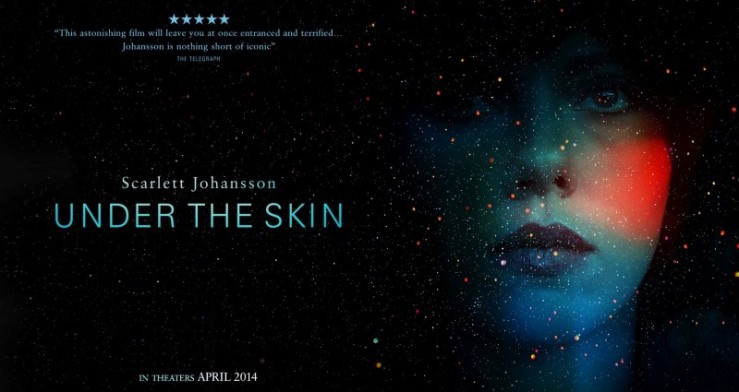
1. I hadn’t read a review of Under the Skin until after I watched it, but I had gleaned an idea of it based on taglines and posters—something like “Scarlett Johansson as a sexy alien seducing men in Scotland.”
2. That is not what the film is.
3. Under the Skin is an aesthetic experience. Now, this phrase, aesthetic experience, this phrase is extremely pretentious, and the way I’ve used it here also strikes me as pretentious, and even worse, not particularly clear. Any film could be described as an aesthetic experience. Films are, after all, simply light and sound.
4. Under the Skin is best experienced as light and sound—as aesthetic.
5. I’ve neglected to mention the film’s director, Jonathan Glazer, who directed another film I love, Sexy Beast.
6. For Under the Skin, Glazer adapted Michel Faber’s novel of the same name. I haven’t read the book, but a cursory cruise over its Wikipedia page suggests that Glazer dissolved most of the plot, keeping just the frame, or the idea of a frame for his film.
7. What I liked most about Under the Skin: The film is not really about anything. The film just happens.
8. Point 7 is a terrible description! Of course the film is about something—but its themes and motifs are overdetermined and underexplained—or not explained at all.
9. There is very little dialogue in the film—no exposition or explanation for what’s happening, let alone a conversation that might guide the audience to how to think or feel about what’s happening.
10. (Okay: This is not entirely true, but it is mostly true. There is a key conversation, if it can be called that, between Johansson’s unnamed character and a man with a deformed face).
11. The bits of dialogue that do evince often seem unscripted and random. The men Johansson’s character picks up speak in thick Scottish accents, their voices often obscured behind a din of traffic, buzz of music, or the thick glass windows of the van she drives around in.
12. (A favorite moment of auditory distortion in Under the Skin: In a domestic scene, in a kitchen, cleaning up, a man turns on his radio and just-barely tunes in a station. Deacon Blue’s “Real Gone Kid” plays through a hazy crackle. Lovely).
13. The sound mixing in the film is beautiful—waves crashing, the clip-clop of horse hooves on a high road, the wind blowing heavy through tall evergreens—these auditory cues mix in with Mica Levi’s creepy, lush score, which channels Krzysztof Komeda’s work and Bernard Herrmann’s Psycho score through Portishead and Loveless
14. Sound and light—those shots: Cinematographer Daniel Landin is the secret star of the film. Every shot is gorgeous, painterly, and if Glazer often allows a scene to linger just past an acceptable threshold, it’s because he’s in love with the film’s dark beauty.
15. (And/or: Glazer lets his shots linger so long to provoke the viewer into a kind of hypnotic discomfort).
16. The film’s early visual references to Kubrick’s 2001 are a bit on-the-nose—too on-the-nose, too expected. As the film progresses, the shots take their cues not from Kubrick’s sci-fi classic, but his most painterly film, Barry Lyndon.
17. (Under the Skin also reminded me of Upstream Color, Moon, The Man Who Fell toEarth, Tree of Life, and MorvernCallar).
18. The film is best enjoyed, as I’ve said, as an aesthetic experience, art, if that’s the word you like. I think that viewers who attempt to impose their own narrative logic on the film will attune their energy to the wrong frequency. Let the aesthetic happen.
19. (The beach sequence in this film is one of the best scenes I’ve watched in a long, long time).
20. I have completely and purposefully neglected to mention anything about the plot, because I do not think the plot, in the sense of plot-as-arrangement-of-action matters to the film. The film’s aesthetic is the plot.
21. And Under the Skin’s aesthetic is the film’s theme. This film is about seeing, hearing. Touch, taste, smell.
You can boil that down to whichever theory floats your boat—the male gaze, alienation, othering, sexual subversion, radical feminism, etc.—but I think that imposing any schema, any deep reading here, may be a way of anesthetizing the film’s aesthetic.
Enemies at Home is new historical fiction by Lindsey Davis. Blurb from her site:
The second Albia novel will be published by Hodder and Stoughton and St Martin’s Press in 2014
PLOT SUMMARY: Albia novel 2
Every slave is an enemy, said Seneca
When a newly-married couple are violently robbed and murdered in their apartment, the vigiles take the easy way out and accuse their household slaves. The slaves seek refuge in the Temple of Ceres, a more reluctant haven of liberty than tradition claims. Albia’s new friend Manlius Faustus is tasked with persuading the runaways to leave. He hires Albia to help him work out what really happened…
July has been a strange month. The other day I went to the beach and I saw a woman of about thirty, pretty, wearing a black bikini, who was reading standing up. At first I thought she was about to lie down on her towel, but when I looked again she was still standing, and after that I didn’t take my eyes off her. For two hours, more or less, she read standing up, walked over to the water, didn’t go in, let the waves lap her shins, went back to her spot, kept reading, occasionally put the book down while still standing, leaned over a few times and took a big bottle of Pepsi out of a bag and drank, then picked up the book again, and, finally, without ever bending a knee, put her things away and left. Earlier the same day, I saw three girls, all in thongs, gorgeous, one of them had a tattoo on one buttock, they were having a lively conversation, and every once in a while they got in the water and swam and then they would lie down again on their mats, basically a completely normal scene, until all of a sudden, a cell phone rang, I heard it and thought it was mine until I realized it had been a while since I had a cell phone, and then I knew the phone belonged to one of them. I heard them talking. All I can say is that they weren’t speaking Catalan or Spanish. But they sounded deadly serious. Then I watched two of them get up, like zombies, and walk toward some rocks. I got up too and pretended to brush the sand off my trunks. On the rocks, I watched them talk to a huge, hideously ugly man covered in hair, in fact one of the hairiest men I’ve ever seen in my life. They knelt before him and listened attentively without saying a word, and then they went back to where their friend was waiting for them and everything went on as before, as if nothing had happened. Who are these women? I asked myself once it was dark and I had showered and dressed. One drank Pepsi. The others bowed down to a bear. I know who they are. But I don’t really know.
The kind of vision the fiction writer needs to have, or to develop, in order to increase the meaning of his story is called anagogical vision, and that is the kind of vision that is able to see different levels of reality in one image or one situation. The medieval commentators on Scripture found three kinds of meaning in the literal level of the sacred text: one they called allegorical, in which one fact pointed to another; one they called tropological, or moral, which had to do with what should be done; and one they called anagogical, which had to do with the Divine life and our participation in it. Although this was a method applied to biblical exegesis, it was also an attitude toward all of
creation, and a way of reading nature which included most possibilities, and I think it is this enlarged view of the human scene that the fiction writer has to cultivate if he is ever going to write stories that have any chance of becoming a permanent part of our literature. It seems to be a paradox that the larger and more complex the personal view, the easier it is to compress it into fiction.
From Flannery O’Connor’s essay “The Nature and Aim of Fiction.”
















 Biblioklept