Looking Warm (The Appearance of an Urban Widow of the Kansei Era) — Tsukioka Yoshitoshi

Rhyndacus — Walton Ford

rhyndacus0

Watch The Butterfly, an Animated Short Film by Andrei Khrzhanovsky

The BFG, Roald Dahl’s Love Letter to His Lost Daughter

20140706-210704-76024020.jpg

Roald Dahl’s 1982 children’s classic The BFG begins with a dedication to the author’s daughter: “For Olivia: 20th April 1955 — 17th November 1962.”

If I had noticed the dedication when I first read The BFG as a child, I certainly didn’t think about it then. The slim sad range of those dates would have meant nothing to me, eager as I was to dig into a book about child-eating giants, secure in my own childish immortality. However, when I started reading the book with my daughter, the dedication howled out to me, thoroughly coloring the lens through which I read.

Had Olivia Twenty Dahl not died from measles encephalitis at only seven, had she continued to live to be alive now, she would be approaching her sixtieth birthday. But because she died as a seven-year-old little girl, she remained a seven-year-old little girl to me, the reader, who saw her spirit under every page. 

I believe she remained a seven-year-old little girl for Dahl as well—at least in the imaginative world of The BFG where she is recast as the hero Sophie. Reading The BFG, it was impossible for me not to immediately connect Sophie to Olivia, those names with their Greek roots and their long O‘s. It was also impossible for me not to connect these two girls to my own daughter Zoe, who is also seven.

(Parenthetically, I’ll admit that biographical interpretation of literature is often a terrible practice—especially when combined with a touch of reader-response criticism—and that what I am doing here is not something I think advisable, let alone commendable. And yet the central affective power for me in reading The BFG—as an adult to my little girl—rests in my inescapable intuition that Dahl wrote the book to make his daughter live again, to live forever). Continue reading “The BFG, Roald Dahl’s Love Letter to His Lost Daughter”

Inland 2 — Dan McPharlin

mcpharlin-0017_1200

Complaint to God (Alasdair Gray’s Lanark)

The more he worked the more the furious figure of God kept popping in and having to be removed: God driving out Adam and Eve for learning to tell right from wrong, God preferring meat to vegetables and making the first planter hate the first herdsman, God wiping the slate of the world clean with water and leaving only enough numbers to start multiplying again, God fouling up language to prevent the united nations reaching him at Babel, God telling a people to invade, exterminate and enslave for him, then letting other people do the same back. Disaster followed disaster to the horizon until Thaw wanted to block it with the hill and gibbet where God, sick to death of his own violent nature, tried to let divine mercy into the world by getting hung as the criminal he was. It was comical to think he achieved that by telling folk to love and not hurt each other. Thaw groaned aloud and said, “I don’t enjoy hounding you like this, but I refuse to gloss the facts. I admire most of your work. I don’t even resent the ice ages, even if they did make my ancestors carnivorous. I’m astonished by your way of leading fertility into disaster, then repairing the disaster with more fertility. If you were a busy dung beetle pushing the sun above the skyline, if you had the head of a hawk or the horns and legs of a goat I would understand and sympathize. If you headed a squabbling committee of Greek departmental chiefs I would sympathize. But your book claims you are a man, the one perfect man of whom we are imperfect copies. And then you have the bad taste to put yourself in it. Only the miracle of my genius stops me feeling depressed about this, and even so my brushes are clogged by theology, that bastard of the sciences. Let me remember that a painting, before it is anything else, is a surface on which colours are arranged in a certain order.

From Alasdair Gray’s novel Lanark.

Chinese Sage Reading While Riding on a Buffalo — Toyota Hokkei

Milly Finch — James McNeill Whistler

Our best paintings look like screams of pain (Alasdair Gray’s Lanark)

“There was once a building boom,” said Thaw, growing excited, “In north Italy. The local governments and bankers of three or four towns, towns the size of Paisley, put so much wealth and thought into decorating public buildings that half Europe’s greatest painters were bred there in a single century. These bosses weren’t unselfish men, no, no. They knew they could only win votes and stay popular by giving spare wealth to their neighbours in the form of fine streets, halls, towers and cathedrals. So the towns became beautiful and famous and have been a joy to visit ever since. But today our bosses don’t live among the folk they employ. They invest surplus profits in scientific research. Public buildings have became straight engineering jobs, our cities get uglier and uglier and our best paintings look like screams of pain. No wonder! The few who buy them, buy them like diamonds or rare postage stamps, as a form of non-taxable banking.”

From Alasdair Gray’s novel Lanark.

“Lewis and Clark Overheard in Conversation” — James Tate

20140709-140802-50882903.jpg

Monkey Tavern — David Teniers the Younger

Bong Joon Ho Picks DVDs from the Criterion Collection Closet

Ten Story Ideas from F. Scott Fitzgerald’s Notebooks

Unusual death—man pierced by his own belt buckle.

Boobs Bones Mistaken for John The Baptist

Story: A man who wanted an elephant, or some such one of the wisest of beasts who could not talk. Then began to try to teach him to talk.

The Dancer Who Found She Could Fly

Words

A famous writer fakes his own death but things make him come back.
Or else he can’t.

G. men as Samurai class.

Piggy Back Voyage

Girl whose ear is so sensitive she can hear radio. Man gets her out of insane asylum to use her.

Book: It might have been me. My old idea of half truth half lie, including all notes and everything. Shoot the works.

From F. Scott Fitzgerald’s Notebooks.

Reading Comics — Nathan Fox

nathan fox

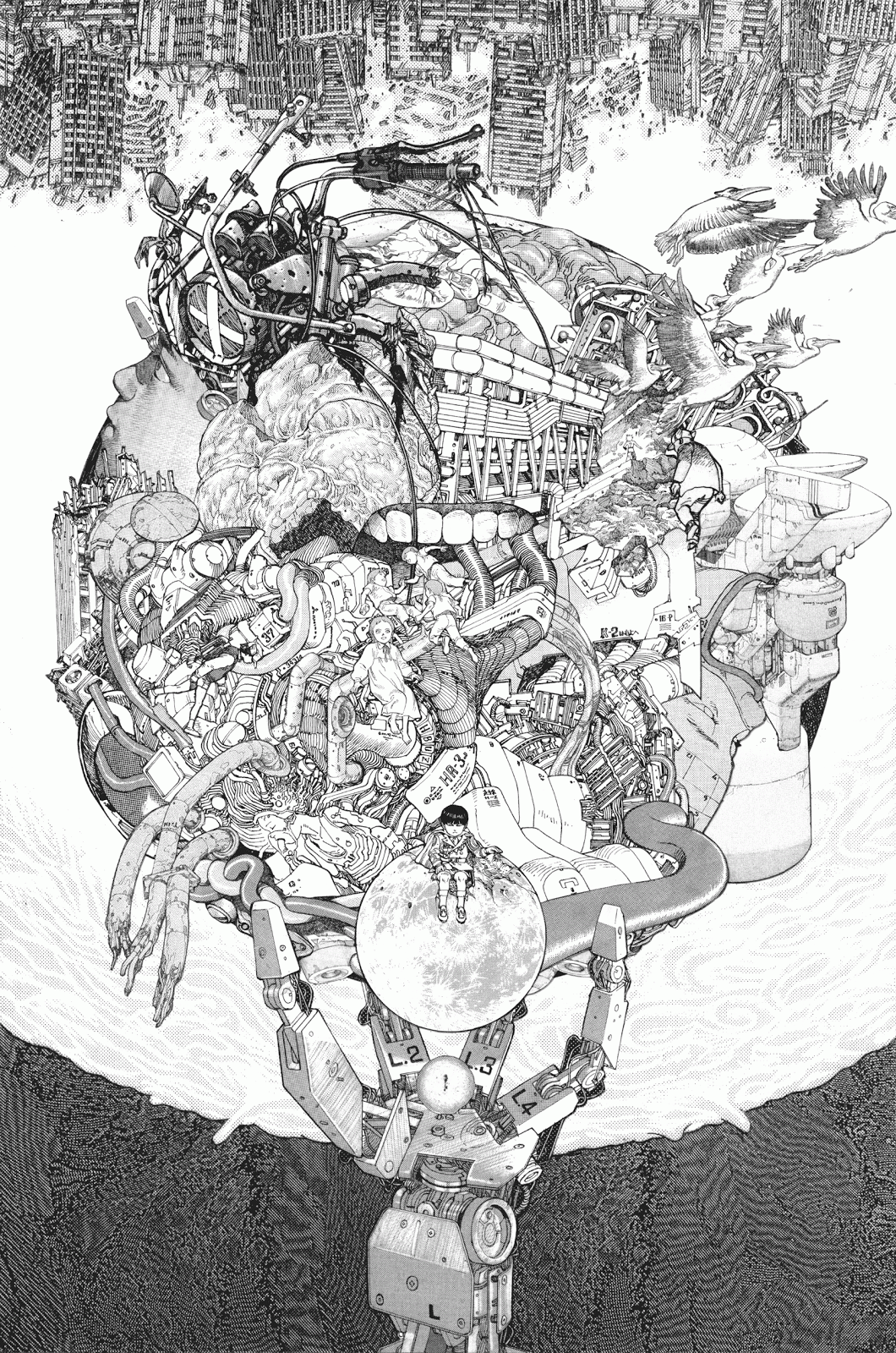
Akira — Katsuhiro Otomo

genga

They have built the asylum for people who are different, and they will not even let us live in the holes with the badgers (Willa Cather)

“Did you want to speak to me, Ivar?” Alexandra asked as she rose from the table. “Come into the sitting-room.”

The old man followed Alexandra, but when she motioned him to a chair he shook his head. She took up her workbasket and waited for him to speak. He stood looking at the carpet, his bushy head bowed, his hands clasped in front of him. Ivar’s bandy legs seemed to have grown shorter with years, and they were completely misfitted to his broad, thick body and heavy shoulders.
“Well, Ivar, what is it?” Alexandra asked after she had waited longer than usual.

Ivar had never learned to speak English and his Norwegian was quaint and grave, like the speech of the more old-fashioned people. He always addressed Alexandra in terms of the deepest respect, hoping to set a good example to the kitchen girls, whom he thought too familiar in their manners.
“Mistress,” he began faintly, without raising his eyes, “the folk have been looking coldly at me of late. You know there has been talk.”

“Talk about what, Ivar?”

“About sending me away; to the asylum.”

Alexandra put down her sewing-basket. “Nobody has come to me with such talk,” she said decidedly. “Why need you listen? You know I would never consent to such a thing.”

Ivar lifted his shaggy head and looked at her out of his little eyes. “They say that you cannot prevent it if the folk complain of me, if your brothers complain to the authorities. They say that your brothers are afraid—God forbid!—that I may do you some injury when my spells are on me. Mistress, how can any one think that?—that I could bite the hand that fed me!” The tears trickled down on the old man’s beard.

Alexandra frowned. “Ivar, I wonder at you, that you should come bothering me with such nonsense. I am still running my own house, and other people have nothing to do with either you or me. So long as I am suited with you, there is nothing to be said.”

Ivar pulled a red handkerchief out of the breast of his blouse and wiped his eyes and beard. “But I should not wish you to keep me if, as they say, it is against your interests, and if it is hard for you to get hands because I am here.”

Alexandra made an impatient gesture, but the old man put out his hand and went on earnestly:—

“Listen, mistress, it is right that you should take these things into account. You know that my spells come from God, and that I would not harm any living creature. You believe that every one should worship God in the way revealed to him. But that is not the way of this country. The way here is for all to do alike. I am despised because I do not wear shoes, because I do not cut my hair, and because I have visions. At home, in the old country, there were many like me, who had been touched by God, or who had seen things in the graveyard at night and were different afterward. We thought nothing of it, and let them alone. But here, if a man is different in his feet or in his head, they put him in the asylum. Look at Peter Kralik; when he was a boy, drinking out of a creek, he swallowed a snake, and always after that he could eat only such food as the creature liked, for when he ate anything else, it became enraged and gnawed him. When he felt it whipping about in him, he drank alcohol to stupefy it and get some ease for himself. He could work as good as any man, and his head was clear, but they locked him up for being different in his stomach. That is the way; they have built the asylum for people who are different, and they will not even let us live in the holes with the badgers. Only your great prosperity has protected me so far. If you had had ill-fortune, they would have taken me to Hastings long ago.”

As Ivar talked, his gloom lifted. Alexandra had found that she could often break his fasts and long penances by talking to him and letting him pour out the thoughts that troubled him. Sympathy always cleared his mind, and ridicule was poison to him.

From Willa Cather’s novel O Pioneers! 

I read the novel back in college, enjoyed it, and read Cather’s later novel Death Comes for the Archbishop years after on my own. I picked up an audiobook version of O Pioneers! and started it this week, and it’s fabulous stuff—so controlled and precise, but also fluid, moving through time, memory, space, into consciousness, into the natural world—Cather’s evocation of nature on the Nebraska plains is particularly remarkable.

The novel is far more modernist than I recall as well. The narration slides slyly from a concrete third-person past-tense voice (what I often think of as the Plain Old Voice, if that makes sense), to a second-person clip that evokes a director telling his camera what to observe, to the workmanlike immediacy of a present-tense voice.

The passage above stands on its own, I think—but it also showcases several of the novel’s early themes, including the divide between the New World and the Old, alienation, and the ways in which conformity and routine are antithetical to the pioneer spirit that Americans like to trick themselves into believing they are heir to. The passage seems to rewrite Emily Dickinson’s “Much madness is divinest sense”; it also calls back to an early line from the book which I very much like: “A pioneer should have imagination, should be able to enjoy the idea of things more than the things themselves.”