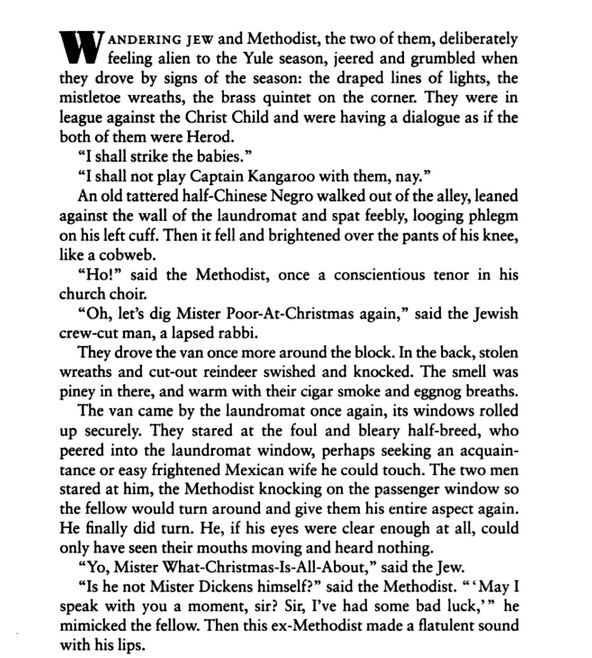
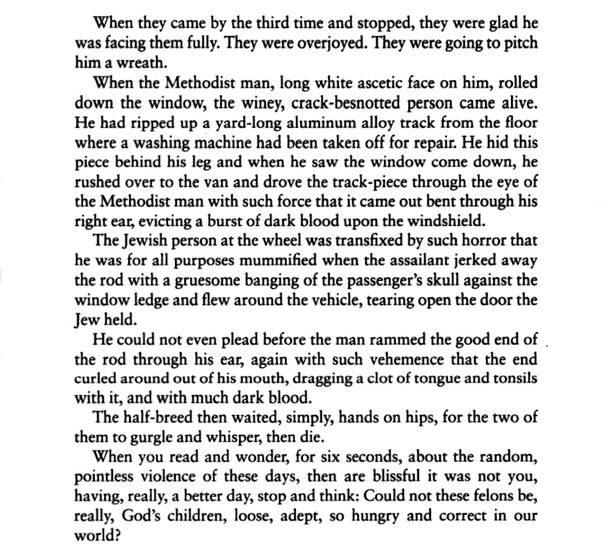
“A Christmas Thought” — Barry Hannah

Donald Barthelme interviewed by George Plimpton (Video)

From The University of Houston and via Jessamyn West.

Seated Woman Reading — François Bonvin

Bonvin,  François Seated woman reading, 1862

Mike Leigh Picks DVDs from the Criterion Collection Closet

Undergrowth with Two Figures — Vincent van Gogh

“To read and to read and to read and to read” (Faulkner’s advice to young writers)

Unidentified participant: Mr. Faulkner, you may have touched on this previously, but could you give some advice to young writers? What advice would you give to young writers?

William Faulkner: At one time I thought the most important thing was talent. I think now that—that the young man or the young woman must possess or teach himself, train himself, in infinite patience, which is to—to try and to try and to try until it comes right. He must train himself in ruthless intolerance. That is, to throw away anything that is false no matter how much he might love that page or that paragraph. The most important thing is insight, that is, to be—to curiosity—to—to wonder, to mull, and to—to—to muse why it is that man does what he does. And if you have that, then I don’t think the talent makes much difference, whether you’ve got that or not.

Unidentified participant: How would you suggest that he get this insight? Through experience?

William Faulkner: Yes, and then the greatest part of experience is in the books, to read. To read and to read and to read and to read. To watch people, to have—to never judge people. To watch people, what they do, with—with—without intolerance. Simply to—to learn why it is they did what they did.

More/audio.

“All art constantly aspires towards the condition of music”

Mary Magdalene Reading — Ambrosius Benson

Will Oldham and Slint talk about shooting the cover of Spiderland

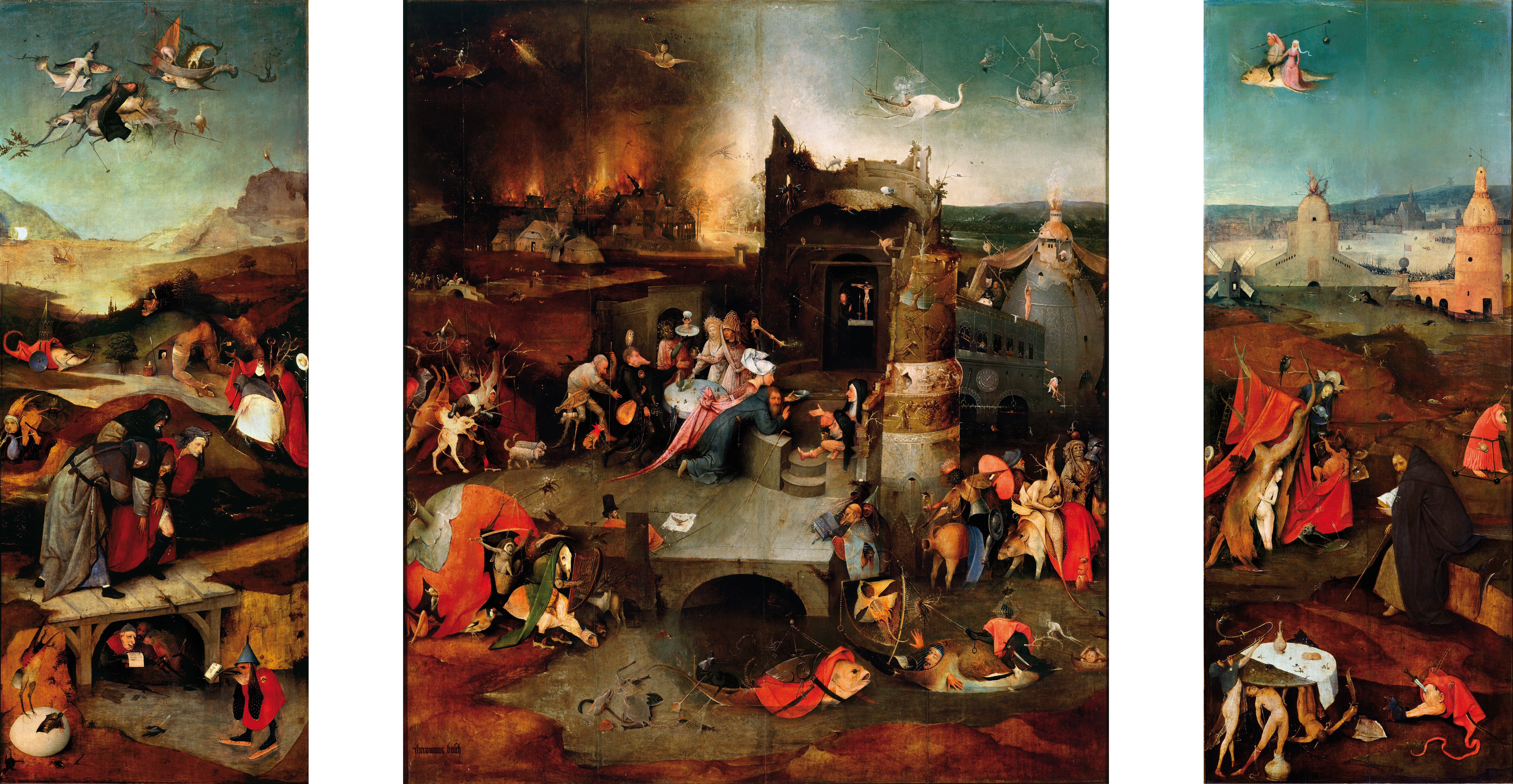
The Temptation of St. Anthony (Detail) — Hieronymus Bosch

11

Duck Tales (Thomas Pynchon’s Mason & Dixon)

Back Inhabitants all up and down the Line soon begin taking the Frenchman’s Duck to their Bosoms, for being exactly what they wish to visit their lives at this Moment,— something possess’d of extra-natural Powers,— Invisibility, inexhaustible Strength, an upper Velocity Range that makes her the match, in Momentum, of much larger opponents,— Americans desiring generally, that ev’ry fight be fair. Soon Tales of Duck Exploits are ev’rywhere the Line may pass. The Duck routs a great army of Indians. The Duck levels a Mountain west of here. In a single afternoon the Duck, with her Beak, has plow’d ev’ry Field in the County, at the same time harrowing with her Tail. That Duck!
As to the Duck’s actual Presence, Opinions among the Party continue to vary. Axmen, for whom tales of disaster, stupidity, and blind luck figure repeatably as occasions for merriment, take to shouting at their Companions, “There she goes!” or, “Nearly fetch’d ye one!” whilst those more susceptible to the shifts of Breeze between the Worlds, notably at Twilight, claim to’ve seen the actual Duck, shimmering into Visibility, for a few moments, then out again.
“I might’ve tried to draw a bead onto it, . . . but it knew I was there. It came walking over and look’d me thump in the eye. I was down flat, we were at the same level, see. ‘Where am I?’ it wants to know. ‘Pennsylvania or Maryland, take your pick,’ says I. It had this kind of Expression onto its Face, and seem’d jumpy. I tried to calm it down. It gave that Hum, and grew vaporous, and disappear’d.”
Mason and Dixon attempt to ignore as much of this as they may, both assuming ’tis only another episode of group Folly, to which this Project seems particularly given, and that ’twill pass all too soon, to be replaced by another, and so on, till perhaps, one day, by something truly dangerous.

From Chapter 45 of Thoma Pynchon’s novel Mason & Dixon.

“Nobody’s Story” — Charles Dickens

“Nobody’s Story”

by

Charles Dickens

He lived on the bank of a mighty river, broad and deep, which was always silently rolling on to a vast undiscovered ocean. It had rolled on, ever since the world began. It had changed its course sometimes, and turned into new channels, leaving its old ways dry and barren; but it had ever been upon the flow, and ever was to flow until Time should be no more. Against its strong, unfathomable stream, nothing made head. No living creature, no flower, no leaf, no particle of animate or inanimate existence, ever strayed back from the undiscovered ocean. The tide of the river set resistlessly towards it; and the tide never stopped, any more than the earth stops in its circling round the sun.

He lived in a busy place, and he worked very hard to live. He had no hope of ever being rich enough to live a month without hard work, but he was quite content, GOD knows, to labour with a cheerful will. He was one of an immense family, all of whose sons and daughters gained their daily bread by daily work, prolonged from their rising up betimes until their lying down at night. Beyond this destiny he had no prospect, and he sought none.

There was over-much drumming, trumpeting, and speech-making, in the neighbourhood where he dwelt; but he had nothing to do with that. Such clash and uproar came from the Bigwig family, at the unaccountable proceedings of which race, he marvelled much. They set up the strangest statues, in iron, marble, bronze, and brass, before his door; and darkened his house with the legs and tails of uncouth images of horses. He wondered what it all meant, smiled in a rough good-humoured way he had, and kept at his hard work. Continue reading ““Nobody’s Story” — Charles Dickens”

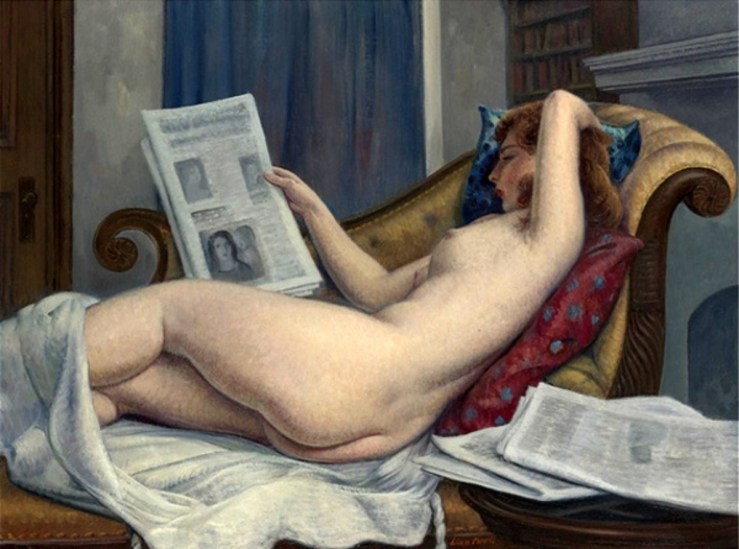
Naked Woman Reading — Leon Kroll

8665005542_0d5f29a020_o

Trailer for Terrence Malick’s new film Knight of Cups

Karl Marx hadn’t seen anything yet (Calvin and Hobbes)

IMG_0134

Manuscript Page of Charles Dickens’s A Christmas Carol