The Reading Girl — Marie-Augustin Zwiller

Pheasant and Snake — Katsushika Hokusai

Serpent, Worm, or Dragon (Thomas Pynchon’s Mason & Dixon)

One cloudless afternoon they stand in the scent of an orange-grove,— as tourists elsewhere might stand and gape at some mighty cataract or chasm,— nose-gaping, rather, at a manifold of odor neither Englishman has ever encountered before. They have been searching for it all the long declining Day,— it is the last Orange-Grove upon the Island,— a souvenir of a Paradise decrepit. Shadows of Clouds dapple the green hillsides, Houses with red Tile roofs preside over small Valleys, the Pasturelying soft as Sheep,— all, with the volcanic Meadow where the two stand, circl’d by the hellish Cusps of Peaks unnatural,— frozen in mid-thrust, jagged at every scale.
 
“Saint Brendan set out in the fifth century to discover an Island he believ’d was the Paradise of the Scriptures,— and found it. Some believ’d it Madeira, Columbus was told by some at Madeira that they had seen it in the West, Philosophers of our own Day say they have prov’d it but a Mirage. So will the Reign of Reason cheerily dispose of any allegations of Paradise.”
 
“Yet suppose this was the Island. He came back, did he not? He died the very old Bishop of the Monastery he founded at Clonfert, as far from the Western Sea as he might, this side of Shannon. Perhaps that was Paradise. Else, why leave?”
 
“A Riddle! Wondrous! Just the Ticket! Why, ere ’tis solv’d, we may be back in England and done with this!”
 
“The Serpent, being the obvious Answer.”
 
“What Serpent?”
 
“The one dwelling within the Volcanoe, Mason, surely you are not ignorant upon the Topick?”
 
“Regretfully, Sir,— ”
 
“Serpent, Worm, or Dragon, ’tis all the same to It, for It speaketh no Tongue but its own. It Rules this Island, whose ancient Curse and secret Name, is Disobedience. In thoughtless Greed, within a few pitiably brief Generations, have these People devastated a Garden in which, once, anything might grow. Their Muck-heaps ev’rywhere, Disease, Madness. One day, not far distant, with the last leaf of the last Old-Father-Never-Die bush destroy’d, whilst the unremitting Wind carries off the last soil from the last barren Meadow, with nought but other Humans the only Life remaining then to the Island,— how will they take their own last step,— how disobey themselves into Oblivion? Simply die one by one, alone and suspicious, as is the style of the place, till all are done? Or will they rather choose to murder one another, for the joy to be had in that?”
 
“How soon is this, that we’re talking about?”
 
“Pray we may be gone by then. We have our own ways of Disobedience,— unless I presume,— express’d in the Motto of Jakob Bernouilli the second,— Invito Patre Sidera Verso,— ‘Against my father’s wishes I study the stars.”’

From Thomas Pynchon’s novel Mason & Dixon. The conversation is between Mason and the English Royal Astronomer Nevil Maskelyne; the volcano under discussion is St. Helena.

Bill Withers at the BBC in 1973

Making Nice (Book Acquired, Some Time in Early November)

IMG_4022

Matt Sumell’s debut is Making Nice. Christine Schutt compares it to Barry Hannah and James Dickey. Keep meaning to dip into it. Publisher Henry Holt’s blurb:

A gut-punch of a debut about love, grief, and family; the arrival of a brilliant, infectious new voice for our age

In Matt Sumell’s blazing first book, our hero Alby flails wildly against the world around him—he punches his sister (she deserved it), “unprotectos” broads (they deserved it and liked it), gets drunk and picks fights (all deserved), defends defenseless creatures both large and small, and spews insults at children, slow drivers, old ladies, and every single surviving member of his family. In each of these stories Alby distills the anguish, the terror, the humor, and the strange grace—or lack of—he experiences in the aftermath of his mother’s death. Swirling at the center of Alby’s rage is a grief so big, so profound, it might swallow him whole. As he drinks, screws, and jokes his way through his pain and heartache, Alby’s anger, his kindness, and his capacity for good bubble up when he (and we) least expect it. Sumell delivers “a naked rendering of a heart sorting through its broken pieces to survive.*”

Making Nice is a powerful, full-steam-ahead ride that will keep you laughing even as you try to catch your breath; a new classic about love, loss, and the fine line between grappling through grief and fighting for (and with) the only family you’ve got.


December — Theodor Severin Kittelsen

The authors William Faulkner consistently returned to

Unidentified participant: Sir, when you are reading for your own pleasure, which authors do you consistently return to?

William Faulkner: The ones I came to love when I was eighteen, nineteen, twenty years old. Moby-Dick, the Old Testament, Shakespeare, a lot of Conrad, Dickens. I read Don Quixote every year.

Via/audio/more.

Young Woman Reading — Marie-Augustin Zwiller

Thomas Pynchon’s Mason & Dixon (First Riff)

A. Mason & Dixon: I bought my copy at Shaman Bookstore in Chiang Mai, Thailand, in the fall of 2002. I had just read and absorbed V., but could not get into Mason & Dixon. Chalk up this initial failure to the novel’s daunting scope, the formal characteristics of its faux-18th c. style, too much Thai whiskey, etc. I made attempts again over the years, sporadic ones, small dents, etc., including a half-hearted attempt after reading the book’s sort-of sequel, Against the Day last year. But of course I needed space from/for a big-assed Pynchon novel, so, a year later, I finally commit to Mason & Dixon. I’ve read the first 15 chapters.

B. “against the Day”: The phrase leaps out in the third paragraph of Chapter 13 (p. 125), imploring me to read Mason & Dixon as a prequel of sorts to Against the Day. The themes, motifs, and formal devices of both novels are utterly Pynchonian, of course (he tautologically types): Paranoia, global powers contesting for domination, science, adventure, means and methods of conveyance, dick jokes, ditties, inebriating substances, all manner of rascalism, man’s inhumanity to etc. And condiments!

C. “ketjap”: Against the Day gave us a history of the cult of mayonnaiseMason & Dixon is the ketchup book. (Not really but maybe really).

D. “The Learned English Dog”: We meet this marvelous beast, this talking dog, early in the novel, and he of course reminds me immediately of Pugnax, the loyal and brave companion to the Chums of Chance in Against the Day.

E. “invisible”: Just as in Against the Day, Pynchon sounds the note “invisible” repeatedly to highlight some of the Big Themes of the novel. Mason & Dixon is about The Age of Reason, or about the limitations of The Age of Reason, or about the limitations of even the very conceptualization of an Age of Reason—an age when “Men of Science” like our titular Daring Duo sought to make the invisible—the passage of the stars and time itself—visible, measurable, defined, bordered, colonized, etc.

F. “…please do not come to the Learned English Dog if it’s religious Comfort you’re after. I may be preternatural, but I am not supernatural. ‘Tis the Age of Reason, rrrf? There is ever an Explanation at hand, and no such thing as a Talking Dog,—Talking Dogs belong with Dragons and Unicorns.” Said the Talking Dog.

G. “inconvenience”: The first time I notice the word—another of Pynchon’s signatures—is in Ch. 3 (p. 28). It stands out: A sailor by the name of Fender-Belly Bodine claims that he once sailed on the H.M.S. Inconvenience. The Chums of Chance of course sail the heavens on their airship The Inconvenience. 

H. But again: “inconvenience” (and iterations of the same) thread through Mason & Dixon: Why? What to make of the word? Perhaps—just a perhaps—The Age of Reason is really a rhetorical substitution for The Age of Convenience, the Age of Better Living (For Some Folks) Through Science. Convenience: The application of some kind of method or utility—relies on measurement, on demarcation, on prediction, etc. Convenience, then, perhaps then, as the practical aim of the age of science.

I. And Inconvenience, then, perhaps then, as a disruptive metaphysical force (?).

J. I’ve neglected entirely to remark on the 18th c. style. Maybe another time.

K. Also the songs.

L. But I will, before closing, remark quickly on how much I enjoy how Pynchon riffs on jocular forms—jokes you mean, right?—to compose elements of the narrative. Early on, Dixon tries to tell a joke about “this Jesuit, this Corsican, and this Chinaman” before he’s stopped by a mortified Mason; they return to the joke about a hundred pages later (still no punchline). Globalization is already there.

M. (Also: An extended episode in the Dutch Cape of South Africa riffs repeatedly on the farmer’s daughters joke. No insight at all here—just love how Pynchon uses the joke to move his narrative along).

M. Okay, then: Just a few opening notes, just a little riff, a sketch, some initial ideas. More to come. Loving the book so far.

“All art constantly aspires towards the condition of music”

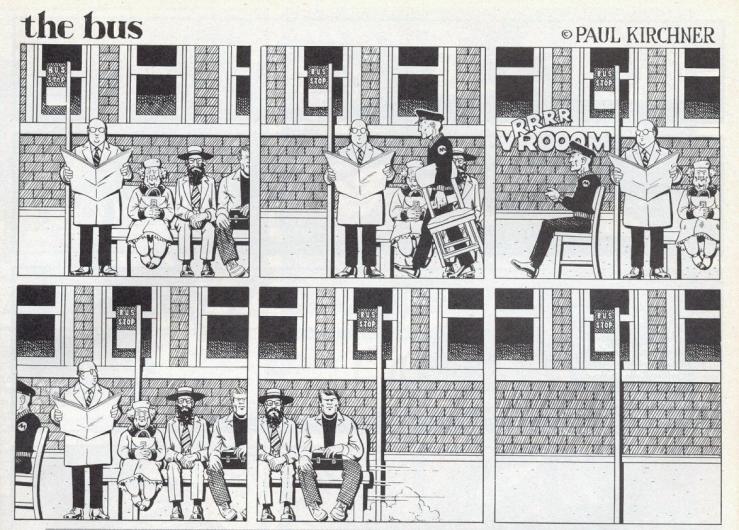
The Bus — Paul Kirchner

g

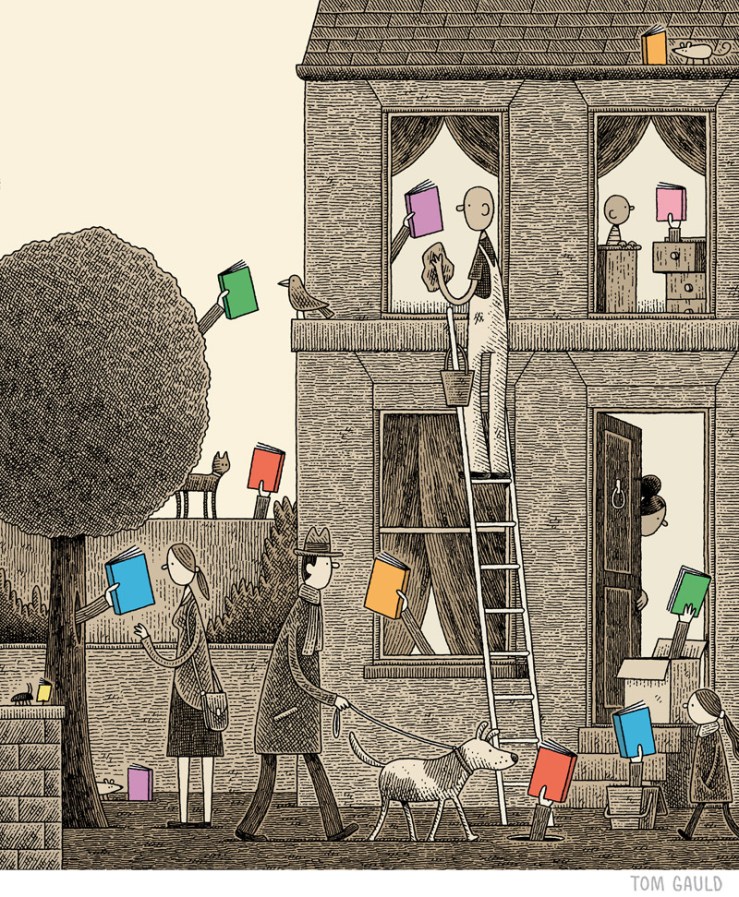
Readers (Guardian Cover) — Tom Gauld

tumblr_nftj4fswTi1rwkrdbo1_1280

Adam & Eve — Gustave Doré

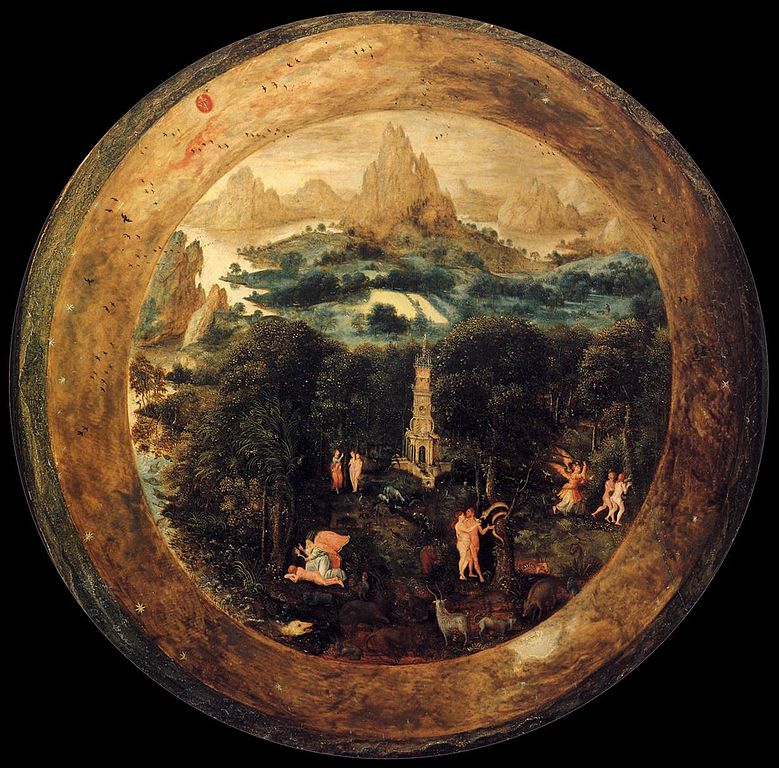
Paradise — Herri met de Blas

779px-Herri_met_de_Bles_-_The_Paradise_-_WGA2266

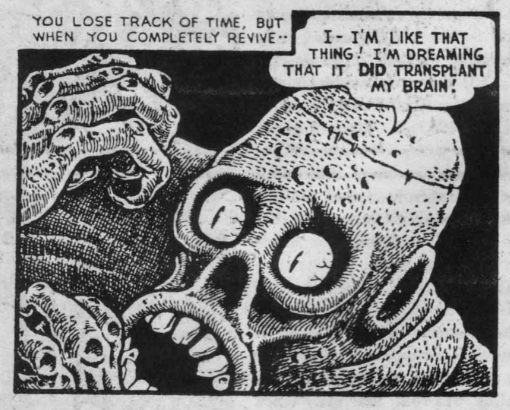
I’m dreaming that it did transplant my brain (Basil Wolverton)

IMG_0129.PNG

Young Woman Reading — Charles-Guillaume Steuben

charlesguillaumeSteuben17881856_thum