Incapable of writing even one word (Kafka diary entry, 8 April 1914)

8 April. Yesterday incapable of writing even one word. Today no better. Who will save me? And the turmoil in me, deep down, scarcely visible; I am like a living lattice-work, a lattice that is solidly planted and would like to tumble down.

Today in the coffee-house with Werfel. How he looked from the distance, seated at the coffee-house table. Stooped, half reclining even in the wooden chair, the beautiful profile of his face pressed against his chest, his face almost wheezing in its fullness (not really fat); entirely indifferent to the surroundings, impudent, and without flaw. His dangling glasses by contrast make it easier to trace the delicate outlines of his face.


From the diaries of Franz Kafka. The entry is from 8 April 1914. English translation by Martin Greenberg.

The Eye That Never Sleeps — Clarence John Laughlin

clarence-john-laughlin-the-eye-that-never-sleeps-1946

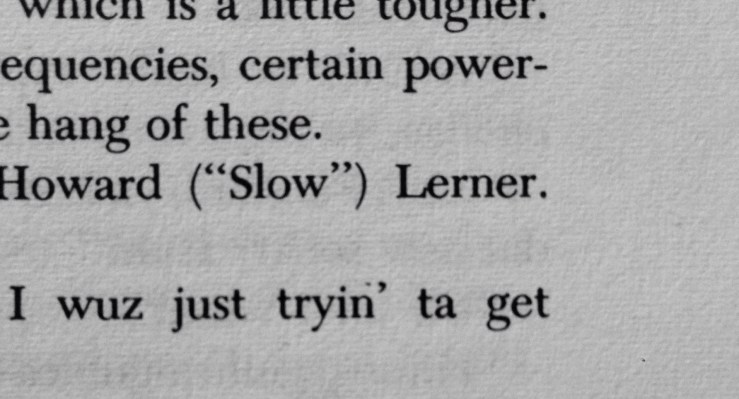
Slow Learner (Pynchon’s Gravity’s Rainbow)

IMG_5725


From page 641 of Gravity’s Rainbow. More hidden future-titles.

Reading backwards (Oscar Wilde)

There is a great deal to be said in favour of reading a novel backwards.  The last page is, as a rule, the most interesting, and when one begins with the catastrophe or the dénoûment one feels on pleasant terms of equality with the author.  It is like going behind the scenes of a theatre.  One is no longer taken in, and the hairbreadth escapes of the hero and the wild agonies of the heroine leave one absolutely unmoved.

From the “Sententiae” section of A Critic in Pall Mall.

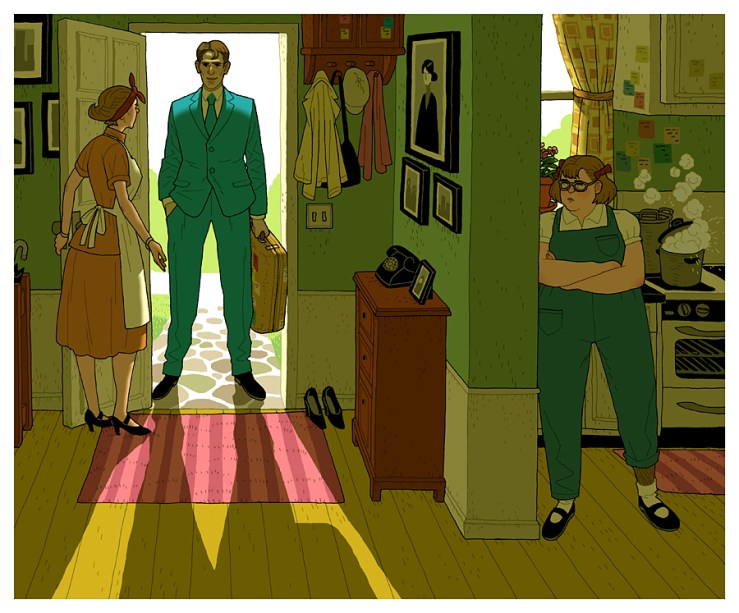
Good Country People (Illustration of the Flannery O’Connor Story) — Afu Chan

good_country_people_by_aznmextofu-d59t5jl

More of Afu Chan’s work.

Read the Flannery O’Connor story “Good Country People.”

“Strange Fruit” — Billie Holiday

ka: desire (Nose-slitting was then listed as a felony punishable by death)

From Joseph T. Shipley’s The Origin of English Words: A Discursive Dictionary of Indo-European Roots.

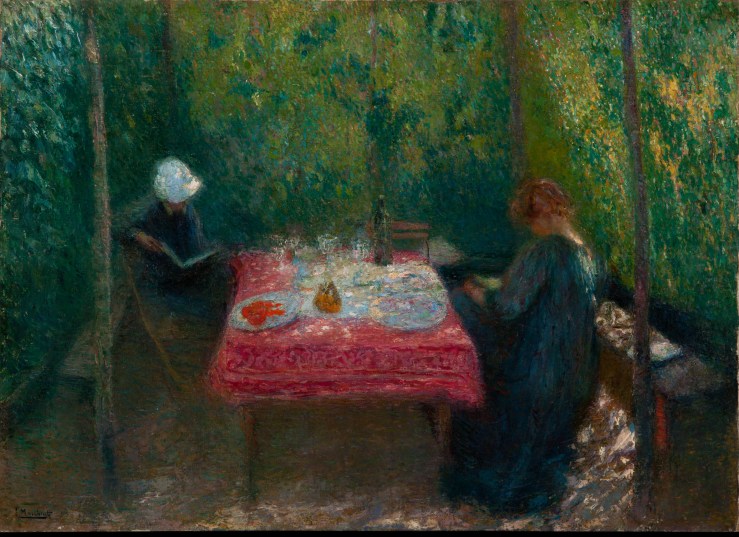
Under the Arbor — Serafino Macchiati

59-Macchiati

Yuri Herrera’s Signs Preceding the End of the World is sharp subterranean fiction

IMG_5790

Yuri Herrera’s sharp, thrilling novella Signs Preceding the End of the World opens with calamity. A sinkhole — “the earth’s insanity” — nearly swallows our hero before we can properly meet her:

I’m dead, Makina said to herself when everything lurched: a man with a cane was crossing the street, a dull groan suddenly surged through the asphalt, the man stood still as if waiting for someone to repeat the question and then the earth opened up beneath his feet: it swallowed the man, and with him a car and a dog, all the oxygen around and even the screams of passers-by. I’m dead, Makina said to herself, and hardly had she said it than her whole body began to contest that verdict and she flailed her feet frantically backward, each step mere inches from the sinkhole, until the precipice settled into a perfect circle and Makina was saved.

This opening passage sets the tone of Signs Preceding the End of the World. Makina will repeatedly plunge into and out of danger as she treks from her village in borderland Mexico into the weird world of the Big Chilango–the United States.

Makina crosses the border to find her estranged brother, who left the village years ago with the dubious plan of claiming some land (supposedly) owned by his family. (Reader, mark the symbolism there). Makina’s mother prompts her journey, but she’s also aided by a trio of adversarial gangsters—Mr. Double-U, Mr. Aitch, and Mr. Q. At the end of the first chapter of Signs, Mr. Q summarizes Makina’s impending quest (and the novella itself) in terse but eloquent language:

You’re going to cross and you’re going to get your feet wet and you’re going to be up against real roughnecks; you’ll get desperate, of course, but you’ll see wonders and in the end you’ll find your brother, and even if you’re sad, you’ll wind up where you need to be.

Mr. Q plays seer in his short monologue, just one example of the novella’s mythic overtones. Or maybe the word I want is undertones: Signs Preceding the End of the World opens with the earth swallowing victims; underworld mobsters send a hero on a night-quest over rough waters and alien terrain; aided by an underground network, Makina must traverse labyrinths and mazes and dark spaces; and, yes, the book ends underground. This is subterranean fiction. Continue reading “Yuri Herrera’s Signs Preceding the End of the World is sharp subterranean fiction”

Woman in Ecstasy — Ferdinand Hodler

Prohibited Thoughts — Vangel Naumovski

“The Tomb of Pan” — Lord Dunsany

“The Tomb of Pan”

by

Lord Dunsany

“Seeing,” they said, “that old-time Pan is dead, let us now make a tomb for him and a monument, that the dreadful worship of long ago may be remembered and avoided by all.”

So said the people of the enlightened lands. And they built a white and mighty tomb of marble. Slowly it rose under the hands of the builders and longer every evening after sunset it gleamed with rays of the departed sun.

And many mourned for Pan while the builders built; many reviled him. Some called the builders to cease and to weep for Pan and others called them to leave no memorial at all of so infamous a god. But the builders built on steadily.

And one day all was finished, and the tomb stood there like a steep sea-cliff. And Pan was carved thereon with humbled head and the feet of angels pressed upon his neck. And when the tomb was finished the sun had already set, but the afterglow was rosy on the huge bulk of Pan.

And presently all the enlightened people came, and saw the tomb and remembered Pan who was dead, and all deplored him and his wicked age. But a few wept apart because of the death of Pan.

But at evening as he stole out of the forest, and slipped like a shadow softly along the hills, Pan saw the tomb and laughed.

Christ Appearing to His Disciples After the Resurrection — William Blake

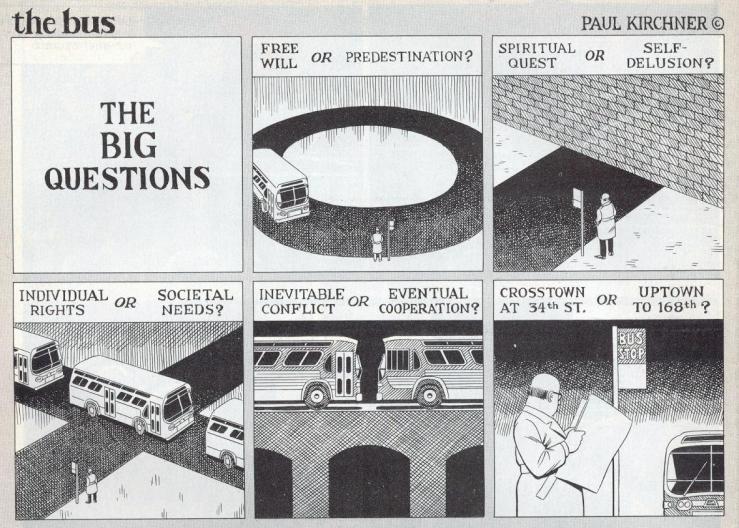
The Bus — Paul Kirchner

YSk6TJQ - Imgur

Happy Easter — Michael Sowa

Mandrake parable (Gravity’s Rainbow)

The sand-colored churchtops rear up on Slothrop’s horizons, apses out to four sides like rocket fins guiding the streamlined spires… chiseled in the sandstone he finds waiting the mark of consecration, a cross in a circle. At last, lying one afternoon spread-eagled at his ease in the sun, at the edge of one of the ancient Plague towns he becomes a cross himself, a crossroads, a living intersection where the judges have come to set up a gibbet for a common criminal who is to be hanged at noon. Black hounds and fanged little hunters slick as weasels, dogs whose breeds have been lost for 700 years, chase a female in heat as the spectators gather, it’s the fourth hanging this spring and not much spectacle here except that this one, dreaming at the last instant of who can say what lifted smock, what fat-haunched gnädige Frau Death may have come sashaying in as, gets an erection, a tremendous darkpurple swelling, and just as his neck breaks, he actually comes in his ragged loin-wrapping creamy as the skin of a saint under the purple cloak of Lent, and one drop of sperm succeeds in rolling dripping hair to hair down the dead leg, all the way down, off the edge of the crusted bare foot, drips to earth at the exact center of the crossroad where, in the workings of the night, it changes into a mandrake root. Next Friday, at dawn, the Magician, his own moving Heiligenschein rippling infrared to ultraviolet in spectral rings around his shadow over the dewy grass, comes with his dog, a coal-black dog who hasn’t been fed for a few days. The Magician digs carefully all around the precious root till it’s held only by the finest root-hairs—ties it to the tail of his black dog, stops his own ears with wax then comes out with a piece of bread to lure the unfed dog rrrowf! dog lunges for bread, root is torn up and lets loose its piercing and fatal scream. The dog drops dead before he’s halfway to breakfast, his holy-light freezes and fades in the million dewdrops. Magician takes the root tenderly home, dresses it in a little white outfit and leaves money with it overnight: in the morning the cash has multiplied tenfold. A delegate from the Committee on Idiopathic Archetypes comes to visit. “Inflation?” the Magician tries to cover up with some flowing hand-moves.” ‘Capital?” “Never heard of that.” “No, no,” replies the visitor, “not at the moment. We’re trying to think ahead. We’d like very much to hear about the basic structure of this. How bad was the scream, for instance?” “Had m’ears plugged up, couldn’t hear it.” The delegate flashes a fraternal business smile. “Can’t say as I blame you… .”

From Thomas Pynchon’s novel Gravity’s Rainbow.