Don’t Try This at Home (Book acquired, 4.30.2015)

IMG_6010

Angela Readman’s short story collection Don’t Try This at Home is new from And Other Stories. Their blurb:

A girl repeatedly chops her boyfriend in half but, while her ‘other half’ multiplies, she is still not satisfied. Love transforms a mother working down the chippie – into Elvis! An old witch takes in a young one and, despite her best, magical powers, can’t help revealing something of the real world to her apprentice. Beautiful, sharp and fearless, these stories breathe. Do Try This at Home.

In Angela Readman’s debut collection, each story packs its share of explosive material.  In every one, quirky new strategies for surviving troubled lives are revealed, often through a transformative touch of contemporary magic.

If Angela Carter were Readman’s fairy godmother, would that make David Lynch her wicked stepbrother? Don’t say you weren’t warned!


 

Moby Dick — Hieronimus Fromm

The Penitent Magdalen in a Landscape (Detail) — Annibale Carracci

agostinocarracci_thepenitentmagdaleninalandscape-detail

Orson Welles’ Sketch Book

Raconteur Orson Welles riffs on a number of subjects in these short commentaries, which originally aired on the BBC in 1955. Topics include earthquakes, curses, police work, negative reviews, Martians, magic, etc.

Tunnel — Winsor McCay

rarebit

“I think I could turn and live with animals” — Walt Whitman

Section 32 of Walt Whitman’s “Song of Myself”

***

I think I could turn and live with animals, they are so placid and self-contain’d;
I stand and look at them long and long.

They do not sweat and whine about their condition;
They do not lie awake in the dark and weep for their sins;
They do not make me sick discussing their duty to God;
Not one is dissatisfied—not one is demented with the mania of owning things;
Not one kneels to another, nor to his kind that lived thousands of years ago;
Not one is respectable or industrious over the whole earth.

So they show their relations to me, and I accept them;
They bring me tokens of myself—they evince them plainly in their possession.

I wonder where they get those tokens:
Did I pass that way huge times ago, and negligently drop them?
Myself moving forward then and now and forever,
Gathering and showing more always and with velocity,
Infinite and omnigenous, and the like of these among them;
Not too exclusive toward the reachers of my remembrancers;
Picking out here one that I love, and now go with him on brotherly terms.

A gigantic beauty of a stallion, fresh and responsive to my caresses,
Head high in the forehead, wide between the ears,
Limbs glossy and supple, tail dusting the ground,
Eyes full of sparkling wickedness—ears finely cut, flexibly moving.

His nostrils dilate, as my heels embrace him;
His well-built limbs tremble with pleasure, as we race around and return.

I but use you a moment, then I resign you, stallion;
Why do I need your paces, when I myself out-gallop them?
Even, as I stand or sit, passing faster than you.

Joseph Cornell — Duane Michals

9680Duane Michals

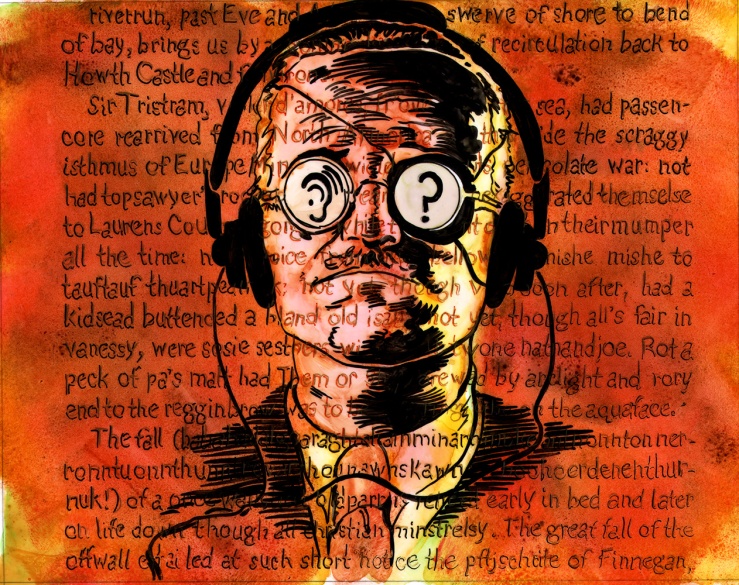
Check out Waywords and Meansigns, a musical adaptation of James Joyce’s Finnegans Wake

Robert Berry copyWaywords and Meansigns, a musical adaptation of James Joyce’s Finnegans Wake, is now available for free download.

I interviewed the project’s director (and contributor) Derek Pyle a few weeks back, and he explained the idea:

Biblioklept: What is Waywords and Meansigns?

Derek Pyle: Waywords and Meansigns is a collaborative music project recreating James Joyce’s Finnegans Wake. Seventeen different musicians from all around world have each taken a chapter of Finnegans Wake and set it to music, thereby creating an unabridged audio version of Finnegans Wake.

Finnegans Wake is an incredible book, but it’s notoriously difficult to read. One hope of the project is to create a version of the Wake that is accessible to newcomers — people can just listen to and enjoy the music. To maximize accessibility, we are distributing all the audio freely via our website. But the project does not only appeal to Wake newcomers — as we’ve seen so far, a lot of scholars and devoted readers are also finding Waywords and Meansigns an exciting way of interpreting and engaging with Joyce’s text.

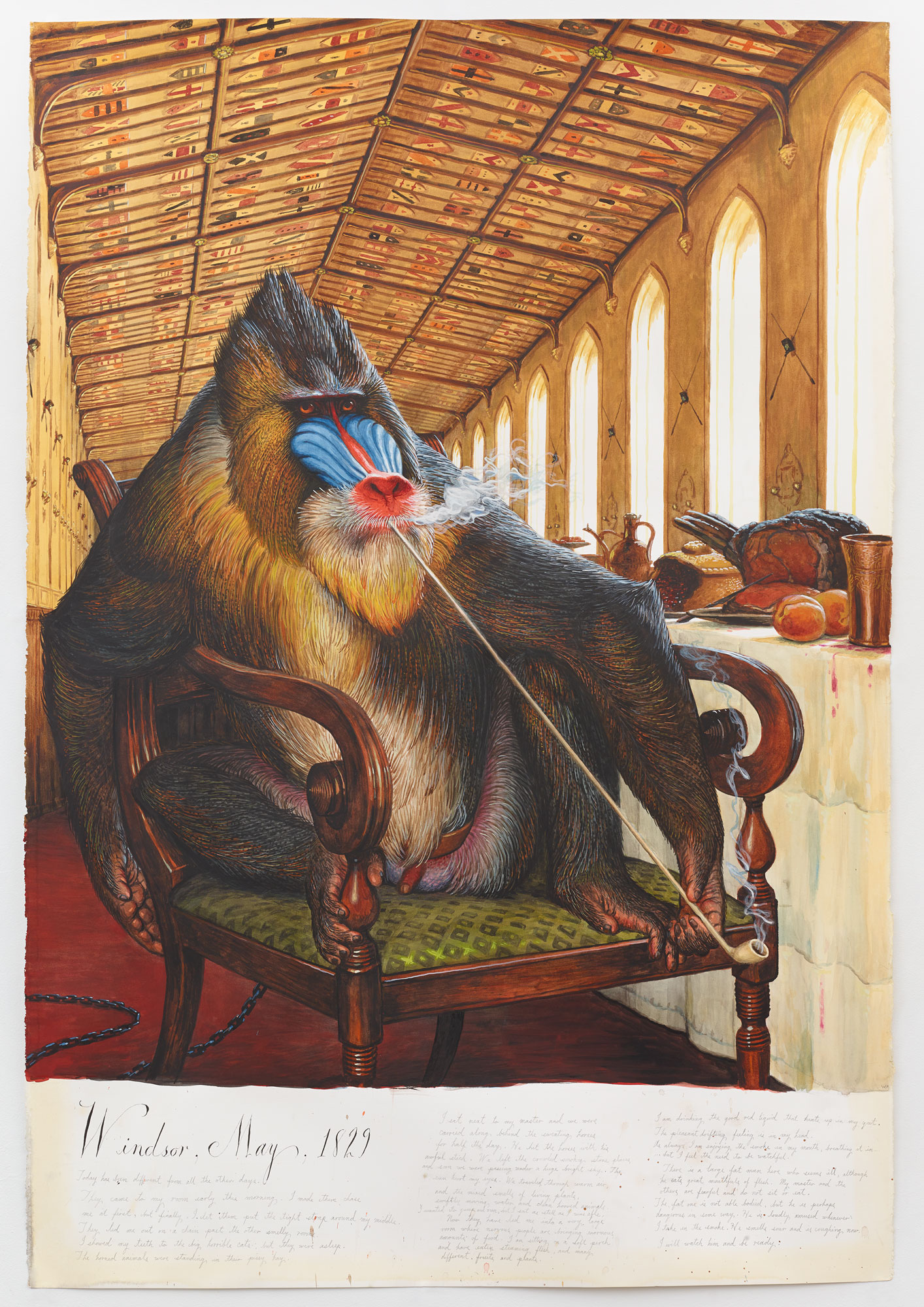
Windsor, May 1829 — Walton Ford

walton-ford-windsor-may

Grass Labyrinth, a short film by Shuji Terayama

“If I should learn, in some quite casual way” — Edna St. Vincent Millay

Screenshot 2015-05-04 at 7

The Explosion of the Spanish Flagship During the Battle of Gibraltar — Cornelis Claesz van Wieringen

Cornelis-Claesz-van-Wieringen

Moebius Star Wars Illustration

(Via).

“Snips of the Tongue” — Harry Mathews

“Snips of the Tongue”

by

Harry Mathews

from Selected Declarations of Independence

Once burned, twice snide

+

Every drug has its day

+

The road to help is paved with good intentions

+

Never pull of tomorrow what you can do today

+

When in Rome, do as the Trojans do

+

Half a loan is better than no bread

+

Every crowd has a silver lining

+

One man’s meat is another man’s person

+

Look before you leave

+

A snitch in time saves nine

+

In the kingdom of the blind, the one-eyed man is kinky

+

Too many cooks spoil the dwarf

First Communion — Pablo Picasso

“Three Sundays in a Week” — Edgar Allan Poe

“Three Sundays in a Week”

by

Edgar Allan Poe

“YOU hard-headed, dunder-headed, obstinate, rusty, crusty, musty, fusty, old savage!” said I, in fancy, one afternoon, to my grand uncle Rumgudgeon—shaking my fist at him in imagination.

Only in imagination. The fact is, some trivial discrepancy did exist, just then, between what I said and what I had not the courage to say—between what I did and what I had half a mind to do.

The old porpoise, as I opened the drawing-room door, was sitting with his feet upon the mantel-piece, and a bumper of port in his paw, making strenuous efforts to accomplish the ditty.

Remplis ton verre vide!

Vide ton verre plein!

“My dear uncle,” said I, closing the door gently, and approaching him with the blandest of smiles, “you are always so very kind and considerate, and have evinced your benevolence in so many—so very many ways—that—that I feel I have only to suggest this little point to you once more to make sure of your full acquiescence.”

“Hem!” said he, “good boy! go on!” Continue reading ““Three Sundays in a Week” — Edgar Allan Poe”