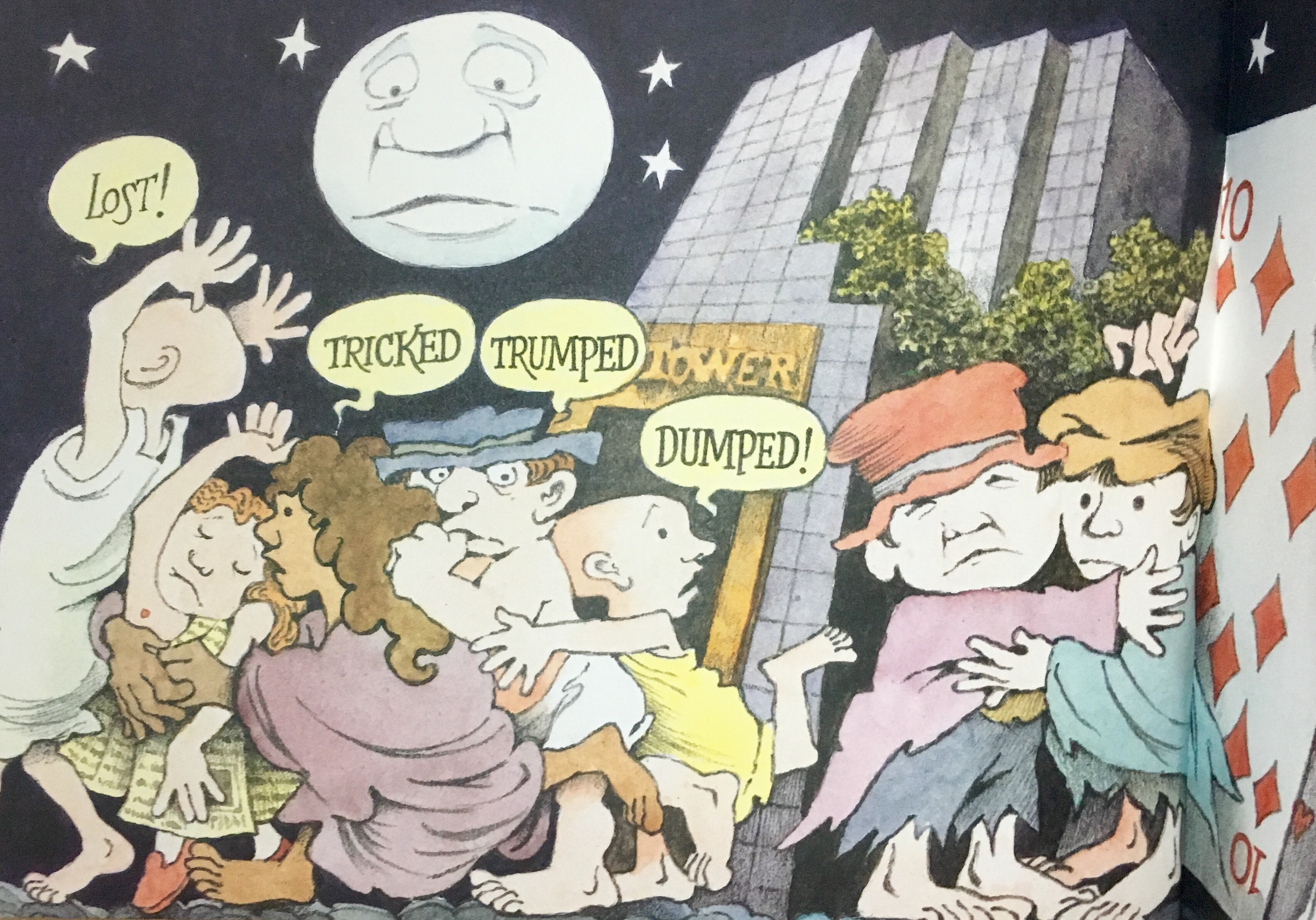
From Maurice Sendak’s We Are All Down in the Dumps with Jack and Guy, which seems to me a more important book than ever.

From Maurice Sendak’s We Are All Down in the Dumps with Jack and Guy, which seems to me a more important book than ever.

The following definitions are from the “G” section of Captain Grose’s Dictionary of the Vulgar Tongue (1811).
GAB, or GOB. The mouth. Gift of the gab; a facility of speech, nimble tongued eloquence. To blow the gab; to confess, or peach.
GAB, or GOB, STRING. A bridle.
GABBY. A foolish fellow.
GAD-SO. An exclamation said to be derived from the
Italian word cazzo.
GAFF. A fair. The drop coves maced the joskins at the
gaff; the ring-droppers cheated the countryman at the fair.
TO GAFF. To game by tossing up halfpence.
GAG. An instrument used chiefly by housebreakers and thieves, for propping open the mouth of a person robbed, thereby to prevent his calling out for assistance.
GAGE. A quart pot, or a pint; also a pipe. CANT.
GAGE, or FOGUS. A pipe of tobacco.
GAGGERS. High and Low. Cheats, who by sham pretences, and wonderful stories of their sufferings, impose on the credulity of well meaning people. See RUM GAGGER.
GALIMAUFREY. A hodgepodge made up of the remnants
and scraps of the larder.
GALL. His gall is not yet broken; a saying used in prisons
of a man just brought in, who appears dejected.
GALLEY. Building the galley; a game formerly used at sea, in order to put a trick upon a landsman, or fresh-water sailor. It being agreed to play at that game, one sailor personates the builder, and another the merchant or contractor: the builder first begins by laying the keel, which consists of a number of men laid all along on their backs, one after another, that is, head to foot; he next puts in the ribs or knees, by making a number of men sit feet to feet, at right angles to, and on each side of, the keel: he now fixing on the person intended to be the object of the joke, observes he is a fierce-looking fellow, and fit for the lion; he accordingly places him at the head, his arms being held or locked in by the two persons next to him, representing the ribs. After several other dispositions, the builder delivers over the galley to the contractor as complete: but he, among other faults and objections, observes the lion is not gilt, on which the builder or one of his assistants, runs to the head, and dipping a mop in the excrement, thrusts it into the face of the lion.
GALLEY FOIST. A city barge, used formerly on the lord
mayor’s day, when he was sworn in at Westminster.
GALLIED. Hurried, vexed, over-fatigued, perhaps like a
galley slave.
GALLIGASKINS. Breeches. Continue reading “Entries under “G” from Captain Grose’s Dictionary of the Vulgar Tongue (1811)”


Went to the bookstore this afternoon to pick up the much-acclaimed collection of stories by Lucia Berlin, A Manual for Cleaning Women (typing out the title, I suddenly hear its ambiguities). My trusty local used bookshop didn’t have a copy, but they did have Homesick, and I love Black Sparrow editions, so hey, cool.
I’ve been tearing through Ursula K. Le Guin’s Hainish novels lately after picking up Rocannon’s World at sorta-random. I’m in the middle of City of Illusion right now, having finished (a third read of) The Dispossessed (fantastic), The Word for World Is Forest (a bit too on-the-nose critique of the Vietnam War; also, James Cameron should send Le Guin some Avatar bucks), and Planet of Exile, which was great. (And oh: George R.R. Martin should send Le Guin some Game of Thrones bucks for that one: Planet of Exile has barbarian invaders from the north, seasons that last for decades, a constant fear that “winter is coming,” and its own white walkers (snow ghouls)).
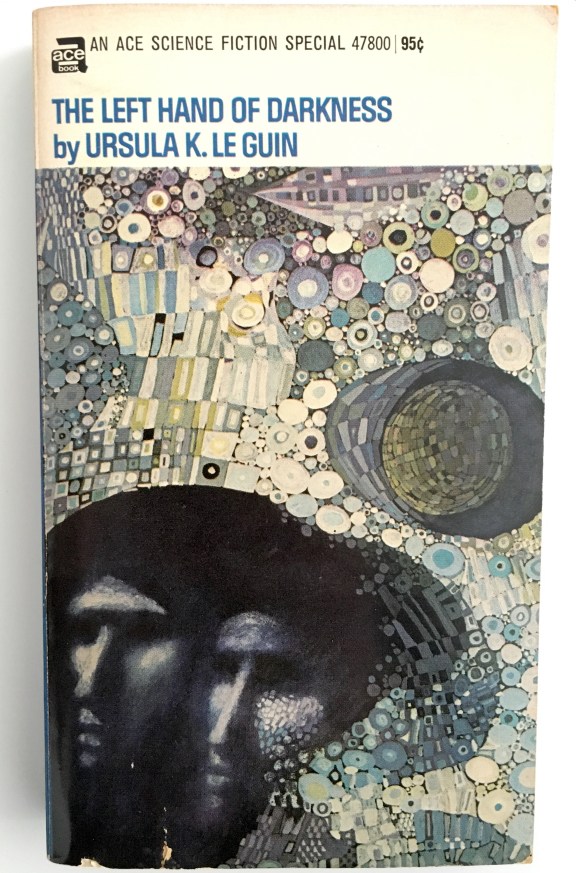
So well and anyway: I already have a copy of The Left Hand of Darkness, which is the next title in the sequence in which I’m reading the Hainish books. My pilfered copy isfrom years back, and I’ve read it a few times—but I just couldn’t pass up this first edition copy with its lovely Klimtesque cover art by Leo and Diane Dillon.


One of the better autobiographical notes I’ve read. This comes from The Norton Anthology of American Literature, Vol. E (8th ed.); my copy of Yellow Back Radio Broke-Down unfortunately doesn’t actually include this note.

I am alive—I guess—
The Branches on my Hand
Are full of Morning Glory—
And at my finger’s end—
The Carmine—tingles warm—
And if I hold a Glass
Across my Mouth—it blurs it—
Physician’s—proof of Breath—
I am alive—because
I am not in a Room—
The Parlor—Commonly—it is—
So Visitors may come—
And lean—and view it sidewise—
And add “How cold—it grew”—
And “Was it conscious—when it stepped
In Immortality?”
I am alive—because
I do not own a House—
Entitled to myself—precise—
And fitting no one else—
And marked my Girlhood’s name—
So Visitors may know
Which Door is mine—and not mistake—
And try another key—
How good—to be alive!
How infinite—to be
Alive—two-fold—the birth I had—
And this—besides, in Thee!
“A Psychological Shipwreck”
by Ambrose Bierce
In the summer of 1874 I was in Liverpool, whither I had gone on business for the mercantile house of Bronson & Jarrett, New York. I am William Jarrett; my partner was Zenas Bronson. The firm failed last year, and unable to endure the fall from affluence to poverty he died.
Having finished my business, and feeling the lassitude and exhaustion incident to its dispatch, I felt that a protracted sea voyage would be both agreeable and beneficial, so instead of embarking for my return on one of the many fine passenger steamers I booked for New York on the sailing vessel Morrow, upon which I had shipped a large and valuable invoice of the goods I had bought. The Morrow was an English ship with, of course, but little accommodation for passengers, of whom there were only myself, a young woman and her servant, who was a middle-aged negress. I thought it singular that a traveling English girl should be so attended, but she afterward explained to me that the woman had been left with her family by a man and his wife from South Carolina, both of whom had died on the same day at the house of the young lady’s father in Devonshire – a circumstance in itself sufficiently uncommon to remain rather distinctly in my memory, even had it not afterward transpired in conversation with the young lady that the name of the man was William Jarrett, the same as my own. I knew that a branch of my family had settled in South Carolina, but of them and their history I was ignorant.
Continue reading ““A Psychological Shipwreck,” a story by Ambrose Bierce”


Paul Kirchner’s cult classic comic strip The Bus originally ran in Heavy Metal from 1979-1985. The (anti-)story of “a hapless commuter and a demonic bus” (as Kichner put it himself in a recent memoir at The Boston Globe), The Bus, at its finest moments, transcends our expectations for what a comic strip can and should do. Sure, Kirchner delivers the set-ups, gags, japes, and jests we expect from a cartoon—but more often than not The Bus surpasses the confines of its form and medium. Its protagonist The Commuter is an allegorical everyman, a passenger tripping through an absurd world. Kirchner’s strip often shows us ways to see that absurd world—which is of course our own absurd world—with fresh eyes.
Thanks in part to the internet (and, in particular, an album of scans posted at Imgur), Kirchner’s comic has found a new audience. Over the past few years, Kirchner’s produced more than 40 new strips, which are now collected in one handsome volume as The Bus 2 (or the bus 2 if you like) from French publisher Tanibis Editions. Tanibis also has collected the original run of The Bus in an edition that’s more complete (and polished) than the Imgur album. These books are fantastic stuff.
The Bus 2 picks up in full satirical mode with an intro that informs us that “the studio that produced ‘The Bus’ was forced to shut down” in 1985; “Its closing left over 70 talented employees jobless.” The intro unwinds over a few pages—we’re told the bus itself and the “commuter’s iconic overcoat” are now in museums, and that the role of the commuter in this sequel will be played by the son of the actor who played the original commuter. From the outset, Kirchner uses irony to draw our attention to the artificiality of his strip, highlighting The Bus as a performance, an entertainment focused on the utterly mundane topic of a daily commute. And even though the intro unfolds over four pages, Kirchner keeps it true to form—literally: Six equal black and white panels.
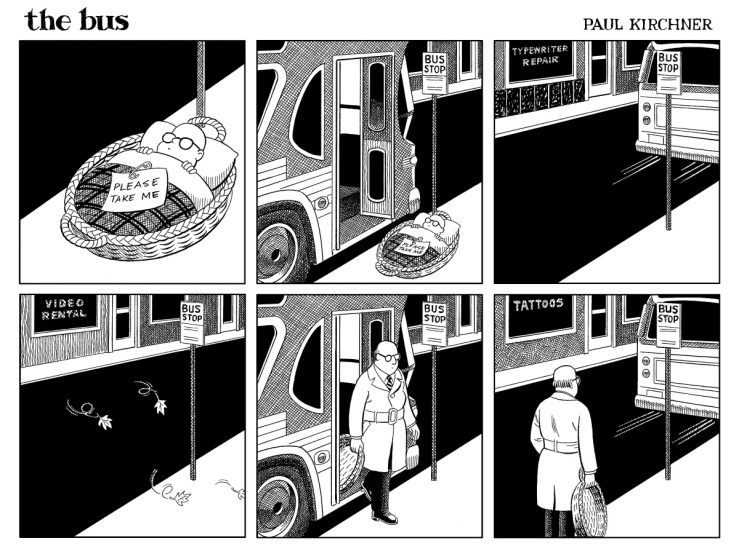
The first strip in the new collection positions The Commuter as an ironic hero, a foundling in a basket like Moses or Superman (note the signs that Kirchner employs to show the passage of time):
 Continue reading “A review of Paul Kirchner’s surreal sequel, The Bus 2”
 Biblioklept