Silence — Henry Fuseli

silence-large

A scattered riff on Thomas Pynchon’s novel Gravity’s Rainbow

I’m safe here at my office, away from Thomas Pynchon’s Gravity’s Rainbow. I almost certainly would not dare to write about it were it proximal. If the book were here with me, its text would infect me, and I’d replicate it in chunks here for you, dear reader, to sort out (or not sort out) as you wish (or do not wish).

□ □ □ □ □ □ □

I’m almost finished with Gravity’s Rainbow, which is how I know that I’m not finished with Gravity’s Rainbow. I’m going to have to read it again. (I want to read it again).

□ □ □ □ □ □ □

I’m about fifty pages from the last page—just got through/endured/delighted in/icked and acked at the Gross Suckling Conference, or, as I like to think of it, the alliterative abject dinner party.

□ □ □ □ □ □ □

Gravity’s Rainbow is filled with more abject imagery than any novel I’ve ever read.

□ □ □ □ □ □ □

I mean abjection here in the general sense of degradation, etc., but also in the specific sense that Julia Kristeva uses in Powers of Horror:

The corpse (or cadaver: cadere, to fall), that which has irremediably come a cropper, is cesspool, and death; it upsets even more violently the one who confronts it as fragile and fallacious chance. A wound with blood and pus, or the sickly, acrid smell of sweat, of decay, does not signify death. In the presence of signified death—a flat encephalograph, for instance—I would understand, react, or accept. No, as in true theater, without makeup or masks, refuse and corpses show me what I permanently thrust aside in order to live. These body fluids, this defilement, this shit are what life withstands, hardly and with difficulty, on the part of death. There, I am at the border of my condition as a living being. My body extricates itself, as being alive, from that border. Such wastes drop so that I might live, until, from loss to loss, nothing remains in me and my entire body falls beyond the limit—cadere, cadaver. If dung signifies the other side of the border, the place where I am not and which permits me to be, the corpse, the most sickening of wastes, is a border that has encroached upon everything. It is no longer I who expel, “I” is expelled. The border has become an object. How can I be without border? That elsewhere that I imagine beyond the present, or that I hallucinate so that I might, in a present time, speak to you, conceive of you—it is now here, jetted, abjected, into “my” world. Deprived of world, therefore, I fall in a faint. In that compelling, raw, insolent thing in the morgue’s full sunlight, in that thing that no longer matches and therefore no longer signifies anything, I behold the breaking down of a world that has erased its borders: fainting away. The corpse, seen without God and outside of science, is the utmost of abjection. It is death infecting life. Abject. It is something rejected from which one does not part, from which one does not protect oneself as from an object. Imaginary uncanniness and real threat, it beckons to us and ends up engulfing us.

□ □ □ □ □ □ □

Forgive me for citing at such length, but perhaps Kristeva summarizes some aspect of Gravity’s Rainbow that deeply interests me: The core of the novel (the core that Pynchon atomizes, decentralizes, scatters like his main man Tyrone Slothrop)—the core of the novel rests on love and death, me and not-me: “How can I be without border?” The war and its corpses and rockets and dissolutions. Continue reading “A scattered riff on Thomas Pynchon’s novel Gravity’s Rainbow”

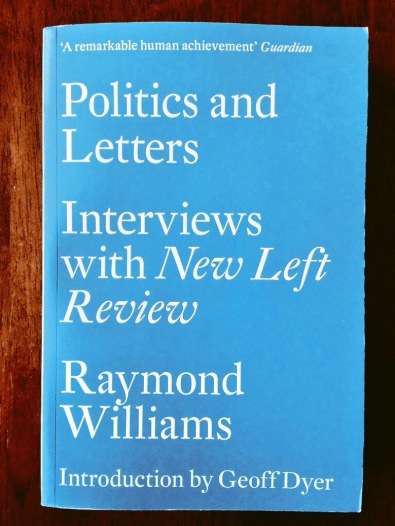
Raymond Williams’s Politics and Letters: Interviews with New Left Review (Book acquired, 4.03.2015)

IMG_5721

Politics and Letters: Interviews with New Left Review collects Raymond Williams’s interviews with the New Left Review. It’s new from Verso. Their blurb:

Raymond Williams made a central contribution to the intellectual culture of the Left in the English-speaking world. He was also one of the key figures in the foundation of cultural studies in Britain, which turned critical skills honed on textual analysis to the examination of structures and forms of resistance apparent in everyday life. Politics and Letters is a volume of interviews with Williams, conducted by New Left Review, designed to bring into clear focus the major theoretical and political issues posed by his work. Introduced by writer Geoff Dyer, Politics and Letters ranges across Williams’s biographical development, the evolution of his cultural theory and literary criticism, his work on dramatic forms and his fiction, and an exploration of British and international politics.

What Can Happen in Berlin If I Forget to Close Shutters in Evening? — Josef Ehm

ehm_what-can-happen-in-berlin_575

Incapable of writing even one word (Kafka diary entry, 8 April 1914)

8 April. Yesterday incapable of writing even one word. Today no better. Who will save me? And the turmoil in me, deep down, scarcely visible; I am like a living lattice-work, a lattice that is solidly planted and would like to tumble down.

Today in the coffee-house with Werfel. How he looked from the distance, seated at the coffee-house table. Stooped, half reclining even in the wooden chair, the beautiful profile of his face pressed against his chest, his face almost wheezing in its fullness (not really fat); entirely indifferent to the surroundings, impudent, and without flaw. His dangling glasses by contrast make it easier to trace the delicate outlines of his face.


From the diaries of Franz Kafka. The entry is from 8 April 1914. English translation by Martin Greenberg.

The Eye That Never Sleeps — Clarence John Laughlin

clarence-john-laughlin-the-eye-that-never-sleeps-1946

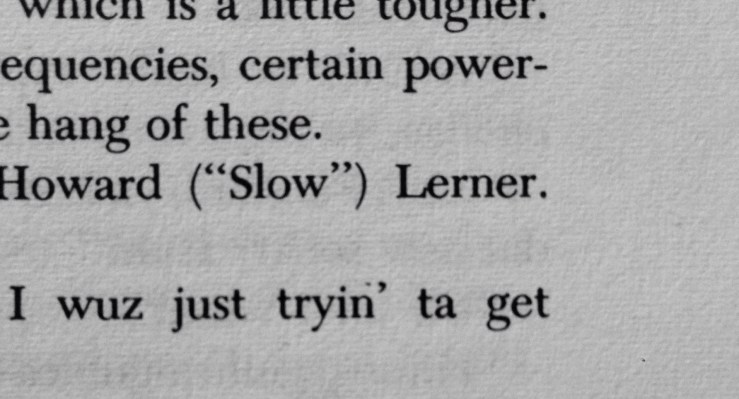
Slow Learner (Pynchon’s Gravity’s Rainbow)

IMG_5725


From page 641 of Gravity’s Rainbow. More hidden future-titles.

Reading backwards (Oscar Wilde)

There is a great deal to be said in favour of reading a novel backwards.  The last page is, as a rule, the most interesting, and when one begins with the catastrophe or the dénoûment one feels on pleasant terms of equality with the author.  It is like going behind the scenes of a theatre.  One is no longer taken in, and the hairbreadth escapes of the hero and the wild agonies of the heroine leave one absolutely unmoved.

From the “Sententiae” section of A Critic in Pall Mall.

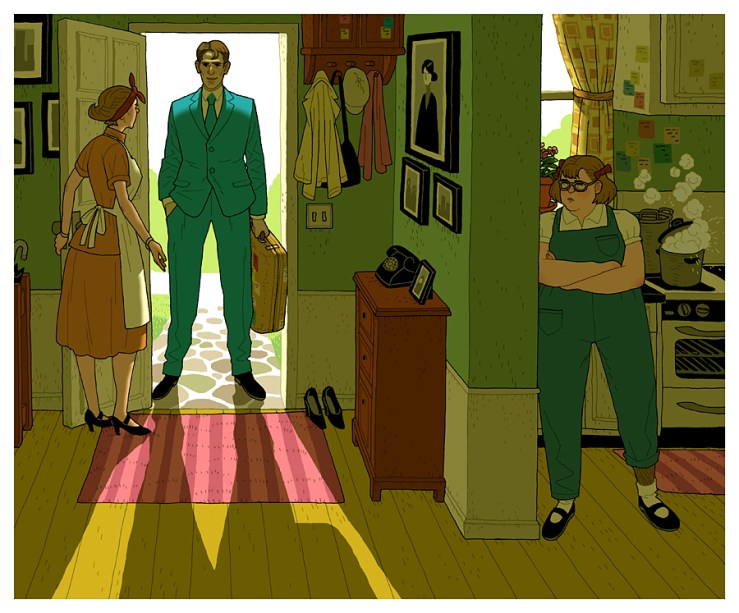
Good Country People (Illustration of the Flannery O’Connor Story) — Afu Chan

good_country_people_by_aznmextofu-d59t5jl

More of Afu Chan’s work.

Read the Flannery O’Connor story “Good Country People.”

“Strange Fruit” — Billie Holiday

ka: desire (Nose-slitting was then listed as a felony punishable by death)

From Joseph T. Shipley’s The Origin of English Words: A Discursive Dictionary of Indo-European Roots.

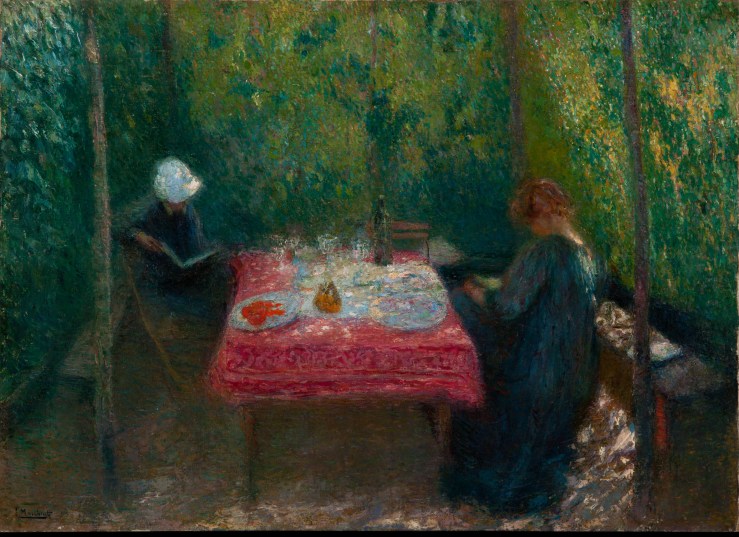
Under the Arbor — Serafino Macchiati

59-Macchiati

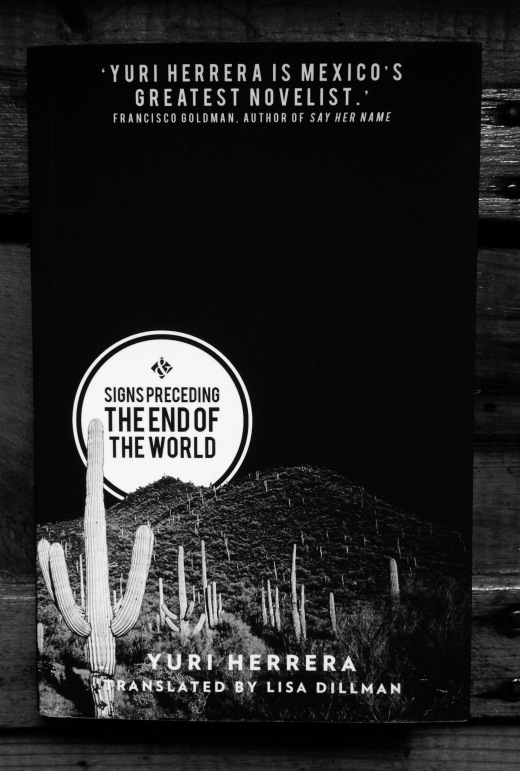
Yuri Herrera’s Signs Preceding the End of the World is sharp subterranean fiction

IMG_5790

Yuri Herrera’s sharp, thrilling novella Signs Preceding the End of the World opens with calamity. A sinkhole — “the earth’s insanity” — nearly swallows our hero before we can properly meet her:

I’m dead, Makina said to herself when everything lurched: a man with a cane was crossing the street, a dull groan suddenly surged through the asphalt, the man stood still as if waiting for someone to repeat the question and then the earth opened up beneath his feet: it swallowed the man, and with him a car and a dog, all the oxygen around and even the screams of passers-by. I’m dead, Makina said to herself, and hardly had she said it than her whole body began to contest that verdict and she flailed her feet frantically backward, each step mere inches from the sinkhole, until the precipice settled into a perfect circle and Makina was saved.

This opening passage sets the tone of Signs Preceding the End of the World. Makina will repeatedly plunge into and out of danger as she treks from her village in borderland Mexico into the weird world of the Big Chilango–the United States.

Makina crosses the border to find her estranged brother, who left the village years ago with the dubious plan of claiming some land (supposedly) owned by his family. (Reader, mark the symbolism there). Makina’s mother prompts her journey, but she’s also aided by a trio of adversarial gangsters—Mr. Double-U, Mr. Aitch, and Mr. Q. At the end of the first chapter of Signs, Mr. Q summarizes Makina’s impending quest (and the novella itself) in terse but eloquent language:

You’re going to cross and you’re going to get your feet wet and you’re going to be up against real roughnecks; you’ll get desperate, of course, but you’ll see wonders and in the end you’ll find your brother, and even if you’re sad, you’ll wind up where you need to be.

Mr. Q plays seer in his short monologue, just one example of the novella’s mythic overtones. Or maybe the word I want is undertones: Signs Preceding the End of the World opens with the earth swallowing victims; underworld mobsters send a hero on a night-quest over rough waters and alien terrain; aided by an underground network, Makina must traverse labyrinths and mazes and dark spaces; and, yes, the book ends underground. This is subterranean fiction. Continue reading “Yuri Herrera’s Signs Preceding the End of the World is sharp subterranean fiction”

Woman in Ecstasy — Ferdinand Hodler

Prohibited Thoughts — Vangel Naumovski

“The Tomb of Pan” — Lord Dunsany

“The Tomb of Pan”

by

Lord Dunsany

“Seeing,” they said, “that old-time Pan is dead, let us now make a tomb for him and a monument, that the dreadful worship of long ago may be remembered and avoided by all.”

So said the people of the enlightened lands. And they built a white and mighty tomb of marble. Slowly it rose under the hands of the builders and longer every evening after sunset it gleamed with rays of the departed sun.

And many mourned for Pan while the builders built; many reviled him. Some called the builders to cease and to weep for Pan and others called them to leave no memorial at all of so infamous a god. But the builders built on steadily.

And one day all was finished, and the tomb stood there like a steep sea-cliff. And Pan was carved thereon with humbled head and the feet of angels pressed upon his neck. And when the tomb was finished the sun had already set, but the afterglow was rosy on the huge bulk of Pan.

And presently all the enlightened people came, and saw the tomb and remembered Pan who was dead, and all deplored him and his wicked age. But a few wept apart because of the death of Pan.

But at evening as he stole out of the forest, and slipped like a shadow softly along the hills, Pan saw the tomb and laughed.

Christ Appearing to His Disciples After the Resurrection — William Blake