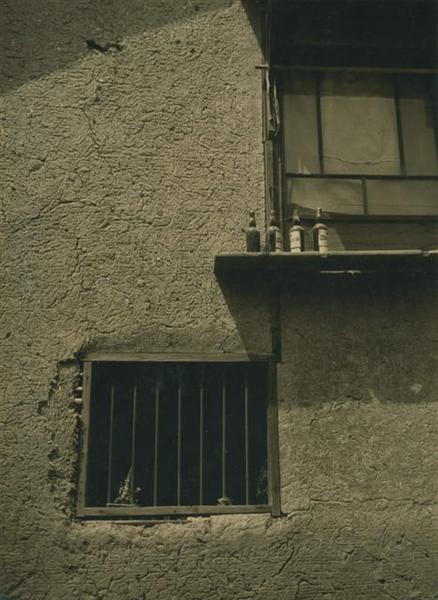
Window — Kansuke Yamamoto

window-1941.jpg!Large.jpg

Window, 1941 by Kansuke Yamamoto (1930-86)

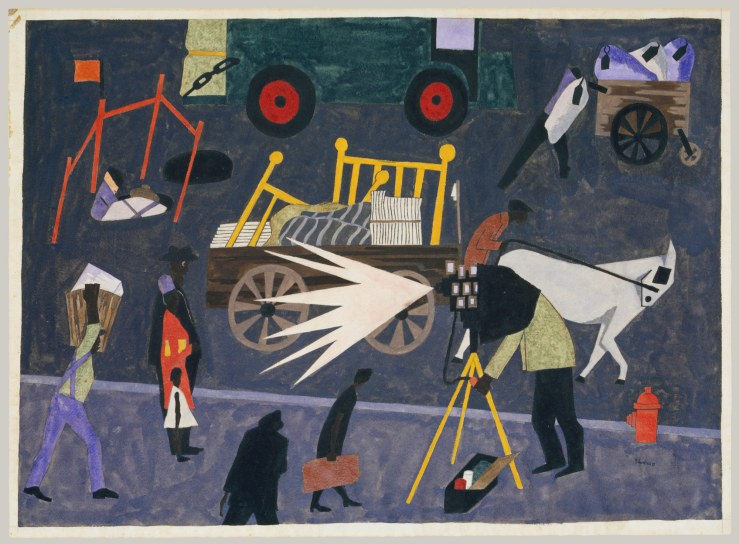
The Photographer — Jacob Lawrence

hb_2001.205a

The Photographer, 1942 by Jacob Lawrence (1917–2000)

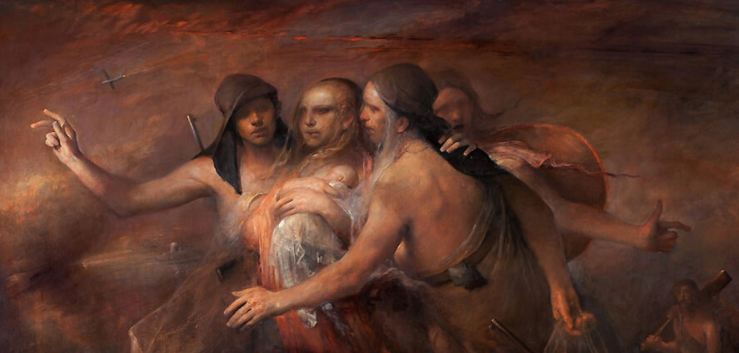
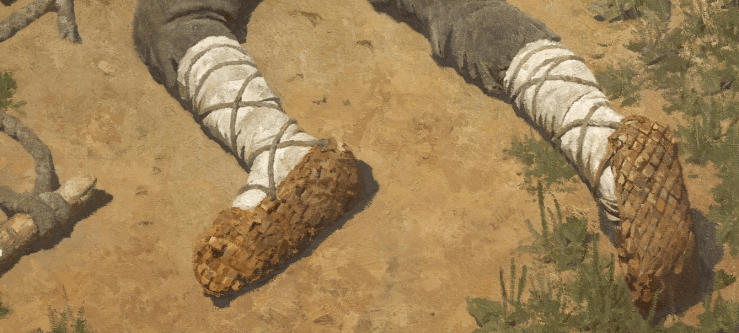
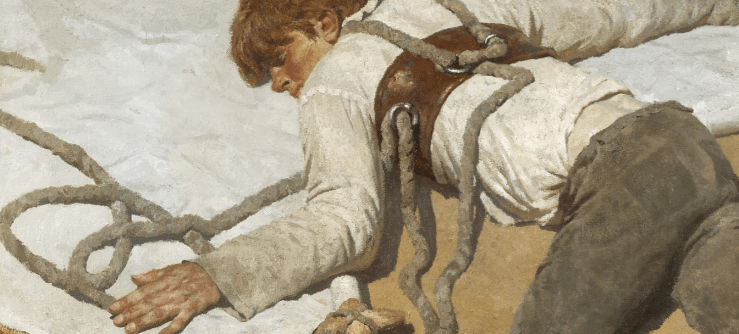
Crossing the Border — Odd Nerdrum

Crossing-the-border.jpg

ab

Crossing the Border by Odd Nerdrum (b. 1944)

“O Florida, Venereal Soil” — Wallace Stevens

“O Florida, Venereal Soil”

by

Wallace Stevens


A few things for themselves,
Convolvulus and coral,
Buzzards and live-moss,
Tiestas from the keys,
A few things for themselves,
Florida, venereal soil,
Disclose to the lover.

The dreadful sundry of this world,
The Cuban, Polodowsky,
The Mexican women,
The negro undertaker
Killing the time between corpses
Fishing for crayfish…
Virgin of boorish births,

Swiftly in the nights,
In the porches of Key West,
Behind the bougainvilleas,
After the guitar is asleep,
Lasciviously as the wind,
You come tormenting,
Insatiable,

When you might sit,
A scholar of darkness,
Sequestered over the sea,
Wearing a clear tiara
Of red and blue and red,
Sparkling, solitary, still,
In the high sea-shadow.

Donna, donna, dark,
Stooping in indigo gown
And cloudy constellations,
Conceal yourself or disclose
Fewest things to the lover —
A hand that bears a thick-leaved fruit,
A pungent bloom against your shade.

“Old Jerusalem” — Palace Music

River-House Showdown — Samual Weinberg

samual-weinberg_01

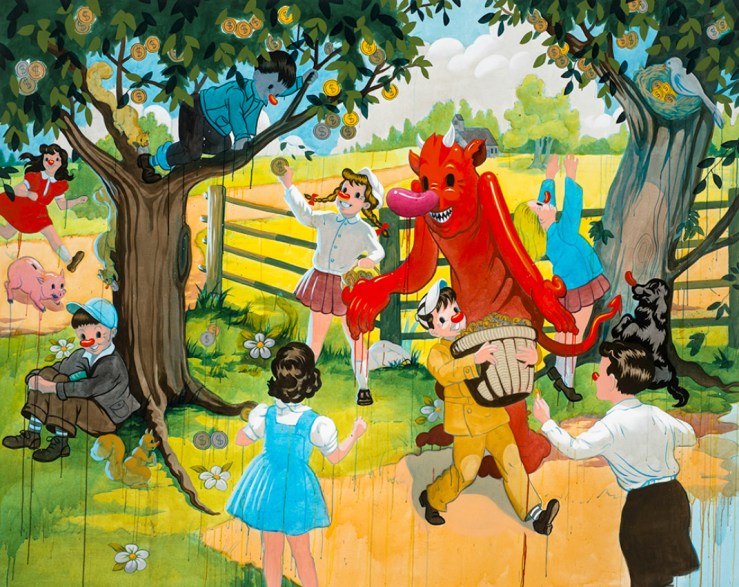
River-House Showdown, 2016 by Samual Weinberg

The Big Dream — Victor Castillo

tumblr_on4zovdOOU1rv33k2o8_1280

The Big Dream, 2016 by Victor Castillo (b. 1973)


Ready to go and not going.

img_5638

I left the city and made my way downriver alone, to meet the ship I awaited without knowing when it would come.

I reached the old wharf, that inexplicable structure. The city and its harbor have always been where they are, a quarter-league farther upriver.

I observed, among its pilings, the writhing patch of water that ebbs between them.

A dead monkey, still whole, still undecomposed, drifted back and forth with a certain precision upon those ripples and eddies without exit. All his life the water at forest’s edge had beckoned him to a journey, a journey he did not take until he was no longer a monkey but only a monkey’s corpse. The water that bore him up tried to bear him away, but he was caught among the posts of the decrepit wharf and there he was, ready to go and not going. And there we were.

There we were: Ready to go and not going.

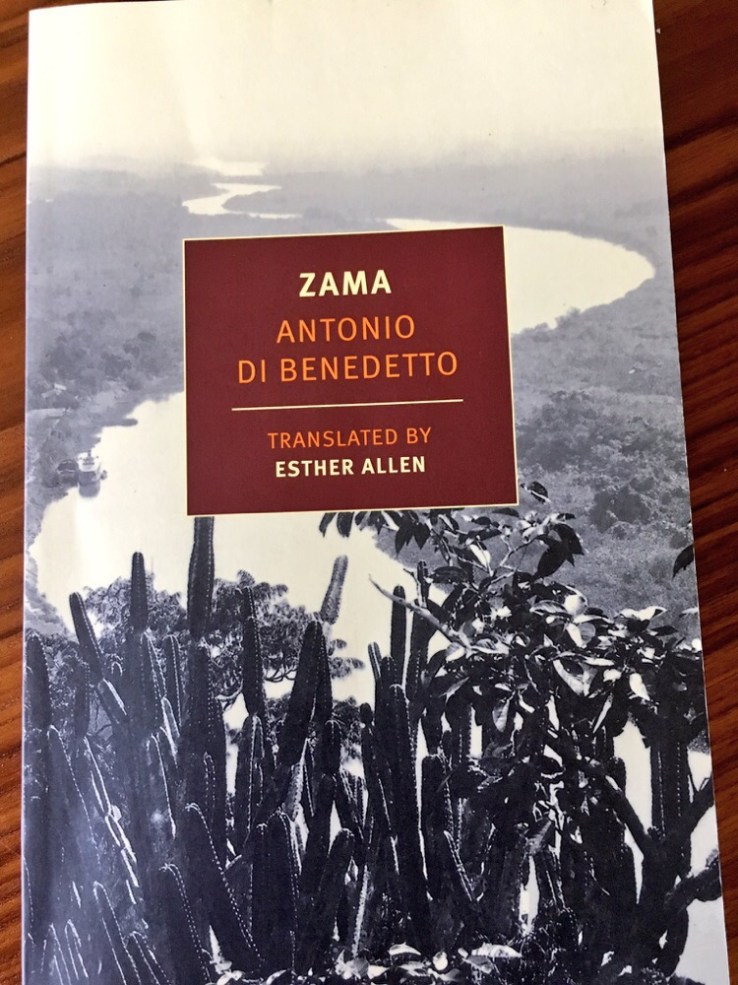
These are the opening sentences of Antonio di Benedetto’s 1956 novel Zama; English translation by Esther Allen (NYRB 2016). I finished it last night and then started it again.

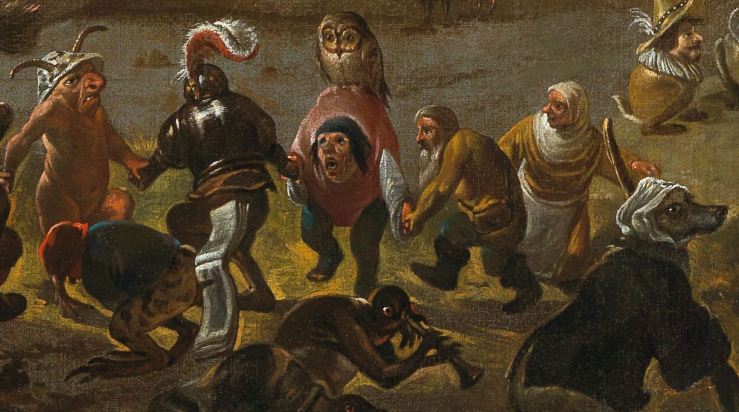
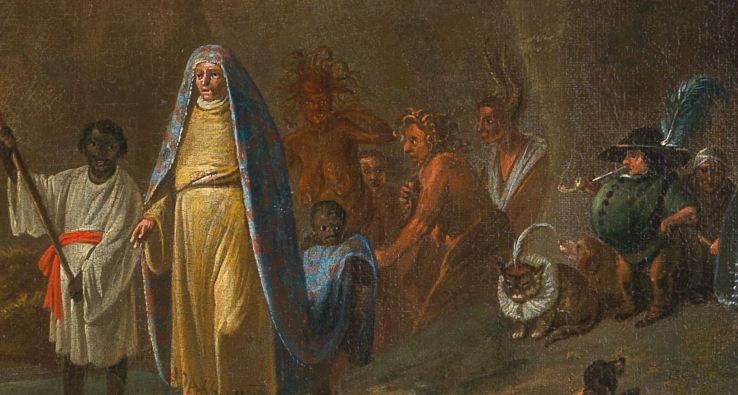
The Temptation of St. Anthony — Cornelis Saftleven

Cornelis_Saftleven_Versuchung_des_hl_Antonius.jpg

abcdefg

Die Versuchung des heiligen Antonius (The Temptation of St. Anthony), 1629 by Cornelis Saftleven (1607-81).

Boy with a Crow — Akseli Gallen-Kallela

Akseli_Gallen-Kallela_-_Boy_with_a_Crow_-_Google_Art_ProjectScreenshot 2017-04-02 at 8.50.35 PM

Boy with a Crow, 1884 by Akseli Gallen-Kallela (1865-1931)

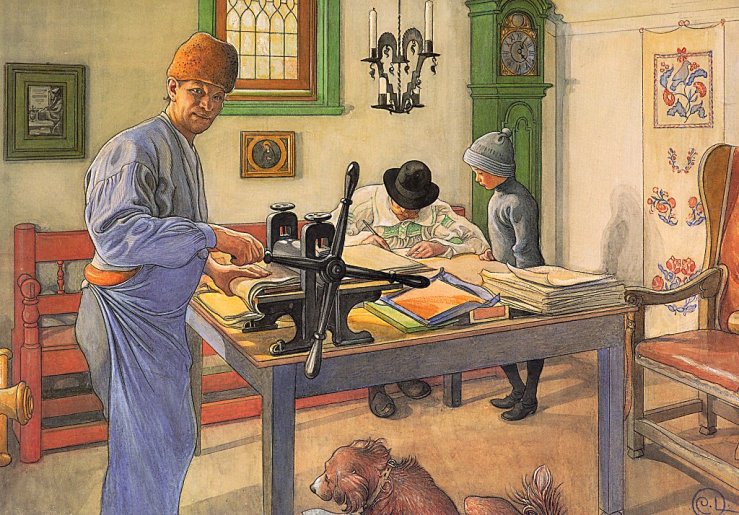
My Acid Workshop (Where I Do My Etching) — Carl Larsson

my-acid-workshop-where-i-do-my-etching-1910(1)

My Acid Workshop (Where I Do My Etching), 1910 by Carl Larsson (1853-1919)

Posted in Art

Sunday Comics 

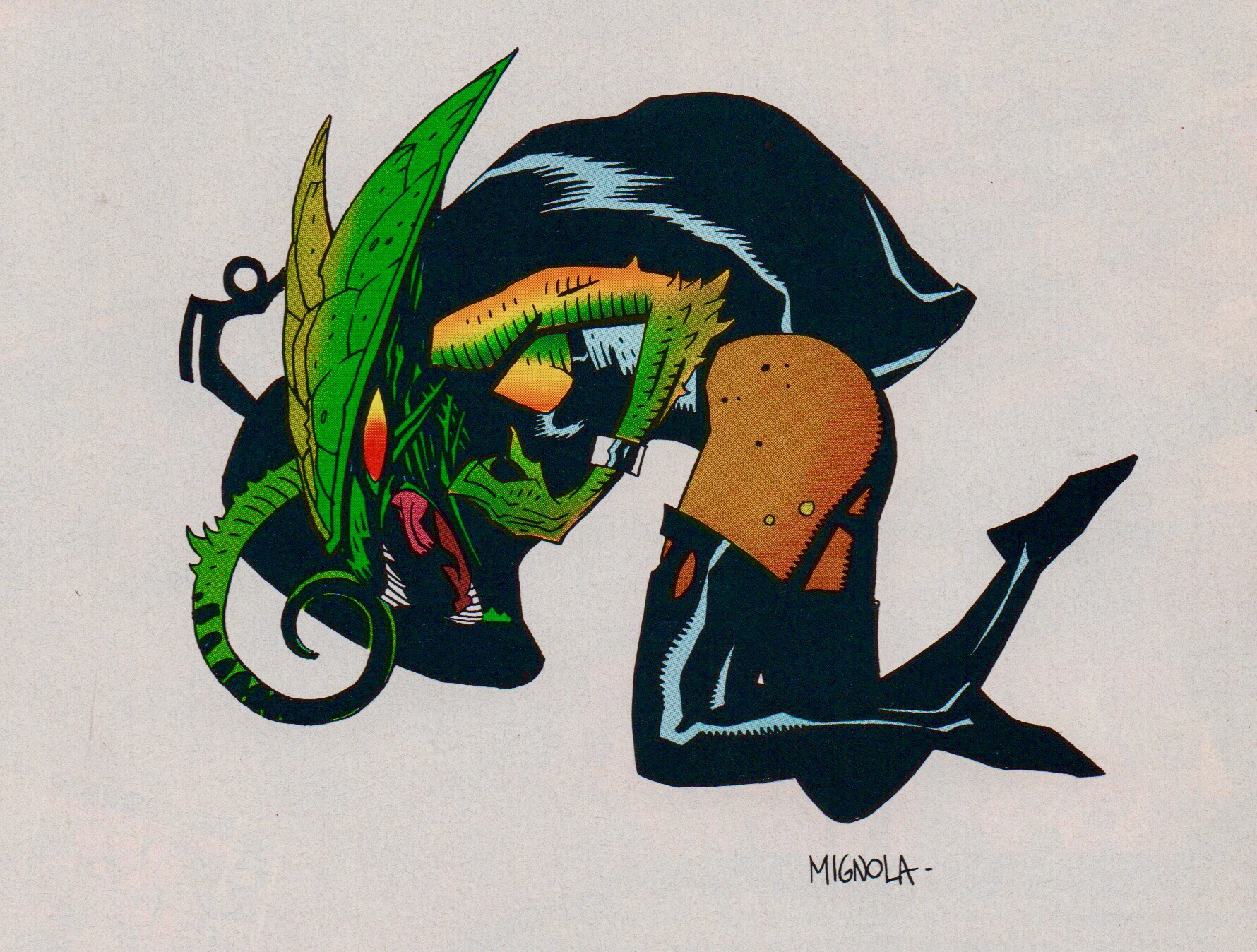
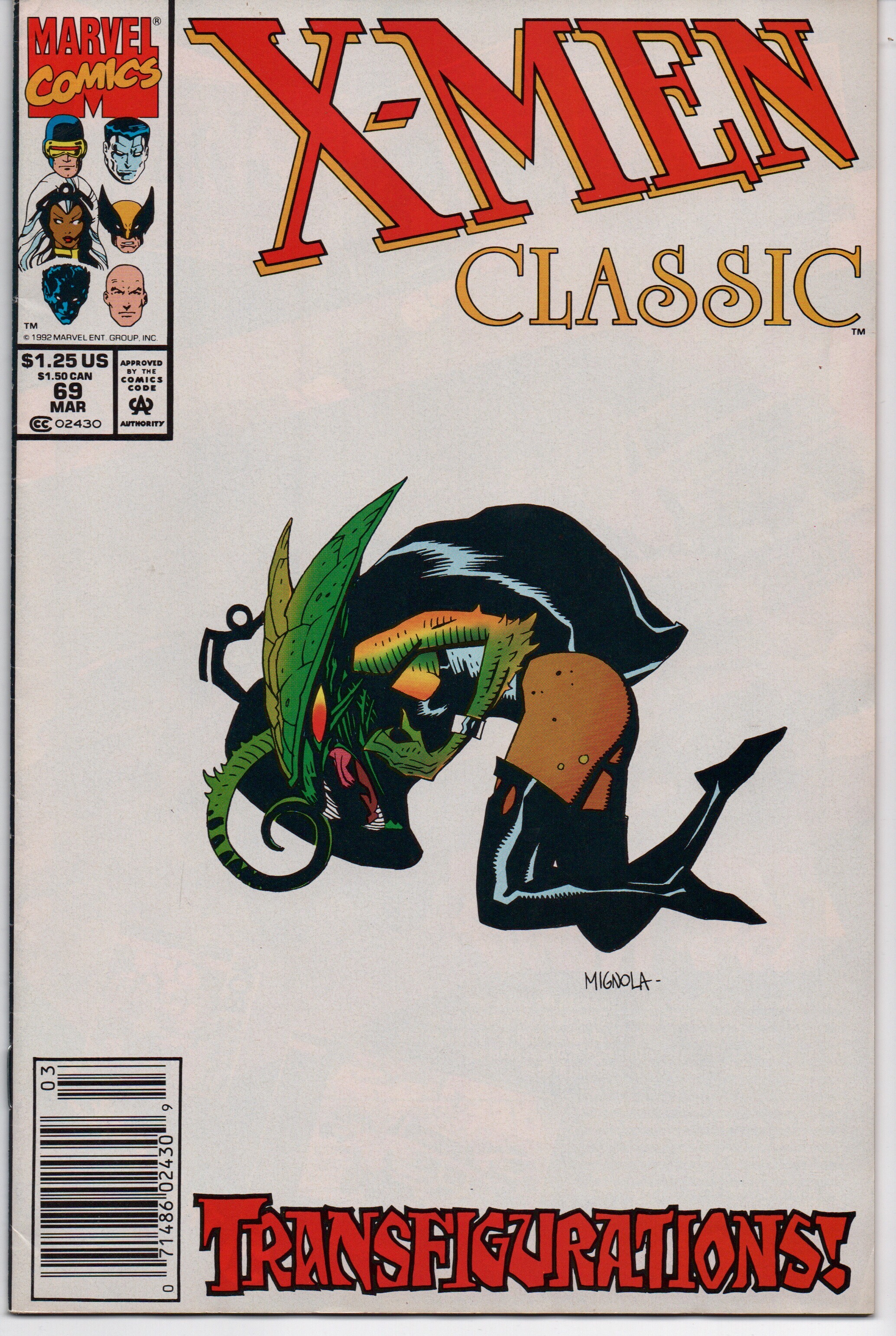
I was a huge fan of Chris Claremont’s 1980’s run on Uncanny X-Men. I’m not sure how well the comics have aged, because I have a hard time looking at them without my nostalgia lenses on. When I sold most of my comic book collection in the early 1990s, I couldn’t bear to part with most of the Claremont issues (although I did sell a few books that were particularly highly-valued—over-valued, really. I bought a Fender guitar with the money, a Bullet. Anyway). I even kept a bunch of Marvel’s concurrent reprint series, Classic X-Men (also stylized as X-Men Classic). I’ve still got a handful of the issues that Mike Mignola did covers for—he was (and is) one of my favorite stylists.

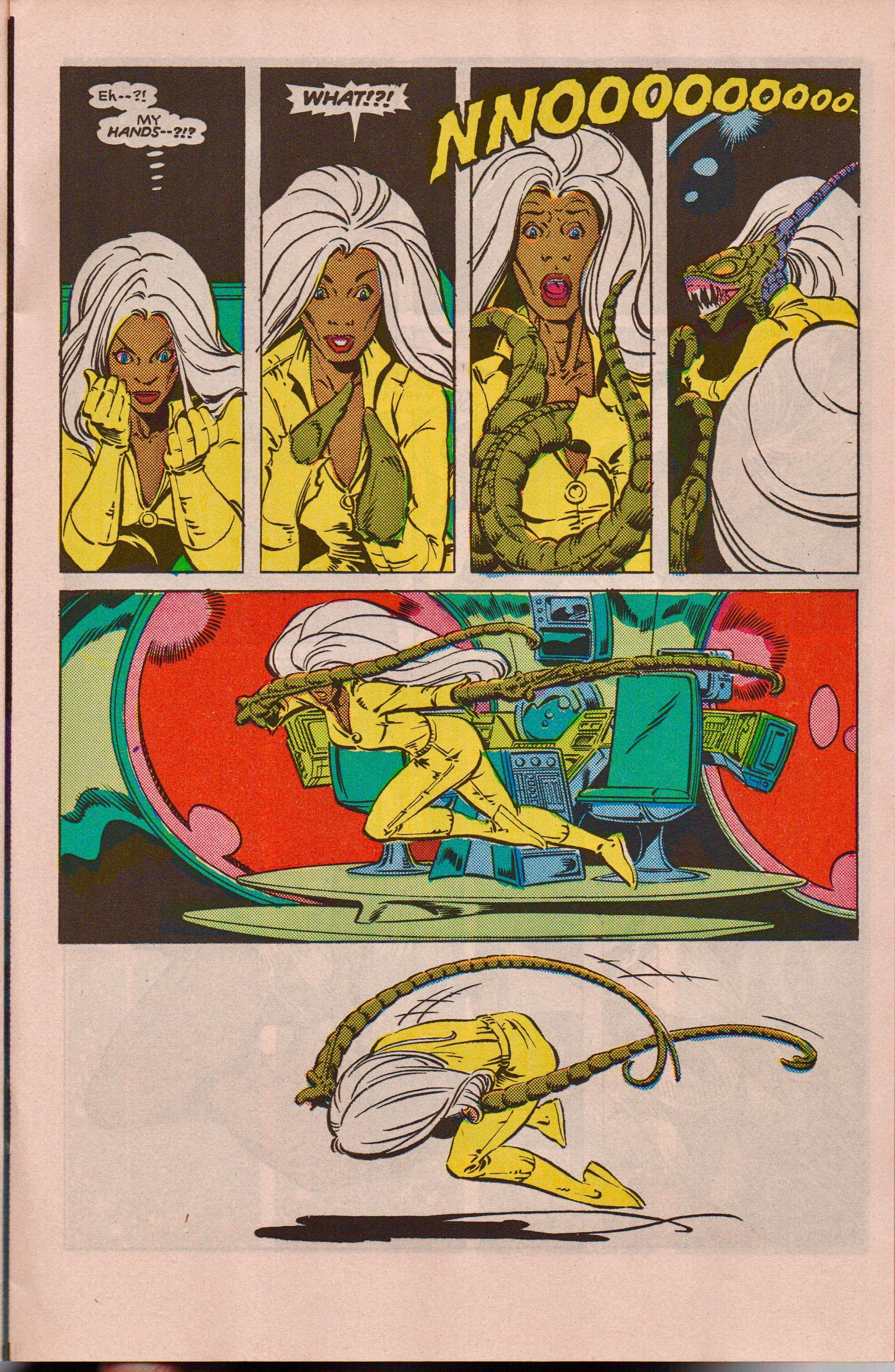
Anyway, the image of Storm above is Mignola’s cover for X-Men Classic #69, March, 1992. The issue reprints Uncanny X-Men #165—script by Claremont, natch, with art by Paul Smith and Bob Wiacek and colors by Lynn Varley. Here’s the page that Mignola took his cover queue from:

And here’s the full cover:

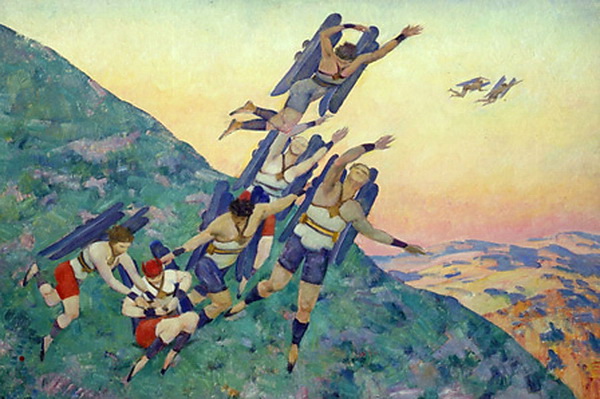
People of the Future — Konstantin Yuon

people-of-the-future-1929

Люди будущего (People of the Future), 1929 by Konstantin Yuon (1875-1958)

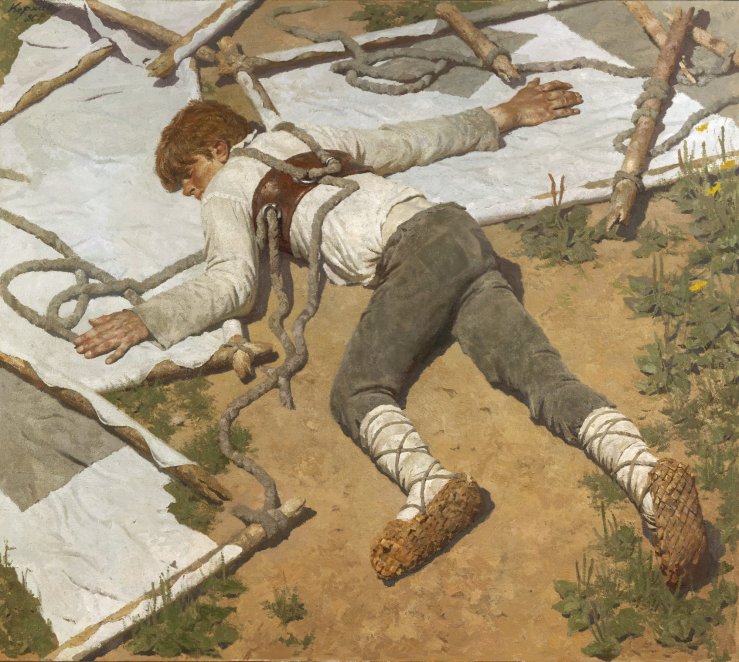
Egorka the Flyer — Gely Korzhev

icarus

Screenshot 2017-04-01 at 5.00.29 PMScreenshot 2017-04-01 at 5.00.11 PM

 Егорка-летун (Egorka the Flyer), 1976-80 by Gely Korzhev (1925-2012).

What I needed was to get away from myself.

img_5638

What I needed was to get away from myself.

I took my small hoard of coins to the horse races with a mind to enlarge it or be left destitute.

I went very early, in midafternoon. The  sun was brutal. Only the riders and the judges ventured out under its rays, and even they withdrew every two or three races to be replaced by others.

Those of us with money at stake lay sprawled under the trees at the forest’s edge. None but men were in attendance so there was no limit to the consumption of aguardiente and many stripped down until only their lower parts were covered.

I lost twice, won once, and then, in a subsequent race, lost everything I had won.

Out of prudence, I called a temporary halt to the gambling. I had reason to fear that my wagers might be ill-advised; I was unable to get a good view of the horses from so far away. It behooved me to wait till the sun was lower in the sky. As the afternoon waned, I could go to the edge of the track, which would make it easier to assess the possibilities.

With nothing at stake in the contests to come, I strolled about among the groups and whiled away the time in idle talk. Finally, at some remove from all the others, I stretched out under a palm tree.

Only one man lay on the ground nearby, drunk and fast asleep, his breath whistling. He was an acquaintance of mine: a wealthy man.

I observed the start and first leg of another race. Then I grew drowsy and my eyelids closed.

By my calculation, I slept no more than moment. When I opened my eyes, the same horses were just trotting back from the finish line. But there followed an instant of bewilderment. Disoriented, I needed to take stock of everything that had surrounded me before I fell asleep.

I sought to focus on what was there: in front of me, the test races: I myself, seated here with my back against a tree trunk; the rest of them over to the side; nearby, the drunk. …Something indefinable was alive in the grass next to him, moving toward him. A spider, I intuited, and one of considerable dimensions. My thought was not for the sleeping man but for myself, though I judged the distance between us too great for any such vermin, however quick, to cross—particularly since I was forewarned.

Then I saw it more clearly. I made out its legs, long and very slender, which barely bent the thin blades of grass. Whether spiders with long thin legs were poisonous I did not know. I told myself that they were not.

The spider approached the drunk. From a quarter vara away, these spiders can leap and bite so that if taken by surprise, even a man who’s awake has no time to defend himself. I had no wish to move. I could crush it with my boot but would postpone until the last.

The spider moved toward the sleeping head and I watched to see whether anything out of the ordinary would transpire. Would the man—obedient to some mysterious warning instinct—suddenly awaken and kill it? He did not. Now the insect was crawling in his hair. I didn’t see it climb up; I saw it there on him and then I was quite certain I should do nothing.

It stepped down the forehead, edged along the nose and mouth, extending its legs along the right cheek, then proceeded onto the neck. This is when it bites, I said to myself. It did not bite. It stretched up a leg and perched on the beard. The man’s snoring rustled the hair of his beard. This man’s snoring rustled the hair of his beard, which moved up and down, and I was certain that now the spider, feeling under attack, would bite. There it was, rising and falling on the tips of the beard.

The situation could not go on. It ended in the way I’d least imagined: The drunk gave a swift swipe of his great paw and sent the spider flying at least a vara through the air.

He might be awake now, I thought, and feared some rebuke for not having defended him. But his arm fell back in its former position, his whole body slack with pleasure in its repose. The snoring went on as loudly as before.

I got up to find the spider’s corpse. It had fallen on a patch of smooth red sand, not dead but crippled; the adventure had cost it four or five legs. I contemplated it for a moment then destroyed it with my heel.

I reviewed the episode. At no point had I felt any emotion, except when I imagined the man had wakened and was about to deliver himself of an entirely justified diatribe against me.
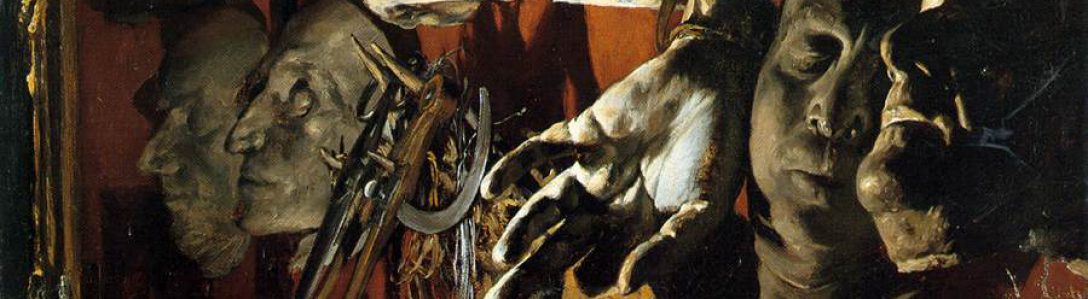
From Antonio di Benedetto’s 1956 novel Zama; English translation by Esther Allen (NYRB 2016).

Zama is the brutally funny story of Don Diego de Zama, a bored and horny americano wasting away in the provincial backwaters of Paraguay—the end of the world at the end of the 18th century. Zama fills his time with schemes of lust and petty pride, shirking his job as a nominal authority as much as possible. The passage above is, I think, representative of Di Benedetto’s rhetorical skill—he gives us a deceptively lucid first-person narrator who articulately elides key information—both from the reader and himself. We see here Zama’s continual slip into a Kafkaesque abyss. Lovely stuff.

April / Fools

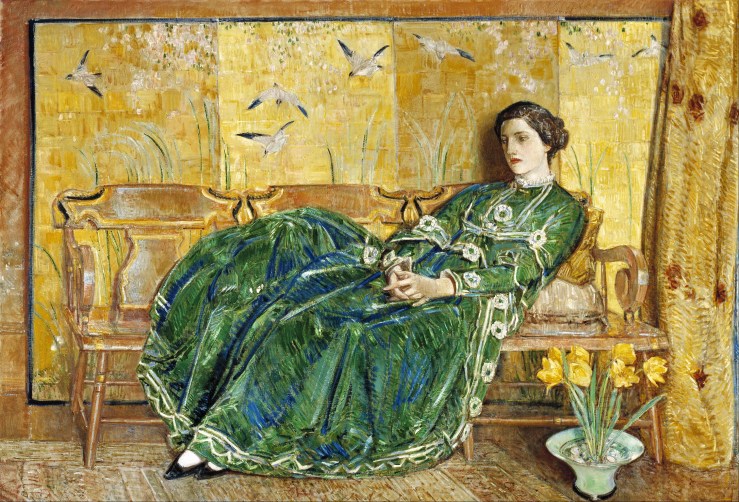
Childe_Hassam_-_April_-_(The_Green_Gown)_-_Google_Art_Project

April (The Green Gown), 1919 by Childe Hassam (1859–1935)

the-ship-of-fools-1500(1)

Ship of Fools, c. 1490–1500 by Hieronymus Bosch (c. 1450-1516)