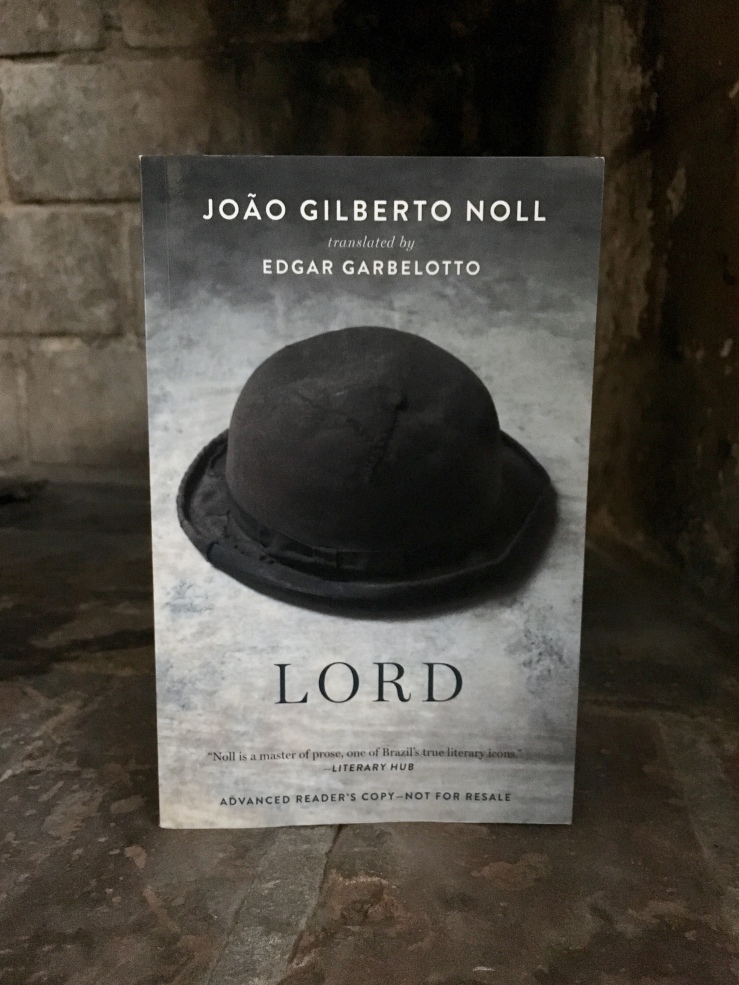
João Gilberto Noll’s short novel Lord is an abject and surreal tale of madness. Madness is perhaps not the correct term, although it does point towards Lord’s gothic and abject modes. Perhaps it’s more accurate to say that in Lord, Noll gives us a consciousness dissolving and reconstituting itself, a first-person voice shifting from one reality to the next with absurdly picaresque energy.
That first-person voice is “a Brazilian who wrote books that were mostly well received by critics but not the public.” The Brazilian novelist travels to cold winter London on an unspecified “mission.” Indeed, the mission remains unspecified to both reader and narrator alike, although it does seem to involve an English university. The man who arranges for the narrator to come to London is himself a shifting cipher in Lord, transforming into different entities—at least in the narrator’s (often paranoid) view. We get the sense in Lord that consciousness is always under radical duress, that a state of being might collapse at any time or give way to some other, unknown state of being.
Throughout Lord, Noll dramatizes abject consciousness in turmoil. Early on, the narrator, already feeling uncertain about why he has moved halfway across the world, arrives at a university’s Portuguese department. In a book-lined office, he attempts to stabilize himself through the textual “reality” of printed matter:
The walls were covered with books. I trailed my hand over them as if to confirm the reality I was living in. Though I knew I was not living an unreality per se—like those born out of a simple dream and ending up in a nightmare, which we can only escape from when we wake up sweaty, trembling, and confused.
The irony is that the narrator has not fully comprehended yet that he is living an unreality, that he is actually narrating the nightmare. Noll’s hero is an unfixed voice, a voice that can’t square the signifiers around him with any stable signified meaning in his consciousness.
Slowly (but not too slowly—Lord moves at a steady clip), the narrator embraces this abjection and wills the dissolution of his self and its reformation into some new other. “My tiredness did not demand sleep, but, damn!, how I craved some indistinguishability between bodies, volumes, and formats,” he tells us.
The narrator carries his project of transformation even farther, applying cosmetics and hair dye to alter his appearance and “find a new source for [his] new formation”:
My lack of definition was already greater than me, although I had lost myself and begun to suspect that even my English boss couldn’t do anything to bring me back to me. I needed to keep up this task of being every- one somehow, because without it I wouldn’t even make it as far as the corner: without asking anyone, I happened to have overcome being the individual whom I had mechanically created for other people. I had to find a new source for my new formation, even now in my fifties, and that fountain would come from him, that light brown-haired man with makeup on, who lived in London for the time being without exactly remembering why.
Lord’s narrator takes this new version of himself on various London adventures, most of which are lurid and gross, and many of which are downright horny. Our Brazilian writer (who is slowly unbecoming a Brazilian writer) visits museums and has weird sex encounters, sleeps on the streets and takes a soapy bath with a Professor of Latin American Studies. Lord moves at a rapid and occasionally bewildering pace, giving the narrator’s quest a mock-ironic urgency. In Edgar Garbeletto’s capable English translation from the Portuguese, the paragraphs go on for pages but the sentences are choppy, riddled with colons and dashes, lurches and leaps, falls and stops.
Through this turbulent rhetoric, Lord’s narrator channels other voices, sublimating them into the text proper. The narrator absorbs bits and pieces of the other voices he encounters, dissolving his consciousness into and out of them as he strives for transformation. He also absorbs bits and pieces of bodies—fluids and other detritus, other abject bits of our human borders.
Our narrator is obsessed with borders, but his transgression of them has little to do with a moral framework. For the narrator, moral semblance is simply the result of an “individual…mechanically created for other people.” Rather, the narrator is fascinated by what makes a consciousness conscious. However, he’s not yet willing to cross the ultimate border, despite his fascination. In one little episode of Lord, our hero happens upon a dying man on the street. He watches the man pass from life:
I squeezed his hand. His mouth opened, and I could see the pool of blood that had overflowed his rotten teeth. That death, in some way, in some corner of my mind, gave me tremendous satisfaction. Someone was not afraid to go all the way to the end. To do for others what everyone tried to avoid. I wished I could follow him, but I didn’t have his bravery; I lacked the necessary elements to consummate the act. I needed that hug today.
A strange hug indeed!
The apparent finality of death as cessation-of consciousness holds a certain appeal to Lord’s narrator, whose quest is perhaps to overcome abjection via transformation. But it’s not easy,
It’s not just a snap, man: it’s being stuck in this limbo between staying in England and going back to South America that made me unrecognizable to myself anymore, it didn’t let me transfigure myself, it wouldn’t let me leave this stupid little body here, vomit myself out in disgust, or turn me into someone else.
Indeed, the quest in Lord might be summarized by that phrase: “vomit myself out in disgust.” While the voice in Lord remains untethered by the normal strictures of narrative (or even moral) logic, it is hardly free or disembodied. Indeed, the relationship between bodies and consciousness is perhaps the primary problem of Lord. Our narrator’s voice has a body that can’t catch up to what’s happening in its consciousness. Hence the novel’s preoccupation with the corporeal reality of bodies: blood, urine, semen, sweat, vomit…all the leaking stuff of humanity spurting out, transgressing the apparent borders and showing those borders are but a moral fiction.
In one abject episode, our narrator attempts to dispel London himself from his consciousness:
On a corner in Bloomsbury, a totally unexpected need to vomit hit me. I wiped myself with a sheet of newspaper that was fluttering by. But I couldn’t stop; I realized it was London I was throwing up, London with its ghosts and impossible missions, already entirely unsuccessful.
Tellingly, the narrator grasps a newspaper that just happens to be “fluttering by” to clean himself, to restore the moral fiction of an arranged, presentable self. The newspaper, like the books in the university office, is another nod to Lord’s metatextual motif. The written word proves to be illusory as an anchor in Noll’s novel—it cannot codify consciousness, it cannot fix meaning. Hence, the novel’s strange, disruptive rhetorical program, which takes first-person consciousness and literally deconstructs it.
The fact that Noll’s hero is/was a writer, “a Brazilian who wrote books that were mostly well received by critics but not the public,” suggests another metatextual nod. Lord’s narrator is a strange cipher of Noll himself. In 2004, the year Lord was published, Noll served as writer-in-residence at the Centre for the Study of Brazilian Culture and Society at King’s College London. But the narrator is a cipher of Noll only—a voice that deconstructs and reconstructs itself, autofiction that dissolves the self.
This abject voice tries to reinvent itself from the outside in, only to vomit the inside back out again. Utter disintegration seems fatally imminent; madness seems inescapable. As one reaches the final pages of Lord, one senses that the narrative might fall apart into nothing—which, to be clear, it doesn’t. Lord sticks its ending a strangely and suitably satisfying way. I won’t give away the end, but instead reverse the course of my previous sentence: Lord falls apart into something.
Like Quiet Creature on the Corner and Atlantic Hotel (the other Noll books currently available in English translation), Lord is propelled on its own dream-nightmare logic. It’s fucked-up, gross, abject, and surreal. It’s permeated by a vague horror. Reading it might make parts of your stomach hurt. I like these particular flavors, and I particularly like a book that doesn’t just upset me with its themes and its plot, but also with its style and its rhetoric. Lord certainly isn’t for everyone, but I loved it, and I think that there’s an audience of weirdos out there like me who will really dig this book too. Highly recommended.
João Gilberto Noll’s Lord is new from Two Lines Press. It is the third novel by Noll Two Lines has published. I hope they publish more.





 Biblioklept