A review of Octavia Butler’s dystopian novel Parable of the Sower

joga-put-k-samosozidaniyu-i-zdorovyu-iz-tryoh-shagov
Cover art for Parable of the Sower by John Jude Palencar 

Octavia Butler’s 1993 novel Parable of the Sower imagines what a radical affirmation of life might look like set against a backdrop of impending extinction. Set between 2024 and 2027, Parable of the Sower conjures  a crumbling America. Hyperinflation abounds, infrastructure is falling apart, water is scarce, environmental collapse is imminent, and the social institutions that bind the nation have all but frayed.

When we first meet our narrator Lauren Olamina, she is one of the lucky few who has a life of moderate comfort, stability, and security. Lauren lives in a gated community in a sort of compound with her brothers, stepmother, and father, an academic/preacher. Lauren’s father is the ersatz leader of this community,  He leads the neighborhood’s shooting practices, trains them in survival skills, and organizes a perimeter watch against the thieves and arsonists that constantly threaten their survival. He is the central role model for Lauren, who takes his lessons to heart. When the community finally fragments under an attack it can’t endure, Lauren is the only one of her family to survive. She even has the presence of mind to grab her bug-out bag.

After this initial staging of events, Parable of the Sower turns into a road novel. Lauren and two other survivors of the compound head north along the California freeways, slowly gathering followers. Lauren’s leadership drives the novel and inspires those around her. She offers her followers an alternative to the predation around them, a predation most strongly figured in the roving bands of arsonists that prey on travelers and communities alike. She offers her followers the prospect of belonging to a We—an interracial, inter-generational collective.

Lauren’s leadership capability derives from two strands. The first strand is the religion she is creating, an idea she calls “Earthseed.” The basic premise of Earthseed (one that the novel repeats ad nauseum) is that “God is Change.” Another tenet is that people are the seeds of the earth (like, uh, Earthseed—get it?). Lauren’s long-term vision is that humanity might seed a new planet. The post-WW2 dream of NASA and the futurity of exploration—a Manifest Destiny of the stars—glows in the background of Sower, and often points to a more interesting conclusion than the novel finally musters.

The second source of Lauren’s drive comes from a condition she suffers called hyperempathy or “sharing,” a mutation that’s the result of her birth-mother’s drug addiction during pregnancy. Simply put, when Lauren witnesses another person’s injury, she feels their pain. This affliction is a devastating weakness in a predatory, violent (non)society: for Lauren, self-defense entails self-harm. At the same time, Lauren’s hyperempathy is a strength—it makes her understand, at the most visceral level, the need for a community to work together in order to thrive in a world that seems to be dying.

Perhaps the greatest strength of Butler’s novel is that she shows her readers what Lauren can never quite see—namely that Lauren’s hyperempathy is a strength. Sower assumes the form of a journal, Lauren’s first-person recollections scrawled out in rare moments of respite from the terrors of the road. While her first-person perspective is generously broad (she seems to see a lot), she still never quite realizes that her hyperempathy contributes to her strength as a leader. Lauren’s hyperempathy necessitates imaginative forethought; it also entails a need to act decisively in times of crisis. And Parable of the Sower is all crisis, all the time.

Lauren’s journal style mixes the high with the low. She cribs the poetry of her Earthseed religion from the King James Version of the Bible, with often corny results. (I am pretty sure the corniness is unintentional). She’s also occasionally psychologically introspective, going through thought experiments to better understand those around her.

Despite its Earthseed flights into poetical musings and boldly-declared profundities, most of Lauren’s narrative is strangely mundane in its accounting of a slow apocalypse though. There are seemingly-endless lists of supplies to be bought or scavenged, survival chores to be checked off, and California roads to be traversed (sections of Parable of the Sower often reminded me more of the SNL recurring sketch “The Californians” than, say, Cormac McCarthy’s The Road). The bulk of Butler’s book hovers around disaster prepping, finding temporary shelter, and looting bodies, motifs that won’t seem strange to contemporary audiences reared on cable television and addicted to battle royale video games.

Lauren is 15 at the novel’s outset in 2024, yet she seems fully mature. If this was a coming-of-age novel, I missed it—Lauren, while far from perfect, is generally self-assured in her powers of decision making. At a quite literal level, she commands the narrative, propelling it forward without any of the wishy-washiness we might get from the narrator of, say, The Handmaid’s Tale. If Lauren second-guesses herself, she doesn’t bother to second-guess her second guesses. Butler seems to envision her rather as a hero-model for the coming disaster the novel anticipates. Much of Parable of the Sower reads like a checklist of What To Do After the End of Civilization.

The novel’s biggest weakness is that it can’t quite articulate just how bad things have gotten. Is this actually The End of Civilization? Butler paints a bleak picture. Drought is the new norm. Most Americans are illiterate. Work is hard to find. The roads are too dangerous to travel at night. Packs of feral dogs hunt down humans. Packs of feral children eat humans. Women live with the constant threat of rape. Overt racism is fully normalized. Company towns make a comeback, issuing scrip instead of currency, leading to indentured servitude. Water is a commodity to literally kill for, the police are essentially an organized gang, and a large portion of the population are addicted to a drug that makes setting fires better than sex. Murder is an open business, and there is no recourse to any established justice.

And at the same time that it evokes all of these apocalyptic images and themes, Butler’s novel points to tinges of normalcy—a presidential election carried out sans violence, the sense that a university system is still in play, various notations of different regulatory bodies. Parable of the Sower often reads like The Walking Dead or The Road, but then it might turn a weird corner to uncanny normalcy, where characters shop in a Walmart-like (if hyperbolized) superstore. As one character puts it,

Federal, state, and local governments still exist— in name at least— and sometimes they manage to do something more than collect taxes and send in the military. And the money is still good. That amazes me. However much more you need of it to buy anything these days, it is still accepted. That may be a hopeful sign— or perhaps it’s only more evidence of what I just said: We haven’t hit bottom yet.

Perhaps what I perceive here is simply Butler showing her narrator’s essential naivete, a naivete that doesn’t evince on the surface of the first-person narration. Lauren doesn’t know what she doesn’t know. She doesn’t fully understand how bad things have gotten because she doesn’t fully understand the potential in America that existed before her own life. But she does intuit how bad things are. Despite her intuition, she’s hopeful. This hope, and the despair that foregrounds it, evinces strongly in the final moments of the book. Lauren has finally made it to a kind of promised-land, a frontier-space where she can create a new life with a new love, a much-older man named Bankole. Bankole was a doctor in his old life, but now he’s a survivor. At the end of the novel, he mourns the American dream, the American we, and mourns that Lauren cannot mourn it with him:

He said nothing for a while. Then he stopped and put his hand on my shoulder to stop me. At first he only stood looking at me, almost studying my face. “You’re so young,” he said. “It seems almost criminal that you should be so young in these terrible times. I wish you could have known this country when it was still salvageable.”

“It might survive,” I said, “changed, but still itself.”

“No.” He drew me to his side and put one arm around me. “Human beings will survive of course. Some other countries will survive. Maybe they’ll absorb what’s left of us. Or maybe we’ll just break up into a lot of little states quarreling and fighting with each other over whatever crumbs are left. That’s almost happened now with states shutting themselves off from one another, treating state lines as national borders. As bright as you are, I don’t think you understand—I don’t think you can understand what we’ve lost. Perhaps that’s a blessing.”

Banokole’s summary of America in the late 2020s seems like a dire if hyperbolic prognostication of our current trajectory. More than a quarter century ago, Butler knew what was up. Butler also offered an answer to the problem in her mouthpiece Lauren, who replies to her (way-too-much older) lover Bankole, “We’ve got work to do.”

Parable of the Sower is not a particularly fun novel, although of course, it never intends to be. The dour tone is appropriate to its subject matter, I suppose, but that grim tone can become exhausting. The novel’s trajectory and moral vision keep it from falling into an exercise in nihilism or apocalypse porn, like, say, The Walking Dead. But like The Walking Dead, Butler’s novel often plods along. Maybe this is a rhetorical feature—maybe Butler intends her reader to feel just as weary and depressed as Lauren.

Parable of the Sower was published just a year after a superficially-similar novel, Neal Stephenson’s Snow Crash, which also presciently envisions a fragmenting America where like-groups seal themselves off from each other. In contrast though, Stephenson’s novel is zany and vibrant, a cartoon world devoid of any hyperempathy that might get in the way of anarchic fun. Over 25 years old now, many of the tropes in both Snow Crash and Parable of the Sower have so fully infiltrated our media—books and video games, films and television shows—that their initial vital strangeness is hard to detect.

The dystopian tropes of Parable of the Sower don’t feel particularly fresh in 2019, but the novel’s prescience still has an alarming bite. (Her sequel, Parable of the Talents, features a right-wing Presidential candidate who runs on the promise to “Make America great again”). Sower works best as an extended thought experiment on what might happen to society—to democracy in particular—when impending ecological collapse threatens our very existence. And Butler proposes a solution to the problems posed in her thought experiment: “We’ve got work to do.”

“We’ve got work to do” not only summarizes Parable of the Sower’s central message, it also describes current zeitgeist. Lauren would have been born in 2009; my daughter was born in 2007 and my son in 2010. She could be one of their classmates; she could be my own daughter. The novel’s vision of hyperempathy in the face of brutality and creeping fascism points back to that phrase — “We’ve got work to do” — which of course, requires a We. The we here is a radical affirmation, an echo even of the We the People that so boldly engendered a U.S. America. But Butler’s vision, conveyed through Lauren, is far more pluralistic and diverse than the We the framers evoked in the Preamble to the Constitution. Butler’s we names the namelessness of a coming society, a society that seems impossible and yet is possible, its possibility instantiated in the simple proof that it can be imagined. Parable of the Sower ultimately points toward the seeds of that imagining.

[Ed. note—Biblioklept first published this review in March of 2019.]
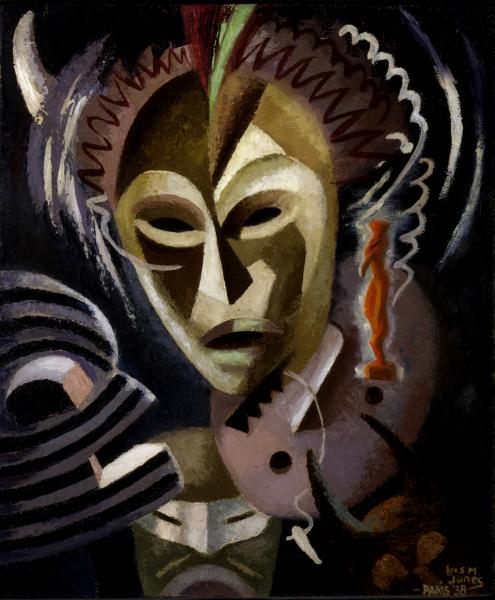
Les Fétiches — Loïs Mailou Jones

Les Fétiches, 1938 by Loïs Mailou Jones (19051998)

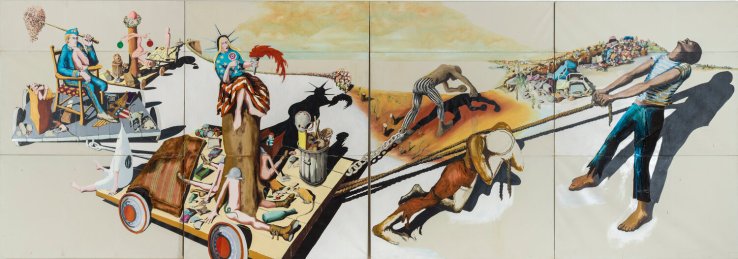
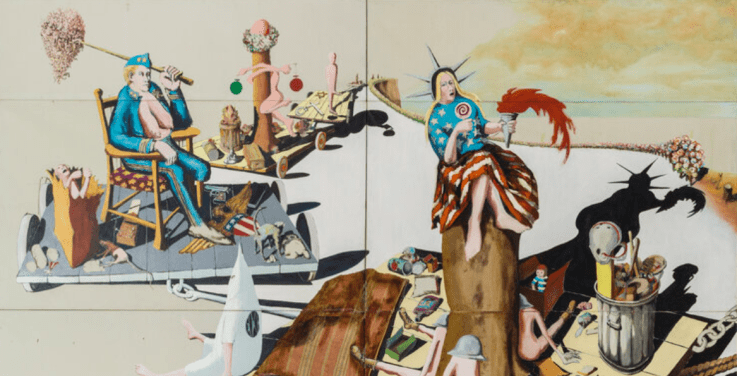
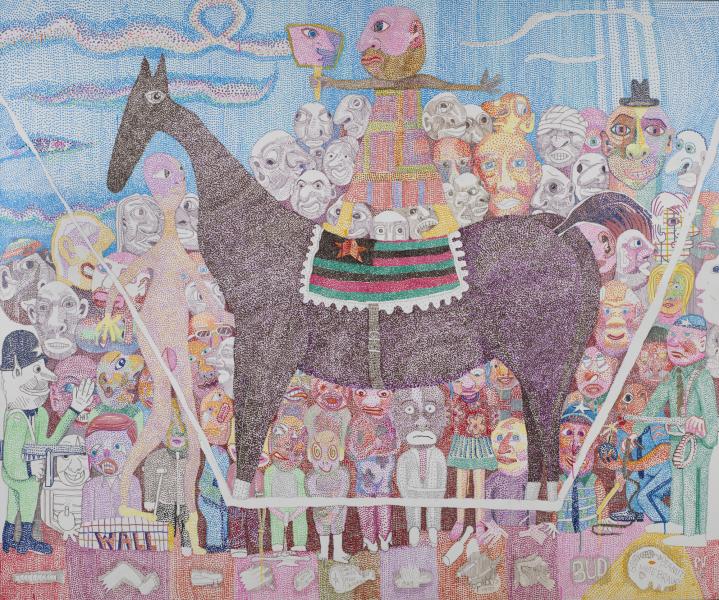
Trash — Benny Andrews

Trash, 1971 by Benny Andrews (1930-2006)

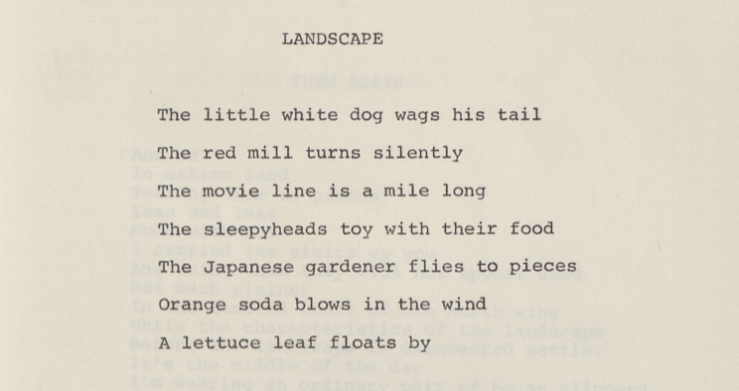
“Landscape” — Larry Fagin

Mother and Son — Lamar Peterson

Mother and Son, 2004 by Lamar Peterson (b. 1974)

“The Dictionary of the Wolf” — Melvin B. Tolson

“The Dictionary of the Wolf”

by

Melvin B. Tolson


“We all declare for liberty,” Lincoln said.
“We use the word and mean all sorts of things:
In the sweat of thy face shalt thou eat bread.
Rifle the basket that thy neighbor brings.”

The grizzled axman squinted at Honest Abe,
The six feet four of him, gaunt, sad of face,
The hands to split a log or cradle a babe,
The cracked palm hat, the homespun of his race.

“The wolf tears at the sheep’s throat: and the sheep
Extols the shepherd for cudgeling tyranny;
The wolf, convulsed with indignation deep,
Accuses the shepherd of murdering liberty.

“But the dictionary of the wolf is writ
In words the rats of time chew bit by bit.”

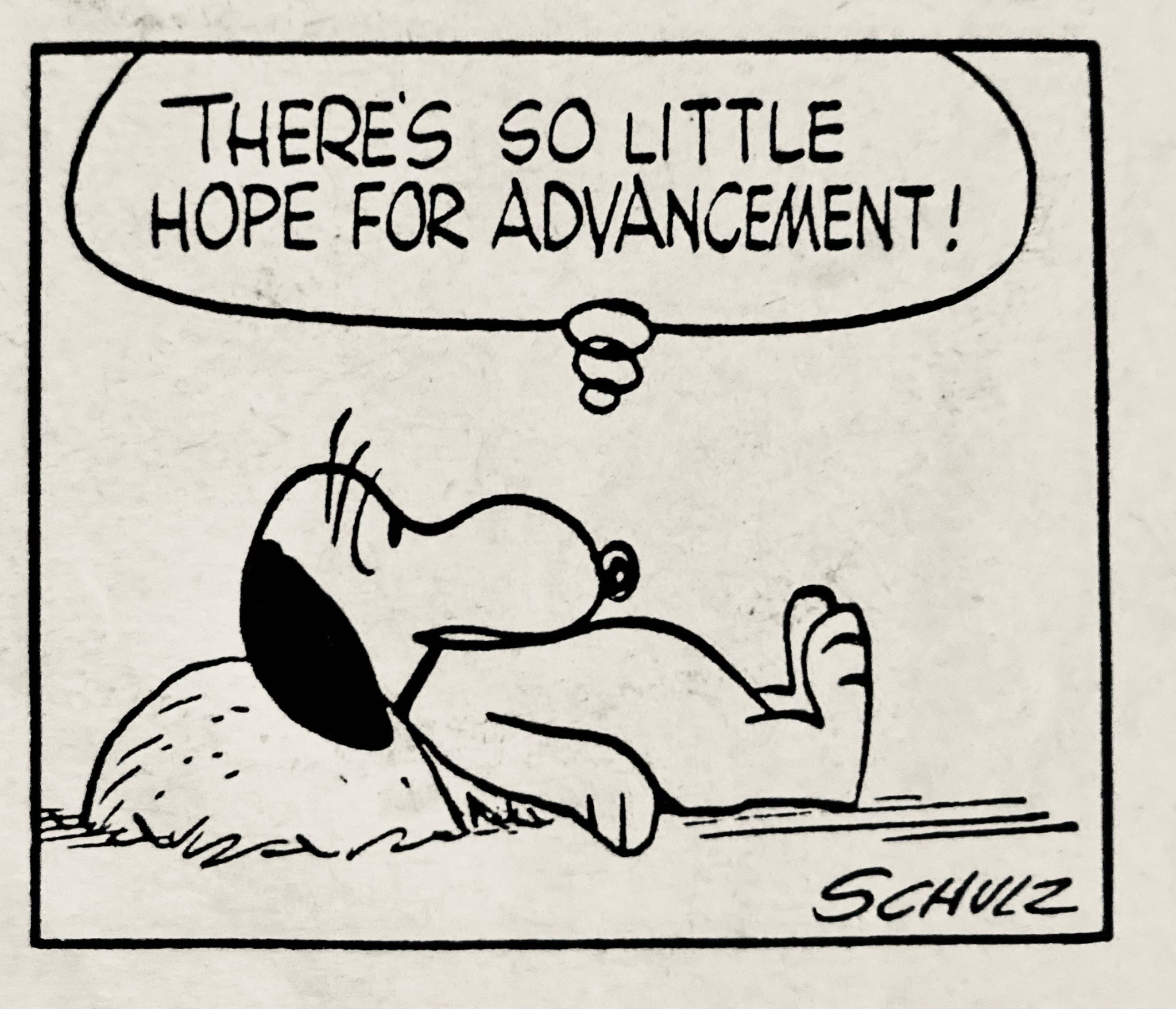
Little hope (Peanuts)

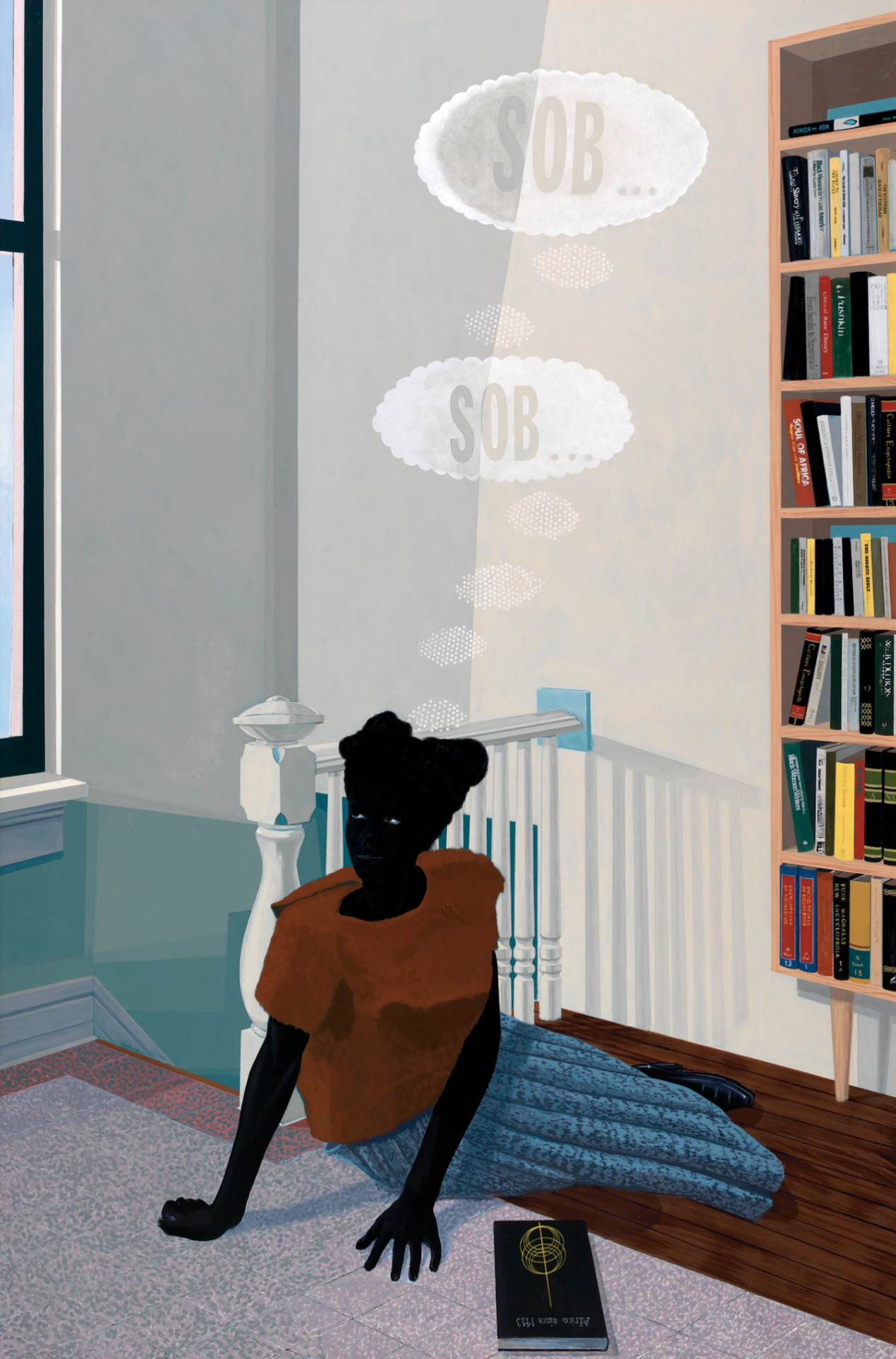
SOB, SOB — Kerry James Marshall

SOB, SOB, 2003 by Kerry James Marshall (b. 1955)

“Basil Valentine, Last of the Alchemists, First of the Chemists” — James J. Walsh

Th

by

James J. Walsh, K.C.St.G., M.D. Ph.D., LL.D., Litt.D., Sc.D.

from

Old Time Makers of Medicine, 1911


“Fieri enim potest ut operator erret et a via regia deflectat, sed ut erret natura quando recte tractatur fieri non potest.”

“For it is quite possible that the physician should err and be turned aside from the straight (royal) road, but that nature when she is rightly treated should err is quite impossible.”

This is one of the preliminary maxims of a treatise on medicine written by a physician born not later than the first half of the fifteenth century, and who may have lived even somewhat earlier. We are so prone to think of the men of that time as utterly dependent on authority, not daring to follow their own observation, suspecting nature, and almost sure to be convinced that only by going counter to her could success in the treatment of disease be obtained, that it is a surprise to most people to find how completely the attitude of mind, that is supposed to be so typically modern in this regard, was anticipated full four centuries ago. There are other expressions of this same great physician and medical writer, Basil Valentine, which serve to show how faithfully he strove with the lights that he had to work out the treatment of patients, just as we do now, by trying to find out nature’s way, so as to imitate her beneficent processes and purposes. It is quite clear that he is but one of many faithful, patient observers and experimenters—true scientists in the best sense of the word—who lived in all the centuries of the Middle Ages.

Speculations and experiments with regard to the elixir of life, the philosopher’s stone, and the transmutation of metals, are presumed to have filled up all the serious interests of the alchemists, supposed to be almost the only scientists of those days. As a matter of fact, however, men were making original observations of profound significance, and these were considered so valuable by their contemporaries that, though printing had not yet been invented, even the immense labor involved in the manifold copying of large folio volumes by the slow hand process did not suffice to deter them from multiplying the writings of these men so numerously that they were preserved in many copies for future generations, until the printing press came to perpetuate them.

Of this there is abundant evidence in the preceding pages as regards medicine, and, above all, surgery, while a summary of accomplishments of workers in other departments will be found in Appendix II, “Science at the Medieval Universities.”

At the beginning of the twentieth century, with some of the supposed foundations of modern chemistry crumbling to pieces under the influence of the peculiarly active light thrown upon our nineteenth century chemical theories by the discovery of radium, and our observations on radio-active elements generally, there is a reawakening of interest in some of the old-time chemical observers, whose work used to be laughed at as so unscientific, or, at most, but a caricature of real science, and whose theory of the transmutation of elements into one another was considered so absurd. It is interesting in the light of this to recall that the idea that the elementary substances were essentially distinct from each other, and that it would be impossible under any circumstances to convert one element into another, belongs entirely to the nineteenth century. Even so deeply scientific a mind as that of Newton, in the preceding century, could not bring itself to acknowledge the tradition, that came to be accepted subsequent to his time, of the absurdity of metallic transformation. On the contrary, he believed quite formally in transmutation as a basic chemical principle, and declared that it might be expected to occur at any time. He had seen specimens of gold ores in connection with metallic copper, and concluded that this was a manifestation of the natural transformation of one of these yellow metals into the other.

With the discovery that radium transforms itself into helium, and that, indeed, all the so-called radioactivities of the heavy metals are probably due to a natural transmutation process constantly at work, the ideas of the older chemists cease entirely to be a subject for amusement. The physical chemists of the present day are very ready to admit that the old teaching of the absolute independence of something over seventy elements is no longer tenable, except as a working hypothesis. The doctrine of “matter and form,” taught for so many centuries by the scholastic philosophers, which proclaimed that all matter is composed of two principles, an underlying material substratum, and a dynamic or informing principle, has now more acknowledged verisimilitude, or lies at least closer to the generally accepted ideas of the most progressive scientists, than it has at any time for the last two or three centuries. Not only the great physicists, but also the great chemists, are speculating along lines that suggest the existence of but one form of matter, modified according to the energies that it possesses under a varying physical and chemical environment. This is, after all, only a restatement in modern times of the teaching of St. Thomas of Aquin, in the thirteenth century.

It is not surprising, then, that there should be a reawakening of interest in the lives of some of the men, who, dominated by some of the earlier scholastic ideas, by the tradition of the possibility of finding the philosopher’s stone, which would transmute the baser metals into the precious metals, devoted themselves with quite as much zeal as any modern chemist to the observation of chemical phenomena. One of the most interesting of these—indeed, he might well be said to be the greatest of the alchemists—is the man whose only name that we know is that which appears on a series of manuscripts written in the High German dialect of the end of the fifteenth and the beginning of the sixteenth century. That name is Basil Valentine, and the writer, according to the best historical traditions, was a Benedictine monk. The name Basil Valentine may only have been a pseudonym, for it has been impossible to trace it among the records of the monasteries of the time. That the writer was a monk, however, there seems to be no room for doubt, for his writings give abundant evidence of it, and, besides, in printed form they began to have their vogue at a time when there was little likelihood of their being attributed to a monastic source, unless an indubitable tradition connected them with some monastery. Continue reading ““Basil Valentine, Last of the Alchemists, First of the Chemists” — James J. Walsh”

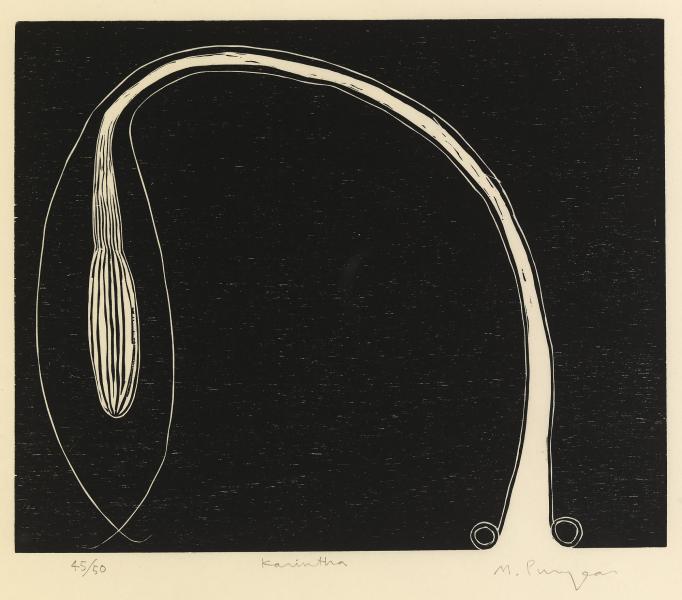
Karintha — James Puryear

Karintha, from the portfolio Cane, 2000 by James Puryear (b. 1941)


“Karintha”

by

Jean Toomer

from Cane


Her skin is like dusk on the eastern horizon,

O can’t you see it,

O can’t you see it,

Her skin is like dusk on the eastern horizon

. . . When the sun goes down.

Men had always wanted her, this Karintha, even as a child, Karintha carrying beauty, perfect as dusk when the sun goes down. Old men rode her hobby-horse upon their knees. Young men danced with her at frolics when they should have been dancing with their grown-up girls. God grant us youth, secretly prayed the old men. The younger fellows counted the time to pass before she would be old enough to mate with them. This interest of the male, that wishes to ripen a growing thing too soon, could mean no good to her. Continue reading “Karintha — James Puryear”

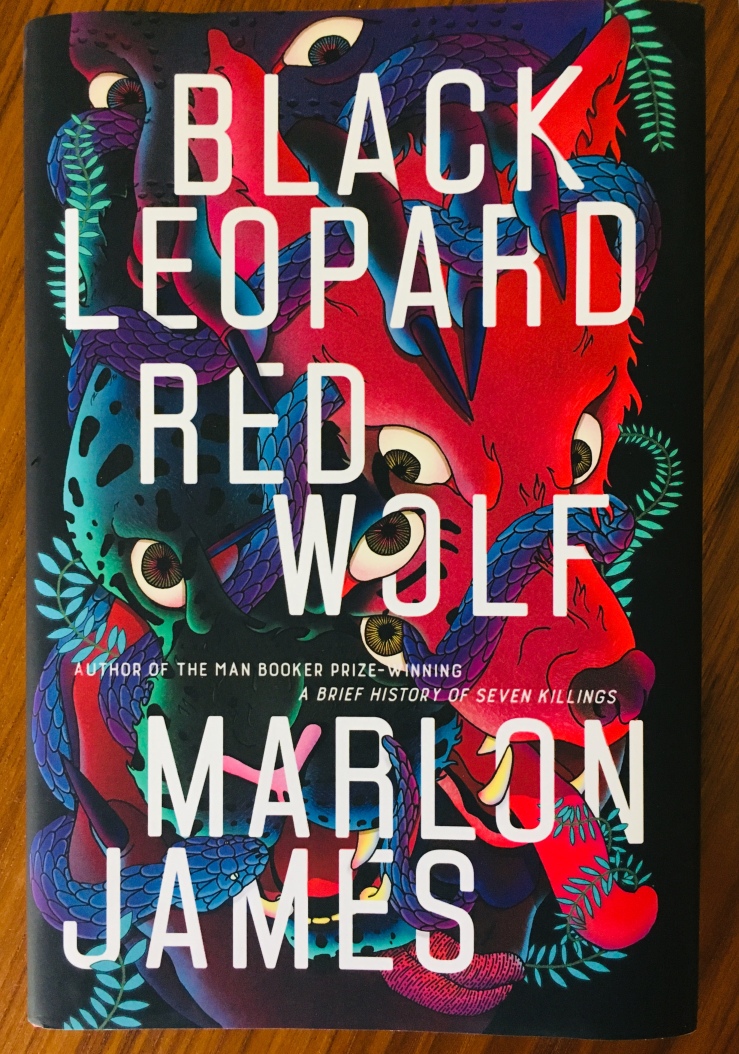
Marlon James’s Black Leopard, Red Wolf is a postmodern fantasy novel that challenges the conventions of storytelling itself

img_2496

Marlon James’s novel Black Leopard, Red Wolf is a postmodern fantasy that takes place in medieval sub-Saharan Africa. Set against the backdrop of two warring states, the North Kingdom and the South Kingdom, Black Leopard, Red Wolf is the story—or stories, really—of Tracker, a man “with a nose” who can track down pretty much anyone (as long as he’s got the scent).

The central quest of Black Leopard, Red Wolf is for Tracker to find and recover a missing child of great importance. An explanation of exactly how and why the child is so important is deferred repeatedly; indeed, James’s novel is as much a detective story as it is a fantasy. In his detective-quest, Tracker partners with a number of strange allies: a talkative giant (who tells us repeatedly that he is not a giant), an anti-witch who places charms on Tracker, a duplicitous Moon Witch, a skin-shedding warrior-spy, a sandy-colored soldier from an alien land, a surly archer, a very smart buffalo, and more, more, more.

I used the word allies above, but truculent Tracker is just as likely to fight against the members of his fellowship as he is to fight with them. Black Leopard, Red Wolf runs on the same logic we find in comic books, where heroes fight each other first and then figure out why they are fighting each other after the fact. Sure, they’ll band together to fight lightning zombies, vampires, or roof-walking night demons—but they’re just as likely to go at each other with brass knuckles, axes, or arrows right after.

Chief among Tracker’s  allies/rivals is the Leopard, a shapeshifter. Throughout the book, Tracker and the Leopard fall in and fall out, fight and fuck, laugh and scream. Their bond is forged early in the novel, when they work together to rescue Mingi children, outcast mutants with strange appearances and stranger abilities. These children become an ersatz family for Tracker and provide an emotional ballast to a novel that often reads like a violent tangle of chaotic, meaningless tangents.

The fact that Leopard and Tracker—the title characters for the novel (Tracker gets his eye sucked out by a were-hyena and replaces it with a magical wolf eye; don’t ask)—the fact that Leopard and Tracker save children, particularly strange children is central to understanding their motivations in their quest to save the missing child.

From the outset though, the reader has to doubt just how successful the quest will be. Black Leopard, Red Wolf opens with these intriguing sentences: “The child is dead. There is nothing left to know.” These lines for foreground the novel’s two major themes: radical infanticide and the problem of knowing what we know and (story)telling what we know.

James’s novel uses infanticidal threat as the impetus for its central plot, the fellowship’s quest to save a child. In the backdrop though is Tracker’s oedipal rage toward his father/grandfather (don’t ask), a rage born out of the infanticidal threats Tracker himself has survived. Tracker has survived, but he is not at peace. He is perhaps the angriest narrator I have ever read, quick to temper and driven by (oedipal) impulses of revenge against a target he cannot name. His anger boils over repeatedly, and not just at his foes, but at his partners and his lovers—the Leopard, in particular.

At the same time, Black Leopard, Red Wolf transports us to scenes of strange love and strange families. James’s novel shows how radical love—Tracker and his Mingi children—might mediate, disrupt, or upend the impulses of revenge. And yet there is nothing permanent or stable in this postmodern novel.

Indeed, Black Leopard, Red Wolf is very much about the problem of how we know what we know and how we can express what we know. Tracker is our narrator, but he doesn’t tell us his story straight (there is nothing straight about this queer novel). Tracker tells his stories—the novel—to someone he addresses as inquisitor, but we never learn how Tracker came to be the inquisitor’s captive. Like Sheherezade in One Thousand and One Nights, Tracker seems to spin his story as a life-saving trick.

Black Leopard, Red Wolf is a tangle, a fluid that courses this way and that, a jumble of time and space. Like the “Ten and Nine Doors” that Tracker’s fellowship uses to teleport from one city-state to another, the narrative leaps through time and space, discursive and discontinuous. Tracker nests his narrative as well. We get tales inside tales inside tales, a matryoshka doll without a clear and definite shape. I occasionally felt submerged in reading James’s novel, as if I’d disappeared into an undersea cave only to find some strange current that bore me elsewhere.

Late in Black Leopard, Red Wolf, Tracker neatly summarizes the novel’s deconstruction of a stable truth, and then reverses the roles, demanding testimony from the inquisitor:

And that is all and all is truth, great inquisitor. You wanted a tale, did you not? From the dawn of it to the dusk of it, and such is the tale I have given you. What you wanted was testimony, but what you really wanted was story, is it not true? Now you sound like men I have heard of, men coming from the West for they heard of slave flesh, men who ask, Is this true? When we find this, shall we seek no more? It is truth as you call it, truth in entire? What is truth when it always expands and shrinks? Truth is just another story.

James has planned to write two sequels to Black Leopard, Red Wolf in what he is calling his “Dark Star” trilogy, and he’s stated that each entry in the series will, like an episode in Akira Kurosawa’s 1950 film Rashomon, tell the story from another perspective. After all, “Truth is just another story.”

Of course, Tracker’s telling can be confounding, even exhausting. James’s prose often feels picaresque, one-damn-thing-happening-after-another, a phantasmagoria of sex and violence signifying nothing—only it doesn’t signify nothing. It means something. Many readers won’t want to puzzle that out though.

A lot of the plot is delivered after the fact of the action. We get a form of clunky post-exposition—another form of storytelling, really, with one character summarizing the fragmented details the reader has been wading through for another character. In a kind of metatextual recognition of his tale’s messiness, James will often wink at the reader through his characters. Summarizing pages and pages of plot for the Leopard (and the reader), Tracker finds himself befuddled:

I told the Leopard all this and this is truth, I was more confused by the telling than he was by listening. Only when he repeated all that I said did I understand it.

A few chapters later, the pattern repeats. “The more you tell me the less I know,” one character tells another. Even storytelling can’t stabilize the truth.

While the plot’s unwieldiness can become tiresome, it is not a defect of the book as much as an intentional feature. However, some of the battle scenes fall into a kind of mechanical repetition of blank violence. Tracker tells us again and again how he “hacked” or “yanked,” etc. in scenes that become duller and duller as there are more of them.

The book is far more fun when it’s weirder—Tracker getting trapped by a mutant spider demon who sprays webs all over his face, or Tracker swimming with mermaids to the land of the dead, or Tracker and his companion visiting a technologically-advanced tree city-state ruled by a mad queen. James’s best set pieces don’t need battles to reverberate with energy.

The sex is more interesting than the violence in Black Leopard, Red Wolf—and there’s plenty of both. “Fantastic beasts, fantastic urges,” our lead characters repeat to themselves. James’s novel is deeply horny, its characters fluidly shifting into all kinds of weird fucking. Tracker partners with various members of his fellowship in more ways than one. Sex is magic in Black Leopard, Red Wolf, too—only ten pages in, Tracker ejaculates on a witch, she flicks his semen into a river, fish eat it, and turn into mermaids who lead him to the land of the dead.

There’s so much more in Black Leopard, Red Wolf that I haven’t touched on. The novel is lurid and horny, abject and affecting. It’s often quite funny, and, in the end, it turned out to be unexpectedly moving. It’s also exhausting and confusing, and will likely prove divisive for many readers. It’s clear that Lord of the Rings was a reference point for James (the word “fellowship” is oft-repeated in his novel), but Black Leopard, Red Wolf reminded me more of Jonathan Littell’s The Kindly Ones than it did a traditional fantasy.

In its vivid weirdness and pure invention, James’s book also reminded me of Brian Catling’s novel The Vorrh. However, Catling’s novel often takes the colonialist viewpoint. Black Leopard, Red Wolf  points to a fantasy that could reverse our own history, potentially obliterate that viewpoint’s existence. When Tracker asks the inquisitor, “Now you sound like men I have heard of, men coming from the West for they heard of slave flesh, men who ask, Is this true?”, his questioning seems to point to the larger implications of the James’s Dark Star universe—a precolonial space with a looming threat from the West. Late in Black Leopard, Red Wolf, one character warns the others that the warring between the North and South Kingdoms, between tribes and city-states must end. There’s an existential threat on the horizon. I find the potential storytelling here intriguing.

Black Leopard, Red Wolf is clearly Not for Everybody. It’s violent and strange, and the sex in it will likely upset conservative readers. It’s also shaggy and unwieldy. It probably has a future as a cult novel. You just sort of have to go with its fluid (in every sense of that word) program and enjoy the ride. I enjoyed it very much and am looking forward to the sequel.

[Ed. note — Biblioklept first published this review in May of 2019. This novel’s sequel, Moon Witch, Spider King, is out next week.]

“Lovers of the Poor ” — Gwendolyn Brooks

“The Lovers of the Poor”
by
Gwendolyn Brooks

arrive. The Ladies from the Ladies’ Betterment League
Arrive in the afternoon, the late light slanting
In diluted gold bars across the boulevard brag
Of proud, seamed faces with mercy and murder hinting
Here, there, interrupting, all deep and debonair,
The pink paint on the innocence of fear;
Walk in a gingerly manner up the hall.
Cutting with knives served by their softest care,
Served by their love, so barbarously fair.
Whose mothers taught: You’d better not be cruel!
You had better not throw stones upon the wrens!
Herein they kiss and coddle and assault
Anew and dearly in the innocence
With which they baffle nature. Who are full,
Sleek, tender-clad, fit, fiftyish, a-glow, all
Sweetly abortive, hinting at fat fruit,
Judge it high time that fiftyish fingers felt
Beneath the lovelier planes of enterprise.
To resurrect. To moisten with milky chill.
To be a random hitching-post or plush.
To be, for wet eyes, random and handy hem.
                        Their guild is giving money to the poor.
The worthy poor. The very very worthy
And beautiful poor. Perhaps just not too swarthy?
perhaps just not too dirty nor too dim
Nor—passionate. In truth, what they could wish
Is—something less than derelict or dull.
Not staunch enough to stab, though, gaze for gaze!
God shield them sharply from the beggar-bold!
The noxious needy ones whose battle’s bald
Nonetheless for being voiceless, hits one down.
                        But it’s all so bad! and entirely too much for them.
The stench; the urine, cabbage, and dead beans,
Dead porridges of assorted dusty grains,
The old smoke, heavy diapers, and, they’re told,
Something called chitterlings. The darkness. Drawn
Darkness, or dirty light. The soil that stirs.
The soil that looks the soil of centuries.
And for that matter the general oldness. Old
Wood. Old marble. Old tile. Old old old.
Not homekind Oldness! Not Lake Forest, Glencoe.
Nothing is sturdy, nothing is majestic,
There is no quiet drama, no rubbed glaze, no
Unkillable infirmity of such
A tasteful turn as lately they have left,
Glencoe, Lake Forest, and to which their cars
Must presently restore them. When they’re done
With dullards and distortions of this fistic
Patience of the poor and put-upon.
                        They’ve never seen such a make-do-ness as
Newspaper rugs before! In this, this “flat,”
Their hostess is gathering up the oozed, the rich
Rugs of the morning (tattered! the bespattered. . . .)
Readies to spread clean rugs for afternoon.
Here is a scene for you. The Ladies look,
In horror, behind a substantial citizeness
Whose trains clank out across her swollen heart.
Who, arms akimbo, almost fills a door.
All tumbling children, quilts dragged to the floor
And tortured thereover, potato peelings, soft-
Eyed kitten, hunched-up, haggard, to-be-hurt.
                        Their League is allotting largesse to the Lost.
But to put their clean, their pretty money, to put
Their money collected from delicate rose-fingers
Tipped with their hundred flawless rose-nails seems . . .
                        They own Spode, Lowestoft, candelabra,
Mantels, and hostess gowns, and sunburst clocks,
Turtle soup, Chippendale, red satin “hangings,”
Aubussons and Hattie Carnegie. They Winter
In Palm Beach; cross the Water in June; attend,
When suitable, the nice Art Institute;
Buy the right books in the best bindings; saunter
On Michigan, Easter mornings, in sun or wind.
Oh Squalor! This sick four-story hulk, this fibre
With fissures everywhere! Why, what are bringings
Of loathe-love largesse? What shall peril hungers
So old old, what shall flatter the desolate?
Tin can, blocked fire escape and chitterling
And swaggering seeking youth and the puzzled wreckage
Of the middle passage, and urine and stale shames
And, again, the porridges of the underslung
And children children children. Heavens! That
Was a rat, surely, off there, in the shadows? Long
And long-tailed? Gray? The Ladies from the Ladies’
Betterment League agree it will be better
To achieve the outer air that rights and steadies,
To hie to a house that does not holler, to ring
Bells elsetime, better presently to cater
To no more Possibilities, to get
Away. Perhaps the money can be posted.
Perhaps they two may choose another Slum!
Some serious sooty half-unhappy home!—
Where loathe-love likelier may be invested.
                        Keeping their scented bodies in the center
Of the hall as they walk down the hysterical hall,
They allow their lovely skirts to graze no wall,
Are off at what they manage of a canter,
And, resuming all the clues of what they were,
Try to avoid inhaling the laden air.

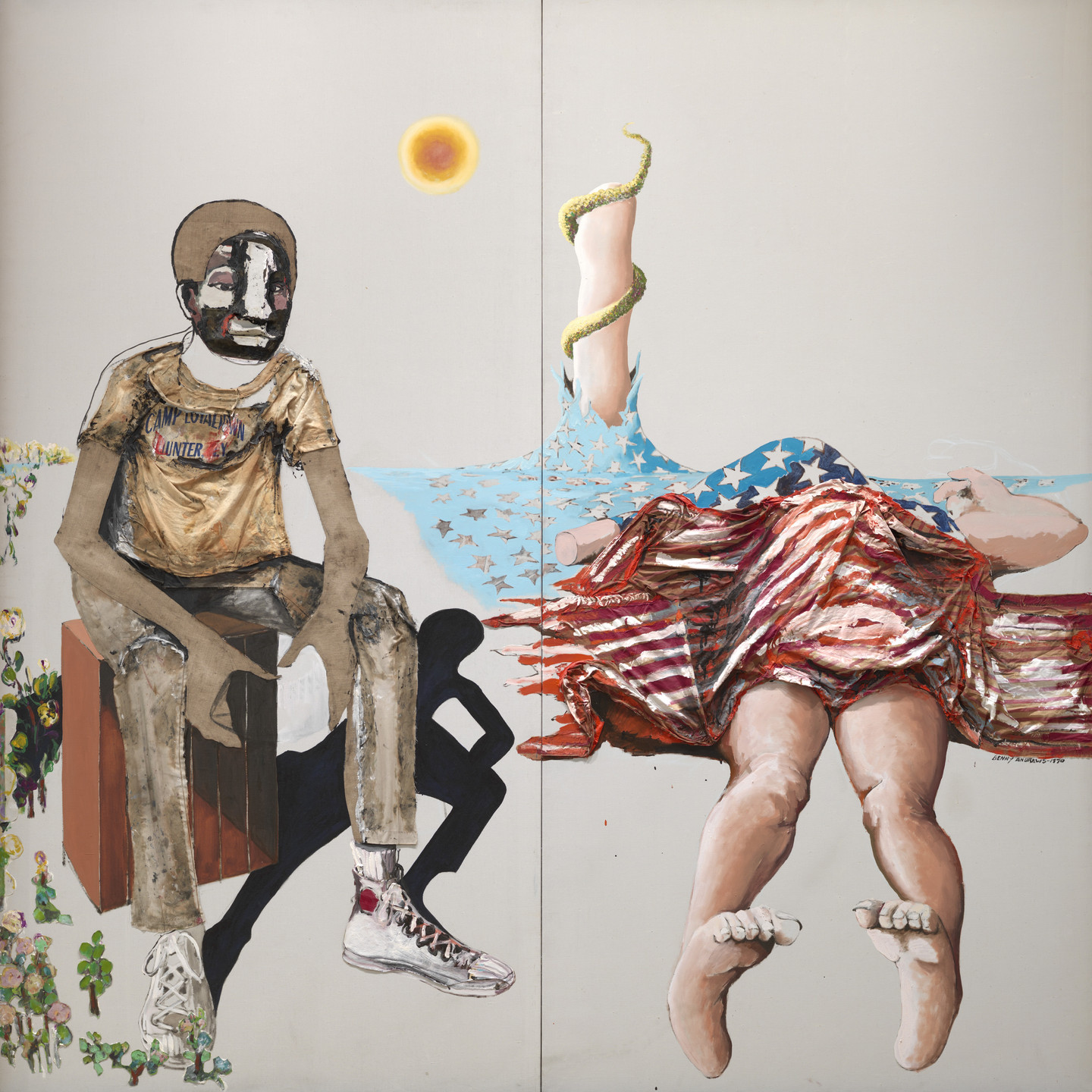
No More Games — Benny Andrews

No More Games, 1970 by Benny Andrews (1930-2006)

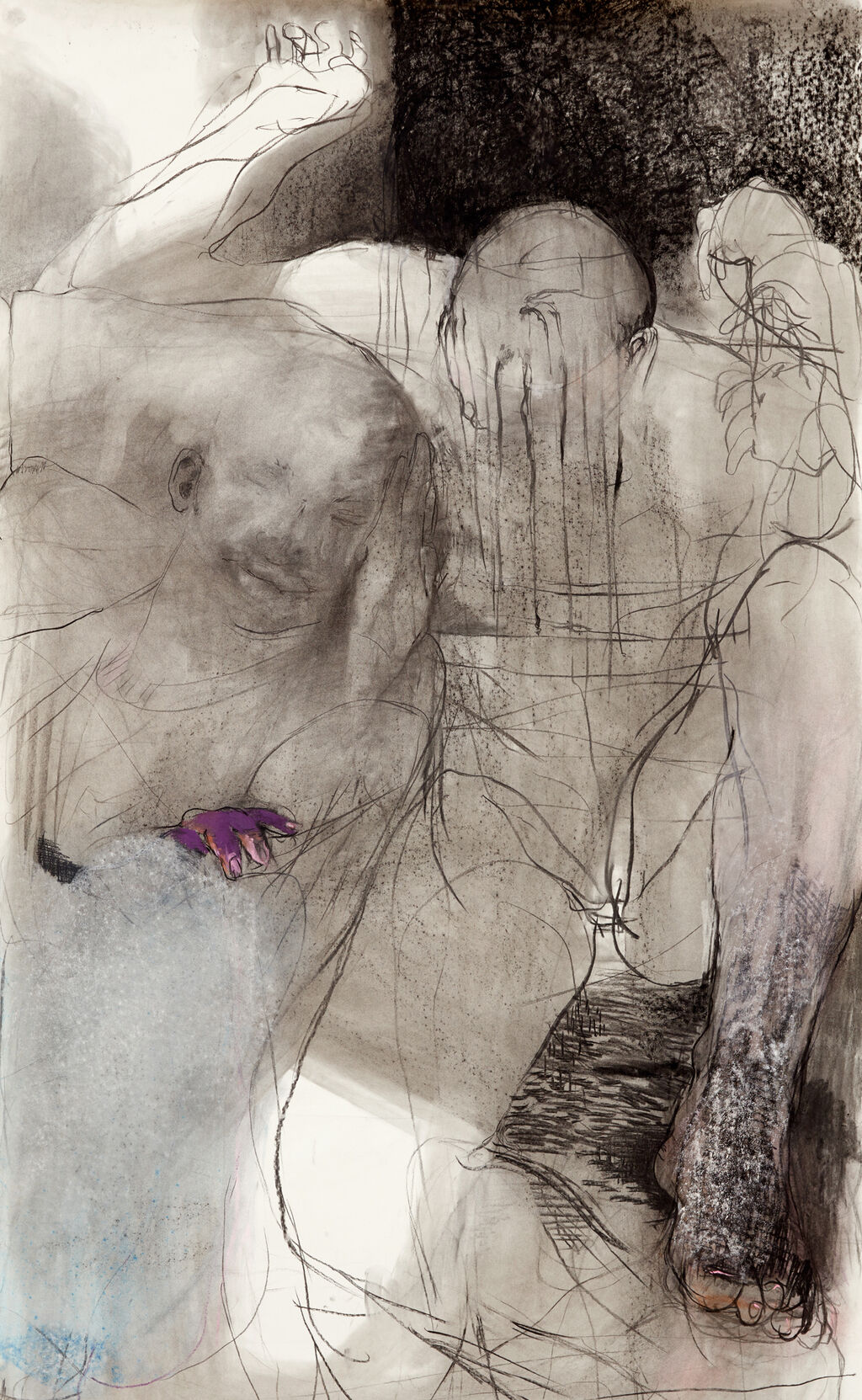
The Mind Is Its Own Place — Jennifer Packer

The Mind Is Its Own Place, 2020 by Jennifer Packer (b. 1984)

A review of William Melvin Kelley’s polyglossic postmodern novel Dunfords Travels Everywheres

William Melvin Kelley’s final novel Dunfords Travels Everywhere was published in 1970 to mixed reviews and then languished out of print for half a century. Formally and conceptually challenging, Dunfords contrasts strongly with the mannered modernism of Kelley’s first (and arguably most popular) novel A Different Drummer (1962). In A Different Drummer, Kelley offered the lucid yet Faulknerian tale of Caliban Tucker, a black Southerner who leads his people to freedom. The novel is naturalistic and ultimately optimistic. Kelley’s follow up, A Drop of Patience (1965), follows a similar naturalistic approach. By 1967 though, Kelley moved to a more radical style in his satire dem. In dem, Kelley enlarges his realism, injecting the novel with heavy doses of distortion. dem is angrier, more ironic and hyperbolic than the works that preceded it. Its structure is strange—not fragmented, exactly—but the narrative is parceled out in vignettes which the reader must synthesize himself. dem’s experimentation is understated, but its form—and its angry energy—point clearly towards Kelley’s most postmodern novel, Dunfords Travels Everywheres. Polyglossic, fragmented, and bubbling with aporia, Dunfords, now in print again, will no doubt baffle, delight, and divide readers today the same way it did fifty years ago.

Dunfords Travels Everywheres opens in a fictional European city. A group of American travelers meet for a softball game, only to learn that their president has been assassinated. They head to a cafe to console themselves. After some wine, the Americans toast their fallen president and begin singing “one of the two or three songs the people back home considered patriotic.” Chig Dunford, the sole black member of the travelers, refrains from singing, and when his patriotism is questioned and he is implored to sing, he explodes: “No, motherfucker!” The profane outburst alienates his companions, and Chig questions his language: “Where on earth had those words come from? He tried always to choose his words with care, to hold back anger until he found the correct words.”

It turns out that Chig’s motherfucker is a secret spell, a compound streetword that unlocks the dreamlanguage of Dunfords Travels Everywheres. After its incantation, Dunfords’ rhetoric pivots:

Witches oneWay tspike Mr. Chigyle’s Languish, n curryng him back tRealty, recoremince wi hUnmisereaducation. Maya we now go on wi yReconstruction, Mr. Chuggle? Awick now? Goodd, a’god Moanng agen everybubbahs n babys among you, d’yonLadys in front who always come vear too, days ago, dhisMorning We wddeal, in dhis Sagmint of Lecturian Angleash 161, w’all the daisiastrous effects, the foxnoxious bland of stimili, the infortunelessnesses of circusdances which weak to worsen the phistorystematical intrafricanical firmly structure of our distinct coresins: The Blafringro‐Arumericans.

So Chig, who has told us he looks always to choose the “correct words,” comes through languish/language “back tRealty,” to commence again his education and reconstruction. He’s given new names Mr. Chuggle and Mr. Chigyle. Renaming becomes a motif in the novel. Here in the dreamworld—or is it reality, as Chig’s dreamteachers seem to suggest?—there are multiple Chigs, a plot point emphasized in the novel’s strange title. Dunfords Travels Everwheres seems initially ungrammatical—shouldn’t the title be something like Dunford Travels Everywhere or Dunford’s Travels Everywhere? one wonders at first. Packed into the title though is a key to the novel’s meaning: There are multiple Dunfords, multiple travels, and, perhaps most significantly, multiple everywheres. The novel’s title also points to two of its reference points, Swift’s satire Gulliver’s Travels and James Joyce’s Finnegans Wake (famously absent an apostrophe).

Many readers will undoubtedly recognize the influence of Joyce’s Wake in Kelley’s so-called experimental passages. And while Finnegans is clearly an inspiration, Kelley’s prose has a different flavor—more creole, more pidgin, more Afrocentric than Joyce’s synthesis of European tongues. The passages can be difficult if you want them to be, or you can simply float along with them. I found myself reading them aloud, letting my ear make connections that my eyes might have missed. I’ll also readily concede that there’s a ton of stuff in the passages that I found inscrutable. Sometimes its best to go with the flow.

And where does that flow go? The title promises everywheres, and the central plot of Dunfords might best be understood as a consciousness traveling though an infinite but subtly shifting loop. Chig Dunford slips in and out of the dreamworld, traveling through Europe and then back to America. The final third of the novel is a surreal transatlantic sea voyage that darkly mirrors the Euro-American slave trade. It’s also a shocking parody of America’s sexual and racial hang-ups. It’s also really confusing at times, calling into question what elements of the book are “real” and what elements are “dream.” In my estimation though, the distinction doesn’t matter in Dunfords. All that matters is the language.

The language—specifically the so-called experimental language—transports characters and readers alike. We’re first absorbed into the dreamlanguage on page fifty, and swirl around in it for a dozen more pages before arriving somewhere far, far away from Chig Dunford in the European cafe. In the course of a paragraph, the narrative moves from linguistic surrealism to lucid realism to start a new thread in the novel:

Now will ox you, Mr. Chirlyle? Be your satisfreed from the dimage of the Muffitoy? Heave you learned your caughtomkidsm? Can we send you out on your hownor? Passable. But proveably not yetso tokentinue the candsolidation of the initiatory natsure of your helotionary sexperience, le we smiuve for illustration of chiltural rackage on the cause of a Hardlim denteeth who had stopped loving his wife. Before he stopped loving her, he had given her a wonderful wardrobe, a brownstone on the Hill, and a cottage on Long Island. Unfortunately, her appetite remained unappeased. She wanted one more thing—a cruise around the world. And so he asked her for a divorce.

This Harlem dentist employs Carlyle Bedlow, a minor but important character in dem, to seduce his wife. Bedlow then becomes a kind of twin to Chig, as the novel shifts between Chig’s story and Bedlow’s, always mediated via dreamlanguage. Bedlow’s adventures are somewhat more comical than Chig’s (he even outfoxes the Devil), and although he’s rooted in Harlem, he’s just as much an alien to his own country as Chig is.

Dunfords’ so-called experimental passages are a linguistic bid to overcome that alienation. While they clearly recall the language of Finnegans Wake, they also point to another of Joyce’s novels, A Portrait of the Artist as a Young Man. Kelley pulls the first of Dunfords’ three epigraphs from Joyce’s novel:

The language in which we are speaking is his before it is mine…I cannot speak or write these words without unrest of spirit. His language, so familiar and so foreign, will always be for me an acquired speech…My soul frets in the shadow of his language.

In Portrait, Stephen Dedalus realizes that he is linguistically inscribed in a conqueror’s tongue, but he will work to forge that language into something capable of expressing the “uncreated conscience of [his] race.” The linguistic play of Dunfords finds Kelley forging his own language, his own tongue of resistance.

The dreamlanguage overtakes the final pages of Dunfords, melting African folklore with Norse myths into something wholly new, sticky, rich. There’s more than a dissertation’s worth of parsing in those last fifteen pages. I missed in them than I caught, but I don’t mind being baffled, especially when the book’s final paragraph is so lovely:

You got aLearn whow you talking n when tsay whit, man. What, man? No, man. Soaree! Yes sayd dIt t’me too thlow. Oilready I vbegin tshift m Voyace. But you llbob bub aGain. We cdntlet aHabbub dfifd on Fur ever, only fo waTerm aTime tpickcip dSpyrate by pinchng dSkein. In Side, out! Good-bye, man: Good-buy, man. Go odd-buy Man. Go Wood, buy Man. Gold buy Man. MAN!BE!GOLD!BE!

You’ve got to learn how/who you are talking to and when to say what/wit, right? The line “Oilready I vbegin tshift m Voyace” points to shifting voices, shifting consciousnesses , but also the voice as the voyage, the tongue as a traveler.

The passages I’ve shared above should give you a sense of whether or not the ludic prose of Dunfords  is your particular flavor of choice. Initial reviews were critical of Kelley’s choices, including both the novel’s language and its structure. It received two contemporary reviews in The New York Times; in the first, Christopher Lehmann-Haupt praised Kelley’s use of “a black form of the dreamlanguage of James Joyce’s Finnegans Wake…to escape the strictures of the conventional (white) novel,” but concluded that “there are many things in the novel that don’t work, that seem curiously cryptic and incomplete.” Playwright Clifford Mason was far harsher in his review a few weeks later, writing that “the experimental passages offer little to justify the effort needed to decipher them. The endless little word games can only be called tiresome.”

I did not find the word games endless, little, or tiring, but I’m sure there are many folks who would agree with Mason’s sentiments from five decades ago. While American culture has slowly been catching up to Kelley’s politics and aesthetics, his dreamlanguage will no doubt alienate many contemporary readers who prefer their prose hardened into lucid meaning. Kelley understood the power of language shift. He coined the word “woke” in a 1962 New York Times piece that both lamented and celebrated the way that black language was appropriated by white folks only to be reinvented again by by black speakers. In some ways, Dunfords is his push into a language so woke it appears to be the language of sleep. But the subconscious talkers in Dunfords don’t babble. Their words pack—perhaps overpack—meaning.

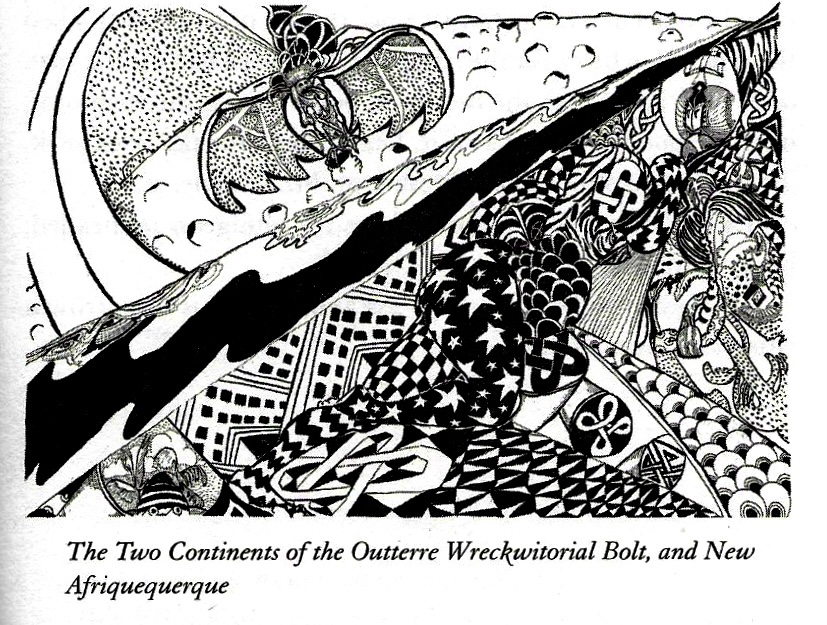
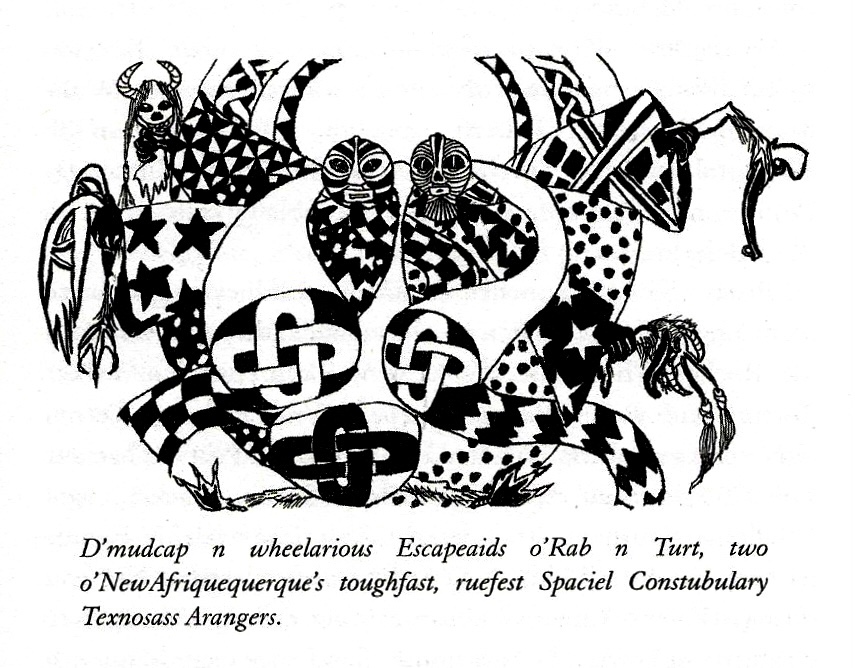
The overpacking makes for a difficult read at times. Readers interested in Kelley—an overlooked writer, for sure—might do better to start with A Different Drummer or dem, both of which are more conventional, both in prose and plot. Thankfully, Anchor Books has reprinted all five of Kelley’s books, each with new covers by Kelley’s daughter. This new edition of Dunfords also features pen-and-ink illustrations that Kelley commissioned from his wife Aiki. These illustrations, which were not included in the novel’s first edition in 1970, add to the novel’s surreal energy. I’ve included a few in this review.

Dunfords Travels Everywheres is a challenging, rich, weird read. At times baffling, it’s never boring. Those who elect to read it should go with the flow and resist trying to impose their own logical or rhetorical schemes on the narrative. It’s a fantastic voyage—or Voyace?—check it out.

[Ed note–Biblioklept first published this review in October 2020.]

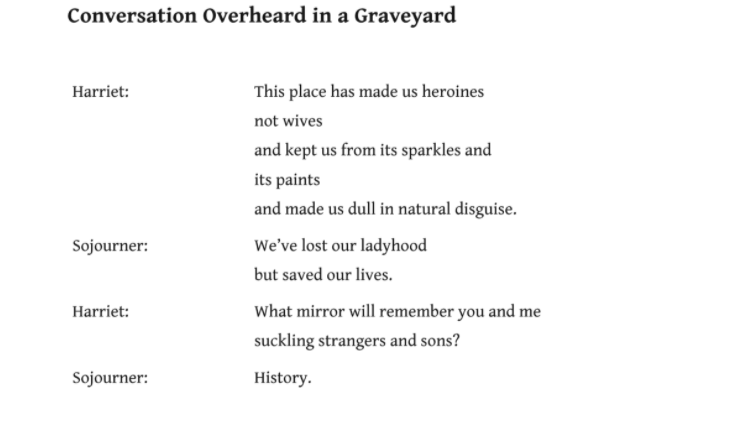
“Conversation Overheard in a Graveyard” — Lucille Clifton

A Foolish Trick — Peter Williams

A Foolish Trick, 2018 by Peter Williams (1952-2021)