Candide — Voltaire

I liked pretty much all of the assigned reading in high school (okay, I hated every page of Tess of the D’Ubervilles). Some of the books I left behind, metaphorically at least (Lord of the Flies, The Catcher in the Rye), and some books bewildered me, but I returned to them later, perhaps better equipped (Billy Budd; Leaves of Grass). No book stuck with me quite as much as Candide, Voltaire’s scathing satire of the Enlightenment.

20110911-025457.jpg

I remember being unenthusiastic when my 10th grade English teacher assigned the book—it was the cover, I suppose (I stole the book and still have it), but the novel quickly absorbed all of my attention. I devoured it. It was (is) surreal and harsh and violent and funny, a prolonged attack on all of the bullshit that my 15 year old self seemed to perceive everywhere: baseless optimism, can-do spirit, and the guiding thesis that “all is for the best.” The novel gelled immediately with the Kurt Vonnegut books I was gobbling up, seemed to antecede the Beat lit I was flirting with. And while the tone of the book certainly held my attention, its structure, pacing, and plot enthralled me. I’d never read a book so willing to kill off major characters (repeatedly), to upset and displace its characters, to shift their fortunes so erratically and drastically. Not only did Voltaire repeatedly shake up the fortunes of Candide and his not-so-merry band—Pangloss, the ignorant philosopher; Cunegonde, Candide’s love interest and raison d’etre and her maid the Old Woman; Candide’s valet Cacambo; Martin, his cynical adviser—but the author seemed to play by Marvel Comics rules, bringing dead characters back to life willy nilly. While most of the novels I had been reading (both on my own and those assigned) relied on plot arcs, grand themes, and character development, Candide was (is) a bizarre series of one-damn-thing-happening-after-another. Each chapter was its own little saga, an adventure writ in miniature, with attendant rises and falls. I loved it.

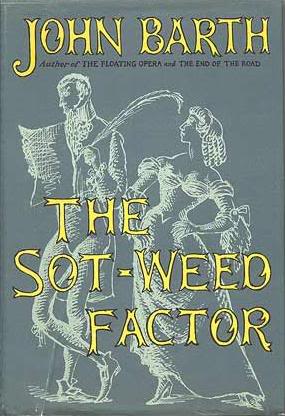
I reread Candide this weekend for no real reason in particular. I’ve read it a few times since high school, but it was never assigned again—not in college, not in grad school—which may or may not be a shame. I don’t know. In any case, the book still rings my bell; indeed, for me it’s the gold standard of picaresque novels, a genre I’ve come to dearly love. Perhaps I reread it with the bad taste of John Barth’s The Sot-Weed Factor still in my mouth. As I worked my way through that bloated mess, I just kept thinking, “Okay, Voltaire did it 200 years earlier, much better and much shorter.”

Revisiting Candide for the first time in years, I find that the book is richer, meaner, and far more violent than I’d realized. Even as a callow youth, I couldn’t miss Voltaire’s attack on the Age of Reason, sustained over a slim 120 pages or so. Through the lens of more experience (both life and reading), I see that Voltaire’s project in Candide is not just to satirize the Enlightenment’s ideals of rationality and the promise of progress, but also to actively destabilize those ideals through the structure of the narrative itself. Voltaire offers us a genuine adventure narrative and punctures it repeatedly, allowing only the barest slivers of heroism—and those only come from his innocent (i.e. ignorant) title character. Candide is topsy-turvy, steeped in both irony and violence.

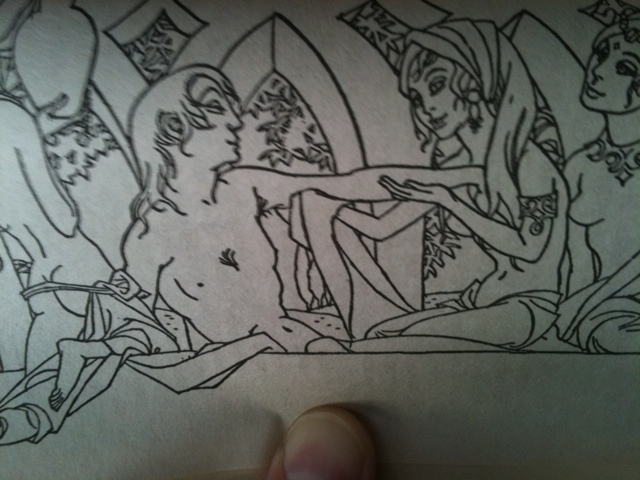
As a youth, the more surreal aspects of the violence appealed to me. (An auto-da-fé! Man on monkey murder! Earthquakes! Piracy! Cannibalizing buttocks!). The sexy illustrations in the edition I stole from my school helped intrigue me as well—

20110911-025719.jpg

The self who read the book this weekend still loves a narrative steeped in violence—I can’t help it—Blood Meridian, 2666, the Marquis de Sade, Denis Johnson, etc.—but I realize now that, despite its occasional cartoonish distortions, Candide is achingly aware of the wars of Europe and the genocide underway in the New World. Voltaire by turns attacks rape and slavery, serfdom and warfare, always with a curdling contempt for the powers that be.

But perhaps I’ve gone too long though without quoting from this marvelous book, so here’s a passage from the last chapter that perhaps gives summary to Candide and his troupe’s rambling adventures: by way of context (and, honestly spoiling nothing), Candide and his friends find themselves eking out a living in boredom (although not despair) and finding war still raging around them (no shortage of heads on spikes); Candide’s Cunegonde is no longer fair but “growing uglier everyday” (and shrewish to boot!), Pangloss no longer believes that “it is the best of all worlds” they live in, yet he still preaches this philosophy, Martin finds little solace in the confirmation of his cynicism and misanthropy, and the Old Woman is withering away to death. The group finds their only entertainment comes from disputing abstract questions—

But when they were not arguing, their boredom became so oppressive that one day the old woman was driven to say, “I’d like to know which is worse: to be raped a hundred times by Negro pirates, to have one buttock cut off, to run the guantlet in the Bulgar army, to be whipped and hanged in an auto-da-fé, to be dissected, to be a galley slave—in short, to suffer all the miseries we’ve all gone through—or stay here and do nothing.

“That’s a hard question,” said Candide.

It’s amazing that over 200 years ago Voltaire posits boredom as an existential dilemma equal to violence; indeed, as its opposite. (I should stop and give credit here to Lowell Blair’s marvelous translation, which sheds much of the finicky verbiage you might find in other editions in favor of a dry, snappy deadpan, characterized in Candide’s rejoinder above). The book’s longevity might easily be attributed to its prescience, for Voltaire’s uncanny ability to swiftly and expertly assassinate all the rhetorical and philosophical veils by which civilization hides its inclinations to predation and straight up evil. But it’s more than that. Pointing out that humanity is ugly and nasty and hypocritical is perhaps easy enough, but few writers can do this in a way that is as entertaining as what we find in Candide. Beyond that entertainment factor, Candide earns its famous conclusion: “We must cultivate our garden,” young (or not so young now) Candide avers, a simple, declarative statement, one that points to the book’s grand thesis: we must work to overcome poverty, ignorance, and, yes, boredom. I’m sure, gentle, well-read reader, that you’ve read Candide before, but I’d humbly suggest to read it again.

Book Acquired, 9.09.11 — Or, I Buy Yet Another William T. Vollmann Book Against My Better Judgment

20110909-044233.jpg

I like William T. Vollmann the persona probably more than I like William T. Vollmann the writer. That isn’t to say that I haven’t thought that the handful of books I’ve read by him were brilliant, strange, and engrossing—because they are—but I’ll admit that his methods, his back story, his sheer and absolute not-giving-a-fuckness is a major attraction. Voluminous Vollmann, unreadable Vollmann; smartypants Vollmann, fragile Vollmann. Vollmann, producer of travelogues, alternate histories, hagiographies for hookers; Vollmann, Ice Age chronicler; saga-slinging Vollmann. I can’t think of a writer who does more and says more and, because of his maximalist approach, will be largely unread, both for his career and for posterity—unless he concedes to edit. I think the irony is that, in wanting to give everything to his reader and wanting to preserve everything about his subjects—an act of love, compassion, empathy, what have you—in these grand, hopeless gestures, Vollmann paradoxically displays that intrinsic not-giving-a-fuckness. He needs an editor.

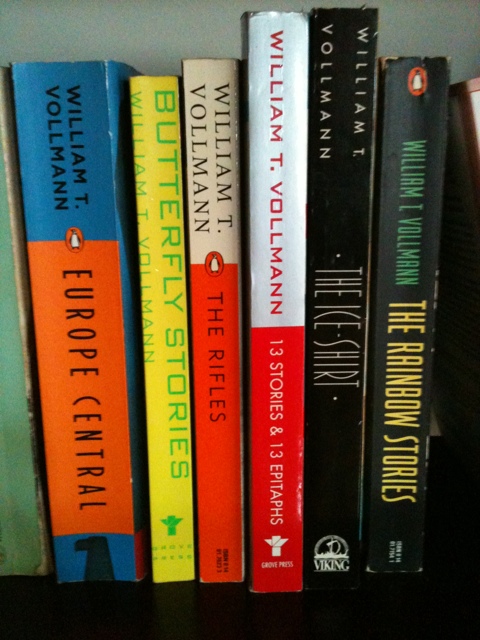
So, this afternoon, browsing at my favorite bookshop, a labyrinthine twisty thing, I ambled innocently past the ‘V’s of General Fiction, looking for a novel by Karel Capek in the sci-fi section, which abuts said ‘V’ aisle. Again, this was all innocence. I had no intention of picking up anything by Vollmann, despite the huge stack of his works there, used testaments to the futility of trying to read Vollmann perhaps—at least a dozen souls who said “fuck it” to Europe Central. Here are the Vollmann volumes (volmumes?) I possess—

20110909-044243.jpg

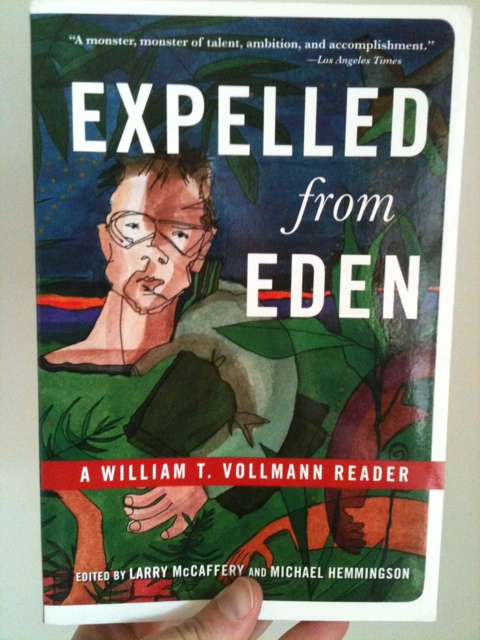
I’ve read Butterfly Stories, The Rifles, and The Ice-Shirt; I’ve read most of 13 Stories & 13 Epitaphs. I’ve read bits of The Rainbow Stories and mostly nothing of Europe Central, which migrated out of the “to read” stack a few years ago. So, yeah, I wasn’t looking for another Vollmann. But I’m too frequent a visitor at this particular labyrinthy, somewhat famous North Florida bookshop, so I noticed a “new” Vollmann in the stack, Expelled from Eden. And I started thumbing through it. Against my better judgment. 20 minutes later I was brainstorming reasons not to pick it up, but honestly, the credit in book trade I have with the store nails most economic arguments, and really, I’m thinking this is exactly what I wanted someone to do with Vollmann: edit that shit.

Larry McCaffrey and Michael Hemmingson have excised, chopped, moved around, and pulled from all over Vollmann’s massive world, putting together a book organized around Vollmann’s grand themes—travel writing; war; violence; prostitution; literature. There are lists, drawings, photographs. There is biography. I came home and read for an hour. I’m sure I’ll be sharing some citations down the road.

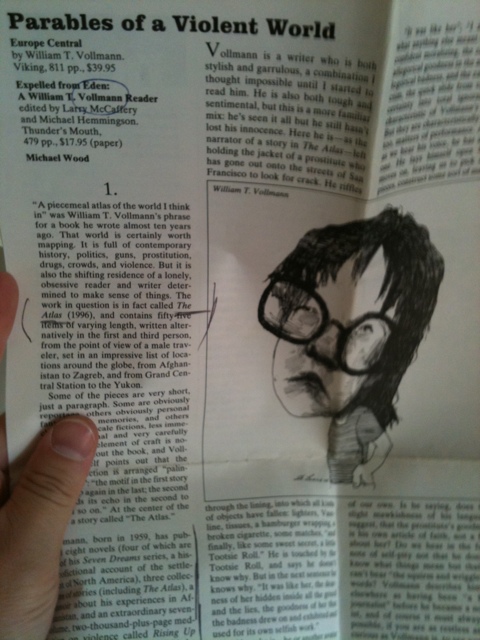
As a sort of bonus—and I always love to pick up a book where something is neatly tucked away—is an entire 2005 feature from The New York Review on Vollmann, focusing on Expelled from Eden and Europe Central.

20110909-044253.jpg

“I’m One of Those Writers Who Gropes Her Way into a Story” — Biblioklept Interviews Joan Leegant About Her Novel Wherever You Go

Joan Leegant’s latest novel Wherever You Go tells the story of three Americans in Israel whose lives intersect against the backdrop of Jewish extremism and the tension between democracy and terror. Wherever You Go is Joan’s second book; her first, An Hour in Paradise, a collection of stories that grapple with religion and identity, won the PEN/New England Book Award and was a finalist for the National Jewish Book Award. Joan was a lawyer and taught at Harvard for eight years before seriously pursuing a career in fiction writing.  She splits her time between Boston and Israel, where she’s the visiting writer at Bar-Ilan University in Tel Aviv. Wherever You Go and An Hour in Paradise are both available from W.W. Norton. You can learn more about her and her work at her website. Joan was kind enough to talk to me about her writing over a series of emails.

Biblioklept: How did Wherever You Go come about? Can you talk about the genesis behind the plot?

Joan Leegant: I knew only a couple of things about the book when I began to write it: first, that I wanted to write a novel about Israel, and second, that I wanted to write about Americans in Israel, specifically American Jews. The impulse for that is pretty straightforward. I’ve spent a lot of my adult life either being in Israel, or thinking or reading or worrying or despairing about Israel. In fact, my adult life seems to have been bookended by long stays in Israel. I first went there from Massachusetts in 1978 as a young lawyer for what I thought would be six months; I stayed 3 years. Flash-forward 30 years when I was invited to be a visiting writer for a semester at an Israeli university that, lucky for me, keeps inviting me back.

So the experience of American Jews in Israel interests me — why they go there, what they do when they get there – and that’s what I wanted to write about. Some of that curiosity is personal in that I lived there for a time and thought I would stay but didn’t. So part of the impulse to write is the “what if” that fiction writers traffic in: what if I had stayed?

But I learned through writing the book that I have strong feelings, passions, related to the experience of Americans in Israel that aren’t strictly personal. Americans have been among the most notorious Jewish extremists in Israel. Americans also comprise a segment of the radical settlers. Their numbers are small, but some Israelis hold a stereotype of American Jews in Israel as fanatics. Obviously there are plenty of American Jews living there who are not fanatics of any sort. But I was interested in exploring those who were.

There’s another source of this curiosity, which someone reading the book would be hard-pressed to guess. And it’s this: I was a college student in the late 1960s,  during the heyday of SDS (Students for a Democratic Society), the Weathermen, the anti-war movement, the push to get ROTC off campus. At my university there were student take-overs of university buildings, faculty protest strikes. My school was no Kent State, but I remember the president of the university calling in the National Guard at some point. And who was making all this happen, yelling into the megaphones on college campuses and morphing from heiress Patty Hearst into the SLA’s Tanya with a machine gun? Young twenty-somethings convinced of the rightness of their cause. As a cautious, careful person, I was intrigued by their passion. Often their cause was just even if their methods were violent or wrong-headed. This came back to me while I was writing Wherever You Go. 

But I didn’t know any of this when I began the novel. I’m one of those writers who gropes her way into a story. I don’t think anything through in advance. I don’t even like to think much about a story while I’m writing it. It’s like I have to turn off my head to write. I don’t know if that’s because of my legal training (linear, organized, concerned with relevance, and in my case, probably a bit rigid) or if it’s one of those left-brain right-brain things. Whatever the reason, I’ve learned to trust my instincts and have faith that something will emerge if I’ve got a reasonably promising premise or situation or character to work with. I wrote short stories for a long time before attempting a novel, and that turned out to be good practice for learning to let the story run the show. So I began Wherever You Go with some characters, went where they led me. Not accidentally, they led me straight into my own passions.

The plot emerged from the characters. Fairly early on, I knew that one of them, Aaron, was going to do something violent. I wrote the scene where he commits the violent act, and for a long time I kept that scene as a prologue. I thought I might structure the book so that the reader knew about the act from the start. Eventually it occurred to me that keeping it as the prologue had been a kind of place-holder for me, a helpful signpost: all things in the book needed to either lead up to that event or be the aftermath of the event. Once all that was written, I moved the event into the body of the book.

I also intuited at a point early on that the lives of the three main characters would intersect around this violent act, though I didn’t know how that would come about — how or why their paths would cross — until I wrote it all out. This enabled me to envision a structure. It also allowed me to use points of view I felt reasonably proficient in, which were three third-person narratives. From all this — the characters, the specific event, the structure, the points of view — a plot emerged.

Biblioklept: That structure gives you the tools to explore these characters, who are all in very different places in their relationships to Israel and the Jewish faith. Obviously, Wherever You Go will appeal to a Jewish audience (American or otherwise), but were you ever worried about alienating certain readers who may feel that your complex approach might sometimes portray Jewish people in a less than flattering light?

JL: I did worry. After I’d finished the book and it was at the publisher, in production, I began contacting Jewish venues about giving book talks. One of the first people I reached was the program director of a prominent Jewish cultural institute. She enthusiastically requested a review copy and then called two weeks later to say that, though she’d loved the book, she couldn’t host me there; her board simply wouldn’t have it—she knew this without even having to ask. This worried me and I thought I’d killed the possibility of a book tour. As you may know, the Jewish community is very well-organized for book events. Nearly every city has an annual book fair where authors speak, and most synagogues regularly host writers for book talks. So when this institute turned me down early in the outreach effort, I thought: uh oh.

But then, remarkably, the opposite happened: Jewish organizations were eager to have me come speak. In the ten months following the initial publication of Wherever You Go, I spoke at 100+ Jewish venues up and down the east coast, in Chicago, California, Seattle. It turns out that a great many American Jews are worried about the same things I’m worried about; namely, the rise of extremism in Israel, the power and influence of the settlement movement, and the drift to the right in Israeli politics and policy. Like me, many are deeply devoted to Israel and care passionately about its survival; yet we also believe there must be a Palestinian state, and that the Palestinian narrative must be heard as well as the Jewish narrative.

Who were these audiences who turned out for my book talks? They weren’t young lefties or radicals associated with, for instance, the movement promoting sanctions or divestment. They were mostly middle-aged women and men who identify strongly as Jews and Zionists but are worried about where Israel is headed and dismayed about the hijacking of the Jewish tradition by those with fundamentalist views. Instead of being angry that I was talking about Jewish extremism, they wanted to know more about it, to become better informed. I think this feeling is best captured by a line from the review of Wherever You Go that ran in The Forward, the pre-eminent American Jewish newspaper: “Finally, a novel about Israel by an American Jew that’s written well and without sentimentality.” American Jews don’t want an update to Exodus. Certainly those who are knowledgeable about Israel, who’ve been there or follow the news, want to read books that depict the country, as it is today, with more nuance.

Which is not to say that some people didn’t get upset with me. I got some nasty reviews, most which I’m pretty sure were motivated not by literary critique but political animus. One early reviewer for a well-regarded Jewish newspaper was startlingly honest about his discomfort. In a measured and articulate piece, he praised the book for its insight, character development and accuracy–and then said he just wished I hadn’t written it. Couldn’t I have used my novelistic talent to write about something else? he asked. Frankly, I admired him, and still do, for being up front about his personal reaction instead of feeling the need to find a reason to rip the book apart.

I seem to be one of those writers capable of remaining oblivious of her readers while engaged in the act of writing. I didn’t much think about alienating readers or reviewers while I was working on the book. It took me seven years to complete this work, and for a long time I simply didn’t know if I would produce a novel at all, let alone publish one. So that enabled me to sink into the material without giving a lot of thought to its reception. I also didn’t know until quite a ways in that the book would contain such charged material, since I began with character, not theme or idea. This also helped me wade in deep while maintaining a kind of happy ignorance about what I was heading toward, subject-wise.

Nonetheless, I’ve come to understand that writers working out of a particular ethnic or religious or regional tradition often upset members of their own group when their work is released into the wider world. Philip Roth infuriated many in the Jewish community when he published Goodbye, Columbus in 1959 (National Book Award notwithstanding) because of the less than flattering light in which he portrayed his characters. I hope I’m not misremembering, but I believe I once read that Sherman Alexie’s work was not happily received by his fellow Native Americans, for the same reason. I have a friend who is a playwright; she is also Armenian. She told me that with her next play, her first about being Armenian, she expects to be nearly excommunicated. This is part of the territory of writing. You tell the truth, not, to my lights, in order to be outrageous or provocative or snide or even merely clever, but because honesty is essential. Not everyone is going to like it.

Biblioklept: I imagine (if you’ll permit me that license) that although Alexie would like for Indians to read his books and relate, and perhaps your Armenian friend wishes that Armenians will be able to identify the truth in her work, I imagine that both writers hope for audiences beyond their own ethnic backgrounds. Do you worry about your books being perceived as “Jewish books”—not necessarily during the crafting (as you’ve already described), but perhaps in the nitty-gritty of the marketing and so forth?

JL: I don’t worry about that kind of labeling very much, though perhaps I should. Maybe this comes out of initially publishing short stories. The first piece I ever published was about a 75-year-old rabbi thrown into a spiritual crisis when a pair of Siamese twins appears at his morning minyan — he’s been waiting for a sign from the Divine for a long time and wonders if they are it — and it was published in Nimrod, a very fine literary journal out of the University of Tulsa. Several things came out of that publishing experience. First, I learned that, like the old advertisement for Levy’s Rye Bread (“You don’t have to be Jewish to love Levy’s”), you didn’t have to be Jewish to connect to and enjoy a good Jewish story. Now, of course, I knew intellectually that non-Jewish readers could, and did, appreciate intensely Jewish fiction all the time. One of my literary beacons is Bernard Malamud, many of whose short stories are masterpieces, particularly those in The Magic Barrel,another National Book Award winner from the 1950s. When it comes to Jewish stories, you can’t get much more Jewish than that. But I’m no Malamud, and until I began to publish, I didn’t know where my work might end up. When Nimrod took that first piece, I understood that the work had transcended a strictly ethnic readership, something, I might add, that my wonderful teacher, Bret Lott, had already told me. It was Bret who pushed me to send that story out in the first place.

The second thing that came from the Nimrod experience was attending their annual writers conference. The story they took — it’s called “The Tenth”– had won third place in Nimrod’s Katherine Anne Porter Prize; they flew me to Tulsa to accept the prize and participate in the conference, where I also met the judge, novelist Anita Shreve. And what I found while talking to people all weekend and being at an awards dinner with a couple hundred guests was that the truths I was exploring in that story — the wish to connect to the Divine, the terror of having glimpsed the Angel of Death – were indeed universal. This gave me the impetus to keep mining the Jewish vein, and I did the classic obsessed-writer thing: I scribbled potential story titles and opening paragraphs all over the backs of the conference materials on the plane ride home. The prize and the talky weekend were the boosts I needed to say to myself, OK, write those Jewish stories. If they’re good, people will read them.

Marketing that first book as a Jewish book, then, became primarily a business decision, and it was by my doing, my choice. That holds true for my novel, Wherever You Go, as wellAs I mentioned earlier, the Jewish community is well-organized in terms of providing opportunities for writers to get the word out. So the community has been a natural launching pad for my work. I was also very lucky with my first book, An Hour in Paradise, in that it was selected early on for the Barnes & Noble Discover Great New Writers Program and then won the Winship/PEN New England Book Award, two honors that kept it from being perceived as exclusively of interest to Jewish readers.

That said, I’d love both books, and especially the novel, Wherever You Go, to reach more  readers in the broader world. Wherever You Go deals with religious fanaticism, and while the focus is the Arab-Israeli conflict, and Jewish extremism in particular, much of what’s explored in the book applies to any kind of fundamentalism. Which, as we know, is happening all over the globe. What allows people to commit violence in the name of God? What draws certain individuals to embrace the fanatic’s worldview? How do families deal with the rifts within them caused by differences in ideology? These are questions I think a lot of us are asking in this new century. Then there are the themes of forgiveness and atonement and repairing relationships. I’m hoping general readers will be interested in exploring these issues through the lens of fiction.

Biblioklept: What are you working on next? What projects are on your horizon?

JL: I’m working on stories as well as a larger project. I won’t say much about the larger work because I’m still finding my way into it, except to say that it’s set in central Massachusetts in apple growing country. The stories are set in Israel and are about secular Israelis — a departure from the world I explored in my novel, Wherever You GoThe new stories are also a change for me stylistically in that they are written in first-person, which is not a voice or point of view I’ve used much at all. But that’s just how they’re coming out. And you have to go with the demands of the story.

The new stories and new novel are both leaps for me both in terms of subject matter and style (narrative structure, voice, etc.). While that can feel unsettling, it’s also great to be pushing into uncharted territory. I didn’t start writing fiction until I was almost 40; now I’m 60, a slow writer, and hope I have enough time to keep trying new things.

Biblioklept: Have you ever stolen a book?

JL: I am the quintessential good girl and have never stolen anything. I even became a lawyer because I liked rules. The closest I came to stealing a book was when I stayed for a week at the home of friends who were away for a semester and began reading their copy of Francine Prose’s novel, Blue Angel. I was loving the book but wasn’t going to be able to finish before I had to leave. So I took it with me. But I felt so guilty that I bought another copy for myself and slipped back into my friends’ unoccupied house to return theirs. I know they would have given it to me had I asked. But I felt so tarnished by my original conduct that I couldn’t even ask.


Time, Space, Distortion: Falling Toward a 9/11 Literature

The_Falling_Man

In his essay In the Ruins of the Future,” published in December of 2001, Don DeLillo wrote this about the 9/11 attacks: “The writer wants to understand what this day has done to us. Is it too soon?” His question was both profound and at the same time utterly banal—of course it was too soon to measure the effects of the 9/11 attacks. But could time’s distance somehow sharpen or enrich perspective? DeLillo continues: “We seem pressed for time, all of us. Time is scarcer now. There is a sense of compression, plans made hurriedly, time forced and distorted.”

In retrospect—what with the Bush administration’s ludicrous invasion of Iraq and the power-grab of the Patriot Act—DeLillo’s notation of “plans made hurriedly” seems downright scary. Still, I remember that immediate, overwhelming shock, that paralyzing inertia that had to be overcome. DeLillo wanted—needed—to grapple with this spectacular destruction immediately. David Foster Wallace responded with similar immediacy; the caveat that prefaces his moving essay The View from Mrs. Thompson’s states that the piece was “Written very fast and in what probably qualifies as shock.” The same caveat would also apply neatly to Art Spiegelman’s big, brilliant, messy attempt at cataloging his impressions immediately post-9/11, In the Shadow of No Towers.

In contrast, the trio of 9/11 stories at the heart of Chris Adrian’s short story collection, A Better Angel, all employ distance and distortion—both temporal and spatial—as a means to address the disaster (or inability to address the disaster) of the attacks on the World Trade Center. Adrian’s 9/11 tales (and his works in general, really), ask how one can grieve or attest to death on such a massive, spectacular scale. The victims of the 9/11 attacks forever haunt his protagonists, literally possessing them, demons that can’t let go, forcing the living to wallow in grief. In “The Changeling,” for example, the grief of the attacks is literally measured in blood, as a father repeatedly maims himself as the only means to assuage the terror and confusion of his possessed son. Adrian sets one of the collection’s most intriguing tales, “The Vision of Peter Damien,” in nineteenth-century rural Ohio. This temporal distortion veers into metaphysical territory as the titular Damien, along with other children in his village, become sick, haunted by the victims of 9/11. Adrian’s displaced milieu creates a bizarre cognitive dissonance for his readers, a response that DeLillo also articulated in his 2007 novel Falling Man.

DeLillo initiates the novel as a sort of creation story: “It was not a street anymore but a world, a time and space of falling ash and near night.” The demarcation of this new world recapitulates DeLillo’s initial concern with time and space, but his novel seems ultimately to suggest an inertia, a meaninglessness, or at least the hollow ambiguity of any artistic response. This stands, of course, in sharp contrast to his sense of urgency in his earlier essay. Like the performance artist in the novel who is repeatedly sighted hanging suspended from a harness, there’s a sad anonymity in the background of Falling Man: the artist hangs as static witness to disaster, but looking for comfort, or even perhaps meaning, in the gesture is impossible.

David Foster Wallace’s short story “The Suffering Channel,” (from his 2004 collection Oblivion) is in many ways a far more satisfying take on 9/11, although to be fair, the majority of the story’s events take place in July of 2001. The story (or novella, really; it’s 90 pages) centers around a magazine headquartered in the World Trade Center that plans to run an article—on September 10th, 2001—about a man who literally shits out pieces of art. Wallace’s critique of American culture (shit as art, commerce as style, advertising as language) is devastating against the context of the looming disaster to which his characters are so oblivious. As the novella reaches its close (culminating in the shit artist producing an original work for a live audience), we learn more about “The Suffering Channel,” a cable channel devoted to broadcasting only images of human beings suffering intense and horrible pain. Wallace seems to suggest that The Suffering Channel’s audience watches out of Schadenfreude or morbid fascination, that modern American culture so disconnects people that genuine suffering cannot be witnessed with empathy, but only as a form of spectacular, disengaged entertainment. And yet even as Wallace critiques American culture, the specter of the 9/11 attacks ironically inform his story. With our awful knowledge of what will happen the day after the shit artist article is published, we are able to see the ridiculous and ephemeral nature of the characters’ various concerns. At the same time, Wallace’s tale reveals that empathy for suffering is possible, but also that it comes at a tremendous price.

To contrast the journalistic immediacy of pieces like “In the Ruins of the Future” and “The View from Mrs. Thompson’s” with their respective writers attempts to measure 9/11 in literary fiction is perhaps a bit unfair. Still, Wallace’s and DeLillo’s essays transmit something of the ineffable, visceral quality of that terrible day, as well as the strange ways we sought comfort through human connection. In contrast, the distance and distortion of their literary efforts lose something. I apologize—I don’t have a word for this “something” that the essays have that the novel and novella lack (perhaps the absence is purposeful; perhaps not). It’s not clarity, but perhaps it’s a clarity of distortion that the essays convey, the duress, or to return to Wallace’s own notation, the pieces were “Written very fast and in what probably qualifies as shock.” It’s that shock, I suppose, that I’m trying to name, to say that it’s still there, accessible in those early responses (I realize now I’ve unfairly neglected Spiegelman’s book, which is a great example of immediacy). And to relive that shock is important, because, as Wallace reveals in both of his pieces, the cathartic power of shared tragedy makes us human, allows us to really live, and to be thankful that we do live.

Looking over this piece, I realize that it’s overly long and really says nothing, or at least nothing much about 9/11, or literature, or whatever. But I don’t want to be negative. I highly encourage you to read (or re-read) The View from Mrs. Thompson’s” and In the Ruins of the Future.” And I’ll leave it at that.

[Editorial note: We ran a (somewhat sloppier) version of this essay on 9.11.2009]

Biblioklept’s Favorite Books of the Summer

With Memorial Day ’11 just a memory and Labor Day warning off the wearing of white, I revisit some of the best books I read this summer:

Although I posted a review of Roberto Bolaño’s collection Between Parentheses two weeks before Memorial Day, I continued to read and reread the book over the entire summer. It was the gift that kept giving, a kind of blurry filter for the summer heat, a rambling literary dictionary for book thieves. For example, when I started Witold Gombrowicz’s Trans-Atlantyk a week or two ago, I spent a beer-soaked midnight tracing through Bolaño’s many notations on the Polish self-exile.

Trans-Atlantyk also goes on this list, or a sub-list of this list: great books that I’ve read, been reading (or in some cases, listened to/am listening to) but have not yet reviewed. I finished Trans-Atlantyk at two AM Sunday morning (surely the intellectual antidote to having watched twelve hours of college football that day) and it’s one of the strangest, most perplexing books I’ve ever read—and that’s saying something. Full review when I can process the book (or at least process the idea of processing the book).

I also read and absolutely loved Russell Hoban’s Kleinzeit, which is almost as bizarre as Trans-Atlantyk; like that novel (and Hoban’s cult classic Riddley Walker), Kleinzeit  is written in its own idiom, an animist world where concepts like Death and Action and Hospital and even God become concrete characters. It’s funny and sad. Also funny and sad: Christopher Boucher’s How to Keep Your Volkswagen Alive (new from Melville House). Like Trans-Atlantyk and Kleinzheit, Volkswagen is composed in its own language, a concrete surrealism full of mismatched metaphorical displacements. It’s a rare bird, an experimental novel with a great big heart. Full reviews forthcoming.

I’ll be running a review of Evelio Rosero’s new novel Good Offices this week, but I read it two sittings at the beginning of August and it certainly belongs on this list. It’s a compact and spirited satire of corruption in a Catholic church in Bogotá, unwinding almost like a stage play over the course of a few hours in one life-changing evening for a hunchback and his friends. Good stuff.

On the audiobook front, I’ve been working my way through George R. R. Martin’s A Song of Ice and Fire series; I finished the first audiobook, A Game of Thrones, after enjoying the HBO series, and then moved into the second book, A Clash of Kings, which I’m only a few hours from completing. I think that the HBO series, which follows the first book fairly faithfully, is much closer to The Wire or Deadwood than it is to Peter Jackson’s Tolkien films—the story is less about fantasy and magic than it is about political intrigue during an ongoing civil war. This is a world where honor and chivalry, not to mention magic and dragons, have disappeared, replaced by Machiavellian cunning and schemers of every stripe. Martin slowly releases fantastic elements into this largely desacralized world, contesting his characters’ notions of order and meaning. There are also beheadings. Lots and lots of beheadings. The books are a contemporary English department’s wet dream, by the by. Martin’s epic concerns decentered authority; it critiques power as a constantly shifting set of differential relations lacking a magical centering force. He also tells his story through multiple viewpoints, eschewing the glowing third person omniscient lens that usually focuses on grand heroes in fantasy, and concentrates instead, via a sharp free indirect style, on protagonists who have been relegated to the margins of heroism: a dwarf, a cripple, a bastard, a mother trying to hold her family together, a teenage exile . . . good stuff.

Leo Tolstoy’s final work Hadji Murad also depicts a world of shifting power, civil war, unstable alliances, and beheadings (although not as many as in Martin’s books). Hadji Murad tells the story of the real-life Caucasian Avar general Hadji Murad who fought under Imam Shamil, the leader of the Muslim tribes of the Northern Caucuses; Shamil was Russia’s greatest foe. This novel concerns Murad’s attempt to defect to the Russians and save his family, which Shamil has captured. The book is a richly detailed and surprisingly funny critique of power and violence.

William Faulkner’s Light in August might be the best book I read this summer; it’s certainly the sweatiest, headiest, and grossest, filled with all sorts of vile abjection and hatred. Faulkner’s writing is thick, archaeological even, plowing through layers of Southern sediment to dig up and reanimate old corpses. The book is somehow both nauseating and vital. Not a pleasant read, to be honest, but one that sticks with you—sticks in you even—long after the last page.

Although David Foster Wallace’s posthumous novel The Pale King was released in the spring, I didn’t start reading it until June; too much buzz in my ears. If you’ve avoided reading it so far because of the hype, fair enough—but don’t neglect it completely. It’s a beautiful, frustrating, and extremely rewarding read.

Speaking of fragments from dead writers: part two of Roberto Bolaño’s The Third Reich, published in the summer issue of The Paris Review, was a perfect treat over the July 4th weekend. I’m enjoying the suspense of a serialized novel far more than I would have imagined.

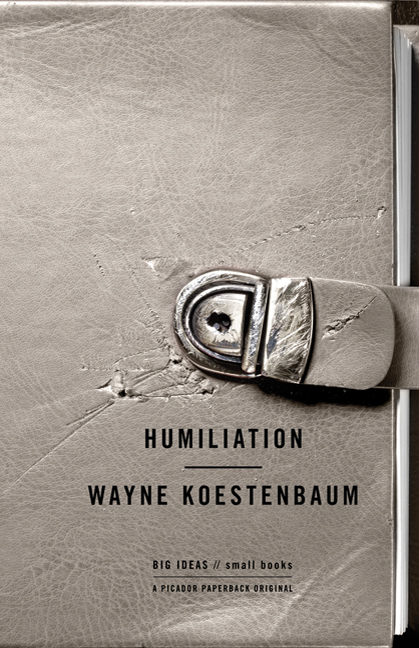
Wayne Koestenbaum’s Humiliation is probably the funniest, wisest, and most moving work of cultural studies I’ve ever read.  Unlike many of the tomes that clutter academia, Humiliation is accessible, humorous, and loving, a work of philosophical inquiry that also functions as cultural memoir. Despite its subject of pain and abjection, it repeatedly offers solutions when it can, and consolation and sympathy when it cannot.

So the second posthumously published, unfinished novel from a suicide I read this summer was Ernest Hemingway’s The Garden of Eden, the sultry strange tale of a doomed ménage à trois. (I’m as humiliated by that last phrase as you might be, dear reader. Sorry). Hemingway’s story of young beautiful newlyweds drinking and screwing and eating their way across the French Riviera is probably the weirdest thing he ever wrote. It’s a story of gender reversals, the problems of a three-way marriage, elephant hunting, bizarre haircuts, and heavy, heavy drinking. The Garden of Eden is perhaps Hemingway at his most self-critical; it’s a study in how Hemingway writes (his protagonist and stand-in is a rising author) that also actively critiques his shortcomings (as both author and human). The Garden of Eden should not be overlooked when working through Hemingway’s oeuvre. I’d love to see a critical edition with the full text someday (the novel that Scribner published pared down Hemingway’s unfinished manuscript to about a third of its size).

Also fragmentary fun: F. Scott Fitzgerald’s Notebooks. Like Twitter before Twitter, sort of.

These weren’t the only books I read this summer but they were the best.

“It’s No Accident that Civics Isn’t Taught Anymore” — More from §19 of David Foster Wallace’s The Pale King

(Help yourself to some context (or not)).

Let’s look at some more of  §19 of David Foster Wallace’s The Pale King. Our interlocutors, all IRS agents, stuck in an elevator (methinks), direct their attention toward the decline of civics education (“‘Civics is the branch of political science that quote concerns itself with citizenship and the rights and duties of US citizens,’” we learn) in America and link this decline to the 1960s—

‘I think it’s no accident that civics isn’t taught anymore or that a young man like yourself bridles at the word duty.’

‘We’ve gotten soft, you’re saying.’

‘I’m saying that the sixties—which God love them did a lot for raising people’s consciousness in a whole lot of areas, such as racism and feminism—‘

‘Not to mention Vietnam.’

‘No, mention it, because here was a whole generation where most of them now for the first time questioned authority and said that their individual moral beliefs about the war outweighed their duty to go fight if their duly elected representatives told them to.’

‘In other words that their highest actual duty was to themselves.’

And down a bit—

‘The sixties were America’s starting to decline into decadence and selfish individualism—the Me generation.’

‘There was more decadence in the twenties than there was in the sixties though.’

‘You know what I think? I think the Constitution and Federalist Papers of this country were an incredible moral and imaginative achievement. For really the first time in a modern nation, those in power set up a system where the citizens’ power over their own government was to be a matter of substance and not mere symbolism. It was utterly priceless, and will go down in history with Athens and the Magna Carta. The fact that it was a utopia which for over two hundred years actually worked makes it beyond priceless—it’s literally a miracle. And—and I’m speaking of Jefferson, Madison, Adams, Franklin, the real church Fathers—what raised the American experiment beyond great imagination and made it very nearly work was not just these men’s intelligence but their profound moral enlightenment—their sense of civics. The fact is that they cared more about the nation and the citizens than about themselves. They could have just set America up as an oligarchy where powerful eastern industrialists and southern landowners controlled all the power and ruled with an iron hand in a glove of liberal rhetoric. Need I say Robespierre, or the Bolsheviks, or the Ayatollah? These Founding Fathers were geniuses of civic virtue. They were heroes. Most of their effort went into restraining the power of the government.’

‘Checks and balances.’

‘Power to the people.’

‘They knew the tendency of power to corrupt—’

As I said in some earlier posts about  §19, I don’t really have any great thesis to share about it: I really just want folks to read it. I think it’s a thoughtful and sometimes funny discussion that seems especially relevant against the backdrop of current American politics, which seem to be infected by a terrible case of the reactionaries, a very vocal contingent that does not seem to believe in civic duty.

Most reviewers have remarked (rightly) upon Wallace’s grand theme of boredom in The Pale King, but I don’t know how much attention has been paid to the way the book tries to measure the costs of existence (namely, death and taxes). Wallace squares boredom as both symptom and affect of a postindustrial existence, a post-democratic existence, an existence that has the leisure, or at least the means and the common vocabulary, to hash out the finnicky sinews between rights and duties—or, in turn, the leisure and means (and entertainments) to psychologically deflect or otherwise ignore those costs. His characters in The Pale King—and not just these guys stuck in the elevator, but, hey, their colloquy is especially instructive—his characters are in many ways are trying to find meaning, a sense of duty, against terrible, soul-crushing boredom, a boredom that capitalist culture fosters and with one hand and then assuages with the other, like a heroin dealer stringing along a junkie for all he’s worth. (There’s an intersection here with Infinite Jest, of course).

It seems that “civics” is a dirty word now, or even worse, a word unattached to any real concept in the American hivemind. It’s pretty much a given (and “given” in the sense of, like, “submission”) that our politicians are wholly corrupted by power, part and parcel of a corporatocracy that thrives on manufactured desire, on the promotion of “lack,” constantly feeding into the basest instincts of a populace easily motivated by xenophobia, paranoia, and the sense that a creeping dark “other” is destabilizing America’s “natural” progress to some great grand glowing telos in the sky. The great lie of the past few decades has been to perpetuate the ideal of a cost-free existence, a metaphysical out, an endless deflection of our rapid consumption. We live in a world where the leading Republican candidates for the 2012 election race are basically cartoons. We live in a world where headlines from The Onion seem more the work of prescient prescription than outright satire. We live in a world where an honest assessment of who-pays-what-taxes can only come from a comedy show.

Perhaps I’m ranting; perhaps this post is too hyperbolic. Sorry. I’ll return to Wallace’s language and that opening line: “‘I think it’s no accident that civics isn’t taught anymore or that a young man like yourself bridles at the word duty.'” Americans are being told that they have no duty to other Americans, that they should not have to have any relationship with other Americans, that, essentially, there is no civic duty to one’s country, to one’s fellow Americans—there is only a duty to one’s ruggedly individual self, only a duty to one’s bootstraps, which you must always pull up by yourself. The corporate-advertising-entertainment-industrial complex perpetuates the illusion of rugged individualism and politicians reinforce it with their empty rhetoric, blasting at any element of a public, civic corpus that isn’t part of the American war machine (which remains of course untouchable; perhaps the greatest signal of cognitive dissonance I regularly see on my commute to and from work are the cars in front of me that somehow bear anti-tax bumper stickers right next to calls to “Support Our Troops”).

Wallace perhaps rightly links the genesis of this cognitive dissonance when it comes to civic rights and civic duties to the 1960s, when the baby boomers, finding power in sheer numbers, were able to assert a generational agency unseen in this country’s history. His elevator talkers here are at the precipice of the Reagan ’80s, post-Watergate disenchantment, but also post-Carter malaise, a time when the boomers are oiled and primed for the complete ideological failure that should forever mark their generation.

There’s more rant in me, of course, but I’ll save it for more excerpts from  §19.

RIP Stetson Kennedy, Florida Folklorist, Writer, and Human Rights Activist

Stetson Kennedy died today at 94 in his native city, Jacksonville, FL.

Kennedy began his career collecting folklore throughout the South in 1937 after leaving the University of Florida. Kennedy worked for the Works Progress Administration’s Florida Writers’ Project, traveling with Zora Neale Hurston to collect oral histories and folk tales from both black and white Floridians alike. In the 1940s, Kennedy worked for the Atlanta office of the CIO. He also infiltrated the Ku Klux Klan in the 1940s and ’50s, exposing many of the racist organization’s secrets and alerting the world to the intrinsic injustice of the Jim Crow system in Southern states.

When Kennedy ran (quite unsuccessfully) for Governor of Florida in 1952, Woody Guthrie wrote the song “Stetson Kennedy” to support his good friend (Wilco and Billy Bragg put the lyrics to music decades later). Kennedy’s anti-Jim Crow, early Civil Rights platform didn’t win him much popularity throughout the state, and when his home in Fruit Cove was firebombed, he moved to France. It was there that the philosopher Jean-Paul Sartre published Kennedy’s The Jim Crow Guide—but the book was too controversial for US publication, despite multiple translations across Europe. Even more incendiary was Kennedy’s expose The Klan Unmasked (1954), which helped to undermine the organization’s secret authority in the South.

Just as Kennedy’s contribution to the Civil Rights movement cannot be underestimated, neither can his work in collecting and preserving Florida folklore (as well as Southern folklore in general). Kennedy helped found the Florida Folklore Society and also served as president, and volumes like Palmetto County and Grits and Grunts: Folkloric Key West will remain staples of Florida folk culture. In 2009, Kennedy bequeathed his papers and personal library to the Civic Media Center in Gainesville, FL, a nonprofit info center and alternative library devoted to human rights, environmental protection, and other causes. Kennedy was closely involved with the CMC since its inception in 1993.

Kennedy was a vibrant fount of cultural and historical force, a man who worked his entire, long life not just to preserve folklore and its history, but also to show the radical place that folk culture occupies throughout time, linking core human values from generation to generation. Stetson Kennedy will live through his legacy.

Kennedy’s website sheds light on his final moments—

He was with his wife and stepdaughter, He was in no pain. And as recently as 4 days ago he was lucid and talking. The doctor, checking his mental faculties asked him questions “where are you from”, Kennedy replied, “The planet Earth”

Stetson’s wishes were for a party and not a funeral. A luncheon at Beluthahatchee will be held October 1st.

Kennedy on This American Life.

Read a 2011 interview with Kennedy in Vice Magazine.

I Watch The Decemberists’ David Foster Wallace Video

I’ll be upfront: I don’t care for the music of The Decemberists. I’ve tried, after being told repeatedly how “deep” or “clever” or “literate” the lyrics are, and how good the music is—but it all strikes me as awfully bland stuff, like someone’s shitty take on R.E.M.

Anyway, I do very much like David Foster Wallace’s novel Infinite Jest, the “inspiration” (yes, I’ll put the word in suspicious quotation marks) behind The Decemberists’ new music video for “Calamity Song.” Here’s their singer/songwriter Colin Meloy (via NPR)—

I wrote “Calamity Song” shortly after I’d finished reading David Foster Wallace’s epic Infinite Jest. The book didn’t so much inspire the song itself, but Wallace’s irreverent and brilliant humor definitely wound its way into the thing. And I had this funny idea that a good video for the song would be a re-creation of the Enfield Tennis Academy’s round of Eschaton — basically, a global thermonuclear crisis re-created on a tennis court — that’s played about a third of the way into the book. Thankfully, after having a good many people balk at the idea, I found a kindred spirit in Michael Schur, a man with an even greater enthusiasm for Wallace’s work than my own. With much adoration and respect to this seminal, genius book, this is what we’ve come up with. I can only hope DFW would be proud.

I’m not going to conjecture whether Wallace would be proud or not. That seems like total asshole move. But, I am interested in seeing a filmed version of Eschaton, and I do like Michael Schur’s show Parks and Recreation. So I’m going to watch the video now—unmuted and everything—and then post a reaction. Here’s the vid—

Okay. Nice production values, I guess. I think that’s the band, right? I like it when bands are in their own videos and “act.” I guess they’re playing the older ETA kids who are watching the game this Interdependence Day. The singer is Pemulis, that seems clear. It snows in the Escahton episode, but it looks like only some rain here. I like the Otis P. Lord kid, but I don’t know if the other kids look right. This is weak criticism, I know. Hmmm. The song . . . well, I’m not into this song, but I guess it’s pleasant enough. It’s terribly competent. Bits of it sound like a sped up version of R.E.M.’s “Talk About the Passion.” Some of the lyrics seem to reference or play off of Infinite Jest maybe—like “Year of the Something Something”  or something.

I don’t know. What can I say here? I hope no one tries to make a movie out of Infinite Jest. It was all I could do to fast forward through most of Jim from The Office’s movie of Hideous Men.

The Garden of Eden — Ernest Hemingway

In general, I dislike reviews that frontload context—get to the book, right? So here’s a short review of Ernest Hemingway’s The Garden of Eden: it is stranger than most of what Hemingway wrote, by turns pleasant, uncomfortable, bewildering, and beautiful. And readable. It’s very, very readable. Young people (or older folks; let’s not be prejudiced) working their way through Hemingway shouldn’t put The Garden of Eden on the back-burner in favor of his more famous works, and anyone who might have written off Hemingway as unreflective macho bravado should take a look at some of the strange gender games this novel has to offer. So, that’s a recommendation, okay?

Now on to that context, which I think is important here. See, The Garden of Eden is one of those unfinished novels that get published posthumously, put together by editors and publishers and other book folk, who play a larger role than we like to admit in the finished books we get from living authors anyway. For various reasons, cultural, historical, etc., we seem to favor the idea of the Singular Artistic Genius who sculpts beauty and truth out of raw Platonic forms that only he or she can access (poor tortured soul). The reality of how our books get to us is a much messier affair, and editors and publishers and even literary studies departments in universities have a large hand in this process, one we tend to ignore in favor of the charms of a Singular Artistic Genius. There’s a fascinating process there, but also a troubling one. Editing issues complicate our ideals of (quite literally) stable authority—is this what the author intended?, we ask (New Critics be damned!). David Foster Wallace and Michael Pietsch, Raymond Carver and Gordon Lish, Franz Kafka and Max Brod, Mary Shelley and Percy Shelley . . .  not to mention Shakespeare, Chaucer, Beowulf, The Bible, Homer, etc. etc. etc. But you’re here to read about The Garden of Eden, right gentle reader? Mea culpa. I’ve been blathering away. Let me turn the reins over to the estimable talents of E.L. Doctorow, who offers the following context in his 1986 review of the book in The New York Times

Since Hemingway’s death in 1961, his estate and his publishers, Charles Scribner’s Sons, have been catching up to him, issuing the work which, for one reason or another, he did not publish during his lifetime. He held back ”A Moveable Feast” out of concern for the feelings of the people in it who might still be alive. But for the novel ”Islands in the Stream” he seems to have had editorial misgivings. Even more deeply in this category is ”The Garden of Eden,” which he began in 1946 and worked on intermittently in the last 15 years of his life and left unfinished. It is a highly readable story, if not possibly the book he envisioned. As published it is composed of 30 short chapters running to about 70,000 words. A publisher’s note advises that ”some cuts” have been made in the manuscript, but according to Mr. Baker’s biography, at one point a revised manuscript of the work ran to 48 chapters and 200,000 words, so the publisher’s note is disingenuous. In an interview with The New York Times last December, a Scribners editor admitted to taking out a subplot in rough draft that he felt had not been integrated into the ”main body” of the text, but this cut reduced the book’s length by two-thirds.

So, yeah. The version we have of The Garden of Eden is heavily cut, and also likely heavily arranged. But that’s what editors do, and this is the book we have (for now, anyway—it seems like on the year of its 25th anniversary of publication, and the 50th anniversary of Hemingway’s death that Scribner should work toward putting out an unedited scholarly edition) — so I’ll talk about that book a bit.

The Garden of Eden tells the story of a few months in the lives of a young newlywed couple, David Bourne, an emerging novelist, and his wife Catherine, a trust fund baby flitting about Europe. The novel is set primarily on the French Riviera, in the thin sliver of high years between the two big wars. David and Catherine spend most of their days in this Edenic setting eating fine food and making love and swimming and riding bikes and fishing. And drinking. Lots and lots of drinking. Lots of drinking. It all sounds quite beautiful—h0w about a taste?

On this morning there was brioche and red raspberry preserve and the eggs were boiled and there was a pat of butter that melted as they stirred them and salted them lightly and ground pepper over them in the cups. They were big eggs and fresh and the girl’s were not cooked quite as long as the young man’s. He remembered that easily and he he was happy with his which he diced up with the spoon and ate with only the flow of the butter to moisten them and the fresh early morning texture and the bite of the coarsely ground pepper grains and the hot coffee and the chickory-fragrant bowl of café au lait.

Hemingway’s technique throughout the novel is to present the phenomenological contours of a heady world. It’s lovely to ride along with David and Catherine, rich and free and beautiful.

Their new life together is hardly charmed, however. See, Catherine gets a haircut—

Her hair was cropped as short as a boy’s. It was cut with no compromises. It was brushed back, heavy as always, but the sides were cut short and the ears that grew close to her head were clear and the tawny line of her hair was cropped close to her head and smooth and sweeping back. She turned her head and lifted her breasts and said, “Kiss me please.”  . . .

“You see, she said. “That’s the surprise. I’m a girl. But now I’m a boy too and I can do anything and anything and anything.”

“Sit here by me,” he said. “What do you want, brother.”

David’s playful response—calling his wife “brother”—covers up some of his shock and fear, but it also points to his underlying curiosity and gender confusion. And indeed, Catherine’s new haircut licenses her to “do anything and anything and anything” — beginning with some strange bed games that night—

He had shut his eyes and he could feel the long light weight of her on him and her breasts pressing against him and her lips on his. He lay there and felt something and then her hand holding him and searching lower and he helped with his hands and then lay back in the dark and did not think at all and only felt the weight and the strangeness inside and she said, “Now you can’t tell who is who can you?”

“No.”

“You are changing,” she said. “Oh you are. You are. Yes you are and you’re my girl Catherine. Will you change and be my girl and let me take you?”

“You’re Catherine.”

“No. I’m Peter. You’re my wonderful Catherine. You’re my beautiful, lovely Catherine. You were so good to change. Oh thank you, Catherine, so much. Please understand. Please know and understand. I’m going to make love to you forever.”

David, partial stand-in for Hemingway, transforms into a girl who feels “something” during sex with Catherine (or, ahem, Peter)—note that that “something” has no clear referent. As their gender inverting games continue (much to David’s horror), Hemingway’s usually concrete language retreats to vague proforms without referents, “it”s without antecedents; his usually precise diction dissolves in these scenes, much as the Bournes’ marriage dissolves each time Catherine escalates the gender inversion. David gives her the nickname “Devil,” as if she were both Eve and Serpent in their Garden. Catherine’s transformations continue as she cuts her hair back even more, and sunbathes all the time so that she can be as dark as possible. She dyes her hair a silver blonde and makes David get his hair cut and dyed the same.

The bizarre behavior (shades of Scott and Zelda?) culminates in Catherine introducing another woman into the marriage. Marita falls in love with both David and Catherine, but her lesbian sex with Catherine only accelerates the latter’s encroaching insanity. David is initially radically ambivalent to the ménage à trois proposed by his wife; he has the good sense to see that a three-way marriage is ultimately untenable and that his wife is going crazy. He vacillates between hostility and love for the two women, but eventually finds a support system in Marita as it becomes increasingly apparent (to all three) that Catherine is depressed and mentally unstable, enraged that David has ceased to write about the pair’s honeymoon adventures on the Riviera. Catherine has been bankrolling David; jealous of good reviews from his last novel, she insists that he write only their story, but David would rather write “the hardest story” he knows—the story of his childhood in East Africa with his father, a big game hunter.

In some of the most extraordinary passages of The Garden of Eden, David writes himself into his boyhood existence, trailing a bull elephant with his father through a jungle trek. David has spotted the elephant by moonlight, prompting his father and his father’s fellow tracker and gun bearer Juma to hunt the old beast. As they trail the animal, David begins to realize how horrible the hunt is, how cruel it is to kill the animal for sport. The passages are somewhat perplexing given Hemingway’s reputation as a hunter. Indeed, this is one of the major features of The Garden of Eden: it repeatedly confounds or complicates our ideas about Hemingway the man’s man, Hemingway the writer, Hemingway the hunter. David describes the wounded, dying elephant—

They found him anchored, in such suffering and despair that he could no longer move. He had crashed through the heavy cover where he had been feeding and crossed a path of open forest and David and his father had run along the heavily splashed blood trail. Then the elephant had gone on into thick forest and David had seen him ahead standing gray and huge against the trunk of a tree. David could only see his stern and then his father moved ahead of him and he followed and they came alongside the elephant as though he was a ship and David saw the blood coming from his flanks and running down his sides and then his father raised his rifle and fired and the elephant turned his head with the great tusks moving heavy and slow and looked at them and when his father fired the second barrel the elephant seemed to sway like a felled tree and came smashing down toward them. But he was not dead. He had been anchored and now he was down with his shoulder broken. He did not move but his eye was alive and looked at David. He had very long eyelashes and his eye was the most alive thing David had ever seen.

David succeeds in writing this “hard” story, and the passages are remarkable in their authenticity—David’s story is a good story, the highlight of the book perhaps; it’s not just Hemingway telling us that David wrote a great story, we actually get to experience the story itself as well as the grueling process by which it was made. Hemingway and his surrogate David show us—make us experience—how difficult writing really is, and then share the fruit of that labor with us. These scenes raise the stakes of The Garden of Eden, revealing how serious David is when he remarks (repeatedly) that the writing is the most important thing—that it outweighs love, it surpasses his marriage. These realizations freight the climax of the novel all the more heavily, but I will avoid anymore spoilers.

The Garden of Eden has some obvious flaws. Marita is underdeveloped at best for such an important character, and her love for David and Catherine remains unexplored, and in fact barely remarked upon. The biggest problem with the book is its conclusion, which feels too pat, too obvious for such a strange, amorphous book. It is here that the presence of an editorial hand seems clearest, to the extent that I wonder if the short little chapter that concludes the novel wasn’t cobbled together from a few stray sentences throughout the manuscript. But The Garden of Eden, despite some shortcomings, is a book well worth reading. The novel complicates not just Hemingway’s reputation, but also our sense of Hemingway’s sense of himself. Recommended.

“Corporations Are Getting Better and Better at Seducing Us into Thinking the Way They Think” — David Foster Wallace

From  §19 of David Foster Wallace’s The Pale King:

‘I have no idea what we do. As citizens we cede more and more of our autonomy, but if we the government take away citizens’ freedom to cede their autonomy we’re now taking away their autonomy. It’s a paradox. Citizens are constitutionally empowered to choose to default and leave the decisions to corporations and a government we expect to control them. Corporations are getting better and better at seducing us into thinking the way they think—of profits as the telos and responsibility as something to be enshrined in symbol and evaded in reality. Cleverness as opposed to wisdom. Wanting and having instead of thinking and making. We cannot stop it. I suspect what’ll happen is that there will be some sort of disaster—depression, hyperinflation—and then it’ll be showtime: We’ll either wake up and retake our freedom or we’ll fall apart utterly. Like Rome—conqueror of its own people.’

(This is the second paragraph; read the first here (or, like, buy the book)).

I want to write about this chapter against the backdrop of America’s current political/social/cultural climate—the so-called “debate” about government’s role, individual responsibility, our corporate welfare state, etc. What I want to write I am having a hard time writing. For one, the issue seems so big, so slippery, so oily, so recent, so indigestible. For another, I feel like Wallace’s chapter is so smart and engaging on its own that I shouldn’t be messing with it when I really don’t have anything smart or engaging to say about it.

I guess what I really want is for people to read it, or at least parts of it, so I’ll be posting bits of it over the next week or two, with occasional comments.

If I can’t be analytic about  §19 of The Pale King, perhaps I can at least offer a rough description:

The chapter is one of the longer ones in the novel at 20 pages, although it’s hardly the longest.

The chapter is probably set in early 1980 (or possible late 1979).

The chapter is probably set in a stuck elevator, probably as the result of a power failure, as the lights seem to be off.

The chapter is written entirely as a dialogue, mainly (solely?) between three IRS agents: Glendenning, DeWitt, and someone referred to as ‘X.’

The chapter references The Excorist, which might have been intended to be (or maybe is?) a motif in The Pale King.

The chapter discusses the cultural upheaval of the 1960s and early ’70s, and links this upheaval to the dawning conservatism of the Reagan years (which obviously have not yet happened in terms of the chapter’s timeline, but which one of the interlocutors nevertheless perspicaciously anticipates).

The dialogue (Socratic, if I’m feeling analytic) traces the tension between individual freedom, individual liberty, and the role of the government as an arbiter of civic life.

I’ll end with the somewhat generic definition of “civics” the chapter offers—

‘Civics is the branch of political science that quote concerns itself with citizenship and the rights and duties of US citizens.’

And there we go—that conflict between rights and duties.

Spurious — Lars Iyer

Lars Iyer’s début novel Spurious is about two would-be intellectuals, W., the book’s comic hero, and his closest friend, our narrator Lars. They bitch and moan and despair: it’s the end of the world, it’s the apocalypse; they find themselves incapable of original thought, of producing any good writing. The shadow of Kafka paralyzes them. They travel about Europe, seeking out knowledge and inspiration — or at least a glimpse of some beautiful first editions of Rosenzweig. They attend dreadful academic conferences; they write letters. They flounder and fail. In the meantime, a fungus of seemingly metaphysical proportions infects Lars’s apartment, soaking it through, compounding his desperation, as no one can figure out how to get rid of it—

No one understands the damp. It’s Talmudic. The damp is the enigma at the heart of everything. It draws into it the light of all explanation, all hope. The damp says: I exist, and that is all. I am that I am: so the damp. I will outlast you and outlast everything: so the damp.

The passage is a lovely example of Iyer’s humor, which pervades the book just as the damp creeps through his narrator’s home, absurd and bewildering. Iyer is willing to play with tropes of theology and philosophy in ways that are simultaneously absurd, hyperbolic, and deadly serious. “These are the End Times, but who knows it but us?” his hapless heroes wonder. W. is not without solutions though—-

Every conversation must be driven through the apocalyptic towards the messianic, that’s W.’s principle; the shared sense that it’s all at an end, it’s all finished. He loves nothing better than conversations of this kind, W. says, when everything’s at stake, when everything that could be said is said.

That’s when messianism begins, W. says, You have to wear out speech, to run it down. And then? And then, W. says, inanity begins, reckless inanity. The whole night opens up. You have to drink a great deal to get there. It’s an art.

The dialogue (or monologue pretending to be dialogue, more accurately) highlights the verbal slapstick of Spurious, its willingness to shift direction while retaining tone. “Both characters are mesmerised by a real disaster,” Iyer told me in a recent interview (the interview, by the way, makes a better case for reading Spurious than I can hope to here) . “And both — particularly W. — are mesmerised by their partial responsibility for this disaster. The ‘strained and unreasoning’ laughter of Spurious is a response to the grimness of the world that is of our making.”

W.’s response to our grim, apocalyptic world is a mix of absurd humor and real cruelty toward his friend Lars. And if W. is willing to mock and laugh at his friend, he also mocks and laughs at the world, and himself—only his laughter never absolves or forgives or otherwise deflects the cruelty and grimness of the world (or his own cruelty, in turn). When W. calls Lars fat or chastises his laziness or derides his intellect, there’s a recursive angle to his jabs, a sense that they will return to rest on his own brow. It’s all in good fun except when it’s not.

W. and Lars face the same trial that all thinking people face during the End Times, the inescapable, all-devouring nightmare of history, art, philosophy. Perhaps a passage will explicate better than I—

Kafka was always our model, we agree. How is it possible that a human being could write like that?, W. says, again and again. It’s always at the end of the night when he says this, after we’ve drunk a great deal and the sky opens above us, and it is possible to think of what is most important.

At the same time, we have Kafka to blame for everything. Our lives each took a wrong turn when we opened The Castle. It was quite fatal: there was literature itself! We were finished. What could we do, simple apes, but exhaust ourselves in imitation? We had been struck by something we could not understand. It was above us, beyond us, and we were not of its order.

If our heroes are disciples of literature (or the purity of “literature itself”), they are also its prisoners, its slaves, the tormented. W. attempts to find ways out through mathematics and Talmudic theology, but these disciplines entail their own weight and chains—and ultimately, W.’s own shortcomings in these areas only point back to his own reliance on literature (and, in turn, his own shortcomings there again). Still, W. (or Lars, or Iyer, I guess), is willing to share his citations with us, quoting or paraphrasing from a rich intellectual diet.

Although in some ways Spurious is fragmentary and elliptical, a series of riffs, vignettes, and skits, it is also in many ways a traditional novel, with emotionally drawn characters in Lars and W., whose friendship resounds with a deep reality and psychological honesty with which most readers will identify. W. suggests that companionship and friendship are reasons enough to continue existence in the face of despair and absurdity; he then turns around and accuses Lars of being a terrible friend. Iyer offers the kind of truth that has become a cliché, offers it perhaps without cynicism or irony, and then immediately punctures it, even as he reinforces its original truth. Spurious is full of such vacillations, reeling like its often-drunk heroes at times, but always unified by a consistent tone and tight prose. Funny and lively, even when it’s erudite and depressive, Spurious is a lovely little book for drinking and thinking. Read it and pass it on to a dear friend.

Spurious is available now from Melville House; I encourage you again, dear reader, to read my interview with Lars Iyer.

On Overrated Books

There’s a silly little article at Slate today about “overrated” books. The article collects a decent survey of critics and writers discussing the “great books” that they find boring, difficult to read, or otherwise overrated. There are a few tomes I agree with on the list—I am proud that I read all of Tess of the D’Ubervilles in the 10th grade, unlike most of my peers who, undoubtedly wiser than I, resorted to Cliffs Notes, but Hardy’s book was the biggest chore of my young reading life. There are plenty of books targeted in the article that may be overrated, but that doesn’t mean that they are bad or terrible books. But Slate is always quick to post a catchy, “provocative” headline, no doubt intended to generate hits; indeed, they’re almost as bad as Huffington Post, which has published similar articles in the past, including this recent execrable example of “literary criticism,” “Bad Classics: Books We Think Are Overrated.” Huffington Post’s list is ridiculous, taking weak stabs at Waiting for Godot, Moby-Dick, and that most sacred of cows, Ulysses.

Joyce’s big book shows up on the Slate list too. I’ll be the first to admit that the book is likely overrated, held in perhaps too high esteem by those who haven’t read it, and the academic industry it has produced does its reputation no favors among a general reading public. But it’s not a “bad classic.” It’s a beautiful, moving, and, yes, important book, and because of its status, both in the academy and in popular culture, it has become yet another easy target for contrarians. From the Slate piece, here’s Daniel Mendelsohn of the NYRB, explaining why Ulysses is inauthentic and has never “persuaded” him —-

. . . it’s as if Joyce were both the author of his book and the future comp lit grad student who’s trying to decipher it. Indeed, it’s small wonder that Ulysses has become the bible of academic lit departments; it seems to have been practically written for literary theorists. (Dubliners, by contrast, is a book for “ordinary readers”—a term I use admiringly.)

I understand that Ulysses’ place in the academy can be terribly frustrating, but Mendelsohn’s critique strikes me as populist rubbish; it’s more an attack on the reputation of the book than the book itself. But I don’t really care; I mean, Mendelsohn is entitled to his opinion, which I’m sure is well-informed.

What I’m ultimately concerned about here is the potential effect that pieces like these at Slate and Huffington Post (and similar sites) can have on a reading public. How freeing to be told by the experts that Ulysses or Moby-Dick or Gravity’s Rainbow is not worth my time! I can get back to those Swedish crime novels now, or those vampire books written at a 4th grade reading level, or, better yet, fuck books. I’m sure there are spoiled rotten housewives throwing chardonnay at each other on TV.

Author Elif Batuman also didn’t care for Ulysses, but she offers the most sensible response in the entire article—-

Like many people, I enjoy learning which canonical books are unbeloved by which contemporary writers. However, I don’t think participants in such surveys ought to blame either themselves (“I’m so lazy/uneducated”) or the canonical books (“Ulysses is so overrated”). My view is that the right book has to reach you at the right time, and no person can be reached by every book. Literature is supposed to be beautiful and/or necessary—so if at a given time you don’t either enjoy or need a certain book, then you should read something else, and not feel guilty about it.

Canonical books I did not enjoy include The Iliad and The Sound and the Fury, and, although I did read Ulysses with some degree of technical interest, it wasn’t fun for me. I maintain that this doesn’t reflect badly on Homer, Faulkner, Joyce, or me.

I think Batuman’s tone and approach is perfect here; I also admire her complete avoidance of playing those favorite games of internet writers: swiping at sacred cows and trying to point out that the emperor is naked. Instead, Batuman acknowledges the inherent fun in articles like the one she’s participating in and then quickly points out that reading is not a contest. She saliently points out that “the right book has to reach you at the right time, and no person can be reached by every book.” To my shame, a younger version of myself wrote some nasty things about William Faulkner on this blog, suggesting that he was the most overrated American writer of all time. I took it all back, of course, and now would rate Light in August and Go Down, Moses as two of my favorite books. I am happy that I read Go Down, Moses at the right time—like Batuman says, timing is a huge factor in how a reader receives a book.

It seems to me that articles like the ones at Slate and HuffPo are symptomatic of an empty populism sweeping through much of America today. I am in no way suggesting that the writers and critics in the surveys are practitioners or purveyors of empty populism; rather, their estimable talents have been circumscribed by engines of culture-production (and culture-absorption) to absolve an increasingly distracted populace from even making a pretense of reading some really great and important books. Articles like these engender slapdash and shallow thinking, licensing poseurs to make claims about books they’ve failed to read. Even worse, these kinds of surveys provide ammunition to the those who hold the word “elite” as an insult. I am not suggesting that articles like these will undo the Western canon, or that they signal the death of the novel, or an end to complex reading — but they certainly don’t help.

We Review John from Cincinnati, David Milch’s Metaphysical Surf Odyssey

Let’s be clear from the get go — John from Cincinnati probably isn’t for most people. I liked it, despite its many, many flaws, but it’s pretentious, willfully weird, and hides its shakiness and lack of direction under opaque philosophical mumbo jumbo. It’s also frequently brilliant and occasionally transcendent TV, powered by David Milch’s trademark Shakespearean (or, more accurately, Shakespearean-by-way-of-Melville) dialog and a stellar ensemble cast, including Ed O’Neill, Rebecca De Mornay, Luis Guzman, and Bruce Greenwood.

So, what’s it about? Here’s Milch on Craig Ferguson, back in 2007 when the show debuted on HBO (right after the series finale of The Sopranos, a spot that probably helped to kill it at birth)—

If you don’t feel like watching the segment (and, if so, why not? –Milch is fascinating), here’s the takeaway: “I don’t know what it’s about…I don’t know the bottom line. But, uh, if God were trying to reach out to us, right, and if he felt a certain urgency about it, that’s what it’s about. And if God were trying to reach out to us and teach us something about the deepest nature of man, uh, he might use some drugged out surfers.”

Those drugged out surfers are the Yosts, a clan that takes its dysfunction three generations deep. Mitch Yost (Bruce Greenwood) is the young grandfather, a one-time surf star who retreats to his tree house after a bad knee injury. He and his wife Cissy (De Mornay) raise their grandson Shaun, a quiet and centered boy of 15 whose surfing career is just now emerging—much to the chagrin of Mitch. You see, Bruce and Cissy kind of fucked up with their only child, Shaun’s dad Butchie, a one time bad-boy superstar of the surf circuit who’s since degenerated into heroin addiction and alcoholism, living in a dumpster of a hotel, and barely seeing his son. Multimillionaire surf promoter Linc Stark (Luke Perry) is partly to blame for Butchie’s fate, and now he wants to sign Shaun to his company.

Against this backdrop of familial toil, a stranger — John from Cincinnati (uh, JC, if you will) arrives. John is seemingly childlike and naïve; he parrots back the words that others say to him and seems incapable of answering questions directly. He also possesses strange powers, powers that unfold throughout the series’s ten episodes and extend into the bizarre community of Imperial Beach. There are the Yosts themselves—Mitch begins levitating, Shaun comes back from the dead, and Butchie no longer craves dope—but J of C’s powers also influence those in the Yosts’ circle, like ex-detective, Bill Jacks, who fights the despair at losing his dead wife by communicating telepathically with a parrot. Jacks is played by Ed O’Neill in a performance that deserves something better than an Emmy or whatever bullshit they give actors for TV series. Ed O’Neill + David Milch = fucking gold. Seriously. Here’s five seconds of Ed O’Neill’s Bill Jacks, context unimportant—-

Jacks is the highlight of a strange circle of weirdos and grotesques that elliptically orbit the Yosts, including a number of ringers from Milch’s Deadwood (Dayton Callie, Paula Malcolmson, and Garret Dillahunt) as well as other fantastic character actors like Guzman, Paul Ben-Victor, and Willie Garson. Over nine days,  J of C enters into the lives of these characters, transforming their dysfunction into a more unified, if still unstable community. This was the theme of Milch’s Deadwood, only in JfC it’s writ large and bold, if not obviously apparent.

Where Deadwood took a cold hard look at capitalism and our grand national myths, JfC explores the miraculous in the everyday. What would happen if we witnessed miracles? Could we credit them? Could we credit ourselves to understand them, or to even accept them—could we allow ourselves to be transformed by them? This is the dramatic thrust of JfC. The series is not so much about interpretation, then—it is not simply a reworking of the New Testament set in Southern California—rather it is a TV show about witnessing, what it would mean to see a miracle.

To this end, there are many, many scenes of characters witnessing and reacting to events that affect other characters in JfC. In any other world, such witnesses might be surrogates for the audience, allowing the producers to communicate their vision and meaning, but in JfC, witnessing is not a passive process, or even a matter of voyeurism: witnessing is just as important as the event that is witnessed; indeed, witnessing is what allows the event that is witnessed some measure of phenomenological reality. This is no small thing when set against the miraculous, against what our rational, scientific minds have told us to resist.

Because John from Cincinnati traffics in the inexplicable, it was bound to alienate its audience. The show was cancelled after one ten-episode run, and there’s a sense in the later episodes that the producers knew they would have to wrap up too much business without enough time. Thus: clunky exposition; new characters who show up for no reason and then disappear for no reason; major characters explained away with a simple voice over line or two; etc., etc., etc.

All of this is only frustrating though if one is seeking an explanation from JfC, when I think what the show is really offering is a view to a view of the inexplicable, to what it is to witness what we are told we cannot rationally witness. Like Twin Peaks, to which it bears considerable comparison, JfC is a study in dialog, mood, tone, and characterization. Those searching for story will likely be disappointed. That isn’t to say that JfC doesn’t have a good story—I think it does—but it hardly gels at the end. To put it another way, JfC lacks the central, galvanizing vision of Deadwood or other HBO shows like The Wire and Rome. Still, I think that fans of Milch’s dialog could hardly be disappointed with JfC, and the cast is marvelous (particularly Ed O’Neill). I’ll end by sharing what is likely the standout scene of JfC, an esoteric climax of sort from the sixth episode. It’s probably a riff on Jesus’ Sermon on the Mount—or maybe not—I don’t really want to analyze or interpret or even praise here—but it is a wonderful moment where Milch shows how community might happen. Recommended.

The Sot-Weed Factor — John Barth

I finished the audiobook version of John Barth’s novel The Sot-Weed Factor last week. I’d tried to read the novel a few times in the past, never getting past page 56 of my Bantam mass market edition, which runs to 819 pages. That’s a long book. The unabridged audiobook runs just over 36 hours. That’s a long time. Too long, really, for what Barth has to offer here, but before I get into that, I’ll give a tip of the hat to the excellent production values and the wonderful voice talent of Geoffrey Centlivre, who is by turns expressive, wry, pathetic, bathetic, or understated, depending on what Barth’s prose calls for. He understands the novel and does an estimable job translating it.

The Sot-Weed Factor enjoys the reputation of being Barth’s finest work (although let me just go ahead and disagree with this generalized assumption that I’ve attributed to no one in particular and say up front that the novel is ultimately a boring overlong drag and anyone interested in Barth is better off starting with Lost in the Funhouse). The novel parodies a number of literary styles — Bildungsromans, picaresques, Künstlerromans, adventure stories, histories, romances, and serialized narratives in general. Adopting the language (diction, tone, syntax, form and all) of 17th century prose, Barth tells the story of Ebenezer Cooke, a real historical figure whose 1708 poem “The Sotweed Factor, or A Voyage to Maryland, A Satyr” is considered by some literary historians to be the first American satire.

Barth’s Ebenezer is an innocent soul à la Voltaire’s Candide (hero of another picaresque that has the decency to be funnier, sharper, and, ahem, much, much shorter), a would-be poet whose spurious claims to being “Poet Laureate of Maryland” come constantly under fire. Ebenezer attributes his artistic powers (which are dubious at best) to the metaphysical virtue of his virginity; one of the major conflicts of the plot of The Sot-Weed Factor is poor Ebenezer defending his cherry from the various whores and ne’er-do-well who populate the book. And there are a lot of these whores and ne’er-do-wells: rascals and pirates and pimps and thieves and slavers and sluts of every stripe shuffle through The Sot-Weed Factor, underscoring several of Barth’s themes — innocence versus experience, perception versus reality, virtue versus vice, and stability versus flux.

In my reading, this last theme — the instability of identity, particularly American identity — is the major thrust of The Sot-Weed Factor. But before going into this idea, I suppose I should share at least some of the plot, or at least try to summarize it, which is almost impossible, as it shifts and slants and reverses in every chapter. In the interest of making a (very) long story short, dear reader, and making my job a bit easier, I’ll borrow from Don D’Ammassa’s summary (he’s got a great Barth page for those inclined)—

The story is set during the 17th Century.  Ebenezer Cooke is the son of a well-to-do British gentleman who owns property in the Maryland colony in the New World.  Ebenezer and his sister are tutored by Henry Burlingame until his sudden dismissal while they are in their late teens.  Ebenezer is sent off to boarding school, where he finds it difficult to form a bond between himself and his environment, eventually retreating into poetry.  He is also afflicted by an extreme form of indecisiveness in which he is literally frozen in place, some times for hours on end, incapable of making a decision.  His abstraction from the world is reminiscent of Jacob Horner and Todd Andrews, although exaggerated even further.

The plot grows rapidly more complicated.  Ebenezer is apprenticed in London, where he fails to prosper.  He becomes infatuated with a prostitute, despite his own militant virginity; his poor prospects are then conveyed to his father, who ships him off to the family holdings in the colonies.  Ebenezer decides to request a commission from Lord Calvert, governor of Maryland, to become its official Poet Laureate, believes that he has been awarded that honor, and sets out for the new world.  In the course of that journey, he rediscovers Henry Burlingame, who has taken on another identity, is kidnapped by pirates, walks the plank, and eventually reaches land.

The complexity and twisted humor that ensue cannot be adequately described in a few words.  Secret identities are revealed, coincidences flourish, absurd situations follow in rapid sequence.  Ebenezer is honored and disgraced, is captured by angry natives and threatened with death.  He discovers pieces of a secret journal of the adventures of John Smith and Pocahontas, and helps Henry Burlingame discover the truth about his own origins.  There is considerable bawdy content, much of it surrounding the mysterious process by which John Smith managed to sexually satisfy Pocahontas.

I’m impressed with D’Ammassa’s concision here—he neatly puts together the major elements of a sprawling, fat novel. As you may see from D’Ammassa’s summary, The Sot-Weed Factor is all about the instability of place, the lack of solid ground in swampy Maryland, the discontinuity of historical narrative, the inability of art to overcome reality, and the rapid reversals of fortune and identity that might occur in a New World. It’s all “assy-turvy,” to use one of the character’s terms. The Sot-Weed Factor here shows its post-modern bona fides; there’s a constant inconstancy, a doubling of people, places, things, and then a trebling. Ebenezer’s Old World romantic virtues—his insistence on the metaphysical value of his virginity and the power of his feeble poetry—are not just contested but obliterated (only poor Eb’s too blind to see this). Barth reworks American history, dismantling and satirizing the Pocahontas narrative, and emphasizing the plight of the native Americans, enslaved Africans, and indentured Europeans in this brave new world.

The book is also a dismantling of literary history, a jab at metaphysical poetry and identity narratives like Tom Jones or the work of Dickens. While Ebenezer spouts the loftiest supplications to his airy muse, Barth keeps his humor stuck sloppily in the toilet. The Sot-Weed Factor surpasses any ribald work I’ve ever read. The book is larded with dick jokes, fart jokes, jokes about diarrhea, jokes about sex and venereal diseases and so on—it culminates with (as D’Ammassa points out above) a riff on 17th century Viagra. In short, Bath focuses most of his keen literary powers on the kind of sophomoric japes that might keep Bevis and Butthead’s attention. Again, it’s all “assy-turvy.”

Barth’s toilet humor is at times funny, but it becomes tiresome over the book’s long duration, especially when it’s often the sole reward for long expanses of poorly-conceived exposition. I found myself bored to tears at times listening to The Sot-Weed Factor, and had to force myself to continue in its final third, a challenge that became easier when the narrative finally picked up a bit. Just a bit though. The book’s major problem is not its bloat though, or its saggy exposition, or even its redundant fart jokes. No, these feel more a symptom than a cause, and I think they are symptom of a too self-satisfied (or self-satisfying) author; over its 800+ pages (or 36+ hours), The Sot-Weed Factor reveals itself as the literary equivalent of a very bright writer jacking off to his own research. In what must be the worst case of unrestrained writing I’ve ever seen (or heard, I suppose), Barth allows two of his characters, catty women arguing, one English, one French, to trade insults with each other, all various euphemisms for “whore.” This process goes on for minutes in the audiobook version and for six goddamn pages in my Bantam edition and, like much of the details in this fat beast, does little or nothing to add to the narrative. It’s as if in his research Barth has dug up dozens and dozens of lovely little antiquated slurs and can’t bear to edit a single one. If  the process rewards Barth, it does little for the reader.

But if literary diarrhea is the mode of the book, then I guess it mirrors one of The Sot-Weed Factor’s many rude motifs. Personally, I wish I had my time back. There’s great value in reimagining the origin of America (I think immediately of Terence Malick’s The New World or Toni Morrison’s A Mercy or even some of William Blake’s work), but Barth’s narrative seems too self-indulgent and unrewarding to make any real claims to democratic (or, if I’m feeling harsh, artistic) insight. Perhaps The Sot-Weed Factor is the kind of novel that remains indivisible from its form, and perhaps to a contemporary reader like me this form is just too flabby and flaccid to spark spirit. As I’ve tried to communicate here, Barth has a sharp intellect and he’s more than capable of performing a wry, wise, and often funny analysis of early American history. But he indulges too much in his own sophomoric games and winks too often at the reader. It’s amazing that such a long book could feel so hollow.

Humiliation — Wayne Koestenbaum

Wayne Koestenbaum’s Humiliation explores the ways that having a body (among other bodies, among a social body) might leave us humiliated or otherwise abject. To perform this exploration, Koestenbaum surveys a discursive range of subjects, including the humiliation of public figures, the sordid “private” lives of celebrities, the work of philosophers and cultural theorists, and the art, music, films, and writing of various artists and performers. The book’s central subject though is Koestenbaum himself, who shares his own humiliations in a way that surpasses ironic self-deprecation. The results are surprisingly moving, intelligent, and very funny. I’ll let Koestenbaum explain his project—

Not merely because I am tired, but because this subject, humiliation, is monstrous, and because it erodes the voice that tries to lay siege to its complexities, I will resign myself, in the fugues that follow, to set forth an open-ended series of paradoxes and juxtapositions. (I call these excursions “fugues” not only because I want the rhetorical license offered by invoking counterpoint but because a “fugue state” is a mentally unbalanced condition of dissociated wandering away from one’s own identity.) Some of my fugal juxtapositions are literal and logical, while others are figurative, meant merely to suggest the presence of undercurrents, sympathies, resonances shared between essentially unlike experiences. If there is any reward to be found in this exercise of juxtaposing contraries to detect the occasional gleam of likeness, that dividend lies in the apprehension of a singular prey: the detection of a whimpering beast inside each of us, a beast whose cries are micropitches, too faint for regular notation.

Koestenbaum composes these fugues, these thematized chapters of his book, in small blocks of text, numbered entries that range from single sentences to several pages. These are aphorisms, anecdotes, japes, jokes, riffs, prose poems, howls. The style recalls Nietzsche’s aphoristic work or Barthes’s short essays in Mythologies, although these comparisons seem inappropriately pretentious. In any case, Koestenbaum sets these short pieces against each other to achieve the fugue state he describes above, a willful wandering from topic to topic—all within the kingdom of humiliation.

So what is humiliation? Or, rather, how does Koestenbaum define humiliation? While the entire book addresses the subject, our author gives us a fairly succinct definition upfront—

Humiliation involves a triangle: (1) the victim, (2) the abuser, and (3) the witness. The humiliated person may also behold her own degradation, or may imagine someone else, in the future, watching it or hearing about it. The scene’s horror—its energy, its electricity—involves the presence of three. An infernal waltz.

Koestenbaum takes turns playing all three roles, both through personal, historical, and cultural memory, as well as through a profound imaginative capacity. It is worth remarking upon, or at least listing, some of his examples here: Joan of Arc, King Lear, Liza Minelli, Bill Clinton, Antonin Artaud, Jean Genet, Jean-Michael Basquiat, Larry Craig, American Idol, The Swan, Anita Bryant, Harriet Jacobs, Richard M. Nixon, various creeps trolling Craigslist for weird sex, the Marquis de Sade, Abu Ghraib, lynching postcards, Michael Jackson—and always Koestenbaum himself (as well as his family, his friends, his colleagues, his students . . . ).  Koestenbaum shuffles through his subjects, looking at the various ways that they might fall into his triangle of humiliation, and even when he tries on the hat of the abuser, he modulates this position by keeping his subject’s agency within his critical purview. Indeed, one of the great warnings that Koestenbaum has to offer concerns what he labels “the Jim Crow gaze” — the propensity and capacity that each person holds within himself at all times to look at another human without recognition that that person is a human being, an agent of his or her own desires, emotions, and intellect. Koestenbaum readily admits his own failings, times he has turned the Jim Crow gaze on others, a look that goes past “othering” to actually desubjectify the gaze’s object. Koestenbaum’s project pays great dividends here; by moving discursively from a range of subjects (including himself), he reveals the limitations of first-person consciousness when coming into contact with the social, the cultural, the political, the historical. Put another way, Humiliation is one of the few works of cultural studies I’ve ever read to actively show why cultural studies matters. Here’s Koestenbaum again—

The humiliation of a derided performer on American Idol is immeasurably different from the humiliation of a Palestinian under Israeli occupation. One plight is chosen, the other is not. But isn’t there present, in both situations, an underlying coldheartedness, a rock-bottom refusal to believe the worthiness of the person whose reputation (or house, or land, or ego, or self-esteem) is stolen, trashed, occupied, razed? Isn’t there present, in both situations, an underlying will to deracinate and desubjectify this other person? And, most insidiously—isn’t there an insistence on considering this process of desubjectification (with my laughter I take away your humanity) an entertaining process, even a cathartic exercise, therapeutic and energizing, like calisthenics?

This willingness to connect American Idol to the Israeli-Palestinian conflict dramatically highlights the underlying psychological conditions lurking under the phenomenological apparatuses we see (or choose not to see) on a daily basis. And just as ridicule or schadenfreude may be posited as cathartic for the victimizer, Koestenbaum also finds that “the aftermath of humiliation can be paradoxically relaxing. Tranquilizing to have undergone humiliation and then emerge on the other side.” Perhaps it is toward some sense of release or tranquility then that Koestenbaum shares so much of his own humiliation with us—snubbings, embarrassments, accusations, disavowals, and, of course, his penis (he even apologizes for the “phallic” nature of the book).

Koestenbaum is willing to consider other penises too. Humiliation is very much a study of bodies in general: what it means to have a body, what it means for others to look at your body, how what your body looks like (its shape, its color, its gender, its parts, its excess, its lack) matters to others. Working from Julia Kristeva’s theory of the abject (see: Powers of Horror), Koestenbaum writes—

Humiliation involves physical process: fluids , solids, organs, cavities, orifices, outpouring, ingestions, excrescences, spillages. Humiliation demands a soiling. Even if the ordeal is merely mental, the body itself gets dragged into the mess.

Our most abject moments then are when we realize that our body is not the impermeable fortress of self that we might imagine, but rather a dripping mess with ill-defined borders. We are constantly leaking. Private shame always lurks, is always susceptible to public scrutiny. Koestenbaum again—

An object that should be private and unseen is suddenly visible . . . My unseen experience has been forcibly ejected—thrust outside. The judge hears my secrets. My inner rottenness lies exposed. My skin has been turned inside out. This fold (the self become a seam) is the structure of revulsion.

Yet going through these trials is part of forming an individual, subjective identity. “Humiliation, an educating experience,  breeds identity,” writes Koestenbaum. Of course, this idea goes back to our oldest stories, yet it often remains unremarked (curiously, Koestenbaum does not write about Adam and Eve in Eden, that primal scene of triangular humiliation). And while Koestenbaum posits the educational (and even possibly therapeutic) dimensions of humiliation, he’s very clear about the deep pain repetitive, institutionalized humiliation can cause—

 I presume that as moral individuals we should work toward minimizing humiliation, toward not inflicting it. We should practice an ethics of abstention. Vow: I abstain from deliberately humiliating others. When I find myself involved in this abhorrent practice, I will immediately desist and try to reverse the process and remedy the crime. And yet is a world without humiliation possible.? It’s disenchanting to write about a horrible situation. About this subject, I can’t rhapsodize.

I’m happy to rhapsodize about Humiliation more, but I fear that this review teeters on becoming overlong any word now. I’ve yet to remark on Humiliation’s humor, which is abundant, weird, occasionally dark, but always warm and deeply human. In the interest of time, perhaps you’ll trust the director John Waters, who provides the following blurb for the book: “This literary ‘topping from the bottom’ is the funniest, smartest, most heartbreaking yet powerful book I’ve read in a long time.” I agree completely with Waters, and  looking over my review, I fear that I may have portrayed a very accessible, humorous, and loving book in terms that are too academic. Humiliation may be a work of philosophical inquiry, but it also functions as a sort of cultural memoir, and if it’s a narrative of pain and abjection, it also repeatedly offers solutions to this pain when it can, and consolation and sympathy when it cannot. Very highly recommended.

Humiliation, part of the BIG IDEAS // small books series, is new this month from Picador.

I Have Writer’s Block (but I’ll Share a Vomit Story Anyway)

I have the writer’s block somethin’ terrible.

Everything was going so well, too—I seemed able to blather and drivel at will for a few weeks, dribbling out my noisome little posts on books or films or TV shows or what have you.

But now, nothing, which is terrible, because I have been reading up a storm—putting away half a Hemingway in a day (The Garden of Eden), flying through Donald Harrington’s epic comic masterpiece Architecture of the Arkansas Ozarks (still not finished), trudging through Breece D’J Pancake’s stories when I think I can take the sadness, and polishing off Wayne Koestenbaum’s Humiliation in three short sessions.

I kind of blame Koestenbaum’s book for the writer’s block. It’s always hard to write about a book that you love, that you think others should read too, but even harder when the book is about subjects and figures that most people would rather not think about, like abjection or vomit or gloryholes or the terrible pain of Liza Minelli or Antonin Artaud’s electroshock therapy or Jean Genet’s prison sex or lynching photographs or  Michael Jackson’s penis. Plus, Koestenbaum repeatedly points out that the act of writing itself, particularly writing for publication, writing for others to read is an abject, humiliating process. Here’s Koestenbaum—

Writing is a process of turning myself inside out: a regurgitation. I extrude my vulnerable inner lining. I purge. And then I examine the contents—my expulsed interior—and begin the bloody interrogation. I ask whether it is filthy or clean, valuable or deplorable.

Koestenbaum goes beyond metaphorical vomiting to consider the literal act of regurgitation in his book. There’s a lot of vomit in Humiliation—other bodily expulsions too, but Koestenbaum singles vomiting as a primary site of abjection (this seems a little less intense or mordant than theorist Julia Kristeva—whose work Koestenbaum is surely working from—who finds the corpse the ultimate abject object).

Maybe I’ll try to work through my writer’s block by telling a vomit story. The story is made more germane (to what, though?), perhaps, in light of the fact that I had just read some of Koestenbaum’s vomit theory (or vomit prose, if you prefer) the night previous.

Here is the setting: it is a pediatrician’s waiting room. I am waiting with my son, who is 13 months old, who is to receive shots on this visit to protect him from disease. The waiting room is packed and the progress is unusually slow. The woman across from me makes idle chit chat with me and with her own son who is maybe 13 or 14 years old; he’s in marching band; he needs new shoes for marching band; jazz band will be discontinued due to budget cuts, but the teacher (a man who shares my last name, I hear by eavesdropping although how can it be eavesdropping when their conversation is so public and the room so small) will teach jazz band after school. These details are unimportant to the vomiting story, although they perhaps signal the teenager’s mother’s caring, involved nature in her son’s life.

Here is the climax of the story: to my right, another man is at the doctor’s with his son, waiting; the son is perhaps 3 or 4 years old. He doesn’t look well—he looks queasy. In fact, when I look at him (not directly of course, but glancingly, the way that people might in a waiting room or other such place where direct eye contact is unspokenly shunned), when I look at him, I internally remark his queasiness, his ill gills, his distraught angle; I also internally remark his father’s concern, the way his father slowly strokes the son’s back in impotent consolation. And at the same moment I remark on these details, it occurs to me that this queasy looking boy is in the wrong section, that there is a clearly marked, smaller room (not so much a room but an alcove or adjoined large cubby—no door separates the two) for “sick” patients, for patients who are not attending a regular “well” visit (like my own son). My reaction though was not fear or disgust or anger, but more mild annoyance that the father was either flouting a convention of the office (one that I didn’t really care about, knowing that, hey, really, is that smaller room really going to protect my health or my child’s? Because, no it’s not), or that the father simply failed to read a clear sign (I feel a similar annoyance when people at the grocery store where I shop treat the clearly-marked entrance as an exit and vice-versa).

Anyway, I promised a climax, and failed to deliver. How humiliating. So here is the climax: the man’s son up and vomited all over the floor, all over the man’s leg. It was not the tidy vomit that we might sometimes manage—the short, projectile aimed mass that usually conforms to a strict element, mostly solid or mostly liquid. No, this was a messy, mucusy, ill affair, the kind of vomit that hangs from the vomiter’s mouth and sticks to the floor (for me, the most abject, threatening detail). It was foul. And yet I felt no abject horror or humiliation for the man or his child—in short, none of the vomit-horror that Koestenbaum describes in his book (a description I know I have not described for you, dear reader). Instead, I felt immediate empathy and compassion for the man. The mother of the teenager responded even more demonstrably. She immediately located a garbage bin for the boy to continue vomiting in, alerted the staff, went to the bathroom for paper towels, and helped the man while speaking consolingly to the son. She did what I wished that I had did. She behaved like a good human.

The point of this vomit story is to try to address what Koestenbaum does not address in his fantastic book. This is not meant to be a slight or an attack or even a criticism. A book should never be attacked for what it doesn’t aim to do. But what Koestenbaum, in his wonderful analyses of vomit, of expulsion, of all the ways our bodies, the material facts of our bodies humiliate us, make us abject, what Koestenbaum doesn’t consider is that the loving parent’s relation to a helpless child’s body’s expulsions bears the possibility (the strong possibility) of not being abject, but instead a site of abjection’s flipside: grace, love, empathy and all that jazz. In short, no one in the waiting room where the child vomited shrank in disgust or showed any visible sign of shared humiliation—quite the opposite. The child’s demonstrable illness became a moment not of horror but of empathy, of understanding the child’s illness and the father’s worry and care and love for his ill child, a love that transcends humiliation’s gaze.

So there’s my vomit story, or one of my vomit stories. But I still don’t know how to review the book right now.

Midnight in Paris — Woody Allen

Woody Allen’s new film Midnight in Paris opens with a sumptuous montage of the City of Light, clearly establishing from the get-go that the movie is Allen’s love letter to Paris. The romantic overture idealizes Paris, just as the film’s protagonist Gil, played pitch perfect by Owen Wilson, idealizes the Lost Generation of writers and artists who populated the cafes and bars of Paris in the ’20s. Gil is on a working vacation with his fiancé and future in-laws; he’s a successful Hollywood screenwriter but dreams of becoming a great novelist. Only he’s struggling with his novel-in-progress, which features a protagonist who runs a nostalgia shop. Nostalgia, or the romance of nostalgia, is the primary idiom of Midnight in Paris, and Owen Wilson transcends the usual parameters of Woody-surrogate in bringing this idiom to life. Wilson’s breezy charisma propels the movie forward at all times; indeed, the entire plot rests on Wilson’s charm, which saves the film from falling into syrupy dreck or boring indie whimsy.

Midnight in Paris works to literally charm its viewers and its protagonist, transporting the narrative back into the ’20s via a magical motorcar, where Wilson’s Gil falls in with a host of notable writers, artists, dancers, and other personalities. There are Cole Porter and Salvador Dali, Man Ray and Luis Bunuel, Pablo Picasso and Josephine Baker—but the standouts are the Fitzgeralds, Gertrude Stein, and Ernest Hemingway. The Hemingway character is a marvelous parody of both Hemingway’s caricature and Hemingway’s prose—although I think the humor in his scenes was lost on more than a few of the audience members I watched the film with. On Hemingway’s advice, Gil submits his manuscript to Gertrude Stein for an honest critique. In the meantime, Gil engages in a romance with Adrianna, Picasso’s muse and mistress, who herself pines for the Belle Époque era. Through another magical transposition, Gil and Adrianna move again through time, heading back to the 1890s to meet Toulouse-Lautrec and Paul Gaugin. As Gil pursues a romance with Adrianna (and the nostalgia of an idealized past), his own fiancé seems to be spending a bit too much time with a windbaggish and pretentious American who is a visiting lecturer at the Sorbonne. The reality of this conflict pulls Gil into making dramatic choices about his own future.

Midnight in Paris falls squarely into Allen’s fantasy films like The Purple Rose of Cairo, A Midsummer Night’s Sex Comedy, Alice, and Shadows and Fog. The film has much to offer those who, like Gil, find themselves fascinated by the romance of the Lost Generation. Allen’s parodies of the Fitzgeralds, Hemingway, and the rest are loving and gentle, and will surely be appreciated by most English majors. At the same time, Midnight in Paris is a slight, ephemeral work, one that relies on beautiful cinematography and the charm of its lead character more than plot, insight, or even jokes. There is no risk or danger in Gil’s fantasy, no sense that his sanity is in jeopardy or that he might not come to realize the theme of the film, which he spells out clearly for the audience if they somehow missed it—the tendency to romanticize the past has more to do with a dissatisfaction with the present than with any objective evidence that the past was somehow better, and dissatisfaction with the present should be viewed positively, for dissatisfaction can be productive and meaningful if we engage it. Recommended.