I. In this riff, Chapters 133-134 of Moby-Dick.
II. Ch. 133, “The Chase—First Day.”
We finally get there.
Ahab has posed one question throughout the book: “Hast seen the White Whale?”
That is the only viewpoint that matters to him—a viewpoint that can point him toward vengeance.
He gets to answer his own question:
“There she blows!—there she blows! A hump like a snow-hill! It is Moby Dick!”
And then the chase begins.
III. Ahab demands of his lookouts whether or not they sighted Moby Dick first. Tashtego claims that he, “saw him almost that same instant, sir, that Captain Ahab did,” but Ahab denies this (much as Stubb takes credit for the first whale The Pequod sights much earlier in the novel).
Ahab is ever-dominant: “Not the same instant; not the same—no, the doubloon is mine, Fate reserved the doubloon for me. I only; none of ye could have raised the White Whale first.”
Ahab’s “I only” condenses his monomania to three syllables.
Ahab’s monomania turns his rhetoric into a series of repetitions through which he tunes himself to the rhythm of the whale:
“There she blows!—there she blows!—there she blows! There again!—there again!” he cried, in long-drawn, lingering, methodic tones, attuned to the gradual prolongings of the whale’s visible jets.
IV. Ahab and his mates set to their boats to chase the White Whale—only Starbuck remains, as previously commanded by Ahab. Omnipresent Ishmael, shows us Ahab seeing Moby Dick: “He saw the vast, involved wrinkles of the slightly projecting head beyond.” And then, in a remarkable passage, we get what I think is Ishmael seeing Moby Dick, or Ishmael seeing Moby Dick as he wished Ahab could see Moby Dick:
A gentle joyousness—a mighty mildness of repose in swiftness, invested the gliding whale. Not the white bull Jupiter swimming away with ravished Europa clinging to his graceful horns; his lovely, leering eyes sideways intent upon the maid; with smooth bewitching fleetness, rippling straight for the nuptial bower in Crete; not Jove, not that great majesty Supreme! did surpass the glorified White Whale as he so divinely swam.
The whale here is godlike. But remember that Ahab would strike the sun, would cast down the Titans.
V. Ahab and his men continue to hunt the godlike whale “through the serene tranquillities of the tropical sea”; Moby Dick ducks and dives, refusing them the sight of “the full terrors of his submerged trunk.”
Soon though, eagle-eyed Tashtego spies the sign of the whale’s re-emergence:
“The birds!—the birds!” cried Tashtego.
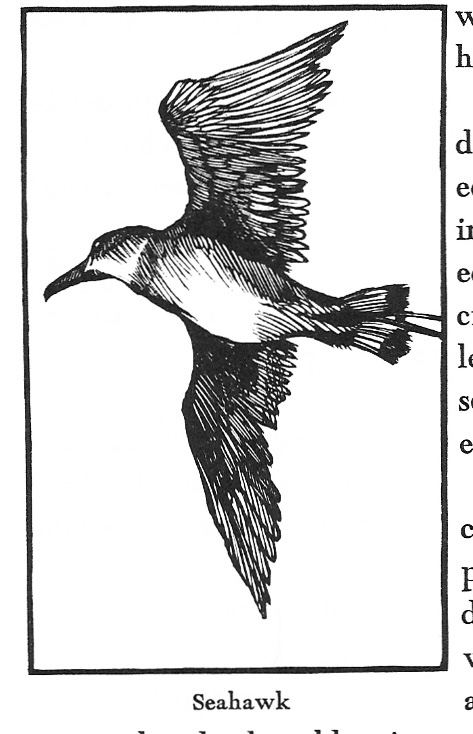
In long Indian file, as when herons take wing, the white birds were now all flying towards Ahab’s boat; and when within a few yards began fluttering over he water there, wheeling round and round, with joyous, expectant cries. Their vision was keener than man’s; Ahab could discover no sign in the sea.
Melville seems to underline a few points here—Tashtego raises a whale for the third time—here, by spying the herons, which our author notes travel in “Indian file” and by noting that this “Indian file” sounds the alarm for the whale. They can see more deeply than Ahab.
VI. But Ahab soon does see something, but only because it rises up to meet him from the ocean’s depths: “It was Moby Dick’s open mouth and scrolled jaw.”
But it’s just the first day of the chase in this novel of tripled trios. Ahab’s not done yet, even though “The glittering mouth yawned beneath the boat like an open-doored marble tomb.” There’s some foreshadowing for you!
VII. Ahab escapes on this first day, although his boat does not—Moby Dick chomps it to pieces. All sailors are saved too, although Ahab shows more concern for the harpoon he forged earlier aboard The Pequod (it’s saved too).
Moral Starbuck declares the business of the wrecked boat an ill omen, but Ahab won’t read the signs that way:
Omen? omen?—the dictionary! If the gods think to speak outright to man, they will honorably speak outright; not shake their heads, and give an old wives’ darkling hint.—Begone! Ye two are the opposite poles of one thing; Starbuck is Stubb reversed, and Stubb is Starbuck; and ye two are all mankind; and Ahab stands alone among the millions of the peopled earth, nor gods nor men his neighbors!
VIII. Ch. 134, “The Chase—Second Day.”
And so the second day.
It starts out with an enthusiastically-received mistake. The lookout calls out that he’s sighted Moby Dick, rousing the crew into a kind of mad fury; Ahab’s monomania inspirits them all:
The hand of Fate had snatched all their souls; and by the stirring perils of the previous day; the rack of the past night’s suspense; the fixed, unfearing, blind, reckless way in which their wild craft went plunging towards its flying mark; by all these things, their hearts were bowled along. The wind that made great bellies of their sails, and rushed the vessel on by arms invisible as irresistible; this seemed the symbol of that unseen agency which so enslaved them to the race.
“They were one man, not thirty,” notes Ishmael, in another satanic inversion of the earlier oversoul blending the men have experienced. We are now in the mode of blood, a reversal of “the very milk and sperm of kindness.”
IX. But Ahab chastises the men: “ye have been deceived; not Moby Dick casts one odd jet that way, and then disappears.” Ahab ascends the rigging himself, and quickly sights the White Whale again. “Aye, breach your last to the sun, Moby Dick!” he brags, setting out again in a restored boat (and again leaving Starbuck on The Pequod).
X. A complex battle ensues. All three harpooneers manage to lance Moby Dick, but “in his untraceable evolutions, the White Whale so crossed and recrossed, and in a thousand ways entangled the slack of the three lines now fast to him, that they foreshortened, and, of themselves, warped the devoted boats towards the planted irons in him.” The image evokes to me a kind of elegant wild writing. Moby Dick crossing and recrossing the lines, warping and weaving the material of which he is the unknowable center.
Moby Dick rewrites the violence Ahab seeks to wreak upon him. The men’s lances become “corkscrewed in the mazes of the line,” and Ahab’s only recourse is to edit. He takes a knife to the lines attached to his boat. But Ahab causes an unintended effect—although he’s freed from the whale, the other boats are not, and “the more involved boats of Stubb and Flask” are dashed…together like two rolling husks on a surf-beaten beach.”
XI. Moby Dick then destroys Ahab’s second boat. The particular paragraph is an astounding piece of rhetoric, a single sentence of 141 words, fourteen commas, seven em dashes, and four semicolons. And it begins with While—Melville tries to make his rhetoric do what film does, to situate his sentences as movement, sound, simultaneity. His goal is to set a scene impossible for an eye to take in and comprehend in a simple glance—the wreck of the boats, the struggle of Stubb, Flask, and their men—condensed perhaps most neatly in the phrase which occurs right in the middle of the paragraph—
—in that wild simultaneousness of a thousand concreted perils,—
(Those dashes do so much work, forcefully connecting and separating the elements of Melville’s tangled, disastrous paragraph of a sentence.)
XII. And well so what happened in that wild simultaneousness of a thousand concreted peril?
—Ahab’s yet unstricken boat seemed drawn up towards Heaven by invisible wires,—as, arrow-like, shooting perpendicularly from the sea, the White Whale dashed his broad forehead against its bottom, and sent it, turning over and over, into the air; till it fell again—gunwale downwards—and Ahab and his men struggled out from under it, like seals from a sea-side cave.
XIII. The men, including Ahab, are returned to The Pequod. But Ahab’s “ivory leg had been snapped off, leaving but one short sharp splinter.”
Ahab then musters the men and finds Fedallah missing; Stubb attests that the Parsee was dragged down in the tangles of Ahab’s lines. Ahab is the author of Fedallah’s death. He goes full King Lear:
My line! my line? Gone?—gone? What means that little word?—What death-knell rings in it, that old Ahab shakes as if he were the belfry. The harpoon, too!—toss over the litter there,—d’ye see it?—the forged iron, men, the white whale’s—no, no, no,—
(Etc.)
Ahab’s “line” here points in multiple directions—the concrete harpoon line, the genealogical futurity of his familial line; his “line” as an author.
XIV. Ahab’s mad monologue pushes Starbuck over the edge. “Great God! but for one single instant show thyself,” Starbuck implores, perhaps echoing Melville’s own metaphysical misgivings. “In Jesus’ name no more of this,” he implores, ending his own rejoining monologue by declaiming it, “Impiety and blasphemy to hunt him more!”
XV. Ahab’s ego overwhelms in the end though. He concedes that “of late” he’s felt “strangely moved” to Starbuck’s thinking, but then trips into his own fury:
Ahab is for ever Ahab, man. This whole act’s immutably decreed. ’Twas rehearsed by thee and me a billion years before this ocean rolled. Fool! I am the Fates’ lieutenant; I act under orders. Look thou, underling! that thou obeyest mine.—Stand round me, men. Ye see an old man cut down to the stump; leaning on a shivered lance; propped up on a lonely foot. ’Tis Ahab—his body’s part; but Ahab’s soul’s a centipede, that moves upon a hundred legs. I feel strained, half stranded, as ropes that tow dismasted frigates in a gale; and I may look so. But ere I break, ye’ll hear me crack; and till ye hear that, know that Ahab’s hawser tows his purpose yet. Believe ye, men, in the things called omens? Then laugh aloud, and cry encore! For ere they drown, drowning things will twice rise to the surface; then rise again, to sink for evermore. So with Moby Dick—two days he’s floated—tomorrow will be the third. Aye, men, he’ll rise once more,—but only to spout his last! D’ye feel brave men, brave?
So do you feel brave?