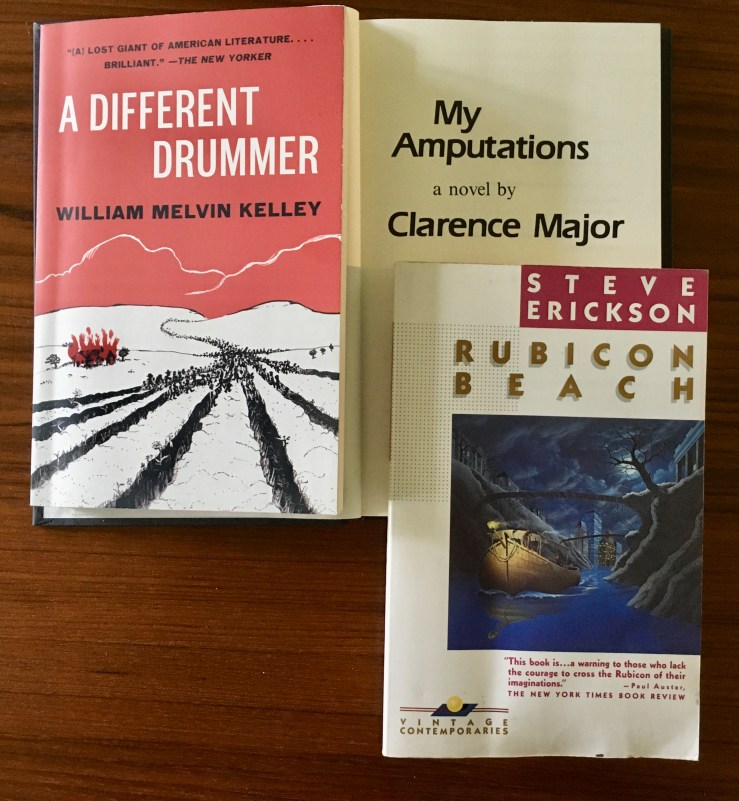
Guillermo Stitch’s Lake of Urine (Book acquired, 27 April 2020)

img_5466

I just finished the first section of Guillermo Stitch’s new novel Lake of Urine (from indie Sagging Meniscus). The beginning of the novel has made me want to read the rest of the novel. It is weird, man, which I guess you’d expect from a novel titled Lake of Urine. So far, the book seems to run on its own comic-logic, a verbal slapstick routine that shifts in voice and tone from  paragraph to paragraph. The sentences are fantastic; Stitch’s prose so far reminds me of Barry Hannah and Donald Barthelme, but also definitely its own thing. Here’s a blurb, via the author’s site:

 Once upon a time that doesn’t make a blind bit of sense, in a place that seems awfully familiar but definitely doesn’t exist, Willem Seiler’s obsession with measuring his world—with wrapping it up in his beloved string to keep the madness out—wreaks havoc on the Wakeling family.

Noranbole Wakeling lives in the scrub and toil of the pantry, in the ashes of the cold hearth…which, come to think of it, also sounds pretty familiar…She lives, too, in the shadow of her much wooed and cosseted sister, worshipped by the madman Seiler but overlooked by everyone else.

And that, it turns out, is a good thing.

As lives are lost to Seiler’s vanity, the inattention spares her. She spots her chance to break free of the fetters that tie her to Tiny Village—and bolts.

But some cords are never really cut. In her absence, the unravelling of the world she has escaped is complete. Another madness—her mother’s—reaches out to entangle her newfound Big City freedom. The unpicked quilt-work of a life in ruins threatens to ruin her own. It will be up to Noranbole to stitch it all together, into something she can call true.

The blurb doesn’t really capture the energy and humor in Lake of Urine though (let alone its utter weirdness. Here’s an excerpt; the conversation is between Emma Wakeling (mother of Urine and Noranbole) and her tenant, William Seiler:

The melts are not long off.

. . .

Yes?

Yes.

The days grow lengthier and more detailed.

I’m not, eh . . .

You have been here for nine weeks.

Yes.

You may recall the conversation we had in November, Mr Seiler, which resulted in your entering my employ.

A bit formal.

Just answer.

I do remember, yes.

Your brief which I outlined at the time was to be of assistance to me during the winter in the monitoring of my two girls, both of whom were of marriageable age and one of whom was attractive—a siren to the lads of the county.

Yes.

I haven’t asked much else of you.

No.

Apart from the sharpening of some tools. Indeed your . . . remunerations have exceeded what we originally agreed in both nature and degree. Despite your squirreling yourself away in that shed, increasingly. I am only trying to help, you know.

Yes.

A man’s fluids require frequent liberation or they will stew.

Some of the tools are really very blunt.

I have asked for this little chat Mr Seiler because I wish to express my disappointment.

Oh?

Oh? I surprise you? Really? You are surprised? For reals? You didn’t anticipate disappointment here, today?

Well . . .

You need reminding perhaps of yesterday’s unfortunate events? The toesnappingly cold trek through wolf-infested forest? The yelling and the wailing? The gnashing? The wet clouds of breath in the grief-stricken air, the frozen-teared faces of the bereaved? A quick recap?

No, I do remember.

Excellent. You would acknowledge then that as we approach the end of your tenure here one of my girls appears to be—and I recognize that there is some evidential uncertainty here—dead?

That would appear to be the case, yes, notwithstanding the as you say murky specifics.

I am to be grateful I suppose, to be appreciative of the fact that at least it isn’t my Urine who has been lost.

Eh . . .

You give no indication, Mr Seiler, that you recognize the seriousness of the . . . the precariousness of your . . . hm?

Oh, no . . . no, no I can . . . what?

Be under no illusions, Seiler. One more dead daughter and you’re fired.

That does seem fair.

Now lie still. Stop squirming!


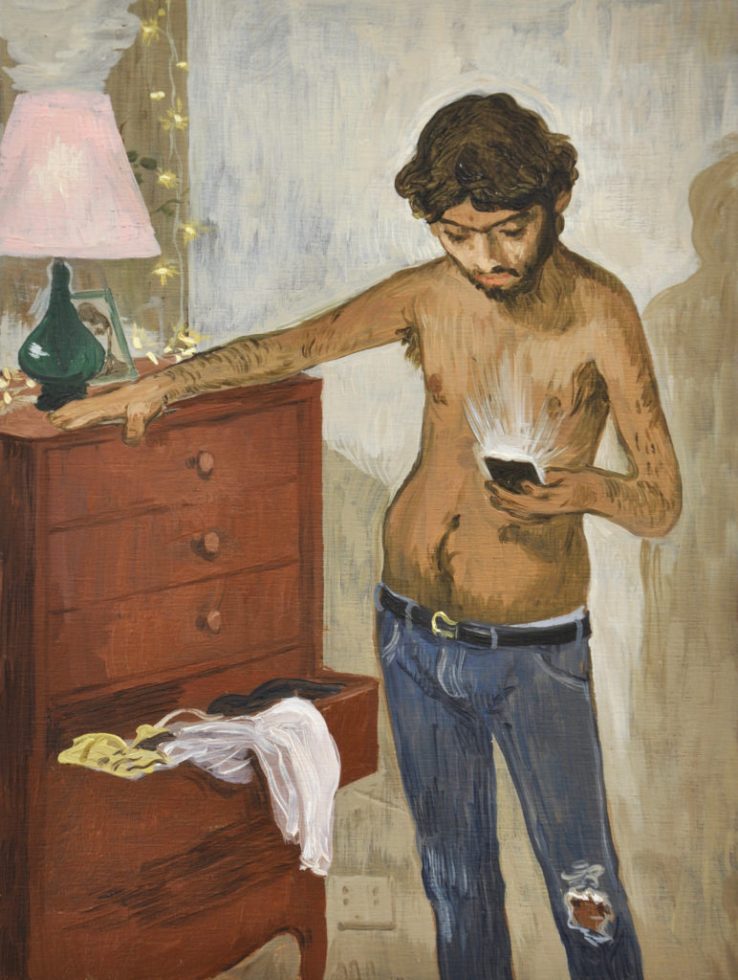
Reification #66 — Dario Maglionico

r66-1536x1128-1

Reification #66, 2020 by Dario Maglionico (b. 1986)

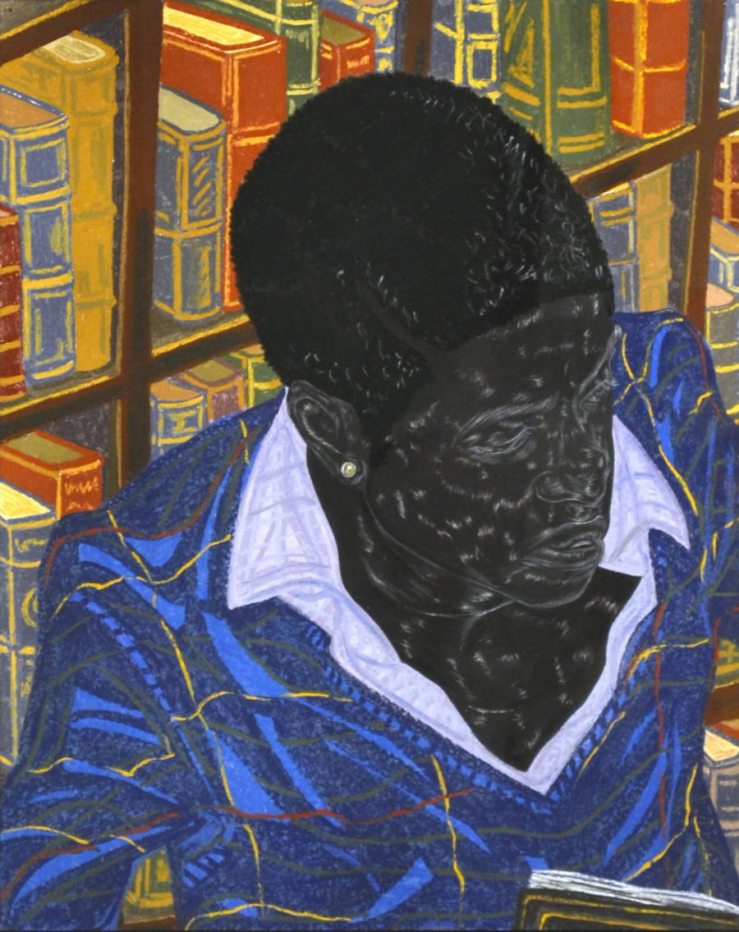
Book Club — Greg Burak

bookclubnew

Book Club, 2018 by Greg Burak (b. 1986)

“The Hope Diamond” — Tom Clark

Screenshot 2020-05-12 at 3.58.54 PM

Breadcrumb Trail, a documentary about Slint

The Return from Cythera — George Warner Allen

The Return from Cythera 1985-6 by George Warner Allen 1916-1988

The Return from Cythera, 1986 by George Warner Allen (1916–1988)

The Embarkation for Cythera — Antoine Watteau

l27embarquement_pour_cythere2c_by_antoine_watteau2c_from_c2rmf_retouched

The Embarkation for Cythera, 1719 by Antoine Watteau (1684-1721)

The Carnival of St. Cerro — Manuel Macarrulla

saam-2016.62_1

The Carnival of St. Cerro, 1981 by Manuel Macarrulla (b. 1952)

Mother and Son — Ambrose McEvoy

Mother and Son c.1910 by Ambrose McEvoy 1878-1927

Mother and Son c.1910 by Ambrose McEvoy (1877–1927)

“A Mother” — James Joyce

“A Mother”

by

James Joyce


Mr Holohan, assistant secretary of the Eire Abu Society, had been walking up and down Dublin for nearly a month, with his hands and pockets full of dirty pieces of paper, arranging about the series of concerts. He had a game leg and for this his friends called him Hoppy Holohan. He walked up and down constantly, stood by the hour at street corners arguing the point and made notes; but in the end it was Mrs Kearney who arranged everything.

Miss Devlin had become Mrs Kearney out of spite. She had been educated in a high-class convent, where she had learned French and music. As she was naturally pale and unbending in manner she made few friends at school. When she came to the age of marriage she was sent out to many houses where her playing and ivory manners were much admired. She sat amid the chilly circle of her accomplishments, waiting for some suitor to brave it and offer her a brilliant life. But the young men whom she met were ordinary and she gave them no encouragement, trying to console her romantic desires by eating a great deal of Turkish Delight in secret. However, when she drew near the limit and her friends began to loosen their tongues about her, she silenced them by marrying Mr Kearney, who was a bootmaker on Ormond Quay.

He was much older than she. His conversation, which was serious, took place at intervals in his great brown beard. After the first year of married life, Mrs Kearney perceived that such a man would wear better than a romantic person, but she never put her own romantic ideas away. He was sober, thrifty and pious; he went to the altar every first Friday, sometimes with her, oftener by himself. But she never weakened in her religion and was a good wife to him. At some party in a strange house when she lifted her eyebrow ever so slightly he stood up to take his leave and, when his cough troubled him, she put the eider-down quilt over his feet and made a strong rum punch. For his part, he was a model father. By paying a small sum every week into a society, he ensured for both his daughters a dowry of one hundred pounds each when they came to the age of twenty-four. He sent the elder daughter, Kathleen, to a good convent, where she learned French and music, and afterward paid her fees at the Academy. Every year in the month of July Mrs Kearney found occasion to say to some friend:

“My good man is packing us off to Skerries for a few weeks.”

If it was not Skerries it was Howth or Greystones.

When the Irish Revival began to be appreciable Mrs Kearney determined to take advantage of her daughter’s name and brought an Irish teacher to the house. Kathleen and her sister sent Irish picture postcards to their friends and these friends sent back other Irish picture postcards. On special Sundays, when Mr Kearney went with his family to the pro-cathedral, a little crowd of people would assemble after mass at the corner of Cathedral Street. They were all friends of the Kearneys—musical friends or Nationalist friends; and, when they had played every little counter of gossip, they shook hands with one another all together, laughing at the crossing of so many hands, and said good-bye to one another in Irish. Soon the name of Miss Kathleen Kearney began to be heard often on people’s lips. People said that she was very clever at music and a very nice girl and, moreover, that she was a believer in the language movement. Mrs Kearney was well content at this. Therefore she was not surprised when one day Mr Holohan came to her and proposed that her daughter should be the accompanist at a series of four grand concerts which his Society was going to give in the Antient Concert Rooms. She brought him into the drawing-room, made him sit down and brought out the decanter and the silver biscuit-barrel. She entered heart and soul into the details of the enterprise, advised and dissuaded; and finally a contract was drawn up by which Kathleen was to receive eight guineas for her services as accompanist at the four grand concerts. Continue reading ““A Mother” — James Joyce”

Figure in a Room I — Jack Smith

Figure in a Room I 1959 by Jack Smith 1928-2011

Figure in a Room I, 1959 by Jack Smith 1928–2011

In the Rocks — Christian Brandl

brandl-in-den-felsen2c-20162c-135x160cm2c-occ88l-auf-leinwand

In the Rocks, 2016 by Christian Brandl (b. 1970)

Selections from One-Star Amazon Reviews of Thomas Pynchon’s Inherent Vice

[Editorial note: The following citations come from one-star Amazon reviews of Thomas Pynchon’s novel Inherent Vice. To be clear, I’m a big Pynchon fanI’ve preserved the reviewers’ own styles of punctuation and spelling. More one-star Amazon reviews].


Wow.

drivel

stilted dialogue

knock yourself out

every detail is described

This was my first Pynchon

my second stab at Pynchon

I so rarely abandon anything

shouldn’t have been published

that ridiculous post-modern credo

pick up James Ellroy. He is a true artist

like a novelization of the Big Lebowski

false as a jet contrail in an 1880’s western movie

I had to read whole pages twice or even three times

practically nothing that occurs is important to move the plot along

he smokes a joint and stumbles across a clue that leads him to the next chapter

does a disservice to liberals by portraying them as a bunch of negative stereotypes

This book makes the classic NAKED LUNCH by Burroughs completely coherent

No one in our entire bookclub could finish it and we are all avid readers

NEVER BUY BOOKS THAT CRITICS RAVE ABOUT, THEY ALWAYS SUCK!!!

It glorifies hippies and condemns the right-wing Man

one of the most useless novels I have ever read

This is my first experience with Pynchon

this may make a decent movie

nothing redeeming about it

no entertainment value

difficult and obscure

no meter

Uugghh.

As a Scandinavian

It is a bad detective story

Pynchon wants this to be a film.

When Amazon recommends a book, I take notice.

I have never read a book by Thomas Pynchon before

I am beginning to think the “professionals” just like crap.

The Author is the type that critics love to refer to as edgy

Pynchon is probably the most overrated American writer.

It is as if this author was stoned the entire time he wrote this.

numerous drug and hallucination references and insinuations

story telling with drugs and hallucinations are better left to movies or television

Definitively a good movie was made based on an awful book by an overrated writer.

Pynchon maybe in top 10 most overrated writers in the last 100 yrs.

Let me start by saying that I have never read Pynchon before.

I had to re-read several pages and passages multiple times

Thomas Pynchon is supposed to be a great author

Remember those dumb “Family Circus” cartoons

the author appears to be a wanna be stoner

I am in the process of writing my own novel

Where is Kerouac when you need him?

The whole novel is one long inside joke.

I’m in a book club with 10 guys….

nonsensical plot

Studpid

Blech.

meandering piece of slop

What’s not cool is this book.

an Elmore Leonard Want-a-be

I could write a hippie chick way better.

The professor also said he hated reading it.

Do not recommend to anyone under the age of 65

This is my first encounter with a book about drug usage

The seventies were a time of sex, drugs and rock and roll.

The volumes I have read , sadly, occupy a large footprint on the planet.

Doc, the protagonist, is in a drug-induced haze for the majority of the novel

My extremities are tingling with the feeling that Socrates had after drinking a cup of hemlock.

ARPAnet, forerunner of the internet, is discussed as if everyone knows about it

written by a cute undergraduate student working under Pynchon’s wing

characters who make brief appearances

bad acid trips and a caricature of a plot

the ramblings of an intoxicated person

I really wanted to like this book

I am an avid fiction reader.

This was my first Pynchon

Some call it “stoner noir.”

you are the sober one

strangled by Pynchon

unsexy sex scenes

fiction is useless

H are to follow

little cat feet

Some Roses and Their Phantoms — Dorothea Tanning

Some Roses and Their Phantoms 1952 by Dorothea Tanning born 1910

Some Roses and Their Phantoms, 1952 by Dorothea Tanning (1910-2012)

Trial cover art for Gravity’s Rainbow

trial art for gr

This trial cover for Thomas Pynchon’s novel Gravity’s Rainbow is included in Luc Herman and Steven Weisenburger’s book Gravity’s Rainbow, Domination, and Freedom (University of Georgia Press, 2013).

Herman and Weisenburger note the existence of an even earlier version with Pynchon’s working title Mindless Pleasures. I found it quickly at Pynchon Wiki, which notes:

how the image is based on the Tarot card The Tower, which – as we learn in Weissmann’s Tarot (p. 746-47) – represents “any System which cannot tolerate heresy: a system which, by its nature, must sooner or later fall. We know by now that it is also the Rocket.”

mindless-pleasures

Here are Herman and Weisenburger on that first title, Mindless Pleasures:

…Pynchon’s, or perhaps the Viking editors’, extraction of that phrase [“mindless pleasures”] for the book title, although scotched, surely indexed some shared sense of thematic relevance. An early trial cover put the title “Mindless Pleasures” over a cleverly stylized version of the Tower, a key card in Weissmann/Blicero’s tarot reading. A second trial cover, also scotched, put “Gravity’s Rainbow” over the same image. The Tower gathers several interpretations, most notably (says our narrator) that of “a Gnostic or Cathar symbol for the Church of Rome, and this is generalized to mean any system which cannot tolerate heresy: a system which, by its nature, must sooner or later fall. We know by now that it is also the Rocket.” The notion of tolerance and intolerance is catchy and may also link to Marcuse on repression…. One reading of this cover would be that mindless pleasures bring down the system, are anathema to it. The common gloss of “mindless” is that it refers to the contrary of normativity, or not a mentality conditioned or “defined within rigid societal parameters”…. This contrariness presumes a hierarchy, an established order elevated above a variety of upstart alternatives, many of them popular, carnivalesque, of the body. And the arts are among them…

Weissmann’s tarot:

img_4289-1

Herman and Weisenburger cite Clifford Mead’s Thomas Pynchon: A Bibliography of Primary and Secondary Materials (Dalkey, 1989) as their source for the trial cover.

As far as I can find, no cover designer is credited.

Lady on a Sofa — Harold Gilman

Lady on a Sofa c.1910 by Harold Gilman 1876-1919

Lady on a Sofa, c.1910 by Harold Gilman (1876–1919)

“Vineland is not the novel Pynchon’s fans were expecting” | A 1990 Pynchon profile