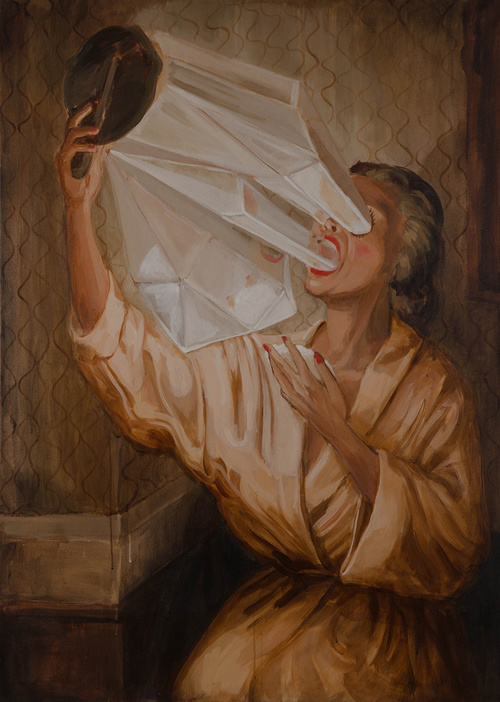
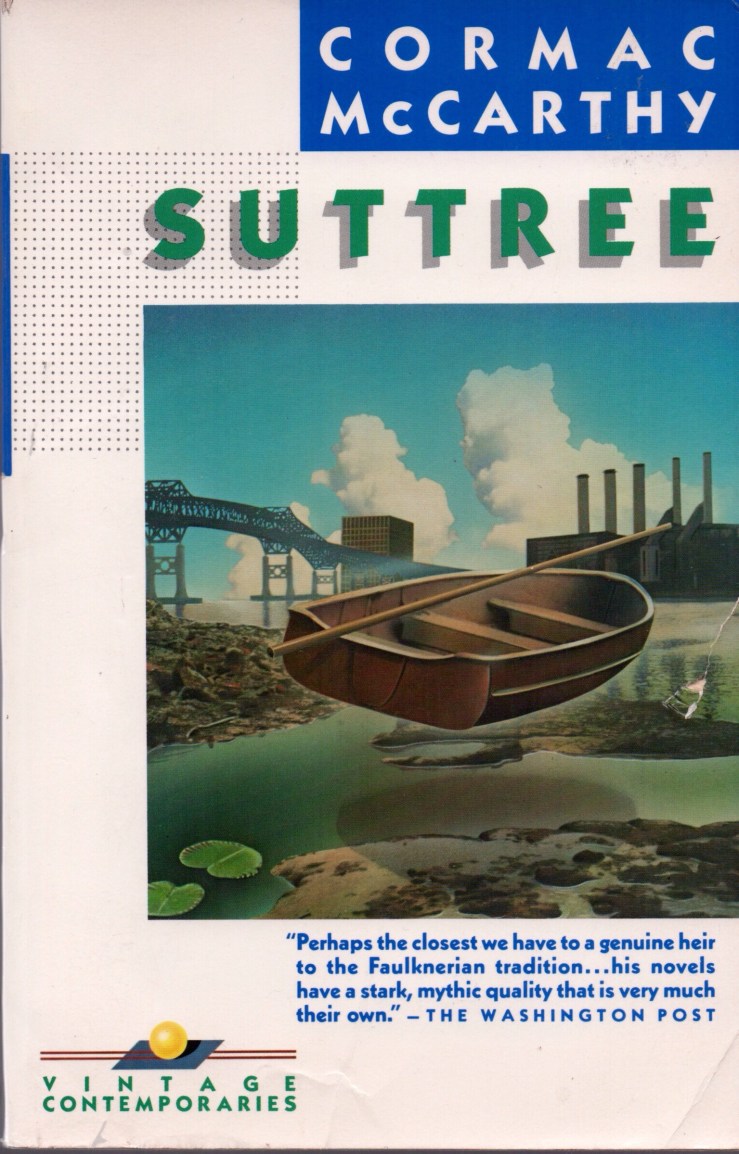
I’ve been a big fan of the Vintage Contemporaries 1980s series for ages now. The books were easily available, cheap and used, in the nineties, and I first read Raymond Carver and Jay McInerney in VC editions, later adding novels by Denis Johnson, Don DeLillo, Jerzy Kosinski to the burgeoning collection. I was thrilled to find a VC copy of Cormac McCarthy’s Suttree years ago; I wasn’t looking for it in particular, but the spine of a Vintage Contemporaries edition is hard to miss in a used bookstore. I picked it up of course, and gave the Vintage International edition I’d read to a friend who’d just finished Blood Meridian. The dark, moody Vintage International covers strongly contrast the bright, vivid VC edition (with a surreal painting by Marc Tauss):
In time, I’d unshelve at least one or two VC editions when browsing a used bookstore, especially if it was an author I’d been meaning to read. I ended up reading and loving Joy Williams’ first collection, Taking Care, that way, as well as Charles Portis’s Norwood (which led to me reading every Portis novel I could get my hands on).
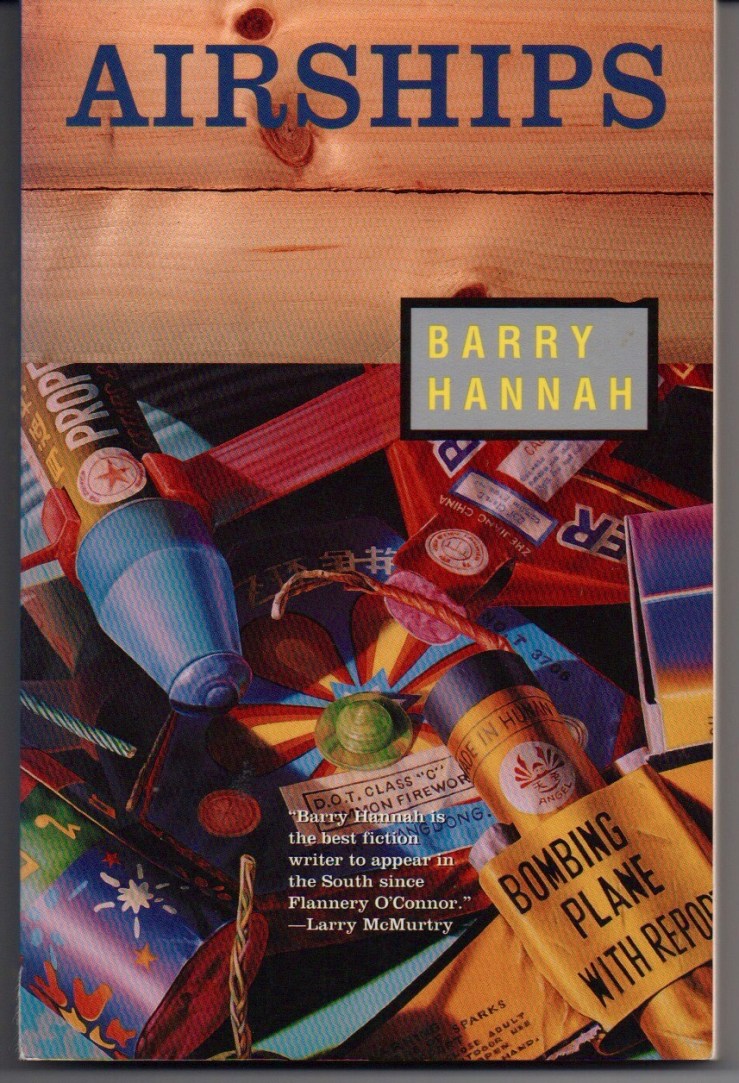
The one I really, really wanted though was the Vintage Contemporaries edition of Barry Hannah’s collection Airships. I must have seen it first–just the spine–in this great write up of VC designs at Talking Covers, and then added it to a mental list of titles to check for. There’s absolutely nothing wrong with the Grove Press copy I have of Airships; indeed, I really dig its photorealistic cover by Hannah’s contemporary Glennray Tutor—but I guess at this point I have to admit I’m collector (of cheap eighties paperbacks).
I read them, books, too, of course. Here’s the intro to my 2011 review of Airships:
In his 1978 collection Airships, Barry Hannah sets stories in disparate milieux, from the northern front of the Civil War, to an apocalyptic future, to the Vietnam War, to strange pockets of the late-twentieth century South. Despite the shifts in time and place, Airships is one of those collections of short stories that feels somehow like an elliptical, fragmentary novel. There are the stories that correspond directly to each other — the opener “Water Liars,” for instance, features (presumably, anyway), the same group of old men as “All the Old Harkening Faces at the Rail.” The old men love to crony up, gossip, tell tall tales. An outsider spoils the fun in “Water Liars” by telling a truth more terrible than any lie; in “Harkening,” an old man shows off his new (much younger) bride. These stories are perhaps the simplest in the collection, the homiest, anyway, or at least the most “normal” (whatever that means), yet they are both girded by a strange darkness, both humorous and violent, that informs all of Airships.
Well so and anyway:
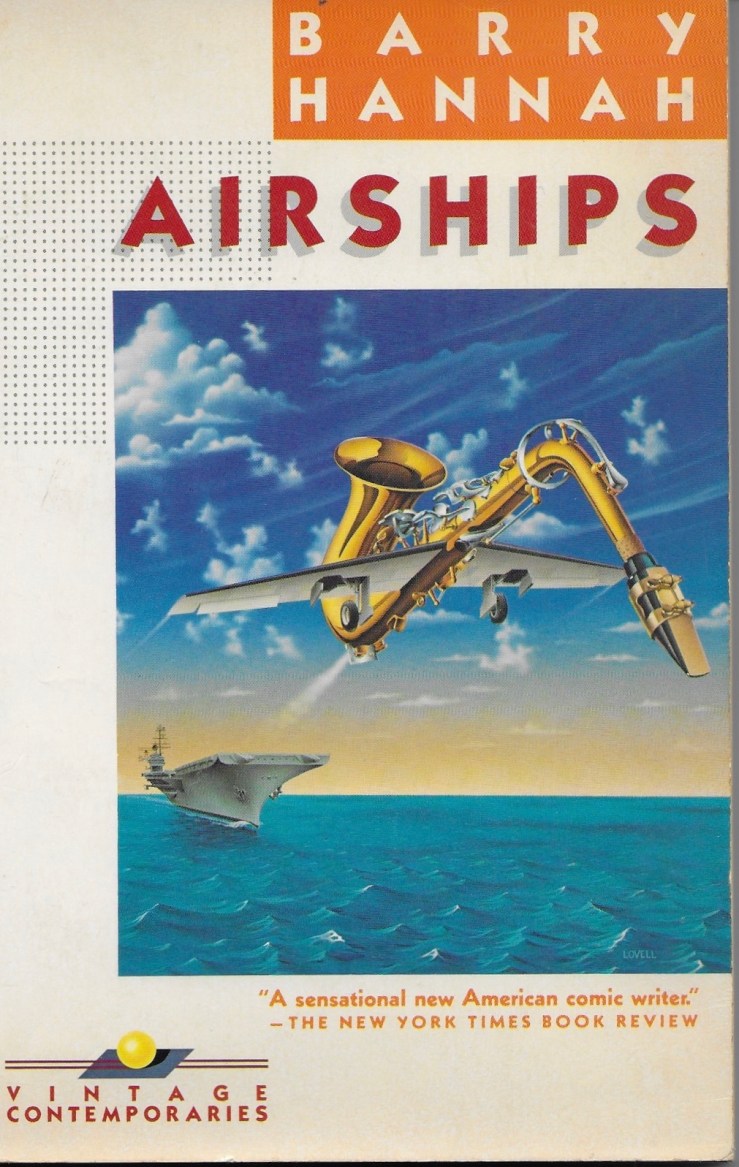
Yesterday, browsing my beloved used bookstore, I found, while not really looking for it, the Vintage Contemporaries edition of Airships. I was in the “H” section of General Fiction, looking for something by Chester Himes (which I found, but in the Mysteries section, which I really have never browsed before), and there it was, its spine singing to me from a low shelf. I was happy to note the cover is by Rick Lovell, who’s responsible for my favorite VC editions (along with, obviously, series designer Lorraine Louie). As a sort of cherry on top, my edition has a little gold sticker at the top of the inside cover, proclaiming “Square Books on the Square, Oxford Mississippi.” Hannah taught at Ole Miss for nearly three decades. Square Books is still there.
I was excited with my find and I’m a dork so I tweeted about it. The next tweet I saw in my timeline was this tweet by Christopher DeWeese (retweeted by the writer John Lingan):
(I love the blurb by Thomas Pynchon.)
David Berman was a poet, musician, and singer (and more) who died almost exactly a  year ago. He was kind of a hero of mine, as far as these things go, and as such I never made an attempt to contact him, even when he linked to this blog on his blog, Menthol Mountains. I absolutely love the cover he made—or did he make it? I don’t actually know—but I know that he loved Vintage Contemporaries, that they were important to him. I recall John Lingan tweeting about having to cut some of his discussion about the series with Berman in his fantastic profile of the then-not-late artist. I couldn’t find the tweet, but I reached out to John, and he told me I remembered right; he also told me he recalled seeing a copy of Harold Brodkey’s First Love and Other Sorrows in Berman’s room.
I wonder if Berman and I had the same VC edition of First Love and Other Sorrows? The one with the Rick Lovell cover of butterflies on a sandcastle? Or maybe he had the one with the purple cover? I gave my copy to a good friend years ago, and have never seen one with the Lovell cover since.
I also wonder if Berman read the VC edition of Airships. I know he met Hannah, who apparently read Berman’s work. I recall now too that both men show up in The Minus Times Collected, which I never picked up. I’m going to order it now.
















 In his
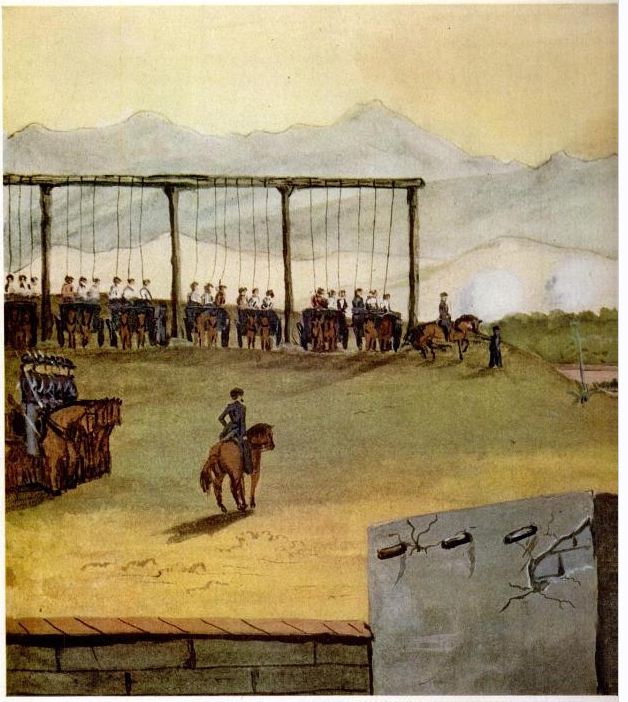
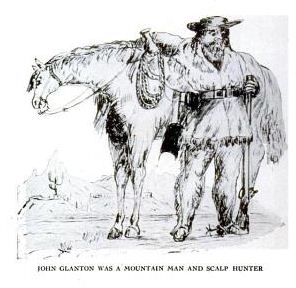 According to Chamberlain, John Glanton was born in South Carolina and migrated to Stephen Austin’s settlement in Texas. There he fell in love with an orphan girl and was prepared to marry her. One day while he was gone, Lipan warriors raided the area scalping the elderly and the children and kidnapping the women- including Glanton’s fiancee. Glanton and the other settlers pursued and slaughtered the natives, but during the battle the women were tomahawked and scalped. Legend has it, Glanton began a series of retaliatory raids which always yielded “fresh scalps.” When Texas fought for its independence from Mexico, Glanton fought with Col. Fannin, and was one of the few to escape the slaughter of that regiment at the hands of the Mexican Gen. Urrea- the man who would eventually employ Glanton as a scalp hunter. During the Range Wars, Glanton took no side but simply assassinated individuals who had crossed him. He was banished, to no avail, by Gen. Sam Houston and fought as a “free Ranger” in the war against Mexico. Following the war he took up the Urrea’s offer of $50 per Apache scalp (with a bonus of $1000 for the scalp of the Chief Santana). Local rumor had it that Glanton always “raised the hair” of the Indians he killed and that he had a “mule load of these barbarous trophies, smoke-dried” in his hut even before he turned professional.
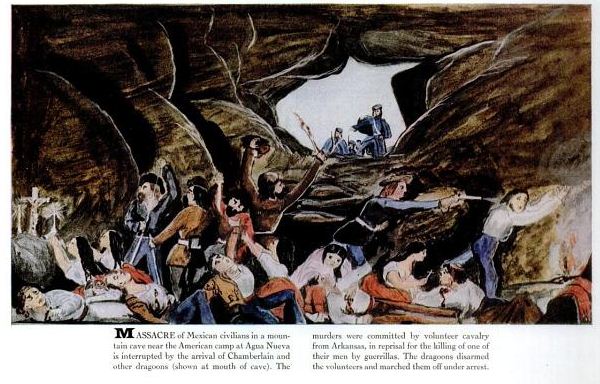
 It’s fascinating to note how much of the Judge is already there–the pedophilia, the marksmanship, the scholarship, and, most interesting of all, the lack of hair. Confession goes on to detail the killing, scalping, raping, and raiding spree that comprises the center of Blood Meridian. Chamberlain even describes the final battle with the Yumas, an event that signals the dissolution of the Glanton gang in McCarthy’s novel.

 Content aside, Chamberlain’s prose also seems to presage McCarthy’s prose. In his book
 You can view many of Chamberlain’s paintings and read an edit of his Confession in three editions of Life magazine from 1956, digitally preserved thanks to Google Books–here’s