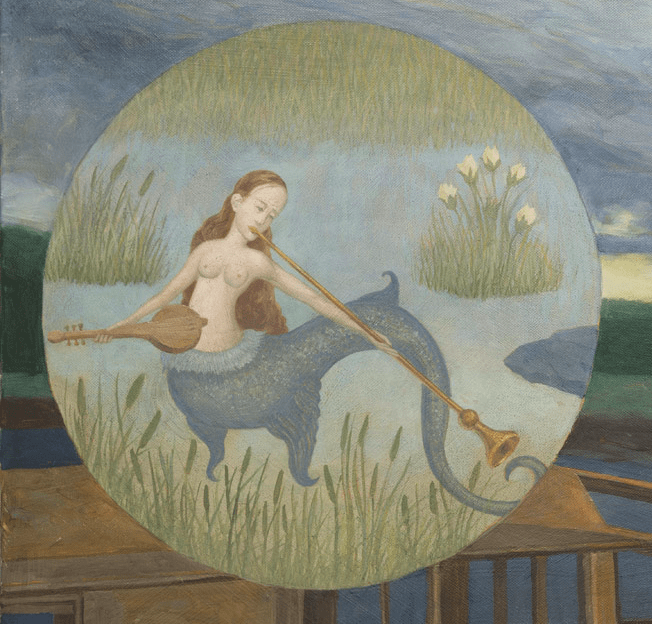
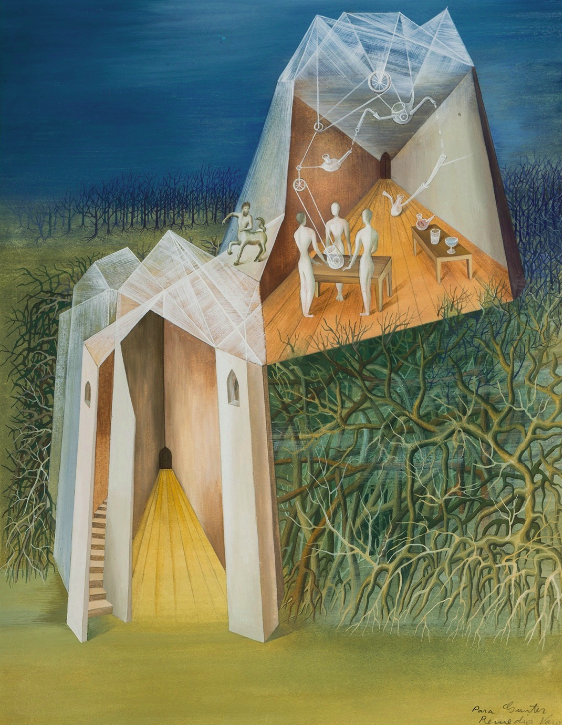
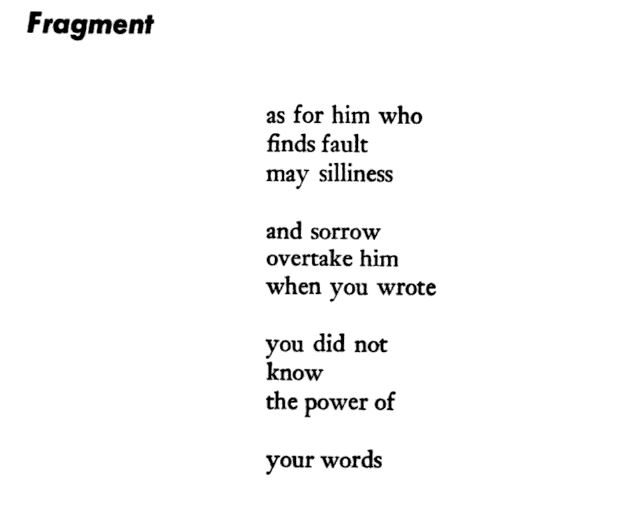
The Beggars, 1520 by Lucas van Leyden (c. 1494–1533)
Author: Biblioklept
Half Time — Axel Krause

Half Time, 2015 by Axel Krause (b. 1958)
The unregenerated man shivers within me | Nathaniel Hawthorne’s journal entry for April 13th, 1841
Brook Farm, Oak Hill, April 13th, 1841.–. . . Here I am in a polar Paradise! I know not how to interpret this aspect of nature,–whether it be of good or evil omen to our enterprise. But I reflect that the Plymouth pilgrims arrived in the midst of storm, and stepped ashore upon mountain snow-drifts; and, nevertheless, they prospered, and became a great people,–and doubtless it will be the same with us. I laud my stars, however, that you will not have your first impressions of (perhaps) our future home from such a day as this, . . . Through faith, I persist in believing that Spring and Summer will come in their due season; but the unregenerated man shivers within me, and suggests a doubt whether I may not have wandered within the precincts of the Arctic Circle, and chosen my heritage among everlasting snows, . . . Provide yourself with a good stock of furs, and, if you can obtain the skin of a polar bear, you will find it a very suitable summer dress for this region. . . .
I have not yet taken my first lesson in agriculture, except that I went to see our cows foddered, yesterday afternoon. We have eight of our own; and the number is now increased by a transcendental heifer belonging to Miss Margaret Fuller. She is very fractious, I believe, and apt to kick over the milk-pail. . . . I intend to convert myself into a milkmaid this evening, but I pray Heaven that Mr. Ripley may be moved to assign me the kindliest cow in the herd, otherwise I shall perform my duty with fear and trembling.
I like my brethren in affliction very well; and, could you see us sitting round our table at meal-times, before the great kitchen fire, you would call it a cheerful sight. Mrs. B—- is a most comfortable woman to behold. She looks as if her ample person were stuffed full of tenderness,–indeed, as if she were all one great, kind heart.
The entry is the first of Hawthorne’s journals to mention Brook Farm, a utopian enterprise that forms the basis of Hawthorne’s 1852 novel The Blithedale Romance (which I am currently re-reading).
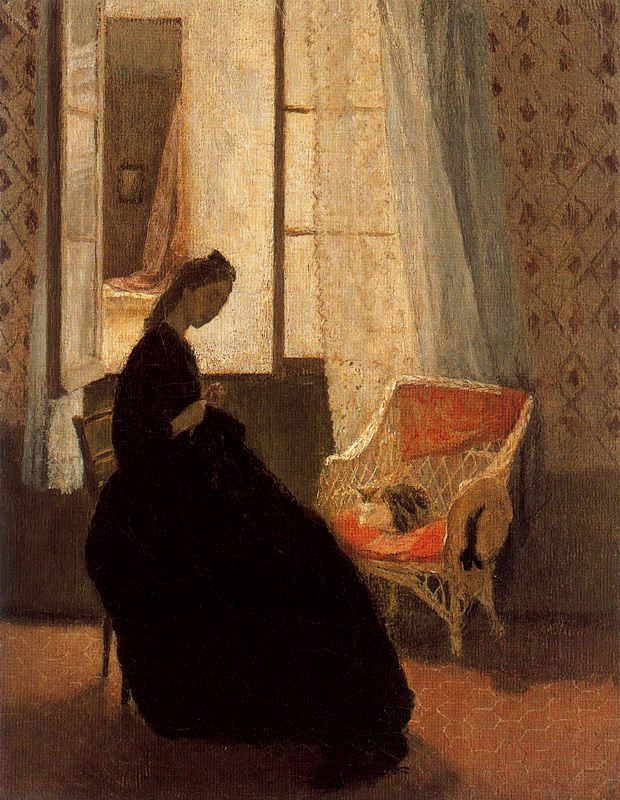
Woman Sewing at a Window — Gwen John

Woman Sewing at a Window by Gwen John (1876-1939)
Blog about Lydia Davis’s short story “Happiest Moment”

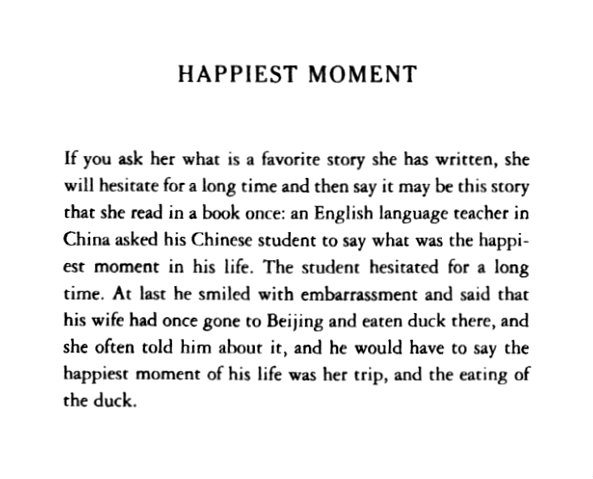
I’m not sure exactly how many nested layers there are to Lydia Davis’s short story “Happiest Moment.” Sometimes I count as many as nine frames to the tale, sometimes only four or five. Sometimes the story seems its own discrete entity. A matryoshka doll could look like one thing or lots of things, I guess, and this matryoskha doll points back at herself: When you open the final doll, the minutest level of narrative, you find that you’ve found the source of the story. The biggest doll is there nesting in the belly of the smallest doll.
But I’m getting ahead, maybe. Break it down:
“Happiest Moment”
The title is the first frame, the big doll that declares: This is a story.
If you
The second-person pronoun here is general, sure, but also points directly at you, you reader you. We have here another frame, one outside of the story (because you are the reader) but also bounded inside of it (as the character you).
ask her what is a favorite story she has written,
We’re not into the next frame yet, but we’ve got a new character, a her—a story writer! Like Lydia Davis! The author of this particular story!
she will hesitate for a long time
Still no new frame, but rather the space between layers, the hesitation, the drawing together of thought, judgment, analysis, reflection—Davis doesn’t make the reader feel any of that rhetorically, instead snappily snapping to the point of this whole deal.
and then say
Okay here’s the next frame. I’m not counting though.
it may be this story that she read in a book once:
Good lord, where to start here. Okay, so, we have another frame, but even more significantly, we have this verbal shift: Our her, our she, our hero-author, who has been asked (hypothetically by interlocutor you) about a favorite story she’s written avers that the favorite story she’s written is a story that she read in a book once.
(To save me the trouble of coming back later: Of course our hero-author is writing the story she read in a book once now; “Happiest Moment” is this performance, kinda, sorta, kindasorta).
an English language teacher in China
There’s a frame.
asked his Chinese student
Another frame (and a second ask).
to say what was the happiest moment in his life.
The student, like the hero-author-has to say his answer (not write it).
The student hesitated for a long time.
(Like the hero-author—note the precise repetition of verbs in this tale).
At last he smiled with embarrassment
(God I love this guy).
and said that his wife had once gone to Beijing and eaten duck there,
(We’re getting to our climax folks).
and she often told him about it,
Another frame, another telling.
and he would have to say
Our verb, our answer—
that the happiest moment of his life was her trip and the eating of the duck.
What a sweet, sweet ending.
The Chinese English language student’s wife’s enjoyment of duck in Beijing is his favorite memory, despite it not being a memory at all, but rather the story of a memory, not his own, but his beloved’s. He relays this memory of someone else’s to his English teacher and the memory somehow ends up in a book, which the hero-author of “Happiest Moment” somehow reads, and then attests to be the most favorite story she has written, despite the fact that she makes it clear that this is a story she read and didn’t write—although of course, she wrote it, because it is the story “Happiest Moment.”
Those the River Keeps, Study 7 — Geoffrey Laurence

Those the River Keeps, Study 7 (2006) by Geoffrey Laurence (b. 1949)
Labyrinth — Enrique Arnal

Labyrinth, 1975 by Enrique Arnal (b. 1932)
Blog about “The Silvery Veil” allegory in Nathaniel Hawthorne’s The Blithedale Romance (and David Foster Wallace’s Madame Psychosis)
This afternoon I got to Ch. XIII of Nathaniel Hawthorne’s novel The Blithedale Romance. Titled “Zenobia’s Legend,” most of the chapter is given over to the titular heroine’s tale “The Silvery Veil,” a wonderfully pre-postmodern moment in Hawthorne’s novel.
Let’s look lookingly at the layers: The Blithdale Romance is Hawthorne’s ironic-but-sincere dark-romantic semi-autobiographical account of his time at Brook Farm, a failed utopian community of Transcendentalists who maybe didn’t quite, uh, transcend. Zenobia is based partially on the great American feminist Margaret Fuller (who also did time on Brook Farm). Taking center stage here in (the aptly-numbered) thirteenth chapter of Blithedale, Zenobia extemporizes a story about The Veiled Lady. This Veiled Lady is a local celebrity, a clairvoyant of some renown who (we learn in the opening chapter of the novel) has recently disappeared. Zenobia’s yarn is a leisure-time amusement, one she contends that she’ll spin to get out of an apparent rut:
“I am getting weary of this,” said she, after a moment’s thought. “Our own features, and our own figures and airs, show a little too intrusively through all the characters we assume. We have so much familiarity with one another’s realities, that we cannot remove ourselves, at pleasure, into an imaginary sphere. Let us have no more pictures to-night; but, to make you what poor amends I can, how would you like to have me trump up a wild, spectral legend, on the spur of the moment?”
Ironically however, Zenobia clearly relies on her “own features” as well as the features of Blithedale’s spectral ingenue Priscilla to inform her performance. Despite her declaration to “remove” herself and her auditors “into an imaginary sphere,” Zenobia essentially recasts poor Priscilla’s waifery into a supernatural ultraromantic mode. The story’s basic conceit is thus: There is a famous veiled lady who may be extraordinarily beautiful or who may be extraordinarily ugly. No one knows what she looks like because like the the veil obviously hides her face, preventing any viewer’s agency to interpret for himself.
Zenobia’s legend is a tale within a tale within a tale—a performance that each member of the small Blithedale community will recode into their own readings. However, Zenobia guides her audience toward a certain conclusion, all but declaring that meek Priscilla is in fact the Veiled Lady—hell, Zenobia even throws a bit of gauze she’d been vamping with over the poor dear’s head at the climax of her tale.
“The Silvery Veil,” in another pre-postmodern layer, is a thin but clear echo of Hawthorne’s famous allegory “The Minister’s Black Veil,” which was published 15 years before The Blithedale Romance, and would clearly have been known to Hawthorne’s intended audience of Transcendentalites. (There’s perhaps a more clear connection between “The Silvery Veil” and “The Minister’s Black Veil” : Hawthorne likely based the titular minister on the real-life preacher Joseph Moody, who wore a handkerchief over his face. Blithedale features a character named “Old Moodie” who we eventually learn is Pricilla’s secret father).
So Hawthorne overloads the allegory with meaning and misdirection—is Zenobia’s legend “The Silvery Veil” the secret key to Priscilla’s identity? A clue to Blithedale’s destiny? A watery paraphrase of Hawthorne’s own stronger story, “The Minister’s Black Veil”? Simply a Saturday night’s entertainment?
The trick of the tale I think rests in the undecidability of what’s under the veil, in the not knowing, which is neatly summed up in a paragraph:
Some upheld that the veil covered the most beautiful countenance in the world; others,—and certainly with more reason, considering the sex of the Veiled Lady,—that the face was the most hideous and horrible, and that this was her sole motive for hiding it. It was the face of a corpse; it was the head of a skeleton; it was a monstrous visage, with snaky locks, like Medusa’s, and one great red eye in the centre of the forehead. Again, it was affirmed that there was no single and unchangeable set of features beneath the veil; but that whosoever should be bold enough to lift it would behold the features of that person, in all the world, who was destined to be his fate; perhaps he would be greeted by the tender smile of the woman whom he loved, or, quite as probably, the deadly scowl of his bitterest enemy would throw a blight over his life.
Hawthorne’s description here immediately reminded me of Joelle van Dyne aka Madame Psychosis aka the P.G.O.A.T., a character in David Foster Wallace’s novel Infinite Jest who wears a veil either because she’s too beautiful to behold and/or because she bears a physical deformity to abject to bear. I can’t actually remember if it’s the “and” or the “or” in that previous sentence that’s correct, even though I’ve read IJ a few times (and even not that long ago). Which is like, maybe the point of this literary veiling—what I mean is that we read faces, we read expressions, and the veil covers over what we would read directly, giving us a blank space to interpret through the lens of our wild (or not so wild) imaginations. Hawthorne’s veils (and maybe Wallace’s veils) require an inward reading, asking us to interpret a signifier that does not bear a clear signified—a most puzzling sign.
The Wait — Neo Rauch

Die Warte (The Wait), 2011 by Neo Rauch (b. 1960)
Untitled — Sterling Hundley

Untitled by Sterling Hundley (b. 1976)
Blog about “a perfectly inextricable knot of polygamy” (in Hawthorne’s The Blithedale Romance)

I hit Chapter XII of Nathaniel Hawthorne’s novel The Blithedale Romance this afternoon and was delighted by some lines from its first paragraph, wherein Our Narrator Coverdale retreats to a little fort he’s made in the woods:
Long since, in this part of our circumjacent wood, I had found out for myself a little hermitage. It was a kind of leafy cave, high upward into the air, among the midmost branches of a white-pine tree. A wild grapevine, of unusual size and luxuriance, had twined and twisted itself up into the tree, and, after wreathing the entanglement of its tendrils around almost every bough, had caught hold of three or four neighboring trees, and married the whole clump with a perfectly inextricable knot of polygamy.
I was deeply disappointed that the version of myself who had read this same physical copy of The Blithedale Romance almost 15 years earlier had failed to muster a single annotation on the passage (despite having left like 10,000 other scratches and loops on the yellow pages).
Hawthorne’s naturalism is fantastically naturalistically fantastical. The wild grapevine he conjures here that “married the whole clump with a perfectly inextricable knot of polygamy” is simultaneously a physical entity “wreathing” itself around the surrounding trees and at the same time a metonymy for the Bacchic spirit that pulls the souls of Blithedale into a weird marriage, an “inextricable knot of polygamy.” Hawthorne’s image points to exuberant and wild joy on one hand, but also to the thick bonds that tightly tie desire down in any moral system. The grapevine image serves as shorthand for the entire novel, underlining the push-pull tension of the narrator’s (and author’s!) conflict between Puritanism and Transcendentalism. The “inextricable knot of polygamy” is wonderfully pure in its impurity, in its radical transcendence.
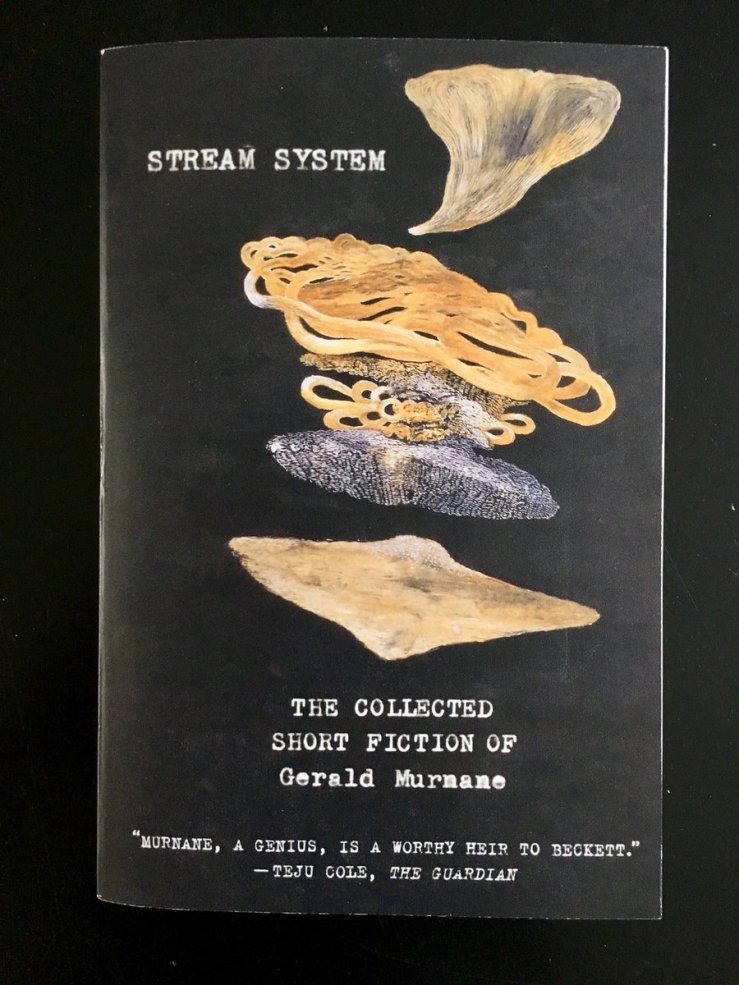
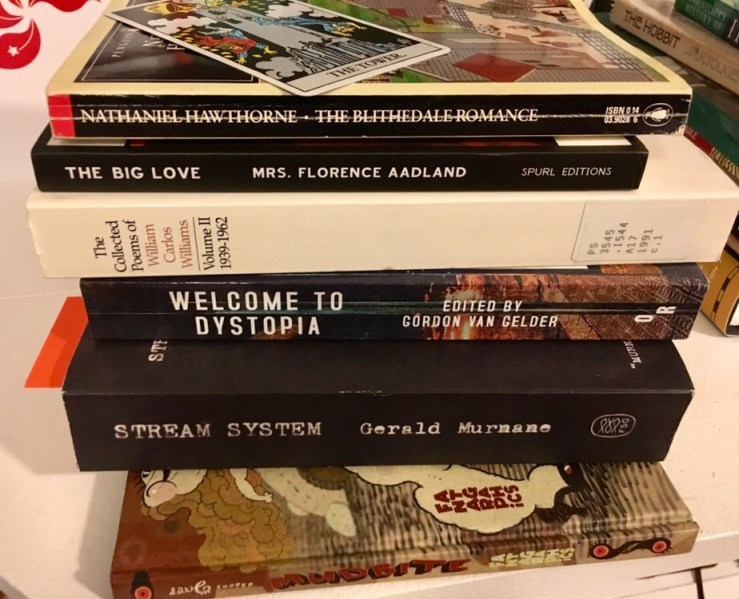
Gerald Murnane’s Stream System (Book acquired, 5 April 2018)

Four stories into Gerald Murnane’s Stream System and digging it a lot. I’ll do some kind of post about some of the stuff in here soon. For now, here’s FS&G’s blurb:
Never before available to readers in this hemisphere, these stories―originally published from 1985 to 2012―offer an irresistible compendium of the work of one of contemporary fiction’s greatest magicians.
While the Australian master Gerald Murnane’s reputation rests largely on his longer works of fiction, his short stories stand among the most brilliant and idiosyncratic uses of the form since Borges, Beckett, and Nabokov. Brutal, comic, obscene, and crystalline, Stream System runs from the haunting “Land Deal,” which imagines the colonization of Australia and the ultimate vengeance of its indigenous people as a series of nested dreams; to “Finger Web,” which tells a quietly terrifying, fractal tale of the scars of war and the roots of misogyny; to “The Interior of Gaaldine,” which finds its anxious protagonist stranded beyond the limits of fiction itself.
No one else writes like Murnane, and there are few other authors alive still capable of changing how―and why―we read.
Speech — Luc Tuymans

Speech, 2010 by Luc Tuymans (b. 1958)
The Water Protectors — Odd Nerdrum

the Water Protectors, 1985 by Odd Nerdrum (b. 1944)
Broadway: A History of New York City in Thirteen Miles (Book acquired, 14 March 2018)

A copy of Fran Leadon’s Broadway: A History of New York in Thirteen Miles arrived at Biblioklept World Headquarters last month, reminding me that I don’t read enough nonfiction. The book is out this month in hardback from W.W. Norton. Their blurb:
In the early seventeenth century, in a backwater Dutch colony, there was a wide, muddy cow path that the settlers called the Brede Wegh. As the street grew longer, houses and taverns began to spring up alongside it. What was once New Amsterdam became New York, and farmlands gradually gave way to department stores, theaters, hotels, and, finally, the perpetual traffic of the twentieth century’s Great White Way. From Bowling Green all the way up to Marble Hill, Broadway takes us on a mile-by-mile journey up America’s most vibrant and complex thoroughfare, through the history at the heart of Manhattan.
Today, Broadway almost feels inevitable, but over the past four hundred years there have been thousands who have tried to draw and erase its path. Following their footsteps, we learn why one side of the street was once considered more fashionable than the other; witness the construction of Trinity Church, the Flatiron Building, and the Ansonia Hotel; the burning of P. T. Barnum’s American Museum; and discover that Columbia University was built on the site of an insane asylum. Along the way we meet Alexander Hamilton, Emma Goldman, Edgar Allan Poe, John James Audubon, “Bill the Butcher” Poole, and the assorted real-estate speculators, impresarios, and politicians who helped turn Broadway into New York’s commercial and cultural spine.
Broadway traces the physical and social transformation of an avenue that has been both the “Path of Progress” and a “street of broken dreams,” home to both parades and riots, startling wealth and appalling destitution. Glamorous, complex, and sometimes troubling, the evolution of an oft-flooded dead end to a canyon of steel and glass is the story of American progress.
Blog about Don DeLillo’s novel The Names, which I read a few weeks ago and now only half remember

A physical copy of Don DeLillo’s 1982 novel The Names is on a shelf a few steps away from me. Normally I’d pick it up and thumb through it before writing about it—or better yet, reread it before writing about it—or even better, simply not write about it at all. But none of that would be in the spirit of these Blog about posts.
The plot of The Names, such as I remember it, is something like this: the novel’s protagonist and narrator (whose name may or may not be named Nick—I don’t really remember) is an American operative of some kind who basically works for the CIA. This specific job description is never really clear to the American protagonist or anyone else in the novel. He moves to Greece to be closer to his wife, who has left him, and his son, a budding novelist of sorts (despite being like nine or ten), whom DeLillo based on Atticus Lish (son of Gordon Lish and now a superb novelist in his own right) The protagonist’s estranged wife works an archaeological dig headed by an older dude named Owen (the protagonist’s son’s novel is Owen’s fictional biography). Owen, and later (or is it before—I can’t remember?!) the protagonist, encounter a weird language cult that performs ritualistic linguistic murders.
The Names’ great appeal is DeLillo’s riffs on language and meaning in a postmodern era. The language cult isn’t some socioculturally-realistic entity that draws the reader in, but rather an occasion for monologue. The novel is very much a monologue, no matter who is speaking. This may sound like a criticism as I now type it out (it does to me, anyway), but DeLillo’s monologue has a fun force to it. It’s sort of like a Derridean teledrama in novelistic form, all its pollyglossic intentions subsumed into a low dry clipped clever voice: DeLillo waxes on film; DeLillo waxes on pleasure; DeLillo waxes on Americanism; DeLillo waxes on expatriation; DeLillo waxes on globalism; DeLillo waxes on airports; DeLillo waxes on terrorism. A big takeaway from the novel for me was that DeLillo wrote his 9/11 novel two decades before the fact. No wonder he wrote Falling Man so quickly; he’d already thought through the problems.
I can’t really remember the linguistic system or philosophy or language critique in The Names, but I do remember the repetitions—the word name threads throughout, usually pointing toward a symbol, a referent, a landing strip. DeLillo also repeats the word recognition—which I take to simply be the power of name(s) (why would I use the adverb “simply” there?!). But the keyword isn’t name—I think the keyword of The Names is the world, a term that seems to refer to the absolute set of possibility (linguistic or otherwise) that Exist—a shifting, unstable, but nevertheless complete set that everyone must play within.
While its expatriation visions ring true, DeLillo doesn’t fully conjure the world in The Names, although that’s never his intention, I think. The whole affair is more oblique. Clipped is the word I used before—the novel is dry, witty, but resists being pegged as glib through its strangeness and humor. I laughed a lot in The Names. What I think I like most though is the ending, which I still remember—I haven’t read everything by DeLillo, but I’ve read a lot, and I can’t think of another of his that sticks the ending so well. And he does it by borrowing. DeLillo cribs from the protagonist’s son’s novel—which is to say from a child’s novel—which is to say from a real child’s work, Atticus Lish’s stuff—and that cribbing is somehow the magic ingredient that makes the rest of his novel rise up. It’s a second voice (or hey, the idea of a second voice) in a monologue, and it makes a huge difference.
Woman Reading — Eastman Johnson

Woman Reading, 1874 by Eastman Johnson (1824-1906)