“The Mirror of Ink,” a short tale from Jorge Luis Borges

“The Mirror of Ink”

by

Jorge Luis Borges

Translated by Norman Thomas di Giovanni


All history knows that the cruelest of the rulers of the Sudan was Yaqub the Ailing, who delivered his country to the rapacity of Egyptian tax collectors and died in a palace chamber on the fourteenth day of the moon of Barmahat, in the year 1842. There are those who hold that the wizard Abd-er-Rahman al-Masmudi (whose name may be translated as the ‘Servant of the All-Merciful) slew him by means of a dagger or poison. That he died a natural death is more likely, however, since he was called the Ailing. Captain Richard F. Burton spoke to the wizard in 1853, and recounts the tale I quote here:

It is true that as a consequence of the conspiracy woven by my brother Ibrahim, with the treacherous and useless support of the black chiefs of Kordofan, who betrayed him, I suffered captivity in the castle of Yaqub the Ailing. My brother perished by the sword, on the blood-red skin of Justice, but I flung myself at the hated feet of the Ailing, telling him that I was a wizard, and that if he spared my life I would show him shapes and appearances still more wonderful than those of the magic lantern. The tyrant demanded an immediate proof. I asked for a reed pen, a pair of scissors, a large leaf of Venetian paper, an inkhorn, a chafing dish with some live coals in it, some coriander seeds, and an ounce of benzoin. I cut up the paper into six strips, wrote charms and invocation on the first five, and on the remaining one wrote the following words, taken from the glorious Koran: ‘And we have removed from thee thy veil; and thy sight today is piercing.’ Then I drew a magic square in the palm of Yaqub’s right hand, told him to make a hollow of it, and into the centre I poured a pool of ink. I asked him if he saw himself clearly reflected in it, and he answered that he did. I told him not to raise his head. I dropped the benzoin and coriander seeds into the chafing dish, and I burned the invocations upon the glowing coals. I next asked him to name the image he desired to see.

He thought a moment and said, ‘A wild horse, the finest of those that graze along the borders of the desert.’ Looking, he saw a quiet, green pasture, and a minute later a horse drawing near, lithe as a leopard, with a white spot on its face. He asked me for a drove of horses as handsome as the first one, and on the horizon he saw a cloud of dust, and then the drove. It was at this point that I knew my life was spared.

From that day on, with the first streak of light in the eastern sky, two soldiers would enter my cell and lead me to the Ailing’s bedchamber, where the incense, the chafing dish, and the ink were already laid out. So it was that he demanded of me, and I showed him, all the visible things of this world. This man, whom I still hate, had in his palm everything seen by men now dead and everything seen by the living: the cities, the climates, the kingdoms into which the earth is divided; the treasures hidden in its bowels; the ships that ply its seas; the many instruments of war, of music, of surgery; fair women; the fixed stars and the planets; the colours used by the ungodly to paint their odious pictures; minerals and plants, with the secrets and properties they hold locked up in them; the silvery angels, whose only food is the praise and worship of the Lord; the awarding of prizes in schools; the idols of birds and kings buried in the heart of the pyramids; the shadow cast by the bull that holds up the world and by the fish that lies under the bull; the sandy wastes of Allah the All-Merciful. He saw things impossible to tell, like gaslit streets and the whale that dies on hearing the cry of a man. Once, he ordered me to show him the city called Europe. I let him see its main thoroughfare, and it was there, I believe, in that great stream of men all wearing black and many using spectacles that he first set eyes on the Man with the Mask.

This figure, at times in Sudanese garments and at times in uniform, but always with a veil over his face, from then on haunted the things we saw. He was never absent, and we dared not divine who he was. The images in the mirror of ink, at first fleeting or fixed, were more intricate now; they obeyed my commands without delay, and the tyrant saw them quite plainly. Of course, the growing cruelty of the scenes left us both in a state of exhaustion. We witnessed nothing but punishments, garrottings, mutilations, the pleasures of the executioner and of the merciless.

In this way, we came to the dawn of the fourteenth day of the moon of Barmahat. The circle of ink had been poured into the tyrant’s hand, the benzoin and coriander cast into the chafing dish, the invocations burned. The two of us were alone. The Ailing ordered me to show him a punishment both lawful and unappealable, for that day his heart hungered to view an execution. I let him see the soldiers with their drums, the spread calfskin, the persons lucky enough to be onlookers, the executioner wielding the sword of Justice. Marveling at the sight of him, Yaqub told me, ‘That’s Abu Kir, he who dealt justice to your brother Ibrahim, he who will seal your fate when it’s given me to know the science of bringing together these images without your aid.’

He asked me to have the doomed man brought forward. When this was done, seeing that the man to be executed was the mysterious man of the veil, the tyrant paled. I was ordered to have the veil removed before justice was carried out. At this, I threw myself at his feet, beseeching, ‘O king of time and sum and substance of the age, this figure is not like any of the others, for we do not know his name or the name of his fathers or the name of the city where he was born. I dare not tamper with the image, for fear of incurring a sin for which I shall be held to account.’

The Ailing laughed, and when he finished he swore that he would take the guilt on his own head if guilt there were. He swore this by his sword and by the Koran. I then commanded that the prisoner be stripped and that he be bound on the calfskin, and that the mask be torn from his face. These things were done. At last, Yaqub’s stricken eyes could see the face it was his own. He was filled with fear and madness. I gripped his trembling hand in mine, which was steady, and I ordered him to go on witnessing the ceremony of his death. He was possessed by the mirror, so much so that he attempted neither to avert his eyes nor to spill the ink. When in the vision the sword fell on the guilty head, Yaqub moaned with a sound that left my pity untouched, and he tumbled to the floor, dead. Glory be to Him, who endureth forever, and in whose hand are the keys of unlimited Pardon and unending Punishment.

From The Lake Regions of Central Africa (1860) by Richard F. Burton

The Pleasures of Dagobert (Detail) — Leonora Carrington

The Pleasures of Dagobert (detail), 1945 by Leonora Carrington (1917–2011)

Plagiarism

an archivist

ripple effects

cursed history

perimenopause

estranged friend

small-town Texas

thirst for revenge

Gatsbyish parties

vampire geneticist

pregnant girlfriend

locked-room thriller

globe-trotting romp

magical realist romp

decades of instability

long-held class issues

moment of transition

deep into his own past

teenager goes missing

a torrent of memories

religious-zealot husband

wealthy summer resident

Adirondack summer camp

personal assistant disappears

across Italy, France and Spain

crumbling Victorian mansion

missing father officially dead

the beloved private detective

dreams of becoming a sommelier

turning all of their lives upside down

hellbent on reliving his very dark past

latest in this best-selling mystery series

who can rack up more sexual conquests

a new historical novel with an artistic bent

where sex, power and corruption intersect

young lovers try to forge a future together

the life-changing epiphany of a hydrologist

a fellow émigré with whom he had an affair

stymied by the responsibilities of motherhood

reshaping American science fiction and fantasy

the family fortune has dwindled to almost nothing

more interested in luxury wellness than social justice

a kid full of promise whose life changed one summer night

must reckon with how to build a future for their young twins

a wealthy family grappling with the aftershocks of its patriarch’s kidnapping

must put his retirement plans on hold and find the missing girl

must join forces with one of the unknowable robots

the sisters take it as a sign to change their lives

embarking on a search for his missing brother

expelled from Maine’s Penobscot Reservation

embroiled in some murky business dealings

following a family of Murano glassblowers

the world careens toward global conflict

a narrative that comments on ambition

he crosses paths with two sex workers

idyllic but aging house on Cape Cod

a New England mill town in decline

a gangster who works in nightlife

comfort in a 14th-century poem

her own mother’s ambivalence

crucible of domestic pressure

grappling with the intensities

cult-favorite art house film

industrial dynasty grapples

cookie-cutter McMansion

working-class community

caused a stir on the island

ghosts of a different kind

life’s pivotal moments

lesser-known players

two forbidden lovers

wealthy tourist island

off-grid hunting trip

into the underworld

hyperbaric chamber

family’s revelations

impending baptism

rags-to-riches story

tech-free getaway

murderous youth

home burns down

Maine hometown

dystopian reality

emotional needs

worrisome ways

ultimate fates

tragedy struck

scholar-witch

refugees fled

middle-aged

old-money

epic

Posted in Art

Mass-market Monday | David R. Bunch’s Moderan


Moderan, David R. Bunch. Avon Books, first edition (1971). No cover artist credited. 240 pages.

The uncredited Boschian cover for this 1971 mass-market paperback edition of Moderan is by Norman Adams. (Adams did a similar cover in 1972 for Jack Williamson’s novel The Humanoids.)

I think copies of this volume were expensive and hard to find previous to NYRB’s 2018 release of a new edition of Moderan (which included eleven new tales). That’s the version I read—although I was happy to snap this old paperback up for three bucks at a used bookstore. I wrote of the novel in my 2018 reading round-up:

Moderan works as a post-nuke dystopian satire on toxic masculinity. The tropes here might seem familiar—cyborgs and dome homes, caste systems and ultraviolence, a world of made and not born ruled by manunkind (to steal from E.E. Cummings)—it’s the way that Bunch conveys this world that is so astounding. Moderan is told in its own idiom; the voice of our narrator Stronghold-10 booms with a bravado that’s ultimately undercut by the authorial irony that lurks under its surface. The book seems equal to the task of satirizing the trajectory of our zeitgeist in a way that some contemporary satirists have failed to.

The Pleasures of Dagobert (Detail) — Leonora Carrington

The Pleasures of Dagobert (detail), 1945 by Leonora Carrington (1917–2011)

Untitled — Wolfgang Paalen

Untitled, c. 1955 by Wolfgang Paalen (1905-1959)

Heaven — Hilary Harkness 

Heaven, 2020 by Hilary Harkness (b. 1971)

“Intercourse,” a very short story by Diane Williams

“Intercourse”

by

Diane Williams


At the post office the woman finally got a good long look at the monster, a stare. She was breathing the same air, not as before, de­prived.

When she had first sighted the monster, this woman had not been sure whether or not to trust her instinct.

Was it a monster?

What it was was a monstrous posture she had seen, and the hair on top of the head was heaped so that it appeared as a bulge of hair, with far too much hair coming down at the side, so as to be an abnormal amount. Otherwise, the form of the monster was spin­dly. It was a small-sized monster.

The eyes were pale turquoise. The facial skin was milky milky white. The nose was a short, finely shaped nose. The mouth was full-lipped, painted coral. The hair was the woman’s favorite color hair—cinnamon color. The voice was girl-like when the woman heard it. The black-inked handwriting on the brown-paper-wrapped package was indecipherable from the distance it was observed from, but it was a curvaceous handwrit­ing. The high-heeled shoes with ankle straps were made of metallic gold leather. The purse was like bronze.

Okay, the emergence of this bombshell has gone on long enough for me. Occasionally I select a man, but my preference is for women who could easily steal away my beloved husband who is not taboo.

Carnality is common in rude society. The incarna­tion is temporary or permanent.

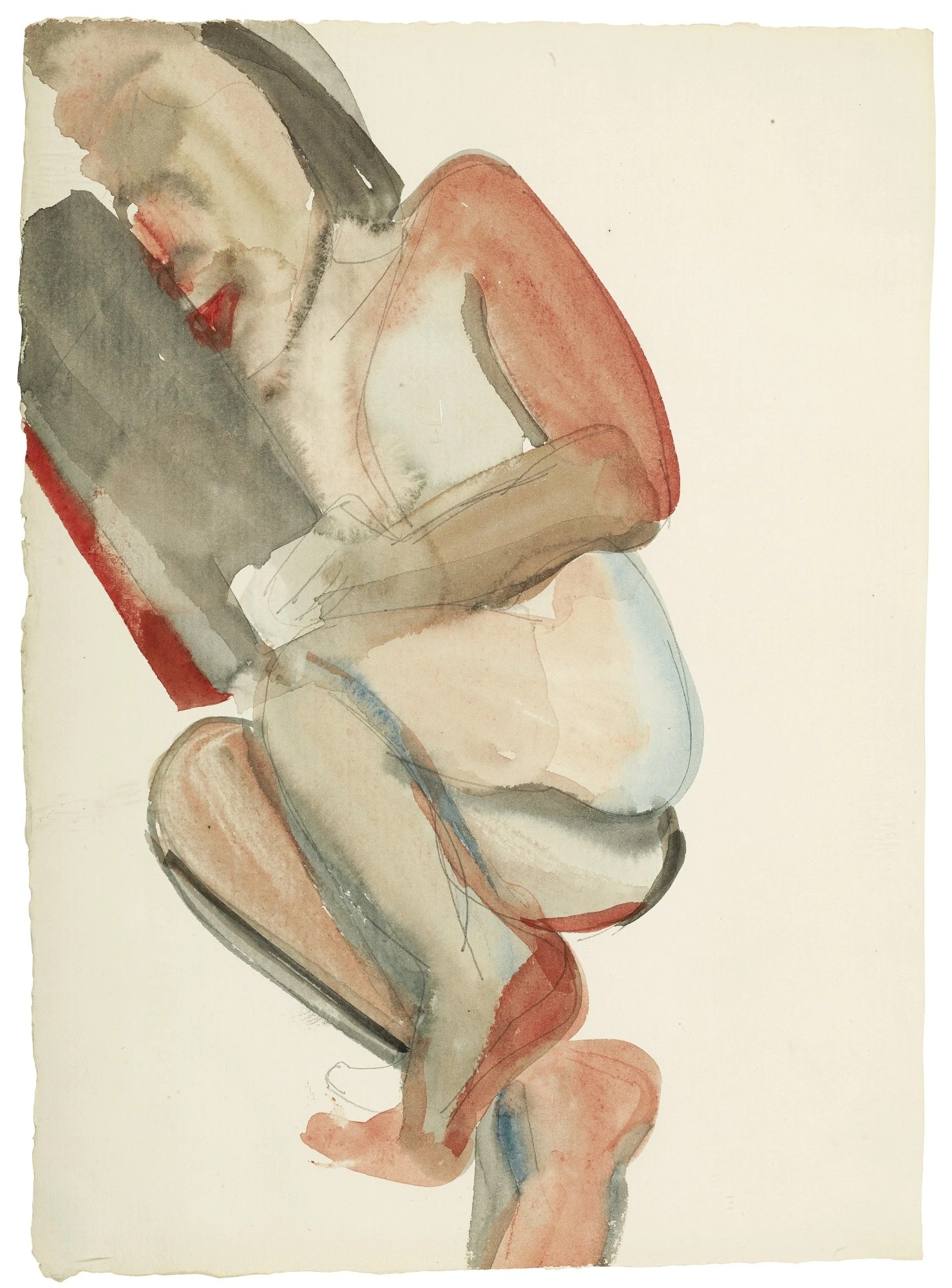
Enigmatic Variation II — Enrico Pinardi

Enigmatic Variation II by Enrico Pinardi (1934-2021)

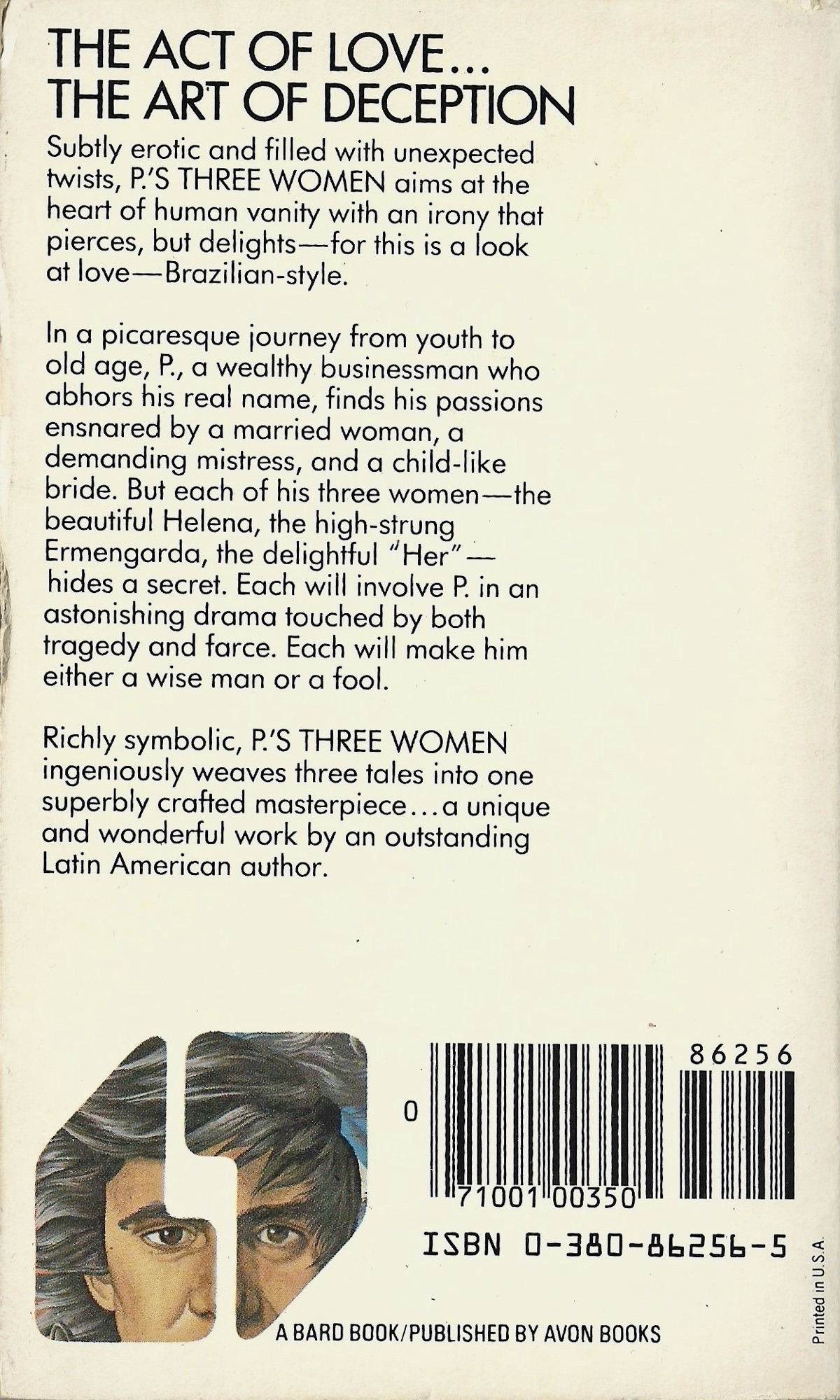
Mass-market Monday | Herman Melville’s Redburn

Redburn, Herman Melville. Doubleday Anchor Books (1957). Cover art by Edward Gorey. 301 pages.

Redburn is as good a place as any to start with Melville, I suppose. From Elizabeth Hardwick’s essay “Melville in Love,” which prompted me to finally read Redburn:

Melville’s state of mind is revealed…with a purity of expressiveness in the novel Redburn, one of his most appealing and certainly the most personal of his works. He is said to have more or less disowned the book, more rather than less, since he claimed it was only written for tobacco. Whether this is a serious misjudgment of his own work or a withdrawal, after the fact, from having shown his early experience of life without his notable reserve and distance is, of course, not clear. For a contemporary reader, Redburn, the grief-stricken youth, cast among the vicious, ruined men on the ship, walking the streets of Liverpool in the late 1830s, even meeting with the homosexual hustler Harry Bolton might have more interest than Typee’s breadfruit and coconut island and the nymph, Fayaway. But it is only pertinent to think of Redburn on its own: a novel written after Typee, Omoo, and Mardi in the year 1849, ten years after he left Lansingburgh to go on his first voyage.


A father is a necessary evil (From James Joyce’s Ulysses)

—A father, Stephen said, battling against hopelessness, is a necessary evil. He wrote the play in the months that followed his father’s death. If you hold that he, a greying man with two marriageable daughters, with thirtyfive years of life, nel mezzo del cammin di nostra vita, with fifty of experience, is the beardless undergraduate from Wittenberg then you must hold that his seventyyear old mother is the lustful queen. No. The corpse of John Shakespeare does not walk the night. From hour to hour it rots and rots. He rests, disarmed of fatherhood, having devised that mystical estate upon his son. Boccaccio’s Calandrino was the first and last man who felt himself with child. Fatherhood, in the sense of conscious begetting, is unknown to man. It is a mystical estate, an apostolic succession, from only begetter to only begotten. On that mystery and not on the madonna which the cunning Italian intellect flung to the mob of Europe the church is founded and founded irremovably because founded, like the world, macro and microcosm, upon the void. Upon incertitude, upon unlikelihood. Amor matris, subjective and objective genitive, may be the only true thing in life. Paternity may be a legal fiction. Who is the father of any son that any son should love him or he any son?

What the hell are you driving at?

I know. Shut up. Blast you. I have reasons.

Amplius. Adhuc. Iterum. Postea.

Are you condemned to do this?

—They are sundered by a bodily shame so steadfast that the criminal annals of the world, stained with all other incests and bestialities, hardly record its breach. Sons with mothers, sires with daughters, lesbic sisters, loves that dare not speak their name, nephews with grandmothers, jailbirds with keyholes, queens with prize bulls. The son unborn mars beauty: born, he brings pain, divides affection, increases care. He is a new male: his growth is his father’s decline, his youth his father’s envy, his friend his father’s enemy.

In rue Monsieur-le-Prince I thought it.

—What links them in nature? An instant of blind rut.

Am I a father? If I were?

Shrunken uncertain hand.

—Sabellius, the African, subtlest heresiarch of all the beasts of the field, held that the Father was Himself His Own Son. The bulldog of Aquin, with whom no word shall be impossible, refutes him. Well: if the father who has not a son be not a father can the son who has not a father be a son? When Rutlandbaconsouthamptonshakespeare or another poet of the same name in the comedy of errors wrote Hamlet he was not the father of his own son merely but, being no more a son, he was and felt himself the father of all his race, the father of his own grandfather, the father of his unborn grandson who, by the same token, never was born, for nature, as Mr Magee understands her, abhors perfection.

Stephen Dedalus, holding forth in Ulysses. (Context, if necessary: The referent of He in the second paragraph is William Shakespeare; the play is of course Hamlet).

The 16 Types of Dads (Life in Hell)

“Ulysses” — Denis Johnson

“Ulysses”

by

Denis Johnson


The hull of the knife and the surf
of our hurting

The outrigger of the bullet and the whitecaps
of our mistakes

The Commander of Suicide
and the archipelago
of the mirror

Ariane Koch’s Overstaying (Book acquired, 13 June 2024)

Ariane Koch’s Overstaying is forthcoming this fall from Dorothy, in translation by Damion Searls. Dorothy’s blurb:

Winner of the aspekte Prize, the most prestigious German prize for debut fiction, Swiss playwright and visual artist Ariane Koch’s Overstaying is an absurdist tour de force.

“I don’t see my writing as chronological or classically narrative, but as spatial—a kind of architecture. I keep adding rooms, and readers can take different paths through the rooms,” writes Ariane Koch of Overstaying, her anarchically comic debut. Koch’s narrator is an impudent young woman, a contemporary Bartleby living alone in her parents’ old house in the small hometown she hates but can’t bring herself to leave. When a visitor turns up, promisingly new, she takes him in, and instantly her life revolves around him. Yet it is hard to tell what, exactly, this visitor is. A mooch, a lover, an absence, a presence—possibly a pet? Mostly, he is a set of contradictions, an occasion for Koch’s wild imagination to take readers in brilliant and unexpected directions.

On Vladimir Sorokin’s Blue Lard, pp. 277-354 (Hitler’s head, Stalin’s brain, Blue Lard’s end?)

Previously on Blue Lard…

pp. 1-47

pp. 48-110

pp. 111-61

pp. 162-87

pp. 188-222

pp. 223-76

The following discussion of Vladimir Sorokin’s novel Blue Lard (in translation by Max Lawton) is intended for those who have read or are reading the book. It contains significant spoilers; to be very clear, I strongly recommend entering Blue Lard cold.

I’ve had too many false starts with this last (for now) riff on Blue Lard that I’ve ended up rereading the last 100 or so pages maybe four times now. When I first started this ridiculous series of riffs–way back in February!–I promised to surf Blue Lard’s wave; I have not done that. I’ve bogged myself down in summarizing. I’ve found myself reading Wikipedia entry after Wikipedia entry of the various Soviet luminaries–politicians, artists, writers, scientists, etc.–who lard the end of the novel. I’ve tried to figure out the ending by going back to the epistolary beginning. I’ve tried, I suppose, to flesh out the thesis I arrived at in the last riff I did, where I suggested that “Blue Lard is hypersurreal, shocking, deviant. But it’s also more balanced and nuanced than a first go-through might suggest, not just absurdist shit-throwing and jabberwocky, but an accomplished analysis of the emerging post-Soviet era.”

So well where were we? Or rather, where are we? The novel’s final section begins with Hitler loading his family, his bodyguard, his lover Khrushchev and a retinue of ninjas into his private plane. They abscond with the cache of blue lard and make their way to Germany to meet up with their old pal Hitler, irking Beria and his murderous allies.

On route to Hitler’s Berghof, Stalin’s wife Nadezhda reads aloud the first act of  a new play by Konstantin Simonov, A Glass of Russian Blood. The play seems to be an allegory framing the Soviet intelligentsia as literal bloodsuckers, vampires feasting on the proletariat. Khrushchev dismisses the play’s subject as “fashionable rancor”; Stalin is more charitable, remarking that “Every writer has his ups and downs.” As usual, I found myself going down a rabbit hole, trying to glean a possible critique of the Simonov’s journal Novy Mir in particular and Soviet literature in general. This is not the way to read Blue Lard. Meanwhile, unconcerned with absurd theater, Stalin’s daughter is hungry; she declares she’d like to eat a unicorn. (In one of the earlier translations of Blue Lard I read, Max includes a footnote explaining that he’s substituted unicorn for the original tyanitolkai (тяни-Толкай) in the interest of readability.)

Back in Moscow, Beria is trying to track down Stalin and the missing blue lard. He’s also ordered the torture of Andrei Sakharov who’s been condemned for, as his torturer notes, suggesting that “Time is a head of cabbage and all events are just aphids eating their way through it” — a complete rejection of Soviet communism’s teleological conception of historical materialism.

Sakharov’s torturer is Alexander Khvat, who the narrator informs us was “the lead investigator on the case of the sinister saboteur Vavilov who’d devoted his life to cultivating ‘quick ergot’ and using it to infect Kuban wheat.” The historical Vavilov, which is to say our historical Vavilov, was an agrinomical geneticist who tried to use science to feed the world.

But Sorokin’s critique doesn’t seem to be aimed at Soviet communism alone; rather, he seems to condemn the brutal stupidity and close-mindedness of those who fear what they do not comprehend. Blue Lard’s absurdity and violence critiques power—and the fear of loss of power that consumes those who hold power.

Stalin’s crew passes over the great Prague Wall which separates the West from the East, the Third Reich and its partner the USSR, and soon arrive at the Berghof:

The long, unusually smooth tarmac of the airfield was reminiscent of a frozen mountain lake and ran up against a granite statue of Hitler’s head, carved from an entire mountain by the efforts of Arno Breker and six thousand French and British prisoners.

The Hitlers (the führer has married mistress Eva in this reality) and the Stalins kiss their hellos and with their accompanying entourages head to yet another of Blue Lard’s many, many feasts. (The narrator notes that “Meanwhile, in the plane, Ajooba, Sisul, and the ninjas were quickly and professionally strangling the airplane’s crew” — the adverb professionally there is marvelous.)

Just as he does with Stalin, Sorokin renders Hitler in kitschy pop-glam strokes:

Hitler put his unfinished glass down on a tray held up to him by an SS servant, then, opening his long arms in the narrow sleeves of a dark-blue frock coat, lace cuffs spilling out of them, walked over to Stalin, his high-heeled shoes with their golden spurs loudly knocking against the marble. Eva followed him, her thin body nestled snugly into a leopard dress.

Tacky-glam of Hitler of Blue Lard is also a bit of a carnivore, unlike the vegetarian of our own historical record. “The table was covered primarily in meat-based hors d’oeuvres, as the Führer couldn’t stand fruits and vegetables,” the narrator notes. But he’s still an animal lover. When he pets his dog Blondie, his hands sparkle and crackle with electric energy. This Hitler shoots electrical beams from his fingertips, a talent that helps him win WW2.

Blue Lard’s final sequence in Hitler’s Berghof is full of depravities and (soap) operatics. Hitler essentially rapes Vesta, while her mother Nadezdha watches through a keyhole. Stricken, Nadezdha makes a call to her on-again-off-again lover Boris Leonidovich—presumably Boris Pasternak (we encountered his clone, author of the thirteen-stanza poem “Pussy” in the first section of Blue Lard), who chastises her for the sin of “pleonasm” (!) after she accuses him of cheating on her with “that jester… that clown… that idiot” Shklovsky (presumably the literary theorist Viktor Shklovsky).

Then all kinds of shit goes down. I’ve gotten bogged down in over-summarizing again; not my intention. The final strands of Blue Lard twist about like fragments of old spy films or war films—double crosses, unclear intentions. Heinrich Himmler shows up with just a few pages left in the novel, a thousand-pound mutant (Jabba to Hitler’s Emperor? Did Sorokin, like, get mad coked up and watch Return of the Jedi and write Blue Lard?)

It all ends, or doesn’t end, with Stalin injecting blue lard into his brain, which then expands and expands and expands:

Iosif Stalin’s brain gradually filled up the entire universe, absorbing its planets and stars. After 126,407,500 years, the brain turned into a black hole and began to shrink. After 34,564,007,330 years, the brain had shrunk back to the original size of Iosif Stalin’s brain. But the mass of the leader’s brain was 345,000 times greater than the mass of the sun. Then Stalin remembered about the pear.

And opened his eyes.

And now we are back where we started, a hundred years or so from Stalin’s then-present. An old, old man with a thick rural accent, he attends to the bratty recipient of Boris Gloger’s letters. In fact, he gives the brat the missive from Gloger dated 2 January (2048) that initiates Blue Lard—we are in a strange loop. (Is this an endorsement or refutation of the aphids-in-a-head-of-cabbage theory of time?) The letter’s recipient, Gloger’s “tender bastard,” tosses it to the ground after just a few sentences or two.

He’s more interested in the outfit he’ll wear to the Easter ball, a special outfit Stalin has apparently tailored: a mantle composed of blue lard. So rise again.


Jean-Baptise Del Amo’s The Son of Man (Book acquired, 8 June 2024)

The day after my birthday, I got the review copy I’d requested of Jean-Baptiste Del Amo’s novel The Son of Man. It was a nice late gift, hungover as I was from a surprise party for my sister-in-law’s 40th, a surprise party which usurped a rare Friday birthday of my own (meet me in 2030 on a Friday (or don’t)). I loved Frank Wynne’s translation of Del Amo’s previous novel, Animalia, suggesting in a 2020 reading round up that the novel “is a visceral, naturalistic, and very precise rendering of humans as animals. . . . Animalia made me physically ill at times. It’s an excellent novel.”

I read the first forty pages of The Son of Man this afternoon; the opening fifteen pages in particular foreground the humans-as-animals dynamic that Animalia worked through. These pages seem like an overture for the novel. They focus on a prehistoric troop of hunter-gatherers, like, hunting and gathering. It’s marvelous. The novel then pivots, I dunno, a couple of thousand years or so to a contemporary scene. We’re somewhere in France; a man and a woman and a boy leave a city in a car and go into the mountains, eventually pressing towards a ruined estate. A dread starts to thicken. The anxiety congeals more from the gaps in the standard cerebral cause-and-effect that we might expect from a novel which isn’t so much replaced as supplanted by precise, lucid detailing of the physical world. Consider this description of the mother:

She lights a cigarette, exhales a first plume of smoke — she holds the filter between the distal phalanges of her index and middle fingers, close to the nails — walks down the central reservation of yellowed grass, then retraces her steps. She brings the cigarette to her lips, darting brief glances that linger on the shadows nesting in the branches of trees and in privet hedges.

Del Amo’s prose, via Wynne’s limpid translation, works like a camera. More thoughts to come. Publisher’s blurb here if you like.

“In the Tules,” a short story by Bret Harte

“In the Tules”

by

Bret Harte


He had never seen a steamboat in his life. Born and reared in one of the Western Territories, far from a navigable river, he had only known the “dugout” or canoe as a means of conveyance across the scant streams whose fordable waters made even those scarcely a necessity. The long, narrow, hooded wagon, drawn by swaying oxen, known familiarly as a “prairie schooner,” in which he journeyed across the plains to California in ’53, did not help his conception by that nautical figure. And when at last he dropped upon the land of promise through one of the Southern mountain passes he halted all unconsciously upon the low banks of a great yellow river amidst a tangled brake of strange, reed-like grasses that were unknown to him. The river, broadening as it debouched through many channels into a lordly bay, seemed to him the ULTIMA THULE of his journeyings. Unyoking his oxen on the edge of the luxuriant meadows which blended with scarcely any line of demarcation into the great stream itself, he found the prospect “good” according to his lights and prairial experiences, and, converting his halted wagon into a temporary cabin, he resolved to rest here and “settle.”

There was little difficulty in so doing. The cultivated clearings he had passed were few and far between; the land would be his by discovery and occupation; his habits of loneliness and self- reliance made him independent of neighbors. He took his first meal in his new solitude under a spreading willow, but so near his natural boundary that the waters gurgled and oozed in the reeds but a few feet from him. The sun sank, deepening the gold of the river until it might have been the stream of Pactolus itself. But Martin Morse had no imagination; he was not even a gold-seeker; he had simply obeyed the roving instincts of the frontiersman in coming hither. The land was virgin and unoccupied; it was his; he was alone. These questions settled, he smoked his pipe with less concern over his three thousand miles’ transference of habitation than the man of cities who had moved into a next street. When the sun sank, he rolled himself in his blankets in the wagon bed and went quietly to sleep.

But he was presently awakened by something which at first he could not determine to be a noise or an intangible sensation. It was a deep throbbing through the silence of the night–a pulsation that seemed even to be communicated to the rude bed whereon he lay. As it came nearer it separated itself into a labored, monotonous panting, continuous, but distinct from an equally monotonous but fainter beating of the waters, as if the whole track of the river were being coursed and trodden by a multitude of swiftly trampling feet. A strange feeling took possession of him–half of fear, half of curious expectation. It was coming nearer. He rose, leaped hurriedly from the wagon, and ran to the bank. The night was dark; at first he saw nothing before him but the steel-black sky pierced with far-spaced, irregularly scattered stars. Then there seemed to be approaching him, from the left, another and more symmetrical constellation–a few red and blue stars high above the river, with three compact lines of larger planetary lights flashing towards him and apparently on his own level. It was almost upon him; he involuntarily drew back as the strange phenomenon swept abreast of where he stood, and resolved itself into a dark yet airy bulk, whose vagueness, topped by enormous towers, was yet illuminated by those open squares of light that he had taken for stars, but which he saw now were brilliantly lit windows. Continue reading ““In the Tules,” a short story by Bret Harte”