“Every mediocre writer tries to mask his own natural style” (Schopenhauer)

Style is the physiognomy of the mind, and a safer index to character than the face. To imitate another man’s style is like wearing a mask, which, be it never so fine, is not long in arousing disgust and abhorrence, because it is lifeless; so that even the ugliest living face is better. Hence those who write in Latin and copy the manner of ancient authors, may be said to speak through a mask; the reader, it is true, hears what they say, but he cannot observe their physiognomy too; he cannot see their style. With the Latin works of writers who think for themselves, the case is different, and their style is visible; writers, I mean, who have not condescended to any sort of imitation, such as Scotus Erigena, Petrarch, Bacon, Descartes, Spinoza, and many others. An affectation in style is like making grimaces. Further, the language in which a man writes is the physiognomy of the nation to which he belongs; and here there are many hard and fast differences, beginning from the language of the Greeks, down to that of the Caribbean islanders.

To form a provincial estimate of the value of a writer’s productions, it is not directly necessary to know the subject on which he has thought, or what it is that he has said about it; that would imply a perusal of all his works. It will be enough, in the main, to know how he has thought. This, which means the essential temper or general quality of his mind, may be precisely determined by his style. A man’s style shows the formal nature of all his thoughts—the formal nature which can never change, be the subject or the character of his thoughts what it may: it is, as it were, the dough out of which all the contents of his mind are kneaded. When Eulenspiegel was asked how long it would take to walk to the next village, he gave the seemingly incongruous answer: Walk. He wanted to find out by the man’s pace the distance he would cover in a given time. In the same way, when I have read a few pages of an author, I know fairly well how far he can bring me.

Every mediocre writer tries to mask his own natural style, because in his heart he knows the truth of what I am saying. He is thus forced, at the outset, to give up any attempt at being frank or naïve—a privilege which is thereby reserved for superior minds, conscious of their own worth, and therefore sure of themselves. What I mean is that these everyday writers are absolutely unable to resolve upon writing just as they think; because they have a notion that, were they to do so, their work might possibly look very childish and simple. For all that, it would not be without its value. If they would only go honestly to work, and say, quite simply, the things they have really thought, and just as they have thought them, these writers would be readable and, within their own proper sphere, even instructive.

From The Art of Literature by Arthur Schopenhauer.

Latitudes — Natalie Andrewson

Latitudes_Natalieandrewson_web

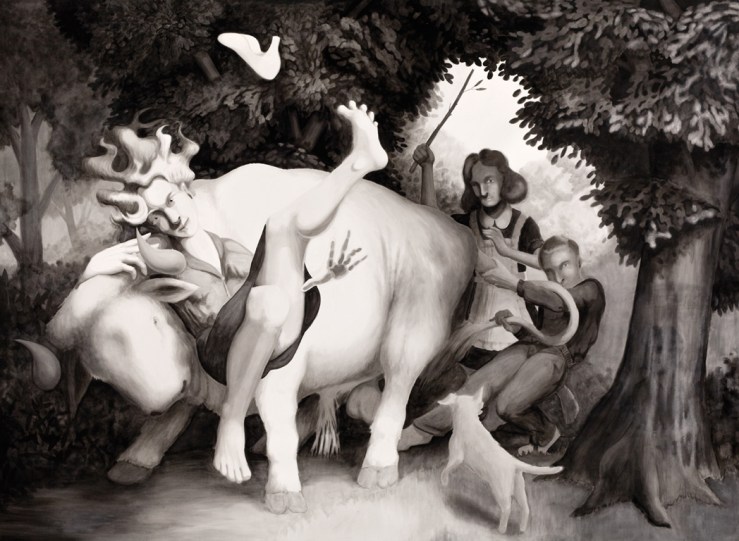
The Minotaur — Remedios Varo

The Moles — Félix Bracquemond

“Reading is thinking with someone else’s head” (Schopenhauer)

Reading is thinking with someone else’s head instead of one’s own. To think with one’s own head is always to aim at developing a coherent whole—a system, even though it be not a strictly complete one; and nothing hinders this so much as too strong a current of others’ thoughts, such as comes of continual reading. These thoughts, springing every one of them from different minds, belonging to different systems, and tinged with different colors, never of themselves flow together into an intellectual whole; they never form a unity of knowledge, or insight, or conviction; but, rather, fill the head with a Babylonian confusion of tongues. The mind that is over-loaded with alien thought is thus deprived of all clear insight, and is well-nigh disorganized. This is a state of things observable in many men of learning; and it makes them inferior in sound sense, correct judgment and practical tact, to many illiterate persons, who, after obtaining a little knowledge from without, by means of experience, intercourse with others, and a small amount of reading, have always subordinated it to, and embodied it with, their own thought.

From The Art of Literature by Arthur Schopenhauer.

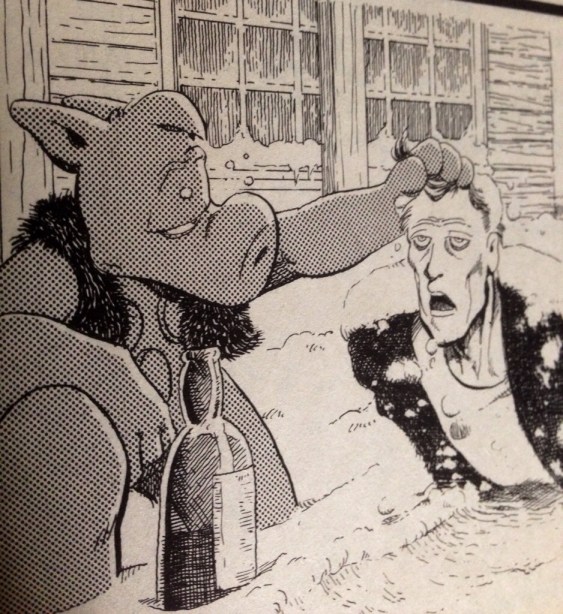
Thor Brand Pickled Herring (Tony Millionaire)

strangetales20206

“The Food of Death” — Lord Dunsany

death

Portrait of Mstislav Dobuzhinsky — Osip Braz

“By the by, a pretty riddle or fable might be made” | More Notes From Nathaniel Hawthorne

  1. Dandelions and blue flowers are still growing in sunny places. Saw in a barn a prodigious treasure of onions in their silvery coats, exhaling a penetrating perfume.
  2.  How exceeding bright looks the sunshine, casually reflected from a looking-glass into a gloomy region of the chamber, distinctly marking out the figures and colors of the paper-hangings, which are scarcely seen elsewhere. It is like the light of mind thrown on an obscure subject.
  3.  Man’s finest workmanship, the closer you observe it, the more imperfections it shows; as in a piece of polished steel a microscope will discover a rough surface. Whereas, what may look coarse and rough in Nature’s workmanship will show an infinitely minute perfection, the closer you look into it. The reason of the minute superiority of Nature’s work over man’s is, that the former works from the innermost germ, while the latter works merely superficially.
  4. Standing in the cross-road that leads by the Mineral Spring, and looking towards an opposite shore of the lake, an ascending bank, with a dense border of trees, green, yellow, red, russet, all bright colors, brightened by the mild brilliancy of the descending sun; it was strange to recognize the sober old friends of spring and summer in this new dress. By the by, a pretty riddle or fable might be made out of the changes in apparel of the familiar trees round a house adapted for children. But in the lake, beneath the aforesaid border of trees,–the water being not rippled, but its grassy surface somewhat moved and shaken by the remote agitation of a breeze that was breathing on the outer lake,–this being in a sort of bay,–in the slightly agitated mirror, the variegated trees were reflected dreamily and indistinctly; a broad belt of bright and diversified colors shining in the water beneath. Sometimes the image of a tree might be almost traced; then nothing but this sweep of broken rainbow. It was like the recollection of the real scene in an observer’s mind,–a confused radiance.
  5. A whirlwind, whirling the dried leaves round in a circle, not very violently.
  6.  To well consider the characters of a family of persons in a certain condition,–in poverty, for instance,–and endeavor to judge how an altered condition would affect the character of each.
  7.  The aromatic odor of peat-smoke in the sunny autumnal air is very pleasant.

Notations from Nathaniel Hawthorne’s American Note-Books.

Portrait of Heinrich von Kleist — Andre Masson

William H. Gass Reading From Middle C

What Greets the Eye When You Look Back at the Pilot — Frank Johnston

“Notes on the Movements of Young Children” — Robert Louis Stevenson

“Notes on the Movements of Young Children” — Robert Louis Stevenson

I wish to direct the reader’s attention to a certain quality in the movements of children when young, which is somehow lovable in them, although it would be even unpleasant in any grown person. Their movements are not graceful, but they fall short of grace by something so sweetly humorous that we only admire them the more. The imperfection is so pretty and pathetic, and it gives so great a promise of something different in the future, that it attracts us more than many forms of beauty. They have something of the merit of a rough sketch by a master, in which we pardon what is wanting or excessive for the sake of the very bluntness and directness of the thing. It gives us pleasure to see the beginning of gracious impulses and the springs of harmonious movement laid bare to us with innocent simplicity.

One night some ladies formed a sort of impromptu dancing-school in the drawing-room of an hotel in France. One of the ladies led the ring, and I can recall her as a model of accomplished, cultured movement. Two little girls, about eight years old, were the pupils; that is an age of great interest in girls, when natural grace comes to its consummation of justice and purity, with little admixture of that other grace of forethought and discipline that will shortly supersede it altogether. In these two, particularly, the rhythm was sometimes broken by an excess of energy, as though the pleasure of the music in their light bodies could endure no longer the restraint of regulated dance. So that, between these and the lady, there was not only some beginning of the very contrast I wish to insist upon, but matter enough to set one thinking a long while on the beauty of motion. I do not know that, here in England, we have any good opportunity of seeing what that is; the generation of British dancing men and women are certainly more remarkable for other qualities than for grace: they are, many of them, very conscientious artists, and give quite a serious regard to the technical parts of their performance; but the spectacle, somehow, is not often beautiful, and strikes no note of pleasure. If I had seen no more, therefore, this evening might have remained in my memory as a rare experience. But the best part of it was yet to come. For after the others had desisted, the musician still continued to play, and a little button between two and three years old came out into the cleared space and began to figure before us as the music prompted. I had an opportunity of seeing her, not on this night only, but on many subsequent nights; and the wonder and comical admiration she inspired was only deepened as time went on. She had an admirable musical ear; and each new melody, as it struck in her a new humour, suggested wonderful combinations and variations of movement. Now it would be a dance with which she would suit the music, now rather an appropriate pantomime, and now a mere string of disconnected attitudes. But whatever she did, she did it with the same verve and gusto. The spirit of the air seemed to have entered into her, and to possess her like a passion; and you could see her struggling to find expression for the beauty that was in her against the inefficacy of the dull, half-informed body. Though her footing was uneven, and her gestures often ludicrously helpless, still the spectacle was not merely amusing; and though subtle inspirations of movement miscarried in tottering travesty, you could still see that they had been inspirations; you could still see that she had set her heart on realising something just and beautiful, and that, by the discipline of these abortive efforts, she was making for herself in the future a quick, supple, and obedient body. It was grace in the making. She was not to be daunted by any merriment of people looking on critically; the music said something to her, and her whole spirit was intent on what the music said: she must carry out its suggestions, she must do her best to translate its language into that other dialect of the modulated body into which it can be translated most easily and fully. Continue reading ““Notes on the Movements of Young Children” — Robert Louis Stevenson”

Young Girl Reading a Manuscript — Thomas Cooper Gotch

gotch

Oedipus the Wayfarer — Gustave Moreau

“The White Giant’s Thigh” — Dylan Thomas (Autograph Manuscript)

Dylan-Thomas-whute-giants-Thigh1

“The Young Housewife” — William Carlos Williams

wcw